Adding Support to Countertop
Quick Answer
Understanding adding support to countertop helps ensure a successful countertop installation.
Stone countertops need structural support for any overhang exceeding 8-10 inches (depending on material thickness). Support options include steel brackets, hidden support bars, corbels, and knee walls. For a standard 3 cm granite or quartz countertop, the general rule is: overhangs up to 10 inches need no extra support, 10-15 inches require brackets every 24 inches, and anything over 15 inches typically needs a knee wall or steel reinforcement.
TL;DR
- Overhangs up to 10 inches on 3 cm stone generally need no extra support
- 2 cm stone requires support at just 6-8 inches of overhang
- Steel brackets are the most common solution - install every 18-24 inches
- Hidden flat steel bars (like the Granite Grabber) keep the look clean
- Decorative corbels add support and a design element but take up leg space
- Plywood substrate under 2 cm stone is not the same as overhang support
- Weight matters: granite weighs 18-20 lbs/sq ft at 3 cm; a 12 sq ft bar overhang is 220+ lbs
- Exceeding overhang limits without support is one of the top causes of countertop cracks
Why Countertop Support Matters
Stone countertops are strong in compression - they can handle heavy pots, appliances, and people leaning on them when properly supported from below. But stone is weak in tension. When an unsupported overhang bends downward (even slightly), the top surface goes into compression while the bottom goes into tension. Since stone does not flex, it cracks.
Calculate your material waste savings
See exactly how much slab material and money you could save with optimized cutting layouts.
Try the free Waste CalculatorA cracked countertop from an unsupported overhang is not covered by warranty. It is also one of the most expensive fabrication mistakes, with replacement costs running $1,500-$4,000 per piece.
Overhang Limits by Material and Thickness
| Material | Thickness | Max Unsupported Overhang |
|---|---|---|
| Granite | 3 cm (1-1/4") | 10-12 inches |
| Granite | 2 cm (3/4") | 6-8 inches |
| Quartz | 3 cm | 10-14 inches (varies by brand) |
| Quartz | 2 cm | 6-8 inches |
| Marble | 3 cm | 8-10 inches |
| Marble | 2 cm | 6 inches |
| Quartzite | 3 cm | 10-12 inches |
| Porcelain slab | 12 mm | 4-6 inches (always needs substrate) |
Important: These are general guidelines. Manufacturer specifications override these numbers. For example, Cambria allows up to 14 inches of unsupported overhang for their 3 cm quartz, while some marble fabricators cap it at 8 inches.
Types of Countertop Supports
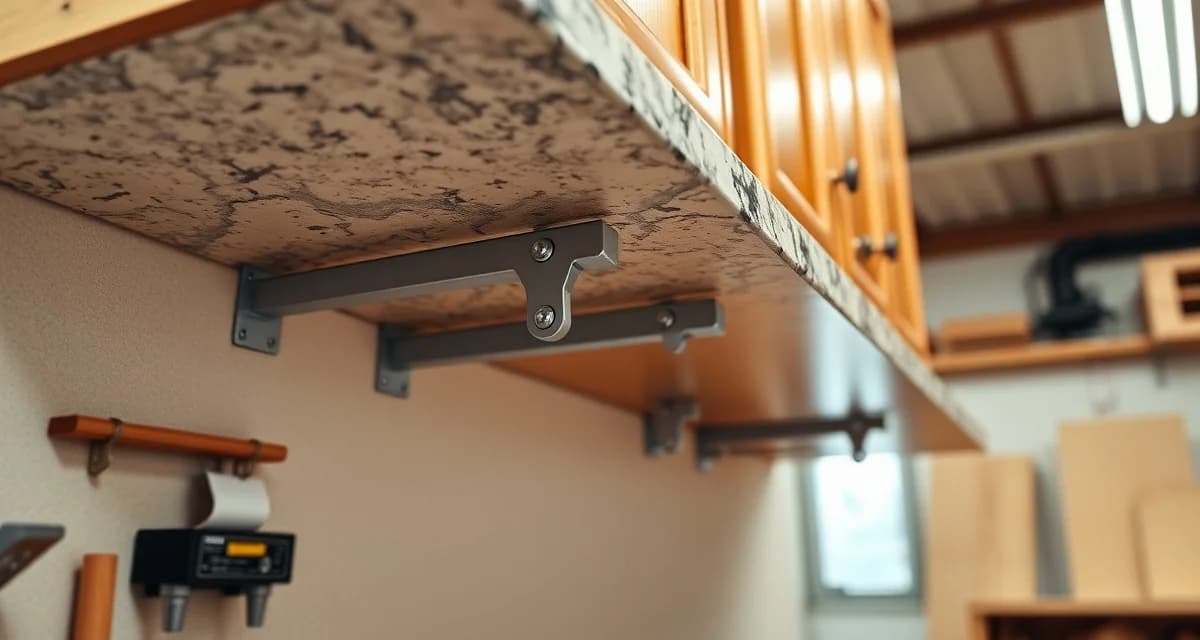
1. Steel L-Brackets
The most common and cost-effective option. These are L-shaped steel brackets that mount to the cabinet wall or side and extend horizontally under the overhang.
Specs:
- Material: 1/4" to 3/8" steel
- Sizes: 10", 12", 15", 18", 20" extensions
- Spacing: Every 18-24 inches along the overhang
- Load rating: 75-200 lbs per bracket (varies by size and steel gauge)
- Cost: $15-$40 per bracket
Best for: Bar overhangs, island seating areas, peninsula overhangs
Installation:
- Locate wall studs or cabinet structural members
- Mount brackets using 3/8" lag bolts (minimum 2 per bracket)
- Level each bracket
- Place countertop on brackets; the stone's weight holds it in place
2. Hidden Flat Support Bars
Flat steel bars that sit in a channel between the cabinet top and the countertop. They extend horizontally and are completely invisible once the stone is placed.
Specs:
- Material: 1/4" steel plate
- Profile: Flat (no visible bracket below the overhang)
- Extension: Up to 12 inches (longer overhangs need L-brackets)
- Cost: $20-$50 per bar
Best for: Overhangs where you want a floating appearance with no visible support
3. Decorative Corbels
Corbels are structural or decorative brackets that mount to the cabinet face and support the overhang from below. They come in wood, metal, or composite materials and range from simple to ornate.
Pros:
- Add architectural detail to the kitchen
- Available in dozens of styles (mission, traditional, contemporary)
- Strong support when properly sized
Cons:
- Take up leg space under bar overhangs (people bump their knees)
- Can look dated depending on the style
- More expensive than plain steel brackets ($30-$150 each)
Sizing rule: The corbel should extend to at least 2/3 of the overhang depth. A 15-inch overhang needs a corbel that sticks out at least 10 inches.
4. Steel Reinforcement Rod (Rebar in Epoxy)
For extreme overhangs or waterfall edges, some fabricators drill into the edge of the stone and epoxy steel rods in place. This is a specialized technique used for:
- Waterfall edges where the vertical piece meets the horizontal
- Cantilevered overhangs beyond 15 inches
- Floating countertop designs
Cost: $200-$500+ per installation (labor-intensive)
5. Knee Walls and Half Walls
For very long overhangs (18+ inches) or when maximum support is needed, building a half-height wall (knee wall) under the countertop provides the most solid support. The countertop essentially sits on top of the wall like it sits on a cabinet.
Best for: Island seating overhangs over 18 inches, heavy stone materials, earthquake-prone areas
Island Seating Overhangs: The Most Common Use Case
The most frequent need for countertop support is at a kitchen island with bar seating. Standard overhang dimensions for seating:
| Seating Type | Overhang Needed | Support Required |
|---|---|---|
| Bar stool (no back) | 12-15 inches | Yes - brackets every 24" |
| Bar stool (with back) | 15-18 inches | Yes - brackets every 18" |
| Dining height | 12-15 inches | Yes - brackets every 24" |
| ADA accessible | 17-19 inches | Yes - knee wall or heavy brackets |
How Many Brackets Do I Need?
Calculate based on this formula:
Number of brackets = (Overhang length in inches / 24) + 1
Example: A 72-inch (6-foot) island overhang needs (72/24) + 1 = 4 brackets, evenly spaced.
For 2 cm stone or marble, reduce spacing to every 18 inches.
Supporting Specific Countertop Features
Sink Areas
The area around a sink cutout is structurally weakened by the removal of stone. The narrow strip between the sink cutout and the front edge is a common failure point. Good fabricators ensure:
- At least 3 inches of stone between the sink cutout and the edge
- Plywood support underneath if the stone is 2 cm
- No overhang at the sink area exceeds unsupported limits
Cooktop Cutouts
Similar to sinks, but worse - cooktop cutouts are typically larger (30-36 inches wide). The remaining stone strips on each side of the cutout need support from the cabinet below.
Corner Seams
Where two pieces of countertop meet at a 90-degree angle (like an L-shaped kitchen), the seam area needs continuous support underneath. A gap in cabinet support at the seam location is a recipe for cracking.
Common Mistakes
1. Relying on Plywood as Overhang Support
Plywood substrate (typically 3/4" birch plywood) is used under 2 cm stone to give it the rigidity it lacks on its own. But plywood alone does not support an overhang - plywood needs its own support, just like the stone on top of it.
2. Using Drywall Anchors Instead of Studs
Brackets supporting stone countertops must be lag-bolted into studs, cabinet framing, or structural members. Drywall anchors (even heavy-duty ones) cannot handle the shear forces involved.
3. Incorrect Bracket Spacing
Spreading brackets too far apart (more than 24 inches) creates unsupported spans between them. The stone can still crack in the middle of two brackets if the span is too long.
4. Adding Brackets After Installation
It is much harder to add support brackets after the stone is already installed. The countertop has to be lifted (risking cracks) or the brackets have to be retrofitted from below in awkward positions. Plan support before installation.
What Fabricators Need to Know
For stone fabrication shops, overhang support is both a technical responsibility and a liability issue. If a countertop cracks because the shop did not specify or verify proper support, the shop often eats the cost of a remake - $1,500-$4,000 per piece.
Best practices for fabricators:
- Document support requirements on every job ticket
- Include overhang support in the quote (brackets should be a line item)
- Verify support during template - measure cabinet structure and note any gaps
- Photograph cabinet support before installation day
- Refuse to install on inadequate support - it is cheaper to postpone than to replace
Fabrication management tools like SlabWise help shops track these details through template verification checklists, reducing the risk of overlooked support requirements.
How far can a granite countertop overhang without support?
At 3 cm thickness, granite can overhang 10-12 inches without additional support. At 2 cm, the limit drops to 6-8 inches.
What is the best type of bracket for a countertop overhang?
For most residential kitchens, 1/4-inch steel L-brackets rated for 100+ lbs each are the standard choice. Space them every 18-24 inches.
Can I use corbels instead of steel brackets?
Yes, as long as the corbels extend at least 2/3 of the overhang depth and are rated for the weight. Decorative-only corbels are not structural and should not be relied upon.
Do quartz countertops need more or less support than granite?
About the same. Most quartz manufacturers recommend the same overhang limits as granite. Check your specific brand's installation guide for exact numbers.
How much weight can a countertop overhang hold?
A properly supported overhang can hold several hundred pounds. An unsupported overhang should not support any significant weight beyond the stone itself.
Can I add support brackets after my countertop is already installed?
It is possible but difficult. The countertop may need to be temporarily lifted or supported while brackets are installed beneath it. Hire a professional - this is not a good DIY project with stone in place.
Does a waterfall countertop edge need extra support?
Yes. The vertical piece is usually epoxied and sometimes pinned with steel rods to the horizontal piece. The joint is a potential failure point and needs proper reinforcement.
What about support for outdoor kitchen countertops?
Outdoor countertops face additional stresses from temperature changes and ground settling. Use more brackets, shorter spacing (every 16-18 inches), and ensure the base structure is rated for outdoor use.
Is plywood underneath the same as overhang support?
No. Plywood gives 2 cm stone rigidity across supported spans. It does not create support where there is no cabinet underneath. You still need brackets for overhangs.
How do I know if my existing countertop has enough support?
Check for any flex or bounce when you press down on the overhang. If it moves at all, it needs more support. Also measure the overhang and compare to the limits in this article.
Plan Your Countertop Project Right
Proper support planning is part of getting a good countertop installation. Use our quick calculator to estimate your project cost, including overhang support requirements.
Try the SlabWise Quick Quote Calculator →
Try These Free Tools
- Photo to Template -- Snap a photo of an existing countertop and get an AI-generated DXF template.
- Template Compare -- Upload two templates and see every dimension change highlighted instantly.
- AI Template Verification -- Cross-check your template against manufacturer specs before cutting.
Sources & Further Reading
- Natural Stone Institute - Countertop Support Guidelines
- International Surface Fabricators Association - Structural Support Requirements
- National Kitchen & Bath Association - Countertop Installation Standards
- ASTM International - C1526 Standard Specification for Serpentine Dimension Stone