TL;DR
- Countertop fabricators most commonly attend Coverings (stone and tile), The International Surface Event (TISE), and KBIS (Kitchen and Bath Industry Show).
- Shops doing natural stone also watch StonExpo and Marmomacc in Verona.
- The right show depends on whether you're buying slabs, hunting equipment, learning fabrication technique, or meeting the GCs and designers who feed your wholesale channel.
Why do fabricators go to trade shows at all?
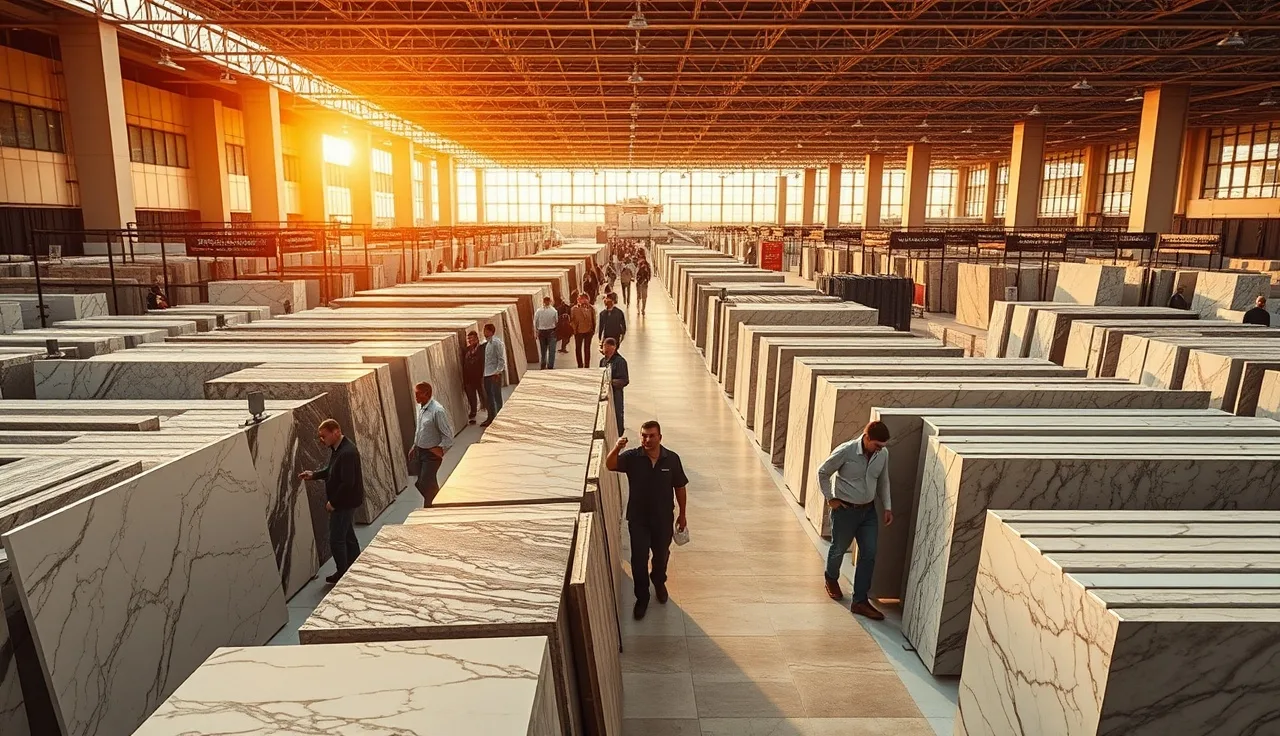
Most shops have no training budget and no dedicated sales team. Trade shows are how they compress a year of product research, supplier negotiation, and industry education into three days. You can put your hands on 200 slabs in one afternoon at Coverings. Seeing that much material through distributor visits would take six months.
The equipment angle matters too. A bridge saw or CNC router is a $50,000-to-$250,000 decision. Nobody buys one from a catalog. Shops go to shows specifically to run live demos, talk to other shops using the machine, and sometimes negotiate a show discount that runs 5-15% off list price.
Networking is the third reason, and it's underrated. Design centers, GCs, and kitchen dealers all show up at KBIS. Meeting them at a booth is a warmer introduction than a cold call. Plenty of fabricators trace their best wholesale accounts back to a single conversation at a show.
What are the biggest trade shows for countertop fabricators?
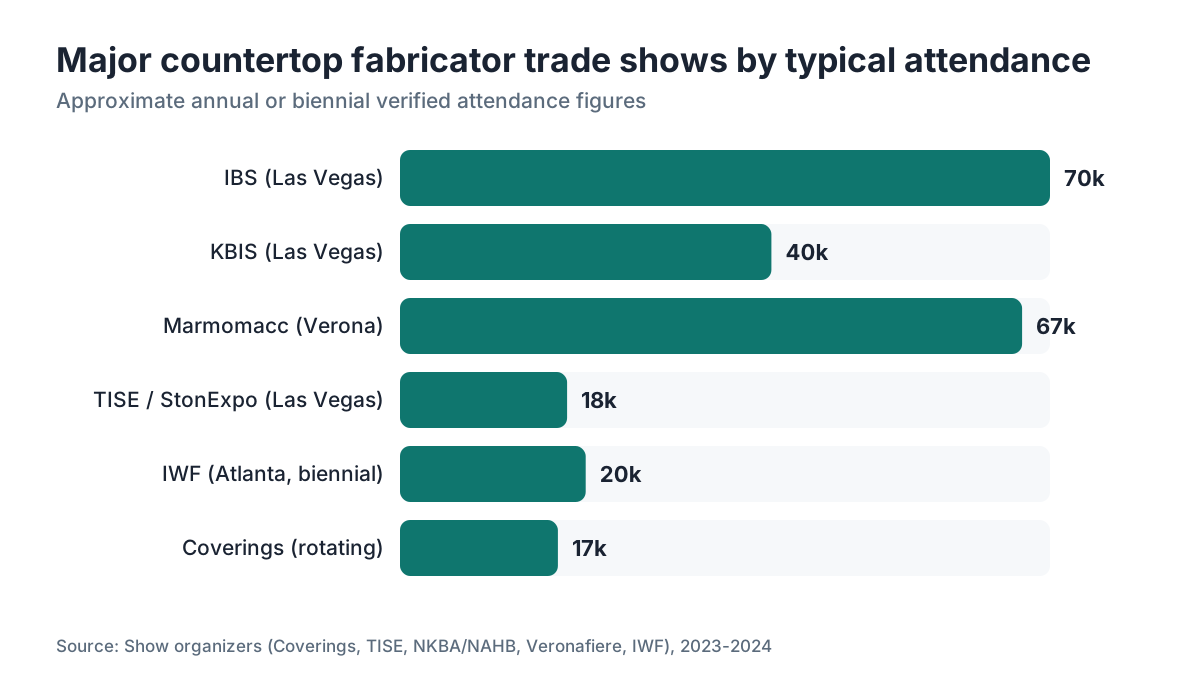
Roughly eight shows come up again and again in fabricator conversations. They split by audience, geography, and what you can actually do on the floor. Here's how they stack up:
| Show | Focus | Typical Dates | Location | Avg. Attendance |
|---|---|---|---|---|
| Coverings | Stone, tile, setting materials | April | Rotates (Las Vegas, Orlando, Atlanta) | 17,000+ [1] |
| TISE (The International Surface Event) | Hard and soft surfaces | January | Las Vegas | 18,000+ [2] |
| KBIS (Kitchen & Bath Industry Show) | Kitchen/bath products, design | February (co-located with IBS) | Las Vegas | 40,000+ [3] |
| StonExpo (part of TISE) | Stone fabrication tools and slabs | January | Las Vegas | Subset of TISE |
| Marmomacc | International stone | September | Verona, Italy | 67,000+ [4] |
| Surfaces (flooring, now part of TISE) | Flooring, surfaces | January | Las Vegas | Subset of TISE |
| IWF (International Woodworking Fair) | Cabinetry, millwork, tooling | August (biennial, even years) | Atlanta | 20,000+ [5] |
| NAHB International Builders Show (IBS) | Residential construction | February (co-located with KBIS) | Las Vegas | 70,000+ [6] |
Most fabricators who go to one show pick TISE or Coverings. Shops that also do cabinetry or millwork add IWF. Shops chasing builder and GC relationships add IBS. The European stone world runs on Marmomacc, and U.S. buyers who source natural stone overseas treat it as a buying trip, not a learning one.
What happens at Coverings and why is it so popular with stone shops?
Coverings is the largest tile and stone trade show in North America, co-produced by the Tile Council of North America and the National Tile Contractors Association, and it pulls exhibitors from over 40 countries [1][8]. For fabricators, the stone pavilion is the draw. Importers, distributors, and quarry reps bring physical slabs and samples you can inspect for color variation, veining consistency, and surface finish.
The continuing education program runs dozens of sessions on installation methods, stone chemistry, and business practices. Some state licensing boards accept Coverings CEUs, but check your specific board before you bank on it.
Coverings is a good show to bring a lead installer or project manager. The technical content is hands-on enough to help people who aren't running the business side. Admission for trade professionals is usually free with pre-registration. The 2024 event was in Atlanta [1].
What is TISE (The International Surface Event) and what does it offer fabricators?
TISE runs every January in Las Vegas and is really three shows under one roof: SURFACES (flooring), StonExpo/Marmomac (stone), and TileExpo [2]. For countertop fabricators, StonExpo is the piece that matters. Bridge saw makers, waterjet companies, CNC router vendors, tooling suppliers, and slab distributors all sit in one building.
The StonExpo section targets stone fabrication businesses directly. This is where Braxton-Bragg, Park Industries, Donatoni, and similar companies set up large working demos. Shopping for a saw or router? You can watch it cut live stone and ask the operator the technical questions a sales rep can't answer.
Registration costs vary by category. In recent years, a full StonExpo/Marmomac badge ran roughly $50-$100 for pre-registration. Equipment on the floor sells with show-special pricing, and many vendors collect deposits at the event for machines shipping in Q1 or Q2.
One practical note. January in Las Vegas is pleasant weather-wise, but hotel prices spike during TISE week. Book 3-4 months out if you want to stay inside a reasonable budget.
Should fabricators attend KBIS or IBS?
KBIS (Kitchen and Bath Industry Show) is produced by the National Kitchen and Bath Association (NKBA). It co-locates with NAHB's International Builders Show every February in Las Vegas, and the combined event pulls more than 100,000 attendees across both shows [3][6].
For a countertop fabricator, KBIS isn't a sourcing show. You won't find slab distributors or equipment vendors the way you would at TISE. What you find is every major kitchen cabinet brand, appliance manufacturer, and fixture supplier, plus tens of thousands of designers, kitchen dealers, and custom builders. If your shop is trying to grow its wholesale channel with design centers or kitchen dealers, KBIS is worth one visit to see the design world you're selling into.
NKBA offers a professional member rate on registration, and members who hold the CKBD (Certified Kitchen and Bath Designer) credential get additional access [9]. Fabricators aren't the core audience. Shops that position themselves as design-forward still use the show to make connections that feed a year of referrals.
IBS leans builder. If your bread and butter is new construction and builder accounts, IBS has the GCs, production builders, and purchasing managers you want. The combined KBIS-plus-IBS footprint at the Las Vegas Convention Center is one of the largest annual trade shows in the U.S. by floor space [6].
What is Marmomacc and is it worth the trip to Italy?
Marmomacc runs every September in Verona, Italy, and it's the largest international stone fair in the world, drawing over 67,000 visitors from more than 150 countries in recent years [4]. For U.S. fabricators, this is a different category of trip. No CNC demos, no local GC business cards. You see every major quarry from Brazil, Turkey, Italy, India, Greece, and Portugal presenting their actual blocks and slabs.
The shops that make this trip are buying a container or more of exotic natural stone straight from the source, or building relationships with importers who can ship material stateside. The price gap on direct-source exotic stone can be big. You're also taking on currency risk, shipping logistics, and a longer lead time.
A Verona trip including flights, hotel, and registration runs $3,000-$6,000 per person depending on how far ahead you book. Most U.S. shops send one buyer and treat it as a sourcing trip. If you're doing $3M or more and natural stone is your primary material, Marmomacc deserves a serious look every other year.
Are there regional or smaller shows worth attending?
Yes, and they often beat the big national events for new shops. Several state stone associations and regional tile contractor groups run annual events or tabletop shows that cost far less and are easier to get value from while you're still figuring out what you need.
The Natural Stone Institute (NSI) runs its own annual convention, typically drawing 400 to 800 stone professionals. It's more intimate than TISE, and the education is built for stone fabrication and installation, not flooring or tile [7]. NSI membership also includes access to standards documents like the Dimension Stone Design Manual, which fabricators working with architects lean on regularly.
Metro-level homebuilder association events are another underused option. Your local HBA almost certainly runs a spring event or contractor mixer that puts you in front of local builders for under $500 in registration and display costs. For shops doing under $1M in revenue, these events beat a flight to Las Vegas on cost per qualified lead.
Fabricators who also work with laminate surfaces (like Formica countertops or Corian countertops) will find the TISE Surfaces section covers those materials in more depth than any stone-focused show.
How much does attending a trade show actually cost a fabrication shop?
The registration fee is usually the smallest line item. Here's a realistic budget for one person attending TISE in Las Vegas:
| Cost Category | Low | High |
|---|---|---|
| Registration (StonExpo/TISE) | $0 (comp) | $150 |
| Flights (U.S. domestic) | $250 | $700 |
| Hotel (3 nights, show week) | $450 | $1,200 |
| Food and transport | $200 | $400 |
| Tooling and sample purchases | $200 | $2,000+ |
| Total per person | ~$1,100 | ~$4,450+ |
Send two people and budget $3,000-$6,000 all-in for a domestic show. That's real money for a shop doing $500K in revenue. Ask yourself one question before you buy tickets: what specific supplier relationship, piece of equipment, or skill are you trying to bring home? Shops that go with a clear objective say the ROI is strong. Shops that go to see what's out there tend to come home with a tote bag and not much else.
Many equipment vendors will negotiate freight, installation, and extended warranty terms at the show that they won't touch later. If you're close to a capital purchase, going specifically to close that deal can pay for the whole trip in a single line-item discount.
What do fabricators actually buy or learn at these shows?
On the buying side, tooling is the most common category. Diamond blades, polishing pads, adhesives, color epoxies, seam setters, vacuum lifts. Vendors like Braxton-Bragg, M3 Technologies, and Tenax run booths at TISE with show pricing and order incentives. You can often lock in a year of consumable pricing during a single show negotiation.
Equipment purchases happen too, usually after the show rather than on the floor. A fabricator demos a saw at TISE, goes home, runs the numbers, and places the order in March. The show triggers the decision. The paperwork follows.
On the education side, NSI certifications are among the more concrete credentials a stone shop can display. NSI's Accredited Business program requires shops to meet standards for employee training, safety, and business practices [7]. Continuing education sessions at Coverings and TISE feed straight into keeping those credentials current.
For shops eyeing new materials, shows are a good place to compare granite countertops, marble countertops, and engineered quartz in person when you're evaluating a new product line. Distributors bring physical samples because buyers make better decisions with stone in their hands.
How do fabricators find out about shows and stay current on the industry calendar?
The Natural Stone Institute publishes an industry event calendar on its website [7]. NKBA runs a separate events page for KBIS and regional programming [3]. Most shows have email lists that send exhibitor announcements and early-bird registration reminders 6 to 9 months out.
Online fabricator communities move fastest on word of mouth. The Facebook groups dedicated to stone fabrication and the countertop sections of pro contractor forums are where shops share booth recommendations, split hotel rooms, and organize dinners during show week.
Trade publications like Stone World cover the show calendar and publish pre-show buying guides that help shops prioritize which halls to walk and which exhibitors to book in advance [10]. Pre-scheduling appointments with two or three key vendors before you land is standard practice for experienced show-goers. Walking the floor cold is far less efficient.
For shops managing quoting and operations software alongside show prep, tools like SlabWise (which handles quoting and nesting for fabrication shops) often exhibit at or sponsor events in the TISE and NSI orbit, which makes shows a good place to try new tech while you're already in evaluation mode.
Which shows make the most sense for a fabricator at each stage of growth?
This is where most advice goes generic. Here's an honest take by shop size and situation.
New shop (under $500K revenue, fewer than 5 employees): skip the big national shows your first year. Go to your regional HBA event and your state stone association show if one exists. Lower cost, local and actionable connections, and you won't be swallowed by the scale.
Growing shop ($500K-$2M revenue): TISE is your best national show. Budget one trip every 12 to 18 months. Focus on tooling sourcing and one or two education sessions on technique or operations. If you're close to a major equipment purchase, plan the trip around that decision.
Established shop ($2M+ revenue): TISE plus Coverings every other year is a reasonable baseline. Add KBIS once to understand the design ecosystem if you're chasing that channel. Marmomacc is worth evaluating if exotic natural stone is a meaningful share of your revenue.
For shops focused on countertop installation quality and training, NSI's annual convention rates highly with attendees for technical content you can carry straight back to the shop floor. It's smaller, less flashy, and more useful than a booth-walk across a 500,000-square-foot hall.
What should fabricators do before, during, and after a trade show?
Before: register early. Most shows offer lower-cost or free trade professional registration if you sign up 6 to 8 weeks out. Download the show app or floor map, mark the 10 to 15 booths that match your buying priorities, and email two or three key vendors to set a specific appointment time. Shows are chaotic. Unscheduled booths get crowded and you end up with a 3-minute conversation instead of a real one.
During: photograph everything you'd consider buying and keep a running note on your phone with pricing, lead time, and the rep's contact info. Don't commit to a big purchase on day one of a three-day show. Vendors rarely pull early-bird pricing as fast as it feels like they might. Attend at least one education session even if you came to source. The good ones surface problems you didn't know you had.
After: follow up within a week. The rep you met is talking to hundreds of shops and will forget the specifics fast. Send a short email referencing what you discussed and your next step. If you took any sample material, process it and report back with real feedback. That kind of follow-up builds a supplier relationship instead of a vendor transaction.
For shops working across material categories including kitchen countertops in stone, quartz, and solid surface, a consistent way to document what you saw and map it to your catalog saves real time when you're quoting jobs three months later.
Frequently asked questions
Is Coverings or TISE better for a stone fabricator?
TISE's StonExpo section is more fabrication-focused: you'll see live equipment demos and tooling vendors. Coverings is stronger for slab sourcing and design-side education. If you can only go to one, TISE is the better choice for a shop owner managing production. Coverings makes more sense if slab sourcing and design relationships are your current priority.
How often do fabricators go to trade shows?
Most active fabrication shops attend one or two shows per year. The common pattern is TISE every January as the anchor event, with Coverings added every other year. Smaller regional shows fill in between. Shops focused on growth tend to show up more consistently than shops in maintenance mode.
Can homeowners attend countertop trade shows?
Most large fabrication trade shows (TISE, Coverings, StonExpo) are trade-only and require proof of business or professional credentials to register. KBIS allows general public attendance on select days, and some regional home shows that overlap with countertop materials are open to consumers. If you're a homeowner pricing countertops, your best source is working directly with a local fabricator.
What does it cost to exhibit at a countertop trade show?
Booth space at TISE or Coverings typically starts around $3,000-$5,000 for a 10x10 space, not counting display materials, shipping, staffing, or travel. A full island booth for a major equipment vendor can run $30,000-$100,000 all-in. Most fabricators attend as buyers rather than exhibitors; exhibiting makes sense mainly for suppliers, distributors, and software vendors.
Are there online or virtual trade shows for fabricators?
During 2020-2021, several shows tried virtual formats with limited success. TISE and Coverings returned to in-person by 2022. Some webinar series from NSI and NKBA run year-round and cover similar educational content, but there's no widely used virtual replacement for in-person shows where physical slab inspection and live equipment demos are the core value.
What is the Natural Stone Institute and why do fabricators join?
The Natural Stone Institute (NSI) is the primary U.S. trade association for natural stone fabricators and installers. It formed in 2015 from the merger of the Marble Institute of America and the Building Stone Institute. NSI publishes technical standards, offers the Accredited Business certification, and runs its own annual convention focused on stone fabrication education. Membership starts around $400-$800 per year for small shops.
What equipment can fabricators see at trade shows?
TISE's StonExpo is the best place to see bridge saws, CNC routers, waterjets, vacuum lifting systems, polishing equipment, and seam setters running on live stone. Major brands like Park Industries, Donatoni, Prussiani, and HanStone typically exhibit. Schedule a demo in advance by contacting exhibitors before the show, which gets you more time with the machine than a walk-up visit.
Do trade shows offer continuing education credits for stone fabricators?
Yes. Coverings and TISE both offer CEU sessions accepted by some professional certification bodies. NSI's convention is designed around continuing education for stone professionals. Whether those credits apply to your specific state license or certification depends on the issuing body, so confirm with your certifying organization before attending a session for credit.
Is Marmomacc worth attending for a U.S. countertop shop?
Only if you're sourcing exotic natural stone directly from international quarries or importers. The trip runs $3,000-$6,000 per person all-in. Shops doing $3M or more with significant natural stone volume can justify it every other year as a sourcing and relationship trip. For shops focused on domestic quartz or granite distribution, the ROI doesn't pencil out against domestic shows.
What is IWF and should countertop fabricators attend?
The International Woodworking Fair (IWF) runs every two years in Atlanta in August, focused on cabinetry, millwork, and wood manufacturing equipment. Countertop fabricators who also do cabinet work or work closely alongside cabinet shops find it useful for equipment and workflow ideas. Pure countertop shops without a millwork component usually skip it.
What are the best trade shows for learning quartz vs. natural stone fabrication?
For quartz and engineered surfaces, the TISE Surfaces section and vendor-specific training from brands like Cambria, Caesarstone, or Silestone are your best options. For natural stone technique, Coverings and the NSI annual convention are stronger. NSI's technical sessions go deep on natural stone chemistry, installation failures, and repair methods that quartz-focused events don't cover.
How do fabricators network with designers and GCs at trade shows?
KBIS is the primary venue for meeting designers and kitchen dealers. IBS is better for GCs and production builders. Both co-locate in Las Vegas every February, so you can cover both in one trip. Evening events and industry dinners are often where the real relationship-building happens; most major associations host a members' reception during show week.
Are there countertop-specific sessions at home improvement expos?
Some regional home shows have contractor exhibit space where fabricators display samples, but they're consumer-facing rather than trade education events. They can work as a lead generation tool for retail residential work but aren't substitutes for trade shows on the sourcing or education side.
Sources
- Coverings (official show site) - About Coverings: Coverings is the largest tile and stone trade show in North America, drawing exhibitors from over 40 countries and 17,000+ attendees.
- TISE (The International Surface Event) - Show Overview: TISE runs every January in Las Vegas and includes StonExpo/Marmomac, SURFACES, and TileExpo under one roof, drawing 18,000+ attendees.
- NKBA (National Kitchen and Bath Association) - KBIS: KBIS co-locates with IBS every February in Las Vegas and is produced by NKBA; combined attendance across KBIS and IBS exceeds 100,000.
- Veronafiere - Marmomacc Exhibition: Marmomacc in Verona, Italy draws over 67,000 visitors from more than 150 countries and is the largest international stone fair in the world.
- IWF (International Woodworking Fair) - Show Facts: IWF runs every two years in Atlanta, focused on cabinetry, millwork, and woodworking equipment, drawing over 20,000 attendees.
- NAHB (National Association of Home Builders) - International Builders Show: NAHB's International Builders Show draws 70,000+ attendees and co-locates with KBIS in Las Vegas every February, making it one of the largest U.S. trade shows by attendance.
- Natural Stone Institute - About NSI: NSI formed in 2015 from the merger of the Marble Institute of America and the Building Stone Institute; it offers the Accredited Business certification and publishes stone fabrication standards.
- Tile Council of North America - About TCNA: Coverings is co-produced by the Tile Council of North America (TCNA) and the National Tile Contractors Association (NTCA).
- NKBA - CKBD Certification: NKBA offers the Certified Kitchen and Bath Designer (CKBD) credential and related professional membership rates for show registration at KBIS.
- Stone World Magazine - Trade Show Coverage: Stone World covers the annual trade show calendar for the stone fabrication industry and publishes pre-show buying guides for major events including TISE and Coverings.
- U.S. Small Business Administration - Marketing and Sales: The SBA advises small businesses that trade shows can generate qualified leads and supplier relationships, and recommends setting clear objectives before attending to measure return on the expense.
- U.S. Census Bureau - Economic Census (Stone Product Manufacturing, NAICS 3279): The U.S. Census Bureau tracks stone product manufacturing establishments under NAICS code 327991, data fabricators and distributors use to size regional markets before choosing shows.
- Occupational Safety and Health Administration - Silica in Stone Fabrication: OSHA sets the respirable crystalline silica permissible exposure limit at 50 micrograms per cubic meter of air as an 8-hour time-weighted average, a standard covered in many trade show safety and equipment sessions.
Last updated 2026-07-11