TL;DR
- A full granite slab in 3 cm (about 1-1/4 inch) thickness weighs 1,100 to 1,600 pounds at typical sizes.
- Drop to 2 cm and the same slab runs 550 to 1,000 lbs.
- Granite averages 166.7 pounds per cubic foot, which works out to about 18 to 20 lbs per square foot at 3 cm.
- Cabinets and residential floors handle cut countertop pieces with room to spare.
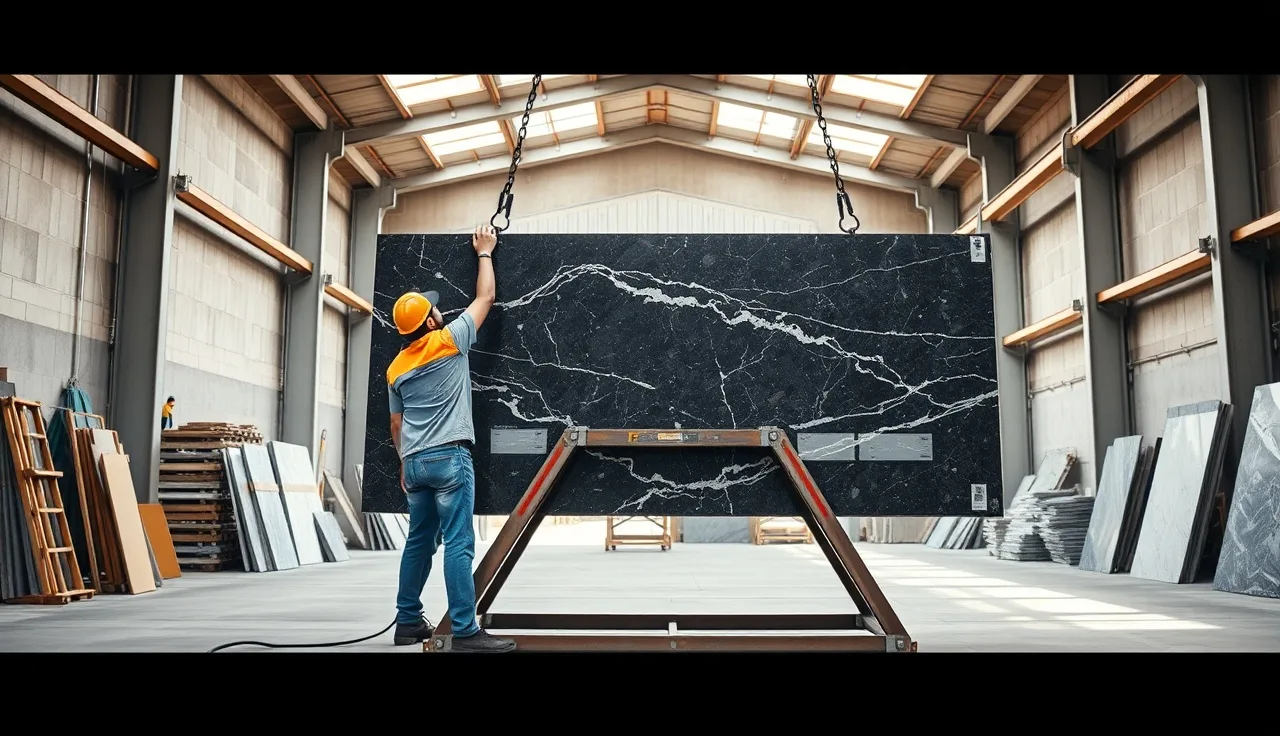
- Full uncut slabs need forklifts and A-frame racks, never hands.
How much does a full granite slab weigh?
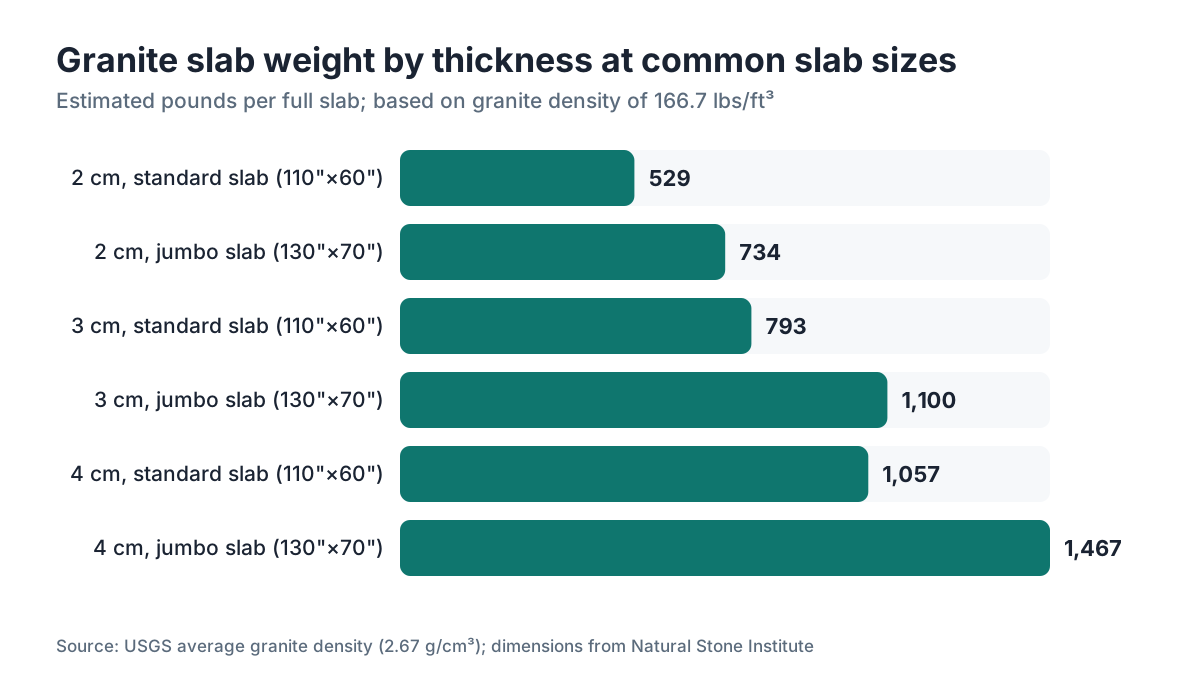
A full granite slab in standard 3 cm (roughly 1-1/4 inch) thickness, measuring about 105 to 115 inches long by 55 to 65 inches wide, weighs between 1,100 and 1,600 pounds. The older 2 cm (3/4 inch) thickness brings a comparable slab down to 550 to 1,000 lbs.
Those ranges are wide for a reason. Slab dimensions swing hard by quarry origin and by the specific block a slab came from. Brazilian slabs tend to run larger, sometimes hitting 120 x 70 inches. Slabs from certain Italian quarries come narrower. Mineral composition changes density from one color to the next too, which we'll get into below.
Most fabricators quote a rule of thumb: 3 cm granite weighs about 18 to 20 lbs per square foot of slab surface. A slab at 60 x 110 inches (about 45.8 square feet) at 18 lbs/sqft comes in near 825 lbs at 2 cm and 1,240 lbs at 3 cm [1].
Here's the one thing to remember if you're moving or receiving slabs. Never plan to hand-carry or dolly a full slab without mechanized help. A single 3 cm slab weighs more than a grand piano.
What is granite's density and how does that translate to slab weight?
Granite is an igneous rock made mostly of quartz, feldspar, and mica. Its density runs 2.63 to 2.75 grams per cubic centimeter, which is roughly 164 to 172 pounds per cubic foot [2]. The USGS reports an average granite density of 2.67 g/cm³, or 166.7 lbs/ft³ [2].
To turn density into slab weight, multiply length (ft) x width (ft) x thickness (ft) x 166.7 lbs/ft³.
Take a slab that is 110 inches x 60 inches x 1.18 inches (3 cm):
- Convert to feet: 9.17 ft x 5.0 ft x 0.098 ft
- Volume: 4.49 cubic feet
- Weight: 4.49 x 166.7 = about 749 lbs
That's lower than the 1,200 lb figure some fabricators cite, and the gap is all about size. Real quarry slabs often run much larger than 110 x 60 inches. A full quarry slab at 130 x 70 inches at 3 cm works out to 6.18 cubic feet, or about 1,030 lbs.
Thickness is never perfectly uniform either. Real slabs vary by a few millimeters across the face, so actual weight runs a bit higher than the formula predicts. Fabricators who put slabs on truck scales report most full 3 cm slabs land in the 1,100 to 1,600 lb range at average sizes, with outliers on both ends [1].
| Thickness | Approx. lbs per sq ft | Full slab (110"x60") | Full slab (130"x70") |
|---|---|---|---|
| 2 cm (0.79") | ~12 lbs/sqft | ~550 lbs | ~760 lbs |
| 3 cm (1.18") | ~18 lbs/sqft | ~825 lbs | ~1,140 lbs |
| 4 cm (1.57") | ~24 lbs/sqft | ~1,100 lbs | ~1,520 lbs |
Does granite color or type affect how much a slab weighs?
Yes, and the difference is real. Granite isn't a uniform material. Dark granites like Absolute Black or Black Galaxy carry higher concentrations of mafic minerals (hornblende, pyroxene, biotite) that are denser than the feldspars dominant in lighter stones. Light granites like White Ice or Colonial White lean quartz-feldspar rich and sit toward the low end of the density range.
The density swing from the lightest to the darkest granite is maybe 5 to 8%. On a 1,000 lb slab, that's 50 to 80 lbs. It matters to a forklift operator. It won't change your kitchen.
Quartzite, often sold right next to granite at stone yards, is denser at 2.65 to 2.80 g/cm³ [3]. Marble runs a touch less dense, around 2.56 to 2.86 g/cm³ [3]. Engineered quartz (like Cambria) uses about the same density as natural quartz at 2.65 g/cm³, so its weight per square foot lands very close to granite at equal thickness.
Color-to-weight only matters when you're pushing the limit of what a floor can hold, which almost never happens with residential countertops. It can matter in commercial installs on upper floors with light steel decking.
How much does a granite countertop weigh after it's cut and installed?
Cut a slab into countertop pieces and the weight per piece drops fast. A typical kitchen island at 36 x 96 inches (24 square feet) in 3 cm granite weighs about 432 lbs by formula, though real weight lands closer to 380 to 450 lbs depending on mineral mix and actual thickness [1].
A standard L-shaped kitchen counter with about 45 square feet of surface runs roughly 700 to 900 lbs installed in 3 cm, spread across the full cabinet run. That's about 15 to 20 lbs per linear foot of cabinet underneath.
Base cabinets shrug this off. KCMA structural tests load cabinet tops with 250 lbs concentrated on a 12-inch span during certification, and installed granite spreads its weight far more gently than that [4]. Well-built 3/4-inch plywood cabinet boxes with a solid face frame carry residential granite without any reinforcement in the vast majority of installs.
Where weight turns into a real problem is spans. Granite 3 cm thick bridges unsupported spans of about 12 to 18 inches without much crack risk, depending on stone quality and edge thickness. A breakfast bar overhang past 10 to 12 inches needs brackets or corbels. This has nothing to do with floor load. It's the tensile limit of the stone itself.
Planning a full kitchen and want to see how slab coverage and waste factor into total weight and cost? The quoting tools at SlabWise let you lay out countertop pieces against slab dimensions before you order.
Can my floor support the weight of granite countertops?
For almost every residential install, yes. Floor systems built to code carry 40 psf (pounds per square foot) of live load, per the International Residential Code [5]. Granite countertops at 3 cm on standard cabinets add roughly 1 to 2 psf of distributed load to the floor below, because the weight spreads across every cabinet footprint. That sits well inside any code-compliant floor's capacity.
The worry about floors and granite is mostly a myth that keeps getting repeated. It turns slightly real in old homes with badly rotted joists, or in odd cases like a huge stone bathtub surround or a massive island on a weak crawlspace floor. There, a structural engineer's look is worth the money.
A full uncut slab stored flat is a different math problem. A 1,200 lb slab on a 6 x 10 foot footprint is about 20 psf of dead load. That's still inside residential capacity most of the time, but you would not want several slabs stacked flat on a house floor. Fabricator warehouses use reinforced concrete or grade-level floors for exactly this reason.
The IRC sets a residential floor live load of 40 psf for most living areas, with some uses rated higher [5]. Granite countertops never come close to stressing that.
How do fabricators move and handle full granite slabs safely?
Full slabs don't travel flat. They ship and store on their edge, in A-frame racks, because granite is strong in compression but weak in tension. Lay a slab flat, support it only at the ends, and it can crack under its own weight once the span gets long enough. A-frame racks keep the slab near-vertical and spread contact stress along its length [6].
At the warehouse, forklifts with padded side-clamp attachments or boom arms with suction cup systems do the lifting. On the jobsite, smaller cuts go in by hand with two or three people and granite-specific suction cup handles. A 3 cm piece at 8 square feet weighs about 145 lbs and two people can carry it on a flat path with good suction cups. Anything bigger, or anything with stairs, gets a portable vacuum lifter.
Don't use standard moving straps or carpet sliders on granite. The stone can flex if the strap points aren't right, and any flex in a big piece risks a crack. A suction cup grip keeps the piece rigid and the lifting force spread out.
For full slab deliveries, trucks use tilt-bed trailers or box trucks with A-frame racks bolted to the floor. The slab gets strapped at multiple points so it can't shift on a corner. This isn't only good practice. A broken slab in transit is the fabricator's loss, and a 1,400 lb slab that topples in a moving truck can punch through the floor.
Homeowners watching an install should never see the crew wrestling full slabs by hand. If they are, ask whether the pieces were pre-cut to manageable sizes at the shop. OSHA treats heavy stone handling as a recognized workplace hazard, and good shops plan lifts accordingly [9].
How does granite slab weight compare to other countertop materials?
Granite sits on the heavy end of countertop materials, but it has company. Engineered quartz like Silestone or Cambria weighs nearly the same per square foot. Marble is close. Real weight savings only show up when you switch to a thinner material or a different category entirely.
| Material | Approx. lbs per sq ft (typical thickness) | Notes |
|---|---|---|
| Granite 3 cm | 18 to 20 lbs | Dense igneous rock |
| Marble 3 cm | 16 to 19 lbs | Slightly less dense on average |
| Engineered quartz 3 cm | 18 to 21 lbs | Resin-bound, similar density |
| Concrete countertop | 18 to 25 lbs | Varies heavily with mix |
| Soapstone 3 cm | 20 to 22 lbs | One of the denser stone options |
| Butcher block 1.5" | 6 to 9 lbs | Much lighter |
| Laminate | 1 to 3 lbs | Substrate adds some, still light |
| Corian/solid surface | 3 to 5 lbs | Much lighter than stone |
If weight is a genuine constraint (a weak upper-floor subfloor, a mobile home, a camper van build), laminate or solid surface is the honest choice. For a normal residential kitchen, the weight difference between granite and engineered quartz is zero as a practical matter. Still deciding on material? Read up on the full range of kitchen countertop options.
What size is a standard granite slab and how does that affect total weight?
Quarries don't cut to a single standard size. Most stone distributors stock two broad categories: standard slabs and jumbo slabs.
Standard slabs run roughly 105 to 115 inches long by 50 to 60 inches wide. Jumbo slabs, more and more common from Brazilian and Indian quarries, reach 120 to 130 inches long by 60 to 70 inches wide. Some exotic material shows up as small as 90 x 48 inches when the quarry block had inclusions or fissures that cut the yield.
The weight gap between a small standard slab and a large jumbo in the same material at 3 cm can hit 600 to 800 lbs. That's a big deal for logistics and almost nothing for your finished kitchen, since you only use the cut pieces.
For granite countertops in a typical kitchen, one full slab usually covers 35 to 55 square feet depending on layout. A galley kitchen might use 80% of a standard slab. An L-kitchen with an island might need a slab and a half. Waste from sinks, cooktops, and odd angles usually runs 15 to 30% of slab area depending on how complex the layout is.
Fabricators who nest cuts well can sometimes pull a second small job out of remnants. Remnant weight just prorates from the per-square-foot numbers above.
How do you calculate the weight of a granite slab yourself?
The formula is short:
Weight (lbs) = Length (in) x Width (in) x Thickness (in) / 1,728 x 166.7
The 1,728 converts cubic inches to cubic feet. The 166.7 is granite's average density in lbs/ft³ [2].
Example: a slab at 112 x 62 x 1.18 inches (3 cm)
- 112 x 62 x 1.18 = 8,195 cubic inches
- 8,195 / 1,728 = 4.74 cubic feet
- 4.74 x 166.7 = 790 lbs
Same slab at 2 cm (0.79 inches): 112 x 62 x 0.79 / 1,728 x 166.7 = 529 lbs.
Real weights run about 5 to 10% above the formula, thanks to thickness variation across the slab, surface texture, and the odd dense pocket in the stone. So a formula result of 790 lbs probably means the slab actually weighs 830 to 870 lbs.
Tracking slab inventory and weights for logistics? Quoting tools like SlabWise can map piece weights against truck capacity when you schedule deliveries.
For cut pieces, run the same formula with the piece dimensions. A sink cutout at 33 x 22 x 1.18 inches weighs about 65 lbs by formula, so the slab piece that held it weighs proportionally less after cutting.
Does slab thickness affect structural performance more than weight?
Yes, and this matters more than weight for most countertop calls.
2 cm granite was common through the 1990s and needed a plywood substrate underneath for full support. Without it, a 2 cm slab cracks at unsupported spans, near cutouts, and at overhangs. 3 cm granite supports itself in most residential countertop applications and needs no substrate, which is why the industry moved to 3 cm over the last two decades.
4 cm (sometimes faked by laminating two 2 cm pieces at the edge for a thick look) adds weight without adding meaningful strength for countertop spans. It's a visual choice, not a structural one.
At 3 cm, fabricators generally put the practical unsupported overhang at 10 to 12 inches before you need a bracket. The Marble Institute of America (now the Natural Stone Institute) guidance is stricter on paper: "for overhangs more than 6 inches, support is recommended; for overhangs beyond 12 inches, support is required" [6]. A good default is to support anything past a third of the counter depth.
For countertop installation planning, lock in the overhang spec before the slab gets cut. Adding a bracket to a finished edge after the fact is a pain.
Thickness also drives the edge profile you can cut. A mitered waterfall edge on 3 cm granite needs precise angle cuts and clean adhesive work. On 2 cm, that same look is harder to pull off.
What do installers need to know about weight for the actual installation day?
Installers pre-cut slabs into manageable pieces at the shop so nobody has to move a 1,200 lb monolith on a jobsite. A kitchen job usually shows up in 3 to 6 pieces, each under 200 to 300 lbs for most layouts. Two experienced installers with suction cups can move a 200 lb piece on a clear path.
The checklist that actually matters before delivery day:
- The path from truck to kitchen has to fit the piece. An 8-foot piece won't turn a tight hallway corner.
- Cabinets have to be level. Granite doesn't flex to fix a cabinet that's off by 1/4 inch across its run.
- Account for any step into the kitchen or raised threshold. You don't slide granite over bumps.
- Adhesive cure time: most fabricators use 100% silicone or a silicone/construction adhesive combo. Full cure runs 24 to 48 hours, and the counter shouldn't take heavy load during that window [7].
One thing that catches homeowners off-guard. Installers shim the stone with plastic shims to hold it level while the silicone sets, and those shims often stay in place permanently. That's fine.
For marble countertops and other softer stones, the weight rules are identical, but the handling gets more careful because marble scratches and chips more easily on corners during a move.
Frequently asked questions
How much does a 3 cm granite slab weigh per square foot?
At 3 cm thickness, granite weighs about 18 to 20 pounds per square foot of surface. That's based on granite's average density of 166.7 lbs per cubic foot. A 40 square foot kitchen island section in 3 cm granite weighs roughly 720 to 800 lbs. The figure holds for most common granite colors, though very dark mafic-rich granites run slightly heavier.
How heavy is a granite slab compared to a quartz slab?
Essentially the same. Engineered quartz (like Cambria or Silestone) has a density near natural quartz at about 2.65 g/cm³, versus granite at 2.63 to 2.75 g/cm³. Both run 18 to 21 lbs per square foot at 3 cm. If you're switching from granite to quartz to save weight, you won't notice a meaningful difference.
Can standard kitchen cabinets support the weight of granite countertops?
Yes. Standard base cabinets built to KCMA standards carry granite countertops without modification. The weight of 3 cm granite spread across a typical run adds roughly 15 to 20 lbs per linear foot to the cabinets below, well inside rated load capacity. Reinforcement is only needed for unusually long unsupported spans or damaged cabinet boxes.
How much does a full granite slab weigh in kilograms?
A full 3 cm slab at typical dimensions (110 to 130 inches long by 55 to 70 inches wide) weighs about 450 to 800 kilograms. The most common sizes run 500 to 650 kg. Use the formula: length x width x thickness in cm, divide by 1,000 to get liters, then multiply by 2.67 (granite's average specific gravity in kg/L) for kilograms.
How do stone yards store full granite slabs without damaging the floor?
Commercial stone warehouses use reinforced concrete slab-on-grade floors built for heavy loads, often rated at 250 to 500 psf or more. Slabs store on edge in A-frame steel racks, not flat, which puts weight on a narrow floor contact strip and keeps the stone out of bending stress. Residential floors aren't designed for slab storage.
What is the weight limit for a granite countertop overhang without support?
The Marble Institute of America recommends support for overhangs past 6 inches and requires it past 12 inches in 3 cm granite. The overhang's weight is less the issue than bending moment, which can crack stone at the cabinet edge. Install brackets or corbels rated for the overhang depth before the stone goes down, not after.
How much does a granite kitchen countertop weigh when fully installed?
A typical residential kitchen with 40 to 55 square feet of 3 cm granite weighs about 720 to 1,100 lbs total, installed. That spreads across the full cabinet run, so the distributed load per square foot of floor is low, usually well under 5 psf. Structural floor concerns almost never apply to standard kitchen countertop installs.
Does 2 cm granite weigh significantly less than 3 cm granite?
Yes, about 33% less per square foot. 2 cm granite runs roughly 12 to 13 lbs per square foot versus 18 to 20 lbs for 3 cm. Across a full slab, that can mean a 300 to 500 lb difference. But 2 cm needs a plywood substrate for support, which adds back some weight and complexity. Most fabricators stopped recommending 2 cm for residential counters for this reason.
How many people does it take to carry and install a granite countertop piece?
A piece up to 150 lbs can go in with two people using granite suction cup handles on a clear flat path. Pieces from 150 to 300 lbs need three people and careful coordination, especially around corners. Anything over 300 lbs should have a mechanical assist. Most fabricators pre-cut pieces to stay under 200 lbs to keep two-person installation practical.
What is the heaviest granite slab size available?
Jumbo slabs from Brazilian or Indian quarries reach 130 inches by 75 inches or more at 3 cm. At those dimensions the formula gives roughly 1,500 to 1,700 lbs. Some specialty quarries produce extra-large slabs for commercial jobs that top 2,000 lbs. Those need heavy forklifts and reinforced transport frames and are uncommon in residential supply.
Is granite heavier than concrete countertops?
About the same, and concrete can edge out heavier. Granite at 3 cm runs 18 to 20 lbs per square foot. Concrete countertops typically weigh 18 to 25 lbs per square foot at similar thickness, depending on mix design, reinforcement, and whether a lightweight aggregate was used. High-density concrete mixes can beat granite's weight per square foot.
Does the weight of granite affect shipping costs?
Yes. Granite ships as freight, and LTL (less-than-truckload) pricing is weight-based. A full A-frame rack of 10 to 15 slabs can weigh 12,000 to 20,000 lbs, and freight rates per hundredweight vary by lane and carrier. Local deliveries from a stone yard to a fab shop often carry a flat delivery fee, but long-haul imports from Brazil or Italy price on weight directly.
Can I calculate granite countertop weight before the slab is cut?
Yes. Measure the slab in inches, multiply length x width x thickness, divide by 1,728 for cubic feet, then multiply by 166.7 for pounds. That gives the full slab weight before cutting. After cutting, run the same formula on each piece using its actual dimensions. Real weights run about 5 to 10% above the formula because of thickness variation.
Sources
- Natural Stone Institute, Technical Manual: Fabricator and industry body guidance on granite slab dimensions, weight-per-square-foot estimates, and handling practices
- USGS (U.S. Geological Survey), rock density reference: Granite average density of 2.67 g/cm³ (approximately 166.7 lbs/ft³); density range 2.63 to 2.75 g/cm³
- Geological Society of America, rock density reference: Quartzite density 2.65 to 2.80 g/cm³; marble density 2.56 to 2.86 g/cm³
- Kitchen Cabinet Manufacturers Association (KCMA), ANSI/KCMA A161.1 Performance Standard: KCMA structural tests load cabinet tops at 250 lbs concentrated on a 12-inch span as part of cabinet certification
- International Code Council, International Residential Code (IRC) Table R301.5: Residential floor live load requirement of 40 psf for most living areas per IRC Table R301.5
- Natural Stone Institute (formerly Marble Institute of America), Dimension Stone Design Manual: Guidance that overhangs beyond 6 inches should have support and overhangs beyond 12 inches require support; slabs should be stored and transported on A-frame racks
- Momentive (GE Sealants), construction silicone cure time reference: 100% silicone construction adhesives typically reach full cure in 24 to 48 hours depending on temperature and humidity
- USGS National Minerals Information Center, stone statistics: Granite as an igneous rock composed primarily of quartz, feldspar, and mica; physical properties reference
- Occupational Safety and Health Administration (OSHA): Workplace safety requirements for lifting and moving heavy stone slabs in fabrication settings
- American Institute of Architects (AIA): Standard countertop thickness specifications and overhang guidelines for residential construction
Last updated 2026-07-11