TL;DR
- Granite void filling uses clear, white, black, tan/beige, and gray epoxy as base colors, tinted with universal pigments to match the specific stone.
- The right color depends on the granite's background tone, the void depth, and the finish type.
- Clear epoxy works on translucent or light stones.
- Darker granites need tinted or black fillers.
- No single universal color exists.
Why do fabricators fill voids in granite at all?
Granite is a natural stone, and natural stone has natural flaws. Pits, fissures, and pores form as the stone cools and crystallizes deep underground. Some granites, especially those with large feldspar crystals or heavy mica content, come off the saw with gaps you can see across the room. Those gaps collect debris, crack under stress, and make a surface that's hard to clean. Filling them isn't a cover-up. It's what every professional shop does.
The goal is structural and visual. A void near an edge or a sink cutout is a place where a crack likes to start under load. Epoxy bonds the surrounding crystals, steadies the area, and makes the finished surface read as one continuous piece. Most fabricators fill during grinding and polishing, after the slab is cut but before final polish, so the epoxy cures flush and takes the same sheen as the stone around it [1].
For homeowners pricing a new granite countertop, this step is expected and baked into a quality job. Epoxy in a finished slab edge is not a red flag. Large, obvious color mismatches are.
What epoxy colors are actually used to fill granite voids?
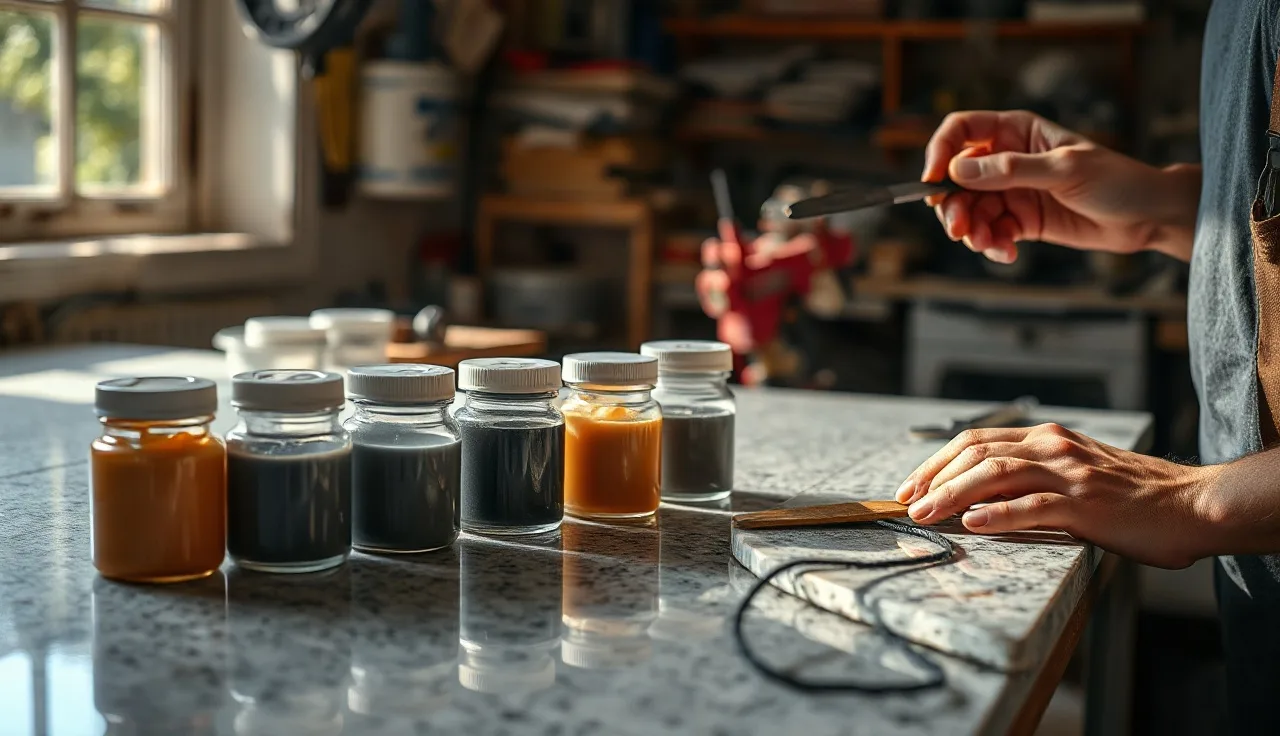
The short answer: clear, white, black, tan/beige, gray, and custom-tinted versions of those bases. Fabrication supply companies sell polyester and epoxy fillers in a core palette, and fabricators mix in universal stone pigments to close the gap to the real stone color [2].
Here's how each base color gets used at the bench:
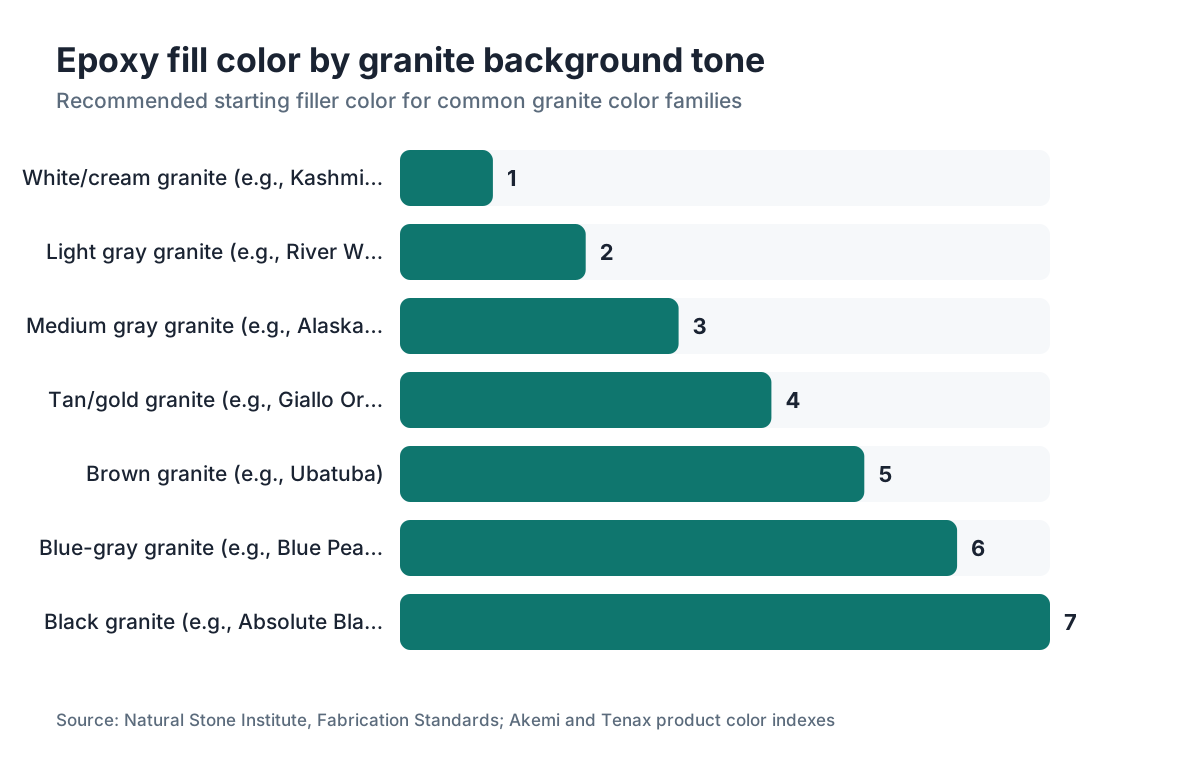
Clear epoxy is the usual starting point. Cured, it goes slightly amber or nearly water-clear depending on the brand. It works on light granites (whites, creams, light grays) and on any stone where the void is small enough that you want the surrounding mineral to show through. On a White Kashmir or a Bianco Romano, a clear fill blends because the void basically vanishes.
White or off-white paste is the pick for milky or sugar-white granites like White Ice or Arctic White. Clear works too, but its amber cast can look warm against a very cool white. A pre-tinted white base is faster and cleaner.
Black or dark gray goes on black granites like Absolute Black, Black Galaxy, or Black Pearl. Tinting clear all the way to black is a losing game and usually turns muddy. Reach for a black base instead. Plenty of shops use a deep charcoal rather than pure black, because the stone itself is rarely a true black under bright light.
Tan, beige, or brown covers the big family of brown and gold granites: Giallo Ornamental, Venetian Gold, Colonial Gold, and their cousins. These are among the hardest to match because the background isn't one color. Most fabricators start with a tan base and add a touch of gold or ochre pigment.
Gray handles blue-gray stones like Blue Pearl and many leathered granites. Gray also works as a neutral mixer when the stone runs veining across several tones at once.
Beyond the bases, experienced fabricators keep a set of universal pigment pastes (iron oxide yellows, reds, blacks, and whites do most of the work) plus specialty pigments like mica powder for sparkle-heavy stones such as Blue Pearl or Labrador Antique [2].
What types of epoxy and filler products do fabricators actually use?
The word "epoxy" gets used loosely in shops. In practice there are three product categories:
1. Polyester-based fillers (Akemi, Tenax, Integra Adhesives): Fast-curing, usually under 15 minutes, with a wide color range. Polyester is the common choice for granite because it sands and polishes without smearing. Akemi's color-matched system and Tenax's Mastice line are shop standards. Tenax lists over 30 color variants in its polyester filler range [3].
2. Two-part epoxy adhesives (Integra, Dural, Simpson Strong-Tie): True two-part epoxies cure slower, end up harder, and hold their shape better than polyester. Shops reach for them on structural repairs, like regluing a broken corner, rather than cosmetic void filling. They don't sand as clean as polyester.
3. UV-cure resins: Some fabricators use UV-activated resin for small surface pits. Apply it, hit it with a UV lamp for 30 to 60 seconds, done. The surface is ready to polish almost right away. These run clear or very lightly tinted and do best on small, shallow voids.
For routine void filling during fabrication, polyester is the practical pick in most shops. The cure time fits the production flow, the color selection is broad, and sanding flush is straightforward.
If you run the numbers on materials per job, filler is one of those line items that's easy to undercharge. Tools like SlabWise let you fold consumables like filler and pigment into your job costing so they don't quietly eat your margin.
How do fabricators match epoxy color to a specific granite?
Color matching is part skill, part experience, and part knowing the stone category. There's no universal formula, because granite color shifts slab to slab, even inside the same batch from the same quarry.
The basic process most shops run:
- Identify the dominant background color of the stone (not the veins, not the crystals, just the overall field color).
- Start with the closest base color in your stock.
- Add pigment paste in small amounts and mix it thoroughly. Less is more. A tiny bit of pigment moves the mix a long way.
- Test on a scrap piece or a hidden spot on the actual slab. Let it cure, then sand flush. Wet color and cured-then-sanded color are two different things, and you need the final one.
- Adjust and repeat.
Crystalline or speckled granites add a wrinkle. A stone like Alaska White has white, gray, and black crystals in a field that reads as medium gray overall. The right epoxy color is often a flat gray that looks neutral once polished, even though no single crystal in the stone is that color. The eye reads the surrounding pattern and fills in the rest.
Mica-heavy granites like Volga Blue or Labrador Antique carry a metallic sparkle no pigment paste truly copies. The best you can do is nail the background color and accept a fill that doesn't glitter. On a busy, multicolored stone the eye rarely catches it. On a uniform stone with isolated voids, the missing sparkle can show.
One trick experienced fabricators trust: go slightly lighter than you think you need. Fills read darker than the stone around them after polishing, because the perfectly smooth surface reflects light differently than the crystalline stone next to it. A fill that looks dead-on in the raw mix often looks a shade dark when it's finished [1].
Does the type of finish (polished vs. honed vs. leathered) change the color choice?
Yes. Homeowners rarely think about it, but fabricators deal with it on every textured job.
On a polished surface, fills bounce light straight back. A slight mismatch that would hide on a honed top jumps out on polished stone, because the reflectivity magnifies contrast. Polished fills need a careful match.
Honed granite has a matte face, and matte is forgiving of minor color drift. The fill still has to be close, but without direct reflectivity a small difference reads as texture, not a patch.
Leathered granite is the tough one. Leathering (a diamond brush at the factory or in the shop) builds a textured surface full of micro-shadows and shifts in sheen. An epoxy fill sits a hair proud or slightly recessed against that texture, and even a perfect color can show because the texture breaks at the fill. Some shops fill voids before leathering and let the brush rough up the fill along with the stone. Others fill after. Filling before is generally better for textured finishes.
If you're picking a finish for your kitchen countertops, honed and leathered hide natural variation better than polished. That doesn't make repairs invisible. It makes them quieter.
What's the difference between filling a void and filling a fissure?
Voids are three-dimensional holes or pits in the stone surface. Fissures are linear cracks or separations that run through the stone, sometimes clean through the slab.
The distinction changes your color approach because fissures usually have different depth and width than voids. A fissure can be narrow and deep, and forcing a thick paste into it is hard. Many fabricators use a low-viscosity epoxy on fissures, letting it wick in by capillary action before topping with paste.
For a fissure in a mostly white stone, clear low-viscosity epoxy first, then white paste on top, is a common two-step move. On dark granites, same process, but with black or dark gray paste.
Fissures along a slab edge are the highest-risk voids in the shop. Edge profiling loads the stone mechanically, and an unfilled or poorly filled edge fissure can run into a full crack during routing. Fill these before profiling, not after. The countertop installation process piles more stress onto seams and support points, one more reason edge fissures need real structural filler and more than a cosmetic color match.
Are there specific product lines fabricators rely on for granite void filling?
A handful of names come up again and again in shops across the U.S. and Canada:
Akemi (German, sold through stone supply distributors): Akemi's color chart runs around 50 matched colors for common granite and marble types. Its polyester paste is widely treated as the benchmark for color accuracy and workability [4].
Tenax (Italian): Tenax Mastice and Tenax Tixo are staples. Tenax also puts out a color index booklet that some fabricators keep at the bench as a matching reference [3].
Integra Adhesives: A U.S. manufacturer with both polyester and epoxy systems, including a color-matched line built for stone fabrication. Its seam adhesive line is widely used too.
StonePro: Makes UV-cure products alongside polyester fillers, popular in shops chasing faster throughput on small voids.
Custom Building Products and Laticrete: More an installation thing than a fabrication one, but their epoxy grouts sometimes get pressed into very large voids where a grout-like consistency helps.
Brand loyalty in shops is real. Most experienced fabricators have tested two or three systems, found one that fits their workflow, and stayed put. Switching filler brands means relearning how the product behaves: cure speed, shrinkage, how it sands.
Can you see epoxy fills in finished granite countertops?
Sometimes, yes. A skilled fabricator with a close-matched filler on a uniform light granite can get a fill that's basically invisible. On a busy, multicolored granite with a lot of movement, even a rough match disappears because the eye is already sorting through pattern.
Where fills show most:
- Large voids (anything past about 10mm across) on a uniform-colored stone.
- Fills on polished black granite. Black is unforgiving. A slight gray or brown cast reads hard against the flat black field.
- Fills near edges that get a profile cut, where the filler cross-section shows on both the top and the edge.
- UV-cure clear fills on darker stones, where the amber cast leaves a warm spot.
Invisibility should be the standard, not the exception. If you can spot patchwork on a delivered countertop from standing height, that's a quality issue worth raising with your fabricator. If you can only find it by crouching and looking at a raking angle, that's inside normal tolerance for natural stone.
Natural stone always carries some character, and marble countertops and granite alike hold variation no filler fully copies. The goal is a surface that reads as continuous stone, not a perfect clone of every crystal around the fill.
How does void filling affect granite durability and sealability?
Cured polyester and epoxy fills are non-porous. Stone sealers are silane or siloxane-based penetrating sealers that soak into the mineral structure to repel liquids [5]. They don't penetrate cured epoxy. That matters for two reasons.
First, the fill doesn't need sealing and won't take it. The stone around the fill does. A good sealer application treats the stone field evenly, and the epoxy areas just don't absorb.
Second, if a fill sits proud of the surface (not sanded perfectly flush), sealer or cleaner can pool at its edge and leave a faint discolored ring over time. Fills finished flush don't do this.
On durability: a properly bonded polyester fill isn't going to fall out under normal use. Adhesion failure in a household kitchen is rare. The real long-term risk is thermal cycling. Epoxy and stone expand and contract at different rates. In very cold climates or outdoor installs, that mismatch can eventually crack a fill loose at the edges. For an interior kitchen in a climate-controlled home, it's essentially never a problem.
For maintenance, the Natural Stone Institute (which absorbed the Marble Institute of America) recommends resealing granite countertops every one to three years depending on porosity and use [6]. The epoxy fills don't factor into that schedule.
What do homeowners need to know about epoxy fills before buying granite?
A few practical points that don't always come up at the stone yard:
Fills are normal. Every slab of natural stone carries variation, and most slabs that pass through a shop get at least minor filling. This isn't a defect you need disclosed. It's standard fabrication.
You can inspect the fills before installation. At the yard, look at your slab under bright light at a low angle. You'll catch any large repairs done at the quarry or during import, usually polyester fills done in Italy or Brazil before the slab shipped. Nobody's hiding anything. This is routine.
If you're set on a stone with known fissure trouble (some exotics like Azul Macaubas quartzite or certain Lemurian blues have notorious fissure networks), ask your fabricator exactly how they plan to handle the problem areas before they cut. A good one will walk the slab with you, point out the issues, and explain the plan.
Price tells you something too. A very low bid sometimes means a shop skipping the careful void-filling step, or using cheap off-color filler and betting you won't notice. Compare bids and ask what's included. If your quote came from a tool like SlabWise's quoting platform, the fabricators using it tend to itemize their process, which makes an apples-to-apples comparison easier.
Does the color of epoxy affect its strength?
Pigment in epoxy or polyester filler usually runs 1 to 5 percent by weight. At those levels the effect on mechanical properties is small. The pigment is there to change color, not chemistry.
Push past that, though, and it matters. More than roughly 5 to 10 percent by weight, depending on the pigment, can interfere with cure and cut bond strength. Iron oxide pigments are chemically inert and leave cure alone. Some organic dyes fight the hardener chemistry in epoxy systems. That's why stone pros use pigments formulated for stone epoxy instead of hardware store paint tints.
The base resin color is chosen partly for looks and partly for reactivity. A black base uses carbon black, which is very inert. A white base uses titanium dioxide, also inert. Those two are the most common pre-tinted bases for a reason.
For fabricators mixing custom colors: stick to the pigment pastes sold by your filler supplier. They're built to match the resin system you're running. Incompatible colorants are one of the more common reasons a fill cures soft or won't bond [2].
What are the environmental and safety considerations when using epoxy fillers in a shop?
Polyester fillers contain styrene, a volatile organic compound listed by the EPA under the Toxic Substances Control Act [7]. Styrene evaporates fast and has a strong odor. In a shop, that means ventilation is not optional. OSHA's permissible exposure limit for styrene is 100 parts per million as an 8-hour time-weighted average [8].
Two-part epoxy systems skip the styrene but carry reactive hardeners that are skin sensitizers. Amine hardeners in epoxy systems are classified as potential sensitizers, so repeated skin contact can lead to allergic dermatitis. Nitrile gloves are the floor. Fabricators handling epoxy daily often move up to thicker chemical-resistant gloves.
UV-cure resins run lower on VOC content and skip styrene, one reason some shops shift toward them for small voids. They still need UV eye protection during curing.
Pigment pastes carry their own handling notes, especially older ones with heavy metal oxides like chrome greens and cadmium yellows, though most modern stone pigments use iron oxides that are relatively benign [9].
In states with strict air quality rules (California under CARB, for one), the styrene in polyester fillers is an active compliance question. Some California shops have shifted to low-styrene or styrene-free polyester formulations because of it [10].
Frequently asked questions
Can I use regular epoxy from a hardware store to fill granite voids?
You can, but you shouldn't. Hardware store epoxy (like J-B Weld or basic two-part clear epoxy) doesn't sand cleanly, isn't built to polish to a stone finish, and comes in almost no useful granite colors. It also tends to yellow over time. Stone-specific polyester fillers from suppliers like Akemi or Tenax are made to sand flush, take polish, and hold their color.
How long does epoxy void fill last in a granite countertop?
In an indoor kitchen, a properly applied polyester or epoxy fill can last the life of the countertop, typically 20-plus years with normal use. The main failure risk is thermal cycling in extreme conditions or a direct impact on the fill. Fills near sink cutout edges or seams that move regularly can loosen sooner, usually showing as a hairline gap at the fill boundary.
Will granite sealer affect the epoxy fill areas?
No. Penetrating sealers work by soaking into the pores of the stone. Cured epoxy and polyester are non-porous, so the sealer doesn't absorb into filled areas. Apply sealer normally across the whole surface. The fill areas simply won't take it, and the excess wipes off. It causes no problems.
What color epoxy do fabricators use for white granite?
Clear or off-white base epoxy is standard for white granites. Clear works for small voids because it lets the surrounding mineral show. For larger fills or a warm cream background, a pre-tinted off-white or ivory base matches better. Pure bright-white epoxy tends to read too stark against the natural warmth of most white granites like Kashmir White or Colonial White.
What color epoxy is used for black granite?
Black or very dark charcoal base epoxy. Clear or gray fills show immediately against black granite because the polished black surface is so uniform. Most shops use a purpose-made black polyester filler like Akemi Black or the black variant in Tenax's Mastice line. Going slightly dark charcoal rather than jet black is often a better match, because most "black" granites have subtle brown or green undertones.
Why does epoxy fill sometimes look different after polishing than it did when first applied?
Two reasons. First, epoxy changes color slightly as it cures, so the wet mix looks different from the cured solid. Second, polishing removes the surface layer and reveals the bulk color of the fill, which can differ from the surface. Experienced fabricators test their mix on scrap, let it cure fully, and sand it to see the final polished color before touching the actual stone.
Can epoxy fills be colored to match sparkly or metallic granite?
Partially. Mica powders and metallic pigments can be added to epoxy to fake sparkle, but the result rarely matches the real crystal glint of mica, pyrite, or labradorite in the stone. On a sparkle-heavy granite like Blue Pearl or Labrador Antique, the background color match matters more than replicating the shine. The visual complexity of the stone hides most of the imperfection.
Is void filling included in a standard granite fabrication quote?
It should be, and usually is at reputable shops. Minor void filling is a normal part of finishing and isn't typically itemized separately. Large structural repairs, like epoxying a broken slab section or a major edge fissure, may be charged separately. If you're comparing quotes and one is much cheaper, ask specifically whether void filling and edge repair are included.
Do different granite colors require different types of epoxy or just different colors?
Mostly just different colors. The base chemistry of a good polyester filler works across granite types. The formulation differences that matter are viscosity (thin liquids for fissures, thick paste for open voids) and cure speed. Color is adjusted with pigment. Some very porous exotic granites absorb filler differently, but that's about porosity and texture, not stone color.
What happens if the epoxy color doesn't match the granite?
The fill shows as a patch. On complex multicolored granite it may stay subtle enough that only you notice. On uniform stones like Absolute Black or white granites, a mismatch stands out clearly. A good fabricator will re-do a visible fill or grind it out and try again before delivery. If a mismatch turns up after installation, a skilled stone restoration technician can sometimes grind it out and re-fill in place, though matching is harder without the slab at a bench.
How do fabricators handle voids in quartzite vs. granite?
The process is similar, but quartzite is harder and less porous than most granite, which can make filler adhesion trickier. Some quartzites also have translucent areas where clear or near-clear filler is the only option that doesn't look opaque and obvious. The same polyester fillers used for granite work on quartzite, but color matching is often more demanding because quartzite tends toward subtler, more complex coloration.
Can homeowners repair a chip or void in their granite countertop themselves?
Small chips and pits, yes, with a consumer-grade granite repair kit (Tenax sells them, as does StonePro). The results rarely match a shop repair because you can't sand and re-polish the whole surface. For small edge chips in an inconspicuous spot, DIY is reasonable. For visible voids in the middle of a polished surface, a stone restoration professional will get a much better result.
Are epoxy fills food-safe once cured?
Cured epoxy and polyester fills are chemically inert and don't leach into food at normal kitchen temperatures. The FDA classifies cured epoxy resins as generally acceptable for incidental food contact when properly cured [11]. The key word is cured: partially cured filler can still off-gas. Most polyester fillers reach full cure within 24 hours at room temperature. After that, the fill is stable.
Sources
- Natural Stone Institute, Fabrication Standards: Void filling is standard practice in professional stone fabrication, done during grinding and polishing phases before final finish.
- Marble Institute of America (Natural Stone Institute), Stone Restoration and Maintenance: Universal pigment pastes including iron oxide yellows, reds, blacks, and whites are standard for tinting stone fillers; pigment loading above 5-10% by weight can affect cure.
- Tenax USA, Product Catalog: Tenax lists over 30 color variants in their polyester filler (Mastice/Tixo) range for stone fabrication.
- Akemi North America, Color-Matched Filler System: Akemi's color chart lists around 50 matched colors for common granite and marble types.
- Natural Stone Institute, Sealer Technology: Silane and siloxane penetrating sealers work by entering the mineral pore structure of stone; they do not penetrate cured epoxy fills.
- Natural Stone Institute, Care and Maintenance Guidelines: The Natural Stone Institute recommends resealing granite countertops every one to three years depending on porosity and use intensity.
- U.S. EPA, Toxic Substances Control Act (TSCA) Chemical Substance Inventory: Styrene is listed under TSCA and is a VOC present in polyester-based stone fillers.
- OSHA, Chemical Sampling Information: Styrene: OSHA permissible exposure limit (PEL) for styrene is 100 ppm as an 8-hour time-weighted average.
- NIOSH, Occupational Exposure Information: Iron oxide pigments used in stone fillers are classified as relatively benign; modern stone pigments have largely replaced heavy metal oxide colorants.
- California Air Resources Board (CARB), Consumer Products Regulation: CARB regulations limit VOC content in adhesives and surface coatings, affecting styrene-containing polyester filler use in California fabrication shops.
- U.S. FDA, Code of Federal Regulations Title 21, Section 175.300 (Resinous and Polymeric Coatings): Fully cured epoxy resins are generally acceptable for incidental food contact under FDA 21 CFR regulations.
Last updated 2026-07-10