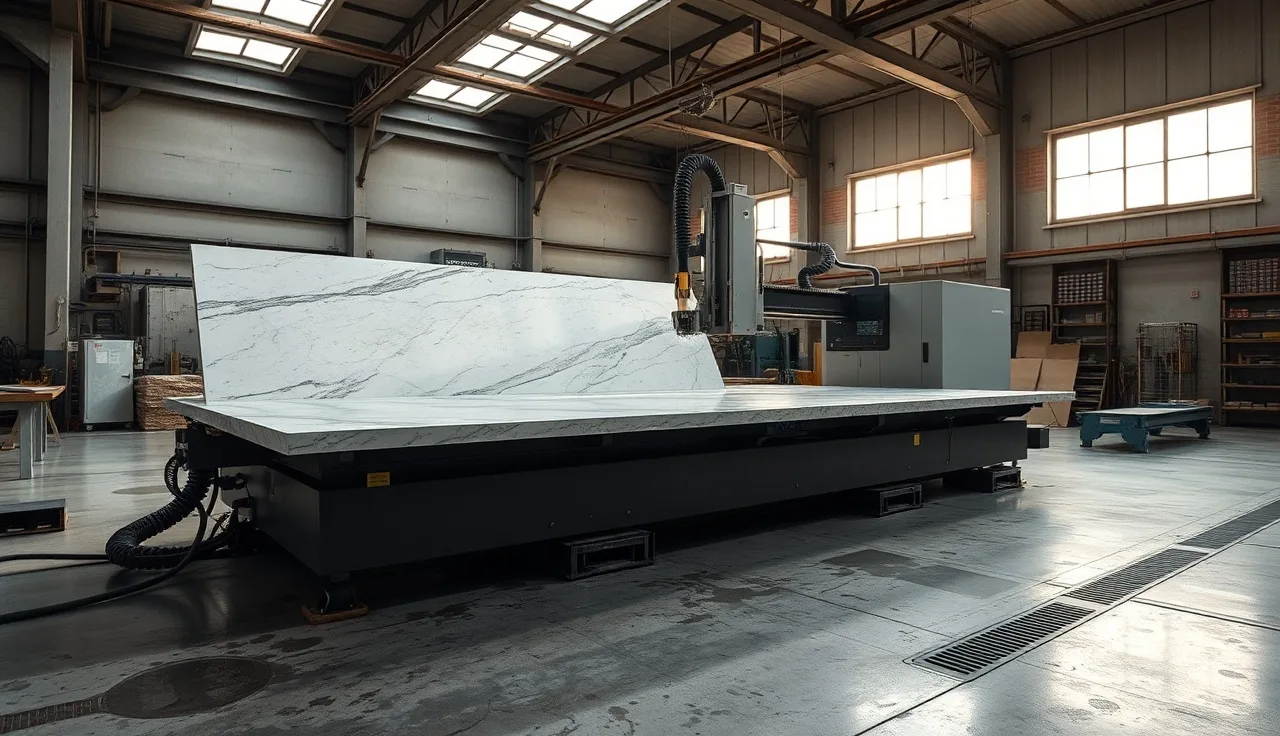
TL;DR
- For most stone fabrication shops, the backbone is a bridge saw with a 10 to 14 hp spindle, a 14-inch diamond blade, and a recirculating water filtration system.
- A 5-axis CNC bridge saw handles 90% of production cuts and miter work.
- Smaller shops starting out can run a quality rail saw in the $8,000, $20,000 range.
- Waterjet is additive, not a replacement.
What does a complete wet saw setup actually include?
A wet saw setup in a stone fab shop is more than a machine and a blade. It is a system: the saw itself, the water delivery and filtration loop, the blade, the table or bridge mechanics, the dust and slurry management, and the electrical service feeding all of it.
The saw cuts stone. The water cools the blade and suppresses silica dust, which is the real reason the setup matters from a regulatory standpoint. The Occupational Safety and Health Administration's silica standard for construction (29 CFR 1926.1153) and the general industry standard (29 CFR 1910.1053) both require wet methods as an engineering control when cutting stone that contains crystalline silica [1]. Granite, quartzite, engineered quartz, and many marbles all qualify. You can't skip the water system and stay compliant.
So before you price saws, figure out your water situation. You need a supply line, a recirculating filtration tank (or a connection to a settling tank), and a drain or pump-out plan for slurry. Most shops run a closed-loop system where slurry falls into a tank, solids settle or get filtered out, and clean water recirculates. A basic recirculating tank runs $1,500, $5,000. A full automated filtration system with press or centrifuge can reach $30,000.
Then there is the electrical service. A bridge saw with a 10 to 15 hp spindle motor typically needs a 3-phase, 208 to 240V or 480V feed. If your building only has single-phase power, that is a real constraint and adds cost for a phase converter or transformer before you even buy the saw.
What are the main types of wet saws used in stone fabrication?
There are four categories most shops deal with:
Rail saws (hand-guided or semi-guided): These are the entry point. A circular saw head rides on a rail or arm, and the operator guides the cut. Good ones from manufacturers like MK Diamond or Husqvarna run $3,000, $12,000. They work for straight cuts on slabs, but they require skill to hold tolerances, and they are slow on volume. A busy shop will outgrow a rail saw fast.
Bridge saws (manual and CNC): This is where most mid-size and large shops live. A bridge saw mounts the blade head on a gantry that travels over a fixed or rotating table. Manual bridge saws cost roughly $20,000, $60,000 new. A CNC bridge saw, where the gantry, table rotation, and head tilt are computer-controlled, runs $60,000, $180,000 for a solid Italian or Spanish machine [2]. These machines can do straight cuts, miter cuts at 45 degrees or custom angles, and with the right tooling, sink cutouts.
5-axis CNC bridge saws: The 5-axis adds the ability to tilt the blade head in multiple planes at once, which is essential for compound miter work and complex waterfall edges without secondary operations. Price range is $120,000, $250,000 for new machines from Breton, Comandulli, or Park Industries.
Waterjet cutters: Not a saw in the traditional sense. A waterjet uses ultra-high-pressure water (typically 60,000 to 90,000 psi) mixed with abrasive garnet to cut stone without heat or mechanical stress [3]. They shine on curves, medallions, and detailed inlays that a blade cannot do. Entry-level stone waterjets from Flow or OMAX start around $80,000, $150,000. They are additive for most shops, not a replacement for the bridge saw.
The right answer for a new shop is almost always: start with a CNC bridge saw. Add a waterjet when your order mix justifies it.
How do wet saw costs compare across machine types?
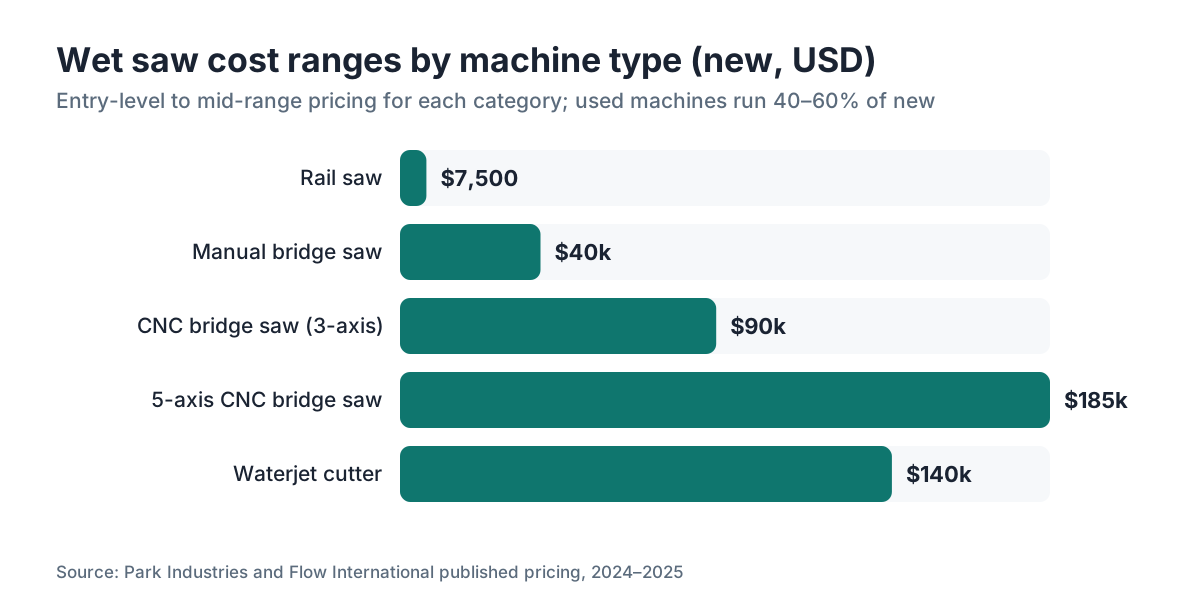
The table below covers real market ranges as of 2024 to 2025. Used machine prices vary enormously based on hours, condition, and brand, so treat those as rough guides.
| Machine Type | New Price Range | Used Price Range | Typical Spindle Power |
|---|---|---|---|
| Rail saw (quality) | $3,000, $12,000 | $800, $4,000 | 2 to 5 hp |
| Manual bridge saw | $20,000, $60,000 | $8,000, $25,000 | 7 to 12 hp |
| CNC bridge saw (3-axis) | $60,000, $120,000 | $25,000, $70,000 | 10 to 20 hp |
| 5-axis CNC bridge saw | $120,000, $250,000 | $50,000, $130,000 | 15 to 25 hp |
| Waterjet cutter | $80,000, $200,000 | $30,000, $90,000 | N/A (pump hp varies) |
These numbers come from published price ranges by distributors like Park Industries and from machine listings on used equipment marketplaces [2][4]. They do not include installation, freight (often $2,000, $8,000 for large machines), or electrical and plumbing work.
One thing shops underestimate: the ongoing blade cost. A quality 14-inch diamond segmented blade for granite costs $80, $300 depending on bond hardness and segment count. A shop doing 10 to 15 slabs a day might burn through blades weekly. That adds up faster than most owners project.
What blade specifications actually matter for stone cutting?
The blade is the consumable that determines cut quality, speed, and cost per square foot. Getting it wrong means chipping, slow cuts, or premature wear.
For granite and hard stone, you want a harder bond with a finer diamond concentration. Hard bonds hold the diamond longer in dense material. For softer stones like marble or limestone, a softer bond lets the diamonds expose and cut more aggressively, since the stone itself wears the bond away appropriately.
Blade diameter: 14-inch (350mm) is the standard for most bridge saws cutting slabs. Some machines run 16-inch or 18-inch blades for thicker material or deeper cuts. Bigger diameter means faster cut speed at the same RPM, but also more torque demand on the spindle.
Segment type: Turbo segments cut faster but leave a rougher edge. Segmented (gullet) blades clear slurry better and run cooler. For production work where edges get polished anyway, a fast-cutting segmented blade is fine. For finished edge work where the saw cut is more exposed, a turbo or continuous rim blade gives a cleaner result.
RPM and surface speed: The ideal surface speed for diamond blades cutting granite is roughly 4,000 to 5,500 surface feet per minute (SFPM). Running too fast heats the blade. Running too slow glazes the segments. Check the blade manufacturer's spec and set your machine RPM accordingly. Most bridge saws are adjustable.
Blade manufacturers worth knowing: Husqvarna Construction, Diamax, MK Diamond, and Alpha Professional Tools all have published technical guides that specify bond hardness recommendations by material. Use those. Do more than buy the cheapest blade.
What water flow rate and filtration do you need?
OSHA's Table 1 for the silica standard specifies that a wet saw cutting stone must use water at a flow rate sufficient to suppress dust at the point of cut [1]. The actual requirement is performance-based: the water has to visibly suppress dust, more than drip. In practice, most bridge saws are designed to deliver 1 to 4 gallons per minute (GPM) to the blade, directed at both sides of the cut.
For a single bridge saw, a recirculating system needs a tank with at least 200 to 300 gallons of capacity to give solids time to settle before water recirculates. Many shops run 500-gallon settling tanks. The slurry (stone fines and water) that accumulates is a waste stream that needs handling. Wet stone slurry with a high pH can be regulated as a special waste in some states, though most natural stone slurry is inert and can go to a licensed dumpster or be dewatered and landfilled.
If you are running multiple saws, edge polishers, and CNC machines at once, calculate total water demand and size your filtration accordingly. A shop with four wet machines might need 1,500 to 2,000 gallons of tank capacity and a pump capable of 10 to 15 GPM total throughput.
Filter media options range from simple settling baffles (cheap, manual cleanout) to bag filters to centrifuges to filter presses. A filter press is the most efficient for high-volume shops because it produces dry cakes that are easy to dispose of, but they cost $15,000, $40,000. Most small shops start with a settling tank and a sump pump and upgrade later.
How should a shop set up the physical space around the wet saw?
The saw is only as productive as the space around it. Material handling is where most shops lose time.
The loading zone matters more than people think. A bridge saw table is typically 9 to 12 feet long and 5 to 7 feet wide. You need clearance on all four sides for the gantry travel plus operator access, which means a footprint of roughly 16x14 feet minimum for the machine alone. Add 10 to 15 feet on the feed side for a slab cart or A-frame storage rack.
Slab carts with air-powered tilt mechanisms or overhead cranes make loading faster and safer. A 300 to 400 lb granite slab lifted manually is a serious injury risk. OSHA's ergonomics guidelines and state-level workers' compensation data consistently show manual material handling as the leading injury source in stone shops. If you are buying a $100,000 saw, budget $5,000, $15,000 for proper material handling equipment around it.
Floor: concrete, sealed or epoxy-coated, with a floor drain or trough routed to your slurry tank. Slope the floor toward the drain at about 1/8 inch per foot. A wet shop floor with no drain is a slip hazard.
Lighting: good, direct, shadow-free lighting over the saw table. You need to see pencil layout lines clearly on polished and unpolished surfaces. LED strip lights or T5 fluorescent fixtures mounted to the bridge saw frame or ceiling directly above the work area are standard.
Noise: bridge saws and waterjets are loud. A shop with multiple machines easily exceeds 85 dBA, OSHA's action level that triggers a hearing conservation program [5]. Plan for hearing protection stations near every machine.
CNC bridge saw vs. manual bridge saw: which is right for your shop?
The honest answer depends on your volume and your labor market.
A skilled operator on a manual bridge saw can cut fast and accurately, and the machine costs half to a third of a comparable CNC. If you have reliable skilled labor and your job mix is mostly straight cuts with simple miter work, a manual bridge saw is a defensible choice. Many one- and two-person shops run this way profitably.
But the skilled stone saw operator is genuinely hard to find in most markets right now. The median wage for a stone cutter and slab saw operator (BLS occupation code 51-9195) was $18.96 an hour as of May 2023 [6]. That sounds modest, but shops report that finding someone with the experience to run a manual saw consistently, without chipping edges or misreading layouts, takes months of training. With a CNC machine, a less-experienced operator loads the slab, confirms the digital layout, and the machine executes the cuts. Error rates drop. Throughput rises.
CNC machines also do things a manual saw cannot do repeatably: complex polygonal sink cutouts, precise miter angles for waterfall islands, and automatic optimization of cut paths to reduce material waste. That last point connects directly to nesting software. When your CNC bridge saw is paired with digital templating and nesting tools (like those built into shop management platforms), you can squeeze more usable countertop out of every slab, which is where the real margin improvement happens.
For a shop doing 15+ slabs per week, the math almost always favors CNC. For a shop doing 5 to 8 slabs per week, a manual bridge saw with a solid operator can still pencil out.
What electrical and infrastructure requirements should you plan for?
This is the part that surprises shop owners who buy a machine before checking their building.
A 10-hp three-phase motor draws roughly 28 to 30 amps at 240V, or about 14 to 15 amps at 480V (theoretical; actual draw with motor efficiency and power factor is higher). Most bridge saws specify a dedicated 50 to 100 amp circuit at 240V/3-phase or a 30 to 60 amp circuit at 480V/3-phase. Your electrician needs the machine's nameplate data to size the wiring and breaker correctly per NEC Article 430 [7].
If your shop only has single-phase service, you have two options: install a rotary or digital phase converter (cost: $1,500, $6,000 depending on hp), or negotiate with your utility to bring in three-phase service, which can cost anywhere from a few thousand dollars to $30,000+ depending on how far the utility has to run new infrastructure. In most industrial zones, three-phase is available at the street. It is worth checking before you sign a lease.
Compressed air is a secondary requirement for many CNC machines that use pneumatic clamping or tool changers. A 5 hp compressor delivering 15 to 20 CFM at 100 psi is usually sufficient for a single bridge saw.
If you are adding a waterjet, the high-pressure pump is a major power draw. A 50-hp waterjet pump needs its own 150-amp, 480V circuit minimum. Plan the electrical layout for your whole shop before you buy equipment.
What does OSHA require for silica dust control on wet saws?
This is not optional and the enforcement is real.
OSHA's crystalline silica standard for general industry (29 CFR 1910.1053) went into effect for most employers on June 23, 2018 [1]. It sets a permissible exposure limit (PEL) of 50 micrograms of respirable crystalline silica per cubic meter of air (50 µg/m3) as an 8-hour time-weighted average. The action level is 25 µg/m3.
For wet saws, OSHA's Table 1 (the engineering controls table from the construction standard, which OSHA has cross-referenced for stone fabrication guidance) lists wet methods as an acceptable control for handheld and stationary masonry saws when water flow is maintained and workers are not in the path of the mist [10]. Using a fully wet bridge saw with a recirculating system and an enclosure or splash guard generally satisfies the wet-method requirement without requiring real-time air monitoring, provided you also ensure workers are not doing dry cleanup (blowing dust with compressed air, for example) or dry cutting anywhere in the shop.
OSHA has specifically cited stone fabrication shops for silica violations. The agency published a hazard alert for engineered stone (quartz composite) in particular, noting that engineered stone surfaces contain up to 90% crystalline silica by weight, compared with roughly 20 to 45% for granite [8]. Engineered stone (quartz) is now among the highest-risk materials in a stone shop.
"Workers who cut, grind, or polish artificial stone countertops face higher exposures than those working with natural stone," according to OSHA's engineered stone hazard alert [8]. That quote is from the agency's published guidance and should be on every shop owner's radar if they cut quartz.
What brands and machines do experienced fabricators actually recommend?
Brand recommendations in the stone equipment world tend to cluster around a handful of manufacturers with long track records and real parts availability in North America.
For CNC bridge saws, Park Industries (based in St. Cloud, Minnesota) is the most commonly cited brand for North American shops that want domestic service and support. Their Titan and CNC Saw lines are well-regarded [4]. Italian manufacturers, particularly Breton and Comandulli, are the benchmark for precision and build quality, though parts lead times from Europe are longer. GMM (Gastone Moscatelli Macchine) is another Italian brand with a North American presence.
For waterjet, Flow International and OMAX are the two dominant names for stone applications. Both have published application data for stone cutting and have North American service networks [3].
For blades, there is broad agreement among experienced fabricators that budget blades are false economy on a $100,000 machine. Husqvarna, Diamax, and Alpha are the brands that come up most often. The blade spec matters more than the brand, but buying from a company that publishes bond-hardness-by-material guidance is a good proxy for quality.
For manual bridge saws in the mid-range, Achilli (Italian) and Denver (Italian) have a loyal following. The used market for these is decent, which is relevant if you are buying your first machine and managing cash flow carefully.
One honest caveat: machine preference is regional and relationship-driven. Who has a service tech within four hours of your shop matters more than brand prestige when a machine goes down during a busy week.
How do you estimate ROI on a wet saw upgrade?
The inputs that drive ROI on a bridge saw upgrade are: slabs per week, average revenue per slab job, labor cost per cut, and material yield improvement from better nesting and cut accuracy.
A rough model: if your shop currently cuts 12 slabs per week at an average job value of $1,200 (countertops installed), that is about $748,800 in annual revenue at full weeks. If a CNC upgrade reduces wasted stone by 8% (a conservative estimate from CNC nesting vs. manual layout), and your average slab costs $200, $400 in material, you recover roughly $1.60, $3.20 per square foot of avoided waste. A 12-slab shop buying stone might purchase 100+ slabs annually. At $300 per slab and 8% yield improvement, that is $2,400 a year in stone savings alone.
The bigger lever is labor. A manual saw requiring two skilled operators versus a CNC requiring one operator and one helper can shift labor costs by $30,000, $60,000 per year in many markets. That alone can justify a $100,000 machine financed over 5 to 7 years at current equipment loan rates.
Shops that use digital templating integrated with nesting software see additional yield gains because the cut plan is optimized before the stone ever goes on the table. If you are running a shop with multiple saws and want to tighten quoting and material tracking, a platform like SlabWise connects the quoting and nesting workflow to your actual cut sheets, which reduces re-cuts and over-ordering.
Nobody has clean, published ROI data for stone fabrication equipment upgrades. The closest data is from case studies published by Park Industries and from the Natural Stone Institute's operational benchmarks [4][9]. Those suggest that shops moving from manual to CNC typically see 20 to 35% throughput increases on comparable staff.
What accessories and tooling complete a wet saw setup?
The saw is the headline, but the accessories are what make it actually run.
For granite countertops and marble countertops, the edge profile work happens after the bridge saw, typically on a dedicated edge polisher with diamond-segmented profile wheels. That is a separate machine investment ($15,000, $50,000 for a CNC edge polisher), but it is the piece that lets your bridge saw stay in production on straight cuts instead of getting tied up with hand-finishing.
Sink cutout tooling: core drills, router bits for CNC machines, and jig setups for plunge cuts. A standard undermount sink cutout on a CNC bridge saw takes 8 to 15 minutes with the right tooling programmed in. Manual jig routing takes 20 to 40 minutes and produces more variable results.
Clamping: vacuum clamping systems for bridge saw tables hold material without mechanical clamps that can crack stone. A vacuum pod system for a large table costs $2,000, $8,000.
Laser or digital measuring: many modern bridge saws have integrated laser scribers or camera systems for layout. If yours does not, a digital measuring arm (like the Proliner from Prodim) or even a good straightedge and digital angle gauge helps operators set up cuts accurately.
Safety equipment: face shields (more than safety glasses) for operators, nitrile or neoprene gloves for wet stone handling, and non-slip rubber-soled boots. These are not optional items and OSHA can cite their absence [5].
For shops running high volumes of kitchen countertops, a second bridge saw, even a manual one for straight rip cuts, can prevent the CNC from becoming a bottleneck on simple jobs.
How should a new fabrication shop sequence its wet saw purchases?
If you are starting from scratch with limited capital, the temptation is to buy used and buy cheap. That can work, but the failure modes are real: a used machine with worn bearings or a compromised spindle will chip edges, which means re-cuts, which means lost margin and unhappy customers.
A sensible entry sequence for a new shop:
Year 1: A used manual bridge saw from a known brand in decent condition ($15,000, $30,000), a quality blade setup, and a basic recirculating water system. Run this while you build volume and learn your actual job mix.
Year 2 to 3: Add a used or new CNC bridge saw as your primary production machine. The manual saw becomes your backup and secondary cut machine.
Year 4 to 5: Evaluate whether waterjet volume justifies the investment. For most shops doing residential countertops, the answer is no. For shops doing hospitality, commercial, or decorative inlay work, yes.
At each stage, investing in proper material handling (A-frame carts, a forklift or slab crane) reduces injury risk and speeds throughput as much as the saw upgrade itself. A shop with a $200,000 saw and no material handling system is slower and more dangerous than a shop with a $50,000 saw and good logistics.
The countertop installation side of the business also benefits from tighter saw precision: field measurements that feed directly into your CNC cut program reduce field re-cuts, which is where most shops bleed margin invisibly.
Frequently asked questions
What size wet saw does a small countertop fabrication shop need?
A small shop doing 5 to 15 slabs per week can run efficiently on a quality manual bridge saw with a 10 to 12 hp spindle and a 14-inch blade. A used machine in the $15,000, $30,000 range is a realistic starting point. Make sure it can handle full slab size (typically 60x120 inches) and has proper water delivery. Rail saws work but limit your speed and accuracy on production volume.
Can you run a wet saw on single-phase power?
Most bridge saws need three-phase power. You can run them on single-phase with a rotary or digital phase converter, which typically costs $1,500, $6,000 depending on the horsepower needed. Phase converters add some efficiency loss and occasional torque irregularity, which matters less on a saw than on a precision CNC mill. If your shop has access to three-phase at the street, it is worth the utility connection cost.
How often do diamond blades need to be replaced on a stone wet saw?
It depends heavily on the material. Cutting engineered quartz wears blades faster than cutting marble. A shop doing mostly granite and quartz might replace a 14-inch blade every 300 to 600 running feet of cut in hard material, or stretch a softer-stone blade to 1,000+ feet. Blade cost runs $80, $300 each. Monitoring cut speed and edge chipping are the practical indicators: if cuts slow down or the edge gets rough, the blade is done.
What water flow rate does a bridge saw need to control silica dust?
OSHA's wet method requirement is performance-based: water must visibly suppress dust at the cut point. In practice, bridge saws are engineered to deliver 1 to 4 gallons per minute to the blade, directed at both sides. That flow rate, combined with a splash guard or enclosure, satisfies the engineering control requirement under OSHA 29 CFR 1910.1053 without needing constant air monitoring.
Is a waterjet cutter worth buying for a countertop shop?
For most shops focused on residential countertops, a waterjet is hard to justify. The machine costs $80,000, $200,000 new, requires a high-pressure pump on its own dedicated electrical circuit, and the work it does (curves, medallions, inlays) is a small fraction of typical residential volume. Shops doing hospitality lobbies, commercial floors, or decorative stone work see real use for it. Most residential shops outsource waterjet work and do not own one.
What is the difference between a 3-axis and 5-axis CNC bridge saw?
A 3-axis CNC bridge saw moves the blade head in X, Y, and Z (across the bridge, along the table, and up and down). A 5-axis adds rotation of the blade head in two tilt planes, which lets you cut compound miters and angled edges without repositioning the slab. For waterfall islands and complex edge profiles cut directly on the saw, 5-axis is the tool. For straight cuts and standard 45-degree miters, 3-axis is sufficient and costs significantly less.
How much does it cost to set up water filtration for a stone shop wet saw?
A basic recirculating settling tank setup costs $1,500, $5,000 and handles one or two wet machines in a low-volume shop. A mid-range system with bag filtration and a proper sump pump runs $5,000, $15,000. A high-volume shop running multiple saws and edge polishers simultaneously might spend $20,000, $40,000 on a filter press system that produces dry waste cakes. Slurry disposal logistics and local regulations also factor into long-term cost.
What spindle horsepower is recommended for cutting granite slabs?
For cutting full granite slabs with a 14-inch blade, a minimum of 10 hp is the practical floor. Most production bridge saws for granite run 12 to 20 hp. Underpowered spindles slow cut speed, cause blade glazing, and wear motors out faster. For harder stones like quartzite, which is denser than granite, staying at the higher end of that range is wise. Check blade manufacturer specs for recommended surface feet per minute and match your machine's RPM to hit that.
How do you dispose of stone slurry from a wet saw?
Stone slurry from natural granite and marble is generally inert and not classified as hazardous waste, though local regulations vary. Most shops either dewater the slurry (using a filter press or settling and scooping out dried material) and landfill it, or contract with a waste hauler. Engineered quartz slurry has a higher crystalline silica content, which raises disposal scrutiny in some jurisdictions. Always check your local solid waste authority rules before establishing a disposal method.
What safety equipment is required for wet saw operators in a stone shop?
At minimum: a face shield (more than safety glasses) for protection from debris and water mist, hearing protection when noise exceeds 85 dBA (which most bridge saws do), cut-resistant gloves rated for stone handling, and non-slip waterproof footwear. OSHA 29 CFR 1910.1053 also requires a written exposure control plan, housekeeping procedures to prevent dry dust accumulation, and prohibiting compressed air for cleanup in stone fabrication areas [1].
How long does a CNC bridge saw take to pay for itself?
There is no published industry-wide payback period, but the variables are consistent: throughput improvement (typically 20 to 35% more slabs per week vs. manual on same staff per Natural Stone Institute benchmarks), labor cost reduction from fewer skilled operators needed, and material savings from better nesting. A shop spending $120,000 on a CNC upgrade and saving $40,000 per year in combined labor and material costs sees a 3-year payback before financing costs. Add financing and it stretches to 4 to 5 years.
Can a wet saw be used to cut engineered quartz (Cambria, Silestone, etc.)?
Yes, and all major CNC and manual bridge saws cut engineered quartz. The key differences from natural stone: quartz is extremely abrasive due to its high silica content (up to 90%), so it eats blades faster. OSHA specifically flagged engineered quartz as the highest silica exposure risk in stone fabrication. Use a blade bonded for hard, abrasive material, maintain full water flow at all times, and ensure operators are not in the path of the slurry mist. See our coverage of Cambria countertops for more on material properties.
Does the saw table need to rotate, and what does that add to cost?
A rotating table (typically 0 to 90 degrees) lets operators cut angles and position large slabs without manually repositioning the stone, which is a real safety and efficiency gain. Most CNC bridge saws include a rotating table as standard. Manual bridge saws often have a fixed table, with some offering an optional manual or motorized rotate. Adding a motorized rotate table to a base manual machine typically adds $8,000, $20,000.
Sources
- OSHA, Crystalline Silica Standard for General Industry (29 CFR 1910.1053): OSHA's silica standard sets a PEL of 50 µg/m3 and requires wet methods as an engineering control for stone cutting operations containing crystalline silica
- Park Industries, CNC Bridge Saw Product Line: CNC bridge saws for stone fabrication range from approximately $60,000 to $180,000 new depending on configuration and axis count
- Flow International Corporation, Waterjet Cutting Technology Overview: Waterjet cutters use ultra-high-pressure water (60,000 to 90,000 psi) mixed with abrasive garnet to cut stone without heat or mechanical stress
- Park Industries, Stone Fabrication Equipment Resources: Park Industries publishes case studies showing 20 to 35% throughput increases for shops transitioning from manual to CNC bridge saws on comparable staff
- OSHA, Noise and Hearing Conservation Standard (29 CFR 1910.95): OSHA requires a hearing conservation program when worker noise exposure exceeds 85 dBA as an 8-hour time-weighted average, an action level routinely exceeded by bridge saws and waterjet machines
- U.S. Bureau of Labor Statistics, Occupational Employment and Wage Statistics, Stone Cutters and Sawyers: The median hourly wage for stone cutters and sawyers (SOC 51-9195) was $18.96 as of May 2023
- National Fire Protection Association, NFPA 70 National Electrical Code (Article 430, Motors): NEC Article 430 governs conductor sizing and overcurrent protection for motor circuits, which applies to bridge saw spindle motors
- OSHA, Hazard Alert: Worker Exposure to Silica during Countertop Manufacturing, Finishing, and Installation: Engineered stone surfaces contain up to 90% crystalline silica by weight versus roughly 20 to 45% for granite, and workers cutting artificial stone face higher exposures than those working natural stone
- Natural Stone Institute (formerly Marble Institute of America), Industry Operational Benchmarks: The Natural Stone Institute publishes operational benchmarks for stone fabrication shops including throughput comparisons for manual versus CNC production environments
- OSHA, Table 1 Engineering Controls for Silica in Construction (29 CFR 1926.1153): OSHA Table 1 lists wet methods as an acceptable engineering control for handheld and stationary masonry saws and has been referenced for stone fabrication guidance
- OMAX Corporation, Waterjet Technology for Stone Cutting: OMAX waterjet systems for stone applications start in the $80,000, $150,000 range for entry-level stone-capable configurations
Last updated 2026-07-10