TL;DR
- OSHA caps respirable crystalline silica at 0.05 mg/m³ as an 8-hour average.
- Hitting that number in a stone shop takes wet cutting, local exhaust ventilation at every dry tool, general dilution air, and respirators where controls fall short.
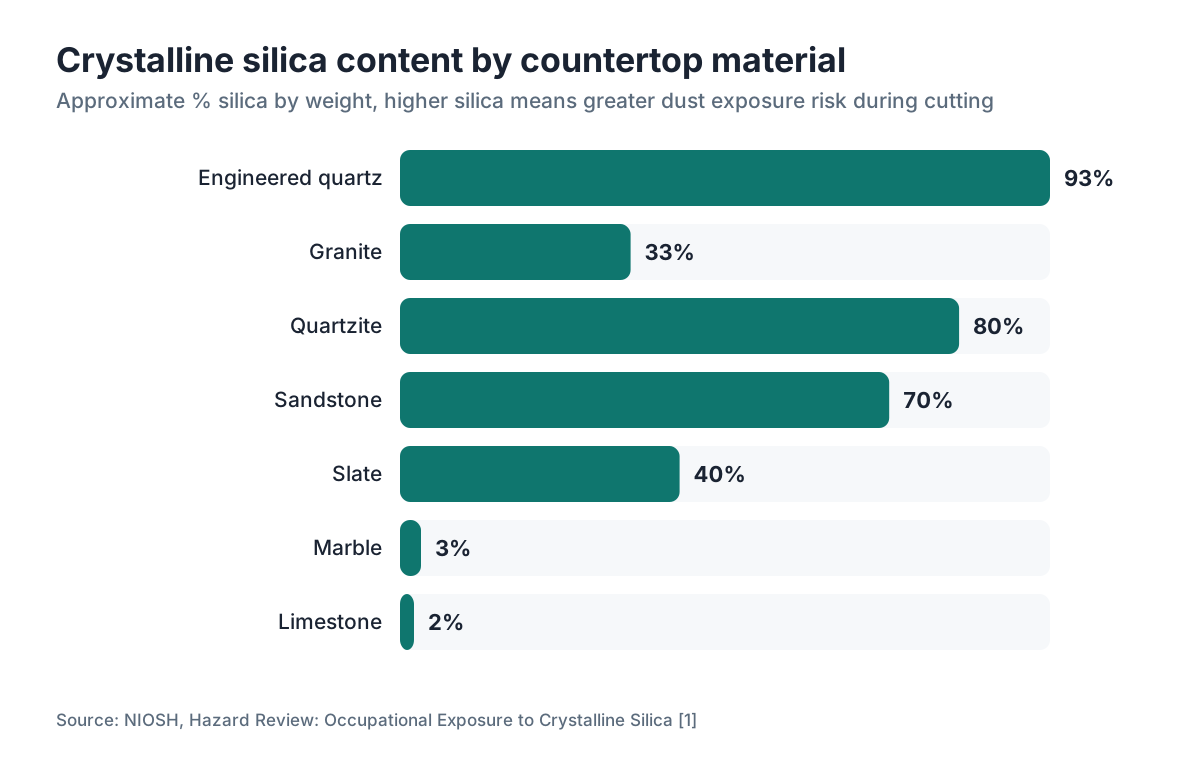
- Engineered quartz is the highest-risk material, sometimes 90-95% silica by weight.
Why is ventilation so critical in a stone fabrication shop?
Stone dust kills people slowly. The fine particles you release cutting, grinding, or polishing granite, marble, quartzite, or engineered quartz carry crystalline silica, mostly the quartz form. Particles small enough to reach the deepest airways, called respirable crystalline silica (RCS), cause silicosis, a scarring lung disease that does not reverse and sometimes kills. There is no cure. No safe threshold has been established below which risk drops to zero, so regulators set enforceable limits based on what is feasible to achieve.
Engineered quartz surfaces can run 90-95% crystalline silica by weight [1]. Natural granite usually sits at 20-45%. Marble is mostly calcium carbonate and carries little silica. A 2019 CDC report in MMWR documented 18 silicosis cases among engineered-stone countertop fabricators in California, Texas, and Colorado, including deaths in workers under 40 [2]. Several had less than 10 years on the job. This is happening now, to young workers.
Ventilation is the main engineering control that keeps airborne RCS under the legal limit. Skip it, and dry-cutting a single slab can push dust hundreds of times past the OSHA limit inside a few minutes.
What does OSHA actually require for silica in fabrication shops?
OSHA's general industry silica standard, 29 CFR 1910.1053, took full effect June 23, 2018 [3]. Two numbers drive everything. The permissible exposure limit (PEL) is 0.05 mg/m³ as an 8-hour time-weighted average (TWA). The action level (AL) is 0.025 mg/m³ as an 8-hour TWA.
Hit the action level and you trigger air monitoring, medical surveillance, and a written exposure control plan. Hit the PEL and full engineering controls stop being optional.
OSHA does not hand you a system to buy. The standard says you reach the limit with feasible engineering and work-practice controls first, then add respirators only if those controls can't finish the job [3]. So your ventilation has to actually work, and you prove it works with air monitoring.
The standard also demands a written exposure control plan. It has to list every task that exposes workers to silica, the controls used for each, and a named competent person who runs the plan. OSHA includes a Table 1 of specified control methods for common tasks, and stone countertop fabrication is on it. Follow the Table 1 controls exactly and you get a presumption of compliance with no individual air monitoring, which is the single biggest shortcut a small shop can take [3].
California runs its own program. Cal/OSHA operates under a state plan and has adopted standards at least as protective as federal OSHA, and several other state-plan states have matched or exceeded the federal rule [4].
What are the OSHA Table 1 ventilation controls for countertop fabrication?
Table 1 (Appendix B to 1910.1053) pairs specific tasks with the controls that create a presumption of compliance. For stone countertop work, the relevant operations and controls look like this:
| Task | Required Engineering Control | Required Respiratory Protection |
|---|---|---|
| Handheld grinder, dry | LEV system (shroud + vacuum, ≥ 25 cfm at blade) | Half-face or full-face respirator with P100 filter |
| Handheld grinder, wet | Continuous water delivery suppressing dust | None required if fully wet |
| Stationary wet saw | Continuous water delivery at blade | None required |
| Stationary dry saw | LEV at blade + enclosure | Powered air-purifying respirator (PAPR) or supplied air |
| Angle grinder, polisher | LEV with shroud capturing ≥ 90% at source | Half-face P100 or better |
| CNC equipment | Full enclosure preferred, or LEV at tool head | Varies by enclosure effectiveness |
For vacuum-based LEV, Table 1 turns on airflow at the point of capture, usually stated as a flow rate at the shroud inlet. OSHA's guidance calls for a HEPA-filtered vacuum, not a shop vac, because standard shop vacs blow fine particles straight back into the room [3].
Can't meet a Table 1 control for a task? Then you monitor the air and fall back to the full performance standard, the 0.05 mg/m³ PEL. Dry hand-grinding without water is the toughest operation to tame, and it usually needs LEV, general exhaust, and a respirator all at once.
What is local exhaust ventilation and how should it be set up at each tool?
Local exhaust ventilation (LEV) grabs dust at the source before it spreads into the room. It is the most effective single engineering control in a stone shop. General dilution ventilation, which just pushes clean air through the building to thin out contaminants, cannot control the peak silica spikes from cutting. You need capture at the tool.
An LEV system has four parts: a hood or shroud on the tool, ductwork to the air mover, a HEPA-filtered collection unit, and an exhaust outlet (or recirculation if the filter is certified for submicron particles). The shroud has to hug the blade or wheel. Leave a gap of an inch or two and capture efficiency falls off a cliff, because air velocity drops with the square of the distance from the source.
Handheld angle grinders need the vacuum to pull at least the flow the tool maker or Table 1 specifies, often 25-60 cfm depending on blade diameter. A standard shop vacuum can't do it. Those units lack the static pressure and the filtration. Reach for industrial HEPA vacuums built for silica, sold as H-class or Type H under the European classification manufacturers like Festool and Hilti use [5].
Bridge saws and CNC routers usually have an integrated shroud port on the tool head. Run it to a central dust collector with ductwork sized to hold 3,500-4,500 feet per minute (FPM) in horizontal runs so particles don't drop out inside the pipe. Settled stone dust in ductwork is a maintenance headache and, if you cut composite materials with organic content, a fire and explosion risk. Pure stone dust is less of a hazard there, but composites change the math.
Duct design decides whether any of this works. Every elbow, reducer, and branch eats static pressure. Undersized systems hum along sounding busy while capturing far too little. Pay a certified industrial hygienist or ventilation engineer to run the calculations before you pour concrete or pull conduit. That money comes back.
How much general exhaust ventilation does a stone shop need?
General exhaust (dilution) ventilation backs up your LEV by moving air through the building. It does three jobs: it feeds makeup air so LEV systems aren't starved, it thins out dust that slips past capture, and it keeps summer temperatures livable. It does not replace LEV.
The American Conference of Governmental Industrial Hygienists (ACGIH) publishes the Industrial Ventilation Manual, the standard design reference for occupational ventilation [6]. For dusty manufacturing spaces it generally points to 6-10 air changes per hour (ACH) as a baseline for dilution. That number never covers you during active cutting. Air changes alone are not enough while blades are spinning.
Here's a working rule. Size general exhaust so it slightly beats the combined exhaust volume of every LEV system that can run at once, then add 15-20% for infiltration. That keeps the building at slight negative pressure to outside, so dust migrates out instead of drifting into offices or clean areas. A shop at neutral or positive pressure with open doors pushes dirty air into every room next door.
Makeup air should come in on the far side of the building from the exhaust and the workers. Avoid short-circuiting, where supply air runs straight from inlet to exhaust without sweeping the work zone. Roof-mounted supply and exhaust on the same wall is a classic small-shop mistake.
Heating that makeup air in winter costs real money. Untempered cold air can freeze water-cooled saws, wreck equipment, and make the shop miserable. The standard fix is a makeup air unit (MAU) with a gas or electric heating coil. Budget $8,000 to $25,000 for a right-sized MAU in a 5,000-10,000 square foot shop, with wide swings by climate zone and utility rates.
What ventilation do CNC machines and bridge saws specifically need?
CNC routers and 5-axis machines matter most because they run unattended through long cycles. Ventilate one poorly and it can contaminate the whole shop while the operator sits in the office.
Full enclosures are the best control for CNC gear. Enclose the machine and the exhaust only has to handle the air inside the box, and the operator never stands in the dust plume. Enclosures cut noise too. Many European and Asian builders ship CNC machines with integrated enclosures, and some American shops retrofit their own. If you cut engineered stone, an enclosed CNC earns its capital cost.
Open CNC machines and wet bridge saws shift the problem. With water at the blade, the concern moves from cutting dust to aerosol mist carrying fine slurry. Wet cutting cuts airborne silica but does not erase it, because fine mist droplets evaporate in flight and leave dried silica particles hanging in the air [7]. The zone around a wet bridge saw still needs general exhaust, and floor drainage plus slurry cleanup have to keep dried slurry from becoming a fresh dust source.
A wet bridge saw needs continuous water at 0.5-1.5 GPM at the blade (confirm against your blade maker's spec), drainage that keeps slurry off floors and surfaces, and enough general exhaust that mist doesn't pool at the ceiling. Regular wet cleanup, never dry sweeping, never a compressed-air blowdown, is a required work-practice control under OSHA's standard [3].
Cutting engineered stone changes the rules again. Under Cal/OSHA's 2019 enforcement guidance, wet methods alone are not enough. Cal/OSHA required engineered stone cutting to use both water suppression and LEV at the tool, not one or the other [4].
What HEPA vacuum and dust collector specs do you need?
For silica, the vacuum you buy is the difference between control and theater. This is the most common gap OSHA finds in stone shops: workers running standard collectors or consumer shop vacs that pass fine silica right through the filter and back into breathing air.
Hand tools need an H-class (or equivalent) HEPA vacuum. The European standard EN 60335-2-69 defines classes L, M, and H. Class H requires the whole system, vacuum plus filter together, to reach 99.995% total separation efficiency at the most penetrating particle size [5]. That is the right class for carcinogenic or silica-bearing dust. Check the certification, not the marketing language on the box.
Central dust collection for multiple tools or CNC machines has to be sized to the combined airflow of everything running at once (or the realistic subset, if not all tools fire together). Filter cartridges or bags have to be rated for submicron particles. Many shops run cartridge collectors with filters rated at 1 micron or finer. Respirable silica lives at 0.5-10 microns, so a 5-micron filter lets a big slice of the dangerous range through.
Pulse-jet cartridge collectors are popular because they knock dust off the cartridge automatically and hold airflow steady. Manual shake-out collectors force you to stop the system to clean filters, and some shops skip that. Whatever you run, measure and log the pressure drop across the filters. A clogged filter starves airflow and kills your LEV.
When you shop for a collector, ask for the measured efficiency at 0.3-1.0 micron under loaded conditions. Manufacturers love publishing peak-clean numbers. What matters is how the filter performs once it's dirty and in service.
What respiratory protection is still required even with good ventilation?
Engineering controls are the foundation. Respirators sit on top of them. OSHA requires respiratory protection where Table 1 specifies it, or where air monitoring shows exposures above the PEL despite your controls [3].
For dry grinding with an LEV-equipped tool, Table 1 sets a floor of a half-face respirator with P100 filters. P100 filters are rated at 99.97% efficiency for oil and non-oil aerosols. Dry cutting without an enclosure moves you up to a powered air-purifying respirator (PAPR) or supplied-air respirator.
Respirators have to be NIOSH-approved [8]. Tight-fitting facepieces need annual fit-testing. Medical evaluation comes first for any respirator that adds breathing resistance, which means everything except a loose-fitting PAPR hood. A physician or other licensed health care professional reviews a medical questionnaire and clears the worker before assignment.
Disposable N95s are not adequate for silica in high-exposure cutting tasks. They may work for lower-exposure jobs like cleanup, but do not lean on an N95 as your main control for cutting or grinding.
A respirator is a backup, not a substitute for ventilation. Workers forget them, don them wrong, or have facial hair that breaks the seal. Ventilation keeps working on bad days. Budget for both.
How do you monitor air quality to know if your ventilation is working?
Air monitoring is how you prove the controls work, or catch that they don't. OSHA requires it whenever exposures may reach the action level (0.025 mg/m³), or when you can't ride on Table 1 compliance [3].
Personal air sampling is the standard method. A certified industrial hygienist (CIH) clips a sample pump and cassette in the worker's breathing zone, usually at the lapel. The pump runs a full shift or a representative slice of it. A lab then analyzes the cassette using NIOSH Method 7500 or 7602 for crystalline silica, by X-ray powder diffraction or infrared spectroscopy [9]. Results come back in mg/m³ as a TWA.
For a first assessment, sample your highest-exposure jobs first: hand grinders, CNC operators running engineered stone, and saw operators. If the worst-exposed workers land below the action level, the lighter-exposure roles almost certainly do too.
Real-time monitors like the TSI DustTrak flag when and where peak exposures happen during a shift, but they read total aerosol mass, not RCS specifically. Use them to tune your process and troubleshoot ventilation. They don't replace NIOSH-method lab analysis for compliance.
OSHA requires reassessment after any change in production, process, or controls. A new material, say a higher-silica engineered stone from a new supplier, can force fresh sampling. New layout, new equipment, new LEV: all of it warrants follow-up monitoring to confirm the change actually cut exposures.
What does a compliant ventilation system cost to install and maintain?
Costs swing hard with shop size, existing infrastructure, and what equipment you pick. These ranges reflect industry equipment pricing across 2024-2025, not a single authoritative study, so treat them as ballpark.
| Component | Typical Cost Range |
|---|---|
| H-class HEPA vacuum (per hand tool station) | $800 to $2,500 |
| Central cartridge dust collector (5,000-10,000 sq ft shop) | $4,000 to $15,000 |
| LEV ductwork design and installation | $5,000 to $20,000 |
| Makeup air unit (MAU) with heating | $8,000 to $30,000 |
| CNC enclosure (retrofit) | $10,000 to $40,000 |
| Professional industrial hygienist air survey | $1,500 to $5,000 |
| OSHA compliance plan development | $500 to $3,000 (with consultant) |
Ongoing costs stack up: filter replacement, equipment maintenance, monitoring reassessments (roughly every 6 months if exposures sit between AL and PEL, or annually if below AL), medical surveillance for enrolled workers (OSHA makes the employer pay), and respirator fit-testing.
Compliance costs real money. Non-compliance costs more. OSHA silica citations run up to $16,131 per serious violation as of 2024 [10]. Repeat or willful violations reach $161,323 per instance. Those numbers look small next to the workers' comp claims and civil suits that silicosis cases produce, some ending in multi-million dollar verdicts.
If you run the numbers side of a shop, track ventilation maintenance and compliance spending in your job costing. Software like SlabWise can fold that overhead into your quotes so compliance doesn't quietly eat your margin.
Are there special rules for shops cutting engineered stone or quartz surfaces?
Yes, and this is where enforcement has ramped up hardest since 2019. Federal OSHA's silica standard covers all crystalline silica exposure regardless of material [3]. But Cal/OSHA and a stack of researchers have singled out engineered stone as uniquely dangerous.
A 2021 study in the American Journal of Respiratory and Critical Care Medicine found accelerated silicosis in young engineered stone countertop workers, some developing disease within 2-3 years of exposure [11]. That progression far outpaces what natural stone historically caused.
Australia banned engineered stone products outright in July 2024 [12]. The European Union hasn't banned them but has tightened exposure standards. The US has no material-specific ban, but OSHA has stepped up inspection targeting of engineered stone fabricators.
For engineered stone, the practical ventilation bar sits higher than for natural stone:
- Wet cutting alone is not enough. Cal/OSHA requires wet cutting plus LEV.
- CNC enclosures move from preferred to strongly recommended.
- Air monitoring should run more often, at least annually even below the AL.
- Medical surveillance should include baseline and annual pulmonary function tests for every exposed worker.
If you process engineered stone at any real volume, bring in an industrial hygienist who knows the current enforcement climate before you assume your natural-stone setup carries over. The silica per slab is far higher, and the exposure during a normal cutting cycle tracks that.
What work practices reduce silica exposure alongside ventilation?
Ventilation works better with disciplined work practices behind it. These are required elements under OSHA 1910.1053, not nice-to-haves.
Never dry-sweep or blow down stone dust with compressed air. Both throw settled dust back into the air and can spike concentrations to brutal levels from surface dust that wasn't airborne a second earlier. Wet mopping, wet sweeping, or an H-class vacuum are the required methods.
Run a housekeeping schedule. Stone dust piles up on flat surfaces, ledges, beam flanges, and above-ceiling panels. Clean rarely and you get periodic high exposures every time that dust gets disturbed. Daily wet cleaning of cutting areas plus weekly full-shop cleaning is a fair baseline.
Keep non-essential people out of cutting areas during active work. Your bookkeeper, delivery drivers, and visitors should not walk through while slabs are being cut. Draw the boundaries and hold them.
Rotate workers where you can to lower individual TWA exposures. Someone who cuts for 4 hours and installs or finishes for 4 hours carries a lower TWA than a worker cutting 8 hours straight. Documented rotation schedules also help support the TWA math.
Wet down slabs and the surrounding floor before work starts. That suppresses surface dust that would otherwise lift off with foot traffic and air movement. Slabs pulled from outdoor storage are usually dirtier than they look.
Homeowners visiting shops to pick slabs should know this too. The granite countertops or marble countertops in the yard may have been cut in shops with very different air quality. If you're spending real time in a cutting area, ask about ventilation.
Frequently asked questions
Can I just use a regular shop vacuum for silica dust in a stone shop?
No. Standard shop vacuums aren't rated for silica and recirculate fine respirable particles back into the air. OSHA's silica standard requires HEPA-filtered vacuums with enough filtration efficiency for carcinogenic dust. Look for H-class or equivalent vacuums meeting EN 60335-2-69 Class H, which requires 99.995% total separation efficiency for the whole system, not the filter alone.
How do I know if my current ventilation is enough to meet OSHA's silica PEL?
You need air monitoring. Hire a certified industrial hygienist to run personal breathing-zone sampling with NIOSH Method 7500 or 7602 during a representative shift. If your highest-exposure workers come back below 0.025 mg/m³, you're under the action level. Following OSHA's Table 1 controls exactly as written creates a presumption of compliance without monitoring, but only if you meet every Table 1 requirement.
Is wet cutting enough to make a stone shop safe without other ventilation?
For natural stone on a bridge saw, wet cutting cuts airborne dust dramatically and may be enough with adequate general exhaust. For engineered stone (90-95% silica), wet cutting alone is not enough. Cal/OSHA has required wet cutting plus local exhaust ventilation at the tool for engineered stone. Wet mist can also carry fine particles that dry and go airborne near the saw.
What air changes per hour does a stone fabrication shop need?
The ACGIH Industrial Ventilation Manual points to 6-10 air changes per hour for dilution in dusty manufacturing spaces. But air changes alone can't control peak silica exposures during active cutting. You need local exhaust ventilation at every cutting and grinding tool on top of general dilution. More air changes help, but they never substitute for source capture.
Do I need a professional to design my ventilation system, or can I do it myself?
For anything past a single-tool setup, professional design pays for itself. Duct sizing, static pressure math, and capture velocity verification take engineering judgment. Get it wrong and you build a system that looks installed but misses Table 1 requirements. An industrial ventilation engineer or certified industrial hygienist can design it and verify it with airflow readings. Expect $2,000-$8,000 for design work depending on shop complexity.
What is the OSHA fine for silica violations in a stone shop?
As of 2024, OSHA's maximum penalty for a serious violation is $16,131 per violation. Willful or repeat violations reach $161,323 per instance. OSHA has actively cited stone countertop fabricators under 29 CFR 1910.1053 since the standard took full effect in 2018. Penalties compound fast when multiple workers are exposed or when a shop fails to monitor, provide respirators, and train employees.
Do small stone shops with just one or two employees have to comply with OSHA's silica standard?
Yes. OSHA's general industry silica standard (29 CFR 1910.1053) applies to every employer covered by the OSH Act, regardless of size. There is no small-business exemption for the PEL or the engineering control requirements. Self-employed people with no employees fall outside OSHA jurisdiction in most states, though state-plan states may cover more. The health risk doesn't shrink with headcount.
What is the difference between LEV and general exhaust ventilation, and do I need both?
Local exhaust ventilation (LEV) captures dust at the tool, where it's generated. General exhaust dilutes contaminants across the room by moving air. You need both. LEV is the primary control because dilution can't handle the peak concentrations from cutting. General exhaust supplies makeup air for LEV, thins what escapes capture, and keeps conditions workable. Running only general exhaust in a stone shop is a compliance failure.
How often does air monitoring need to happen in a stone fabrication shop?
OSHA requires monitoring at least every 6 months if exposures land between the action level (0.025 mg/m³) and the PEL (0.05 mg/m³). Above the PEL, monitor quarterly and add controls. If two consecutive samples at least 7 days apart both fall below the action level, you can stop routine monitoring. Major changes in materials, processes, or equipment force new baseline monitoring regardless of past results.
What should stone shop workers know about silicosis symptoms?
Silicosis symptoms include shortness of breath, a persistent cough, fatigue, and chest pain. Chronic silicosis can surface 10-30 years after first exposure. Accelerated silicosis can appear within 5-10 years, and acute silicosis in as little as a few months under very high exposures. Workers cutting engineered stone face higher risk of faster disease. Medical surveillance under 1910.1053 includes baseline and periodic chest X-rays and lung function testing.
Does ventilation for a stone shop differ when the shop also cuts ceramic or porcelain tile?
Ceramic and porcelain tile carry silica, often 15-40% by weight, less than engineered quartz but still a hazard. OSHA's silica standard applies to any material generating respirable crystalline silica, so the same LEV and wet-cutting rules apply. Mixed-use shops cutting both stone and tile should not assume tile is low-risk. Air monitoring confirms the actual exposures for your specific materials and processes.
Can a stone shop use respirators instead of installing ventilation to save money?
No. OSHA's hierarchy of controls requires engineering controls (ventilation, wet methods, enclosures) as the primary way to cut exposure. Respiratory protection goes on top of engineering controls, not in place of them. An employer can't swap a respirator program for feasible engineering controls. OSHA inspectors look for exactly this shortcut and cite it as a serious violation.
What records does a stone shop need to keep for OSHA silica compliance?
Required records include air monitoring results (kept 30 years), medical surveillance records (kept 30 years), the written exposure control plan (reviewed and updated annually or after process changes), training records (kept 3 years), and objective data if used in place of monitoring. The 30-year retention exists because silicosis and silica-related cancers can take decades to appear.
Sources
- NIOSH, Hazard Review: Occupational Exposure to Crystalline Silica: Engineered stone countertop materials contain 90-95% crystalline silica by weight, compared to 20-45% for natural granite
- CDC MMWR, Silicosis Mortality, Prevention, and Control, United States, 1968 to 2002 and follow-up investigation reports on engineered stone fabricators, 2019: CDC MMWR reported 18 cases of silicosis among engineered-stone countertop fabricators in California, Texas, and Colorado as of 2019, including deaths in workers under 40
- OSHA, 29 CFR 1910.1053 Respirable Crystalline Silica Standard for General Industry: OSHA's PEL for respirable crystalline silica is 0.05 mg/m³ as an 8-hour TWA; action level is 0.025 mg/m³; Table 1 provides specified exposure control methods for stone countertop fabrication
- California Department of Industrial Relations, Cal/OSHA Crystalline Silica and Engineered Stone Enforcement Guidance: Cal/OSHA has required that engineered stone cutting use both water suppression and local exhaust ventilation at the tool, more than one control method
- IEC / European Standard EN 60335-2-69, Particular Requirements for Wet and Dry Vacuum Cleaners Including Power Brush, Industrial Classification for Dust Hazard Classes: Class H vacuums under EN 60335-2-69 must achieve 99.995% total separation efficiency for the most penetrating particle size; this class is appropriate for carcinogenic or silica-containing dust
- American Conference of Governmental Industrial Hygienists (ACGIH), Industrial Ventilation: A Manual of Recommended Practice for Design, 30th Edition: ACGIH recommends a minimum of 6-10 air changes per hour for general dilution ventilation in dusty manufacturing environments; this supplements but does not replace local exhaust at high-emission tools
- NIOSH, Controlling Silica Exposures in Construction and General Industry: Wet-cutting reduces but does not eliminate airborne silica because fine mist droplets can evaporate in transit, leaving dried silica particles in the air
- NIOSH, NIOSH-Approved Respirators and Certification: Respirators used for silica protection must be NIOSH-approved; P100 filters are rated at 99.97% efficiency for both oil and non-oil aerosols
- NIOSH Manual of Analytical Methods (NMAM), Methods 7500 and 7602 for Crystalline Silica Analysis: NIOSH Methods 7500 (XRD) and 7602 (FTIR) are the standard laboratory methods for quantifying crystalline silica in personal breathing-zone air samples
- OSHA, Penalties, Federal OSHA Maximum Penalties: As of 2024, OSHA's maximum penalty for a serious violation is $16,131; willful or repeat violations can reach $161,323 per instance
- American Journal of Respiratory and Critical Care Medicine, Accelerated Silicosis in Engineered Stone Countertop Workers, 2021: A 2021 study in AJRCCM found accelerated silicosis in young engineered stone countertop workers, with some cases developing within 2-3 years of exposure
Last updated 2026-07-11