TL;DR
- Leathered finish is a surface treatment applied to granite (and some other stones) after the slab is cut.
- Diamond-tipped brushes abrade the polished or honed face to close the pores slightly while leaving a soft, matte texture with low sheen.
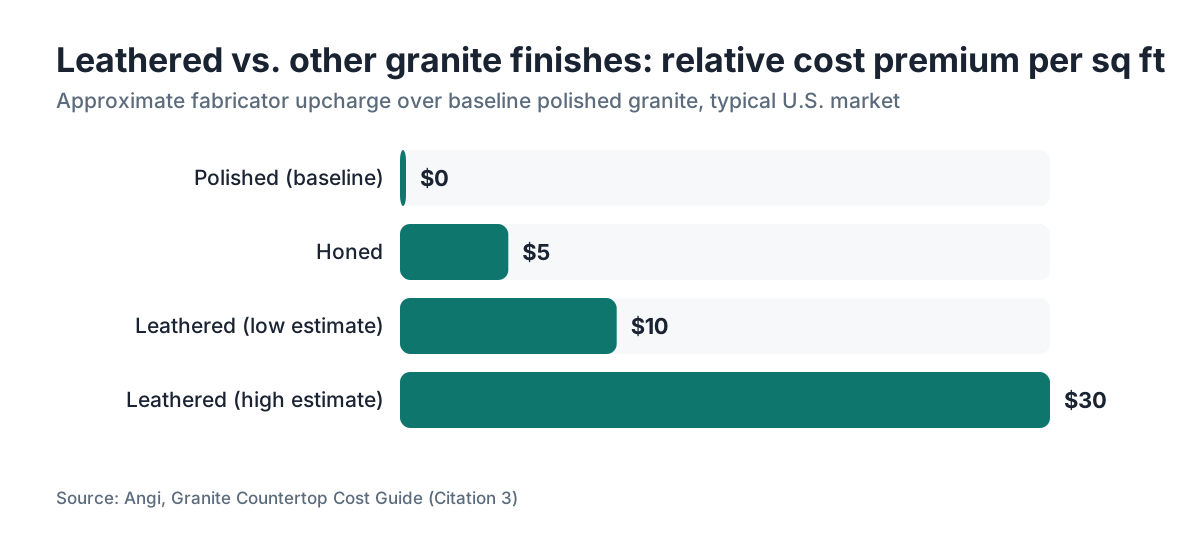
- It hides fingerprints better than polished granite, costs roughly $10 to $30 per square foot more than a standard polish, and looks best on darker, coarse-grained stones.
What does leathered finish mean on granite?
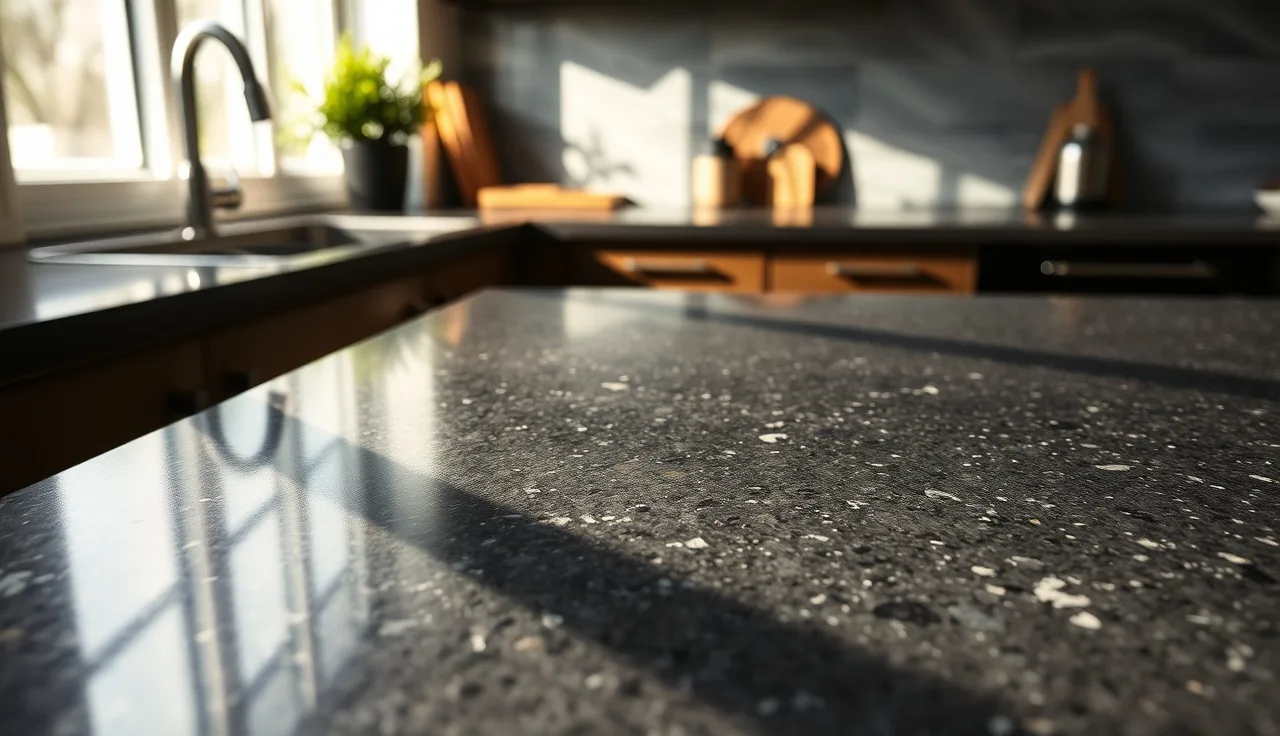
Leathered finish gives granite a soft, matte texture instead of the mirror shine of polished stone. The surface has a gentle undulation, almost like thick leather grain, which is where the name comes from. It's not rough like flamed or sandblasted stone. It's not dead flat like a honed finish either. It sits between the two.
Here's the part most people miss. Leathering partially closes the natural pores in the granite while keeping the topographic character of the crystals. Polishing flattens and fills those microscopic peaks and valleys with a glassy film. Honing grinds the surface flat but leaves it open and matte. Leathering does something else: the brushing compresses and smooths the surface just enough to create a consistent sheen without going reflective [1].
The result looks more like a stone you'd find in the landscape than a manufactured slab. Colors run slightly deeper than a honed finish because the closed pores scatter less light, though they never reach the saturated depth of a full polish. Touch the back side of a piece of slate and you have a rough idea of the feel, though leathered granite is a lot smoother than that.
Fabricators and importers sometimes use "brushed" and "leathered" as if they mean the same thing. Some shops draw a line: brushed is a lighter pass that leaves more texture, leathered is a more refined result. In practice the terms overlap. Ask for a physical sample rather than trusting the label.
How is the leathered finish actually created?
The process starts after the slab is cut to size and shaped. Most fabricators begin with a honed or partially polished slab, then run it under a machine fitted with rotating diamond-tipped brushes [1]. The brushes follow a grit sequence, usually moving from coarse (around 60 to 120 grit) to fine (400 to 800 grit), though the exact steps vary by shop and by stone.
The machine drags the brushes across the surface under controlled pressure with water cooling. The water keeps the stone from heating up and carries away the slurry of ground stone. Each pass removes a tiny amount of material. The effect is cumulative. More passes with finer brushes give you a smoother, more refined surface. Fewer passes with coarser brushes leave more texture and a flatter matte look.
Some fabricators run this on a CNC bridge table with brush attachments. Others use a dedicated flatbed polisher with brush heads. Smaller shops sometimes do a partial version by hand with angle grinders and diamond brush pads, though hand work rarely matches machine consistency across a full slab. Ask specifically whether your leathering is machine-done or hand-finished before you sign a quote.
After brushing, the surface gets rinsed clean and dries completely before any sealer goes on. Because leathering closes the pores somewhat, the stone drinks less sealer. Some fabricators argue that very dense leathered granites (Absolute Black, some Blue Bahia) barely need sealing at all. That's stone-specific. Run a water absorption test before you decide to skip the sealer.
Which granite types work best with a leathered finish?
Not every granite takes leathering well. The finish looks best on stones with larger crystal structures and high mineral contrast, because the brushing brings out the dimensional character of those crystals. Dark, coarse-grained granites like Absolute Black, Blue Bahia, Volga Blue, and Ubatuba are the most common picks [2].
Lighter granites can be leathered, but the result reads softer. The texture is subtler on white or light gray stone, and the color-deepening effect shrinks. It doesn't look bad. You just get more of the tactile, low-sheen benefit than the visual depth.
Quartzite, soapstone, and some limestones take a leathered finish well too. Marble can be leathered, but the softer mineralogy means the surface still etches from acids no matter the finish. Thinking about leathered marble? Read up on how to clean stone countertops first so there are no surprises.
Engineered stone is a different animal. Some quartz brands (Cambria, Silestone) sell a "leathered" or "textured" surface, but no diamond brush touches it. Those surfaces get molded or embossed during manufacturing. The look is close, but the behavior differs because you're dealing with a resin-bound composite. Cambria countertops offers textured lines if you want that look without natural stone.
The worst candidates are very fine-grained, uniform granites. They tend to leather into a flat, slightly dull surface with none of the topographic variation that makes the finish worth doing.
How does leathered granite compare to polished and honed finishes?
Here's a straight comparison across the things that actually matter day to day.
| Characteristic | Polished | Honed | Leathered |
|---|---|---|---|
| Sheen level | High gloss, mirror-like | Flat matte | Low satin, soft sheen |
| Fingerprint visibility | High | Moderate | Low |
| Scratch visibility | Low (gloss hides light scratches) | High (scratches dull surface) | Moderate |
| Sealing frequency needed | Every 1-3 years typical | Every 1-2 years (more porous) | Every 1-3 years, stone-dependent |
| Color saturation | Deepest | Lighter, washed-out look | Moderate depth |
| Texture feel | Smooth, glassy | Smooth, slightly chalky | Slightly tactile, velvety |
| Fabrication cost premium | Baseline | Low or no premium | $10-$30/sq ft premium typical [3] |
| Maintenance difficulty | Easy to wipe | Shows water spots more | Texture traps debris slightly |
The honest read: polished is the easiest to keep clean, because the glassy surface wipes off with a damp cloth and forgives sloppy technique. Honed looks sophisticated but shows water rings and grease more than people expect. Leathered hides fingerprints and casual smudges, which is why busy kitchens love it, but the texture catches crumbs and fine grit. You need a slightly damp cloth, not a dry one, to pull debris out of the micro-texture.
For resale, polished is still what most buyers expect. Renovating to sell? Polished is the safer bet. Leathered is a design statement that some buyers love and others don't even recognize. That's not a reason to avoid it. Just know the context.
Does leathered granite need sealing?
Yes, most leathered granite still needs sealing, and how often comes down to the specific stone. Leathering closes some surface pores compared to a honed finish, so the stone is slightly less porous after brushing. But granite's natural porosity ranges enormously from one stone to the next [4].
The reliable check is the water absorption test. Pour a few tablespoons of water on the dry, clean surface and time how long it takes to soak in and darken the stone. Absorbs in under 4 minutes? Seal it. Beads for 30 minutes or more? You can skip or delay. Most light and medium granites land in the "seal it" camp no matter the finish. The Natural Stone Institute treats this timed water test as the standard field method for deciding whether a stone needs sealing [7].
Dense dark granites like Absolute Black run close to non-porous and may need sealing every few years, or never. Blue Bahia and some black granites have very low absorption. Test anyway rather than assuming.
Use a penetrating (impregnating) sealer on leathered granite. A topical sealer would sit on the surface and fill in the texture, which defeats the whole point. Look for a water-based or solvent-based impregnating sealer rated for granite. The Marble Institute of America's care guidance recommends testing any sealer on an inconspicuous spot before doing the full surface [5].
Re-sealing runs about the same as polished granite of the same stone, roughly every one to three years for a typical kitchen. Heavy cooking zones with oils and acidic foods want more frequent attention.
How much does leathered granite cost compared to polished?
Expect to pay $10 to $30 per square foot more for a leathered finish over the same slab in polished [3]. The range is wide for three reasons: whether your fabricator owns brushing equipment or outsources the step, how dense the stone is (denser stone takes longer to brush), and your region.
Some fabricators fold the leathering into the slab price when they do it in-house all the time. Others list it as a line item. Ask outright, because a quote that reads "granite countertop installed" may or may not include the finish you talked about. Comparing bids? Make sure the finish type is written on every one.
The slab itself can cost more in leathered too, because leathered slabs are less common in distributor inventory and the finishing adds time at the yard or fab shop. Exotic stones like Volga Blue or Blue Bahia already run high on material alone ($70 to $150 per square foot in some markets), so the finishing premium is proportionally smaller.
A typical 50-square-foot kitchen adds roughly $500 to $1,500 for leathering. That's real money. It's also a one-time cost on a surface that should outlast your ownership of the house. If you're gathering multiple bids, SlabWise's instant quote tool lets you compare fabricator pricing with the finish type specified, so you're not guessing whether the leathering is baked in.
Installation costs the same as polished. The leathering happens at the shop before the slab reaches your home, so there's no on-site premium for countertop installation.
What are the pros and cons of leathered granite in a kitchen?
The best argument for leathered granite is fingerprint and smudge resistance. Polished dark granite shows every touch, every water splash, every greasy handprint. The leathered texture diffuses light instead of reflecting it, so those marks just don't register the same way. In a kitchen with kids or heavy use, that's a big deal.
The texture also reads more natural and less manufactured. Some people find polished granite too formal or too shiny for the look they want. Leathered stone feels more relaxed. It pairs well with matte cabinets, unlacquered brass, and other surfaces that show their nature.
The downside is debris. Crumbs, spice dust, and fine particles settle into the micro-texture and don't wipe off as easily as they would from glass-smooth polish. You need a damp cloth, not a dry swipe. If someone in the house habitually does a quick dry wipe to clean up, they'll find leathered frustrating.
Acid etching is still a concern if your stone has calcite veining, or if you've gone with leathered marble or limestone. Granite itself resists acid, so for pure granite the etch risk is low. The finish doesn't change the mineralogy underneath.
Repairs are harder. If a leathered section chips, matching the exact texture and sheen of the surrounding surface is tough. A polished repair on a leathered top will jump out at you. That's a reason to buy from a fabricator with documented leathered experience who can explain, in plain terms, how they'd handle a repair.
Can any fabricator do leathered finish, or is it specialized?
Most established granite fabricators can do leathered finish, but quality varies a lot. The process needs either diamond brush tooling on a CNC machine or a flatbed polisher with brush heads. Shops that run high volumes of natural stone are more likely to own the equipment and to have dialed in the brush sequences for different stones.
Smaller shops sometimes offer hand-leathering with angle grinders and diamond cup brushes. It can look good in skilled hands. It's also slower and harder to keep consistent across a large slab. Ask to see samples of their leathered work on a similar stone before you commit.
Questions worth asking: What grit sequence do you use? Do you start from honed or polished? Can I see a sample of this exact stone in leathered finish? What's your plan if there's a chip or repair down the line? A fabricator who answers those specifically is more trustworthy than one who just says "yeah, we can do that."
If you're a fabricator thinking about adding leathering, the tooling cost is meaningful. Diamond bush hammer plates and diamond brush pads for angle grinders start around $50 to $150 each. Professional machine brush heads for flatbed polishers run considerably more. The Marble Institute of America publishes technical resources on stone finishing that help with speccing the right tooling [5].
How do you clean and maintain leathered granite countertops?
Daily cleaning is simple: warm water and a few drops of pH-neutral dish soap on a soft cloth or microfiber. Keep the cloth slightly damp, not soaking. The dampness lifts debris out of the texture in a way a dry cloth can't. Rinse with a clean damp cloth and dry with a soft towel to head off water spots, especially with hard water.
Skip anything acidic (vinegar, lemon juice, most bathroom cleaners) and anything abrasive (scrub pads, powdered cleaners). Acidic cleaners won't etch pure granite the way they etch marble, but they degrade sealers over time and can affect any calcium carbonate veining. Abrasives wear the texture unevenly.
For stubborn messes, a stone-safe degreaser diluted in water works. Give it a minute or two to break up grease before wiping. The rule for leathered granite matches every natural stone surface covered in how to clean stone countertops: gentle, pH-neutral, no bleach, no ammonia.
Re-sealing is the other job. Run the water absorption test from the sealing section every year or two and re-seal when absorption picks up. Penetrating sealers go on with a soft cloth, sit for 5 to 15 minutes per the product instructions, then get wiped off before they cure on the surface. Never let sealer puddle and dry.
The texture itself is durable. Normal cooking, cutting boards, and moderate pot heat won't change it. But setting a very hot pan (above 300 degrees F) directly on any stone, over and over, is a bad habit for any countertop, polished or leathered.
Is leathered finish available on materials other than granite?
Yes. The same diamond-brush process runs on quartzite, soapstone, marble, travertine, and some limestones. Each stone responds differently.
Quartzite takes leathering very well and is a popular granite alternative for people who want a marble look with better durability. The hard mineralogy brushes cleanly and holds the texture. Comparing options? Granite countertops and marble countertops both have finish considerations worth reading alongside this piece.
Soapstone is already a matte, low-sheen stone, so leathering it changes less than it does on granite. Some fabricators don't bother offering leathered soapstone because the stone's natural character already does most of what leathering would. Cleaning soapstone is its own task regardless of finish, and how to clean soapstone countertops covers it.
Marble can be leathered, but understand this: the finish does not make marble acid-resistant. Marble etches because of its calcite mineralogy, not its surface texture. Leathered marble will still etch. The etch just looks a little different on matte than on polished. Some people find it less noticeable. It's still there.
Engineered quartz (Cambria, Silestone) is not leathered by brushing. Those brands make textured surfaces during manufacturing. A stone fabricator can't retroactively leather a quartz slab the way they can natural stone.
Does leathered granite affect resale value or buyer perception?
Good data here is thin. No large-scale study measures leathered granite's specific effect on home resale value. The closest evidence is general appraisal guidance, which treats granite countertops as a positive kitchen feature but doesn't value finish type separately in most frameworks [6].
In practice, agents report that most buyers recognize polished granite on sight as a premium material, while leathered granite sometimes goes unnoticed or gets mistaken for a lower-grade stone by buyers unfamiliar with the finish. That's a buyer-education gap, not a quality problem. It's still real.
Renovating mainly to sell? Polished granite or a mainstream engineered quartz is the safer play for broad appeal. Renovating for yourself and planning to stay? Leathered granite is a legitimate choice, and plenty of owners stay happy with it for years.
The premium you pay for leathering ($500 to $1,500 on a typical kitchen) is unlikely to come back dollar-for-dollar at sale. Polished rarely returns its full cost either. Countertops get valued for what they add to the overall kitchen impression, not as line items on an appraisal.
Frequently asked questions
Can you change polished granite to leathered finish after it's already installed?
Yes, but it's hard and expensive. A fabricator or stone restoration company can run diamond brush pads over an installed surface with hand tools or specialized machines, but getting a consistent result across a full kitchen without pulling the slab is tough. Edges, corners, and areas near walls are especially hard to reach evenly. Most pros recommend leathering at the shop before installation instead of retrofitting on-site.
Is leathered granite harder to keep clean than polished?
It depends on the mess. Fingerprints, water spots, and light smudges are easier to manage on leathered granite because the texture diffuses light and hides them. But crumbs and fine particles settle into the texture and need a damp cloth rather than a dry wipe to clear fully. Most people find the overall maintenance comparable to polished, just different in character.
Does leathered granite stain more easily than polished?
Leathered granite is slightly more porous than polished granite of the same stone, because polishing creates a denser surface layer. In theory it can absorb staining agents a bit more readily if unsealed. In practice the difference is small for properly sealed stone. Apply a penetrating sealer after installation and re-test annually. Dense stones like Absolute Black are so non-porous that the porosity gap between finishes barely matters.
How long does the leathering process take at a fab shop?
For a typical kitchen set of pieces (40 to 60 square feet), machine leathering on a CNC flatbed usually takes one to three hours of machine time, plus drying and sealing. Hand leathering takes longer and is more variable. It happens before installation, so it doesn't affect your timeline unless the fabricator has to order brush tooling for your specific stone.
What grit brushes are used to create a leathered finish?
Most fabricators run a sequence of diamond-tipped brush wheels starting around 60 to 120 grit for initial texture, then progressing to 400 or 800 grit for refinement. Coarser sequences leave more pronounced texture; finer sequences give a smoother, satin-like result. The exact sequence varies by shop and stone density. Ask your fabricator for their process if consistency matters to you.
Is leathered finish the same as brushed finish on granite?
The two terms often get used interchangeably in the trade, but some fabricators draw a line. Brushed usually means a lighter pass that leaves more visible texture and a rougher feel. Leathered means a finer, more refined result with a softer sheen. Both use the same diamond brush tooling; the difference is grit sequence and number of passes. Always ask for a physical sample rather than trusting the label.
Does leathered granite require a special sealer?
No special sealer, but use a penetrating (impregnating) sealer rather than a topical or coating type. Topical sealers sit on top and fill in the texture, partly killing the leathered look. Penetrating sealers soak into the stone without changing the surface character. Look for a product rated for granite and follow the manufacturer's dwell-time instructions carefully.
Can leathered finish be applied to quartzite or marble?
Yes. The diamond-brush process works on quartzite, marble, soapstone, travertine, and some limestones. Quartzite is a strong candidate because its hardness produces clean, consistent results. Marble can be leathered but stays acid-sensitive regardless of finish, so etching from vinegar, lemon juice, or acidic cleaners is still a risk. The finish changes the surface texture, not the mineralogy of the stone.
How much does it cost to have granite leathered?
Most fabricators charge $10 to $30 per square foot more for leathered finish over the same stone in polished. For a 50-square-foot kitchen, that's roughly $500 to $1,500 added to the project. The range depends on whether the fabricator does the work in-house or outsources it, the density of the specific stone (denser stones take longer to brush), and regional labor rates.
Will a leathered finish hide scratches better than a polished finish?
Partially. The matte, textured surface diffuses light, so light scratches are less visible than on polished granite, which reflects light directionally and makes scratches catch the eye. That said, deep scratches show on any finish, and the leathered texture can make deep-scratch repair more noticeable because matching the texture exactly is difficult. For everyday kitchen use, neither finish scratches easily.
Is leathered granite a good choice for outdoor kitchens?
Generally yes, with caveats. Granite is durable outdoors, and the leathered finish holds up well to UV and weather since there's no topical coating to fade or peel. The non-slip texture is a practical bonus in wet outdoor settings. Use a sealer rated for exterior use and plan to re-seal more often, roughly annually, because sun, rain, and temperature cycling break down sealers faster than indoor conditions.
Does leathered granite look different in different lighting conditions?
Yes, and that's one of its better qualities. Under direct light, the texture throws subtle shadows that make the stone look dimensional. Under low or indirect light, it reads as a rich, deep matte surface. Polished granite can look cold or harsh under bright task lighting because of its reflectivity. Leathered granite holds up across a wider range of lighting, which is part of why it works in kitchens with mixed light sources.
How do I tell if a granite slab is already leathered at the stone yard?
Run your fingers across the surface. A leathered slab has a perceptible texture, soft but not rough, with a slight undulation that follows the crystal structure. The surface has a low, satin sheen rather than a mirror reflection. Polished slabs feel completely smooth and reflect your image. Honed slabs feel smooth and flat but show no sheen. If you're unsure, ask the yard, and look at the surface at a low angle in raking light.
Sources
- Marble Institute of America, Stone Finishes Technical Bulletin: Diamond-tipped brushes are used in a grit sequence to create leathered and brushed finishes on natural stone surfaces
- Natural Stone Institute, Natural Stone Reference Manual: Dark, coarse-grained granites such as Absolute Black and Volga Blue are among the most commonly specified stones for leathered finish
- Angi, Granite Countertop Cost Guide: Leathered finish typically adds $10 to $30 per square foot to the cost of granite countertops compared to standard polished finish
- U.S. Geological Survey, Mineral Commodity Summaries (Dimension Stone): Granite varies widely in physical properties including porosity depending on its mineral composition and origin
- Marble Institute of America, Care and Cleaning for Natural Stone Surfaces: Penetrating (impregnating) sealers are recommended for granite, and sealers should be tested on an inconspicuous area first
- Appraisal Institute, The Appraisal of Real Estate 15th Edition: Granite countertops are treated as a kitchen amenity in appraisal methodology; finish type is not separately valued in standard appraisal frameworks
- Natural Stone Institute, Sealing Natural Stone Best Practices: The timed water absorption test is the standard field method for determining whether natural stone surfaces need sealing
- ASTM International, ASTM C503 Standard Specification for Marble Dimension Stone: ASTM standards define surface finish classifications for dimension stone including polished, honed, and other finish types
- National Kitchen and Bath Association, Kitchen and Bathroom Planning Guidelines: Countertop material and finish selection is identified as a primary design decision in kitchen planning guidelines
Last updated 2026-07-11