TL;DR
- Leathered granite needs a diamond angle grinder or CNC router for cutting, a wet polisher with leather-finish brushes (frankfurt or drum style), a vacuum lifter for handling, and standard edge tooling.
- The leathering step adds roughly 20 to 40 minutes per slab, running brushes at 2,000 to 3,500 RPM with continuous water.
- Budget $800 to $2,500 in dedicated leathering tools on top of a normal granite kit.
What is leathered granite and why does it need different tools?
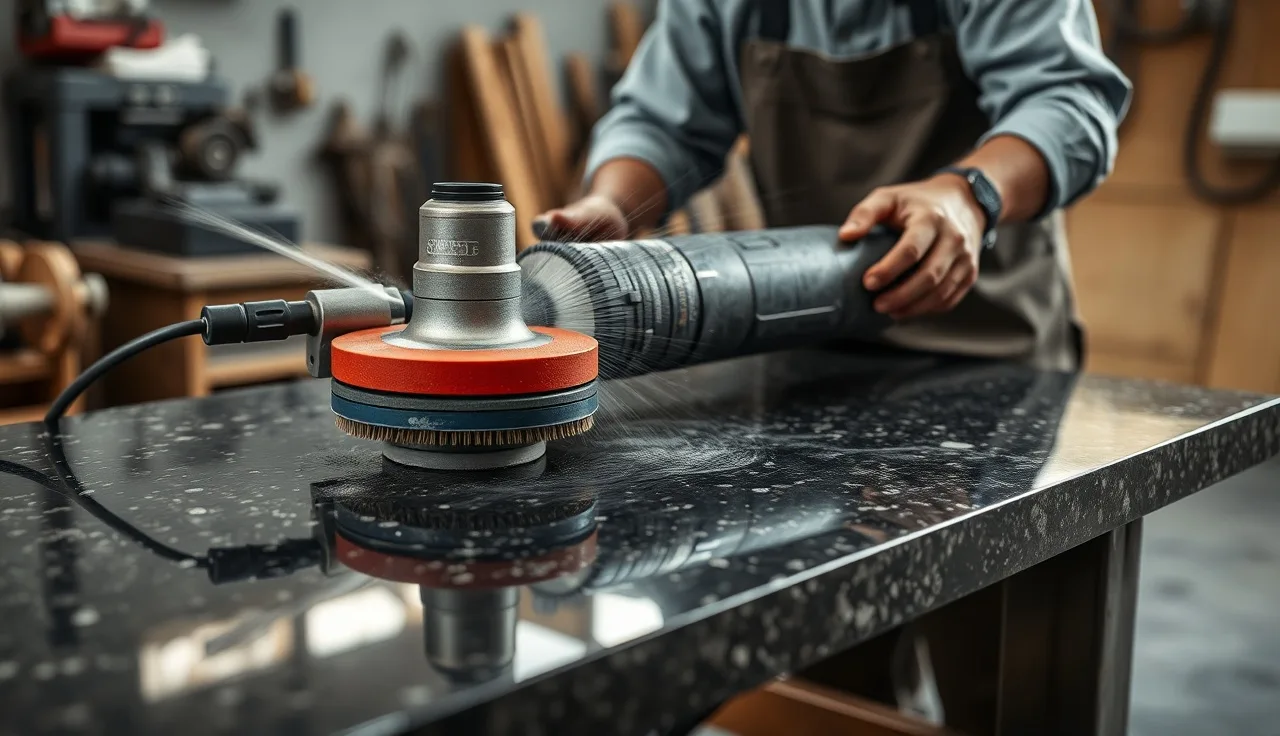
Leathered granite is granite worked with abrasive diamond brushes to open the stone's natural texture, leaving a matte, slightly bumpy surface that looks and feels like leather. It is not honed. Honed is flat and smooth. The leathered finish keeps the stone's natural peaks and fissures while stripping the high shine off a polished slab.
That texture is the whole point, and it is also the tooling problem. Standard polishing pads meant for a mirror finish are too aggressive and too flat. They grind down the peaks you are trying to keep. What you need instead is a diamond bush hammer or a frankfurt-style diamond brush. Both abrade the surface selectively, knocking off loose crystalline material without flattening the topography.
So yes: leathered granite shares maybe 70% of its tooling with standard granite fabrication. The cut-out tools, the bridge saw, the vacuum lifter, the edge router are all the same. What changes is the surface finishing step. If you already run a granite shop, your added cost is just the brushing heads and maybe a dedicated wet grinder. Starting from zero, expect $8,000 to $30,000 and up on a full shop setup before leathering tooling even enters the picture.
Homeowners reading this to understand what their fabricator is doing, here is the short version. Leathered granite takes longer to finish than polished because the brushing pass is extra work. A shop that quotes the same price for leathered and polished on identical slabs is either very efficient or cutting a corner somewhere.
What cutting tools do you use for leathered granite?
Cutting leathered granite is identical to any other granite job. The finish you apply later has zero effect on how you cut the slab. That part of the workflow does not change at all.
The standard options are:
Bridge saw with a diamond blade. This is the workhorse of granite shops. A 14-inch or 16-inch wet-cut diamond blade on a bridge saw handles straight cuts cleanly. Blade quality matters a lot. A cheap turbo blade rated for general masonry will chip granite badly. You want a continuous-rim or segmented blade built for granite, with a bond hardness matched to the abrasive index of the stone. Blades run $40 to $200 for standard options and $200 to $600 for premium sintered blades from brands like Tenax, Alpha, or Goldenstar [1].
CNC router or waterjet. For complex shapes, cutouts, and precise sink openings, CNC is the standard. Waterjet leaves no heat in the stone, which matters for certain granites with thermal stress sensitivity. CNC routers run diamond router bits, not blades, and those bits wear down based on granite hardness. Expect to replace bits every 150 to 400 linear feet of cutting depending on the granite's silica content [2].
Angle grinder with a diamond blade. For plunge cuts and field cuts, a 4.5-inch or 5-inch angle grinder fitted with a dry-cut or wet-cut diamond blade works fine. This is not a precision tool. Use it to remove material quickly, not for finished edges.
For granite countertops fabrication generally, a bridge saw plus an angle grinder for detail work covers most shops.
What are the leather-finish brushes and how do they work?
These are the tools that actually create the leathered finish. There are two common formats, plus a bush hammer for heavier texture.
Frankfurt-style diamond brushes. These are rectangular abrasive blocks, about 4 inches by 2 inches, that mount in a holder on a wet polisher or automated brush machine. They use diamond abrasives bonded in a nylon or resin matrix, and they flex slightly, which lets them follow the stone's natural surface variation instead of grinding it flat. Frankfurt brushes come in grit steps from about 36 or 46 grit (very aggressive, for initial texturing) up through 120 or 220 grit (for smoothing the leathered surface to the texture you want). Most fabricators run two to four grit steps across the slab [3].
A set of Frankfurt brushes for a 6-head or 8-head machine runs $300 to $800 depending on brand and grit range. Brands common in North American shops include Alpha Professional Tools, Stadea, and Weha.
Drum-style or cup-style diamond brushes. These mount on a standard 5/8-11 angle grinder spindle and handle hand-finishing on specific areas or smaller jobs where running a full machine makes no sense. Same mechanism, more operator control over specific spots. A single drum brush runs $35 to $120.
Bush hammer plates. A bush hammer is a different animal. Instead of flexible abrasive fibers, it uses a plate studded with pointed or pyramid-shaped diamond teeth that hammer the surface rapidly, creating a rougher, heavier texture than a leather brush. Some fabricators run a light bush hammer pass first, then follow with brushes to soften the finish. Bush hammer plates for angle grinders cost $80 to $250 [4].
The machine you mount these on matters. You need a variable-speed wet polisher that runs at 2,000 to 3,500 RPM with water fed to the surface. A dry grinder will not do; heat destroys both the brushes and the stone's surface. A quality variable-speed wet polisher from Flex, Metabo, or Makita runs $300 to $600 new.
What RPM and water flow settings should you use for leathering?
Run brushes at 2,000 to 3,500 RPM with continuous water, aiming for around 2,500 RPM on most granite. Too fast and you generate heat that glazes the abrasive and can micro-crack the surface. Too slow and the brush skips and chatters, leaving uneven texture. Water has to flow the whole pass, not drip.
Most diamond brush makers spec 2,000 to 3,500 RPM for Frankfurt-style brushes on granite [3]. Start at the low end with a new set because fresh brushes cut more aggressively until they seat in. Then dial up once you see how the stone responds.
Water flow should be continuous. A drip is not enough. You want water running across the full brush contact area throughout the pass. On a handheld machine, that usually means a water swivel on the grinder spindle plus a pump or gravity feed from a bucket. On a CNC or automated lapping machine, water feeds through the spindle. Minimum useful flow is around 0.5 liters per minute per brush head; some shops run 1 to 2 liters per minute.
Pass speed matters too. Move too fast and texturing comes out incomplete; too slow and you over-abrade. On a manual pass, a slow, consistent walk across the slab at roughly 6 to 10 inches per second is a reasonable start. Adjust based on how the surface looks after the first grit step.
On automated gear like a CNC with brushing heads, these parameters live in the G-code or the machine controller. If your shop runs quoting and job tracking software (SlabWise is one option fabricators use for job parameters and material costs), log your brush settings per granite variety and reuse them instead of re-experimenting every job.
What edge profiling tools do you need?
Edge tools for leathered granite are the same as for any granite: profile wheels on a router, curved diamond pads for hand work, and polishing pads if you want a polished edge. The choice worth making early is the profile itself. Leathered slabs usually pair best with a simple edge, an eased, a slight bevel, or a gentle bullnose. A heavily ornate ogee edge can look disconnected from the raw-textured face.
For edge profiling, the tools are:
Router bits (profile wheels). A CNC router or hand router with a diamond-tipped profile wheel shapes the edge. Common profiles like an eased edge or a 1/4-inch bevel take one or two tool passes. A full bullnose needs multiple passes and a round-over bit. Profile wheel sets for granite cost $80 to $400 per profile depending on shank size and quality [5].
Angle grinder with profile pads. For hand work, a sequence of curved diamond pads in 50, 100, 200, 400, and 800 grit shapes and smooths the edge. Slower than CNC, but an experienced fabricator gets good control.
Edge polishing pads. If you want the edge polished (a common choice, because a polished edge against a leathered face reads as a nice contrast), run the edge through a standard granite polish sequence up to 1500 or 3000 grit. If you want the edge leathered to match the face, you need a flexible drum brush or a curved Frankfurt adapter for the edge, which adds time.
Edge tooling is where a lot of the per-job cost variation lives. A simple eased edge takes 10 to 15 minutes per linear foot by hand; a CNC does it in 2 to 4 minutes.
What material handling tools are required?
You need a vacuum lifter, an A-frame cart, handheld suction cups, and a padded work table. Granite is heavy and fragile at the same time. A 3cm slab runs about 18 to 20 pounds per square foot [6]. A typical kitchen job runs 40 to 70 square feet, so you are moving 700 to 1,400 pounds. Drop it wrong and you have a very expensive pile of rubble.
The handling tools worth owning:
Vacuum lifter. A vacuum lifter grabs the slab face with suction cups so one or two people can move slabs without gripping the edges. Electric vacuum lifters with a battery backup are safer than pneumatic-only models because a power failure does not drop the slab. A quality shop vacuum lifter costs $3,000 to $8,000 new. Aardwolf and Grabo make widely-used options [7].
A-frame slab cart or dolly. Store and move stone vertically on an A-frame, not flat. Flat storage invites cracking. A padded steel A-frame transport cart costs $400 to $1,500.
Suction cup hand lifters. For repositioning a slab on the bench or during templating and install, handheld suction cups in pairs let two people move a slab safely. A good pair rated for 400-plus pounds costs $80 to $200.
Padded workbench or slab table. The fabrication table needs a padded or rubberized surface so the slab face does not scratch during processing. Rubber matting or foam slab pads do the job.
For countertop installation, the same suction cups and a slab dolly go on-site.
What templating tools do you need before fabrication starts?
Templating is the measurement and layout step before any cutting. Two approaches: physical templating with luan, cardboard, and a jigsaw, or digital templating with a laser system like the Proliner. A bad template means a slab cut to the wrong size, and there is no fixing granite once it is cut short.
Physical templating uses strips of luan plywood, cardboard, or dedicated template stock to trace the exact countertop footprint including all walls, appliances, and cutouts. Template material plus a jigsaw and a tape measure is the whole kit. Total tool cost: $100 to $300.
Digital templating uses a laser system to capture measurements and generate a CAD file that feeds straight into a CNC. The Proliner by Prodim is the most widely used system in North American granite shops. A new Proliner runs $15,000 to $25,000 [8]. It pays for itself in reduced waste and fewer error callbacks for shops doing 10 or more jobs per week.
For shops doing occasional leathered granite inside a mixed workflow, physical templating with careful measuring works fine. High-volume shops should buy the digital system.
What safety equipment is required for granite fabrication?
Granite fabrication throws off silica dust, which causes silicosis, an irreversible and sometimes fatal lung disease. OSHA set the permissible exposure limit for respirable crystalline silica at 50 micrograms per cubic meter of air as an 8-hour time-weighted average, effective for construction in 2017 [9]. Stone countertop fabrication falls under OSHA's general industry standard, 29 CFR 1910.1053.
OSHA's rule requires employers, in the agency's own words, to "protect workers from exposure to respirable crystalline silica" and to use engineering controls before relying on respirators [9].
In practice:
Wet cutting at all times. Wet cutting suppresses silica dust at the source. Running a dry blade on granite in an enclosed space is both illegal and dangerous. Do not do it.
Local exhaust ventilation. A vacuum dust shroud on grinders and routers captures dust before it goes airborne. A shop vacuum with a HEPA filter rated for fine dust handles what the shroud grabs.
Respirators. When engineering controls alone fall short, a NIOSH-approved P100 or N95 respirator is required. A half-face respirator with P100 cartridges is the practical minimum for grinding and edge work.
Eye and hearing protection. Safety glasses or a face shield, plus earmuffs or earplugs for all power tool work. Diamond grinders run 90 to 100 dB, well above OSHA's 85 dB action level [10].
Anti-vibration gloves. Long stretches on angle grinders can cause hand-arm vibration syndrome. Anti-vibration gloves cut the risk but do not remove it.
How much does the tooling for leathered granite cost in total?
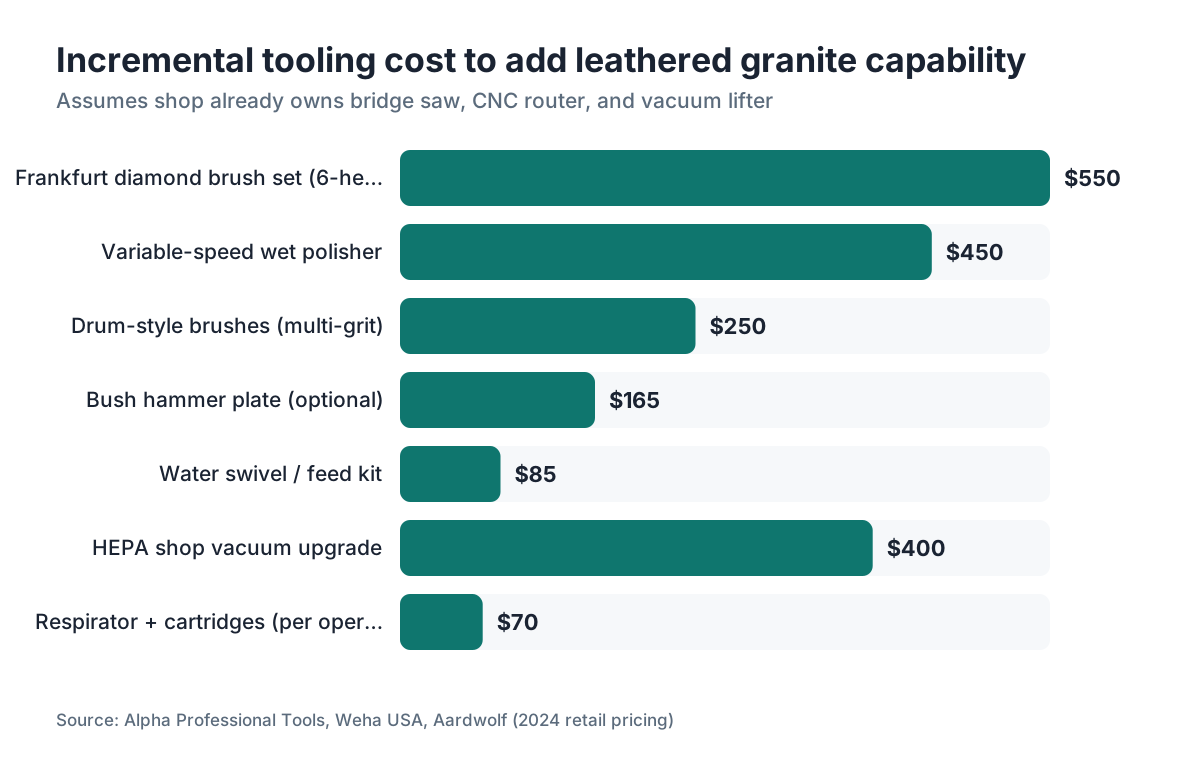
For a shop that already owns a bridge saw, CNC router, and handling gear, adding leathered finish capability costs roughly $1,070 to $2,870 in new tooling. Here is the breakdown.
| Tool | Cost Range | Notes |
|---|---|---|
| Frankfurt diamond brush set (6 heads) | $300-$800 | Alpha, Stadea, Weha |
| Variable-speed wet polisher (dedicated) | $300-$600 | Flex, Metabo, Makita |
| Drum-style diamond brushes (hand use) | $100-$400 | Multiple grits |
| Bush hammer plate (optional) | $80-$250 | For heavier texturing |
| Water swivel / water feed kit | $50-$120 | For handheld machine |
| HEPA shop vacuum upgrade | $200-$600 | If not already owned |
| Respirator + cartridges (per operator) | $40-$100 | OSHA required |
| Total incremental cost | $1,070-$2,870 |
Building a granite shop from scratch is a different number entirely. The full kit including a bridge saw ($15,000 to $60,000), CNC router ($40,000 to $150,000), vacuum lifter ($3,000 to $8,000), and all finishing tooling runs $80,000 to $250,000 [11]. Most shops start with a bridge saw and hand tools, then add CNC as volume justifies it.
For fabricators tracking job-level tool costs and material waste, software like SlabWise lets you set up leathered granite as its own job type with its own time and tooling overhead, so quotes reflect real cost instead of an average.
What are common mistakes fabricators make when leathering granite?
The finish is not hard to produce, but a handful of mistakes show up over and over in shops new to it. Skipped grit steps, dry brushing, and inconsistent hand speed cause most of the bad results.
Skipping grit steps. Jumping from 46 grit straight to 120 grit leaves scratch patterns from the coarse grit that the finer grit cannot fully clear. Run every step. It adds time, but skipping shows in the finished surface.
Insufficient water. Running the brush too dry heats the diamonds, glazes the bond, and kills brush life. It can also thermally shock certain granites. Keep the water flowing.
Inconsistent speed or pressure. On a handheld machine, operator fatigue causes speed variation, which leaves lighter and darker texture bands across the slab. Automated machines fix this; for hand work, stop and rest before you start rushing.
Not testing on offcuts first. Every granite reacts a little differently to the brushing sequence. A dense, fine-grained granite like Absolute Black leathers very differently than a coarse-grained Colonial White. Run your planned sequence on a scrap from the same slab before you touch the finished material.
Leathering after edge work. Do the leathering pass on the slab face before you profile the edges. The other way around risks damaging finished edges with the brush machine.
Wrong sealer. Leathered granite has more surface area than polished granite because of the texture. It drinks sealer faster and needs more product to reach the same depth. Use a penetrating impregnating sealer rated for porous stone, not a topical coating. See how to clean stone countertops for more on sealers and maintenance.
Can you leather granite by hand without a machine?
Technically yes. Practically it is brutal. Hand texturing a full slab with a drum brush on an angle grinder takes 3 to 6 hours of physical labor versus 20 to 40 minutes on a multi-head brushing machine. Consistency over a large area is also much harder to hold.
For small jobs, a single sink cutout, a bar top under 15 square feet, a sample piece, hand leathering with a cup or drum brush on a 5-inch variable-speed grinder is totally reasonable. Plenty of fabricators hand-finish edges and seams this way even when the face was machine-processed.
For a full kitchen at 50-plus square feet, get the right machine. Renting is an option. Some tool rental companies and stone distributors rent wet polishers with brush-head capability. Expect $150 to $400 per day for a capable machine. Do more than two or three leathered jobs a year and owning the equipment makes more financial sense.
Leathered granite gets compared to other specialty stone surfaces too. If your client is weighing options, marble countertops and granite countertops both take a leathered finish, though marble leathers much faster given its lower hardness.
What tools do you use for sealing leathered granite after fabrication?
Sealing is the last shop step before install, and it needs almost no power tools. A microfiber applicator pad or low-nap roller, a timer, and clean dry rags for buffing off excess. That is the kit. What changes with leathered stone is the sealer and the number of coats, because the texture exposes more surface area per square foot than a polished face.
Use a penetrating impregnating sealer, silicone-based or fluoropolymer-based, made for natural stone. Topical sealers sit on the surface and look shiny, which defeats the whole point of a leathered finish. A stone impregnator soaks into the pores and leaves the surface appearance alone.
Application on leathered granite: flood the surface with sealer, let it dwell 10 to 15 minutes (check the manufacturer spec), then wipe off all excess before it dries. Leathered stone often needs a second coat because the first absorbs faster than it would on polished stone. Check absorption by dripping water on the surface; if it soaks in within 5 minutes, apply a second coat.
The water test doubles as a quality check you can show the client. Water beading on the finished surface before install proves the sealer took.
Frequently asked questions
Do I need a CNC machine to fabricate leathered granite?
No. A bridge saw and angle grinder handle cutting for most jobs. A CNC router speeds up edge profiling and complex cutouts, and an automated multi-head brushing machine makes the leathering pass faster and more consistent, but neither is required. Many small shops do excellent leathered granite work with a bridge saw, a quality wet polisher, and good diamond brushes. CNC makes sense when volume justifies the $40,000 to $150,000 investment.
What grit sequence do diamond brushes use for leathering granite?
Most fabricators run three to four grit steps: starting at 36 or 46 grit for initial texturing, then 60 or 80 grit, then 120 grit to smooth the peaks. Some finishes call for a final 220-grit pass for a slightly finer leather texture. The coarser you stop, the rougher and more matte the finish. Skip any step and you risk visible scratch patterns in the final surface.
How long does it take to leather a granite slab?
On a multi-head automated brushing machine, expect 20 to 40 minutes per slab, depending on granite hardness and how many grit steps you run. On a handheld wet grinder with a drum brush, the same slab takes 3 to 6 hours of labor. Time also climbs for harder granites with higher silica content, like Bianco Antico or Kashmir White, versus softer varieties.
What is the difference between leathered and honed granite, and do they use different tools?
Honed granite is ground to a flat, smooth, matte finish using polishing pads stopped before the final polishing stage, typically at 400 to 800 grit. Leathered granite uses diamond brushes that follow the stone's natural surface variation, leaving texture. Different tools: honed uses standard flat polishing pads, leathered uses Frankfurt-style or drum-style flexible diamond brushes. A honed surface is easier to tool but harder to keep clean than leathered.
Are there specific diamond brush brands fabricators prefer for leathering?
In North American shops, Alpha Professional Tools, Weha, and Stadea come up consistently for Frankfurt-style brushes. Tenax and Tyrolit are common in shops with European equipment. Brand choice matters less than buying brushes with the right bond hardness for your granite's abrasive index. A brush bond too hard for soft granite will glaze quickly; too soft for hard granite wears out fast.
Can a homeowner leather granite themselves, or is it always a professional job?
Technically possible for a small piece, like a sample or a bathroom vanity top. You would need a rented variable-speed wet grinder, a drum brush kit in multiple grits, water feed, and proper silica dust controls including wet cutting and a P100 respirator. For a full kitchen, it is a professional job. The risk of uneven texture across a large slab, plus the silica exposure hazard, makes DIY a bad idea on anything over a few square feet.
What safety regulations apply to granite fabrication shops?
OSHA's crystalline silica standard, 29 CFR 1910.1053 for general industry, sets a permissible exposure limit of 50 micrograms per cubic meter as an 8-hour time-weighted average. Shops must use engineering controls first (wet cutting, local exhaust ventilation), provide medical surveillance for exposed workers, and maintain an exposure control plan. OSHA maximum penalties for serious violations reached $16,131 per violation in 2024 under the agency's annual inflation adjustment.
Does leathered granite require a different sealer than polished granite?
Same type of sealer, penetrating impregnating, not topical. The difference is quantity and application: leathered granite absorbs sealer faster and more completely than polished, so you will likely need two coats instead of one. Do the water bead test after sealing to confirm coverage. A sealer that leaves the surface appearing shiny is the wrong product; it will look out of place on a leathered finish and may peel.
What is a bush hammer and when would you use it on granite?
A bush hammer uses a plate studded with pyramid-shaped diamond teeth that impact the stone rapidly, creating a rougher, more heavily textured finish than brushes alone. Some fabricators run a light bush hammer pass first on very dense granite to open the surface, then follow with diamond brushes to control the final texture level. Bush hammer plates for angle grinders cost $80 to $250 and are optional, not required, for standard leathering.
How much more does leathered granite fabrication cost compared to polished?
Fabricator pricing for a leathered finish typically adds $5 to $15 per square foot over polished on labor alone, reflecting the extra brushing time and tooling wear. For a 50-square-foot kitchen that is $250 to $750 in added fabrication cost before any slab price difference. Some fabricators charge a flat per-slab upcharge. The slab itself is usually the same price; the leathered finish is applied in the shop, not at the quarry.
What kind of workbench or table do you need for leathering?
A rigid, flat fabrication table with a padded or rubber-coated surface that keeps the slab face from scratching during the brushing pass. The table needs to be stable enough that the slab does not shift when you pass the grinder across it. Many shops use a steel-frame table with rubber matting or foam pads. The surface should clean easily because the slurry from wet brushing is messy and mildly abrasive.
Can all granite varieties be leathered, or are some unsuitable?
Most granite varieties leather well. Very fine-grained, dense granites like Absolute Black and Nero Impala leather cleanly with a subtle texture. Coarser granites with larger crystals show more dramatic surface variation. The problem granites are those with internal voids, loose inclusions, or pre-existing cracks; the brushing pass can dislodge material and enlarge defects. Always inspect the slab before committing to a leathered finish on questionable material.
What is the role of a water swivel in handheld leathering work?
A water swivel is a fitting that attaches between the angle grinder spindle and the brush head, feeding water through the center of the tool directly to the abrasive contact area. Without it, you have to manually direct water from a separate hose while operating the grinder, which is awkward and often leads to running dry in spots. A water swivel costs $50 to $120 and makes handheld wet leathering far more practical.
Sources
- Alpha Professional Tools, Diamond Blade Product Guide: Diamond blades for granite fabrication range from $40 for entry-level turbo blades to $600 for premium sintered blades; blade bond hardness must match granite abrasive index.
- Stone World Magazine, CNC Routing in Stone Fabrication: CNC diamond router bits for granite typically last 150-400 linear feet per bit depending on silica content of the stone.
- Weha USA, Frankfurt Diamond Brush Technical Specifications: Frankfurt-style diamond brushes for granite leathering are specified for use at 2,000-3,500 RPM with continuous water feed; grit sequences commonly run 46 through 120 or 220 grit.
- Alpha Professional Tools, Bush Hammer Plate Product Listings: Diamond bush hammer plates for angle grinders retail at $80-$250 depending on tooth pattern and diameter.
- Tenax USA, Diamond Profile Wheels for Stone: Diamond router profile wheels for granite edge profiling cost $80-$400 per profile depending on shank diameter and bond quality.
- Natural Stone Institute, Dimensional Stone Design Manual: 3cm granite slab weighs approximately 18-20 pounds per square foot.
- Aardwolf Material Handling, Vacuum Lifter Product Range: Electric vacuum lifters for stone slab handling cost $3,000-$8,000 new for shop-grade models.
- OSHA, Respirable Crystalline Silica Standard (29 CFR 1910.1053): OSHA's permissible exposure limit for respirable crystalline silica is 50 micrograms per cubic meter as an 8-hour time-weighted average; employers must use engineering controls first before relying on respiratory protection.
- OSHA, Occupational Noise Exposure Standard (29 CFR 1910.95): OSHA's noise action level is 85 dB as an 8-hour TWA; diamond angle grinders operate at 90-100 dB, requiring hearing protection.
- Stone World Magazine, Shop Equipment Costs and CNC Pricing Survey: Bridge saws for granite fabrication cost $15,000-$60,000 new; CNC routers cost $40,000-$150,000 new for stone-capable machines.
Last updated 2026-07-11