TL;DR
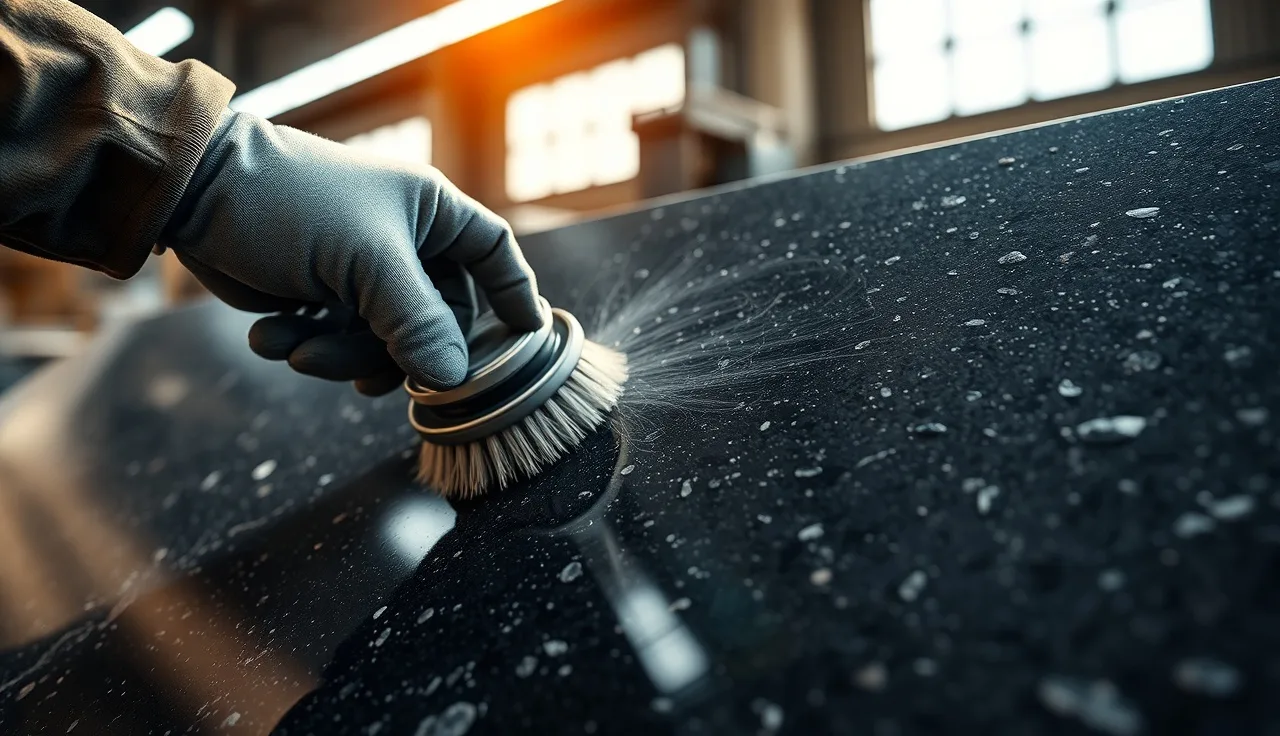
- Leathering granite means running diamond-tipped brushes across a polished or honed surface to close pores and build a matte, tactile finish.
- In a shop, you start around 50-grit brushes and step up through 200-grit, keeping the surface wet the whole time.
- Brush time runs 15 to 45 minutes per slab depending on granite hardness and whether you go by hand or by machine.
What exactly is a leathered granite finish?
Leathered granite has a low-sheen, slightly textured surface that looks closer to the raw stone than a mirror polish does. It is not honed (honed is flat and matte). It is not polished (polished is reflective and glassy). Leathered sits in between. The crystal peaks stay slightly raised, the micro-pits in softer minerals get brushed open or closed depending on the stone, and the whole surface takes on a soft, skin-like feel when you run your hand across it.
The finish came out of Brazilian fabrication tradition, where it is called "leather" or "escovado" (brushed). It caught on in the U.S. market in the early 2010s as a premium upgrade over standard polished slabs. Most distributors now carry some slabs pre-leathered, but plenty of fabricators do it in-house from polished stock, and that is what this article covers.
Not every granite takes the finish the same way. Coarse-grained granites with big feldspar crystals (like Blue Bahia or Absolute Black) show dramatic texture differences between crystal faces. Fine-grained granites end up with a subtler effect. Very soft stones like soapstone or marble can be leathered too, but the process differs enough that this guide sticks to granite. For granite countertops, this finish change affects both the look and the daily maintenance expectations you set with your client.
What tools and equipment do you need to leather granite?
The core tool is a set of diamond-impregnated brushes, sometimes called Frankfurt-style brushes or antique brushes. They mount in a standard Frankfurt holder (the same holder used for polishing pads) and come in grits from around 36 up to 400 or higher. For leathering, most shops use the 50, 100, and 200 range, sometimes adding a 400 finish pass if the client wants a smoother leather rather than a rougher one.
You run these brushes with either:
- An angle grinder with a Frankfurt adapter (hand work, good for edges or small pieces)
- A single-head floor polisher or hand-held planetary machine (for full slabs, faster)
- A CNC bridge saw or polishing machine with a brush spindle (best throughput for shops with volume)
Brush diameter matters. Standard Frankfurt brushes are 140 mm. Some systems use 110 mm or 160 mm brushes depending on the spindle. Check your machine's spindle specs before ordering brushes. Running the wrong diameter can damage the holder or give you inconsistent pressure.
Water supply is not optional. Leathering throws off fine silica dust, and wet grinding is the primary way you keep it out of your lungs. OSHA's silica rule (29 CFR 1926.1153 for construction, and 29 CFR 1910.1053 for general industry) requires engineering controls that hold worker exposure to respirable crystalline silica below 50 micrograms per cubic meter as an 8-hour TWA [1]. A continuous water drip on the brush, plus vacuum extraction when water is not practical, is the accepted engineering control for stone grinding operations. Dry leathering granite without any dust control is not a defensible shop practice.
Other supplies you will need: a shop apron and face shield (the brushes throw water and grit), PPE rated for silica dust if you do any dry passes, and a stone-safe cleaner to degrease the surface before you start.
What grit sequence should you use to leather granite?
Start coarser than you think you need to. The brushes are removing the polished surface and building texture, not lightly scuffing it. A 50-grit diamond brush opens the surface and sets the character of the finish. Skip this step and your leather finish ends up looking like a slightly dingy polish instead of a real texture change.
Here is the sequence most shops use, starting from a factory-polished slab:
| Step | Brush grit | Purpose | Passes |
|---|---|---|---|
| 1 | 50 or 60 | Break the polish, open texture | 2-3 passes |
| 2 | 100 or 120 | Refine the scratch pattern | 2 passes |
| 3 | 200 | Smooth the peaks, close micro-pits | 1-2 passes |
| 4 | 400 (optional) | Very smooth leather, less rustic feel | 1 pass |
If you are starting from a honed slab instead of a polished one, you can sometimes skip the 50-grit and start at 100. The hone already took off the reflective surface. You just need the brush texture.
Machine speed matters more than people expect. Most fabricators run diamond brushes on granite between 1,500 and 3,000 RPM. Too slow and the brushes skip rather than cut. Too fast and you generate heat even with water, which can cause thermal stress in some granites. The brush manufacturer's spec sheet will list a recommended surface speed. Match it on your machine before you touch a client's slab.
Overlap each pass by 50 percent. If you are doing this freehand with an angle grinder, lay the slab flat and work in rows, overlapping each stripe. Random orbital patterns miss spots. You will see the dull leathered area next to the still-polished area clearly under shop lighting, which makes gaps easy to catch.
How long does the leathering process take per slab?
Expect 15 to 45 minutes of brush time for a typical kitchen countertop slab, roughly 50 to 70 square feet. That range is wide because two things dominate the clock: the hardness of the granite and whether you go by hand or by machine.
Hard granites (Mohs 7 and above, which includes most black granites and many Brazilian imports) resist the brushes and take longer. Softer granites cut faster. A single-head planetary machine doing a full slab can finish in 20 minutes. An angle grinder on the same slab takes 35 to 50 minutes, and your arm will feel it.
Setup and cleanup add time: 10 minutes to clean and degrease the slab, 10 to 20 minutes to seal afterward. Call it a total of 45 to 75 minutes per slab as a shop planning number, not counting move time.
For job costing, the consumable cost of diamond brushes matters. A set of Frankfurt diamond brushes (50, 100, 200 grit) runs roughly $30 to $80 depending on brand and quality. A good set handles 300 to 600 square feet before the grit wears out, so your per-square-foot brush cost lands under $0.20 in most cases. Small number, but it adds up if you leather dozens of slabs a month. Tracking it per job is worth doing. If your shop uses quoting software, that consumable line should live in your template. SlabWise, for example, lets you add custom cost lines to job quotes so brush wear and sealer show up in your margin math instead of getting absorbed silently.
Does leathering change how porous the granite is?
Yes, and this is the piece most fabricators explain well but most homeowners don't expect. Leathering does two things to granite porosity that pull in opposite directions.
The brushing action opens the surface micro-texture, which gives liquids more physical texture to sit in and potentially soak into. At the same time, for many granites the brushing presses fine mineral particles into the smaller voids and actually closes some pores. The net result varies by stone. Some granites test as slightly more porous after leathering, some test as slightly less, and the practical difference is small either way.
What matters more is that a leathered surface is harder to seal completely, because the texture traps air during sealer application. You need a penetrating impregnating sealer, not a topical coating. Apply it with a foam applicator and work it into the surface, then wipe off the excess before it flashes dry. A quality penetrating sealer on properly leathered granite protects the surface for 3 to 5 years under normal kitchen use before reapplication, though the real interval depends on the stone's absorption rate [2].
Test the stone before you seal. The water absorption test (drop a quarter-teaspoon of water on the surface and time how long it takes to absorb) tells you whether the granite needs sealing at all. Absolute Black granite, one of the most popular candidates for leathering, is dense enough that it often needs no sealing. Applying sealer to stone that does not absorb it just leaves a hazy residue.
What can go wrong when leathering granite, and how do you fix it?
Three problems come up most: uneven texture, thermal cracking, and blotchy color.
Uneven texture happens when you skip the overlap pattern or rush the early grit stages. It shows up as shiny patches in a matte field, usually visible only in raking light. The fix is going back with the 50-grit brush and reworking the area, which sometimes means re-doing a larger section to blend the edge. Trying to feather a leathered spot into a polished spot never looks right. If the slab is already cut to size and installed, there is no good field repair for this.
Thermal cracking is rare but serious. Running brushes dry, or letting the water supply fail mid-pass on a hard granite, can heat the surface fast enough to open fissures in existing weak planes. Dark granites are more susceptible because they absorb heat faster. Keep the water flowing. Check the water line before every slab.
Blotchy color usually means the stone had silicone, adhesive, or oil contamination before you started. Degrease with a stone-safe cleaner and let it dry fully before you pick up a brush. Some shops run a water absorption test after degreasing to confirm the surface is clean. If a contaminated area still looks blotchy after leathering, you may need to grind back to bare stone and restart that section.
One more issue specific to edges: leathering a slab top and leaving a polished edge looks odd to many clients. Matching the edge texture to the leathered face means brush work with a hand-held grinder, which takes patience. Eased and straight edges are manageable. Ogee or complex profiles are hard to match convincingly, and some shops charge a separate line item for leathered edge work.
How does leathering affect granite compared to polishing or honing?
The three main granite finishes differ in look, maintenance, durability, and how well they hide daily wear. Leathered granite hides fingerprints and water spots better than polished or honed, and that is the main reason clients ask for it in kitchens.
| Finish | Sheen level | Fingerprints | Scratch visibility | Sealing | Typical upcharge |
|---|---|---|---|---|---|
| Polished | High gloss | Very visible | Low | Often needed | Base price |
| Honed | Flat matte | Moderate | Higher | Usually needed | $5-$15/sq ft |
| Leathered | Low sheen, textured | Low | Low | Varies by stone | $8-$25/sq ft |
Polished granite shows every fingerprint and water spot, especially on darker stones. Leathered granite hides both because the texture breaks up the light reflection. That is the practical reason it moves in kitchens.
Honed granite is smoother than leathered, which makes it easier to wipe down but more likely to show scratches and etching (especially on stones that contain calcite). Leathered granite's texture physically hides shallow surface scratches, because the scratch has to compete with the existing surface topography.
The durability of the stone itself does not change with the finish. You are not making the granite harder or softer. You are changing how the surface interacts with light and touch. A leathered piece of Baltic Brown granite is the same granite as a polished piece. The minerals did not change.
For clients comparing kitchen countertops finishes, the honest summary is short: polished for maximum visual drama, honed for a contemporary flat look, leathered for a warm, organic feel that hides daily use better than the other two.
Which granites work best for the leathered finish?
Coarse-grained granites with strong mineral contrast give the most dramatic leathered effect. The brushing differentiates the softer minerals from the harder ones, and when there is a big hardness gap between the crystals (feldspar vs. quartz vs. biotite mica), the texture has real depth.
Top choices for leathered results:
- Absolute Black (Zimbabwe black): dense, fine-grained, dramatic because the leather finish reads so different from the polished mirror look
- Blue Bahia: coarse grain, the blue sodalite crystals and white feldspar create strong contrast
- Typhoon Bordeaux: high mineral variety, brushing brings out the red and gold tones
- Venetian Gold: warm tones read differently leathered vs. polished
- Bianco Antico: light background, the gray and pink movement shows up well
Stones that underwhelm in a leathered finish are the very uniform, fine-grained granites where there is little mineralogical contrast. They end up looking matte-gray rather than textured. That is not a defect, just a personality mismatch.
For clients who love the leathered look but want something softer, the honest answer is that most marble countertops can be leathered similarly, but the maintenance story shifts. Marble's calcite content makes it etch-prone, and the leathered texture makes etching somewhat harder to see (which could be a selling point or a source of confusion, depending on the client).
What does it cost to have granite leathered, and what should a fabricator charge?
For homeowners buying leathered granite countertops, expect to pay $8 to $25 per square foot more than the polished equivalent for the leathering itself. On a 50-square-foot kitchen, that is $400 to $1,250 in added cost. The range is wide because some shops price it as a fixed add-on, some as a percentage of the slab cost, and some fold it into a premium slab tier where the leathered slab is priced differently from the start [3].
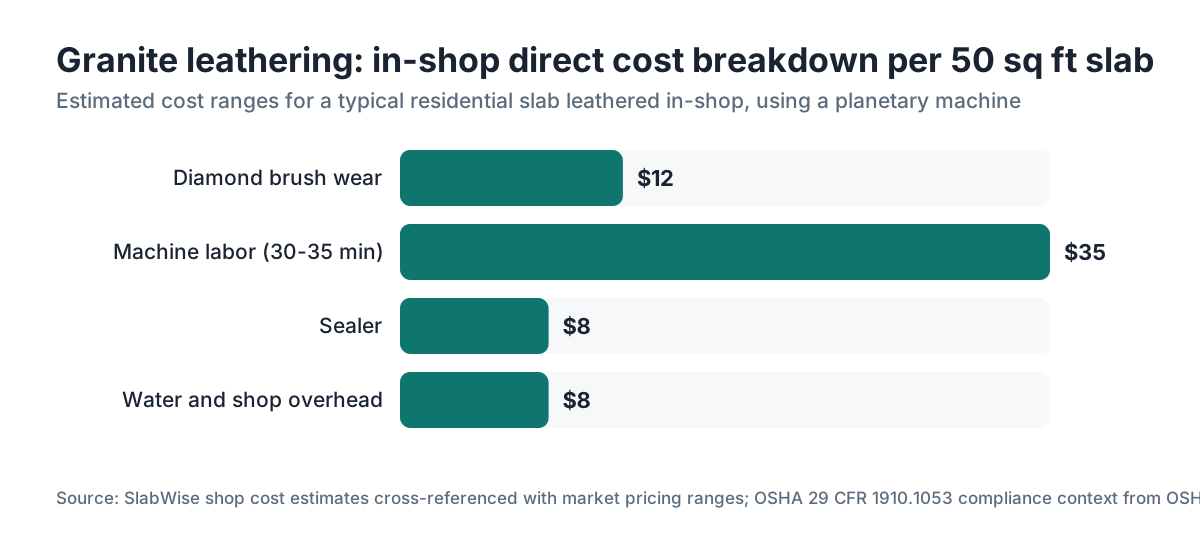
For fabricators setting their own price, here is a reasonable cost breakdown for in-house leathering:
| Cost element | Estimated cost per slab (50 sq ft) |
|---|---|
| Diamond brush wear | $8-$15 |
| Labor (machine, 30-35 min) | $25-$45 |
| Sealer | $5-$10 |
| Water and shop overhead | $5-$10 |
| Total direct cost | $43-$80 |
A shop charging $15/sq ft for leathering on a 50-square-foot slab collects $750 against $43 to $80 in direct cost. The margin is healthy, which is why shops with the equipment push this upgrade. The main risk is underpricing jobs where the granite is unusually hard or the edge work is complex.
If you quote jobs and want to track leathering as a separate line item automatically, that is exactly the kind of configurable job cost that fabrication quoting tools like SlabWise are built for. You set up the finish type as a selectable option in your quote template, and the math runs without you calculating it by hand every time.
How do you maintain a leathered granite surface after installation?
Day-to-day care for leathered granite is simpler than most clients expect. Wipe spills with a damp cloth. Use a pH-neutral stone cleaner weekly, not an all-purpose cleaner with acids or bleach. Skip anything with lemon, vinegar, or citrus, for the same reason you would with any natural stone: acid etches the surface minerals.
The textured surface does trap fine particles in the peaks and valleys, more than a polished surface would. Cooking grease is the main culprit in kitchens. A quick wipe-down with a damp microfiber cloth right after cooking keeps it from building up. If grease does accumulate, a little dish soap in warm water and a soft-bristle brush (not metal) loosens it without hurting the stone.
Sealer maintenance: most leathered granites benefit from re-sealing every 3 to 5 years [2]. Denser stones like Absolute Black may never need it. Tell clients to run the water drop test once a year. If water absorbs in under 4 minutes, it is time to reseal. If it beads longer than that, the sealer is still working.
For clients curious about cleaning stone in general, the same principles carry over to related materials, whether they are caring for stone countertops of other types or comparing care across stone and non-stone options. Leathered granite is one of the more forgiving daily surfaces in the stone category, because the texture camouflages minor water spots and fingerprints that would jump out on a polished surface.
Can you leather granite in the field after installation, or does it have to happen in the shop?
Technically yes, you can leather granite in the field. Practically, it is a mess, and most shops refuse.
Field leathering requires water, and water on installed cabinetry, in electrical outlets, and soaking into grout lines is a problem. You can rig a wet/dry vacuum setup to capture water continuously, but you are still on your knees with an angle grinder in a tight space. The overlap pattern you need for even results is genuinely hard to run in a kitchen with cabinets on both sides.
A few scenarios make field work reasonable: a large island top with clear access all around, an outdoor kitchen counter, or a client who changed their mind after installation where you have clear access and a way to protect everything below. In those cases, run the grinder slowly, keep the vacuum head right at the brush, and work in sections you can finish before water migrates.
For anything in a tight space, the honest advice is to turn down the field job and offer to fabricate a replacement top. The rework risk from uneven texture or water damage to cabinetry is not worth it for most residential jobs.
What safety requirements apply to leathering stone in a shop?
Silica exposure is the safety issue that matters most. Granite contains 20 to 45 percent crystalline silica by weight [4]. Grinding, cutting, or brushing it without controls generates respirable particles that cause silicosis, an irreversible and progressive lung disease. OSHA's final rule on occupational exposure to respirable crystalline silica (29 CFR 1910.1053 for general industry) set the permissible exposure limit at 50 micrograms per cubic meter (50 µg/m³) as an 8-hour time-weighted average, half the previous limit [1].
The rule, which became enforceable for stone fabrication in stages starting in 2018, requires employers to either use a "specified exposure control method" (wet methods and local exhaust ventilation qualify) or conduct air monitoring to verify compliance [1]. Wet leathering with continuous water flow at the brush is the standard engineering control.
Additional requirements for shops running wet processes:
- Housekeeping: sweep silica-containing slurry wet or vacuum with HEPA equipment; never dry sweep or use compressed air to clean stone dust
- Medical surveillance: for workers exposed at or above the action level (25 µg/m³) for 30 or more days per year, OSHA requires periodic medical exams
- Written exposure control plan: required under 1910.1053 for shops covered by the rule
The Occupational Safety and Health Administration keeps a dedicated silica page with compliance resources for stone fabrication shops [1]. NIOSH also maintains research and guidance on stone fabrication hazards [5].
Beyond silica: standard shop PPE applies. Safety glasses or a face shield for the water and grit splash off the brushes. Hearing protection if your planetary machine runs loud. Steel-toed boots because granite slabs are heavy.
Frequently asked questions
Can you leather any type of granite, or are some too hard to brush?
Almost any granite can be leathered, but very hard, fine-grained granites (Mohs 7+) take longer and wear brushes faster. The finish effect is also subtler on uniform, fine-grained stones. Coarse-grained granites with strong mineralogical contrast, like Blue Bahia or Typhoon Bordeaux, give the most dramatic results. Extremely dense granites like Absolute Black leather beautifully but need multiple passes and fresh brushes.
How many square feet do diamond Frankfurt brushes last before they need replacing?
A quality set of diamond Frankfurt brushes (50, 100, 200 grit) typically covers 300 to 600 square feet of granite before the grit wears out enough to hurt cut quality. Harder granites eat brushes faster. Cheap brushes may fail in under 200 square feet. Track square footage per brush set so you can build accurate consumable costs into your job quotes rather than absorbing brush wear in overhead.
What is the difference between leathered and brushed granite?
The terms are used interchangeably across most of the U.S. stone trade, and they describe the same process: diamond brushes applied to a polished or honed surface to create a matte, textured finish. Some fabricators use 'brushed' to imply a lighter touch (fewer grit steps, less texture) and 'leathered' for the full process, but there is no industry-standard distinction between the two terms.
Does leathering granite void the warranty from the slab distributor?
Most slab distributors sell raw stone with no finish warranty attached. The fabricator creates the finish. So leathering a polished slab does not typically void anything from the distributor. However, if you buy pre-leathered slabs and then sand or re-brush them, you are changing the distributor's finish. Check your specific distributor's terms. Most have no written finish warranty anyway.
Can a homeowner leather their own granite countertop without professional equipment?
A handheld angle grinder with a Frankfurt adapter and diamond brushes can technically do the job, but the results are rarely as even as machine work, and the silica exposure risk without proper wet controls and respiratory protection is serious. OSHA limits apply to workers, not homeowners, but the health risk is identical. Be honest with yourself: the equipment cost plus safety gear approaches what a fabricator charges, and the professional result is better.
How do you price leathering as an add-on when quoting a granite job?
Price it as a separate line item: brush consumables, labor time (machine or hand), and sealer cost, plus your markup. A reasonable market rate for the leathering process itself is $8 to $25 per square foot depending on your market and the complexity of the edge work. Price edge leathering separately if the profile is complex. Track your actual brush wear cost per square foot over a month to see if your consumable estimate holds.
Is leathered granite harder to clean than polished granite?
For quick wipe-downs, leathered granite is about the same as polished, and it hides water spots and fingerprints better. The texture can trap fine cooking grease or dust in its peaks and valleys, so a slightly more thorough weekly cleaning keeps it looking good. A damp microfiber cloth handles most of it. Avoid acidic cleaners regardless of finish. Most clients report leathered granite as easier to live with than polished, because minor surface marks stay invisible.
What RPM should diamond brushes run at when leathering granite?
Most manufacturers specify a surface speed target rather than a fixed RPM, because RPM depends on brush diameter. For 140 mm Frankfurt brushes, 1,500 to 3,000 RPM is the common working range. Check the specific brush manufacturer's spec sheet. Running too fast generates heat that can stress the stone even with water present. Running too slow makes the brushes skip rather than cut, leaving uneven texture.
Does a leathered finish make granite more resistant to etching?
No. Etching is a chemical reaction between acid and the carbonate minerals in stone. True granite (as opposed to marble or quartzite sometimes sold as granite) contains little to no calcite, so it does not etch the way marble does regardless of finish. The leathered finish does not change the mineral composition. If a stone etches, it etches leathered or polished. The texture may make etching slightly harder to see, which is not the same as resistance.
How do you match leathered texture on a repair piece or replacement section?
Matching leathered texture on a patch or replacement piece is difficult. The grit sequence, machine speed, and number of passes all shape the final texture, and those variables are hard to replicate exactly without notes from the original job. Start with the same grit sequence you used originally, test on a scrap piece of the same stone, and compare in raking light before committing. Perfect matches are rare. The goal is close enough that the seam in the texture reads less than the seam in the stone color.
Can you leather granite edges to match the face finish?
Yes, but it requires hand work with an angle grinder and Frankfurt adapter. Simple profiles (eased, straight, beveled) are manageable with practice. Complex profiles like ogee or dupont take significant time and skill to texture evenly. Many shops charge a per-linear-foot upcharge for leathered edges on complex profiles. Eased or straight edges on a leathered slab are standard and should be included in your base leathering price.
What personal protective equipment is required when leathering granite in a shop?
At minimum: safety glasses or a face shield for water and grit splash, and wet dust controls at the brush to manage respirable silica. OSHA's silica rule (29 CFR 1910.1053) requires engineering controls limiting exposure to 50 µg/m³ as an 8-hour average. If any dry exposure occurs, a NIOSH-approved respirator rated for silica (N95 minimum, P100 preferred) is required. Hearing protection and steel-toed boots are standard shop PPE regardless of the task.
Does leathering change the color of granite?
Yes, noticeably. Removing the polished surface reduces the refractive depth effect that makes polished granite look darker and richer. Most leathered granites appear 15 to 30 percent lighter than their polished equivalent, and the color reads more matte and natural. Some clients are surprised by this if they approved a color from a polished sample. Always show clients a leathered sample of the specific stone before fabrication, not a polished chip.
Sources
- OSHA, Occupational Exposure to Respirable Crystalline Silica (29 CFR 1910.1053 General Industry): OSHA's silica rule sets the permissible exposure limit at 50 µg/m³ as an 8-hour TWA and requires engineering controls including wet methods for stone fabrication operations
- Marble Institute of America (now Natural Stone Institute), Care and Cleaning for Natural Stone Surfaces: Penetrating sealers on natural stone typically protect the surface for 3 to 5 years under normal use before reapplication is needed
- HomeAdvisor / Angi, Granite Countertop Cost Guide: Specialty finishes including leathered granite carry an upcharge of roughly $8 to $25 per square foot over polished equivalent
- NIOSH, Hazard Review: Health Effects of Occupational Exposure to Respirable Crystalline Silica: Granite contains 20 to 45 percent crystalline silica by weight, making dry grinding and cutting operations a significant silica exposure source
- NIOSH, Stone Fabrication Industry Resources: NIOSH maintains research and guidance on silica exposure controls specific to stone fabrication shops including granite countertop fabrication
- Occupational Safety and Health Administration, Silica in Construction: Controlling Silica Exposures in Construction: Wet methods with continuous water application at the tool are an accepted engineering control for controlling silica exposure during stone grinding operations
- Natural Stone Institute, Fabrication Standards and Specifications for Natural Stone: Industry fabrication standards for stone countertops including surface finish specifications and quality benchmarks
- Marble Institute of America / Natural Stone Institute, Dimension Stone Design Manual: Diamond-impregnated abrasive brushes are the standard tool for creating brushed and leathered finishes on granite and other natural stone
- OSHA, General Industry Silica Standard 29 CFR 1910.1053 Enforcement Dates: OSHA's silica standard became enforceable for stone fabrication general industry operations in 2018
Last updated 2026-07-11