TL;DR
- Honing is a grinding process that leaves marble with a flat, matte-to-satin surface instead of a mirror shine.
- On countertops it reduces the visibility of scratches and acid etching, makes the stone feel velvety, and is the preferred finish for heavy-use kitchens.
- The tradeoff is slightly higher porosity than polished marble, so sealing matters more.
What does honing actually do to marble?
Honing is an abrasive process. A fabricator runs progressively finer diamond pads across the stone surface, stopping before the final buffing stages that create a reflective shine. The result is a surface that scatters light instead of reflecting it back at you, which most people describe as matte, satin, or "leathered-lite."
The mechanics matter because they explain everything downstream. Polishing closes the crystalline surface of calcite (the main mineral in marble) down to a near-glassy smoothness, typically finishing at 3,000-grit or higher. Honing stops somewhere between 200-grit and 800-grit depending on the look you want. A 400-grit hone is the most common countertop finish; it reads as soft gray-white rather than bright white. An 800-grit hone gets close to a low sheen, a look some fabricators call "eggshell." [1]
Because the surface is more open at the microscopic level, honed marble is technically more porous than polished marble of the same stone. That is not a reason to avoid it, but it does mean you need to seal more diligently and re-seal more often.
Why do people choose a honed finish for marble countertops?
The single biggest practical reason is that etching is far less visible on a honed surface. Etching happens when acidic liquids (lemon juice, wine, coffee, tomato sauce) react with the calcite in marble and dissolve a thin layer of the surface. On polished marble, an etch shows up as a dull ring or patch that is immediately obvious against the high gloss. On honed marble, the etch still happens chemically, but because the surrounding surface is already matte, the visual contrast is much smaller. In many cases you simply cannot see it.
Scratches behave the same way. A hairline scratch on polished stone catches light. On honed stone it disappears into the uniform matte texture. For a kitchen that sees daily cooking, this is not a minor aesthetic point. It changes how the counter looks in a year.
There is also a tactile reason people choose honed marble. The surface feels smooth but not slippery, more like fine suede than glass. Many designers prefer it in kitchens because it looks less formal and pairs well with both traditional and modern cabinet styles. [2]
Honed marble also shows fingerprints and water spots less aggressively than polished, though it is not immune. If you are buying white Carrara or Calacatta for a kitchen counter, honed is almost always the smarter choice for everyday life.
How does honed marble compare to polished marble in daily use?
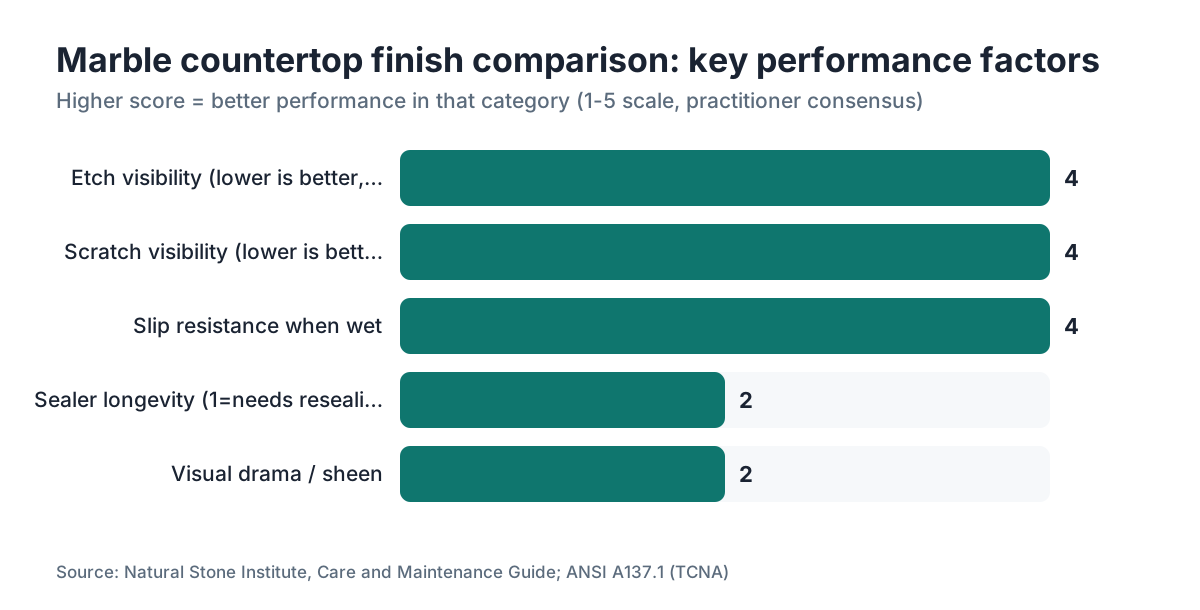
The table below summarizes the key practical differences. Both finishes are real marble and both etch; the question is only how visible the damage is and how much maintenance each demands.
| Property | Honed marble | Polished marble |
|---|---|---|
| Etch visibility | Low (matte hides contrast) | High (dull patch against gloss) |
| Scratch visibility | Low | Moderate to high |
| Porosity | Slightly higher | Slightly lower |
| Sealing frequency | Every 6-12 months typical | Every 1-2 years typical |
| Fingerprints/water spots | Moderate | Moderate to high |
| Light reflectance | Low to medium | High |
| Typical cost premium | None to +5% over polished | Baseline |
| Tactile feel | Velvety, matte | Smooth, glassy |
Neither finish makes marble etch-proof. Marble is calcium carbonate, and acid attacks calcium carbonate regardless of surface texture. If someone tells you honing "protects" marble from etching, that is not accurate. It just makes the aftermath less obvious. [3]
For a bathroom vanity that sees soap and water but almost no acid, polished marble performs fine and the extra sheen shows off the veining beautifully. For a kitchen island used for meal prep, honed is almost always a better daily-life decision.
What types of marble benefit most from honing?
White and light-gray marbles like Carrara, Calacatta, and Statuario show the biggest improvement with a honed finish, because their high contrast between white background and dark veins makes etch rings extremely visible on a polished surface. A 400-grit hone on Carrara can make etches nearly invisible to a casual observer.
Darker marbles, like Nero Marquina (black) or Emperador (dark brown), actually benefit from polishing because the mirror gloss is part of the visual drama of a dark stone. Etches on dark polished marble show up as lighter dull spots, which can be distracting. Some fabricators offer a brushed or leathered texture for dark stones instead, which is a different process than honing but achieves a similar goal. [4]
Softer marble varieties (many Italian marbles test at Mohs 3-4) scratch more easily in general and gain more from honing than harder stones. If your stone is softer, honing is a practical default, more than an aesthetic choice.
For more on how marble behaves compared to similar natural stones, the marble countertops guide on this site covers material properties in depth.
Can you hone marble countertops after they are installed?
Yes, and this is one of marble's genuine advantages over engineered stone. A professional stone restorer can hone an installed polished marble countertop in place, or hone out deep scratches and etch damage and restore the surface to a consistent matte finish. The work is done wet with diamond polishing pads on an angle grinder or specialty stone polisher.
The cost for in-place honing by a stone restoration professional typically runs $4 to $8 per square foot for a straightforward hone and reseal, though prices vary widely by region and condition of the stone. [5] A counter that has significant deep scratches or staining may cost more because the technician needs to start with a coarser grit. Expect to pay $150 to $400 for an average kitchen counter of 40-50 square feet.
You can also hone marble yourself using rented or purchased diamond hand pads. It takes time and patience, and you can create uneven areas if you do not keep your passes consistent, but it is a viable DIY project for small sections or spot repairs. Start at the grit that matches your desired final finish (200 for a very flat matte, 400 for the most popular satin look) and work in consistent overlapping passes with water as a lubricant.
Going the other direction, from honed back to polished, is also possible but requires more work, finishing up to 3,000-grit or higher with a high-speed buffer. Most homeowners hire that out.
How should you seal and care for honed marble countertops?
Because honed marble is more porous than its polished counterpart, a penetrating impregnating sealer (not a topical coating) is essential. The sealer soaks into the stone and fills the pores with a water- and oil-repellent barrier, slowing liquid absorption and staining. It does not change the look of the stone. [6]
The Marble Institute of America recommends testing your sealer's effectiveness with a simple water bead test: drip water on the sealed surface and watch whether it beads up or absorbs within a few minutes. If it absorbs within 3-4 minutes, resealing is due. [7] For honed marble in a kitchen, this test often shows the sealer failing within 6 to 12 months of application. In a bathroom, sealed honed marble may hold for 18 months to 2 years.
Daily cleaning is straightforward: mild dish soap and warm water, or a stone-safe pH-neutral cleaner. Avoid anything acidic (vinegar, lemon-based cleaners) and anything with bleach or ammonia, which can damage the sealer and over time dull the stone. Wipe spills immediately, especially red wine, coffee, and cooking oils, which stain honed marble more readily than polished.
For a broader guide to keeping natural stone surfaces in good condition, see how to clean stone countertops.
What does it cost to get marble countertops honed versus polished by a fabricator?
When you order new marble countertops from a fabricator, requesting a honed finish typically adds nothing or a small premium. Most shops price polished and honed marble at the same rate because the labor steps are similar; the honed job actually skips the final buffing passes, which marginally reduces labor. Some shops charge $2 to $5 per square foot extra because honed jobs require more careful intermediate grit work to produce a uniform appearance, and because they are less common and slower to set up. [8]
The bigger cost variable is the marble slab itself. Carrara marble slabs for a 40-square-foot kitchen counter run roughly $40 to $80 per square foot installed when you factor in material, fabrication, and installation. Calacatta and Statuario run $80 to $200+ per square foot installed. These ranges come from National Kitchen and Bath Association survey data and vary significantly by region, slab quality, and current stone market prices. [9]
Fabrication software like SlabWise helps fabricators price honed jobs accurately, because the yield calculations and finish notes affect total job cost more than most shops realize, especially on patterned or bookmatched slabs.
If your goal is a lower-maintenance kitchen surface with a matte look but marble is not in the budget, consider reading the kitchen countertops overview, which covers the full range of options.
Does honing affect how marble countertops need to be installed?
The installation process for honed marble is identical to polished marble. The slab is cut, edge-profiled, and set with the same adhesives and support requirements. Nothing about the honed finish changes substrate prep, support requirements, or seam technique.
The one installation-adjacent issue is seam appearance. On polished marble, seams are relatively easy to see because the high-gloss surface reflects light evenly and any height difference is obvious. On honed marble, seams are often less visible because the matte texture is more forgiving of small height mismatches, though a skilled fabricator will still align heights carefully. The epoxy or polyester filler used in the seam should match the stone color, and a good fabricator will tint it on-site. [10]
For a complete picture of what happens on installation day, the countertop installation guide walks through every step from template to final set.
How is honing different from leathering, brushing, and other marble finishes?
The stone surface finishing world has more vocabulary than most homeowners expect.
Honing uses flat diamond abrasive pads on a flat-plate machine to produce a uniform matte surface. The surface stays flat. Honing is by far the most common alternative to polished for marble countertops.
Leathering (sometimes called brushing) uses diamond-tipped wire brushes that follow the natural texture of the stone, amplifying micro-pits and undulations. The result is a slightly textured surface that looks and feels like leather. Leathering is more common on granite and quartzite than on marble, because soft marble can lose veining definition with aggressive brushing. Some fabricators offer a light brushed marble, but it requires a softer touch than a typical granite leather job. [4]
A sandblasted or flamed finish applies heat or abrasion to produce a very rough, grip-oriented texture. These are almost never used for countertops; they belong on outdoor pavers and pool copings.
A caressed or antiqued finish combines light brushing with a tumbled edge profile to simulate aged stone. You see this on Mediterranean-style kitchens.
For most people comparing options: polished for maximum drama and easiest stain resistance, honed for practical everyday use, leathered for a rustic or industrial look on harder stones. Marble almost always lands on polished or honed.
Is honed marble a good idea for bathrooms as well as kitchens?
Honed marble in a bathroom is a very natural choice, and in some applications it is safer than polished. A honed marble shower floor has more micro-texture than a polished floor, which reduces slip risk when wet. The Tile Council of North America's ANSI A137.1 standard uses a Dynamic Coefficient of Friction (DCOF) threshold of 0.42 for wet tile floors; honed stone generally meets this threshold more comfortably than polished stone of the same type. [11]
For a bathroom vanity top, the practical argument for honing is less pronounced than in a kitchen, because vanity tops see far less acid exposure. Soap, toothpaste, and water do not etch marble. Perfumes with alcohol can, and some hair products do. So the etch-hiding benefit of a honed finish still applies, just less urgently.
A polished marble vanity in a low-traffic guest bathroom is a perfectly reasonable choice if you want the full veining drama. A honed finish in a family bathroom used by kids every morning is a practical default.
The same logic applies to marble floors and wall cladding: honed is more forgiving in wet zones and high-traffic areas; polished works well where the goal is pure beauty and maintenance is manageable.
What are the common misconceptions about honed marble countertops?
"Honed marble doesn't etch." Wrong. Honing does not change the chemistry of the stone. Marble etches because calcite reacts with acid. Honing changes how visible the etch is, not whether it happens. Anyone selling you honed marble and promising it won't etch is misleading you.
"Honed marble is harder to clean." Not really. Cleaning honed marble takes the same steps as polished: wipe with a pH-neutral cleaner, dry it, and reseal annually or when the water bead test fails. It is not harder to clean, but it does require sealing more often.
"You can't go back to polished once you hone." False. A stone restoration professional can re-polish honed marble in place, though it takes more labor and grit passes than the initial polishing at the factory. It is not cheap, but it is fully reversible.
"Honing removes the pattern and veining." Also false. The veining in marble runs through the full depth of the stone. Honing removes a fraction of a millimeter of surface material. The veining looks different under matte light than under gloss, but it is still there and still beautiful. Many people actually prefer how the veining looks on a honed surface because it appears more natural and less artificial. [2]
Frequently asked questions
Does honed marble stain more easily than polished marble?
Slightly yes, because honing leaves the stone surface more open at the microscopic level. That said, a properly applied penetrating impregnating sealer reduces stain risk significantly on both finishes. The real difference in practice is that honed marble needs resealing every 6 to 12 months in a kitchen, while polished marble may hold a seal for 12 to 24 months before re-application is needed.
How often does honed marble need to be resealed?
Plan on testing your honed marble countertop with a simple water bead test every 6 months. If water absorbs into the surface within 3 to 4 minutes rather than beading up, reseal immediately. In a busy kitchen, resealing once a year is a reasonable baseline. In a bathroom with less acid and oil exposure, 12 to 18 months between sealings is more typical. The actual interval depends on your specific sealer product, stone density, and usage.
Can I hone just one section of my marble counter to remove a bad etch?
A stone restoration professional can spot-hone a damaged area, but matching the sheen across the whole surface is difficult. A single honed patch on a polished counter will look different than the surrounding stone. The better approach is to hone the entire surface to a uniform finish, which produces a consistent look. If the damage is minor and you have a polished surface, a marble polishing compound can sometimes reduce the etch's visibility without full honing.
What grit level is standard for honed marble countertops?
The most common honed countertop finish is 400-grit, which gives a uniform satin-matte look. Some fabricators offer 200-grit for a flatter, more industrial matte, or 800-grit for a soft sheen that approaches polished without being reflective. There is no industry-wide standard grit, so it is worth asking your fabricator to show you samples at different levels before they start cutting your stone.
Is honed marble more expensive than polished marble?
Usually not. Most fabricators price polished and honed at the same per-square-foot rate, since the labor difference is minor. Some shops add $2 to $5 per square foot for honed because setup and quality-checking a matte finish requires care. The slab material itself costs the same regardless of finish. Get a written quote that specifies the finish to avoid surprises.
What cleaner should I use on honed marble daily?
Use a pH-neutral dish soap diluted in warm water, or a cleaner labeled specifically for natural stone. Avoid vinegar, lemon-based cleaners, bleach, and ammonia. These acids and bases both attack the calcite surface and degrade impregnating sealers over time. Plain warm water works fine for everyday wiping. Dry the surface after cleaning to prevent water spots, especially if your tap water is hard.
How do I know if my marble is honed or polished?
Hold a flashlight or phone light at a low angle across the surface. Polished marble reflects a sharp, distinct light source back at you like a mirror. Honed marble scatters the light and produces no distinct reflection. You can also run your finger across the surface: polished feels slick and glassy; honed feels smooth but slightly velvety with no slip. If you are still unsure, a fabricator can identify the finish in seconds.
Can honed marble be used for a kitchen island with heavy prep use?
Yes, and it is actually a better choice than polished for a prep-heavy island. The matte finish hides everyday etch marks and minor scratches far better than polished. You still need to seal it regularly and clean up acidic spills promptly, because the stone itself is still marble. Some cooks place a cutting board between acidic ingredients and the stone surface as extra insurance, regardless of finish.
Does honed marble work on bathroom floors and shower walls?
Honed marble is a solid choice for both. On shower floors, the matte texture provides slightly more grip than polished, helping meet wet-surface slip resistance guidelines. On shower walls and vanity tops, it holds up well against soap, shampoo, and water. Acidic hair products and some fragrances can etch even in bathrooms, so a sealed honed finish handles those better than polished. Grout lines and seams should still be sealed in wet areas.
What is the difference between honed marble and leathered marble?
Honed marble uses flat diamond abrasives to produce a smooth, uniform matte surface. Leathered (or brushed) marble uses rotating wire-tip brushes that follow the stone's natural pits and texture, leaving a slightly rough, tactile surface. Honed is smooth to the touch; leathered has a noticeable texture. Honing is far more common on marble countertops. Leathering is more often applied to harder stones like granite or quartzite.
Can marble countertops be honed after years of use as a polished surface?
Yes. A stone restoration professional can hone installed polished marble to remove accumulated scratches, etches, and surface damage, resetting the stone to a consistent matte finish. This costs roughly $4 to $8 per square foot for a standard job, so a 45-square-foot kitchen counter runs about $180 to $360 in professional labor, plus sealing. It is one of the best arguments for choosing marble over engineered stone: it can be fully resurfaced without replacement.
Does honing change the color of marble?
It changes how the color reads visually without changing the stone chemistry. Polished marble looks brighter and more saturated because the reflective surface bounces light back at your eye. Honed marble looks softer and slightly less intense for the same reason. White marbles look creamier when honed; gray veining looks more subtle. If you are buying honed marble, ask to see a sample wet and dry to understand how the color will read in your kitchen lighting.
Is there a standard test to know when to reseal honed marble?
Yes. The water bead test: place several drops of water on the sealed surface and watch for 3 to 5 minutes. If the water beads up and wipes away cleanly, the sealer is intact. If the water soaks into the stone and darkens it, the sealer has failed and resealing is overdue. The Marble Institute of America describes this method as the simplest way to monitor natural stone sealers, and it costs nothing to perform.
What edge profiles work best with honed marble countertops?
Any edge profile can be applied to honed marble. Fabricators typically hone the face of the top and apply the matching matte finish to the edge at the same time. A simple eased or straight edge shows the honed finish cleanly. An ogee or bullnose edge with tight, detailed curves can be harder to hone uniformly by hand and may show slight sheen variation on those curves. Discuss this with your fabricator before finalizing the profile.
Sources
- Indiana Geological and Water Survey, Indiana University, Dimensional Stone overview: Diamond abrasive grit levels from 200 to 3000+ used in stone surface finishing, with final polished surfaces typically achieved at 3000-grit or higher
- National Park Service Preservation Briefs 43: The Preparation and Use of Finished Lime Putty-Based Plaster (stone surface context for marble character): Matte/honed stone surfaces read as more natural and less formal than high-gloss polished surfaces, a documented preference in preservation and design contexts
- USGS Mineral Resources Program, Carbonate Rocks page: Marble is composed primarily of calcium carbonate (calcite), which reacts with acidic solutions regardless of surface finish or porosity level
- Marble Institute of America (now Natural Stone Institute), Technical Reference Manual: Leathered and brushed finishes use rotating diamond-tipped brushes to create texture; honed finishes use flat abrasive pads for a smooth matte surface; both are standard industry finishes
- Natural Stone Institute, Stone Restoration and Maintenance Bulletin: In-place stone honing and restoration by professionals, typical pricing range and process for installed countertop surfaces
- U.S. EPA, Safer Choice Program: Cleaning Product Ingredient safety and stone sealer categories: Penetrating impregnating sealers are water- and oil-repellent treatments that absorb into porous stone without forming a topical coating, preserving natural appearance
- Marble Institute of America (now Natural Stone Institute), Care and Maintenance Guide for Natural Stone: Water bead test: if water absorbs into sealed stone surface within 3-4 minutes, resealing is recommended; test described as the simplest way to monitor natural stone sealers
- Natural Stone Institute, Fabrication Standards for Dimensional Stone: Honed finish fabrication requires careful intermediate grit passes for uniform appearance; common industry pricing notes honed and polished at parity or a small premium for honed
- National Kitchen and Bath Association (NKBA), Kitchen and Bath Market Index Report: Installed marble countertop pricing ranges for Carrara and premium Italian marbles in the U.S. residential market, including material, fabrication, and installation
- Natural Stone Institute, Fabrication Standards: Seam Filling and Color Matching for Natural Stone: Seam epoxy or polyester filler should be tinted to match stone color; honed surfaces are more forgiving of minor height mismatches than polished surfaces at seams
- American National Standards Institute / Tile Council of North America, ANSI A137.1 Standard Specifications for Ceramic Tile (DCOF threshold for wet surfaces): ANSI A137.1 specifies a minimum Dynamic Coefficient of Friction (DCOF) of 0.42 for wet tile and stone floor surfaces in interior areas; honed stone generally meets this threshold more comfortably than polished
Last updated 2026-07-10