TL;DR
- Park Industries is a St.
- Cloud, Minnesota manufacturer that builds CNC bridge saws, combination saw-waterjet machines, and CNC routers for stone fabrication shops.
- The main lines are the Voyager, Saw Jet, and TITAN.
- Park competes mostly with Italian brands like Brembana and Biesse, plus Northwood at home.
- It's widely considered the dominant U.S.-made brand in the market.
What is Park Industries and what do they make?
Park Industries is a family-owned equipment manufacturer in St. Cloud, Minnesota, founded in 1953. They build CNC bridge saws, combination saw-waterjet machines, CNC routers, and edge polishers for natural stone and engineered stone fabrication. Everything they sell aims at one customer: the countertop shop cutting slabs, polishing edges, and turning raw stone into finished kitchen and bathroom surfaces.
They don't make general-purpose industrial machinery. The whole product line is stone-specific, so the software, the cutting parameters, and the support staff all speak the language of a countertop shop. That focus pays off when you're troubleshooting at 7 a.m. before a big install day.
Park's main product families as of 2025:
- Voyager series: CNC bridge saws for straight and miter cuts on natural stone and quartz
- Saw Jet series: combination machines that do blade cutting and waterjet cutting on the same gantry
- TITAN series: heavy-duty bridge saws built for high-volume production
- CNC routers: for sink cutouts, edge profiles, and decorative shaping
- Edge polishers: automated polishing lines for finished edges
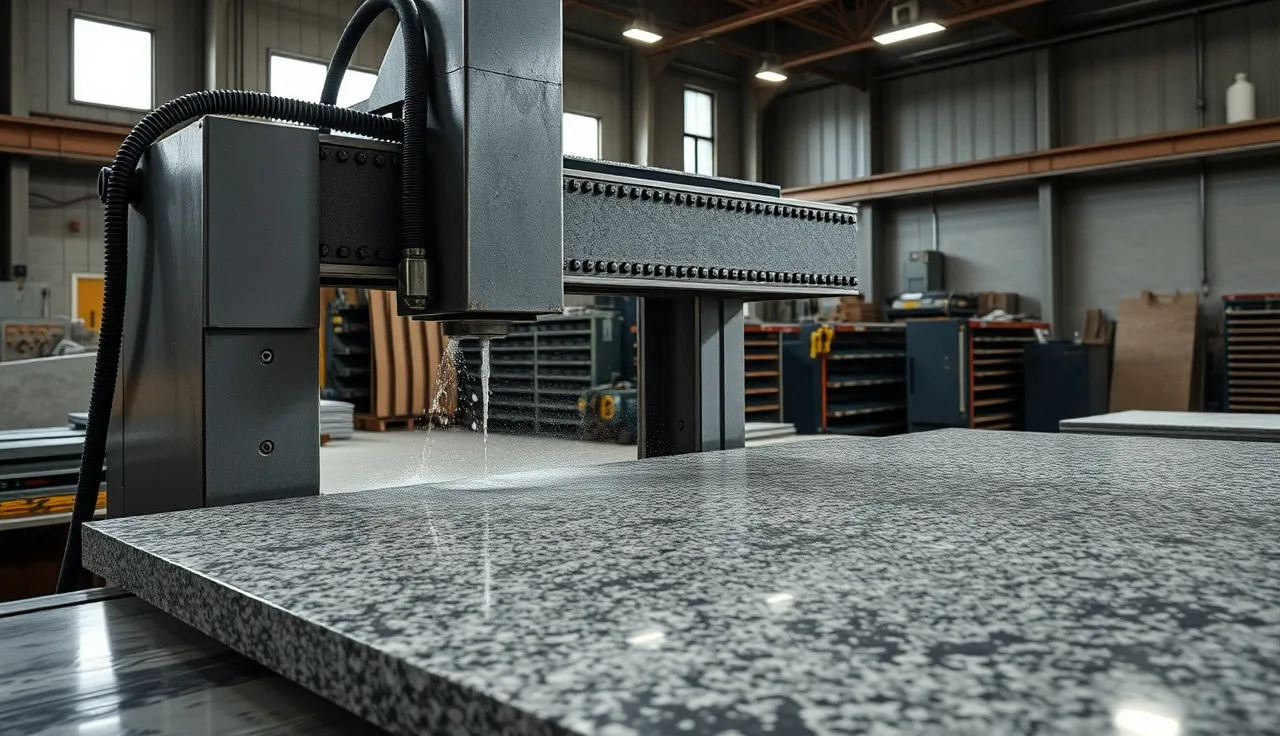
The Saw Jet is the machine people talk about most, because it folds two workflows (saw cutting and waterjet cutting) into one piece of floor space. Smaller shops fighting for square footage find that appealing, even though the price tag reflects the added complexity. [1]
Where are Park Industries machines made?
Park Industries builds its machines in St. Cloud, Minnesota. This is a real Made in USA story, not an assembly line bolting together imported subassemblies. The manufacturing floor, the engineering team, and the corporate headquarters all sit in St. Cloud.
Domestic manufacturing has practical consequences for fabricators. Parts lead times beat waiting for Italian or German components to clear customs. Warranty service doesn't mean coordinating across a European time zone. And the sales and support staff have actually walked the factory floor.
Origin matters for money, too. Shops applying for SBA equipment loans or certain state manufacturing incentive programs sometimes find country of origin affects eligibility or tax treatment. [2]
How much does a Park Industries saw cost?
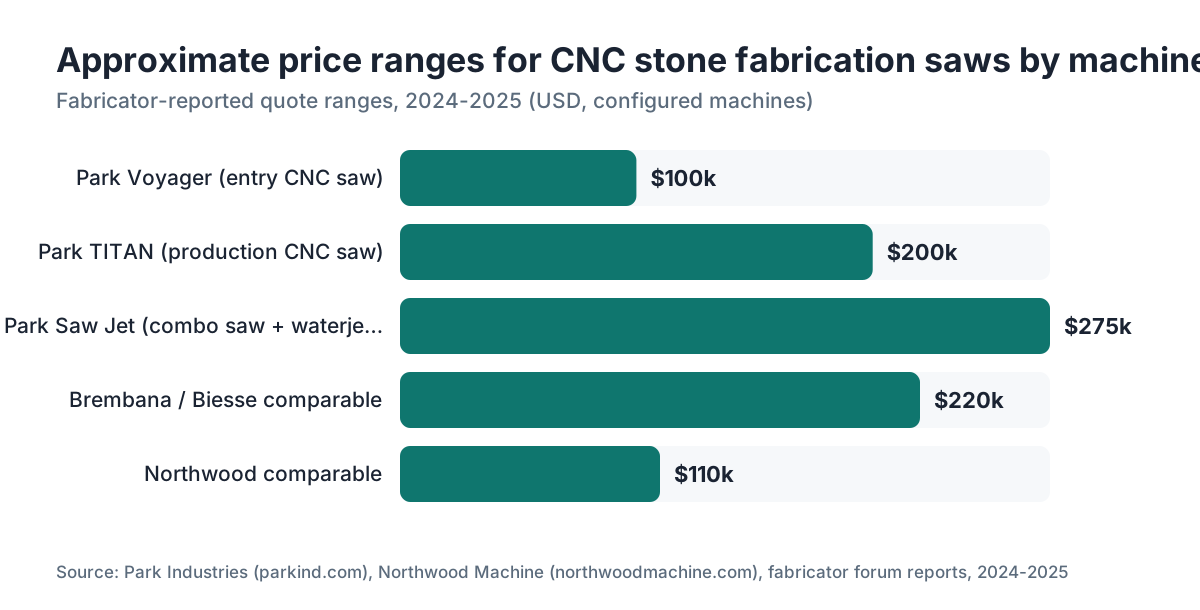
Park Industries doesn't publish retail pricing on its website, which is normal for capital equipment of this class. Based on dealer quotes and fabricator forum reports from 2024-2025, here are rough ranges:
| Machine | Approximate Price Range |
|---|---|
| Voyager CNC Bridge Saw (entry) | $80,000 - $120,000 |
| TITAN CNC Bridge Saw (production) | $150,000 - $250,000+ |
| Saw Jet (combo saw + waterjet) | $200,000 - $350,000+ |
| CNC Router | $60,000 - $130,000 |
Treat these as ballparks. Configuration moves the number a lot: table size, motor power, software package, and optional tooling stations all matter. A fully loaded Saw Jet with automatic tool changers and advanced nesting software lands nowhere near a base-spec unit.
Here's the number people forget. The total installed cost of a new CNC bridge saw system (machine, installation, training, initial tooling) often runs 20-30% above the machine price alone. Budget for that before you sign anything.
Fabricators financing Park equipment often use Section 179 of the U.S. tax code, which in 2024 let businesses deduct up to $1,160,000 in qualifying equipment purchases in the year of purchase instead of depreciating over time. [3] On a $200,000 machine, that deduction changes the effective first-year cost by a wide margin.
How does Park Industries compare to Brembana?
Brembana is an Italian brand (part of the Cosentino group's equipment arm) and probably Park's most direct competitor in U.S. shops. The comparison comes up constantly on fabricator forums like StoneFabricatorAlliance.com.
Brembana machines are generally regarded as having a slight edge in raw cutting precision on very hard stones, particularly granite with high silica content. The Italian engineering tradition in stone machinery runs long, and Brembana has benefited from it. Their software has historically been denser, which means a steeper learning curve but finer control for experienced operators.
Park machines get praised for ease of use, faster operator onboarding, and domestic support response times. If a servo motor dies on a Brembana in rural Texas, you may wait longer for a tech than you would with Park. That downtime is real money.
On price, comparable Brembana configurations tend to run in a similar range to Park, sometimes a bit higher once you account for import logistics. Neither brand is cheap.
The honest summary. Experienced shops with skilled CNC operators and lots of floor space often lean toward Brembana or Biesse for maximum throughput on difficult stone. Shops that prioritize support reliability, shorter learning curves, or domestic parts availability often choose Park. Neither choice is wrong.
How does Park compare to Biesse, Intermac, and other Italian brands?
Biesse and Intermac are both Italian CNC machinery makers with strong footprints in U.S. stone fabrication. Intermac is a brand of Biesse Group, so they share engineering DNA even though they market to slightly different segments.
Biesse and Intermac machines are known for multi-function capability. Their Master and Primus lines handle stone, glass, and some composites, which appeals to shops running mixed materials. The software, particularly Biesse's Biesseworks suite, is sophisticated and ties into CAD/CAM workflows that larger shops may already run.
The tradeoffs echo the Brembana comparison: higher logistical complexity for U.S. buyers, longer parts lead times, and support handled through regional dealers rather than one domestic manufacturer. Biesse does keep U.S. offices and a service network, so you're not completely on your own, but it's a different model than calling Park directly in Minnesota.
For granite countertops production at volume, all three brands (Park, Brembana, Biesse/Intermac) can do the job. The real differences are support infrastructure, operator experience requirements, and the specific feature sets that matter to your shop's workflow. [4]
How does Park Industries compare to Northwood Machine?
Northwood Machine Manufacturing is a domestic competitor to Park, also building CNC bridge saws and routers for stone fabrication. Northwood is based in Romulus, Michigan.
Northwood has a loyal following, especially across the Midwest and Southeast. Their machines get described as solidly built with straightforward mechanical designs. The brand is smaller than Park by most measures, which cuts both ways. Some shops like the more personal relationship with a smaller manufacturer. Others prefer the broader dealer and service network Park has built over decades.
Park has spent more on software integration over the years, particularly nesting and CAD/CAM tie-ins that help shops squeeze more yield out of each slab. Northwood's software works fine but rarely gets mentioned as a reason to buy.
If you're a smaller shop and there's a Northwood dealer nearby who can actually service the machine, that proximity beats brand prestige every time. Capital equipment support is a local business.
What is the Park Industries Saw Jet and is it worth the cost?
The Park Industries Saw Jet puts a diamond blade cutting head and a waterjet cutting head on a single CNC bridge gantry. You make straight cuts and miters with the blade (fast, cheap per foot) and switch to the waterjet for curved cutouts, sink holes, and detail work, all without moving the slab to a second machine.
For a shop that owns a separate saw and a separate waterjet, the Saw Jet promises to recover floor space, cut material handling (moving a heavy slab between machines is both a damage risk and a labor cost), and tighten workflow sequencing.
The honest question is whether the productivity gain justifies the price premium over buying a good bridge saw and a standalone waterjet table separately. It depends heavily on your volume and your floor space. A high-volume shop pushing 15-25 jobs a day may see a genuine throughput jump. A 3-4 job-per-day shop may find that two separate machines, bought used, serve them just as well at a fraction of the capital outlay.
Waterjet cutting carries consumable costs (abrasive garnet, pump maintenance) that keep running whether the machine is a combo or a standalone. Budget roughly $2-5 per square foot of waterjet cutting in consumables and maintenance, depending on stone type and cut complexity. [5]
For shops producing marble countertops or other soft stones with decorative cutouts, the Saw Jet's ability to handle detailed shapes without repositioning the slab is a real operational win.
What software does Park Industries use, and how does it integrate with shop management tools?
Park Industries machines run on their own CAD/CAM software called ProSuite (referred to in some product lines as the Park CAD/CAM system). ProSuite handles job programming, nesting optimization, and machine control. It imports DXF files from templating systems like Laser Products Industries (LPI) digital templaters and others.
The software gets praised for being approachable to operators without deep CNC programming backgrounds. Park has put real work into making the interface stone-specific rather than bending generic industrial CNC software to fit.
Integration gets harder on the business side: connecting machine output data to quoting, job costing, and scheduling. ProSuite is a machine controller, not a shop management platform. Fabricators still need a separate tool for quoting, slab inventory, and job tracking.
This is where shop management software comes in. Tools like SlabWise handle quoting and nesting optimization on the business side, generating accurate material requirements and job costing before the job ever reaches the Park machine. The two systems do different jobs, and most shops that own both run them in parallel. Getting accurate square footage and yield numbers to flow cleanly from your quoting software into your CNC programming is one of the spots where shops quietly lose margin if they're still doing it by hand.
For fabricators running countertop installation on top of fabrication, tying the shop management layer to the machine layer is where the efficiency gains actually land.
What are common complaints about Park Industries machines?
No machine is universally loved, and Park is no exception. The criticisms that show up most in fabricator forums and shop conversations:
Software update friction: Some long-time Park users report that updates occasionally break established workflows or require retraining, which stings on busy production days.
Price of upgrades and accessories: Park's proprietary tooling and accessories run expensive, and some fabricators feel the ecosystem locks them into Park-specific purchases.
Throughput ceiling on the Voyager vs. TITAN: The entry-level Voyager is capable but tops out at a lower cutting speed than the TITAN line. Shops that grow into higher volume sometimes wish they'd sized up at purchase.
Used-market software headaches: Because Park machines have gone through several software generations, buying used can mean inheriting an older platform the current support team is less eager to help with. Always check software version and support status on any used Park purchase.
None of these are deal-breakers for most shops. They're just worth weighing before you sign.
Should a homeowner care what saw cut their countertops?
Probably not much, but a little. The machine cutting your kitchen countertops matters less than the operator running it and the quality of the template. A talented fabricator on an older bridge saw will consistently beat a careless operator on the newest Park TITAN.
What you can reasonably ask a fabricator is whether they use CNC equipment for cutting and whether they use digital templating. Those two questions tell you more about likely precision than the brand name on the machine.
That said, if your job is complex, tight sink-to-wall measurements, mitered edges on multiple pieces, or matched veining across seams in a book-matched marble countertops or granite countertops install, a shop with a Saw Jet or a high-end CNC router has real capability advantages over one cutting with angle grinders and a manual saw.
For cambria countertops specifically, Cambria has fabricator certification requirements that include CNC equipment standards. So the brand of the stone can drive the equipment standard on its own.
Want a quick sense of what your project should cost before you talk to a fabricator? An instant quote tool built on real fabricator pricing data can anchor your expectations, so you walk into the shop knowing whether a number is reasonable.
What questions should a fabricator ask before buying a Park Industries machine?
If you're a shop owner seriously evaluating a Park machine, here's the list I'd actually work through:
1. What is your current and projected daily job volume? The Voyager is sized differently than the TITAN. Buying for today's volume and hitting a bottleneck 18 months later is an expensive mistake.
2. Do you need waterjet capability? If yes, do you want it on a combo Saw Jet or as a separate machine? Combo machines give you flexibility but also combined downtime risk: if one system needs service, the whole machine may go offline.
3. What does your floor space actually allow? The TITAN and Saw Jet need serious footprint, including water management, abrasive slurry handling, and clearance for slab loading.
4. Who will service the machine, and how fast can they get there? Ask for the name of the tech assigned to your region and their average response time. Get it in writing if you can.
5. What software version ships with the machine, and what's the upgrade path? ProSuite versions matter for DXF compatibility with your templating system.
6. What does financing look like, including Section 179 eligibility? Talk to your accountant before you sign, not after. [3]
7. Can you visit a reference shop running the same configuration? Park should be able to connect you with a shop running the exact machine you're considering. If they can't or won't, take that as a signal.
One more thing. If you're weighing how your quoting and nesting workflow connects to the machine, run a parallel review of your shop management software at the same time as the equipment decision. A $200,000 machine on a chaotic quoting and scheduling process will lose to a $100,000 machine in a well-run shop.
Frequently asked questions
Is Park Industries still made in the USA?
Yes. Park Industries manufactures its CNC bridge saws, routers, and edge polishers in St. Cloud, Minnesota, where the company has been based since 1953. The engineering and manufacturing are both domestic, which is a practical advantage for U.S. buyers on parts lead times and service response.
What is the difference between the Park Industries Voyager and the TITAN?
The Voyager is Park's entry-to-mid-range CNC bridge saw, suited to shops doing moderate daily volume. The TITAN is built for high production with heavier construction, faster cutting speeds, and stronger components. The TITAN carries a meaningfully higher price tag, typically $150,000-$250,000 versus the Voyager's $80,000-$120,000 ballpark. Choose based on your actual daily throughput.
How long does a Park Industries machine last?
Well-maintained Park machines commonly run 15-20 years in production. Longevity depends on preventive maintenance, particularly lubrication schedules, water filtration for the cutting system, and software updates. The mechanical frame tends to outlast electronics and servo systems, which may need rebuilding around the 10-12 year mark. Used Park machines from the early 2010s are still in active production in many shops.
Can a Park Industries saw cut quartz engineered stone?
Yes, Park machines cut quartz engineered stone routinely. Quartz needs diamond blades rated for engineered stone, slightly different cutting parameters than natural granite, and proper water cooling to prevent resin burn. Silica dust from cutting quartz is a serious respiratory hazard governed by OSHA's silica standard (29 CFR 1926.1153), which requires wet cutting and exposure controls in fabrication shops.
What is the Park Industries Saw Jet used for?
The Saw Jet combines a diamond blade saw and a waterjet cutter on one machine gantry. Fabricators use the blade for straight cuts and miters (faster and cheaper per linear foot) and switch to the waterjet for sink cutouts, curved shapes, and detail work. The benefit is eliminating a slab move between two separate machines, which reduces handling damage risk and saves floor space.
How does Park Industries compare to Baca Systems?
Baca Systems (makers of the Robo SawJet) approaches the combination saw-waterjet concept with a robotic arm rather than a traditional bridge gantry. Baca's system is highly automated and suited to very high-volume shops. Park's Saw Jet uses a more conventional CNC bridge design. Baca machines generally cost more and need more infrastructure, while Park's approach is more familiar to shops already running traditional CNC saws.
Does Park Industries offer financing?
Park Industries works with equipment financing companies and dealers who can arrange financing. Fabricators should also look at SBA 7(a) or 504 loan programs for equipment purchases, and evaluate Section 179 expensing with their accountant. In 2024, Section 179 allowed up to $1,160,000 in qualifying equipment to be deducted in the purchase year, which can sharply cut the effective first-year cost of a new machine.
What is the silica dust risk from operating a stone saw, and what does OSHA require?
Cutting granite, quartz, and similar stone generates respirable crystalline silica dust, which causes silicosis and lung cancer. OSHA's respirable crystalline silica standards for construction and general industry (29 CFR 1926.1153 and 29 CFR 1910.1053) set a permissible exposure limit of 50 micrograms per cubic meter as an 8-hour TWA. Wet cutting systems on machines like Park's are a primary engineering control for compliance.
How do I find a used Park Industries machine?
Used Park machines show up on Machinery Trader, eBay industrial listings, and occasionally through Park's own dealer network when shops upgrade. Before buying used, check the software version and confirm current support status with Park directly. Ask for maintenance records and inspect rail wear, servo drives, and the water management system. A used machine with undocumented history can cost more in repairs than you saved on the price.
What templating systems work with Park Industries saws?
Park's ProSuite software imports DXF files, the standard output format for major digital templating systems including Laser Products Industries (LPI) digital templaters and Prodim Proliner. The measured template from the job site translates directly into cutting programs on the Park machine without manual re-entry, which cuts errors and speeds up shop floor programming.
Does the type of saw matter for the quality of a granite or quartz countertop seam?
Machine quality contributes to seam quality, but operator skill and template accuracy matter more. A CNC bridge saw (Park or otherwise) produces more consistent straight cuts than a manual saw, which directly affects how tightly two slabs meet at a seam. For high-visibility seam locations in granite or quartz countertops, asking your fabricator about their CNC equipment and seam fitting process is a fair quality question.
How much floor space does a Park Industries bridge saw require?
Exact footprint varies by model. The Voyager needs roughly 14-16 feet in length and 10-12 feet in width for the machine itself, plus clearance for slab loading (typically another 8-10 feet on the loading side) and water/slurry equipment. The TITAN and Saw Jet run larger. Plan for 400-600 square feet of dedicated floor space minimum for a bridge saw installation, including utilities and clearance.
Are there any government grants or incentives for buying stone fabrication equipment?
Federal grants for equipment purchases are rare for private fabrication shops, but state-level manufacturing incentive programs exist in many states and sometimes cover equipment. The SBA's 504 loan program is not a grant but offers below-market fixed rates for equipment and real estate. Section 179 tax expensing is the most broadly accessible federal benefit. Check your state's economic development agency for manufacturing-specific programs.
Sources
- U.S. Small Business Administration, SBA Loans: SBA loan programs including 504 loans support equipment purchases for domestic small manufacturers
- IRS, Section 179 Deduction (Publication 946): Section 179 allowed businesses to deduct up to $1,160,000 in qualifying equipment purchases in 2024
- Biesse Group, Stone Division Product Pages: Biesse and Intermac brand CNC machines are available in the U.S. market for stone fabrication applications
- OMAX Corporation, Waterjet Operating Cost Reference: Waterjet cutting consumable and maintenance costs vary by material and cut type; garnet abrasive is the primary consumable expense
- OSHA, Respirable Crystalline Silica Standard for Construction (29 CFR 1926.1153): OSHA sets a permissible exposure limit of 50 micrograms per cubic meter as an 8-hour TWA for respirable crystalline silica
- OSHA, Respirable Crystalline Silica Standard for General Industry (29 CFR 1910.1053): Wet cutting systems are an identified engineering control for silica dust compliance in stone fabrication under OSHA 29 CFR 1910.1053
- U.S. SBA, 504 Loan Program: SBA 504 loans offer below-market fixed interest rates for equipment and real estate purchases by small businesses
- Northwood Machine Manufacturing, Product Pages (northwoodmachine.com): Northwood Machine Manufacturing, based in Romulus Michigan, produces CNC bridge saws and routers that compete with Park Industries in the domestic stone fabrication market
- IRS, Rev. Proc. 2023-34, Section 179 Inflation Adjustments: The Section 179 deduction limit for tax year 2024 was set at $1,160,000 per IRS inflation adjustments
Last updated 2026-07-10