
TL;DR
- A bridge cut is the narrow strip of countertop stone left between a cooktop cutout and a nearby edge, seam, or second opening.
- Bridges thinner than about 1.5 inches in granite or 2 inches in quartz crack under thermal stress, leaning loads, or vibration.
- Fabricators keep them intact with epoxy-set rods, mesh backing, or a redesigned layout.
What exactly is a bridge cut in a countertop?
A bridge cut is the thin band of stone left over when a cooktop opening gets cut close to a countertop edge, a sink cutout, or another appliance opening. Picture a 30-inch gas cooktop dropped into a run that meets a window wall. If the back of the opening sits an inch from the backsplash edge, that inch of stone is the bridge.
The name comes from the look of it. The slab "bridges" a gap the way a stone arch bridges a creek. But an arch carries load through compression, and a flat slab gets no such gift from its shape. So the bridge is the weakest point in the whole countertop.
Bridge cuts show up constantly. Cooktops sit close to walls. Islands run narrow. Designers spec layouts before anyone checks whether the stone can survive them. A bridge can be three inches wide or half an inch wide, and width decides everything. A two-inch bridge in granite is usually fine. A half-inch bridge in the same slab is a liability the moment the installer packs up and drives away.
Where do bridge cuts typically happen in a kitchen layout?
The four usual spots are the rear edge of a cooktop opening (between the cutout and the backsplash wall), the side of a cooktop opening on a narrow island, the gap between a cooktop and a side sink on a shared run, and the space between two burner pods on modular cooktops.
Island cooktops carry the most risk. A kitchen island typically runs 25 to 42 inches front-to-back [1]. Drop a 21-inch-deep cooktop opening into a 26-inch-deep island and you have roughly 2.5 inches of stone front and back once you account for the lip the cooktop frame rests on. That rear bridge takes the weight of anyone leaning over the island plus every heating cycle from the burners.
A rear bridge on a wall-mounted cooktop gets less mechanical load but plenty of heat. Gas flames radiate upward and warm the surrounding stone. Induction does not heat the stone directly, but the pots do, and that heat conducts into the slab over time. Either way, the material expands and contracts with each cook cycle, and a weak bridge collects micro-cracks long before it finally lets go.
Sometimes the culprit is the template, not the heat. A designer specs a 36-inch cooktop into a 38-inch base cabinet run. That leaves one inch of stone on each side. Those side bridges are more than cosmetically thin. They are the only material tying the cooktop opening to the rest of the top, and one inch of granite is marginal on its best day.
How thin is too thin? Minimum bridge widths by material
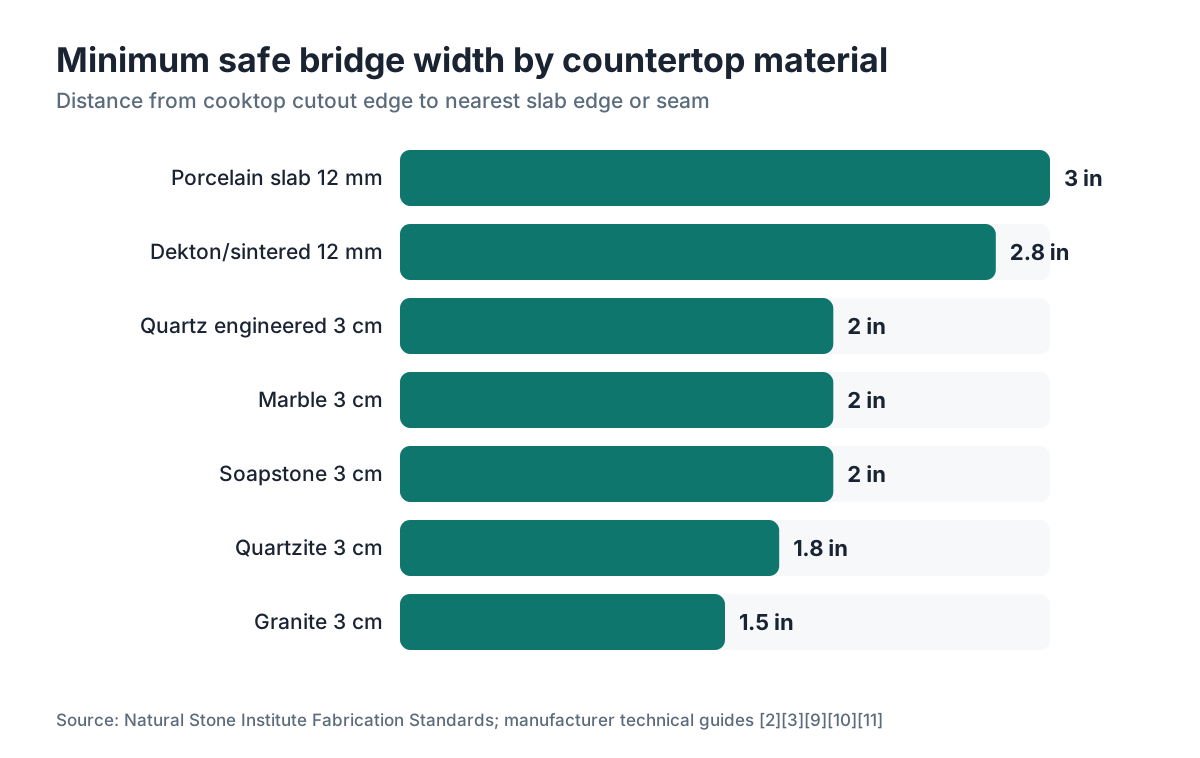
No building code sets a minimum bridge width for countertop stone. The Natural Stone Institute (formerly the Marble Institute of America) publishes the fabrication guidelines that come closest to an industry standard [2]. Those guidelines plus the hard-won habits of working fabricators point to the minimums below.
| Material | Minimum safe bridge width | Notes |
|---|---|---|
| Granite (3 cm) | 1.5 in (38 mm) | Grain structure helps; still reinforce under 2 in |
| Quartz (engineered, 3 cm) | 2 in (51 mm) | Resin binder is brittle; more sensitive to heat |
| Marble (3 cm) | 2 in (51 mm) | Soft and prone to flexural failure |
| Quartzite (3 cm) | 1.5 to 2 in (38 to 51 mm) | Varies by vein orientation |
| Soapstone (3 cm) | 2 in (51 mm) | Relatively soft; cleaves along structure |
| Porcelain slab (12 mm) | 3 in (76 mm) | Thin and extremely brittle without mesh |
| Dekton/sintered (12 mm) | 2.5 to 3 in (64 to 76 mm) | Manufacturer guidelines apply [11] |
| 2 cm natural stone | 2 to 2.5 in (51 to 64 mm) | Thinner slabs have less section depth |
These are working minimums, not promises. A 1.5-inch granite bridge sitting over a fully supported cabinet outperforms a 1.5-inch bridge that cantilevers over open air. Support counts as much as width.
Engineered quartz deserves its own callout. Caesarstone, Silestone, and Cambria all publish technical data sheets with cutout rules [9][10]. Cambria spells out minimum distances between cutouts and edges in its fabrication guide, and those numbers bind the warranty [3]. Cut too close and you void the slab warranty outright, a consequence homeowners rarely hear about until something cracks.
For Cambria countertops specifically, pull the current fabrication guide from the manufacturer before you template a cooktop opening. Not the version from three years ago. The current one.
Why do bridge cuts crack, and what causes the failure?
Three forces break bridges, usually working together.
Flexural stress is the big one. Stone has decent compressive strength (granite averages around 19,000 psi in compression) but far lower tensile strength, roughly 1,000 to 1,500 psi in tension [4]. Lean on the counter near the cooktop, or set a heavy pan down hard, and the bridge bends. Its bottom face goes into tension. Once the tensile stress at the thinnest cross-section beats the material's tensile strength, you get a crack, and it usually runs from the corner of the cooktop opening inward.
Thermal cycling piles on. The stone around a gas burner can reach 300 to 400 degrees Fahrenheit at the surface while you cook, per appliance manufacturer installation data [5]. When the bridge heats up and wants to expand but the larger slab on either side holds it in place, thermal stress builds. Run that cycle a few hundred times and the material fatigues.
Corner stress concentration is the third factor. Cutout corners are the highest-stress points in any plate with a hole, a well-established result in structural mechanics. Sharp square corners create local stress roughly three times the nominal stress in the surrounding material. Rounded corners with a radius of at least 3/8 inch spread that load over a wider area and cut the peak values sharply [6]. Put a bridge next to a sharp corner and you have stacked two risks on top of each other.
How do fabricators reinforce a bridge cut that can't be avoided?
Sometimes the layout is locked and the bridge is what it is. Fabricators have a handful of reliable moves.
Epoxy-set fiberglass or carbon fiber rods are the common one. The fabricator routes a channel into the underside of the slab along the bridge, beds one or two rods in epoxy, fills flush, and lets it fully cure before anything moves. A 3/8-inch carbon fiber rod has a tensile strength around 70,000 to 80,000 psi, which gives a marginal bridge far more resistance to bending [7]. The rod carries no compression, but it stops the bottom face of the bridge from going into tension under normal loads.
Mesh backing is standard on some materials (porcelain slabs often ship factory-meshed) and a fabricator can add it to the bridge zone of natural stone before cutting. It adds less strength than a rod, but it holds fragments together if a crack does run, which matters for safety.
Steel angle brackets can be epoxied to the underside and bolted into the cabinet below, turning some load into bearing rather than cantilever. This works well when the bridge sits directly over a cabinet wall or stretcher.
Layout redesign is the option a good fabricator raises first, before anyone talks reinforcement. Move the cooktop two inches forward, rotate it, or accept a slightly smaller unit, and the bridge problem can vanish. Have that conversation at the template stage, not after the slab is cut and the money is spent.
Fabrication software that models cutout positions against slab edges, like the tools in SlabWise, can flag marginal bridges during quoting and nesting, before any stone gets touched.
Does a bridge cut affect the cooktop warranty or countertop warranty?
Yes, and sometimes directly. On the countertop side, engineered quartz makers nearly all require fabricators to follow published cutout guidelines as a condition of warranty coverage [9]. Cut a bridge narrower than the spec allows, and if the slab cracks, the manufacturer can and does deny the claim on that basis. Homeowners usually learn this only after they file.
The cooktop side works differently. The appliance manufacturer cares less about the stone layout, but many installation manuals set a minimum clearance from the cooktop frame to adjacent edges. That is not the same as a stone bridge, but the two overlap. GE Appliances installation instructions, for example, specify minimum side and rear clearances that have to hold for both performance and warranty [5]. If a narrow bridge forces the cooktop against material that traps heat in a way the design never intended, it can affect ventilation and put the appliance warranty at risk too.
The move is simple. Pull the fabrication guide for the exact slab material and the installation manual for the exact cooktop before you finalize the template. Both are public documents, and the numbers you need sit right in the cutout specification table.
What is the difference between a bridge cut and a standard cooktop cutout?
A standard cooktop cutout is just the opening cut to fit the appliance, with enough stone on all sides that no bridge condition exists. The cooktop manufacturer's template sets the cut size, and as long as you keep two or more inches of stone on every side, you have a standard cutout.
A bridge cut is what you get when one of those margins shrinks to a structurally marginal width. Every cooktop has a cutout. Not every cutout makes a bridge. The bridge is the specific condition of a thin stone remnant, not the opening itself.
Some fabricators use "bridge" more loosely for any narrow span between two openings, including a cooktop and a sink on one run. That usage fits the concept fine, even if it is not the most common case.
How does material thickness change bridge cut risk?
Thickness matters a lot, because bending stiffness scales with the cube of thickness. A 3 cm (about 1.18-inch) slab has roughly 2.4 times the bending stiffness of a 2 cm (about 0.79-inch) slab of the same width [4]. So a 2 cm slab needs a meaningfully wider bridge to carry the same load safely.
That is why 2 cm stone almost never goes into a cooktop countertop without a full plywood substrate underneath. With solid substrate running all the way to the edge of the cutout, the 2 cm material hands most of the bending stress to the substrate. Take the substrate away and a 2 cm bridge is an unreinforced beam with almost no section depth, and it fails easily.
For granite countertops and marble countertops in 3 cm, the bending resistance is a lot better, but corner stress concentration still drives most failures no matter the thickness. The thicker the slab, the more corner radius you need to keep peak stresses down.
What should homeowners ask their fabricator about a bridge cut before signing off?
Five questions are worth asking out loud, before the slab is cut.
First: is there a bridge in this layout, and how wide is it? Ask for the number in inches, not a shrug and a reassurance.
Second: does that width meet the material manufacturer's cutout guidelines? If your top is engineered quartz, that guideline is a published document with specific numbers you can read.
Third: is any reinforcement planned, and what type? Rods, mesh, and brackets each have different strength profiles and different lifespans.
Fourth: does the bridge location affect my warranty? Ask about both the stone and the cooktop.
Fifth: is there a layout change that would remove the bridge entirely? Fabricators sometimes skip this one because it complicates the job. Ask it anyway.
A fabricator who cannot or will not answer these clearly is one to be careful with. Good fabricators think about bridge cuts before they happen, not after the callback.
Can you fix a cracked bridge cut after installation?
Sometimes, but the repair is always a compromise.
For a hairline crack with no displacement, an experienced stone restorer can inject clear low-viscosity epoxy, let it wick in by capillary action, wipe flush, and polish. Under the right light the crack can be nearly invisible. The structural repair is partial: epoxy bonds fragments, but the mended section is weaker than the original, and the same load that caused the first crack can start a second one nearby.
For a crack with fragment displacement, where one side of the bridge has dropped or shifted, the fix becomes cosmetically obvious. Color-matched epoxy fill softens the look, but you will always catch it in raking light. From there the real choices are living with it, cutting out the damaged section and replacing it with a matched piece (very hard with veined stone), or replacing the whole run.
Prevention is far cheaper than repair. Replacing a 10-linear-foot run runs roughly $2,000 to $8,000 depending on material and complexity [8]. A rod reinforcement at fabrication time costs $50 to $150 in materials and a few minutes of shop time. That is the entire argument.
For more on countertop installation choices that lower cracking risk from the start, the substrate under the stone matters as much as the stone.
How do fabrication shops track and avoid bridge cut errors?
Manual verification has always been the baseline. A lead fabricator measures every margin before any cutting starts. Most shops older than a decade have a cooktop opening horror story from before they added that step.
Digital templating with laser or structured-light systems captures every dimension to within a millimeter and lets the shop model the opening on-screen before touching stone. A fabricator sees at a glance whether a bridge condition exists and exactly how wide it is. This is now standard in mid-size and larger shops.
Nesting and job management software adds one more layer. When a cutout drops into a slab layout, good software flags any margin that falls below a configurable minimum. SlabWise's quoting and nesting tools handle cutout management inside the job workflow, so a bad bridge gets caught at the estimate stage, before anyone commits.
Small shops without digital tooling lean on paper templates and careful habits. That works, but the error rate is higher, and the errors show up after the cut, which is too late to fix cheaply.
Does a bridge cut matter differently for gas versus induction cooktops?
The structural concern (a narrow span of stone near the opening) is identical no matter the fuel. The thermal concern is not.
Gas cooktops put open flame above the surface, and the surrounding stone hits higher surface temperatures than it does with induction. For a bridge next to the rear burners on a gas unit, thermal cycling is a bigger stress source.
Induction heats the cookware directly through electromagnetic fields, not the surface, so the stone near an induction zone stays cooler while you cook. But heavy cast iron or thick-bottomed pans hold heat and dump it into the stone when you set them down, and pot-bottom temperatures during cooking can still top 400 degrees Fahrenheit [5]. The thermal stress is lower, not zero.
Mechanically, induction units run slightly heavier than comparable gas units thanks to the electronics and coil assembly, so the installed load on the bridge is a touch higher. In practice that gap is small enough that the same reinforcement standard covers both.
On material choice around induction, kitchen countertops compatibility with induction is its own topic, but it feeds straight into bridge cut material selection.
Frequently asked questions
What is the minimum bridge width for a quartz countertop cooktop opening?
Most engineered quartz manufacturers set a minimum of 2 inches (51 mm) between a cooktop cutout and any edge or adjacent opening. Cambria and Caesarstone both publish fabrication guidelines with these numbers, and cutting closer than specified can void the slab warranty. Check the specific brand's current technical guide before templating.
Does every cooktop cutout create a bridge?
No. A bridge only exists when the margin between the cooktop opening and a nearby edge, seam, or second cutout is too narrow to be structurally safe, generally under 2 inches. A standard cooktop with plenty of stone on all sides has no bridge. The bridge is the narrow remnant, not the cutout itself.
Can a bridge cut be reinforced after the slab is already installed?
It is very difficult. Routing a channel for a reinforcement rod means removing the countertop or working in a brutally awkward position under the slab. Epoxy injection can stabilize a hairline crack but does not fully restore strength. Reinforcing at the fabrication stage, before installation, is far easier and costs a fraction of post-installation remediation.
Will a bridge cut void my cooktop warranty?
Possibly. Cooktop installation manuals specify minimum clearances from the frame to adjacent materials. If a narrow bridge pushes the unit outside those clearances, the appliance warranty may be affected. More often it is the stone manufacturer's warranty at risk: engineered quartz brands void coverage when cutouts fall outside their published fabrication guidelines.
How much does it cost to repair a cracked bridge cut?
A professional stone restoration epoxy fill for a hairline crack typically runs $150 to $400 depending on crack length and location. A structurally failed bridge that needs full section replacement can cost $2,000 to $8,000 or more depending on material and run length. A $50 to $150 reinforcement rod at fabrication is the obvious comparison.
Does the type of stone affect how risky a bridge cut is?
Yes. Porcelain slabs and marble are the most brittle and need the widest bridges. Granite and quartzite in 3 cm are more forgiving but still follow the 1.5-inch practical minimum. Engineered quartz has a resin binder that can creep under sustained thermal load, making it more sensitive to heat at narrow bridges than natural granite of similar thickness.
What corner radius should a cooktop cutout have to protect a bridge?
Most fabrication guidelines recommend a minimum 3/8-inch (about 10 mm) corner radius on cooktop cutouts. Rounded corners reduce peak stress at the corner by spreading load over a larger area. Sharp 90-degree corners concentrate stress at roughly three times the level of the nominal bridge section, which is where most initial cracks start.
Is a bridge cut more common on islands than on perimeter countertops?
Yes. Islands are often narrower than the cooktop depth wants, leaving thin bridges front and back. A typical island runs 25 to 42 inches front-to-back. A 21-inch-deep cooktop opening in a 26-inch island leaves about 2.5 inches on each side before lip and overhang, creating marginal bridges that perimeter countertops against walls rarely see.
Can a laminate or butcher block countertop have bridge cut problems?
Laminate and butcher block handle bridge cuts differently than stone. Laminate on a plywood substrate is more ductile and less likely to crack catastrophically, though it can delaminate at a thin bridge. Butcher block, being wood, can check or split along the grain at a narrow bridge and can take heat damage next to gas burners. Neither is immune.
What should I tell my fabricator to check before they cut the cooktop opening?
Ask them to measure every margin from the cooktop cutout to the nearest edge, seam, or other opening, and confirm each one meets the material manufacturer's cutout spec. Also ask them to verify corner radius and plan any needed rod reinforcement before cutting. That conversation takes five minutes at the template stage and can prevent a very expensive outcome.
How do I know if my existing countertop has a dangerously narrow bridge?
Measure from the edge of the cooktop opening to the nearest countertop edge or other opening. If any side reads less than 1.5 inches on granite or 2 inches on quartz, the bridge is in the marginal range. Also look for hairline cracks at the corners of the cooktop opening. Those are an early sign of stress building before a full failure.
Does a bridge cut affect resale value or home inspection outcomes?
A visible crack or failed bridge gets flagged by a competent home inspector and can become a negotiating point in a sale. Inspectors are not stone specialists, but a cracked countertop next to a cooktop is an obvious defect. Marginal but uncracked bridges rarely come up at inspection, though a thorough inspector who checks kitchen details might note one.
Sources
- National Kitchen and Bath Association, NKBA Kitchen Planning Guidelines: Standard kitchen island depth ranges used in layout planning
- Natural Stone Institute (formerly Marble Institute of America), Dimension Stone Design Manual and Fabrication Standards: Industry fabrication guidelines for cutout margins and minimum bridge widths in natural stone
- Cambria, Fabrication and Installation Guide: Cambria specifies minimum distances between cutouts and edges; violations can void warranty
- NIST (National Institute of Standards and Technology), Engineering Statistics and Materials Reference: Bending stiffness scales with the cube of thickness; granite tensile strength approximately 1,000 to 1,500 psi vs compressive strength around 19,000 psi
- GE Appliances, Cooktop Installation Instructions (general product line): Cooktop installation manuals specify minimum clearances from frame to adjacent materials; stone surface temperatures near burners cited in appliance testing data
- Pilkey, W.D., Peterson's Stress Concentration Factors, Wiley (3rd ed., 2008): Sharp corners in cutouts create local stress concentrations approximately three times higher than nominal stress; rounded corners with adequate radius reduce peak values significantly
- Toray Composite Materials America, Carbon Fiber Product Data: Carbon fiber rod tensile strength approximately 70,000 to 80,000 psi, used as rod reinforcement in stone bridge sections
- USGS (United States Geological Survey), Mineral Commodity Summaries: Dimension Stone: Dimension stone market and material context for countertop replacement cost ranges of approximately $2,000 to $8,000 per standard kitchen run
- Caesarstone, Technical and Fabrication Guide: Engineered quartz manufacturers require fabricators to follow published cutout guidelines as a condition of warranty coverage
- Silestone by Cosentino, Fabrication Guidelines: Minimum edge distances for cooktop cutouts in engineered quartz, consistent with industry standard of 2 inches minimum
- Dekton by Cosentino, Technical Fabrication Guide: Dekton and sintered stone fabrication guidelines specify minimum bridge widths of 2.5 to 3 inches for 12 mm thickness
Last updated 2026-07-11