TL;DR
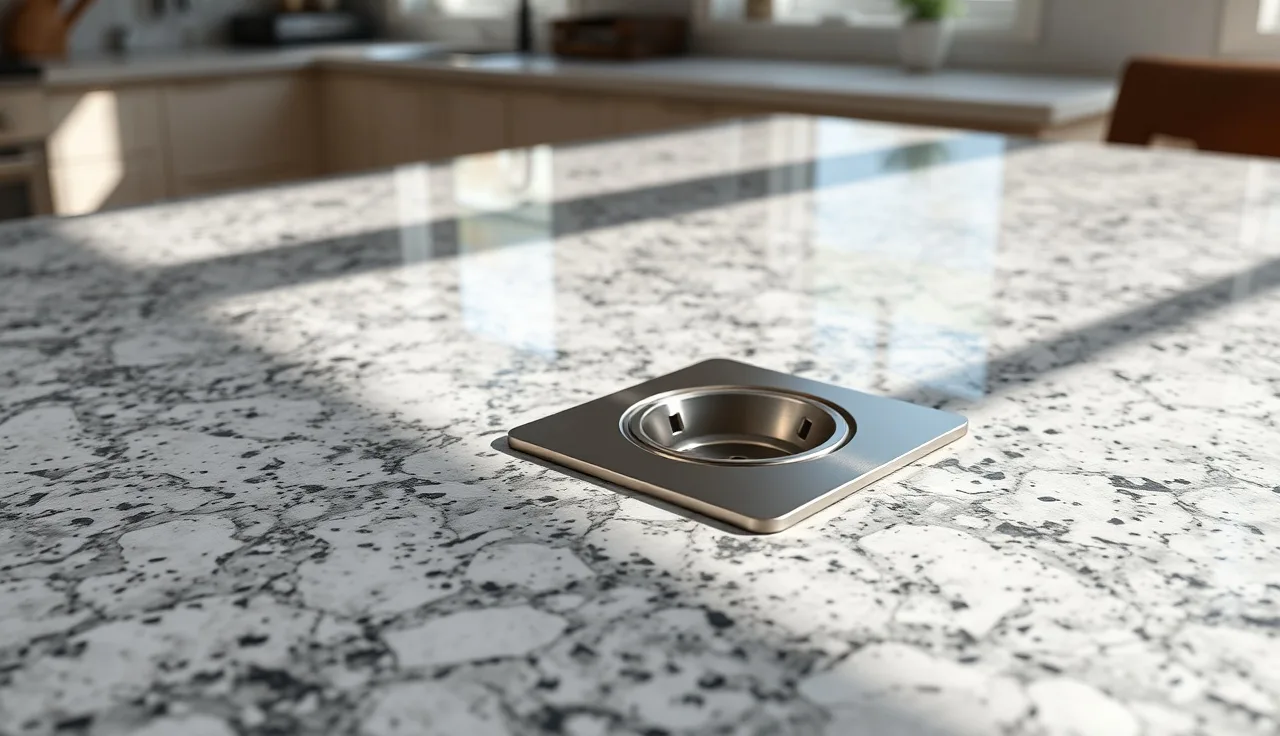
- A flush mount outlet is an electrical receptacle set into a cutout in a stone countertop, sitting level with or just below the surface instead of on a backsplash or wall.
- It keeps the counter clean and puts power where you actually work.
- Installed cost usually runs $150 to $400 per unit, depending on the outlet type and whether the electrical rough-in already exists.
What exactly is a flush mount outlet and how does it sit in stone?
A flush mount outlet drops into a precise cutout in your countertop surface, with the housing living inside the stone and the cover plate landing level with (or a hair below) the finished top. You don't see a box sticking up out of the slab. To use it, you either plug into an always-exposed face or press a button that springs the receptacle up out of its housing.
People also call it a pop-up outlet or a recessed countertop outlet.
There are two main styles. The first is the true flush-face type: a thin metal or trim ring holds a standard outlet face level with the stone, always accessible, always visible. The second is the pop-up or flip-up type, where the outlet hides under a spring-loaded lid you push or slide open. Pop-ups look cleaner when idle. They also cost more and have more moving parts to fail.
The cutout in the stone is usually rectangular, around 2 inches by 3.5 inches for a single-gang flush unit. Pop-up cylinders need a round hole of roughly 3.5 inches in diameter. Your fabricator cuts this with a diamond blade or router during fabrication, before the slab ever goes on your cabinets. You can cut into an already-installed slab, but that carries real risk of cracking, especially with granite or quartzite. Plan these before install day.
The outlet box and wiring run through the cabinet below, same as any under-cabinet rough-in. The National Electrical Code sets the rules for countertop outlets, and a licensed electrician has to make the final connections [1].
Why would someone want a flush mount outlet instead of a standard wall outlet?
Convenience, mostly. A flush mount outlet puts power at the work surface instead of a foot away behind the mixer. Stand at a kitchen island with no backsplash and no nearby wall, and a flush mount is often the only practical way to get an outlet within reach.
Islands drive most of the demand. Building codes in most jurisdictions require an outlet on any island or peninsula counter that measures 12 inches or more in its shorter dimension and 24 inches or more in its longer dimension [1]. No backsplash means that outlet has to go somewhere, and flush mount in the stone is one of the cleaner answers. (The other option is a strip outlet mounted to the side of the cabinet base, which some people prefer.)
Homeowners also pick flush mounts for bathroom vanities, home bars, and outdoor kitchen counters. A vanity with a flush outlet makes a hair dryer or electric toothbrush far less awkward to use. Outdoor kitchens built from concrete or porcelain slabs often spec weatherproof pop-up outlets with GFCI protection.
They show up a lot in kitchen countertops where the backsplash is a full slab of the same material and drilling through it for an outlet would wreck the look.
What types of flush mount outlets are made for stone countertops?
A handful of product families own this market. Here's how they break down.
| Type | Appearance when closed | Typical cutout | Approx. unit cost |
|---|---|---|---|
| Flush face (recessed plate) | Open outlet, trim ring visible | Rectangular, ~2"×3.5" | $30 to $90 |
| Pop-up cylinder | Flat disc or round cap | Round, ~3.5" dia. | $60 to $180 |
| Flip-up lid | Hinged cover, matches trim | Rectangular | $50 to $120 |
| Under-counter swing-out | Hidden under edge | No surface cut | $40 to $100 |
| Wireless charging + outlet combo | Glass pad sits flush | Rectangular | $80 to $250 |
Hubbell, Leviton, and Legrand all make units built for countertop installation. Many of their pop-up and flush-face models ship with GFCI protection built in, which the NEC requires for all countertop outlets in kitchens and bathrooms [1].
For granite countertops and other natural stone, look for a stainless steel or powder-coated trim ring instead of plastic. Plastic rings can telegraph movement over time and leave a visible gap if the stone shifts slightly with temperature.
Some pop-up outlets now pack USB-A and USB-C ports alongside the standard 15A or 20A receptacles. These combos cost more, often $120 to $250 for the hardware alone, but they earn their keep at an island where somebody's phone is always dying.
Marble countertops and softer stones need extra care during cutting, because chips around a rectangular notch can run into a full crack. A fabricator who does pop-up outlets a lot will often use a round hole saw for marble instead of a jigsaw to keep stress fractures down.
Does the NEC require GFCI protection for flush mount outlets in countertops?
Yes. The National Electrical Code, specifically NEC 210.8(A), requires GFCI (Ground Fault Circuit Interrupter) protection on all 125-volt, single-phase, 15A and 20A receptacles that serve countertop surfaces in kitchens, bathrooms, garages, and outdoor areas [1]. It applies whether the outlet is flush-mounted in stone, recessed in a cabinet, or sitting on a standard wall plate.
The NEC updates every three years. The 2023 edition is the current published cycle, but states and cities adopt it on their own schedules. As of 2024, plenty of jurisdictions still enforce the 2020 or 2017 NEC. GFCI protection for kitchen countertops has been in the code for decades, though, so this isn't some new twist.
Here's the practical version. Buy a flush mount unit without integrated GFCI, and your electrician needs either a GFCI breaker on that circuit or a GFCI outlet upstream on the same circuit. Most fabricators and electricians just spec integrated-GFCI pop-up units because it keeps the inspection clean. The International Residential Code (IRC) adopts NEC provisions for electrical work in one- and two-family dwellings [6].
Outdoor countertops get stricter treatment. The NEC and IRC both call for GFCI protection on all outdoor outlets no matter the spot, and any outlet in a wet or damp location needs a weatherproof cover rated for wet conditions [6]. A stainless pop-up built for outdoor use carries a WP (weatherproof) or WR (weather-resistant) marking on the device.
How much does it cost to add a flush mount outlet to a stone countertop?
Cost splits into two buckets: the outlet hardware and the electrical rough-in.
Hardware runs $30 to $250 depending on type, finish, and whether it includes USB ports or wireless charging. A basic recessed flush-face GFCI outlet costs about $30 to $70. A good stainless pop-up with integrated GFCI and dual USB ports runs $120 to $200.
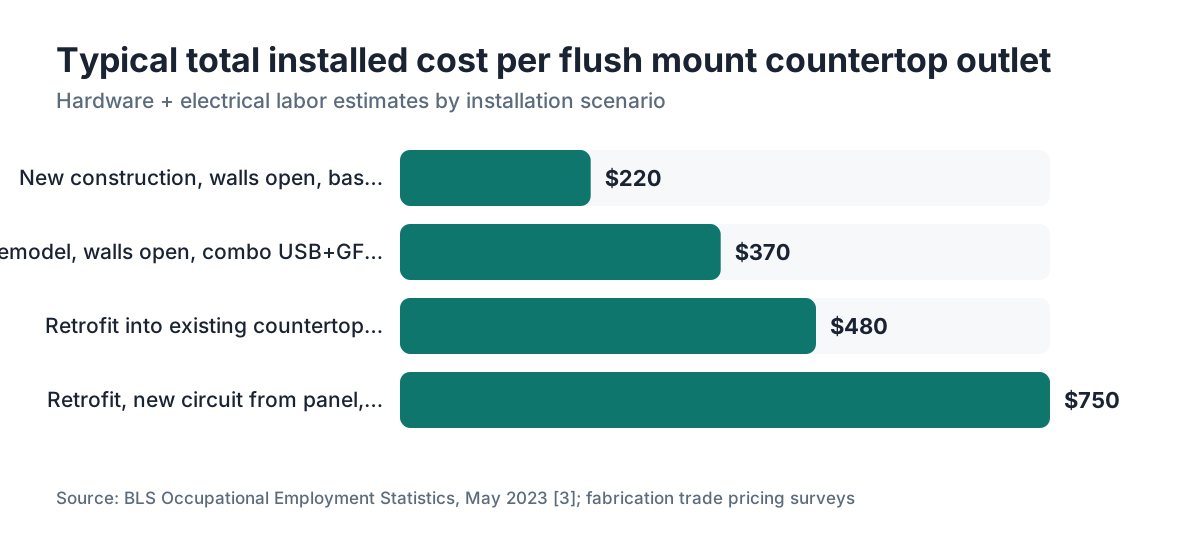
Electrical rough-in is where the number really moves. During a full kitchen remodel with the electrician already running circuits, adding a countertop outlet box might cost $75 to $150 extra for placement and connection. If the countertop is already in and you need a new circuit run from the panel, figure $200 to $600 or more, depending on how far the panel is and whether the walls are open or finished. The U.S. Bureau of Labor Statistics puts the mean hourly wage for electricians at about $61 in May 2023, though residential service calls in metro areas often run $80 to $120 per hour [3].
Fabrication adds a cutting fee. Most shops charge $50 to $150 per cutout for a flush mount opening, separate from the sink and cooktop cutouts on the job. Some fold one or two cutouts into their standard island pricing. Ask before you assume.
Total installed cost per outlet, new construction or a remodel with open walls: $200 to $450. Retrofit into an existing installed countertop with finished walls: easily $400 to $800 once you add drywall patching, a new circuit run, and the fabrication risk premium.
Spec these during the countertop installation phase. Waiting costs you.
Can you cut a flush mount outlet into an already-installed stone countertop?
You can, but you're buying risk. How much risk depends on the stone type, the slab thickness, and how much retrofit work your fabricator has under their belt.
Granite and quartzite are hard and brittle. A rectangular cutout in an installed slab means the fabricator works carefully with a diamond blade, usually plunging from the top. Vibration or blade bind can throw a crack from a cutout corner straight toward an edge or sink opening. Good shops drill relieved round corners before the straight cuts, and they keep the cuts short and wet.
Engineered quartz (brands like Cambria countertops) forgives retrofit cutting a bit more, since the polymer content makes it more ductile than pure stone. Still risky near edges or existing features.
Soapstone and softer stones cut easier after install. Got soapstone or a soft limestone? A retrofit outlet won't cost you as much sleep.
The risk premium is why fabricators charge more for retrofit cuts. If a crack develops, whether they're on the hook depends on your contract, and replacing a section of installed granite island top runs $800 to $2,000 or more in material and labor.
Plan flush mount outlets before fabrication, not after. That's the whole lesson.
What finishes and materials are available for flush mount outlet covers?
The trim ring and cover are the only parts you see, so the finish counts. Common options: brushed stainless steel, polished stainless, oil-rubbed bronze, matte black, satin nickel, and white or almond polymer. Some makers offer custom powder coating.
Brushed stainless is the most common spec in professional installs. It hides fingerprints better than polished stainless and reads neutral against almost any stone. Matte black has climbed alongside the trend toward darker kitchen fixtures.
For marble countertops with white or light veining, a polished stainless or white-trimmed unit can nearly vanish into the surface. On dark granite or soapstone, matte black trim reads intentional instead of utilitarian.
Outdoor jobs should always use stainless steel trim, never polymer or zinc alloy, because UV and moisture chew through cheaper trims over time. Some manufacturers offer 316 marine-grade stainless for coastal installs. Live within a few miles of salt water? Spec it.
Are flush mount outlets safe to use around water on a kitchen countertop?
With the right product and a proper install, yes. The safety is baked into the code requirements and the device specs.
GFCI protection does the heavy lifting [4]. A GFCI outlet or breaker trips in milliseconds when it senses current leaking to ground, which is what happens during a shock. The Consumer Product Safety Commission describes the GFCI as a device that "shuts off an electric power circuit when it detects that current is flowing along an unintended path" [4]. All countertop outlets in kitchens and bathrooms legally require this protection.
Beyond GFCI, the physical design of pop-up and flip-up covers adds water protection. Lid closed, a spill on the surface should not reach the housing. That said, no countertop outlet is built for direct submersion or high-pressure spray. Hose down your counter, or let water pool in the outlet area regularly, and you've got a problem regardless of GFCI.
Installation quality matters a lot here. The housing needs to seat fully in the cutout with no gap between housing and stone. Many installers run a thin bead of silicone around the inside perimeter of the housing flange before dropping it in, which seals against water coming from the top surface. Your fabricator or electrician should do this as standard practice.
For vanity tops and bathrooms, keep the outlet clear of the tub and shower zone and follow NEC 210.52(D) for bathroom receptacle placement [1].
How does a flush mount outlet affect the stone countertop fabrication process?
For a fabricator, a flush mount cutout is a simple feature to plan. It just has to actually get planned. The hole location gets marked on the template during the templating visit and transferred to the slab digitally or with paper patterns.
The big consideration is location relative to the cabinet guts below. The housing has to drop into open cabinet space, not into a drawer slide, shelf, or partition. Your fabricator and electrician need to coordinate on this before the template is final, because once the cutout is in the stone, it doesn't move.
Edge proximity matters too. Most fabricators want at least 2 inches of stone between any cutout and the nearest edge. Get closer and you shrink the section of stone holding tension, which raises crack risk. On an island with an overhang, push the outlet toward the center of the slab, away from the overhang edge.
Fabrication software handles this nesting problem cleanly. Tools like SlabWise let fabricators lay out sink cutouts, cooktop cutouts, and outlet openings at once on a digital slab, so clearance conflicts show up before the saw touches stone. That kind of planning is what keeps expensive mistakes off the job.
For billing, outlet cutouts usually go on the quote as separate line items at $50 to $150 each, which is fair given the setup and execution time.
What stone types work best with flush mount outlets, and which need extra care?
Engineered quartz and solid surface are the most forgiving. The binder matrix in quartz resists propagating cracks from a cutout corner, and solid surface like Corian countertops can even be routed and repaired if something goes sideways.
Granite is the most common natural stone, and it takes cutouts well when the fabricator is competent and the slab is sound. Thicker slabs (3 cm) forgive more than 2 cm.
Quartzite is the wild card. Some quartzite slabs are dense, hard, and cut clean. Others hide natural fissures or softer veins that behave unpredictably under a blade. Have an honest talk with your fabricator about the specific quartzite slab you picked before you add an outlet cutout to the plan.
Marble is soft enough to cut easily but chips at edges more than granite, so corner treatment and blade sharpness matter more. A good fabricator uses a freshly dressed diamond blade for marble outlet cuts.
Soapstone is a pushover in the best sense. You can cut it with woodworking tools in a pinch. Retrofit outlet cutouts in soapstone carry far less risk than in granite. Curious about keeping soapstone looking right after install? See our guide on how to clean soapstone countertops.
Laminate and Formica accept flush outlet cutouts with basically zero crack risk. The router work is simple and the material costs nothing to patch if you slip. See laminate countertops for more on working with these.
How do you choose the right flush mount outlet for your countertop project?
Start with three questions. What load do you actually need? Where does it go? And what finish matches your hardware?
Load: most household countertop appliances (toasters, blenders, coffeemakers) run fine on a 15A circuit. Putting the outlet near a microwave or countertop convection oven? Spec a 20A unit and have the electrician run a 20A circuit to match. A 15A outlet on a 20A circuit is fine under code, but a 20A outlet demands a 20A circuit [5].
Placement: center of the island, roughly inline with where people stand to prep, is the most useful spot. Some designers spec two outlets on a long island, one at each end. Keep the outlet away from where you'd set a dish drying rack or where sink water routinely drains.
Finish: match your faucet and cabinet hardware. Brushed nickel everywhere else means brushed nickel trim. Stainless appliances read well with brushed stainless trim.
Want USB charging built in? Check the USB spec. Older pop-ups have USB-A at 2.1A, which charges phones slowly. Newer units with USB-C Power Delivery can charge a laptop. For an island in a house full of teenagers, USB-C PD is worth the extra $40.
Shops running fabrication quoting software can build outlet cutouts into estimates with a line-item cost per cut plus a hardware allowance. That kills the classic surprise where the homeowner finds out the $300 outlet hardware was never in the countertop quote. If you're a fabricator who wants that process clean, SlabWise handles exactly this kind of itemized quoting.
What are common mistakes homeowners and fabricators make with flush mount outlets?
The biggest one is deciding late. A homeowner walks the finished install and says "actually, I want an outlet in the island" after the countertop is already templated or, worse, installed. That turns a $100 planning decision into a $400 retrofit gamble.
Second most common: no coordination with the electrician before the template. The fabricator cuts exactly where the homeowner pointed, then the electrician finds a drawer slide or structural partition sitting right below. Now there's a hole in the stone that can't reach power without major cabinet surgery.
Third: grabbing a consumer-grade outlet cover at a hardware store instead of a unit built for countertop installation. A standard duplex faceplate has no housing or flange made to sit in stone. It sits crooked, the mounting screws won't hold, and water gets under it.
For fabricators: skipping the corner drill on rectangular cutouts in brittle stone is a bad bet. A 1/4-inch drill hole at each corner costs 30 seconds. A crack through a $900 slab costs the job.
And homeowners sometimes forget to confirm their jurisdiction has adopted the current NEC. Ask your electrician which code cycle your county or city enforces, because that decides exactly which GFCI and spacing rules apply to your project [1] [6].
Frequently asked questions
Can a flush mount outlet be added to any countertop material?
Technically yes, but the risk and process vary widely. Engineered quartz, solid surface, and laminate are the easiest to cut without damage. Granite and quartzite cut cleanly but need an experienced fabricator with the right tooling. Marble chips at edges more easily. Soapstone is very workable. The real key is planning the cutout during fabrication, not after installation.
Do flush mount outlets in countertops require a permit?
In most jurisdictions, yes. Adding or modifying an electrical outlet is electrical work and typically requires a permit and inspection. Requirements vary by city and county, so ask your local building department. Your licensed electrician should pull the permit. Skipping it creates problems at resale and may void your homeowner's insurance if something goes wrong.
Is a pop-up outlet the same as a flush mount outlet?
A pop-up outlet is one type of flush mount outlet. Flush mount refers to any outlet installed recessed into the countertop surface. The pop-up version uses a spring-loaded mechanism to raise the receptacle above the surface when in use and retract it flat when idle. Flush-face and flip-lid styles are also flush mount outlets but don't pop up.
How many outlets does code require on a kitchen island?
The NEC requires at least one outlet on any island or peninsula countertop measuring at least 12 inches in its shorter dimension and 24 inches in its longer dimension. Longer islands may require additional outlets. Check your local code adoption year and verify with your electrician, since some jurisdictions amend these requirements after adoption.
Can I install a flush mount outlet myself or do I need a licensed electrician?
The stone cutting should go to your fabricator, not a DIYer. The electrical connection must be done by a licensed electrician in nearly every jurisdiction. Some states let homeowners do their own electrical work in their own residence, but GFCI countertop circuits still need inspection. Attempting this without permits or proper tools creates real safety risk.
How deep does the cabinet need to be for a flush mount outlet box?
Most countertop outlet housings run 2.5 to 4 inches deep with the lid closed, plus clearance for the wiring connections and box. Standard base cabinets are 24 inches deep with plenty of vertical room, so depth is rarely the issue. What you need to check is whether a drawer, partition, or shelf falls directly below your planned outlet location.
What is the best finish for a flush mount outlet on a white marble countertop?
Brushed stainless or polished stainless both read cleanly on white marble. Polished stainless can nearly disappear on a bright white surface. White polymer trim rings exist and blend in too, though they discolor over time with cleaning products. Avoid oil-rubbed bronze or matte black on very light stone unless you want the outlet to stand out as a design feature.
Can a flush mount outlet include USB charging ports?
Yes. Many manufacturers offer pop-up and flush-face units with one or two standard 15A or 20A receptacles plus USB-A or USB-C ports in the same housing. Units with USB-C Power Delivery charge laptops and tablets quickly. Expect to pay $80 to $200 more for a combo unit versus a basic GFCI flush outlet. These earn their spot at kitchen islands.
Will water damage a flush mount outlet in a kitchen countertop?
A properly installed GFCI flush mount outlet with a tight seal between housing and stone should handle normal countertop water exposure. Spills that run over the surface should not penetrate a well-seated housing. Flooding or sustained pooling near the outlet is a risk regardless of product quality. A silicone bead around the housing flange adds protection. Confirm the unit's IP or WP rating for your application.
How much does a fabricator typically charge just for the outlet cutout, separate from the outlet hardware?
Most fabricators charge $50 to $150 per outlet cutout as a separate line item on the quote. That covers setup, blade wear, and the careful execution a clean opening in stone takes. Retrofit cuts into installed countertops usually cost more, often $100 to $200 or higher, because the fabricator works in place and takes extra precautions against cracking.
Can I put a flush mount outlet on an outdoor stone countertop?
Yes, but you need a unit rated for wet or damp outdoor locations, with a weatherproof lid. The NEC requires GFCI protection for all outdoor outlets. In coastal areas, use 316 marine-grade stainless trim to resist corrosion. The wiring and circuit must also be outdoor-rated. An outdoor kitchen is a common, practical application for flush mount outlets in concrete, porcelain, or granite.
Does a flush mount outlet affect the structural integrity of a stone countertop?
A properly located and cut opening doesn't meaningfully weaken a countertop slab. The key is keeping at least 2 inches of stone between the cutout and any edge, seam, or other opening. Placing a cutout too close to a sink opening or within an inch of an overhang edge leaves a thin web of stone that can crack under load. Proper placement prevents this.
Is a flush mount outlet worth the extra cost compared to a standard backsplash outlet?
For a kitchen island with no backsplash, it's often the best practical option, and code requires an outlet there anyway. For standard perimeter counters with a tile or stone backsplash, a wall outlet is usually cheaper and easier. The flush mount premium makes more sense when looks are the priority and budget isn't the tight constraint.
Sources
- National Fire Protection Association, NFPA 70 National Electrical Code (NEC), 2023 Edition: NEC 210.8(A) requires GFCI protection on all 125V 15A and 20A countertop receptacles in kitchens and bathrooms; NEC 210.52 covers required outlet placement on islands and peninsulas; NEC 210.52(D) covers bathroom receptacle placement
- International Code Council, International Residential Code (IRC), 2021 Edition: The IRC references NEC provisions for electrical work in one- and two-family dwellings, including GFCI protection on countertop circuits
- U.S. Bureau of Labor Statistics, Occupational Employment and Wage Statistics, Electricians (SOC 47-2111), May 2023: Mean hourly wage for electricians was approximately $61 in May 2023 per BLS national data
- U.S. Consumer Product Safety Commission, Ground Fault Circuit Interrupters (GFCI) safety information: A GFCI shuts off an electric power circuit when it detects current flowing along an unintended path, protecting against electric shock in wet environments like kitchens and bathrooms
- National Fire Protection Association, NFPA 70 NEC 2023, Article 406 Receptacles, Cord Connectors, and Attachment Plugs: NEC Article 406 sets installation requirements for receptacles, including countertop-installed receptacles and their housing standards; 20A receptacles require a 20A branch circuit
- International Code Council, International Residential Code 2021, electrical provisions: IRC electrical chapters reference NEC requirements for GFCI protection on countertop circuits and outdoor receptacles, including weatherproof covers for wet locations
- U.S. Bureau of Labor Statistics, Producer Price Index: Used as context for pricing ranges of stone fabrication labor; BLS PPI tracks construction material and fabrication costs
- U.S. Department of Energy, Energy Saver, residential electrical safety guidance: Background reference for safe electrical installation practices in residential kitchen renovation contexts
- Natural Stone Institute (formerly Marble Institute of America), stone fabrication guidelines: Industry guidance on proper cutting techniques for natural stone countertops, including corner drilling to reduce cracking at rectangular cutouts
- National Electrical Manufacturers Association (NEMA), device standards: NEMA establishes device standards for GFCI receptacles, including countertop-installed units, weatherproof ratings, and USB charging port specifications
Last updated 2026-07-11