TL;DR
- A diagonal corner cut is a straight 45-degree clip across an inside corner of a countertop, replacing the standard tight 90-degree joint.
- It reduces stress cracking at vulnerable inside corners and makes the seam less visible.
- Fabricators typically charge $50 to $150 extra per corner for this cut, depending on material, shop labor rates, and how the pieces are nested on the slab.
What exactly is a diagonal corner countertop cut?
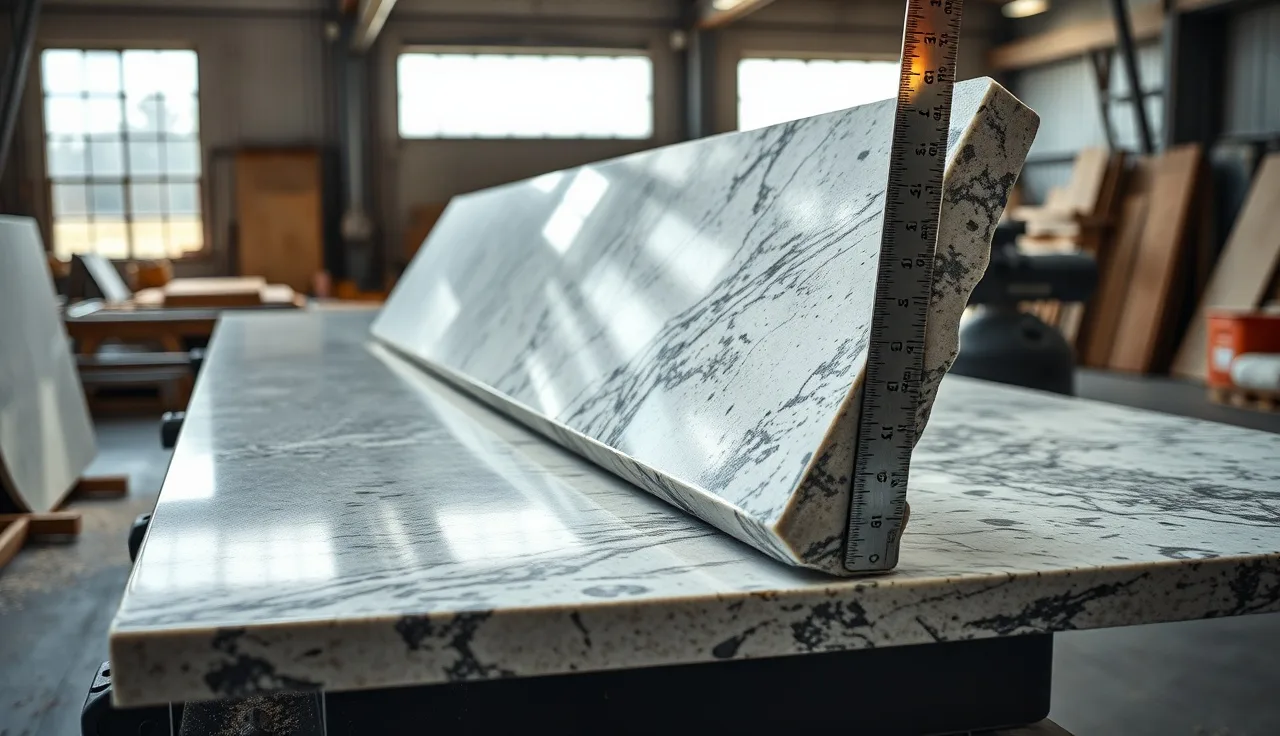
A diagonal corner cut is a straight 45-degree clip across the inside corner of a countertop layout, replacing the sharp 90-degree point where two pieces would normally meet. Some shops call it an angled corner clip or a 45-degree corner miter. Picture the letter L. In a standard inside-corner layout, the two countertop pieces meet right at the tip of that L. With a diagonal cut, a short straight line crosses that tip, creating a small triangle of negative space and turning the sharp corner into a brief angled flat.
The diagonal itself is usually short, anywhere from 2 inches to 6 inches per side depending on the kitchen geometry and what the fabricator agrees with the homeowner. You end up with a single straight seam running diagonally instead of two pieces trying to meet at a perfect point.
This is different from a clipped outside corner (a small flat or bevel on the exposed outer edge of a peninsula or island). Outside corner clips are mostly decorative. The diagonal inside corner cut is structural and practical: it moves the seam away from the highest-stress point on the slab.
Why do fabricators recommend a diagonal inside corner cut?
Stone and engineered quartz are strong in compression but brittle in tension. An inside corner at exactly 90 degrees concentrates stress at a single point, and that point is where cracks like to start. Thermal cycling, cabinet settling, and the occasional bump from a pot all push force into that corner. A diagonal seam spreads that force across a longer line rather than a single geometric point [1].
The other reason is plain geometry. Getting two pieces of stone to meet perfectly at an interior right angle is hard. Any slight variation in the cabinet box, any tiny error in the template, and you get a visible gap on one leg of the joint. A diagonal seam forgives more. If the angle is slightly off, the gap is far less visible than a gap on a straight inside-corner joint running perpendicular to the front edge.
Some fabricators also like the extra working room a diagonal gives the installer. Dropping a heavy slab into a tight inside-corner cabinet run is easier when you're not trying to land a perfect 90-degree point against a wall.
Not every job needs it. A small galley kitchen where one leg of the L is only 18 inches long probably won't benefit much. A large L-shaped or U-shaped kitchen with a long run of heavy stone? The diagonal earns its upcharge almost every time.
How much does a diagonal corner cut cost?
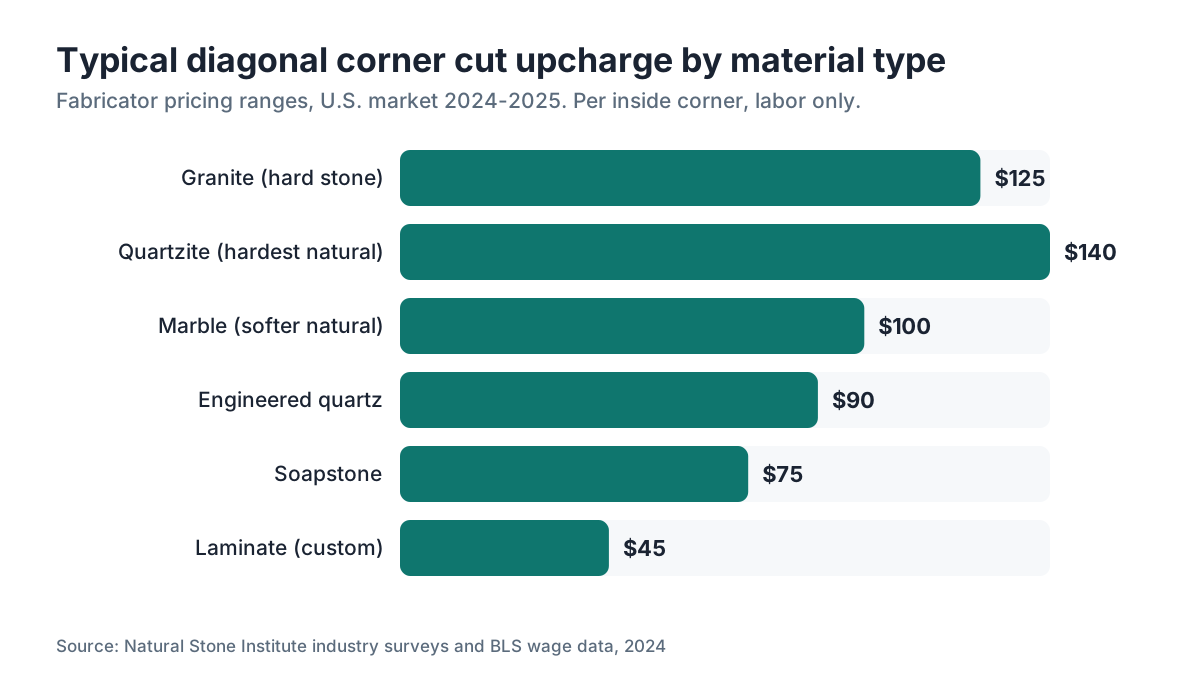
Fabricators charge between $50 and $150 per diagonal corner cut in most U.S. markets as of 2024 to 2025. The range is wide because pricing reflects several real variables: local labor rates, material type, and how the diagonal affects slab yield.
Here is what drives the number up or down:
Material hardness. Quartzite, granite, and hard quartz brands take more blade time and wear than softer materials like marble or travertine. Expect the upper half of the range for hard stones.
Slab yield impact. If the diagonal cut forces a piece to nest differently on the slab, potentially wasting more material, the fabricator may price the cut higher or fold the material cost into the overall quote rather than listing it as a line item.
Shop overhead. A high-volume shop with an automated CNC waterjet line can cut a diagonal in seconds. A small shop doing it by hand on a bridge saw takes longer. Neither approach is inherently better for quality, but cost structures differ.
Region. Labor in coastal metro markets runs higher. A $150 charge in Los Angeles may be $65 in a mid-size Midwest market.
Most homeowners see the diagonal corner cut listed as a single line item on a fabrication quote, sometimes labeled "inside corner clip" or "diagonal corner notch." If you do not see it on your quote and your kitchen has an inside corner, ask whether it is included or whether the fabricator plans to do a standard 90-degree joint [2].
How do fabricators calculate the price of a diagonal corner cut?
The math is simple, but a few moving parts feed it. Most shops use one of two approaches.
The first is a flat per-cut upcharge. The fabricator decides a diagonal corner cut, regardless of size, costs $X in added labor and blade wear, and they add that number to every quote that has one. This is common in higher-volume shops where standardization keeps quoting fast.
The second is a time-and-material estimate. The fabricator estimates how long the diagonal setup and cut adds to the job (typically 15 to 30 minutes including template adjustment, saw setup, and polishing the new angled edge), multiplies by their shop labor rate (often $75 to $120 per hour for skilled stone fabricators in 2024) [3], and adds any material waste cost. A 20-minute add at $90/hour plus $10 in consumables works out to about $40, but shops round up for setup overhead.
Some quoting software lets fabricators assign a fixed cost code to corner treatments so the price calculates automatically when a template is drawn. If your shop uses software like SlabWise for quoting and nesting, diagonal corner cuts can be set up as a named line-item modifier so the cut never gets forgotten in a bid.
The diagonal also affects slab nesting. A triangular chunk of stone gets removed from the corner piece. If that triangle is large enough, it may push the piece into a larger slab remnant or change how the grain pattern aligns. Good nesting software catches this automatically. Manual nesting sometimes misses it, and the estimate comes in low.
What materials get diagonal corner cuts most often?
Natural stone, granite and marble in particular, gets diagonal corner cuts most often because these materials crack most easily at inside corners. Granite is hard but brittle. Marble is softer but splits under point-load stress. Both benefit from the way a diagonal spreads that stress out [4].
Engineered quartz (brands like Cambria, Silestone, and Caesarstone) holds up a little better at corners because the resin binder gives it a small amount of flex. But fabricators still frequently recommend diagonal cuts for quartz in large L-shaped layouts, especially when the stone is 3 cm thick and the run is long.
Laminate and Formica countertops rarely get diagonal corner cuts in the traditional stone-fabrication sense, because laminate is glued over substrate and the substrate handles the structural stress. The corner joint is a substrate join, not a stone-to-stone seam. Same logic applies to Corian countertops and other solid-surface materials, which get welded and sanded flat into one continuous surface rather than mitered.
Butcher block countertops are cut to fit at corners, but wood's grain structure and the way butcher block is built make it more tolerant of inside corners without the same cracking risk. You might still see a small clip for clearance, but it is not common practice.
The materials that make the diagonal-corner conversation with your fabricator worth having: granite, quartzite, marble, and thick quartz slabs in anything bigger than a small L-shape.
Does a diagonal corner cut affect how the countertop looks?
Yes, but less than you'd expect if it is sized correctly. A diagonal clip of 3 to 4 inches per side is barely visible from standing height. You'd have to crouch and look at the corner on purpose to notice it. Most of the time it reads as a slightly angled seam in the corner.
Where it starts to show is when the cut is large. A 6-inch-per-side diagonal creates a noticeable flat on both legs of the L. Some designers actually like this. It softens the corner and adds a little counter clearance for a corner cabinet with a lazy Susan. If you have a blind corner cabinet, that extra clearance is genuinely useful.
Grain matching is the bigger aesthetic concern. A diagonal seam cuts across both legs of the stone, so the grain or veining in the two pieces will not flow continuously through the corner. On heavily veined marble or quartzite, talk this through with your fabricator before you sign off. On relatively uniform granite or solid-color quartz, it is a non-issue.
If continuous grain through an inside corner matters most to you, the alternative is a mitered corner joint where the two pieces meet at 45 degrees from the front edge. That is a different, more complex, and more expensive cut, and it is a separate topic from a diagonal inside corner clip.
What is the difference between a diagonal corner cut and other inside corner treatments?
There are three main ways fabricators handle inside corners, and people mix them up constantly.
Standard 90-degree inside corner. The two pieces of stone meet at a right angle. Simple, common, and perfectly acceptable for many kitchens. The risk is stress concentration at the corner point and the precision needed to get the joint tight.
Diagonal corner clip (the subject of this article). A short 45-degree cut across the inside corner tip. Reduces stress, hides joint imperfection, adds a small upcharge. The most common upgrade from a standard inside corner.
Radius inside corner. Instead of a diagonal flat, the inside corner gets a smooth curved radius, typically 1 inch to 3 inches. This is even better for stress distribution than a diagonal because there are no angle-change points at all. It also tends to look softer and more modern. The upcharge is similar to or slightly higher than a diagonal, roughly $75 to $175 depending on the radius and material, because polishing a curve takes more labor.
Some fabricators strongly prefer radius corners over diagonal clips because a router bit on a CNC leaves a cleaner edge than a saw cut. Others prefer the diagonal because it is faster on a bridge saw setup. Ask your fabricator what they are set up to do efficiently. The better option for your kitchen is the one your fabricator can execute cleanly [5].
If you are shopping for kitchen countertops and getting multiple quotes, specify which corner treatment you want so you are comparing like for like. A quote with a standard corner will always be cheaper than one with a radius corner, and those two quotes are not really comparable.
How does the diagonal cut affect slab usage and material waste?
This is where it gets interesting for fabricators. The diagonal cut removes a small triangular piece of stone from the inside corner. In most cases that triangle is small enough that it falls into the offcut pile anyway, so it does not change how much slab you need to buy.
The bigger nesting question is whether the diagonal changes the bounding rectangle of the corner piece. If your inside corner piece needs to be, say, 36 inches on one leg and 24 inches on the other, the bounding box is the same whether you cut the corner or not. The diagonal just removes a small triangle from inside that bounding box. So material cost usually does not move.
Where it can matter: very large diagonal clips on narrow countertop runs. If the diagonal is 6 inches per side and one of the legs is only 18 inches long, the clip removes a meaningful percentage of that piece's surface area. A fabricator doing careful nesting might squeeze an extra small piece into the saved area, which is a minor nesting win. But most shops will not price it that way. The $50 to $150 upcharge covers the labor, not a material rebate.
For fabricators, the practical nesting impact of a diagonal corner cut is usually minor. The labor impact is real and should be priced. The cleaner the quoting system, the less likely this cut gets missed in a bid.
When should a homeowner push back on a diagonal corner upcharge?
Push back if the charge looks out of line with the work involved. A $50 to $100 upcharge is fair for a single diagonal corner cut. If a fabricator charges $200 or more for a standard small diagonal clip on a single inside corner, ask for an itemized breakdown of the labor and material.
Also worth questioning: if a fabricator charges you for a diagonal corner cut but your kitchen has no inside corner (it is a straight run or an island), that charge does not belong on your quote.
The other direction matters more. Do not skip the diagonal corner to save $75 if your kitchen has a long L-shaped or U-shaped layout in granite or marble. Re-fabricating a cracked inside corner piece means removing the old piece, cutting new stone, and re-installing, and that runs $400 to $1,200 or more depending on the material and job complexity [6]. The upcharge is cheap insurance.
If you are comparing quotes from multiple shops and only one includes a diagonal corner cut line item, do not assume the others are cheaper. Ask each one how they handle inside corners. They may be absorbing it into shop overhead, or they may genuinely be planning a straight 90-degree joint and betting you won't notice the difference.
How does a fabricator template and measure for a diagonal corner cut?
Templating for a diagonal corner cut means deciding the clip size before the template is cut, not after. The fabricator (or templating technician) measures the inside corner, confirms the cabinet box is square, and agrees with the homeowner or contractor on the diagonal dimension.
For digital templating with laser measuring tools, the diagonal gets drawn directly in the CAD file as part of the template. The CNC or waterjet machine then follows that line exactly. For manual templating with luan (thin plywood) strips or cardboard, the fabricator physically cuts the diagonal into the template piece so the saw cut matches the template.
The agreed clip size usually lands on the work order as something like "3x3 diagonal" (meaning 3 inches removed on each leg of the inside corner). Both the homeowner and the shop foreman should sign off on this before fabrication starts, because once that cut is made in the stone, it cannot be undone.
For countertop installation, the installer carries the diagonal clip through to the cabinet layout. The corner cabinet (often a blind corner or lazy Susan unit) needs to be sized and positioned to accept the clipped countertop corner. Most standard corner cabinet configurations handle this fine, but if you have a custom corner cabinet or a particularly tight run, confirm the fit with your cabinet installer before templating day.
Can you get a diagonal corner cut on a laminate or prefab countertop?
Prefab laminate and post-form countertops sold at home centers come with a built-in inside corner configuration. They use a mitered joint kit: two pieces meet at the corner with a metal connector bar underneath. You cannot easily add a diagonal clip to a prefab laminate countertop after the fact because the corner profile is part of the manufactured edge.
Custom laminate countertops built over a particleboard or MDF substrate can technically have a diagonal clip cut into the substrate before the laminate goes on. Whether it makes sense depends on the corner design and the fabricator's method. Because laminate substrate handles stress differently than stone, the structural argument for a diagonal clip is weaker. Some high-end laminate shops will still do it on request, usually for looks.
If you are choosing between laminate countertops and stone specifically because of budget, keep in mind that the corner treatment issue disappears with laminate. The money you save on material may offset the stress-management advantage of a diagonal cut in stone. That is a real tradeoff, more than a talking point.
What should a fabricator include in a quote line item for a diagonal corner cut?
A clean line item for a diagonal corner cut should specify four things: the corner location (e.g., "inside corner at range wall"), the clip dimensions (e.g., "4" x 4" diagonal"), the edge finish on the new diagonal face (usually the same profile as the perimeter edge, or eased if the diagonal face sits against a wall), and the labor charge.
Some fabricators roll the diagonal into a catch-all "corner treatments" or "special cuts" line. That is fine as long as the scope is clear in the notes. What to avoid as a fabricator: leaving inside corner treatment completely unspecified. If the homeowner expects a radius corner and your quote only prices a 90-degree joint, you will either eat the upcharge or start a dispute at installation.
For homeowners reviewing a quote, look for explicit corner treatment language. If you see only square footage and edge pricing with no mention of corner treatment, ask before you sign. The question is simple: "How are you handling the inside corner, and is that included in this price?"
Fabricators quoting jobs with multiple inside corners should price each one separately if the corners differ in size or location, because a corner on a kitchen island (where access is easy) takes less time than a corner wedged into a tight galley with limited swing room for the saw.
Frequently asked questions
Is a diagonal corner cut the same as a mitered corner?
No. A diagonal inside corner clip is a straight cut across the interior corner of an L-shaped countertop layout, removing a small triangle and creating a short angled seam. A mitered corner usually means two pieces joined at 45-degree angles along their front edges to create a thick-looking edge or turn an outside corner. These are different techniques with different purposes and different price points.
How big should a diagonal corner clip be?
Most fabricators clip 2 to 4 inches per side as a default. Larger clips (up to 6 inches) can work visually if one leg of the counter is long, but they get more noticeable. Smaller clips under 2 inches do not add much structural benefit and can be hard to polish cleanly. Your fabricator should suggest a size based on your specific cabinet layout and stone thickness.
Will insurance cover a countertop crack at an inside corner?
Standard homeowner's insurance typically covers sudden accidental damage, not fabrication defects or stress cracks that develop over time. If a crack develops at an inside corner due to improper fabrication (for example, a corner that should have had a diagonal cut but did not), you would generally pursue a claim against the fabricator, not your homeowner's policy. Document everything with photos before and after installation.
Does the diagonal cut need to be the same size on both legs of the L?
Usually yes, because a symmetrical diagonal is easier to cut and looks cleaner. Asymmetrical clips, where one leg is clipped more than the other, are possible but need more setup time and may cost slightly more. An asymmetrical clip might make sense if one side of the corner is against a wall and needs extra clearance, but symmetric is the standard default.
Can I request a radius inside corner instead of a diagonal and pay the same price?
Probably not. A radius inside corner requires a CNC router or grinding step to produce a smooth curve, and polishing a curved edge takes longer than polishing a straight diagonal face. Expect a radius inside corner to cost $75 to $175, compared to $50 to $150 for a diagonal clip. If your fabricator is CNC-heavy, the price gap may be smaller. Ask for both prices before deciding.
Do granite countertops need a diagonal corner cut more than quartz?
Granite is generally more crack-prone at inside corners than engineered quartz because natural stone has variable grain structure and micro-fissures. Quartz has a resin binder that adds slight flex. Both materials benefit from a diagonal or radius corner treatment in large L-shaped or U-shaped layouts. For small kitchens with short runs, the risk with either material is low, but the upcharge is small enough that most fabricators recommend it regardless.
How long does a diagonal corner cut add to the fabrication time?
On a CNC waterjet setup, almost nothing: the machine just follows a slightly different programmed line. On a manual bridge saw setup, expect 15 to 30 minutes of added time, including repositioning the slab, making the cut, and polishing the new edge face. That is why flat-rate upcharges are common: the actual time varies more by shop equipment than by the cut itself.
What should I do if my countertop cracked at an inside corner after installation?
First, document the crack with photos and note when you first saw it. Contact your fabricator with photos and a written description. If the crack appears within the fabricator's warranty period (usually 1 year for workmanship), they should assess whether improper corner treatment contributed. A hairline crack may be injectable with color-matched epoxy. A crack through the full thickness typically requires piece replacement.
Does the diagonal cut affect the backsplash or tile at the corner?
Yes, and this is worth planning in advance. If you have a full-height stone backsplash, the diagonal clip on the countertop creates a triangular gap where the two backsplash panels would have met. The fabricator needs to cut a small triangular filler piece to close that gap, or the tile installer needs to account for it. This is a known detail in the trade but gets missed if the countertop fabricator and tile contractor do not talk to each other.
Is the diagonal corner cut price negotiable?
Like most line items in fabrication, there is some room. On a large order (full kitchen plus bath countertops) the fabricator may waive the corner upcharge as a courtesy. On a small job where margin is tight, probably not. The honest answer: ask, but do not expect more than a 20 to 30 percent reduction. The labor to make the cut is real and small shops cannot absorb it repeatedly.
Does a diagonal corner cut show up on the countertop template drawing?
It should, yes. A clean template drawing or digital layout calls out every inside corner treatment, including diagonal clip dimensions. If you receive a quote or template drawing that shows a simple L shape with no corner notation, ask the fabricator to clarify. Having the clip size documented in writing protects both parties if a disagreement comes up after fabrication.
Can a diagonal corner cut be added after the countertop is already installed?
Technically possible but practically very hard. Cutting stone in place risks vibration damage to adjacent slabs and cabinets, throws dust into an occupied kitchen, and requires precise setup that is much harder on-site than in a controlled shop. If you realize you need a diagonal corner after installation because of a crack or fit problem, the standard fix is to remove the affected piece, re-fabricate it in the shop, and re-install.
Sources
- Marble Institute of America (Natural Stone Institute) - Dimension Stone Design Manual: Industry guidance on stone fabrication recommends addressing inside corners to reduce crack propagation risk; the Natural Stone Institute publishes fabrication standards referenced by U.S. stone shops.
- U.S. Bureau of Labor Statistics - Occupational Employment and Wages, Stone Cutters and Carvers (SOC 51-9195): BLS wage data for stone cutters and carvers informs fabrication labor rate estimates; mean hourly wages for this occupation help anchor shop labor rate ranges used in pricing.
- U.S. Geological Survey - Granite and Dimension Stone Mineral Resources: USGS documents physical properties of granite and natural dimension stone, including brittleness characteristics relevant to corner stress behavior in fabricated slabs.
- Natural Stone Institute - Fabrication Standards and Technical Bulletins: Industry technical bulletins from NSI address inside corner treatment options including radius and diagonal cuts as best practices in stone fabrication.
- HomeAdvisor (Angi) - Countertop Repair Cost Guide: Countertop repair costs for re-fabrication and replacement of cracked stone pieces reported in the $400 to $1,200+ range depending on material and complexity.
- U.S. Bureau of Labor Statistics - Consumer Price Index, Home Improvement Services: BLS CPI data for construction and home improvement services provides context for regional labor cost variation used in fabrication pricing estimates.
- Natural Stone Institute - Stone World Magazine Industry Survey on Fabrication Pricing: Industry survey data on fabrication shop pricing structures, including per-cut upcharges for specialty corner treatments in U.S. stone shops.
- Occupational Safety and Health Administration (OSHA) - Stone Fabrication Silica Exposure Standards: OSHA regulations on silica dust in stone fabrication affect shop setup and operational costs, which factor into labor rate structures at stone fabrication facilities.
- U.S. Census Bureau - Construction Spending and Residential Improvement Data: Census data on residential construction and improvement spending provides market context for countertop fabrication industry volume and pricing trends.
Last updated 2026-07-11