
TL;DR
- The Certified Stone and Tile PRO (CSTP) is a professional credential from the Natural Stone Institute.
- It confirms you understand stone and tile fabrication, installation, and care.
- Earning it takes about 40 hours of approved coursework plus a proctored written exam, then renewal every three years.
- It's built for fabricators, installers, and remodeling pros who want a recognized industry qualification.
What exactly is the Certified Stone and Tile PRO credential?
The Certified Stone and Tile PRO, shortened to CSTP, is a formal certification run by the Natural Stone Institute (NSI), the main trade association for the dimension stone industry in North America [1]. It sets a measurable, consistent standard for people who work with natural stone and tile, in fabrication shops, on install crews, and across the remodeling and construction trades.
The program came out of NSI's education work. For decades the organization published technical manuals and ran training, but there was no single credential a customer or general contractor could point to and say, "Yes, this person has been tested and verified." The CSTP fills that gap.
It covers a lot of ground: stone types and their properties, handling and storage, fabrication methods, installation techniques, surface care, and job-site safety. That breadth is on purpose. The credential is meant to be useful for a countertop fabricator cutting granite countertops in a shop and for an installer setting marble countertops in a bathroom.
The CSTP is not a license. It doesn't legally authorize you to do anything you couldn't do before. What it does is give you, your employer, and your customers a third-party confirmation that you know the material at a professional level.
Who issues the CSTP and can they be trusted?
The Natural Stone Institute is the organization behind the credential [1]. NSI formed in 2015 from the merger of two older trade groups, the Marble Institute of America (founded 1944) and the Building Stone Institute (founded 1919), so the institutional history runs more than a century [7].
NSI publishes the Dimension Stone Design Manual, the closest thing the industry has to a code-reference document for natural stone work. It also sets the ANSI-accredited standards used in stone installation specs [2]. That matters for credibility. A certification built on the same technical framework architects and specifiers actually cite in project documents carries real weight.
The credential is not government-issued or state-regulated, so it won't show up on a contractor license lookup. But in a trade where licensing is patchy (countertop fabricators are largely unregulated in most states), a recognized credential from the dominant trade group is about as close to meaningful third-party vetting as you'll find [10].
NSI also keeps a public directory of CSTP holders, so a homeowner or builder can verify the credential independently. That searchability matters more than people think.
What topics does the CSTP exam actually cover?
The exam content maps to NSI's technical education curriculum. Based on published program materials, the subject areas include [1]:
| Subject Area | Scope |
|---|---|
| Stone identification | Types, geological formation, physical properties |
| Fabrication basics | Cutting, edging, surface finishes, tolerances |
| Installation methods | Substrate prep, setting materials, grouting, sealing |
| Surface care | Cleaning chemistry, stain removal, sealing protocols |
| Job safety | OSHA-relevant practices, dust control, tool safety |
| Business and estimating | Basic quoting, scope of work, client communication |
The fabrication section is where most shop-floor candidates feel at home. The installation and surface-care sections trip up people who've spent a whole career on one side of the trade. Worth knowing before you sit for the exam.
Stone identification is tougher than most expect. Knowing a customer's stone is quartzite versus marble versus dolomitic marble is not academic pedantry. The wrong sealer or cleaning product can etch the surface or strip a finish. The exam tests the practical consequences, more than the taxonomy.
For homeowners researching this credential, the surface care content matches what you'd find in a guide on how to clean stone countertops or how to clean quartzite countertops. A CSTP holder should answer those questions correctly without looking anything up.
How long does it take to earn the CSTP?
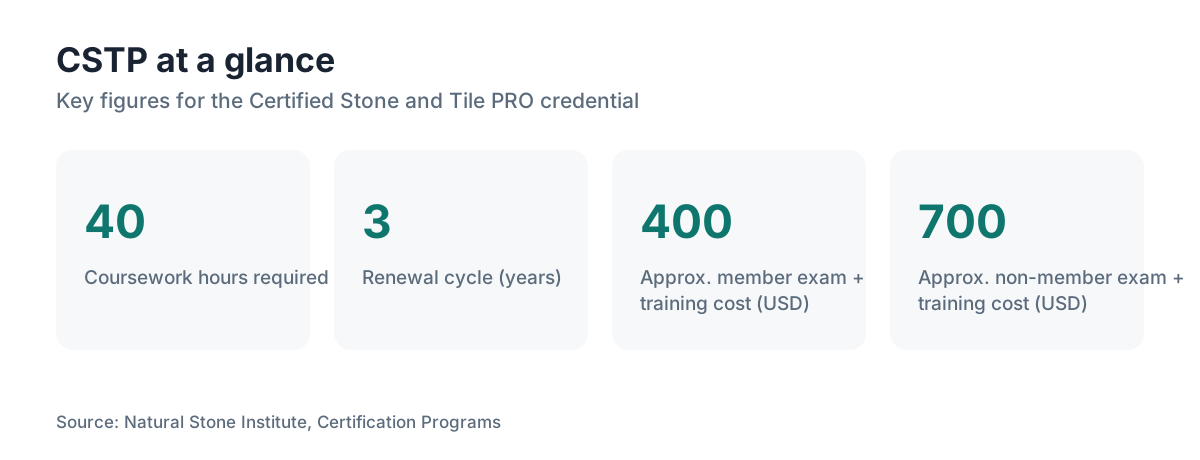
Plan on about 40 hours of approved coursework, delivered through NSI's online education platform [1]. That's roughly a full work week, though most candidates stretch it across several weeks while keeping their day job.
After the coursework you sit for a proctored written exam. NSI has run exam sittings at its annual trade show (Coverings) and at approved testing locations, and remote proctoring options have expanded since 2020. The lag between finishing coursework and sitting for the exam is usually a few weeks, depending on availability.
Start to finish, most candidates report six weeks to four months, depending entirely on how hard they study. There's no minimum clock time between modules, so a motivated person with prior stone experience can compress the coursework a lot.
Once earned, the credential needs renewal. NSI requires continuing education to keep the CSTP in good standing, typically through training credits over a three-year cycle [1]. That renewal requirement is what separates a living credential from a one-time certificate collecting dust on a wall.
How much does the CSTP cost?
Exam and training fees depend on your NSI membership status. Members pay reduced rates across every program. Based on publicly available NSI fee schedules, expect rough costs in these ranges [1]:
| Status | Approximate cost |
|---|---|
| NSI member | $300 to $500 for training + exam |
| Non-member | $500 to $900 for training + exam |
Those are estimates based on NSI's published pricing. They shift periodically, and NSI sometimes bundles training with membership promotions. Check naturalstoneinstitute.org for current numbers before you budget.
Annual NSI membership for a small fabrication shop runs roughly $500 to $1,000 depending on company size and revenue tier [1]. If you're a shop owner sending multiple employees through the CSTP, the member discounts alone can cover the membership.
For individual tradespeople not tied to a member company, the non-member price is real money. Is it worth it? Depends on your market. In regions where general contractors and architects actively specify stone credentials on commercial jobs, the CSTP can be the difference between winning a bid and getting screened out. In residential markets that compete mostly on price, the payback is murkier.
Who should get the CSTP: fabricators, installers, or both?
Both, honestly. The credential was built to span the whole supply chain, and the exam reflects that.
For fabricators, the CSTP signals shop-floor competence beyond being able to run a CNC or a bridge saw. It shows you understand why certain stone species need different blade speeds, why some finishing sequences fail, and which tolerances actually matter for a clean install. Shops that pursue NSI membership and CSTP certification also get NSI's technical resources, which earn their keep when a difficult job lands on the bench.
For installers, the credential is arguably more differentiating, because the install side of the trade has almost no formal licensing in most U.S. states. An installer with a CSTP has something to show that a random sub without one doesn't.
For remodeling contractors and kitchen-and-bath designers who spec and oversee stone without cutting or setting it, the CSTP gives enough technical fluency to hold subs accountable. That has real value on complex projects.
Homeowners won't usually pursue the CSTP. But knowing what it stands for helps you read a quote and vet a contractor. If a fabricator says they're NSI-certified or CSTP-credentialed, that's a real signal, not marketing fluff. If a shop can't tell you what NSI stands for, that tells you something too.
Fabricators running a busy shop often find that pairing CSTP knowledge with solid quoting software closes the loop between technical skill and business efficiency. SlabWise, for example, is built for stone and countertop fabricators who want to quote and nest jobs accurately without wrestling spreadsheets.
How does the CSTP compare to other stone industry certifications?
A handful of adjacent credentials are worth knowing.
The Tile Council of North America (TCNA) and the Ceramic Tile Education Foundation (CTEF) run the Certified Tile Installer (CTI) credential, focused specifically on tile setting [8]. The CTI includes a hands-on skills assessment, more than a written exam, which makes it harder to fake and harder to sit for. The CTI and CSTP complement each other rather than compete. A tile contractor who works with natural stone might reasonably chase both.
The National Tile Contractors Association (NTCA) runs its own training and recognition programs, including the NTCA Five-Star Contractor designation for installation firms [4]. That one is a company-level credential, not an individual one.
On the design side, the National Kitchen and Bath Association (NKBA) offers the Certified Kitchen Designer (CKD) and Certified Bath Designer (CBD) credentials, which include stone selection knowledge but are not fabrication or installation credentials [5].
None of these require the same mix of stone identification, fabrication, and installation knowledge the CSTP covers. The CSTP is the only credential that explicitly bridges the fabrication shop and the install site under one exam.
For fabricators who also work with engineered surfaces, note that Cambria, Cosentino, and other manufacturers run their own installer certification programs. Those are proprietary, with narrower scope, not industry-wide credentials. Worth having if you install a lot of one brand, but they don't replace a material-agnostic credential like the CSTP.
What are the steps to become a Certified Stone and Tile PRO?
The process is short. Here's what it looks like in practice:
-
Join NSI or check whether your employer is already a member. Membership isn't required to sit for the exam, but it cuts costs a lot.
-
Register for the CSTP training program through the NSI website (naturalstoneinstitute.org). The online coursework is self-paced.
-
Work through the roughly 40 hours of curriculum. Take notes on the stone identification and installation sections even if you have years of shop time. The exam tests concepts experienced tradespeople often absorb through practice without ever formalizing the reasoning.
-
Schedule and sit for the proctored exam. NSI provides a candidate handbook covering format, scoring, and what to expect.
-
Get your results. Pass, and NSI adds you to the CSTP directory. Fail, and you can retake it (usually after a waiting period and a re-exam fee).
-
Keep the credential through continuing education over the three-year renewal cycle.
That's the whole path. There are no formal prerequisites for years of experience, though candidates with zero hands-on exposure to stone will find the material harder to absorb. The curriculum assumes you know what a wet saw is. It doesn't require that you've run one for five years.
For homeowners planning a kitchen or bath remodel, walking through what goes into countertop installation helps you see what a credentialed installer is actually doing and why it matters.
Is the CSTP actually recognized by contractors and homeowners?
This is the honest question. A credential is only as good as its recognition in the market where you work.
On commercial projects, the CSTP has real traction. Architects and spec writers who follow NSI standards know it. Some commercial specs explicitly call for NSI-certified professionals or companies. In those markets, the CSTP opens doors.
In residential markets, recognition varies. The NSI directory is public, but most homeowners have never heard of NSI and won't think to check it. The credential works better as a trust signal once you've explained what it means than as a cold marketing hook. Slapping "CSTP" on a business card with no explanation doesn't move most residential customers.
Still, the discipline of earning the credential has value no matter what customers recognize. Fabricators who complete the training report better troubleshooting on difficult stone species, fewer callbacks on install details, and stronger conversations with architects and designers. That's worth real money even where the letters ring no bells.
Among fabricators, NSI membership and CSTP credentials carry weight. If you're hiring shop staff or subcontracting installation work, a candidate's CSTP tells you something about commitment to the trade that a resume line about "years of experience" doesn't.
What's the difference between NSI membership and the CSTP certification?
NSI membership is a company or person joining the trade association. It gives access to NSI's technical resources, the Dimension Stone Design Manual, training discounts, and a seat at NSI events and committees [1]. Membership doesn't certify anything. It's an affiliation.
The CSTP is a credential earned by an individual after completing coursework and passing an exam. An NSI member company can employ people who aren't CSTP-certified, and an individual can earn the CSTP without being a member (it just costs more). Related, but distinct.
For a small shop, the smart play is usually to join NSI at the company level and send the owner or lead fabricator through the CSTP. You get member pricing on the exam, the full set of technical resources, and at least one credentialed person who can represent that standard to customers and contractors.
Shops doing more than a few kitchen countertops a week should think hard about whether the investment pays back in fewer errors and stronger bids. Anecdotally, shops with formal training programs see fewer warranty callbacks, though nobody has published a rigorous controlled study of this. The closest published guidance comes from NSI's own technical bulletins on installation failures, which consistently trace callbacks to substrate preparation errors and wrong setting material selection. Both topics sit in the CSTP curriculum.
Are there resources to study for the CSTP exam?
The main study resource is the NSI online curriculum itself. NSI also publishes technical bulletins and the Dimension Stone Design Manual, the authoritative reference for installation tolerances, substrate requirements, and stone-specific guidance [2].
The ANSI A108 series governs tile and stone installation. ANSI A108.19, for example, covers interior bonded stone installations. These are real standards documents, available through the American National Standards Institute, and knowing them helps a lot on exam questions about installation methods [6].
The Tile Council of North America's Handbook for Ceramic, Glass, and Stone Tile Installation is another practical reference that maps closely to exam content, especially on substrate and setting material questions [8].
For the stone identification and care sections, NSI's own care and cleaning guidance is the right source. It covers acid sensitivity, porosity categories, appropriate sealers by stone type, and cleaning chemistry. If you've been winging stone care recommendations from habit rather than chemistry, studying this material improves your actual work, more than your exam score.
The safety content leans on OSHA's rules for respirable crystalline silica, which apply directly to stone fabrication [9]. Dust control and tool safety show up on the exam because they show up on the shop floor.
For a fabricator also tightening the business side of shop operations, software like SlabWise helps manage the quoting and nesting workflow so your CSTP knowledge turns into accurate, professional bids. A credential means more when the rest of your operation backs it up.
Practice quizzes and study groups live in NSI's member portal. Some regional stone associations and tile councils run exam-prep workshops now and then.
Frequently asked questions
Do I need years of experience to qualify for the CSTP exam?
No formal experience requirement exists. NSI does not specify a minimum number of years in the trade before you can register. That said, the curriculum assumes basic familiarity with stone materials and tools, so candidates with zero hands-on background will need to study harder. Most candidates have at least one to two years of shop or installation experience before sitting for the exam.
How long is the CSTP valid before I need to renew it?
The CSTP runs on a three-year renewal cycle. To keep the credential in good standing, holders must complete continuing education credits through NSI-approved programs within that window. The specific number of required credits is outlined in NSI's certification maintenance policy, which you receive documentation on when you earn the credential.
Can a homeowner verify that a contractor has a CSTP?
Yes. The Natural Stone Institute keeps a public directory of CSTP holders on its website at naturalstoneinstitute.org. You can search by name or company. This is one of the credential's real advantages. Unlike claims made on a business card, the directory lets you confirm the certification independently before signing a contract.
Is the CSTP the same as an NSI company certification?
No. NSI also runs company-level accreditation programs, most notably the NSI Accredited Natural Stone Fabricator program, which evaluates shop equipment, processes, and quality standards. The CSTP is an individual credential for a person. The fabricator accreditation is a company-level designation. A shop can hold company accreditation without every employee being CSTP-certified, and vice versa.
Does the CSTP cover engineered quartz or only natural stone?
The credential title says 'stone and tile' and the curriculum is anchored in natural stone. Engineered quartz (like Cambria or Silestone) gets touched on for comparison, but the core content is natural stone: granite, marble, quartzite, limestone, travertine, soapstone, and similar materials. If your business is primarily engineered stone, the CSTP still offers value, but it's not a quartz-specific credential.
What score do I need to pass the CSTP exam?
NSI has not published a specific numerical pass score in its open marketing materials. The candidate handbook provided at registration covers scoring methodology. Clarify this directly with NSI when you register so you know what threshold you're working toward. Treat this as an 'ask NSI directly' question rather than assuming a specific number.
Is the CSTP recognized outside the United States?
The Natural Stone Institute is a North American organization, and the CSTP is primarily recognized within the U.S. and Canadian stone trade. NSI has international members, and the credential occasionally gets recognized in export markets where U.S. stone standards carry weight, but it's not a globally standardized credential the way some engineering certifications are. Its main value is in North American commercial and residential markets.
What's the difference between the CSTP and a CTI (Certified Tile Installer) credential?
The CTI comes from the Ceramic Tile Education Foundation and includes a hands-on skills assessment on top of written testing. It focuses specifically on tile installation rather than the full stone and tile spectrum the CSTP covers. The CSTP is knowledge-based and exam-only. Contractors who work with both natural stone and ceramic tile might reasonably pursue both, since the credentials address overlapping but distinct skills.
Can I earn the CSTP entirely online, or is there in-person testing?
The coursework is delivered entirely online and is self-paced. The exam was historically available at trade show events and approved testing locations, but remote proctoring options have expanded since 2020. As of the most recent publicly available program information, both in-person and remote exam formats exist. Check naturalstoneinstitute.org for current availability in your area.
Does the CSTP help with getting commercial stone contracts?
It can. Some commercial project specifications from architects and general contractors explicitly call for NSI-credentialed professionals or NSI-member companies. In those cases the CSTP is a literal qualifier for the bid, more than a marketing asset. In residential work the credential is more of a trust signal than a gate. Markets vary: architects who follow NSI standards specify credentials more often than residential developers competing purely on price.
How much does it cost to join NSI and is membership required for the CSTP?
NSI membership is not required to earn the CSTP, but it cuts costs significantly. NSI membership fees for small companies run roughly $500 to $1,000 annually depending on company revenue tier. Non-member candidates pay higher rates for training and the exam, so for shops sending more than one person through the program, membership often pays for itself. Check current rates at naturalstoneinstitute.org.
What continuing education is required to maintain the CSTP?
CSTP holders must complete continuing education credits through NSI-approved programs within the three-year renewal window. NSI offers training through its online platform, annual events, and regional workshops. The specific credit hours required are documented in the certification maintenance policy you receive upon earning the credential. NSI sends renewal reminders as the cycle nears its end date.
Does having a CSTP affect what I can legally do as a contractor?
No. The CSTP is a voluntary industry credential, not a government license. It doesn't authorize any work you couldn't do before, and its absence doesn't legally prohibit any work in most U.S. jurisdictions. Contractor licensing requirements for countertop and tile work vary by state. The CSTP is a professional qualification recognized by the industry, not a regulatory requirement.
Sources
- Natural Stone Institute, Certification Programs: The Natural Stone Institute administers the Certified Stone and Tile PRO (CSTP) credential, which requires approximately 40 hours of coursework and a proctored exam, with a three-year renewal cycle requiring continuing education.
- Natural Stone Institute, Dimension Stone Design Manual: NSI publishes the Dimension Stone Design Manual, the authoritative technical reference for natural stone installation tolerances, substrate requirements, and stone-specific guidance.
- National Tile Contractors Association, Five-Star Contractor Program: The NTCA offers the Five-Star Contractor designation as a company-level credential for installation firms, distinct from individual certifications.
- National Kitchen and Bath Association, Professional Certifications: The NKBA offers the Certified Kitchen Designer (CKD) and Certified Bath Designer (CBD) credentials, which address stone selection knowledge but are not fabrication or installation credentials.
- American National Standards Institute, ANSI A108 Series: The ANSI A108 series governs tile and stone installation standards, including ANSI A108.19 for interior bonded stone installations.
- Natural Stone Institute, Organization History: The Natural Stone Institute was formed in 2015 from the merger of the Marble Institute of America (founded 1944) and the Building Stone Institute (founded 1919).
- Tile Council of North America, Handbook for Ceramic, Glass, and Stone Tile Installation: The TCNA Handbook provides reference guidance on substrate and setting material requirements that maps to CSTP exam content on installation methods.
- Occupational Safety and Health Administration, Silica in Construction: OSHA regulations on respirable crystalline silica apply to stone fabrication and are included in the safety content covered by the CSTP curriculum.
- U.S. Small Business Administration, Licenses and Permits: Contractor licensing requirements vary by state; countertop fabricators are largely unregulated in most U.S. jurisdictions, making voluntary industry credentials the primary form of professional vetting.
Last updated 2026-07-11