
TL;DR
- Builder countertop accounts pay lower margins, demand faster turns, and open cash-flow gaps that can sink a shop.
- Once builder work passes roughly 50-60% of revenue, fabricators typically see price compression of 15-30%, collection delays of 30-90 days, and crew burnout from repetitive high-volume installs.
- Growing retail work protects against all three.
What makes builder countertop accounts different from retail jobs?
Retail customers come in, pick a slab, pay a deposit, and settle the balance on install day. Builders work differently. They negotiate price upfront, often for dozens or hundreds of units at a time, and they expect a discount for that volume. They pay on net-30 or net-60 terms, sometimes net-90, and they push every day of that.
The product mix is different too. Builders gravitate toward lower-cost materials: laminate, basic granite, or entry-level quartz. They specify the same edge profile across an entire subdivision to keep their own costs predictable. That repetition is efficient for your crew in one sense, but it also means your shop is cutting a lot of the same 3cm Uba Tuba at builder pricing instead of a mix of margin-rich retail slabs.
None of that is wrong. Builder work fills the schedule, keeps the crew employed, and funds equipment payments during slow retail seasons. The risk is not doing builder work. The risk is letting it become the gravity well that everything else orbits.
How much of your revenue should come from builder accounts before it becomes a problem?
There is no universal rule, but most experienced fabricators who talk openly about this settle around 40-50% as a reasonable ceiling for builder share of revenue. Push past 60% and you start to feel it. Your retail customers wait longer. Your best installers are tired. Your cash position is always a little tighter than it looks on paper.
The logic is simple. If one builder is 30% of your revenue and they slow their starts, delay payment, or take their business to a competitor who undercut you by $3 a square foot, you have a serious problem. Small Business Administration guidance on managing business finances treats any single customer over 20-25% of revenue as a material vulnerability for a small business [1].
Here is a useful internal test. Could you lose your two largest builder accounts tomorrow and survive the next 90 days without cutting crew? If the honest answer is no, your concentration is already too high.
What happens to your margins when builder volume grows?
Builders know they are volume customers and they negotiate accordingly. The typical discount fabricators report in trade discussions is 15-30% off retail pricing, though the actual number depends on your market, the builder's volume, and how hungry your competition is.
The danger is not the initial discount you agreed to. The danger is price creep. A builder who started at $38 per square foot installed for LVL 1 granite will be at $34 two years later if you are not careful. They raise objections at renewal, they mention a competitor's number, and you shave a dollar to keep the account. Do that three times and you are not covering overhead on the work.
There is also a hidden margin cost that rarely shows up in quotes: change orders and extras. A retail customer who wants a cutout repositioned or an edge upgrade pays for it. Builders often expect minor changes absorbed into the original price, and pushing back risks the relationship. Over a hundred units, those absorbed extras add up to real money.
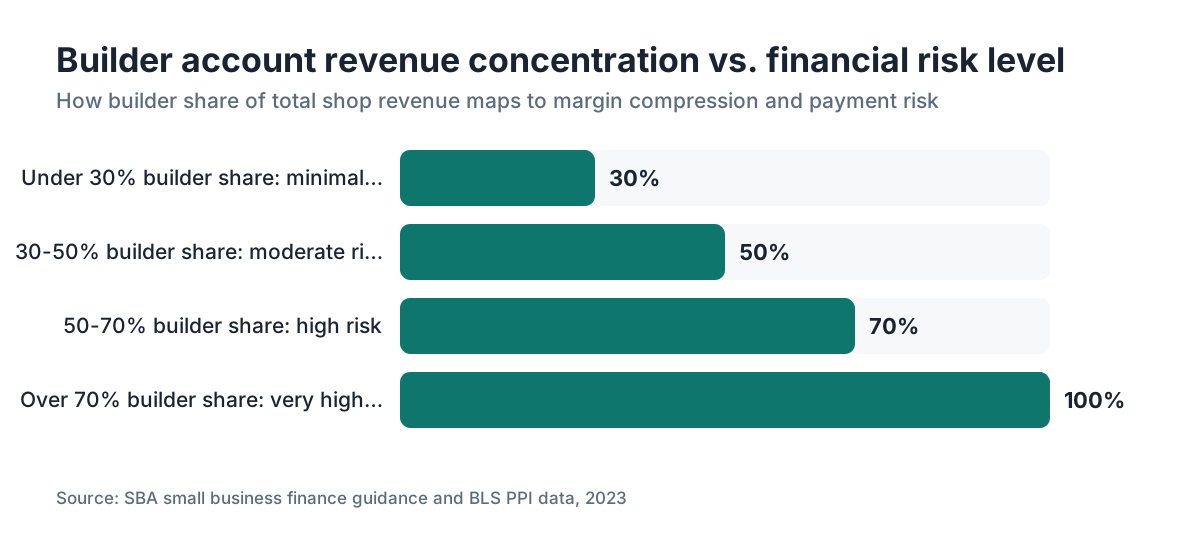
| Revenue share from builders | Typical gross margin impact | Payment terms risk |
|---|---|---|
| Under 30% | Minimal, offsets slow retail periods | Low |
| 30-50% | Moderate compression, watchable | Moderate |
| 50-70% | Measurable margin erosion, 5-10 points | High |
| Over 70% | Significant risk to shop viability | Very high |
Those ranges are directional, not precise. Your actual numbers depend on what you negotiated and how disciplined you are about holding price. The table shows the direction of the risk, not a formula.
How do builder payment terms create cash flow problems?
This is the one that quietly kills shops. You do the work in January. The builder pays in March. Meanwhile you bought the slab, paid your installers, covered fuel, and made your equipment payment in January.
Net-30 terms are common in builder contracts. Net-60 is not unusual for larger production builders. Net-90 shows up more often than fabricators like to admit, especially with regional builders who have their own cash pressure from lenders. The Federal Reserve Bank of New York's Small Business Credit Survey consistently finds cash flow shortfalls to be the most frequently cited financial challenge among small firms [8], and the NFIB's small business surveys track payment timing as a recurring operational problem [2].
When builder work is 20% of your revenue, a slow-paying builder is an annoyance. When it is 60%, a builder paying 30 days late on net-60 terms means you are floating 90-day receivables on more than half your income. Most shops are not capitalized for that. A line of credit helps, but credit costs money and it has limits [7].
The practical fix most fabricators land on is requiring partial payment at slab confirmation, more than a retail deposit and applied to builders too. Many builders push back. Some walk. The ones who walk were probably the ones who would have tested your terms the hardest anyway.
What does builder-heavy volume do to your crew and install schedule?
Production builder work means speed. A builder with 20 kitchens in a subdivision wants them templated and installed on a tight window tied to their closing schedule. Miss that window and you hear about it loudly.
That scheduling pressure has real effects on the shop. Your most experienced installers end up on the builder sites because they can move fast and handle problems without a call back to the shop. Your retail customers, who pay full price and expect more, get the crew that is still learning the rhythm. That creates callbacks, unhappy reviews, and retail referrals that never materialize.
There is also a quieter problem. Skilled fabricators get bored doing the same builder spec over and over. Turnover in stone fabrication is already a challenge. The Bureau of Labor Statistics puts median employee tenure across industries in the low single digits of years [3], and shops running heavy builder volume report that their best people leave for custom work or for shops with more variety. You cannot easily price that cost, but it is real.
The best operators I have read about handle this by keeping builder and retail crews somewhat separate and rotating people through both. That takes enough volume on both sides to make rotation practical, which is another argument for keeping builder share below the point where it crowds out retail.
Does builder work affect your material buying and waste differently than retail?
Yes, and this one surprises fabricators who are new to builder volume. Builder specs tend to lock in specific materials, often lower-cost slabs from a narrow approved list. That sounds efficient. It also creates inventory risk.
If a builder slows starts, you may be sitting on 40 slabs of their approved material in your yard. Generic materials move fine. Niche builder-specified materials may not. Slab carrying costs (storage space, insurance, and capital tied up in inventory) are real expenses that compound the longer you hold the material.
On the other side, the repetition of builder work should improve your nesting efficiency and cut waste per job. And it can, if you run proper nesting software on each job. The catch is that builder jobs often have tight delivery schedules that push the shop to cut fast rather than cut clean. Fabricators running shop management software like SlabWise report that tracking yield by job type shows builder jobs sometimes waste more per square foot than expected once schedule pressure overrides good nesting.
The honest answer: builder work can be efficient on material or wasteful, depending entirely on whether your shop has the systems to hold yield discipline under pressure.
What are the legal and contract risks specific to builder accounts?
Builder contracts often look like a simple purchase order, but they frequently contain terms that shift real risk onto the fabricator. Watch for warranties that exceed what the material manufacturer provides, lien waiver requirements that surrender your right to file a mechanics lien if you go unpaid, and indemnification clauses that make you responsible for defects in adjacent trades' work.
Mechanics lien rights are protected by state statute. The Cornell Legal Information Institute describes a mechanic's lien as "a security interest in the title to property for the benefit of those who have supplied labor or materials that improve the property." [4] Signing a broad unconditional lien waiver before money hits your account gives that protection away. Many builders present these waivers as standard paperwork, and some fabricators sign without reading them.
Builders also include provisions requiring you to hold pricing for a fixed period, often 6-12 months or the entire build-out. If material costs spike during that window, which happened hard in 2020 through 2022 for both stone and quartz, you absorb the increase. Bureau of Labor Statistics Producer Price Index data shows cut stone and stone product prices rose more than 15% between 2020 and 2022 [5]. A contract with price lock-in during that stretch was genuinely painful.
Getting a builder contract reviewed by a construction attorney before you sign costs little relative to the volume of work it governs. It is one of the few expenses that is clearly worth it.
How does relying on builders affect your reputation and retail business?
Here is the indirect risk fabricators least expect: your retail pipeline dries up.
Retail customers come from referrals, from happy homeowners who tell their neighbors. Builder customers are homeowners too, technically, but the relationship runs through the builder. The homeowner who got your countertops in their new build often does not know your name. They know the builder's name. When they renovate in ten years, they search Google, not their memory of a subcontractor they never met.
Some fabricators try to fix this with branded material or a sticker inside the cabinet door near the sink cutout. It helps a little. But builder work builds the builder's brand, not yours.
If your retail reviews on Google or Houzz are thin and your name is not growing in the community, you are badly exposed to any shift in your builder relationships. A builder who goes out of business, switches to a competitor, or simply decides to negotiate harder next season leaves you with no retail base to fall back on. Shops that invested in retail while running builder volume have options. Shops that neglected it do not.
What signs tell you that builder accounts are already hurting your shop?
A few concrete warning signs are worth tracking.
Your average days to collect on accounts receivable is creeping past 45 days. That number, pulled straight from your accounting software, is the clearest early signal of builder payment risk piling up.
Your overall gross margin is trending down quarter over quarter even as revenue holds steady or grows. Revenue growth that comes with margin compression means you are working harder for less. In a countertop shop, that pattern is almost always builder-driven.
Your estimating team (or you, if you still do quotes yourself) is spending a big share of its time re-quoting the same builder specs at lower prices. That is time not spent on retail quoting, and it signals a price negotiation cycle with an account that is not going to get more profitable.
Your best installers are telling you they are tired. Or they have already left.
None of these are instant emergencies. They are early indicators, and catching them early is the whole point. A monthly review of margin by customer type (retail vs. builder vs. commercial) takes about an hour and tells you more about your shop's direction than almost any other single number. SCORE recommends this kind of segment-level margin review as basic financial management for small manufacturers [10].
How do successful fabricators balance builder and retail accounts?
The shops that seem to handle this best share a few habits.
They set a hard internal limit on builder share of revenue, usually in the 30-50% range, and they hold it by saying no to new builder volume when they are near the ceiling rather than adding capacity to serve more builders. Saying no to work feels backward. It is often the right call.
They negotiate payment terms harder with builders, typically pushing for 50% at confirmation and 50% on install rather than net-30 or net-60. Not every builder accepts this. The ones who do are usually the ones with better capitalization and lower payment risk anyway.
They put money into retail marketing continuously, even when the shop is slammed. The worst time to start building a retail customer base is when you suddenly need one. Google reviews, a working website, and relationships with kitchen designers are assets that compound over time.
For countertop installation planning specifically, keeping some retail capacity open means your experienced crew handles a mix of jobs and stays sharp on the detail work that keeps retail customers happy.
If quoting is part of your bottleneck, tools like SlabWise can cut the time spent re-quoting builder specs so your estimators have room for retail quotes too. That is not a cure for over-concentration, but it is one less operational drag.
The fabricators who are most honest about this say the same thing: the builder relationship is easy to enter and hard to leave. Once a builder depends on you and you depend on them, the negotiating power shifts toward the builder. Starting to diversify before you need to is far easier than trying to cut builder share once your crew is already sized for it.
What should you actually do if builders already dominate your revenue?
Start with the number. Pull your revenue by customer type for the last 12 months. If builders are above 50-60%, you have a real concentration problem worth taking seriously.
Do not try to cut builder volume overnight. That is a cash crisis, not a fix. Instead, set a goal: in 18-24 months, builder share should sit below your target ceiling. That gives you time to grow retail without wrecking the cash flow you have.
Assign one installer team, even part-time, to retail work. Protect their schedule from builder overflow. This is hard when the phone is ringing with builder jobs. Do it anyway.
Start collecting Google reviews from retail jobs now. Reviews take months to build up and age into your ranking. A shop with 200 reviews is far more resilient to losing a builder than a shop with 12.
On builder contracts up for renewal, use the renewal to push for better terms: shorter payment windows, escalation clauses tied to a material price index, and removal of unconditional lien waiver requirements before payment. Some builders will accept some of this. The negotiation itself signals that you are running a business, not standing there grateful for the volume.
If you do kitchen countertops or work with premium materials like granite countertops or marble countertops, push those capabilities in retail channels. Builders will never pay for that work at retail rates. Homeowners will, and they refer their friends.
Frequently asked questions
What percentage of revenue from builders is too high for a countertop fabricator?
Most fabricators who talk honestly about this put the safe ceiling at 40-50% of revenue. Above 60%, you start to see compounding problems: margin compression, cash flow gaps from slow payment, and retail pipeline decay. The bigger risk is single-customer concentration; any one builder exceeding 20-25% of your total revenue is a material vulnerability, regardless of the overall builder share.
Why do builder countertop accounts pay lower margins than retail?
Builders buy volume and they know it. They negotiate discounts of 15-30% off retail pricing, expect the same edge profile and material across entire subdivisions, and push back on any extras. There is also hidden margin erosion: minor change orders absorbed without charge, price lock-in provisions on long projects, and the time your estimators spend re-quoting specs at lower prices to keep the account.
How long do builders typically take to pay for countertop work?
Net-30 is common, net-60 is not unusual, and net-90 shows up with larger regional builders. When builder work is a large share of your revenue, even slight delays on that payment cycle create real cash flow pressure. Requiring 50% at slab confirmation rather than waiting for net terms is the most effective protection, though many builders will resist it.
Can a builder going out of business destroy a countertop fabrication shop?
Yes, if that builder is a high share of revenue. If a builder representing 40% of your revenue closes mid-project, you may have unpaid invoices, slab inventory purchased for their jobs, and crew sized for their volume. Without the mechanics lien rights you may have waived, collection is difficult. Shops with diversified revenue survive this. Shops without it often do not.
What is a mechanics lien and why does it matter for builder countertop contracts?
A mechanics lien is a legal claim on a property that a contractor, subcontractor, or supplier can file when they have not been paid for work or materials. State statutes protect this right for fabricators and installers. Builders routinely ask for unconditional lien waivers before payment, which surrenders that protection. Signing one before money is in your account is a significant risk that fabricators should have a construction attorney review first.
Do builder countertop accounts affect retail customers' experience at the same shop?
Yes, in a few ways. Your best and fastest installers end up on builder sites because speed matters there. Retail customers, who paid full price and have higher expectations, sometimes get less experienced crews. Schedule pressure from builder deadlines also compresses the time available for retail templating and install. Over time, retail satisfaction and reviews can quietly decline while you are focused on builder volume.
How should a fabricator negotiate better payment terms with a builder?
Use contract renewal as your pressure point. Push for 50% at material confirmation and 50% on install rather than net-60. Add an escalation clause tied to a published price index so material cost spikes do not land entirely on you. Ask for removal of unconditional lien waiver requirements before payment is received. Not every builder accepts all of this, but the negotiation establishes that you understand your own risk.
How does builder countertop work affect shop material inventory and waste?
Builder specs often call for a narrow list of approved materials. If starts slow down, you may hold slab inventory bought for jobs that are not coming for months. On waste, builder work should theoretically improve nesting efficiency through repetition, but schedule pressure often overrides nesting optimization in practice. Tracking yield by job type (builder vs. retail) is the only reliable way to know what is actually happening.
Why does builder work fail to build a fabricator's retail reputation?
Homeowners in new builds typically know the builder's name, not the countertop subcontractor's. The relationship is mediated through the builder, so satisfied customers rarely search for or review the fabricator directly. Builder volume does not generate Google reviews, referrals, or repeat business for the shop. Shops that focus heavily on builders often find their retail reputation stagnates even as revenue grows.
Is it possible to run a profitable countertop shop that is mostly builder work?
Yes, but it requires strict discipline on a few things: holding your price floor, enforcing payment terms before net terms balloon, careful attention to contract language, and crew management to reduce turnover. Shops that do this successfully tend to be higher volume operations with enough scale to absorb the margin compression. For smaller shops, the risks compound faster and the margin for error is narrower.
What materials do builders typically specify and why does that matter for fabricators?
Builders gravitate toward lower-cost, predictable materials: entry-level granite, basic quartz, and laminate. They rarely specify premium options like quartzite or high-end marble. For fabricators, this means the mix of work shifts toward lower-margin material categories. It also means your shop's expertise in premium materials, which is a competitive differentiator with retail customers, atrophies when builder work dominates the schedule.
How can a countertop fabricator start rebuilding retail volume if builders already dominate?
Set a 12-18 month goal for reducing builder share as a percentage of revenue by growing retail, not by cutting builder jobs abruptly. Dedicate one install team partially to retail and protect their schedule. Start collecting Google reviews from every retail job today; they take months to accumulate. Invest in kitchen designer relationships. Use contract renewals to push for better builder terms while simultaneously building the retail pipeline.
Do builder contracts typically include price locks that can hurt fabricators when material costs rise?
Yes. Many builder contracts specify a fixed price for the duration of a build-out, sometimes 6-12 months or longer. When material prices spike, the fabricator absorbs the increase. The Producer Price Index for cut stone and stone products rose over 15% between 2020 and 2022, which made fixed-price builder contracts genuinely costly during that period. An escalation clause tied to a published index is the contractual fix.
What financial metrics should a fabricator watch to catch builder-account risk early?
Track three numbers monthly: average days to collect on accounts receivable (flag if over 45 days), gross margin by customer type (retail vs. builder), and builder share of total revenue. Margin trending down while revenue holds steady almost always means builder work is growing relative to retail. Catching that pattern 6-12 months early gives you time to respond without a crisis.
Sources
- U.S. Small Business Administration, Manage Your Business guide: Customer concentration exceeding 20-25% of revenue in a single account is treated as a material financial vulnerability for small businesses.
- National Federation of Independent Business, Small Business Economic Trends: NFIB small business surveys track payment timing as a recurring operational problem for small manufacturers and service businesses.
- U.S. Bureau of Labor Statistics, Employee Tenure Summary: BLS reports median employee tenure across industries in the low single digits of years, a benchmark relevant to stone fabrication turnover.
- Cornell Law School Legal Information Institute, mechanic's lien entry: A mechanic's lien is a security interest in the title to property for the benefit of those who supplied labor or materials that improve the property, protected by state statute.
- U.S. Bureau of Labor Statistics, Producer Price Index program: The Producer Price Index for cut stone and stone products rose over 15% between 2020 and 2022, creating cost pressure on fabricators with fixed-price builder contracts.
- U.S. Bureau of Labor Statistics, Occupational Employment and Wage Statistics: BLS tracks employment and wage data for stone cutters, carvers, and related workers, providing benchmarks relevant to shop labor cost planning.
- U.S. Small Business Administration, Plan Your Business guide: Lines of credit and working capital management are standard tools for small manufacturers managing receivables gaps; credit has a real cost that compounds under extended payment terms.
- Federal Reserve Bank of New York, Small Business Credit Survey: Cash flow shortfalls are the most frequently cited financial challenge among small firms in the Federal Reserve's annual Small Business Credit Survey.
- U.S. Bureau of Labor Statistics, Producer Price Index industry data: PPI industry-level data provides fabricators with a published index suitable for price escalation clauses in builder contracts tied to material cost changes.
- SCORE Association, business financials resources: Monthly review of margin by customer segment is recommended as a core financial management practice for small businesses.
Last updated 2026-07-11