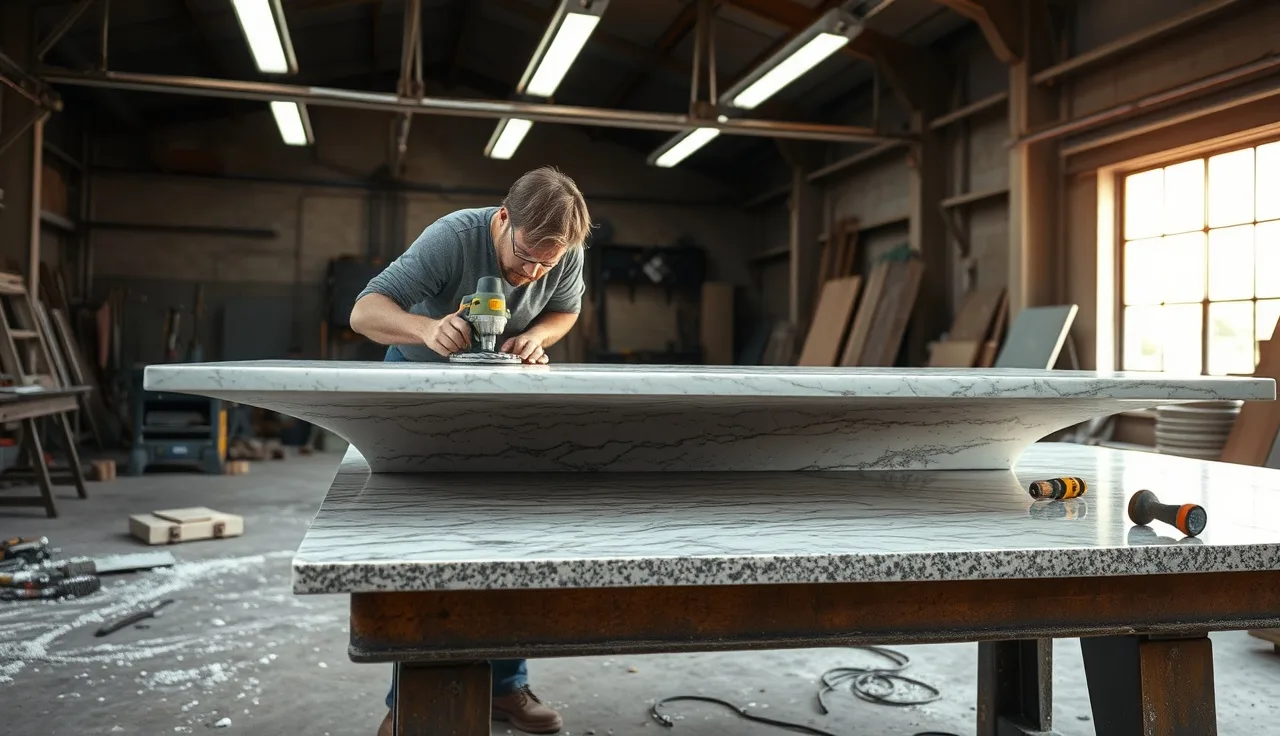
TL;DR
- A cooktop cutout cuts the continuous load path across a slab and leaves two narrow stone strips that crack under weight, heat cycling, or cabinet flex.
- Reinforcing those strips with epoxy-set rods, fiberglass mesh, or a steel angle underneath sharply lowers crack risk.
- The right method depends on stone thickness, strip width, and material type.
Why does a cooktop cutout weaken the countertop?
A cooktop cutout severs the slab's continuous load path and leaves two narrow strips of stone that have to carry weight on their own. Stone is strong in compression and weak in tension. A full slab behaves like a shallow arch over its cabinet base, spreading weight broadly. Cut a rectangular hole in the middle and that arch is gone.
What's left are two strips running front to back on either side of the opening. Each one acts like a short cantilever, anchored only at the front and back edges. They carry their own weight plus whatever lands on them, like a heavy pan resting on the front burner edge.
Those strips also flex. Cabinet boxes settle. Point loads from a full stockpot press down at midspan. The thinner the slab and the wider the cutout, the more the strips move. A 3 cm (1.25-inch) slab handles this geometry far better than a 2 cm (0.75-inch) slab. Even 3 cm stone cracks at cooktop cutouts more than anywhere else in a kitchen, because the inside corners of the opening are stress concentration points. [1]
Heat makes it worse. Cooktops radiate heat into the stone beside them, and stone expands when it warms. If the underside is pinned by adhesive or a badly placed bracket, that expansion has nowhere to go, and the internal stress can crack an unreinforced strip over years of cooking.
Which countertop materials need reinforcement most?
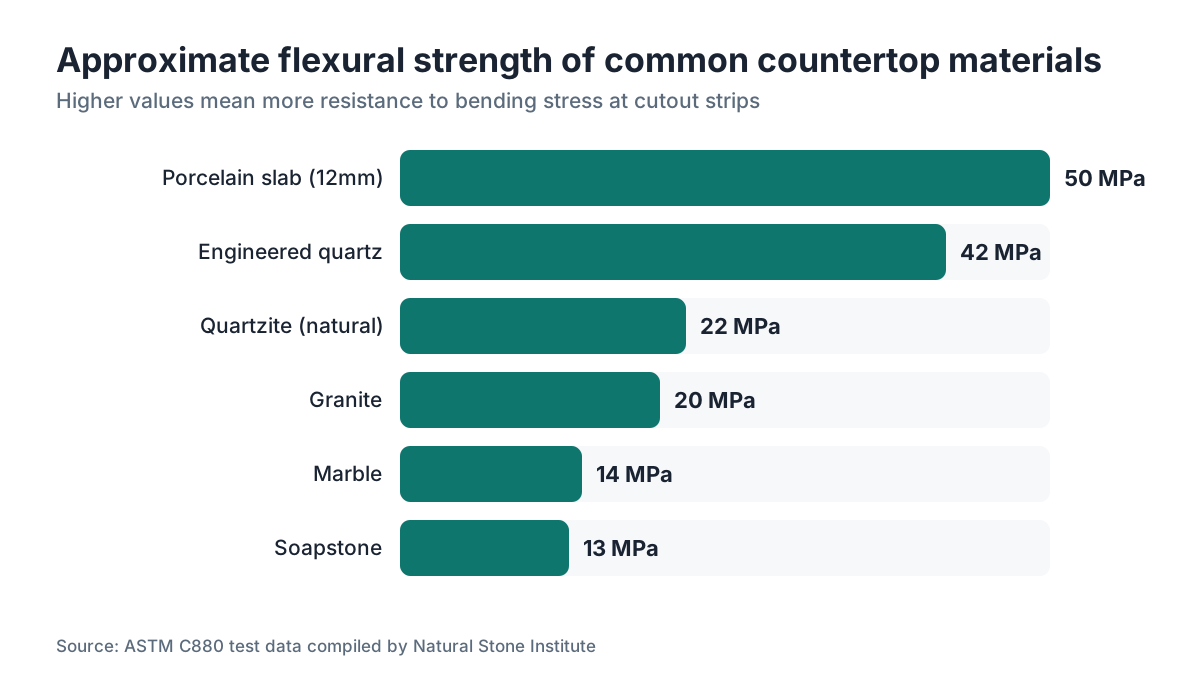
Marble, soapstone, and natural quartzite crack the easiest at a cooktop cutout, so they need reinforcement most. Engineered quartz and porcelain test much stronger in bending, though thin porcelain brings its own problems. Here's how the common materials compare.
| Material | Flexural strength (approx.) | Typical slab thickness | Cooktop cutout risk |
|---|---|---|---|
| Granite | 15-25 MPa | 2 cm or 3 cm | Moderate (higher in 2 cm) |
| Quartzite | 15-30 MPa | 2 cm or 3 cm | Moderate to high |
| Marble | 10-18 MPa | 2 cm or 3 cm | High |
| Engineered quartz | 35-50 MPa | 2 cm or 3 cm | Low to moderate |
| Porcelain slabs | 35-60 MPa | 6-12 mm | Very high (thin material) |
| Soapstone | 10-16 MPa | 3 cm typical | High |
| Laminate (HDF core) | varies | 3/4-inch substrate | Low (substrate flexes, doesn't crack) |
| Butcher block | varies | 1.5-2.5 inches | Low to moderate (can check/split) |
| Quartzite / engineered stone hybrids | varies | 2-3 cm | Moderate |
The flexural strength numbers come from standard test methods and published stone industry data. [2] Marble, soapstone, and natural quartzite are the most brittle materials at typical kitchen thicknesses. Engineered quartz (brands like Cambria use a polymer-bonded composite) tests far stronger in bending, which is part of why fabricators sometimes skip rod reinforcement on quartz that they'd never skip on marble. [3]
Laminate countertops and butcher block countertops over a plywood or MDF substrate don't crack the same way, because the substrate is wood-based and bends instead of fracturing. The risk there is delamination near heat, not a clean split. On formica countertops, the substrate support still matters, but the failure mode looks different.
Granite countertops and marble countertops at 2 cm should almost always get some underside reinforcement at the cooktop cutout. At 3 cm, a good fabricator may judge the granite strip wide enough on its own, but will still reinforce marble.
What are the standard reinforcement methods fabricators use?
Fabricators use four methods: epoxy-set rods in a routed channel, fiberglass mesh laminated to the underside, a steel angle or channel underneath, and smart seam or lamination choices. Which one your fabricator picks depends on the material, the strip width, and the shop's tooling.
Epoxy-set fiberglass or carbon fiber rods This is the most common technique for natural stone. The fabricator routes a shallow channel (typically 3/8 to 1/2 inch wide, 3/8 inch deep) into the underside of the slab, running parallel to the longest cutout edges, roughly 1 to 2 inches back from the opening. A fiberglass or carbon fiber rod drops into that channel and gets encapsulated in structural epoxy. Some shops run two rods per strip on marble or soapstone. The rod runs the full length of the strip, front edge to back edge, so it carries tension across the span instead of just filling a void.
Fiberglass rods are the standard. Carbon fiber rods are lighter and a bit stiffer, but cost more. Either one, set properly in epoxy, raises the tensile capacity of the strip a lot. The rod doesn't have to be big. A 3/8-inch fiberglass rod in good epoxy adds real strength to a 3 cm granite slab. [4]
Mesh or scrim laminated to the underside On thin materials like 6 mm or 12 mm porcelain, many fabricators bond fiberglass mesh across the entire underside before cutting. The mesh sits in epoxy resin and works like rebar in concrete. It adds almost no depth, but it holds fragments together if the slab does crack. That matters for safety as much as strength.
Steel angle or channel brackets For very wide cutouts, a steel angle screwed to the cabinet or the support structure underneath carries the strip's weight and limits deflection. You see this more on commercial jobs where the opening runs 36 inches or wider. The steel usually doesn't attach to the stone at all. It gives the stone a rigid shelf to rest on at the cutout edge. A bead of gap-filling epoxy or silicone between the steel and stone stops point loading.
Lamination and seam placement A skilled fabricator can sometimes orient the slab so a natural seam falls outside the high-stress zone, or laminate a strip of matching material to the underside at the front and back edges to build effective thickness without going to full 3 cm. It's a niche move, used on some ultra-thin porcelain installs where routing a channel isn't practical.
How wide can the strips beside a cooktop cutout safely be?
There's no single published minimum strip width for a cooktop cutout, which is honestly frustrating. The Marble Institute of America (now part of the Natural Stone Institute) publishes fabrication guidance that touches on cutout geometry, but the safe minimum depends on material and thickness and isn't captured in one clean number. [5]
Most experienced fabricators work from rough thresholds like these:
- 3 cm granite or quartz: strips under 3 inches need reinforcement; strips under 2 inches are at real risk and should be discussed with the homeowner before cutting.
- 2 cm granite or marble: strips under 4 inches should always get rod reinforcement.
- Marble at any thickness: anything under 4 inches gets rods, no exceptions.
- Porcelain at 6-12 mm: mesh across the whole panel, plus careful handling.
Width matters, and so does the front-to-back span. A strip 3 inches wide that runs 24 inches front to back carries more bending stress than one that runs 14 inches. Think of a narrow beam. The longer it spans, the more it wants to sag or crack under a point load at midspan.
If a fabricator quotes a job where the cooktop cutout leaves narrow strips, ask for the actual strip dimensions and what reinforcement is included. A shop that templates digitally with countertop installation software can pull exact strip widths off the template before any stone hits the saw. That's when this conversation should happen.
What epoxy should be used for reinforcing stone at a cooktop cutout?
Use a structural stone epoxy rated for heat, with a heat deflection temperature of at least 150°F (65°C), and ideally higher. Standard two-part stone epoxies used for color-matching and crack repair often deflect around 120-140°F (49-60°C), which sounds fine until you realize the underside of a slab beside a gas burner at high heat can reach those temperatures during long cooks. [6]
Akemi, Tenax, and Integra Systems all make stone-specific structural adhesives. Each product data sheet states a heat deflection temperature (HDT) tested per ASTM D648 or ISO 75. For cooktop-adjacent rod channels, read that number and pick a product rated at 150°F or above. [6]
Bond quality matters as much as heat rating. Rod channels have to be clean, dry, and free of stone dust before the epoxy goes in. Many fabricators wipe the channel with acetone before mixing. The rod should be fully wrapped in epoxy with no voids. If the epoxy cures with a gap at one end, that end can't carry tension, and half the reinforcement is wasted.
One honest caution for the DIY homeowner. Routing a channel from below without pulling the countertop is close to impossible to do right. Post-install reinforcement from underneath is a fabricator's job with a router, not a weekend fix with epoxy alone.
Should the cutout corners be rounded, and does that help?
Yes. Rounding the inside corners is one of the highest-impact things a fabricator can do. A square inside corner is a stress concentration point. Under any bending load, cracks start at the sharpest corners first, because stress rises as the notch radius shrinks. This is basic fracture mechanics. [7]
Most shops cut cooktop openings to a minimum inside corner radius. The common standard is 3/8 inch (roughly 10 mm), with some shops going to 1/2 inch or larger on brittle materials like marble or soapstone. The Natural Stone Institute's fabrication guidance calls for rounded corners on all cutouts specifically to reduce crack initiation. [5]
A square-cornered cooktop cutout in 2 cm marble is asking for trouble. A properly radiused corner in 3 cm granite with rod reinforcement is a much safer shape. If you get to review shop drawings or a template before cutting, confirm the corner radii are written down. On digital templates from CNC shops, the radius lives in the CAM file and should be listed.
One thing that doesn't help. Injecting epoxy into a crack that's already started doesn't restore tensile strength. Filling a crack hides it; it doesn't fix it. The rod has to go in before the crack forms, or as part of a repair that bonds the crack and adds rods together.
Does the type of cooktop affect how the cutout should be reinforced?
Yes, more than most people expect. Three things drive it: the opening size, the mounting method, and the heat output.
Drop-in gas cooktops usually have large openings (30 to 36 inches wide) and clip to the underside of the countertop with mounting brackets. Those brackets can press point loads into the stone if they're over-tightened. They should compress against a foam or silicone gasket, never straight onto bare stone. Crank a clip tight against a raw strip and you've built a stress point exactly where the stone is already weakest.
Slide-in ranges make no countertop cutout at all. The range fills the space and the adjacent counter butts up to it with a small gap, so there's no strip-and-cutout geometry to worry about.
Induction cooktops often have smaller footprints than gas units, which leaves wider strips. That's better structurally. But induction surfaces still get hot from the pans sitting on them, so the heat concern doesn't vanish.
Electric coil cooktops sit in large rectangular cutouts much like gas units. Same strip-width and reinforcement concerns apply.
Under-counter induction units that sit fully below the slab surface (a growing category) drop the cutout issue entirely, but they need non-ferromagnetic countertop materials like quartz or granite. And a cast iron pan on a stone slab over an induction element still gets very hot.
Still planning? If you can pick a 30-inch cooktop over a 36-inch, the 30-inch leaves wider strips and is easier for the fabricator to work with in a narrow run.
Can you reinforce a countertop cutout yourself, or does it need a fabricator?
The full rod-channel method needs a fabricator. What a careful DIYer can do post-install is limited to mesh, a steel bracket, and checking the mounting clips. There's a real gap between what's theoretically possible and what's practical without shop tools.
The rod-channel method needs a router with a straight bit running dead straight along the underside, at a steady depth, on stone that weighs 15-25 pounds per square foot. [8] Doing that with the countertop installed means working upside down inside a cabinet, routing into granite or marble freehand. Slip once and you cut through the slab or leave an uneven channel that traps voids in the epoxy. Pros do this on sawhorses in the shop before install, or on a mounted router table or CNC.
What a careful DIYer can realistically manage after install:
- Bond fiberglass mesh to the underside with structural epoxy, if there's enough clearance to work in the cabinet. Imperfect, but better than nothing on an installed slab with borderline strip widths.
- Screw a steel angle bracket to the cabinet framing to support the strip from below, shimmed with foam tape against the stone so it's not a hard point contact.
- Check that the drop-in cooktop clips aren't over-tightened, and add foam gasket material if the seal is compressed or missing.
If there's already a hairline crack at a corner, get a fabricator involved. Hairline cracks in cooktop cutout strips almost always spread unless they're addressed. A crack all the way across a strip means the strip is no longer continuous and needs a full repair or replacement.
Fabrication software like SlabWise flags high-risk geometries during quoting, before the slab is cut. That's by far the best moment to fix the problem.
How much does cooktop cutout reinforcement cost?
Cooktop cutout reinforcement runs roughly $50 to $200 per cutout when it's a separate line item, though many fabricators fold it into the base price on materials that need it. The cost moves with the material, the number of rods, and regional labor rates. [9]
What drives the range:
- Material: marble and soapstone take more care and sometimes more rods than granite, so labor climbs.
- Rod type: carbon fiber costs more than fiberglass, but the material difference is maybe $10-20 per rod.
- Shop type: a CNC shop rodding on the bench before install beats a crew doing it on-site for cost.
- Repair vs. new install: adding reinforcement to an installed counter (when it's even feasible) costs more than doing it during fabrication.
If a quote for a 2 cm marble slab with a cooktop cutout says nothing about reinforcement, ask. A fabricator who tells you up front that they rod every cooktop cutout in marble, and shows you what that looks like, is telling you something about their standards.
Here's the math that matters. Replacing a cracked section costs far more than preventing the crack. A partial replacement with color-matching and seaming can run $800 to $3,000 or more, depending on slab availability and labor. [9] A $100 rod looks cheap against that.
What should you ask a fabricator before the cooktop cutout is made?
Ask for the exact strip widths, the slab thickness, the corner radius, the epoxy's heat rating, and whether reinforcement is included or an add-on. Get these answers before the slab goes on the saw, because after the cut, your options shrink fast.
- What will the strip widths be on each side of the cooktop opening? Get real dimensions, not "it'll be fine."
- What's the slab thickness, and is it 2 cm or 3 cm?
- Does your shop include rod reinforcement in the price for this material, or is it an add-on?
- What's the inside corner radius on the cooktop cutout, and is it built into your CNC template?
- What epoxy do you use in the rod channels, and what's its heat deflection temperature?
- Will the cooktop mounting clips bear against stone or against a gasket?
- If a strip comes in under 3 inches, what do you recommend: reinforce, adjust the layout, or re-orient the slab?
Fabricators who've done this work for years answer all of these without pausing. The ones who look surprised by the questions are the ones to be careful with on a high-risk material like marble or thin quartzite.
For more on what good fabrication looks like across the whole kitchen countertops process, from templating to install, knowing how stone behaves structurally helps you judge what you're being told.
Are there building codes or standards that govern cooktop cutout reinforcement?
No building code specifies countertop reinforcement methods. The International Residential Code (IRC), which most U.S. jurisdictions adopt with local amendments, covers structural framing, electrical, plumbing, and gas supply for cooktops. Countertop fabrication details sit outside its scope. [10]
Gas cooktop installations do have to meet clearance and connection rules under the IRC and NFPA 54 (National Fuel Gas Code), but those rules govern gas supply lines and combustion clearances, not the stone above the unit. [11]
The closest thing to a published fabrication standard comes from the Natural Stone Institute (NSI) and its "Dimension Stone Design Manual." The manual covers cutout geometry and states that "inside corners of cutouts should be radiused to reduce stress concentration." It doesn't mandate a specific rod method, but it does note that reinforcement is appropriate for spans and materials at elevated risk. [5]
With no hard code requirement, the reinforcement call falls to the fabricator's judgment and, honestly, to whatever competitive pricing pressure allows. A shop that skips reinforcement to shave $75 off a bid is betting the homeowner pays for it later.
The ANSI/NSI A108.19 standard covers installation of large-format panels and thin porcelain, but it's aimed at tile installation more than slab fabrication. [12] For porcelain slab countertops, read that standard alongside the slab maker's own installation guide.
Frequently asked questions
How close to the cooktop cutout edge can a seam be placed?
Most fabricators keep seams at least 6 inches from a cooktop cutout edge, and many won't go closer than a full strip width. A seam near the cutout stacks two stress points in one spot. If a seam can't be avoided, it should be fully epoxied and the rod reinforcement should bridge across it. Settle seam placement during the template review, before the stone is cut.
Does quartz need cooktop cutout reinforcement the same way granite does?
Engineered quartz has roughly double the flexural strength of granite, so it tolerates narrow strips better. Many fabricators skip rod reinforcement on 3 cm quartz when strips are 3 inches or wider. At 2 cm, or with strips under 2.5 inches, reinforcement is still smart. Brands like Cambria publish installation guidelines that cover cutout requirements, so check the specific product's documentation.
Can a cracked cooktop cutout strip be repaired instead of replaced?
A hairline crack can sometimes be injected with color-matched structural epoxy, sanded flush, and stabilized with rods added through the cabinet. Full-width cracks that run all the way across a strip are hard to repair invisibly and may need section replacement. The honest truth is that stone crack repair always shows on close inspection. Reinforcing before a crack forms is far more reliable than patching one after.
What is the minimum corner radius for a cooktop cutout in stone?
The accepted minimum in most shops is 3/8 inch (roughly 10 mm). For brittle materials like marble, soapstone, or thin quartzite, 1/2 inch or larger is better. A rounded corner spreads bending stress over a curve instead of piling it at a sharp point, which is exactly where cracks start in stone cutouts. Confirm the radius is written into the shop's CNC or template file before the slab is cut.
Does a farmhouse or undermount sink cutout create the same risk as a cooktop cutout?
Sink cutouts share the mechanics: you remove material and create narrow strips. The difference is that cooktop strips also take heat cycling and point loads from heavy cookware. Sink cutouts are usually wider overall and carry less thermal stress, but they still benefit from rounded corners and rod reinforcement in 2 cm stone or brittle materials. Most fabricators handle this automatically for undermount sinks in marble.
How long does epoxy take to cure before the cooktop can be installed?
Most stone-specific structural epoxies reach handling strength in 20-30 minutes at room temperature and full cure in 24 hours. Fabricators usually wait the full 24 hours before stressing the joint. For cooktops, hold off on using the unit until the countertop is fully installed and any perimeter caulk or silicone has cured too, which usually means 24-48 hours after install.
Is there a maximum cooktop cutout width that stone can handle without steel support underneath?
No single cutout-width limit covers all stone types and thicknesses. In practice, most fabricators flag cutouts wider than 30 inches in 2 cm stone as needing added support. At 3 cm, 36-inch gas cooktop openings are common and handled with rod reinforcement. Spans wider than 36 inches in any natural stone at any thickness call for a structural conversation, possibly including steel framing below.
Will the heat from a cooktop damage the epoxy holding reinforcement rods?
Standard stone repair epoxies can soften near their heat deflection temperature, which for many products sits around 120-140°F. Sustained heat from a gas cooktop at the underside of the stone can approach that. Fabricators doing this right use structural epoxies rated higher, typically 150°F or above per ASTM D648. Ask for the product data sheet if you want to verify what's on your countertop.
Can I add fiberglass mesh to an already-installed countertop to reinforce a cooktop cutout?
Yes, if there's enough clearance to work in the cabinet below. Clean the underside of the stone, bond fiberglass mesh in structural epoxy across the strip area, and let it fully cure before use. It's not as strong as a routed rod channel because it adds little tensile depth, but it holds fragments together if a crack forms and gives some tension resistance. A reasonable backup when shop reinforcement wasn't done.
Does soapstone need reinforcement at a cooktop cutout?
Yes. Soapstone has low flexural strength next to granite or quartz, roughly 10-16 MPa, and it's usually installed at 3 cm because of that softness. At a cooktop cutout, soapstone strips under 4 inches wide should get rod reinforcement. People often choose soapstone for its heat resistance, so the thermal cycling at a cooktop is real. Buying soapstone near a gas range? Make sure your fabricator accounts for this.
What happens if cooktop mounting brackets are over-tightened against stone?
Over-tightened clips press a point load into the underside of the strip right at the cutout edge. Stone can't spread a point load the way wood can, so it fractures. The clip should compress against a gasket, foam tape, or silicone bead, not bare stone. If your cooktop went in with no gasket material between the clips and the stone, pull the cooktop and add foam tape before you use it again.
How do I know if my countertop cooktop cutout was reinforced during fabrication?
Look at the underside of the strip from inside the cabinet with a flashlight. A routed rod channel looks like a narrow groove running parallel to the cutout edge, usually 3/8 to 1/2 inch wide, filled flush with epoxy. You'll often see the slight color difference of the epoxy fill. If the underside is smooth and untouched on a marble or 2 cm granite counter, reinforcement was likely skipped, and it's worth asking a fabricator about your options.
Does a porcelain slab countertop need different reinforcement at a cooktop cutout than granite?
Yes. Porcelain at 6-12 mm can't take a routed channel without risking a through-crack. The standard is full-panel fiberglass mesh bonded to the underside before cutting, plus very careful CNC work at the corners. Porcelain is actually stronger in flexure than most natural stone, but its thinness and brittle edges make cooktop cutouts higher-stakes. Many fabricators charge a premium for porcelain cooktop cutouts because of the difficulty.
Sources
- Natural Stone Institute, Dimension Stone Design Manual: Cooktop cutout corners are stress concentration points where cracks most commonly initiate in stone countertops
- ASTM International, ASTM C880 Standard Test Method for Flexural Strength of Dimension Stone: Flexural strength values for marble, granite, quartzite, and soapstone used in the materials comparison table
- Cambria, Technical Data and Installation Guide: Engineered quartz composite materials have significantly higher flexural strength than natural stone, affecting fabrication requirements at cutouts
- Marble Institute of America (now Natural Stone Institute), Fabrication Best Practices: Epoxy-set fiberglass rods in routed channels are the standard reinforcement method for natural stone at cooktop and sink cutouts
- Natural Stone Institute, Dimension Stone Design Manual, 8th Edition: Inside corners of cutouts should be radiused to reduce stress concentration; reinforcement is appropriate for spans and materials at elevated risk
- ASTM International, ASTM D648 Standard Test Method for Deflection Temperature of Plastics Under Flexural Load: Heat deflection temperature is the standard metric for evaluating epoxy performance under sustained thermal load near cooktops
- Pilkey, Walter D., Peterson's Stress Concentration Factors, Wiley: Stress at a notch or inside corner is inversely proportional to the notch radius; sharper corners have higher stress concentration factors
- Marble Institute of America, Stone Weight Reference Table: Stone countertops weigh approximately 15-25 pounds per square foot depending on material and thickness
- HomeAdvisor / Angi, Countertop Installation Cost Guide: Cooktop cutout reinforcement typically costs $50-$200 as a line item; partial countertop replacement ranges from $800 to $3,000 or more
- International Code Council, International Residential Code (IRC): The IRC covers structural framing, electrical, plumbing, and gas supply for cooktops but does not specify countertop reinforcement methods
- NFPA 54, National Fuel Gas Code: Gas cooktop installations must comply with NFPA 54 clearance and connection requirements; the standard does not address countertop material reinforcement
- ANSI/NSI A108.19, Installation of Large Format Tile and Panels: ANSI A108.19 covers installation of large-format panels including thin porcelain; relevant to porcelain slab countertop fabrication and support
Last updated 2026-07-11