TL;DR
- The most frequent homeowner complaints about countertop installation are poor seam placement, surprise charges beyond the quote, scheduling delays, counters that aren't level, damage to cabinets or walls during the setup, sloppy caulk and adhesive, and fabricators who go quiet after final payment.
- Nearly all of them are preventable with a detailed written contract and a pre-installation walkthrough.
Why do countertop installations go wrong so often?
Countertops are one of the most visible surfaces in a home. The install involves heavy slabs, precision cuts, permanent adhesives, and crews working against the clock. That mix produces complaints at a higher rate than most homeowners expect.
The Better Business Bureau consistently ranks home improvement contractors, including countertop and flooring installers, among the top categories for consumer complaints nationwide [1]. The Federal Trade Commission publishes a consumer advisory on home improvement contracts specifically because this category generates enough disputes to warrant one [2].
Most complaints don't involve dramatic failures. They involve small, persistent problems: a seam that catches the light, a $200 charge that wasn't in the quote, or an installer who won't return calls once the final payment clears. Those are the complaints this article covers, because they're the ones that actually happen to ordinary homeowners.
What are the most common countertop installation complaints?
Here's a ranked look at what homeowners report most often, drawn from BBB complaint data, consumer forum aggregations, and the practical experience baked into fabricator training materials.
| Complaint | Why it happens | How common |
|---|---|---|
| Visible or poorly placed seams | Shop prioritizes material yield over aesthetics | Very common |
| Final price higher than quote | Allowances, edge upgrades, sink cutouts added later | Very common |
| Long delays after template | Shop backlog, slab availability | Common |
| Countertop not level or plumb | Cabinets weren't shimmed; installer skipped checking | Common |
| Cabinet or wall damage during install | Heavy slabs in tight spaces | Common |
| Chips or cracks on delivery | Damage in transit or during handling | Moderate |
| Caulk or silicone applied badly | Rushed finish work | Moderate |
| Wrong color or material delivered | Slab lot swap, communication breakdown | Less common |
| No post-install support | Fabricator moves on; homeowner stuck with issue | Less common |
| Measurement errors requiring refabrication | Template mistakes, CAD input errors | Less common |
The top two, seams and price surprises, account for a disproportionate share of formal disputes.
Why are seams such a big complaint, and what should homeowners expect?
A seam is where two pieces of stone meet. On a long kitchen run or an L-shaped counter, seams are unavoidable, because slabs typically arrive between 55 and 65 inches wide and 110 to 130 inches long [3]. The complaint isn't usually that seams exist. It's that they landed in the most visible spot, or that they're wide, uneven, or filled with the wrong color epoxy.
Fabricators place seams based on material yield first and looks second, unless you negotiate otherwise. If your slab has a vein pattern, a seam that cuts across the grain at the wrong angle will be obvious from ten feet away. A fabricator who color-matches the epoxy filler and aligns the pattern across the joint can make a seam nearly disappear on quartz. On marble or granite, a well-cut seam in a low-traffic spot vanishes. A rushed one at the main prep area will bug you every single day.
Before the template gets cut, ask your fabricator to mark on a shop drawing where seams will fall. Get that in writing. If your material has strong pattern movement, ask specifically about seam placement relative to the veins. This one conversation costs nothing and prevents one of the most common post-install arguments.
For material-specific expectations, the articles on granite countertops and marble countertops cover how grain and pattern affect seam visibility for those stones.
Why does the final countertop price end up higher than the original quote?
This is the complaint that most often turns into a formal dispute, and it has a structural cause. Most countertop quotes rest on assumptions that change between quote and install.
A typical quote includes a square footage price for the field material, a standard edge profile, and a fixed number of cutouts. What it often doesn't lock in: the cost of upgraded edges if you change your mind, the price of a farmhouse or undermount sink cutout versus a drop-in, travel or fuel surcharges, a second template visit if cabinets aren't ready, haul-away fees for old countertops, and a material upcharge if your original slab choice goes out of stock and gets replaced with something pricier.
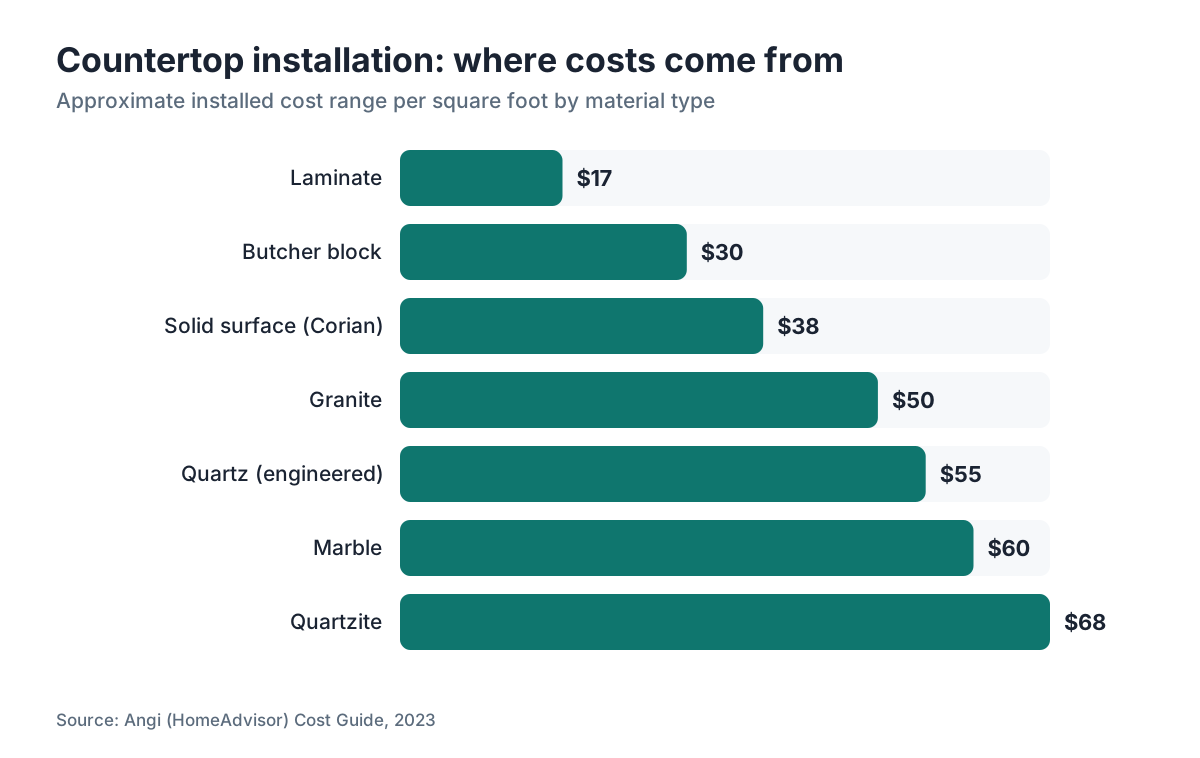
A 2023 HomeAdvisor cost report put average countertop installation between $15 and $70 per square foot installed, with stone materials on the high end, but those figures don't capture the add-ons that inflate real invoices [4]. Homeowners often get quoted at the low end of that range and pay mid-to-high once the extras pile up.
The fix is simple. Before you sign, ask for a fully itemized quote, not a single line-item total. Ask what happens to the price if you switch edge profiles. Ask whether the sink cutout is included and what type of sink it assumes. Ask if there's a restocking or cancellation fee if your chosen slab is unavailable. Every one of those questions should have a written answer.
Fabricators who quote with structured tools, including software like SlabWise that generates line-by-line breakdowns, make it much easier for homeowners to see exactly what's included. When a quote arrives as a single number, that's a warning sign worth addressing before you pay a deposit.
How long should a countertop installation take, and what causes delays?
The typical timeline from signed contract to installed countertop runs 1 to 3 weeks for most stone fabricators, though busy shops in peak season (spring through early fall) often stretch to 4 to 6 weeks [4]. The steps: cabinet installation confirmed, template appointment, slab selection or confirmation, fabrication, and installation day.
Delays stack up at predictable points. Cabinets that aren't level or fully installed push the template back. Slab availability, especially for exotic stones or specific lot matches, adds weeks. Shop backlog during renovation season is real: a two-week lead time in January can become five weeks in May. And scheduling slip-ups at the fabricator, missed calls, or poor communication leave homeowners with no counters and no idea when they'll have any.
The complaint isn't usually about reasonable delays. It's about fabricators who don't communicate. If your template is on a Tuesday and you've heard nothing by Friday, call. If you were told fabrication takes 10 business days and you're at day 14, call again. Document those calls. The fabricators who earn good reviews are the ones who send an unprompted status update when something shifts.
What should homeowners do if their countertop is not level after installation?
A countertop that rocks, slopes, or shows gaps where it meets the wall is a legitimate defect, and one of the more upsetting post-install discoveries, especially after the old counters got hauled out.
The cause is almost always out-of-level cabinets rather than a fabrication error, but that doesn't make it your problem to absorb. A professional installer checks cabinet level before setting stone, shims where needed, and cuts scribe molding or caulks the wall-counter joint to account for wall irregularities. If they skipped those steps, the fix is on them.
Document the problem with a level and photos before you call. A standard 4-foot level should read flat across a finished countertop. A gap of more than 1/8 inch over a 4-foot span is a measurable deviation worth disputing. Some settlement and minor variation is normal in older homes where walls and cabinets are never perfectly true, but visible rocking or a slope that pools water at a sink is not acceptable workmanship.
Contact the fabricator in writing (email), describe the specific issue, attach photos, and give them a reasonable deadline, typically 5 to 10 business days. Most reputable shops will send someone to evaluate and correct the problem. If they won't, your next step is a demand letter referencing your state's contractor licensing law and, if the amount warrants it, small claims court.
What damage can happen during countertop installation, and who is responsible?
Stone slabs are heavy. A 3-centimeter granite slab runs about 18 to 20 pounds per square foot [5]. Moving a full kitchen's worth of stone through a house, around corners, past cabinets, and into position creates real risk of wall dings, cabinet door damage, floor scratches, and the occasional cracked tile.
The most common damage complaints: scratched hardwood or tile floors from slab dragging, cracked cabinet face frames from slab contact, drywall gouges, and broken plumbing connections at sinks.
Before installation day, put down floor protection along the path from your front door to the kitchen. Cardboard, Ram Board, or construction felt all work. Take the doors off the upper cabinets if they're in the work zone. Clear everything off surrounding shelves and counters. Then walk the space with the lead installer before they start and note any pre-existing damage. Take photos.
If damage happens, report it in writing that day. Most legitimate fabrication companies carry general liability insurance; ask for their certificate of insurance before installation starts [6]. If damage occurs and they deny responsibility, their insurance is the right next step, not arguing with the crew.
Why do chips and cracks show up, and is it the fabricator's fault?
Chips on corners and edges are one of the more debated complaints, because responsibility isn't always clear. Natural stone chips more easily than engineered quartz. A thin edge profile on granite is more fragile than a bullnose or eased edge. Corners take the most abuse.
Fabricator fault: chips that appear on delivery or within 24 hours of installation are almost certainly handling damage. The fabricator owns it. Document with photos and report immediately.
Homeowner fault: chips that develop after months of normal use, especially on thin or sharp-profile edges, are typically wear, not defects. A 3/4-inch mitered waterfall edge on quartzite is beautiful and fragile. If you chose it knowing that, a chip six months later isn't a warranty claim.
Material fault: some stones chip more than others. Crema Marfil marble, certain Brazilian granites, and quartzites with natural fissures carry higher edge-damage risk. Your fabricator should tell you this before you choose. If they didn't, that's a failure of professional disclosure, harder to litigate but worth noting in any review you leave.
Cracks through the body of a slab, as opposed to edge chips, are a different animal. A crack that runs through the field of a countertop is almost always a structural failure: a flaw in the stone that fabrication should have caught, a seam failure, or an installation error like unsupported overhang or a poorly shimmed base. That's the fabricator's problem.
What makes caulk and silicone complaints so persistent?
Caulk is unglamorous. It's also the last thing an installer does before packing up, which means it gets done under time pressure and sometimes poorly. Common complaints: caulk applied too thick and smeared on the stone face, wrong color silicone at the backsplash joint, silicone that peels within weeks because the surface wasn't cleaned first, and gaps left uncaulked entirely at the wall-counter seam.
At a sink, a bad silicone job is more than cosmetic. Silicone that fails at the undermount joint lets water get behind the stone, which speeds up cabinet damage. That's a warranty issue worth pursuing.
For wall seams and backsplash joints, the standard spec is 100% silicone (not latex caulk), color-matched to the stone or grout, applied to a clean, dry surface [10]. If yours doesn't meet that, ask the installer to redo it before you make final payment. Silicone is cheap. Removing and redoing a bad caulk job is the expensive part, so address it on install day, not two months later.
What if the wrong material or slab was installed?
This is rare but genuinely disruptive. It happens most often in two ways: you chose a specific slab in the yard and the fabricator used a different slab from the same lot (which can vary in color), or a job-ticket error at the shop sent the wrong material entirely.
Lot variation in natural stone is real and not always explained to homeowners. Two slabs from the same quarry, same nominal color, can look visibly different. If you selected a slab by writing down its lot number or tagging it, and a different slab got used, that's a breach of your agreement. If you ordered by name only, the fabricator has more wiggle room.
For engineered surfaces like quartz, lot variation is much smaller, but it exists. Cambria and similar manufacturers produce material in dye lots, and a color-matched repair piece sourced months later may not perfectly match the original run. The article on Cambria countertops covers this in more detail for that brand.
If the wrong material was used, document it in writing immediately. Photograph your original selection paperwork alongside the installed surface. The fabricator's obligation is to replace and reinstall at their cost.
How do you handle a fabricator who stops responding after installation?
The post-job ghost is frustrating and more common than it should be. You spot a problem two weeks out, you call, you email, and nothing comes back. This is where your paper trail earns its keep.
Send a formal written complaint by email and, if you have a physical address, by certified mail. Be specific: describe the defect, reference the invoice number and installation date, state the remedy you want, and set a deadline, usually 14 days for a response. The Consumer Financial Protection Bureau advises documenting home contractor disputes in writing and using certified mail for formal claims [11].
If you paid by credit card, a dispute under the Fair Credit Billing Act is available when a fabricator refuses to correct defective work, though the card issuer will want proof you tried to resolve it directly. If the amount is under your state's small claims limit (most states set this between $5,000 and $25,000), small claims is a viable and relatively fast option [8].
Check whether your fabricator holds a contractor's license in your state. Many states require home improvement contractors to be licensed, and filing a complaint with the state licensing board adds pressure at no cost to you [6]. The contractor's bond, which licensed contractors carry in most states, can cover consumer damages when direct recovery fails.
For maintenance questions after a job, the guides on how to clean stone countertops and how to clean quartzite countertops answer common care questions so you're not dependent on the fabricator for basic information.
What should a countertop contract include to prevent complaints?
Most countertop complaints trace back to a contract that was either too vague or never existed. Here's what a complete contract should spell out:
- Material: exact name, brand, finish, thickness, and if natural stone, the specific slab number or lot.
- Pricing: per-square-foot rate, total square footage, and a line item for every add-on (edge, cutouts, sink type, demo, haul-away).
- Edge profile: named specifically, more than "standard."
- Seam placement: a diagram or written description of where seams will fall.
- Timeline: template date, estimated fabrication duration, and install date or window.
- Warranty: what defects are covered, for how long, and what the process is.
- Payment terms: deposit amount, when the balance is due, and what triggers final payment (completion and your sign-off, more than the installer's departure).
- Damage and insurance: confirmation that the fabricator carries general liability.
- Change-order process: written agreement required before any work that affects price.
The FTC's guidance on home improvement contracts covers the consumer's right to cancellation and other baseline protections [2]. Your state's contractor licensing board often publishes contract requirement checklists too [6].
Fabricators who use modern quoting tools generate contracts that include most of these elements automatically, because the line-item structure forces specificity. A handwritten quote on a business card is a red flag. So is any fabricator who resists putting seam placement in writing. SlabWise's quoting workflow, for example, outputs itemized proposals homeowners can review line by line before signing, which cuts disputes on both sides.
If you're comparing bids and want to understand what typical countertop installation costs should include, that article breaks down the cost structure in more detail.
Are some countertop materials more complaint-prone than others?
Installation complaints are somewhat material-agnostic. A bad installer creates problems regardless of what they're setting. But some materials carry higher inherent risk for specific complaint types.
Natural stone (granite, marble, quartzite): higher seam visibility risk because vein patterns have to be matched, higher chip risk on thin edges, and more color variation between slabs. The articles on granite countertops and marble countertops cover what to inspect at delivery.
Engineered quartz: lower seam visibility risk in solid colors, but pattern-matched quartz (marble-look) needs the same seam care as natural stone. Thermal shock from direct heat is a real warranty exclusion that surprises homeowners who weren't warned.
Laminate and Formica: complaints usually center on seams at the post-forming edge, chip-out at cutouts, or adhesive bleed. The lower cost means disputes are smaller in dollar terms and often not worth formal action. See the articles on laminate countertops and Formica countertops for what good installation looks like on those materials.
Butcher block and wood: complaints often center on gaps at wall seams as the wood expands and contracts seasonally, and on weak sealing that leads to water damage. The article on butcher block countertops addresses sealing and maintenance.
Solid surface (Corian and similar): seams are nearly invisible when done right, so a visible seam is an obvious installer error. The Corian countertops article explains what factory-certified installation looks like for that material.
What's the single most effective thing homeowners can do before installation day?
Do a pre-installation walkthrough with the lead installer the morning of the job. Not the sales rep. Not a call the day before. The actual person running the crew, standing in your kitchen, going through every item on your contract: where seams fall, how the sink cutout is configured, what happens to the old countertop, what floor protection they're using, and what the sign-off process is before they leave.
That one 15-minute conversation prevents most of the complaints on this list. If the installer can't or won't have it, that tells you something important before a single slab enters your house.
Frequently asked questions
Can I withhold final payment if the countertop installation has defects?
Generally yes, if your contract makes final payment due on completion and your sign-off. Don't withhold payment without documenting the defects in writing first. If you've already paid in full and then find defects, a credit card dispute or demand letter is your best tool. Some states have lien laws that complicate withholding payment, so check your state's home improvement contractor rules before acting.
How long after installation can I file a complaint about countertop defects?
It depends on your contract's warranty terms and your state's statute of limitations for home improvement disputes, which typically runs 2 to 6 years for written contracts. Report visible defects immediately, within 24 to 48 hours of installation if you can. Latent defects (a seam that fails or a crack that develops) should be reported in writing as soon as you discover them, even months later.
What is a reasonable countertop warranty?
Most reputable fabricators offer 1 year on labor and installation workmanship. Material warranties vary: engineered quartz brands like Cambria offer 10 years to lifetime on the material itself [9], but that covers manufacturing defects, not installation. Verify whether the fabricator's labor warranty is in writing and what it excludes, particularly normal wear, chips from impact, and heat damage.
What does a countertop seam look like when it's done well vs. poorly?
A well-done seam is tight, flush across the top surface, color-matched with epoxy, and placed away from high-use areas. From standing height, it should be hard to spot on a solid-color surface. A poor seam has a gap, a ridge where one piece sits higher than the other, mismatched filler color, or sits right at the primary prep area. On patterned stone, a good seam aligns the veins; a poor one ignores pattern entirely.
Is it normal for countertops to crack near the sink?
It's not normal, but it happens. Cracks near sink cutouts usually come from insufficient support beneath the slab, too-thin stone (2 cm instead of 3 cm on longer spans), or an impact. Some natural stones have fissures that run toward cutouts and spread under stress. If your slab cracked near the sink within the first year without an obvious impact, that's a warranty claim worth pursuing with the fabricator.
What's the difference between a fissure and a crack in natural stone?
A fissure is a naturally occurring linear feature in the stone, present when it was quarried. It's part of the material's character, doesn't compromise structural integrity, and is expected. A crack is a fracture that develops after installation, typically from impact, improper support, or thermal shock. Fabricators should disclose visible fissures before installation. A crack that develops during install or shortly after is a defect.
How do I know if my cabinets need to be level before countertop installation?
Yes, cabinets must be installed and level before the template appointment. Fabricators measure from the cabinet surface, and an out-of-level cabinet produces an out-of-level counter. The acceptable tolerance is typically 1/8 inch over 10 feet. If you're not sure your cabinets meet that, rent or borrow a 4-foot level and check across the top rails before calling for a template.
Can I complain about countertop color variation between slabs on a multi-piece job?
Yes, if you specified matching appearance in your contract. Natural stone always has variation, but a visible color difference between adjacent slabs on the same counter is a legitimate complaint if the fabricator didn't disclose it or get your approval before installation. For engineered quartz, lot variation should be minimal, and matching slabs from the same production run is standard practice for multi-piece jobs.
Do countertop fabricators need to be licensed in my state?
Most states require a home improvement contractor license for countertop installation, but requirements vary. California, New York, and Florida have specific licensing rules for home improvement work [6]. Some states classify stone fabrication under a general or specialty contractor license. Check your state's contractor licensing board website to verify requirements and confirm your fabricator's license status before signing.
What should I photograph before, during, and after countertop installation?
Before: your existing cabinets and any pre-existing floor or wall damage. During delivery: inspect each slab for chips, cracks, and correct material before it enters the house. After installation: photograph seams, edges, cutouts, wall-counter joints, and the sink area. Shoot at multiple light angles; problems invisible under artificial light often show clearly in raking natural light. Email photos to yourself the same day so timestamps are documented.
How much overhang on a countertop island is too much?
The general industry guideline is a maximum of 12 inches of unsupported overhang for 3-centimeter stone without corbels or brackets [5]. Beyond that, the risk of cracking under load climbs sharply. If you want bar-height seating with more overhang, your fabricator should install steel corbels or a steel rod reinforcement in the slab. Specify this in the contract, not on installation day.
What are my options if a countertop complaint goes unresolved?
In order: send a formal written demand with a resolution deadline, file a complaint with your state contractor licensing board, file with the Better Business Bureau, dispute through your credit card issuer if you paid by card, and file in small claims court if the amount is within your state's limit (typically $5,000 to $25,000). Licensing board complaints are free and often prompt faster response than any other channel.
Sources
- Better Business Bureau, Home Improvement Contractors complaint category: Home improvement contractors consistently rank among the top categories for consumer complaints filed with the BBB.
- Federal Trade Commission, Consumer Advice on Hiring a Contractor: The FTC publishes consumer guidance on home improvement contracts, including cancellation rights and baseline protections.
- Natural Stone Institute, Natural Stone Countertop Fabrication Standards: Standard stone slabs are typically 55 to 65 inches wide and 110 to 130 inches long, making seams unavoidable on most kitchen countertop runs.
- Angi (HomeAdvisor), Countertop Installation Cost Guide 2023: Average countertop installation costs range from $15 to $70 per square foot installed depending on material, with typical lead times of 1 to 3 weeks at standard shop volume.
- Natural Stone Institute, Technical Bulletins on Slab Weight and Overhang: 3-centimeter granite weighs approximately 18 to 20 pounds per square foot; industry guidelines recommend a maximum of 12 inches of unsupported overhang for stone countertops.
- California Contractors State License Board, Contractor License Requirements: California requires home improvement contractors to be licensed; licensed contractors must carry general liability insurance and a contractor's bond.
- National Center for State Courts, Small Claims Court information: State small claims court limits range from $5,000 to $25,000 depending on jurisdiction, making small claims a viable option for most countertop installation disputes.
- Cambria, Warranty Information: Cambria offers a limited lifetime warranty on its engineered quartz products covering manufacturing defects under normal residential use.
- Natural Stone Institute, Countertop Installation Best Practices: Industry standards call for 100% silicone sealant at wall-counter and sink joints, applied to clean dry surfaces, color-matched to the stone or adjacent grout.
- Consumer Financial Protection Bureau, Resolving Disputes with Home Contractors: The CFPB advises consumers to document home improvement disputes in writing and use certified mail when making formal claims against contractors.
Last updated 2026-07-11