
TL;DR
- Stone fabricators in NYC typically charge $60, $150 per square foot installed, depending on material, edge profiles, and cutouts.
- Labor rates run higher than the national average because of warehouse rents, union labor norms, and tight delivery logistics.
- Vetting a shop means checking their templating process, slab sourcing, and warranty terms before you sign anything.
What does a stone fabricator in NYC actually do?
A stone fabricator buys raw slabs from a distributor or importer, cuts them to your exact dimensions using CNC waterjet or bridge-saw equipment, finishes the edges, and installs the finished pieces in your home or commercial space. That's the whole job, and every step matters.
The "fabrication" part is easy to underestimate. Turning a 120" x 65" slab of quartzite into a kitchen countertop with a mitered waterfall edge, two cooktop cutouts, and a polished bullnose requires skilled programming, precise templating, and careful logistics. A shop that rushes the template will cut wrong. A shop that skips digital templating entirely on complex layouts is gambling with your money.
New York City adds operational constraints most homeowners never think about. Slab storage costs money in a city where commercial real estate runs $50, $100/sq ft and up [1]. Trucks delivering slabs or finished tops need freight elevators, curb-cut permits, and sometimes union sign-off in larger buildings. All of that gets priced into what you pay.
Fabricators are not the same as countertop retailers (who resell prefab tops) or stone importers (who sell raw slabs wholesale). Some NYC shops do all three, but their core business is fabrication and installation.
How much do NYC stone fabricators charge per square foot?
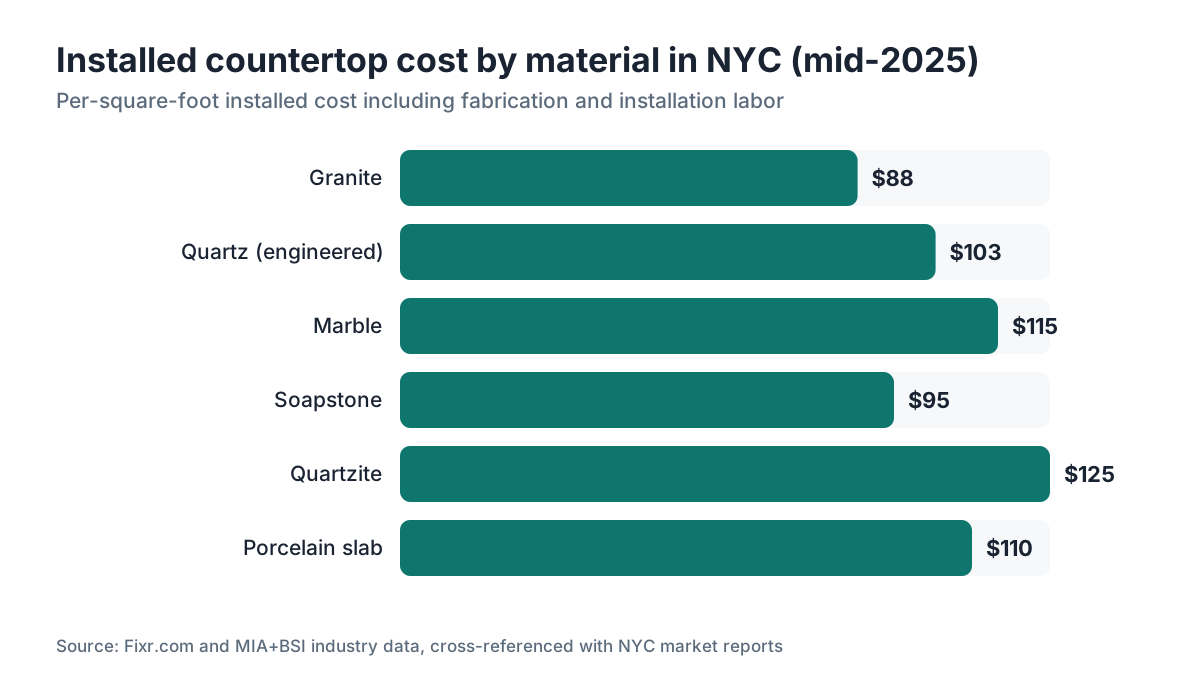
Installed pricing in New York City runs roughly $60, $150 per square foot for the two most common materials, granite and quartz. That range is wide because it folds together slab cost, fabrication labor, edge work, and installation. Marble and quartzite sit at the upper end or above it. Soapstone often prices close to granite. Engineered surfaces like Cambria or Silestone carry manufacturer pricing premiums on top of standard fabrication fees.
Here is a realistic material-by-material comparison based on NYC market rates as of mid-2025:
| Material | Installed cost range (NYC) | Notes |
|---|---|---|
| Granite | $65, $110/sq ft | Wide price spread based on rarity of slab |
| Quartz (engineered) | $75, $130/sq ft | Brand pricing adds cost; Cambria runs higher |
| Marble | $80, $150/sq ft | Carrara is lower end; book-matched exotic marble is much more |
| Quartzite | $90, $160/sq ft | Frequently mislabeled; ask for ASTM test data |
| Soapstone | $70, $120/sq ft | Limited NYC supplier network |
| Porcelain slab | $80, $140/sq ft | Brittle; requires experienced fabricator |
Those numbers line up with national cost-data aggregators like HomeAdvisor and Fixr, which report a national average of $40, $100/sq ft installed, with urban markets running 20 to 40% above that floor [2]. NYC sits firmly in the upper tier.
Edge profiles add cost. A basic eased or beveled edge is usually included. Ogee, mitered waterfall, and dupont edges can add $15, $40 per linear foot. Cutouts for sinks and cooktops typically run $100, $250 each, depending on complexity.
Get at least three quotes. Fabricators price slabs differently, and the same material can cost 30% more at one shop than another based on their slab sourcing and overhead.
How do you find a reputable stone fabricator in NYC?
The fastest starting point is the Marble Institute of America (MIA+BSI) member directory [3]. Member shops agree to a code of ethics and get access to industry training. Not every good NYC fabricator belongs, but membership is a meaningful signal.
You can also check the New York City Department of Consumer and Worker Protection license database [4]. Home improvement contractors doing work over $200 in NYC must hold a Home Improvement Contractor (HIC) license. A fabricator doing residential installs without one is operating illegally, and you lose many of your legal remedies if something goes wrong.
Beyond licenses, ask these questions before you hire:
- Do you do your own templating, or do you subcontract it? In-house templating with a digital laser or Proliner system is more accurate than hand-measuring.
- Where do you source your slabs? Shops with direct distributor relationships or their own slab yard give you more selection and traceability.
- What is your warranty on fabrication defects? Industry standard is one year on workmanship.
- Can I visit your shop? A fabricator who can't or won't show you their equipment is a red flag.
- Do you handle NYC building logistics, including freight elevator reservations and curb-cut permits?
For fabricators and shop owners trying to run tighter operations, tools like SlabWise help with quoting accuracy and slab nesting, which directly affects your material yield and margin. Worth a look if you're juggling multiple jobs.
Referrals from kitchen designers, architects, and general contractors carry real weight in this city. NYC's design community is small, and bad fabricators develop reputations fast.
What is the difference between a fabricator, a distributor, and a stone importer in NYC?
These three types of businesses are different, and mixing them up costs you money and time.
A stone importer brings raw slabs from quarries in Brazil, Italy, India, Spain, or elsewhere directly into the US market. In the NYC metro area, major importers cluster in the South Bronx slab corridor along Exterior Street and in parts of Queens and New Jersey. Importers sell wholesale to fabricators and sometimes to the trade. They usually do not fabricate or install.
A distributor buys from multiple importers and resells slabs to fabricators, designers, and occasionally homeowners. Distributors often keep large slab yards where you can view full slabs in person, which matters because stone varies dramatically from one slab to the next even within the same lot.
A fabricator buys from distributors or importers (or both), cuts, finishes, and installs. Many NYC fabricators also keep a showroom where they display slab samples and finished edge profiles.
Some businesses do all three. If you're a homeowner, you're almost always dealing with a fabricator who is also acting as a retailer. Want to pick your actual slab by hand? Ask whether the shop can take you to the slab yard where their stone is stored. Many will. Choosing the specific slab used in your kitchen is worth a trip, especially for marble or exotic quartzite where color and veining vary enormously.
If you're a fabricator, knowing where your slab comes from matters for traceability and lead time. Import delays, like the port congestion that rippled through the stone industry in 2021 to 2022, can blow out project timelines by weeks [5].
What materials are NYC stone fabricators working with most often?
Granite held the dominant market share for residential countertops through the 2000s and early 2010s. Engineered quartz overtook it in the mid-2010s and remains the highest-volume material in most NYC fabrication shops today, driven by low maintenance, consistent patterning, and broad color availability [6].
Marble has always been strong in New York. The city's history with marble, from the stoops of Brooklyn brownstones to the lobbies of Midtown buildings, gives it cultural staying power. Carrara marble countertops are common in Manhattan apartments even though marble etches from acidic foods and drinks. Most homeowners who choose marble know this and accept it. You can read more about specific materials in our guide to marble countertops and, if you're comparing options, granite countertops.
Quartzite has grown fast as a marble alternative, marketed for its hardness. The problem is that quartzite is widely mislabeled. True quartzite (metamorphic, mostly silica) is very hard. Stones sold as quartzite that are actually marble or dolomitic marble are much softer and will etch. If you're paying quartzite prices, ask the fabricator for ASTM C503 or C119 test data [7]. Reputable shops either have it or can get it from their supplier.
Porcelain slabs (large-format, ultra-compact surfaces like Dekton and Neolith) have grown in NYC commercial and high-end residential work. They require specialized tooling and more careful handling than stone, so not every fabricator does them well. Ask specifically about their porcelain slab experience.
For less common materials like soapstone or butcher block, NYC has fewer specialists. Butcher block countertops and soapstone are typically handled by smaller shops or woodworking specialists rather than high-volume stone fabricators.
What does the NYC fabrication and installation process look like from start to finish?
The timeline from first contact to installed countertops in NYC typically runs two to four weeks for in-stock material. Here is the standard sequence:
- Initial estimate. You provide rough square footage (or the fabricator measures from your plans). You get a ballpark number.
- Material selection. You visit a slab yard or showroom and select your slab. For high-variation materials like marble, this step matters a lot. You can also view edge profiles in the showroom.
- Contract and deposit. Standard practice is 50% deposit at signing, balance due at or before installation. Get the contract in writing. NYC's Home Improvement Contractor law requires written contracts for residential work over $500 [8].
- Templating. A templater visits your home after cabinetry is set and levels are confirmed. Digital laser templating (Proliner, LT2D3D) is now common at mid-to-large NYC shops and produces more accurate results than hand-templating. This visit takes one to two hours for a typical kitchen.
- Fabrication. The shop programs the cut from the template data, nests the pieces on your slab, and runs the cuts. For standard materials and layouts, fabrication takes three to five business days.
- Installation. A crew of two or three delivers and installs. In NYC apartments, this means coordinating freight elevator access, often with a Certificate of Insurance (COI) on file with the building. Budget a full day for a typical kitchen. Seam locations should be agreed on before fabrication.
- Final inspection. Walk the installation with the crew before they leave. Check seams, edges, cutouts, and overhang dimensions.
The biggest schedule risks in NYC are: (1) delayed cabinet installation pushing out the template date, (2) slab damage or breakage requiring a replacement order, and (3) building access logistics, especially COI requirements from co-op and condo boards that can take a week to clear.
What permits or licenses are required for countertop installation in NYC?
Countertop replacement in an existing kitchen typically does not require a New York City Department of Buildings permit because it is not structural work and does not involve plumbing rough-in or electrical rough-in changes [9]. Reconnecting a sink after countertop installation technically involves a plumber, and if that plumber pulls a permit, the permit is for the plumbing, not the countertop itself.
What matters legally is the contractor's license. Under New York City Administrative Code Section 20-386 through 20-406, any home improvement work on a residential property totaling more than $200 requires the contractor to hold a valid NYC Home Improvement Contractor (HIC) license issued by the Department of Consumer and Worker Protection (DCWP) [8]. You can verify a license at the DCWP license lookup tool online [4].
Building-specific requirements (co-ops and condos) are a separate layer. Many NYC co-op and condo boards require: a certificate of insurance naming the building as additional insured, a completed alteration agreement, proof of contractor licensing, and sometimes a noise variance from the building manager for saw work. Some buildings ban stone saw work on-site entirely, requiring all cutting to happen at the fabrication shop. Ask about this before you sign a contract. A fabricator experienced in NYC residential work will already know the drill.
If you're doing a full kitchen renovation that includes moving plumbing or changing electrical, those trades need licensed contractors and likely DOB permits, but again that is separate from the countertop fabrication itself.
How should fabricators in NYC think about quoting and job costing?
NYC fabricators run tighter margins than shops in most other US markets because their fixed costs, slab storage, warehouse rent, delivery, and labor, are higher across the board. Getting quoting right is not optional here.
The core quoting variables are: gross slab square footage needed (including waste and nesting loss), fabrication labor by complexity tier, edge linear footage at the applicable rate, cutout count, delivery and installation labor (including any building logistics premium), and material cost from the distributor.
Waste and yield are bigger problems than most shop owners admit. A typical rectangular kitchen job might waste 15 to 25% of the slab. A complex layout with an island, peninsula, and multiple cutouts can waste 35 to 45% if nesting is done poorly [10]. That waste is your cost, not the customer's, so it has to be priced in accurately.
Digital nesting software cuts material waste by optimizing how pieces are arranged on the slab before cutting. Shops running manual layouts leave real money on the table on every exotic or expensive slab. For shops looking to close that gap, SlabWise is built specifically for fabricator quoting and slab nesting, and the effect on margin is measurable.
NYC fabricators also need to account for building-access costs in their bids. A job in a Manhattan high-rise with a two-hour freight elevator window and a 12th-floor delivery eats more crew time than a ground-floor Brooklyn brownstone. If you're not line-iteming building logistics in your estimate, you're absorbing that cost yourself.
For homeowners reading this: a quote that seems low may simply be ignoring these costs. Ask how waste, delivery, and building logistics are handled in the price.
What questions should homeowners ask before signing with an NYC fabricator?
You have more power before you sign than after. Here are the questions worth asking, and what good answers look like.
"What is your templating method?" Good answer: digital laser templating with a calibrated system. Acceptable answer: digital measuring with hand verification. Concerning answer: hand-measuring only on complex jobs.
"Can I see the specific slab that will be used in my job?" Good answer: yes, come to the yard or we'll send photos and mark the slab for you. Concerning answer: "we'll pick a nice one."
"What does your warranty cover and for how long?" Industry standard is one year on workmanship defects. Get it in writing.
"How do you handle building access requirements in NYC?" A shop that has never heard the term "certificate of insurance for a co-op" has not done much NYC residential work.
"Who does the installation, your own crew or a subcontractor?" In-house crews are generally more accountable. Subcontracted installations are common and fine, but ask whether the sub is licensed.
"What happens if the slab breaks during fabrication or delivery?" This happens. The answer should be: we source a replacement slab and absorb the cost if the breakage is our fault. Get that in writing.
"Do you handle disconnecting and reconnecting plumbing, or do I need my own plumber?" Most fabricators do not do plumbing. You'll need a licensed plumber for the sink reconnect. Some fabricators have a regular plumber they refer. Budget $150, $400 for that work.
The full countertop installation process, regardless of material, follows a similar sequence. Our guide to countertop installation covers the details if you want a step-by-step reference.
What are common complaints about NYC stone fabricators and how do you avoid them?
The NYC DCWP receives thousands of home improvement contractor complaints per year, and countertop-related disputes are a regular part of that volume [4]. The most common issues fall into a few categories.
Poor seam quality. Seams in stone countertops are visible and you can feel them. A bad seam, misaligned, poorly color-matched, or rough to the touch, is one of the most common complaints. Seam location should be agreed on before fabrication, not after. Ask to see examples of their seam work in person.
Template errors. If the template is wrong, the cut is wrong, and fixing it is expensive. Digital templating cuts this risk sharply. If a fabricator hand-measures and gets your overhang or clearance wrong, you may end up with a top that doesn't fit.
Slab substitution. You select a specific slab, and a different one shows up. This happens. Mark your slab at the yard with a paint marker and photograph it. Get the slab lot number in your contract.
Delayed installation. NYC logistics are genuinely hard, but repeated delays without communication are a sign of a disorganized shop. Ask about their current lead time and whether that includes any current backlog.
Damage to adjacent surfaces. Stone installation means heavy slabs in tight spaces. Scratched flooring, chipped tile backsplashes, and nicked cabinet fronts happen. A reputable shop carries liability insurance and will address it. Verify insurance before work begins.
For materials that need specific care after installation, knowing what you're getting into upfront helps. Our guides on how to clean stone countertops and how to clean quartzite countertops are useful references once you're living with your new surface.
How does NYC compare to national stone fabrication pricing and why?
NYC fabrication pricing runs 20 to 40% above the national average on a per-square-foot installed basis. That premium is real and has specific causes.
Commercial real estate. Fabrication shops need serious floor space for slab storage, cutting equipment, and staging. In NYC and the immediate metro area, that space costs multiples of what it costs in suburban or rural markets. A 10,000 sq ft shop in the South Bronx or Maspeth costs far more per year than an equivalent shop in a mid-size Midwestern city.
Labor. New York City's minimum wage is $16.50/hour as of January 2024 [11]. Skilled stone fabricators and installers earn well above minimum wage, but the entire wage floor sits higher in NYC than in most of the US. Union labor norms in larger buildings and commercial projects add more cost.
Logistics. Delivering and installing 400-pound stone tops in a walk-up apartment or a high-rise with freight elevator restrictions takes more crew time and more coordination than a suburban single-family installation. That cost is real and legitimate.
Supply chain. NYC importers and distributors are a step in the supply chain that adds cost but also adds value, holding slab inventory so you're not waiting 8 to 12 weeks for a container from Brazil.
National data from the US Bureau of Labor Statistics [12] on construction labor costs in the New York metro area consistently shows wage rates 25 to 35% above the national median for skilled trades. That alone explains most of the price premium before you get to real estate and logistics.
For homeowners who are genuinely price-sensitive, alternatives like laminate countertops or solid surface options like Corian save real money, though they don't give you natural stone.
Frequently asked questions
How long does it take to get countertops installed by an NYC fabricator?
From signed contract to installed countertops, most NYC fabricators take two to four weeks when the material is in stock. The timeline breaks down roughly as: one to three days to schedule and complete templating, three to five business days for fabrication, and one to three days to schedule installation. Custom or rare materials, complex jobs, and co-op building logistics can push that to six weeks or more.
Do I need a permit to replace countertops in a NYC apartment?
No DOB permit is required for countertop replacement in most cases, since it is cosmetic work with no structural or rough-in changes. Your contractor does need a valid NYC Home Improvement Contractor license for any residential job over $200. Co-op and condo buildings often have their own requirements, including a certificate of insurance and an alteration agreement, that are separate from city permits.
What is a reasonable deposit for a NYC stone fabrication job?
The standard in the NYC market is 50% at contract signing, with the balance due at delivery or installation. Under NYC Home Improvement Contractor rules, deposits over one-third of the total contract price require that the work begin within 30 days, or the contractor must deposit the excess in an escrow account. Be wary of any shop asking for 80 to 100% upfront before any work has started.
How do I verify that an NYC stone fabricator is licensed?
Go to the NYC Department of Consumer and Worker Protection (DCWP) license lookup tool at nyc.gov and search by business name or license number. A valid Home Improvement Contractor license shows the licensed entity name, license number, and expiration date. Always verify before signing a contract. Working with an unlicensed contractor in NYC limits your legal recourse if problems arise.
Can I supply my own slab to a NYC fabricator?
Yes, most NYC fabricators will work with customer-supplied material (CSM), but they typically will not warranty the slab itself, only their fabrication work. You should confirm the fabricator accepts CSM before purchasing. Also confirm that your slab dimensions are sufficient for your layout; the fabricator can advise on this. Transportation and delivery of the slab to their shop is your responsibility unless they arrange pickup.
What edge profiles do NYC fabricators commonly offer?
Standard offerings include eased (flat with slight softening), beveled, bullnose (fully rounded), and half-bullnose. More complex profiles include ogee, dupont, and mitered waterfall edges. The eased edge is typically included in the base price. Ogee, waterfall, and custom profiles add $15, $40 per linear foot. Mitered waterfall edges, popular for islands, require precise fabrication and add the most cost.
Is quartz or granite more common in NYC kitchen renovations?
Engineered quartz has been the higher-volume material in NYC residential fabrication since roughly 2015. It is consistent in patterning, requires no sealing, and handles the high-use demands of city kitchens well. Granite remains popular, particularly for buyers who want natural stone at a lower price point than marble or quartzite. Marble is culturally strong in NYC and common in bathrooms and upscale kitchens despite its maintenance requirements.
How do NYC co-op buildings affect the stone installation process?
Co-op boards typically require contractors to submit a certificate of insurance naming the building corporation as additional insured, sometimes a completed alteration agreement, and proof of licensing before any work starts. Some buildings restrict freight elevator access to specific hours, which compresses your installation window. Some prohibit saw work on-site entirely. Your fabricator should ask about these requirements at the estimate stage, not the day before install.
What causes seam problems in stone countertops and how do I avoid them?
Seam problems come from poor template alignment, inadequate substrate support, or rushed epoxy work. To minimize risk: agree on seam placement in writing before fabrication begins, ask to see photos of the fabricator's recent seam work, and verify that your cabinetry is level before templating. Seams in stone are always somewhat visible; the goal is tight fit, good color matching, and no lip between sections. Any lip over 1/32" is a workmanship issue.
Can an NYC stone fabricator also do bathroom vanity tops?
Yes, most NYC stone fabricators do both kitchen and bathroom work. Vanity tops are smaller and generally less complex than kitchen countertops. The same licensing, templating, and installation process applies. Pricing is usually quoted per square foot with a small-job minimum, since setup and delivery costs are similar regardless of size. Expect a small-job minimum of $500, $800 at most shops.
What is the difference between polished, honed, and leathered finishes?
Polished is the high-gloss finish most people picture; it shows fingerprints and etching more clearly on marble. Honed is matte, softer-looking, and hides surface scratches better but is more porous and can stain more easily on some stones. Leathered has a textured, slightly rough surface created by a brushing process; it is popular for granite and quartzite and hides water spots well. Not all stones are offered in all three finishes by every fabricator.
How do I compare multiple quotes from NYC fabricators?
Make sure each quote specifies the same things: material name and grade, square footage calculation method, edge profile included, number of cutouts, delivery and installation, and any building-access costs. Price-per-square-foot comparisons only work if the scope is identical. A low quote that excludes sink cutouts, uses a lower-grade slab, or doesn't include installation labor is not actually comparable to a higher all-in price.
What warranty should I expect from a reputable NYC stone fabricator?
One year on fabrication workmanship is the industry standard. That covers defects like improper seams, edge quality failures, or incorrect dimensions. It does not cover normal wear, staining from improper care, chips from impact, or manufacturer defects in the slab material itself. Engineered quartz warranties (from brands like Cambria or Silestone) are separate manufacturer warranties, often 10 to 15 years, that come through the brand rather than the fabricator.
Sources
- Fixr.com, Countertop Installation Cost Guide: National average installed countertop cost is $40, $100/sq ft; urban markets typically run 20 to 40% above that floor
- Marble Institute of America (MIA+BSI), Member Directory: MIA+BSI maintains a member directory of fabricators who agree to an industry code of ethics
- U.S. Department of Transportation, Port Congestion and Supply Chain Reports: Port congestion during 2021 to 2022 delayed stone slab import timelines by weeks across the industry
- Marble Institute of America, U.S. Stone Industry Statistics: Engineered quartz overtook granite as the highest-volume residential countertop material in the mid-2010s and remains so
- ASTM International, Standard Specification C503 for Marble Dimension Stone: ASTM C503 and C119 define test methods for classifying dimension stone, including distinguishing true quartzite from marble
- Marble Institute of America, Fabrication Best Practices Manual: Typical slab waste is 15 to 25% for standard layouts; complex layouts with islands and cutouts can reach 35 to 45% with poor nesting
- New York State Department of Labor, Minimum Wage Schedule: NYC minimum wage is $16.50/hour as of January 2024, raising the labor cost floor for all trades including stone fabrication
- U.S. Bureau of Labor Statistics, Occupational Employment and Wage Statistics, New York-Newark-Jersey City MSA: BLS data consistently shows construction and skilled trade wages in the New York metro area running 25 to 35% above the national median
Last updated 2026-07-09