TL;DR
- Dozens of stone shops serve the 28216 zip and west Charlotte, with installed granite running $45 to $100 per square foot depending on grade and edge.
- Plan on 2 to 6 weeks from template to install.
- Get three itemized bids, see your actual slab before cutting, and pick on quality and lead time, not which shop is closest.
Where do stone fabricators near Rozzelles Ferry actually operate?
No stone shop sits directly on Rozzelles Ferry Road. The 28216 zip runs through northwest Charlotte, from Rozzelles Ferry through Brookshire and up toward the I-85 and I-485 corridor, and the fabricators serving it cluster in the industrial pockets nearby: the Brookshire Freeway (NC-16) corridor, the Wilkinson Boulevard zone, and the Steele Creek and Westside areas roughly 10 to 20 minutes south.
Charlotte's metro had well over 50 stone fabrication businesses across Mecklenburg and the surrounding counties as of recent county business-license data, though the count moves year to year as shops open and close [1]. For a homeowner in 28216, a sane search radius is 15 to 25 miles. That opens up Huntersville, Concord, Gastonia, and even Mooresville without much of a drive penalty.
Here's the part people overlook. Almost every fabricator in Charlotte will drive to 28216 to template and install no matter where the shop sits. They cut the stone at their facility and haul it to you. So your real filter is shop quality, lead time, and price. Not the pin closest to your house.
How do you find a reputable stone fabricator in the Charlotte 28216 area?
Start with three sources: the Natural Stone Institute member search, Google Maps reviews filtered to 4-plus stars with at least 30 reviews, and a referral from a local kitchen designer or cabinet shop [2]. Cross-check any name against the North Carolina Licensing Board for General Contractors if the shop is also doing structural work, though countertop-only fabrication in North Carolina falls under specialty trades and does not need a GC license [3].
Cabinet shops and kitchen showrooms are your best lead. They see finished kitchens every week and they hear fast when a fabricator delivers sloppy seams or blows a schedule. A cabinet shop on Wilkinson Boulevard or a showroom in Ballantyne steers you toward people they trust because their own name rides on the referral.
Get at least three bids. Charlotte fabrication pricing varies enough that the highest quote can land 30 to 40% above the lowest for the same slab, partly because stone-material markup is all over the map. One shop buys direct from a large importer. Another buys from a secondary distributor. Those costs flow straight to you.
Check insurance before you sign. Ask any shop to email you a certificate of general liability coverage. A legitimate shop sends it without a fuss. No certificate, walk away.
What does stone countertop installation cost in Charlotte NC right now?
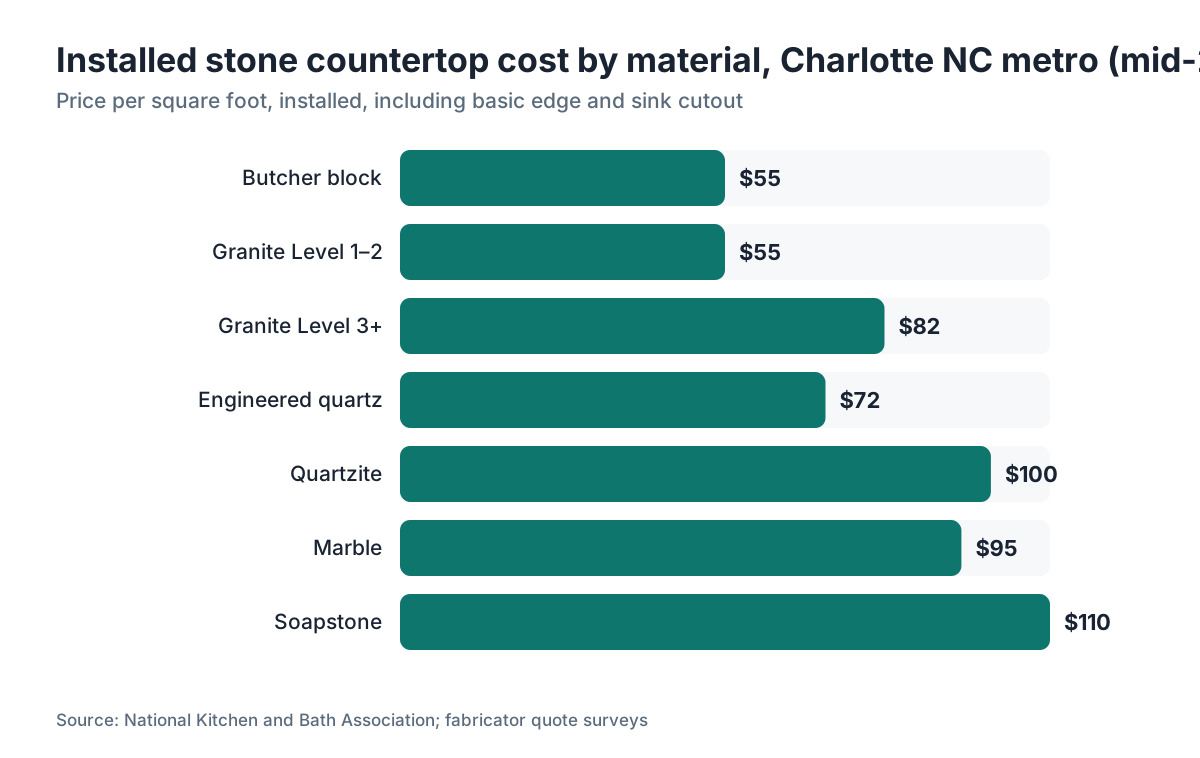
Installed prices in the Charlotte metro as of mid-2025 look roughly like this:
| Material | Low end (installed, per sq ft) | High end (installed, per sq ft) |
|---|---|---|
| Standard granite (Level 1 to 2) | $45 | $65 |
| Premium granite (Level 3+) | $65 | $100 |
| Quartz (engineered) | $55 | $90 |
| Quartzite (natural) | $70 | $130 |
| Marble | $70 | $120 |
| Soapstone | $80 | $140 |
| Butcher block (wood) | $35 | $75 |
Those figures cover material, fabrication labor, a basic edge (eased or beveled), a sink cutout, and installation. They do not cover demolition of old counters, plumbing disconnect and reconnect, or specialty edges like ogee or waterfall. Demolition and hauling usually adds $150 to $350 depending on how much counter comes out [4].
Charlotte is a competitive fabrication market. Prices here run a touch lower than some other Carolina metros because the city has a high density of shops and close access to imported stone through the nearby Port of Charleston [5]. Natural-stone supply costs still swing with fuel prices and Brazilian and Italian export volumes, so any number you read online can be 10 to 15% off by the time you get a real quote [8].
A 30-square-foot kitchen (typical for a modest galley or L-shaped layout in a west Charlotte ranch) runs $1,350 to $3,000 installed at the low-to-mid range. A 60-square-foot kitchen climbs to $2,700 to $6,000. Those are real numbers, not padded estimates.
What questions should you ask a stone fabricator before signing a contract?
These questions separate a real shop from a mediocre one.
Do they fabricate in-house or subcontract the cutting? Some showrooms are just brokers. They take your order and hand it to another shop. That isn't automatically bad, but you need to know, because your warranty and your point of contact for problems shift with it.
What cutting equipment do they run? A shop with a modern CNC and a bridge saw holds tolerances around plus or minus 1/16 inch reliably. A shop working by hand with angle grinders can still do fine work, but it's slower and the variability is higher. Ask to walk the shop floor if they'll let you.
Who does the template, and how? Digital templating with a Laser Products or Proliner system is the current standard for anything with complex angles, multiple sink cutouts, or a cooktop cutout [6]. If a shop still uses cardboard or MDF templates, ask how long they've done it that way and whether it's ever caused a callback. Old-school templating isn't a dealbreaker. Digital is faster and usually more accurate.
Where does the seam go? Any run longer than the slab (roughly 9 to 10 feet for most granite and quartz) needs a seam. Ask where they plan to put it and whether you approve it before they cut. You do not want a seam splitting an island or sitting under a prep zone.
What does the warranty cover, and for how long? A typical fabrication warranty covers workmanship defects (bad seams, install chipping, a wrong cutout) for one year. Material defects are often covered separately by the stone supplier. Get all of it in writing.
How does the stone countertop process work from start to finish?
The sequence matters, because most homeowner frustration comes from not knowing what phase you're in or why it's taking time.
Step one is the estimate. You measure your counters (or give rough dimensions), pick a material, and the shop quotes square footage plus edge plus cutouts. This is usually free.
Step two is slab selection. You go to the shop's yard or a distributor's yard and pick your actual slab. This matters more than people expect. Two slabs of the same granite variety can look nothing alike. Bring a cabinet door sample or a photo.
Step three is the template. After your cabinets are set and level, the fabricator comes out to measure precisely. This is non-negotiable. They can't cut until the cabinets are in. Digital templating runs about 45 to 90 minutes for a typical kitchen.
Step four is fabrication. The slab gets cut, the edges profiled, and the sink or cooktop openings cut at the shop. Figure 3 to 10 business days depending on backlog.
Step five is installation. A two-person crew shows up with the finished pieces, sets them, glues and polishes the seams, and secures the counter to the cabinets. A standard kitchen install takes 2 to 4 hours. Most crews ask you to wait 24 hours before using the sink or stacking weight on the seams.
Total elapsed time from signed contract to installed counter: usually 2 to 5 weeks in Charlotte, though high-volume shops can stretch to 6 to 8 weeks during spring and fall renovation peaks [4].
If you want a fast preliminary number before the site visits and yard trips, a tool like SlabWise's instant quote calculator lets you enter dimensions and material to get a ballpark before you pick up the phone.
What stone materials work best for kitchens in the Charlotte area?
Charlotte's climate is warm and humid enough that you skip the freeze-thaw worries that hit outdoor stone up north. For interior counters, the choice comes down to looks, how much maintenance you'll tolerate, and budget.
Granite is still the most popular material in this price range across Charlotte's older housing stock, which includes a lot of 1990s ranch homes in 28216 that were built with laminate and are now getting updated [1]. It's hard, heat-resistant, and easy to source from local distributors. Granite countertops run from plain blacks and whites at Level 1 pricing up to exotic Brazilian material at Level 4 and above.
Engineered quartz (Cambria, Silestone, MSI) has grown to roughly match granite in Charlotte sales volume over the last five years, going by distributor reports. It's non-porous and never needs sealing, which matters if you have kids or cook hard. Cambria countertops are made in the US (Jordan, Minnesota) and carry a lifetime material warranty.
Quartzite is natural stone people constantly confuse with quartz. It's harder than marble and reads differently than granite, but it does need sealing. If you're leaning that way, read how to clean quartzite countertops first, because some quartzite runs more porous than the yard admits.
Marble ages into something beautiful if you're at peace with etching and patina. Plenty of people aren't. Marble countertops are genuinely high-maintenance in a working kitchen. Know that going in.
Soapstone is less common but worth a look for west Charlotte's craftsman and bungalow stock. It's heat-resistant, non-porous, and develops a patina over time. Read how to clean soapstone countertops to understand the oiling routine it wants.
Budget options some local shops install alongside stone: laminate countertops, Formica, and Corian. These aren't stone, but several Charlotte fabricators handle them.
How do you compare stone fabricator quotes accurately?
Three quotes is the floor. Reading them right is the hard part.
Make every quote match the same scope: same square footage, same edge profile, same cutout count, same material level. A shop that quotes Level 1 granite when you asked for Level 3 looks 30% cheaper and hands you something you didn't want.
Confirm these line items are in every quote:
- Material cost (the slab)
- Fabrication labor
- Edge profile (which one, how many linear feet)
- Cutouts: sink (undermount vs drop-in), cooktop, faucet holes
- Delivery and installation
- Sealer application (some shops include a coat, some charge for it)
These are the ones that hide as extras:
- Old countertop removal and disposal
- Backsplash cuts (4-inch or full-height)
- Corbels or support brackets for overhangs past 12 inches
- Plumbing reconnect
Here's a move that works. Take the lowest quote and ask the other shops what's in that scope they left out. The answer often explains the gap. Sometimes the low quote really is just lower because the shop has less overhead or buys stone smarter. Other times a missing line item closes the whole difference.
Shops running modern quoting software, like the tools SlabWise builds, generate itemized quotes faster and miss fewer line items, which gives you a cleaner comparison as a homeowner.
What permits or contractor licensing applies to countertop work in Charlotte NC?
A straight countertop swap does not need a building permit in Charlotte. The city follows the North Carolina State Building Code, and replacing counters without touching structure, electrical, or plumbing falls outside permit territory [10]. Most standard jobs qualify.
Move plumbing, and that changes. Repositioning a sink drain or a supply line requires a plumbing permit pulled by a licensed North Carolina plumbing contractor. Your countertop fabricator almost never holds a plumbing license. You'd hire a plumber separately or confirm the shop keeps a licensed one on the crew.
North Carolina has no license category for stone countertop installation as a standalone trade [3]. A fabricator working in Charlotte needs an active Mecklenburg County business license, general liability insurance, and, if they have employees, workers' compensation. State law requires workers' comp for any business with three or more employees, which the North Carolina Industrial Commission enforces [7]. The North Carolina Department of Labor publishes the broader contractor compliance rules that apply to specialty trades [9].
One more thing to check. If you're in an HOA, some west Charlotte associations have rules about contractor hours, staging vehicles, and material storage on the property. Read your covenants before you schedule a delivery that puts a large truck or forklift on your street.
How long does a stone countertop installation last, and what maintenance does it need?
Properly sealed and maintained granite and quartzite routinely last 30-plus years. Nobody has a large-sample study on countertop lifespan because no one tracks residential failure rates systematically, but the Natural Stone Institute positions natural stone as a lifetime material under normal home use [2].
Engineered quartz is similarly durable with one known weakness: prolonged direct UV can yellow some formulations. Inside a kitchen this rarely matters. For an outdoor kitchen or a sunroom counter, ask your fabricator about UV-stable options.
Sealing runs on a schedule. Most granite and quartzite wants resealing every 1 to 3 years depending on porosity. The test is simple: drop a tablespoon of water on the surface and wait 10 minutes. If the stone darkens where the water sat, the sealer has worn and it's time to reseal. Quartz, most marble, and soapstone skip the impregnating sealer entirely. Read how to clean stone countertops for the full breakdown.
For daily cleaning, pH-neutral dish soap and water handles every natural stone. Keep acids off marble and quartzite (vinegar, lemon juice, and some commercial cleaners) because etching is a real risk. A solid kitchen countertops routine takes about 30 seconds a day.
What should you know about slab yards and stone selection near Charlotte?
Charlotte has several large distributor yards within an easy drive of 28216. The heaviest concentration sits in the airport and I-85 corridor and in the South End industrial area. These yards stock hundreds of slabs from Brazil, India, Italy, Turkey, and domestic quarries.
Go in person to pick. Do not choose from photos online. Stone varies within a single slab and it varies more across different slabs of the same variety. If you're matching one area to another (an island to a perimeter counter, say), you want slabs from the same quarry run and ideally the same pallet.
Ask to have the slabs pulled vertical so you can read the full face in light close to what you'll have at home. Flat on the ground under fluorescent shop lights is the worst way to judge color and movement.
A 30-square-foot kitchen usually uses part of one slab. Most slabs run 50 to 70 square feet. The leftover becomes shop remnant. Some fabricators credit you for usable remnant, some don't, so ask upfront. Doing a small bath vanity (8 to 15 square feet)? Ask if the shop has remnants from past jobs. A remnant can cut your material cost 30 to 50% on smaller pieces.
Are there red flags that signal a bad stone fabricator?
Yes, and they repeat often enough that you can screen for them fast.
No physical shop, or they won't let you visit. A fabricator with no real location is almost certainly a broker or a tiny operation in a rented unit. Neither is automatically bad, but you should know what you're buying.
All-inclusive pricing with no line items. "Everything included, $2,800 for your whole kitchen" with no breakdown means you can't tell what's covered and you can't compare it to anything.
Pressure to sign same-day or to deposit before you've seen the slab. Real shops don't need to rush you. You should see and approve the actual slab before fabrication starts, every time.
No template date. Some homeowners get a quote, pay a deposit, then learn the template is six weeks out. Ask for the current template schedule before you sign.
Reviews mentioning missed deadlines with no reply from the shop. Every shop has a bad job eventually. How they answer it in public tells you more than the complaint does.
Bargain pricing on premium material. Level 3-plus granite at $40 per square foot installed in Charlotte isn't possible without cutting a corner somewhere: thinner stone, unskilled labor, no warranty, or a bait-and-switch on grade. If a quote sounds too good, ask exactly which grade slab they're pricing.
Frequently asked questions
How far will a Charlotte stone fabricator travel to do a template and install in the 28216 zip code?
Most shops within a 20-mile radius come to 28216 with no travel surcharge. Shops farther out in Concord, Gastonia, or Mooresville may add a small fuel or travel fee, usually $50 to $150. Confirm travel fees upfront. The 28216 zip sits well inside the service area of the majority of Charlotte metro fabricators.
What is the average lead time for stone countertops from a Charlotte area fabricator?
Plan on 2 to 5 weeks from signed contract to install in a normal market. That's roughly 1 week for slab selection and scheduling, 1 to 2 weeks to get a template appointment, and 3 to 7 business days in the shop after template. Spring and fall renovation peaks can push it to 6 to 8 weeks. Ask any shop their current template-to-install window before committing.
Do I need a permit to replace countertops in Charlotte NC?
No permit is required for a straight countertop swap in Charlotte under the North Carolina State Building Code. If the job moves plumbing lines, that work needs a permit pulled by a licensed NC plumbing contractor. Check with your local building department if you're unsure, since permit requirements can change.
How do I know if a Charlotte stone fabricator is licensed and insured?
Ask the shop to email you a certificate of general liability insurance before you pay a deposit. Verify their Mecklenburg County business license is active. North Carolina does not license stone installers as a specific trade, so verification means confirming their business is legally registered and their liability coverage is current, not checking a specialty contractor number.
What is the difference between quartz and quartzite, and which is better for kitchens in Charlotte?
Quartz is engineered stone (ground stone mixed with resin), uniform and non-porous. Quartzite is 100% natural metamorphic rock, often with dramatic veining, and it needs sealing. For high-traffic kitchens with young kids, quartz wins on low maintenance. For buyers who want natural stone without marble's etch risk, quartzite is compelling. Both are widely stocked by Charlotte area fabricators.
What edge profiles do Charlotte fabricators offer, and do they cost extra?
Standard profiles (eased, beveled, half-bullnose) are usually included in the base quote. Complex profiles like ogee, dupont, or waterfall cost extra, usually $10 to $25 per linear foot above the base edge. A full kitchen perimeter might have 25 to 40 linear feet of edge, so a premium profile can add $250 to $1,000. Confirm which profile the quote includes.
Can I save money by supplying my own slab to a Charlotte fabricator?
Some fabricators allow it; many don't. Shops that mark up slab material as part of their margin may decline or charge a fabrication-only premium to make up the lost revenue. If a shop does allow owner-supplied slabs, get it in writing who owns the risk if the slab cracks during cutting, because that responsibility usually stays with whoever bought the stone.
How many square feet of countertop does an average Charlotte kitchen have?
A modest galley or small L-shaped kitchen runs 25 to 35 square feet. A medium U-shaped kitchen with an island runs 50 to 70. Large open-plan kitchens with oversized islands can top 100. Measure your existing counters by multiplying length times depth (standard depth is 25.5 inches) and summing the sections for a rough estimate before you call for quotes.
What is a seam in stone countertops and how visible will it be?
A seam is the joint where two stone pieces meet because the run exceeds slab length (typically 9 to 10 feet). A skilled fabricator color-matches epoxy filler and polishes it tight, so it shows mainly at certain light angles. Seam quality varies by shop. Ask to see photos of past seam work, or read reviews that mention seams. Placement matters: a seam in a corner hides better than one mid-run.
Does granite countertop color or pattern affect the installed price near Rozzelles Ferry?
Yes. Shops grade granite in levels (1 through 4-plus), and price climbs with the level. Level 1 is usually consistent black, white, or beige with little variation. Level 3 and up brings exotic Brazilian, Italian, or Indian material with dramatic veining. The installed difference between Level 1 and Level 4 for the same kitchen can easily run $800 to $2,000 in Charlotte.
Is butcher block a good countertop option for a Charlotte kitchen renovation?
Butcher block works well in Charlotte's climate if you'll oil it 2 to 4 times a year and keep it away from standing water. It's warmer and quieter underfoot than stone, and it's the cheapest way to get a real-material counter (often $35 to $75 per square foot installed). Many homeowners use it on an island paired with stone perimeters to add contrast and hold down cost.
How do I get an accurate countertop quote before my cabinets are installed?
Use your cabinet layout drawings to calculate approximate square footage. Most fabricators give a good-faith estimate from drawings, clearly marked subject to adjustment after template. Online quote calculators give a fast ballpark if you enter dimensions and material. The final price locks after template, because template measurements are the only ones precise enough to cut from.
What happens if a slab cracks during installation near Rozzelles Ferry?
A reputable shop carries that risk. Their general liability policy and shop warranty should cover replacing a slab that cracks from improper handling, bad support, or fabrication error. Confirm this coverage in your contract before signing. If a shop calls a crack 'just the nature of the stone' and takes no responsibility, that tells you how they'll handle any future problem.
Sources
- Mecklenburg County (mecknc.gov), business and licensing records: Mecklenburg County business records provide the basis for tracking active fabrication businesses in the Charlotte metro area.
- Natural Stone Institute, member directory and technical resources: Natural stone countertops are positioned as lifetime-durable materials under normal residential use; the Natural Stone Institute maintains a member directory for finding fabricators.
- North Carolina Licensing Board for General Contractors: Countertop-only installation in North Carolina does not require a General Contractor license; specialty contractor categories apply for certain trades.
- National Kitchen and Bath Association (NKBA): Typical countertop project lead times and cost ranges for installed stone countertops in mid-size US metro markets, including demolition and installation labor.
- South Carolina Ports Authority, Port of Charleston: The Port of Charleston is a primary US entry point for imported stone slabs serving the Southeast US market, affecting pricing in Charlotte-area fabrication shops.
- Laser Products Industries, digital templating systems: Digital templating with laser and Proliner-style systems is the current standard for countertops with complex angles and multiple cutouts.
- North Carolina Industrial Commission, workers' compensation requirements: North Carolina law requires workers' compensation coverage for businesses with three or more employees, including construction and fabrication trades.
- US Geological Survey, National Minerals Information Center (dimension stone): USGS tracks domestic and imported dimension stone volumes and pricing trends, providing a basis for understanding natural stone price variability.
- North Carolina Department of Labor: NC DOL provides guidance on contractor insurance and safety obligations applicable to specialty trades including stone installation.
- City of Charlotte Development Center, building permits: Countertop replacement without structural, electrical, or plumbing changes does not require a building permit under Charlotte's adopted North Carolina State Building Code.
Last updated 2026-07-09