TL;DR
- Stone shops run five core machine categories: bridge saws for straight cuts, CNC machining centers for shapes and edges, waterjet cutters for curves and inlays, edge polishers for finishing, and grinding equipment for thickness.
- An entry-level shop can open for $80,000 to $150,000.
- A full CNC-equipped shop runs $400,000 to $1 million or more in machinery alone.
What machines does a stone fabrication shop actually need?
The honest answer depends on volume and material mix. A shop cutting 20 to 40 slabs a week out of granite and quartz needs a bridge saw, at least one CNC or edge polisher, and a good material handling system. That is the baseline. Every machine beyond that adds capability, speed, or both, and the capital cost compounds fast.
Here is how the five major categories break down:
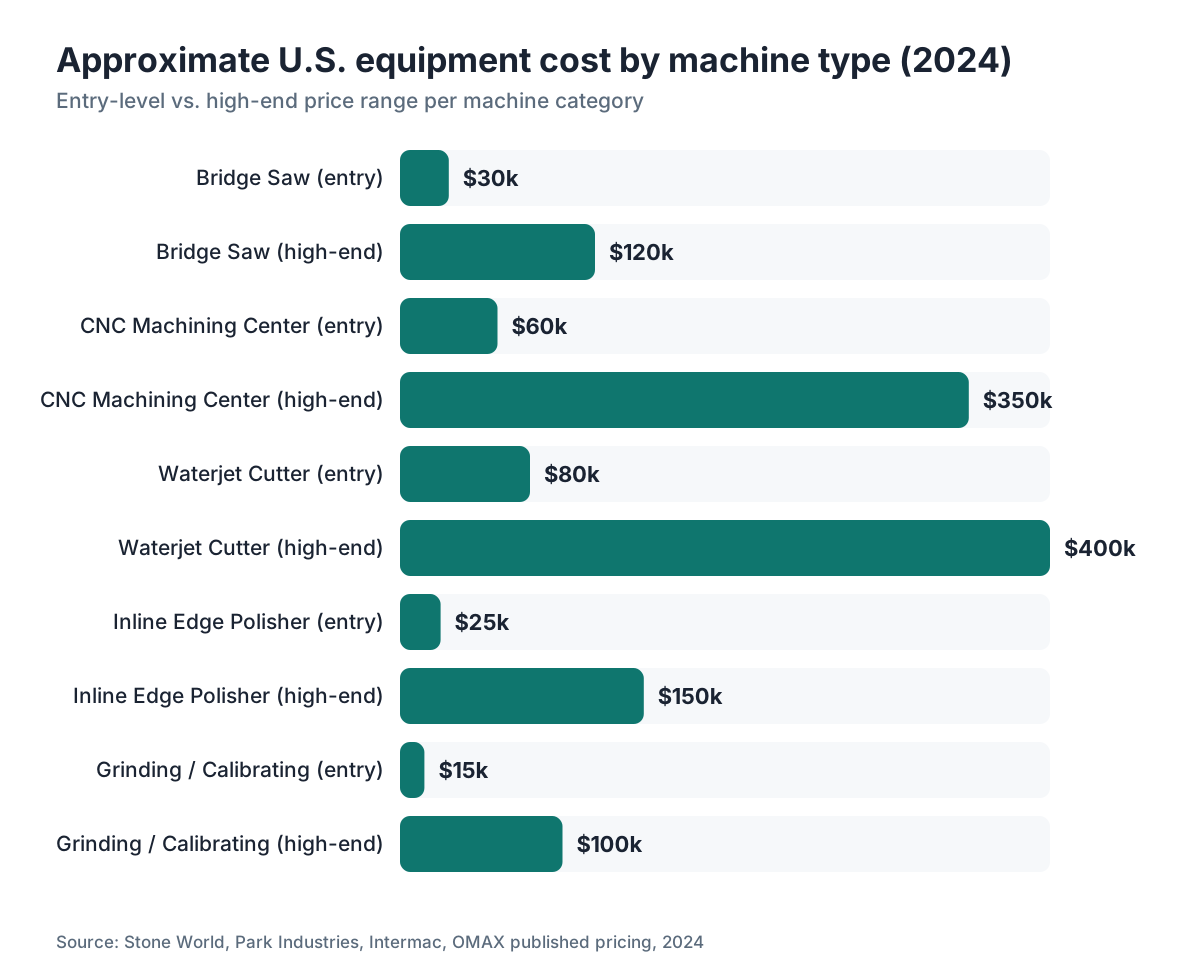
| Machine Category | Primary Job | Entry Price Range | High-End Range |
|---|---|---|---|
| Bridge Saw | Straight slab cuts | $30,000 | $120,000+ |
| CNC Machining Center | Routing, shaping, drilling, edges | $60,000 | $350,000+ |
| Waterjet Cutter | Curves, inlays, fragile materials | $80,000 | $400,000+ |
| Edge Polisher (inline) | Automated edge finishing | $25,000 | $150,000+ |
| Grinding / Calibrating | Surface prep, thickness leveling | $15,000 | $100,000+ |
Prices above are approximate 2024 U.S. market figures based on published dealer and manufacturer price sheets from companies like Park Industries, Prussiani, and Intermac. Exact quotes vary by configuration, waterjet pump horsepower, and spindle count. Import duties and freight add another 5 to 15 percent for European machinery.
You do not need all five categories to open. Plenty of good shops run a bridge saw plus a basic CNC for years before they ever add waterjet capability. The mistake new fabricators make is buying a waterjet first because it looks impressive, then finding out their volume of curved work cannot cover the abrasive consumable cost.
What does a bridge saw do and how do you choose one?
A bridge saw is the workhorse of any stone shop. It makes straight cuts through full slabs, usually with a 14-inch or 16-inch diamond blade spinning at high RPM, flooded with water for cooling and dust suppression. Almost every countertop project starts here. You rough-cut the slab into manageable pieces before detail work happens on a CNC or at an edge polisher.
Bridge saws come in two main configurations: manual tilt-head and CNC-controlled. A manual tilt-head saw lets the operator set bevel angles by hand. A CNC bridge saw sets angles and cut lengths through a programmed sequence, which reduces human error and speeds throughput. For a shop doing more than 15 slabs per week, a CNC bridge saw pays for itself in labor savings within 18 to 36 months in most cases.
Key specs to compare when buying:
- Blade diameter: 14-inch blades handle most countertop material; 16-inch blades are needed for thick pavers and some engineered stone.
- Cutting depth: look for at least 4 inches at 90 degrees, 3 inches at 45 degrees.
- Table size: a 130-inch by 65-inch table accommodates standard 63-by-126-inch slabs. Bigger is better if your shop handles jumbo slabs.
- Water flow and recirculation: a closed-loop water system saves hundreds of gallons per day and matters in regions with water-use restrictions.
- Blade RPM and motor horsepower: most production saws run 4 to 7.5 HP; harder materials like quartzite benefit from the upper end.
European brands (Prussiani, Gaspari Menotti, Donatoni) dominate the high-performance segment. Park Industries is the dominant U.S. manufacturer and offers strong domestic service networks, which matters more than most buyers realize. A saw that sits idle for two weeks waiting on a part from Italy costs you real money.
For shops cutting granite countertops or engineered quartz at volume, a CNC bridge saw in the $60,000 to $90,000 range is usually the right starting point.
What is a CNC machining center for stone and what can it do?
A CNC machining center (sometimes called a CNC router or CNC stone machining center) is the most versatile machine in a fabrication shop. It holds rotating diamond tooling on a gantry that moves in three, four, or five axes over a fixed slab. From a single setup, it cuts profiles, routes sink cutouts, drills faucet holes, mills edge details, and engraves.
The difference between 3-axis and 5-axis machines is significant. A 3-axis machine moves the head in X, Y, and Z. A 5-axis machine adds two rotational axes, letting the spindle tilt and rotate. That means undercuts, complex decorative profiles, and compound angles become possible without flipping the material. Five-axis capability typically adds $80,000 to $150,000 to the machine cost [1].
For a shop producing standard kitchen countertops, a 3-axis machine handles 90 percent of daily work. Where 5-axis earns its keep is in custom furniture, curved reception desks, decorative wall panels, and any project where the design calls for tooling angles a 3-axis head cannot reach.
Spindle speed matters too. Higher-frequency spindles (18,000 to 24,000 RPM) produce smoother finishes on polished edges and reduce tooling wear on hard materials like quartzite or dense white marble [7]. Slower spindles do fine on softer material like limestone or soapstone.
The software driving a CNC matters as much as the hardware. Most machines run proprietary CAM software from the manufacturer, but they accept DXF files from templating and quoting systems. Shops that tie their templating software tightly to their CNC post-processor cut programming time per job from 20 to 45 minutes down to under 5 minutes in most cases. SlabWise integrates with CNC post-processors directly, so template measurements flow into cutting files without manual re-entry.
Leading CNC brands for stone include Intermac (Italy), Breton (Italy), CMS (Italy), Park Industries (USA), and MultiCam (USA). Used machines are available on the secondary market from $25,000 for older 3-axis units, but budget for refurbishment and updated controllers.
When does a shop need a waterjet cutter?
A waterjet cutter forces a stream of water mixed with garnet abrasive through a small orifice at pressures between 55,000 and 94,000 PSI, cutting stone without heat or blade contact [8]. That means no micro-cracking from thermal stress, which makes waterjet the right tool for marble inlays, fragile book-matched panels, and any cut a spinning diamond blade would chip.
The practical case for buying a waterjet comes down to three scenarios:
- You are cutting curves regularly (radius sinks, decorative medallions, custom island shapes).
- You work with delicate materials where blade vibration causes chipping (thin porcelain, certain marbles, onyx).
- Your shop does inlay work, where two pieces of different stone need to nest together with tight tolerances.
For most residential countertop shops, curves represent maybe 10 to 20 percent of jobs, and many of those curves are gentle enough to cut on a CNC with the right tooling. A waterjet is a heavy capital and operating cost commitment. Garnet abrasive alone runs roughly $0.25 to $0.50 per pound, and a busy machine eats hundreds of pounds per week [2].
Waterjet pumps also demand serious infrastructure: high-pressure plumbing, a catch tank, slat beds for material support, and either a municipal water supply capable of the flow rate or an on-site water treatment system. Operators need training on nozzle maintenance and kerf compensation to hold tolerances.
Entry-level waterjet systems from brands like OMAX, Flow International, and WARDJet start around $80,000 for a 5-by-10-foot table with a 50 HP pump. Production stone shops more typically run 7-by-13-foot or larger tables with 100 HP pumps, which push total cost past $200,000 before installation.
For marble countertops with decorative inlays or complex radius work, waterjet capability is often the only way to hit the result without outsourcing. For shops focused on standard rectangular kitchen countertops, sending waterjet cuts to a service bureau on a per-job basis is usually cheaper than owning the machine.
What is an edge polisher and do you need an inline or a manual model?
An edge polisher is exactly what it sounds like: a machine that runs diamond polishing pads across the edge of a cut stone piece, stepping through grits from coarse to fine until the edge reaches its final finish. Edges that would take a skilled hand-polisher 8 to 15 minutes each take 60 to 90 seconds on an inline automated machine.
The two main types are inline (also called automatic) and manual. An inline edge polisher moves the slab on a conveyor past a fixed series of rotating polishing heads. A manual or semi-automatic machine has a fixed table and the operator moves the piece or the head. Inline machines run faster and hold more consistent results on straight edges, but they cannot follow curves. Manual machines handle curves, ogee profiles, and bullnose on radius pieces that an inline machine cannot touch.
For shops running high volume on straight countertop pieces, an inline polisher is one of the highest-ROI machines you can buy. A mid-range inline polisher from a brand like Comandulli or Prussiani runs $40,000 to $90,000 and processes 80 to 120 linear feet of edge per hour at a consistent finish level. That same throughput would need two or three skilled hand-finishers.
Decorative profiles are a different story. On an ogee, dupont, or waterfall the inline machine is not enough. Most shops cut those profiles on a CNC, then hand-polish or use a manual polisher for final sheen. Some CNC machining centers include edge profiling spindles specifically to skip this second step.
A spec people overlook is the number of spindles on an inline polisher. Fewer spindles means fewer grit steps, which can mean a less consistent finish or longer passes. A 10-spindle machine generally delivers a better polish in one pass than a 6-spindle machine at the same feed rate.
How much does stone fabrication equipment cost in total?
There is no single answer, but here is an honest breakdown by shop tier.
A startup shop targeting residential countertops might spend:
- Used bridge saw: $20,000 to $40,000
- Basic 3-axis CNC: $50,000 to $90,000
- Manual edge polisher: $10,000 to $25,000
- Material handling (A-frames, vacuum lifters, carts): $10,000 to $20,000
- Total: roughly $90,000 to $175,000
A mid-volume shop doing 30 to 60 slabs per week might run:
- CNC bridge saw: $70,000 to $100,000
- 3-axis CNC machining center: $80,000 to $150,000
- Inline edge polisher: $50,000 to $90,000
- Vacuum lifter and gantry crane: $15,000 to $30,000
- Total: $215,000 to $370,000
A full-production shop with waterjet capability:
- CNC bridge saw: $90,000 to $120,000
- 5-axis CNC machining center: $200,000 to $350,000
- Waterjet cutter: $150,000 to $300,000
- Inline polisher: $80,000 to $130,000
- Material handling: $30,000 to $60,000
- Total: $550,000 to $960,000
These ranges reflect U.S. market pricing as of 2024 based on published dealer information and industry trade press reporting from sources like Stone World and Slippery Rock Gazette [12]. Financing through equipment lenders like Beacon Funding, TimePayment, or direct manufacturer programs can bring monthly payments to $3,000 to $12,000 depending on the package and term.
Installation is a separate cost. Machines need reinforced concrete floors (typically 6 inches minimum for heavier CNC units), electrical service upgrades (many machines require 480V three-phase), compressed air, and water supply. Budget $15,000 to $50,000 for facility prep on a new installation [4].
What safety and dust control systems do stone shops require?
Silica dust is the dominant safety concern in stone fabrication. Crystalline silica gets released when you cut, grind, or polish silica-containing stone, which includes granite, engineered quartz, and quartzite. OSHA's silica standard for general industry (29 CFR 1910.1053), adopted in 2016 and fully enforced since 2018, sets the permissible exposure limit (PEL) at 50 micrograms per cubic meter of air as an 8-hour time-weighted average. The action level is 25 micrograms [5].
OSHA's rule states directly: "The employer must establish and implement a written exposure control plan" for workplaces where workers may be exposed above the action level [5]. For stone shops, that plan typically covers wet cutting on all machines, local exhaust ventilation (LEV) at grinding and polishing stations, respiratory protection when engineering controls alone cannot hold compliance, and air monitoring at defined intervals.
Wet cutting is built into most modern bridge saws and CNCs as standard operation. The real gap tends to sit at hand-polishing stations and during installation work, where portable grinders without water attachments create high-exposure moments. Shops installing kitchen countertops or other stone surfaces on-site need to apply the same controls in the field as they do in the shop.
For engineered quartz specifically, OSHA and NIOSH have issued hazard alerts noting that quartz contains up to 93 percent crystalline silica by composition, far higher than natural granite (typically 25 to 30 percent) [6]. Several countries including Australia and Spain have moved toward outright bans or severe restrictions on engineered stone fabrication without fully enclosed wet processing. U.S. OSHA has not followed with a product-specific rule as of mid-2025, but the regulatory direction is clear.
Dust collection systems in a stone shop usually include wet cyclone separators connected to CNC machines, central vacuum systems for grinding stations, and water treatment for slurry discharge. Slurry management matters for environmental compliance. Stone slurry cannot simply be dumped into storm drains in most municipalities.
How does templating technology connect to fabrication machines?
Templating used to mean sending a crew to a job site with cardboard or luan strips, cutting physical templates, and hauling them back to the shop. Digital templating changed that workflow over the past 15 years.
Digital templating tools like the Laser Products Industries LT-55, the Prodim Proliner, and Slipstream use laser or stylus measurement to capture a space's exact geometry and output a digital DXF or DWG file. That file flows straight into the CNC machining center's CAM software. No re-measuring, no transcription errors.
The accuracy difference is real. Hand templates introduce errors of 1/8 to 1/4 inch in most shops. Digital templates routinely hold tolerances under 1/16 inch. On a long run of countertop with multiple seams, that precision decides whether the slab pieces align cleanly at installation.
Shop management software closes the loop between the template, the shop floor, and the customer. A platform like SlabWise connects the quote, the material inventory, and the cutting plan in one place, so fabricators can track which slab is assigned to which job and optimize cut layouts to reduce waste before the bridge saw ever starts. That nesting step, placing the digital template on a digital slab to maximize yield, can cut material waste by 8 to 15 percent on complex jobs.
For countertop installation work, the link between template accuracy and machine output is where most callbacks and remakes start. A $200 digital template investment per job often kills a $1,500 to $3,000 remake.
What consumables do stone fabrication machines require?
Consumables are the ongoing cost that surprises new shop owners most. The machines themselves are capital costs. The tooling that wears out is a monthly operating line item that can run $3,000 to $15,000 per month for a busy shop.
The main consumables by machine type:
Diamond saw blades: Bridge saw blades run $150 to $600 each depending on diameter and segment quality. A high-quality 14-inch blade typically cuts 300 to 600 linear feet of granite before it needs to be replaced or re-tipped. Engineered quartz and very hard quartzite shorten blade life a lot.
CNC tooling: Diamond router bits, drum wheels, and profile tools range from $40 for a basic router bit to $800 for a complex profile wheel. A busy shop might burn through $2,000 to $8,000 in CNC tooling per month.
Polishing pads: Resin-bond diamond pads for edge polishing run $15 to $60 each and wear through faster on coarser grits. A set of pads for one polishing cycle on an inline machine might cost $200 to $500 and last 2,000 to 6,000 linear feet depending on material hardness.
Waterjet abrasive: Garnet abrasive for waterjet cutting runs $0.25 to $0.45 per pound in bulk. A 60,000 PSI system cutting granite at a moderate feed rate consumes roughly 0.5 to 1 pound per minute. An 8-hour production day uses 240 to 480 pounds of garnet, or $60 to $216 in abrasive alone [2].
Water and wastewater: Wet cutting uses a lot of water. Closed-loop recirculation systems cut consumption, but the initial investment in a settling tank and pump system adds $5,000 to $20,000.
Tracking consumable cost per linear foot or per square foot of finished stone is how profitable shops manage margins. If your tooling cost per square foot starts climbing, it usually means tooling is running past its useful life, or feed rates and spindle speeds are set wrong for the material.
What is the difference between new and used stone fabrication equipment?
Buying used is common in this industry and often makes sense, but the risks are real and they are not spread evenly across machine types.
Bridge saws hold up well on the secondary market. The mechanical design is relatively simple, parts are available, and a well-maintained saw from a reputable brand can run for 15 to 20 years. A used bridge saw from a shop that closed or upgraded is often a solid buy at $15,000 to $40,000 with some blade and table wear.
Used CNCs are trickier. Controller technology advances fast, and a 10-year-old CNC might carry a proprietary controller with no software support and a manufacturer that no longer makes replacement boards. Check the controller model before buying. Fanuc and Siemens controllers have long parts availability and wide service networks. Proprietary controllers from smaller brands are a risk.
Used waterjet cutters carry the most hidden cost. High-pressure pump components wear heavily, and replacement parts for pumps (intensifier seals, check valves, high-pressure cylinders) cost $5,000 to $20,000 for a rebuild. Ask for pump hours and recent service records. A pump with 8,000-plus hours that has not been rebuilt recently is a near-term capital expense, not a bargain.
Where to find used equipment: stone industry auctions (Ritchie Bros., IronPlanet), direct shop sales listed in Stone World classifieds and the ISFA (International Surface Fabricators Association) marketplace [9], and regional fabricator associations. Always arrange an in-person inspection and, where possible, a test cut before finalizing a purchase.
Leasing versus buying is a real decision for many shops. Leasing preserves capital and can include maintenance agreements, but you build no equity. Buying (with financing) builds asset value and gives full control over maintenance choices. For a machine expected to last 10-plus years with strong residual value like a bridge saw, buying usually wins. For technology-heavy machines like 5-axis CNCs where obsolescence is a real 7-to-10-year risk, leasing merits serious consideration.
What do homeowners need to know about fabrication machinery?
If you are pricing countertops and wondering why two shops quote very different prices for the same material, machinery investment is part of the answer. A shop with a 5-axis CNC and a waterjet can produce cleaner radius edges, tighter seams, and more complex details. A shop running older manual equipment can still turn out excellent work, but the operator skill requirement is higher and throughput is lower, which can mean longer lead times.
For standard kitchen countertops in rectangular layouts with simple edge profiles, the machinery behind the job is almost invisible to the end result. Where it shows up: sink cutouts (machine-cut corners are cleaner than hand-cut on most materials), edge consistency over a long run, and seam placement on complex layouts.
When you tour a fabrication shop, things to notice:
- Is there a CNC machine, or are all edges hand-polished? Hand-polishing is fine work, but it is slower and more variable.
- Do they have a digital templating system? Shops still using physical templates are not necessarily worse, but the tolerance risk is higher.
- Is wet cutting standard on all machines? If you see dry cutting, especially on engineered quartz, that is a safety red flag that also signals a shop maybe cutting corners on maintenance.
- What is their material handling setup? Slab cracks during handling more often than during cutting. A shop with proper A-frames, vacuum lifters, and a gantry crane treats material better than one relying entirely on manual labor.
For specialty materials like marble countertops, ask outright whether the shop has waterjet capability or outsources curved cuts. If they outsource, that adds lead time and a coordination step. No dealbreaker, but worth knowing.
For more on specific stone types and what fabrication involves, see guides on granite countertops and how to clean stone countertops.
Frequently asked questions
How long does it take to learn to operate a CNC stone machining center?
Basic operation, loading jobs and running preset programs, takes most operators 2 to 4 weeks. Programming from scratch and troubleshooting toolpath issues takes 3 to 6 months of hands-on experience. Manufacturers typically offer 3 to 5 days of on-site training with machine purchase. Many community colleges near fabrication hubs offer stone technology programs that include CNC operation as part of a semester curriculum.
What is the floor requirement for stone fabrication machinery?
Most CNC machining centers and bridge saws require a concrete floor of at least 6 inches thick with a compressive strength of 3,000 PSI or better. Heavier 5-axis machines or large waterjet systems may require 8-inch slabs or added reinforcement. Check each machine's installation manual for specific load and anchor bolt requirements before pouring or evaluating an existing shop floor.
Can one machine do everything in a stone shop?
No single machine handles every task well. Some combination CNC systems can saw and profile in one setup, but they still cannot match a dedicated bridge saw's speed on rough cuts or a dedicated inline polisher's throughput on edges. For very small shops or hobby fabricators, a multi-function CNC reduces footprint and capital cost, but production capacity will be the limiting factor.
What is the role of vacuum lifting in stone fabrication?
Vacuum lifters use suction cups to grip polished slab surfaces, letting one or two workers safely move slabs that weigh 500 to 800 pounds. They attach to overhead gantry cranes or articulating boom arms. Without vacuum handling, shops rely on manual A-frame transfers and slab carts, which raise breakage risk and worker injury rates. OSHA's general industry ergonomic guidelines strongly advise mechanical assists for loads over 50 pounds lifted repeatedly [10].
How do fabrication shops reduce stone waste?
The main waste-reduction tool is digital nesting, placing job shapes on a digital slab to maximize yield before cutting begins. Good nesting software can cut offcut waste by 8 to 15 percent on complex jobs. Shops also re-sell usable remnants for smaller projects like bathroom vanities and fireplace surrounds. Many shops selling remnants cover 30 to 60 percent of their slab material cost on remnants alone in high-volume months.
What electrical service does stone fabrication equipment require?
Most production CNC machines and bridge saws require 480V three-phase power, typically at 30 to 60 amps per machine. Inline edge polishers and waterjet pumps have similar requirements. A shop outfitting a new space should plan for a minimum 400-amp three-phase service and confirm transformer availability with the local utility early in the process. Single-phase 240V equipment exists but is limited to smaller or hobbyist-grade machines.
How do fabrication shops handle silica dust compliance?
OSHA's 29 CFR 1910.1053 requires a written exposure control plan, wet cutting or equivalent engineering controls, air monitoring when exposures may exceed the 25 micrograms per cubic meter action level, and respiratory protection when controls alone fall short. Most shops meet this through integrated wet systems on all machines, local exhaust at grinding stations, and periodic industrial hygiene air sampling with documentation kept on file for at least 30 years.
What is the typical maintenance schedule for a bridge saw?
Daily: check water flow, clean table rails, inspect blade condition. Weekly: lubricate linear guides and rack-and-pinion drives, check electrical connections. Monthly: inspect motor brushes, clean water filters, check blade flange runout. Annually: full mechanical inspection, belt and bearing replacement as needed. A well-maintained bridge saw from a quality brand can run for 15 to 20 years. Deferred lubrication is the most common cause of premature wear on linear guides.
Is a waterjet or a CNC better for cutting sink openings in stone countertops?
For most shops, a CNC router with a drum wheel or core bit is faster and cheaper per cut on standard undermount sink openings. The CNC handles 95 percent of sink cutouts with clean corners in 8 to 15 minutes. Waterjet makes more sense for drop-in sinks needing tight radius corners, very fragile materials where vibration causes chipping, or farm sinks in thin marble where CNC vibration risks cracking the piece.
What brands of stone fabrication equipment are most common in U.S. shops?
Park Industries is the most widely used U.S. manufacturer, offering bridge saws, CNCs, and edge polishers with domestic service. European brands with strong U.S. market share include Intermac, Breton, CMS, and Donatoni (Italy) and Prussiani (Italy). For waterjet, OMAX and Flow International are U.S.-made brands commonly found in stone shops. Used equipment often comes from any of these brands on the secondary auction market.
What is the lead time for new stone fabrication equipment?
Lead times vary a lot by machine type and manufacturer. U.S.-made equipment like Park Industries typically ships in 8 to 20 weeks from order. European equipment can run 16 to 36 weeks from order confirmation plus shipping time, often 4 to 8 additional weeks by ocean freight. Factor installation time (1 to 2 weeks for a full CNC setup) and operator training on top of delivery. Plan new equipment timelines at least 6 to 9 months before you need the capacity.
What software do stone fabrication shops use with their CNC machines?
Most CNC manufacturers bundle proprietary CAM software that generates toolpaths from DXF files. Common third-party options include Alphacam, Mastercam, and Planit Cabinet Vision (adapted for stone). The DXF file that feeds the CNC usually comes from digital templating software like Prodim or Laser Products LT-55. Shop management and quoting platforms connect upstream, passing job data to the CAM software and tracking slab inventory.
Can you fabricate porcelain slabs with standard stone machinery?
Yes, but with important differences. Porcelain requires continuous rim diamond blades with very fine segments to prevent chipping, slower feed rates than granite, and routing bits specifically rated for sintered material. Standard granite tooling chips porcelain edges badly. CNC speeds should be dialed back 20 to 40 percent compared to granite settings. Waterjet is often preferred for complex cuts in porcelain because it eliminates mechanical vibration that causes micro-fractures near cut edges.
Sources
- Park Industries, product specification sheets for 5-axis CNC stone machining centers: 5-axis CNC capability adds roughly $80,000 to $150,000 to machine cost over comparable 3-axis configurations
- OMAX Corporation, waterjet abrasive consumption reference data: Garnet abrasive for waterjet cutting runs approximately $0.25 to $0.50 per pound; a production machine consumes hundreds of pounds per week
- Stone World Magazine, shop setup cost reporting: Facility preparation for stone fabrication machinery installation, including electrical, plumbing, and floor work, typically costs $15,000 to $50,000
- OSHA, Occupational Exposure to Respirable Crystalline Silica (29 CFR 1910.1053): OSHA's silica PEL is 50 micrograms per cubic meter as an 8-hour TWA; the action level is 25 micrograms; a written exposure control plan is required
- NIOSH, Hazard Alert: Worker Exposure to Silica During Countertop Manufacturing, Finishing, and Installation: Engineered quartz contains up to 93 percent crystalline silica by composition, significantly higher than natural granite at roughly 25 to 30 percent
- Intermac, CNC machining center technical specifications: Production stone CNC machining centers run spindles at 18,000 to 24,000 RPM for smoother finishes on polished edges
- Flow International Corporation, waterjet system operating pressure and abrasive specifications: Waterjet cutters operate at pressures between 55,000 and 94,000 PSI using garnet abrasive to cut stone without heat or blade contact
- International Surface Fabricators Association (ISFA), industry education and equipment guidance: ISFA provides marketplace listings for used stone fabrication equipment and industry standards for shop operations
- OSHA, Ergonomics, materials handling guidelines for general industry: OSHA ergonomic guidelines strongly advise mechanical assists for loads over 50 pounds lifted repeatedly in industrial settings
- Slippery Rock Gazette, stone industry trade news and equipment pricing surveys: U.S. market pricing for stone fabrication equipment by tier as reported in trade press
Last updated 2026-07-09