TL;DR
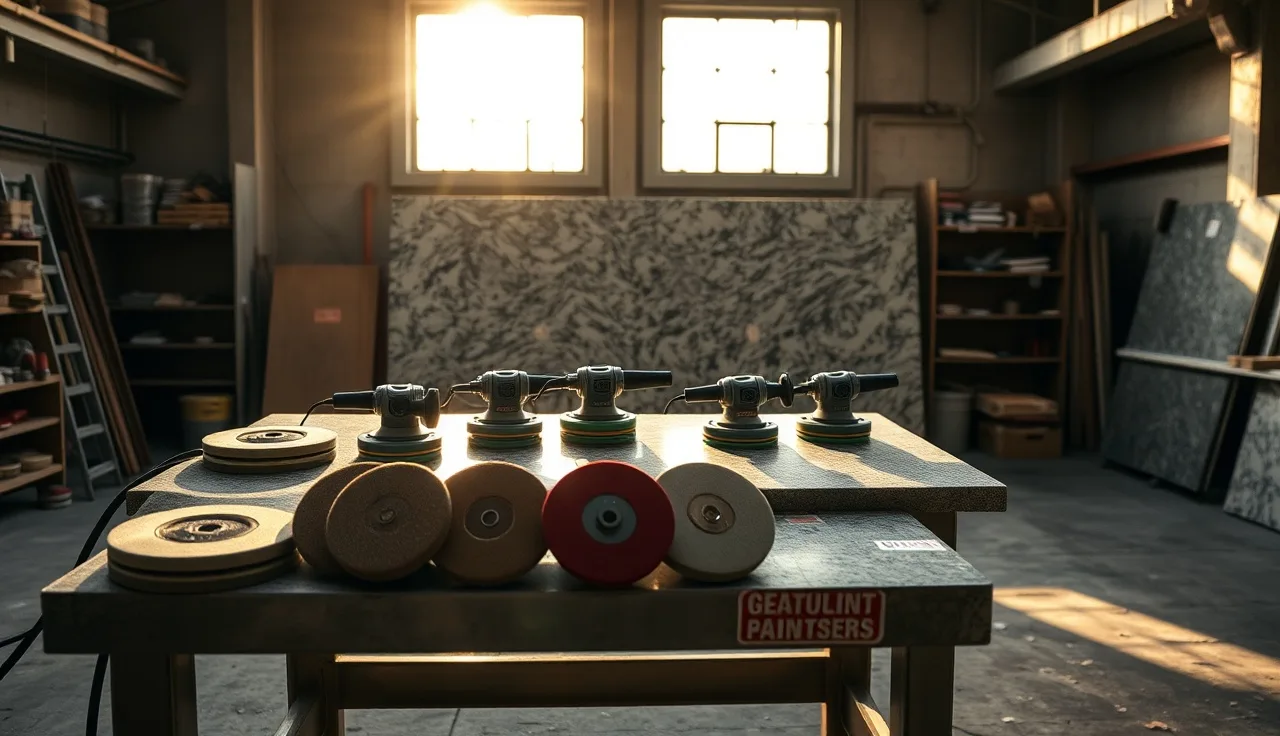
- Stone fabrication supplies fall into five categories: cutting (diamond blades, saw consumables), grinding and shaping (cup wheels, profile wheels), polishing (resin pads, felt buffs), installation (adhesives, sink clips, setting tools), and safety (vacuum shrouds, respirators, slurry systems).
- A well-stocked shop spends roughly $15,000 to $40,000 a year on consumables, depending on volume.
- Diamond tooling is almost always the biggest line item.
What counts as a stone fabrication supply?
Stone fabrication supplies are the consumable and semi-consumable items a shop burns through making countertops, tile, monuments, and custom stone work. The line between a supply and a piece of equipment blurs sometimes, but the practical rule is simple: if it wears out or gets used up in production, it's a supply.
That covers diamond tooling (blades, core bits, cup wheels), abrasive polishing pads, adhesives, epoxies, color pigments, sealer, sink mounting hardware, template material, and personal protective equipment. Machines like bridge saws, CNC routers, and waterjet cutters are equipment. The diamond blades and cutting discs they consume are supplies.
The distinction matters for shop accounting too. Supplies get expensed directly as cost of goods sold. Equipment gets depreciated. Getting that wrong creates real problems at tax time, so ask your accountant how they want it handled.
For granite countertops and natural stone work, consumable tooling is the single largest variable cost in your shop, often 8 to 14 percent of total revenue according to fabricator benchmarks published by the Marble Institute of America (now part of the Natural Stone Institute) [1].
What are the main categories of stone fabrication tools and supplies?
Five categories run every granite and stone shop. Here's how they break down.
1. Cutting consumables Diamond blades are the top spend for most shops. A 14-inch continuous-rim blade for a bridge saw runs $80 to $250 depending on diamond concentration and bond hardness. Segmented blades for harder stone (quartzite, porcelain) push toward the high end. Turbo blades split the difference on cost and speed. Core bits for sink cutouts run $30 to $90 each and need replacement every 50 to 200 cuts depending on stone hardness [2].
2. Grinding and shaping tooling Angle grinder cup wheels rough-profile edges and knock down high spots. A 4-inch double-row cup wheel costs $15 to $40. Profile wheels (also called router bits when used on a CNC or hand router) shape edges: bullnose, ogee, bevel, eased. Good profile wheels run $80 to $350 per piece and last anywhere from 200 to 1,000 linear feet before the profile drifts out of tolerance [2].
3. Polishing abrasives Resin-bond diamond polishing pads are the workhorse here. A full set from grit 50 through 3000, plus a buff pad, runs $80 to $200 depending on diameter (4-inch and 5-inch are most common) and brand. Frankfurt-style abrasives for automated polishing lines cost more per set but last longer per linear foot. Felt buffing wheels and polishing powders (tin oxide, cerium oxide) handle the final gloss on marble and limestone.
4. Installation supplies Two-part epoxy for seaming, color pigments to blend the seam, rodding bar for structural support in long runs, undermount sink clips and silicone, setting blocks, and shims. Epoxy cost runs roughly $15 to $35 per cartridge. A typical countertop job uses half a cartridge to two full cartridges depending on the number of seams [3].
5. Safety and dust control This one is non-negotiable by law. OSHA's silica standard (29 CFR 1926.1153 for construction, 29 CFR 1910.1053 for general industry) requires stone shops to use wet cutting methods, local exhaust ventilation, or supplied-air respirators when cutting, grinding, or polishing stone that contains crystalline silica. Nearly all natural stone, including granite, marble, quartzite, and engineered quartz, contains silica at levels that trigger the standard [4]. Vacuum shrouds, wet cutting attachments, half-face respirators with P100 plus OV cartridges, and slurry containment systems all fall under this supply category.
How much do stone fabrication supplies cost per year?
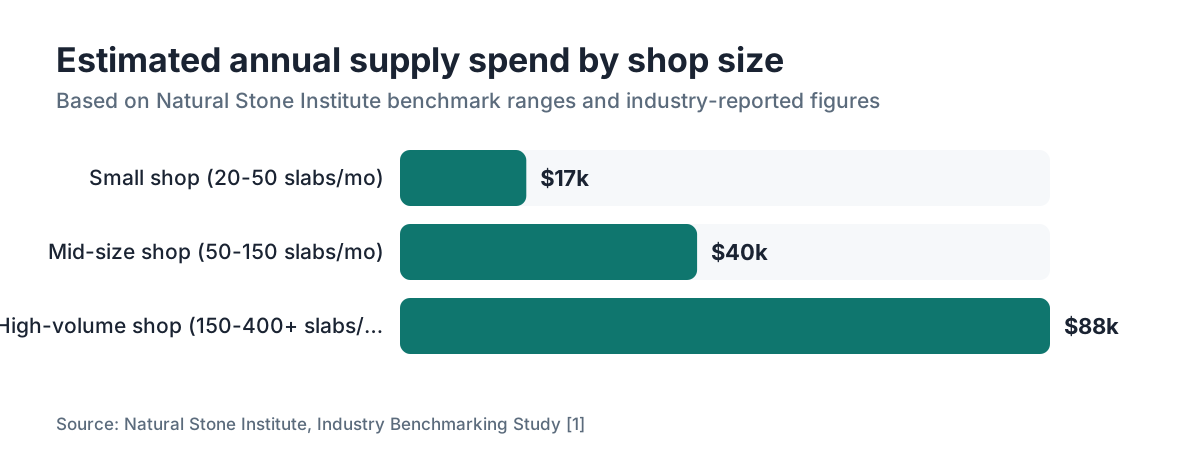
Annual supply spend depends almost entirely on shop volume. Here are ranges drawn from Natural Stone Institute benchmarks and fabricator forums.
| Shop size | Slabs cut per month | Est. annual supply spend |
|---|---|---|
| Small (1-2 fabricators) | 20-50 | $12,000 - $22,000 |
| Mid-size (3-6 fabricators) | 50-150 | $25,000 - $55,000 |
| High-volume (7+ fabricators) | 150-400+ | $55,000 - $120,000+ |
These figures are estimates based on industry benchmark data from the Natural Stone Institute [1] and commonly reported numbers in fabricator community forums. Nobody publishes audited per-shop figures publicly, so treat them as a starting range rather than a hard target.
The biggest single line item is almost always diamond tooling, followed by polishing pads, then adhesives and epoxies. Safety supplies get underbudgeted constantly. A steady supply of disposable P100 respirators, replacement cartridges for reusable half-faces, and vacuum filter bags adds up to $2,000 to $6,000 a year for a mid-size shop [4].
One reliable way to cut per-unit cost is buying blades and pads in bulk from a stone fabrication tools supplier rather than a general construction supply house. Specialty stone suppliers stock tooling built for granite bond structures. General suppliers often carry blades meant for concrete or masonry, which dull faster on granite and cost more per cut.
Where do fabricators buy stone fabrication supplies?
There are three main buying channels, each with real tradeoffs.
Specialty stone suppliers Companies like Braxton-Bragg, Park Industries, or regional distributors stock tooling designed specifically for stone. They carry blade bonds matched to granite, quartzite, and engineered quartz, and their tech support can tell you whether a harder or softer bond suits the material you're cutting. Prices run higher than commodity sources but tooling life is usually better, which lowers true cost per cut [2].
Direct import and overseas suppliers Diamond tooling from Taiwanese and Chinese manufacturers is a lot cheaper per unit, sometimes 40 to 60 percent less than domestic or European brands. Quality varies enormously. Some shops run imported blades without problems. Others report premature core failures and inconsistent diamond distribution. If you go this route, buy a small test batch before committing to a pallet.
Online marketplaces Amazon, eBay, and Alibaba all carry stone tooling. The risk is counterfeit or mislabeled products. A blade labeled "wet-cut granite" that's actually a masonry blade can overheat, glaze over, and in rare cases throw segments. Buy from verified sellers with return policies and spec sheets.
For countertop installation supplies specifically, home improvement stores (Home Depot, Menards) carry acceptable silicone, shims, and basic hardware. They're fine for fills and emergency restocks. They're not where you want to buy diamond blades.
Natural Stone Institute membership includes a supplier directory that lists vetted distributors by region, which is the most reliable starting point for a new shop or a shop switching suppliers [1].
What diamond blades and polishing pads do you actually need?
New shops over-buy tooling. Here's a working minimum kit for a shop cutting mostly granite and marble countertops.
Bridge saw blades: One 14-inch continuous-rim blade for your primary saw. Keep one spare. If you cut a lot of engineered quartz or porcelain, a dedicated sintered blade for those materials saves cost and improves cut quality.
Angle grinder blades: A 4.5-inch turbo blade for rough cuts and notches. A 4-inch segmented blade for straight cuts. Two or three spares of each.
Cup wheels: One 4-inch double-row for rough grinding. One 4-inch single-row for finer work near finished edges.
Profile wheels: One set matching your most common edge profiles (eased, beveled, bullnose at minimum). If you do ogee or more shaped profiles, add those as demand justifies.
Polishing pads: A full grit sequence from 50 to 3000 in 4-inch or 5-inch wet/dry resin pads, plus a buff pad. Buy two sets of each grit because pads wear faster than people expect.
Polishing powders: Tin oxide for marble and limestone. Cerium oxide for glass and some soft stones. Neither is needed for granite, which gets its final gloss from pad sequence alone.
The spec that trips up most new shops is blade bond hardness. Softer bonds (lower bond number in most supplier catalogs) expose fresh diamond faster and work better on hard, abrasive stones like quartzite and hard granite. Harder bonds hold diamond longer and suit softer, less abrasive stones like limestone or travertine. Ask your supplier what bond they recommend for the stone varieties you cut most.
What adhesives and epoxies do stone fabricators use?
Seam adhesive is the most skill-sensitive supply in the shop. The seam either looks invisible or it doesn't, and the adhesive choice matters almost as much as technique.
Two-part polyester adhesive is the most common choice for seaming granite. It cures fast (8 to 15 minutes working time depending on temperature), sands cleanly, and takes color pigment well. Brands like Integra Adhesives and Akemi Akepox are widely used in North American shops. Cost runs $15 to $25 per cartridge.
Two-part epoxy is stronger and better suited to high-stress seams, like those near a cooktop cutout or in a long peninsula. Cure time is longer, usually 30 to 60 minutes, which gives more working time but slows production. Cost runs $20 to $35 per cartridge.
UV-cure adhesive is gaining ground in shops with the right lighting setup. It stays liquid until you hit it with a UV lamp, which means unlimited working time and on-demand cure. The catch: it costs more per cartridge ($30 to $60) and you need the lamp.
Color pigments get mixed into the base adhesive on-site to match the stone. Most suppliers sell sets of 8 to 12 colors. Building a good eye for color matching is a shop skill that takes time. Pre-mixed color kits from your adhesive supplier are worth the premium while you're learning.
Silicone for undermount sinks and perimeter caulking should be neutral-cure (not acetoxy, which smells like vinegar and can etch some stone surfaces). Use 100 percent silicone, not siliconized latex. A 10-ounce cartridge runs $5 to $12.
For kitchen countertops specifically, seam placement and adhesive color match are the two things homeowners notice most. Both are worth slowing down for.
What safety supplies are legally required in a stone shop?
OSHA's crystalline silica standards are the most important regulatory requirement in stone fabrication. Under 29 CFR 1910.1053 (general industry) and 29 CFR 1926.1153 (construction), the permissible exposure limit for respirable crystalline silica is 50 micrograms per cubic meter of air as an 8-hour time-weighted average [4]. The action level that triggers monitoring, medical surveillance, and training is 25 micrograms per cubic meter.
Engineered quartz, which contains 90 to 95 percent crystalline silica by weight, creates the highest exposure risk during cutting and grinding. A 2019 report published in CDC's Morbidity and Mortality Weekly Report identified 18 cases of accelerated silicosis among engineered stone fabricators in the United States, many with disease progression within 3 to 5 years of exposure [5]. NIOSH issued a hazard alert specifically covering engineered stone that recommends wet methods and appropriate respirators as the first line of control [6].
Practically, this means every stone shop needs:
- Wet cutting attachments for bridge saws and angle grinders (water suppresses airborne dust at the source)
- HEPA vacuum shrouds for dry operations that can't be wet-cut
- NIOSH-approved respirators: N95 minimum for occasional short-duration exposure, P100 half-face or supplied-air for heavy grinding on quartz
- A written exposure control plan (required under the OSHA standard once you exceed the action level)
- Training records for all exposed employees
The standard also requires offering medical surveillance (chest X-ray, spirometry) to workers exposed at or above the action level for 30 or more days a year [4]. Non-compliance penalties start at $15,625 per serious violation as of the 2023 penalty schedule [7].
None of this is a place to cut costs. Silicosis is incurable and progressive.
What supplies do fabricators need for CNC and waterjet operations?
CNC routers and waterjets have their own consumable ecosystems.
CNC router consumables: Router bits (profile tooling) are the main spend. A good carbide-core diamond-segment router bit for granite runs $100 to $400 and lasts 500 to 2,000 linear feet of profile work. Coolant (usually plain water with a corrosion inhibitor for the machine itself) runs a few hundred dollars a year. Vacuum pod cups for the CNC table wear out and need replacement. A set of cups runs $50 to $150 depending on diameter.
Waterjet consumables: Garnet abrasive is the biggest recurring cost for waterjet shops. Garnet runs roughly $0.25 to $0.45 per pound, and a waterjet cutting at moderate speed through 3/4-inch granite uses about 0.5 to 1.5 pounds per minute. A busy waterjet shop can go through 500 to 2,000 pounds of garnet per week [8]. Focusing tubes (the nozzle that mixes water and abrasive) last roughly 80 to 120 cutting hours. Orifice jewels (ruby or diamond, they create the high-pressure water jet) last 500 to 1,000 hours under normal conditions.
If you're quoting waterjet jobs, garnet cost is the variable you have to factor in. Shops that don't track garnet consumption per job find out they've been underpricing detailed cuts by 20 to 40 percent.
What supplies are needed for stone templating?
Templating, the process of measuring a job site and creating a physical or digital pattern for the stone, needs its own set of supplies.
Physical templating uses thin luan (1/8-inch plywood) or corrugated plastic sheet, hot glue guns (and plenty of glue sticks), a chalk line, a tape measure, a framing square, and transfer marks. Luan runs about $15 to $20 per sheet. A typical kitchen uses one to three sheets. Hot glue sticks are cheap but shops burn through them fast.
Digital templating uses laser measuring systems like Prodim, Slabsmith, or LT-2D3D. These cut out material cost for the template itself but require ongoing software licensing and calibration supplies (calibration targets, replacement battery packs).
Either way, you need a reliable way to mark sink locations, seam positions, and edge profiles on the template before it goes back to the shop. Paint markers, template tape, and permanent markers are all common. The key is a consistent system everyone in the shop reads the same way.
For shops running several jobs at once, quoting software that links template data to job cost and material yield (like SlabWise) reduces the manual error that happens when a template note gets misread or a seam position changes after quoting. Connecting the template to the quote is where a lot of shops quietly lose money.
Digital templating systems run $5,000 to $20,000 upfront for hardware and software. Most shops that switch report recovering the cost within 6 to 18 months through fewer remakes and faster shop-floor communication, though that range comes from vendor claims and fabricator anecdotes rather than peer-reviewed data.
What finishing and sealing supplies do stone shops need?
The final steps, polishing to the target finish and applying sealer, need their own supply line.
Finishing abrasives: After machine polishing with resin pads, hand-polishing compounds and a foam applicator bring out gloss in hard-to-reach areas. 3M and Mirka both make stone-compatible compounds. A 32-ounce bottle runs $20 to $50.
Stone sealer: Most granite and natural stone gets sealed before delivery. Penetrating (impregnating) sealers are the standard. They soak below the surface rather than forming a film. Look for fluoropolymer or silane/siloxane chemistry. Cost runs $30 to $80 per quart, and a quart covers 200 to 400 square feet depending on stone porosity. Engineered quartz and sintered stone don't need sealer.
Enhancers: Some customers want a wet-look or color-enriched finish on granite or slate. Enhancing sealers do both. They're optional but worth stocking if you serve customers who ask about how to clean stone countertops and keep a rich appearance.
Application supplies: Microfiber applicator pads, lint-free cloths, spray bottles, and blue painter's tape for protecting adjacent surfaces during sealing. Low cost individually. Annoying to run out of in the middle of a job.
Sealer brand loyalty runs strong in fabricator circles, but the honest answer is that most fluoropolymer penetrating sealers from reputable brands perform about the same. The Marble Institute's testing protocols (before the merger into the Natural Stone Institute) didn't find dramatic performance differences between premium and mid-tier sealers on standard granite [1]. What matters more is surface prep. Stone must be clean and dry before sealing, or the sealer won't penetrate correctly.
How do you manage and track stone fabrication supply costs?
Most small shops track supply costs the wrong way. They look at what they spent last month rather than what each job consumed. That's a reporting function, not a management function.
The more useful approach is per-job supply tracking. If you know that a 40-square-foot kitchen with two seams and an undermount sink burns through 0.8 blade inches of wear, 2 polishing pad sets, 1.5 adhesive cartridges, and 12 ounces of sealer, you can cost each job accurately instead of hoping the average holds. Most shops that track at this level find 2 to 4 jobs a month where supply costs ran well above expected, which usually points to a remade cut, a bad blade, or a technique issue worth fixing.
Inventory management for supplies is simpler than for slabs but still worth a system. Minimum stock levels for blades and polishing pads keep the shop from stopping mid-job because a blade gave out. Most shops find that setting a reorder point at 2 to 3 blades (or pad sets) of each type prevents production interruptions without tying up too much cash in inventory.
Shops running SlabWise can connect supply cost assumptions to their quote templates, so the estimated tooling cost flows into the job quote automatically instead of being a manual add-on that gets forgotten.
For shops that fabricate multiple materials (granite, quartzite, porcelain, laminate countertops or Corian countertops as add-ons), keeping separate supply cost profiles by material type is worth the extra bookkeeping. Porcelain chews through blades dramatically faster than granite. Quoting both jobs at the same blade cost per square foot is a reliable way to underprice porcelain work.
What should a new stone fabrication shop buy first?
If you're starting from scratch, the temptation is to overbuy. Resist it. Here's a practical first-order list for a small shop planning to cut granite and standard marble.
Bridge saw blades: two 14-inch continuous-rim blades, one spare. Angle grinder blades: four 4.5-inch turbo blades. Cup wheels: two 4-inch double-row. Profile wheels: eased edge and bevel at minimum. Polishing pads: two full grit sequences (50 through 3000 plus buff) in 4-inch wet/dry. Adhesive: one box each of polyester and epoxy cartridges. Color pigment starter kit. Neutral-cure silicone: one case of 12 cartridges. Safety: four half-face respirators with P100 cartridges, one wet cutting attachment for your angle grinder, one HEPA shop vacuum with a shroud. Sealer: two quarts of a penetrating fluoropolymer sealer.
Total first supply order: roughly $1,500 to $3,500 depending on brand choices and where you source. That gets you through the first 10 to 20 jobs while you learn what you actually burn through fastest.
Buy your second order based on what ran out first. That pattern tells you more about your shop's true supply needs than any generic list, this one included.
Frequently asked questions
What is the most expensive stone fabrication supply?
Diamond tooling, specifically bridge saw blades and CNC profile wheels, is the largest ongoing spend for most shops. A 14-inch bridge saw blade costs $80 to $250 and a CNC profile wheel runs $100 to $400. For shops running waterjet equipment, garnet abrasive can rival or exceed blade cost depending on how many detailed cuts they run per week.
Do you need different supplies for quartz versus granite?
Yes, meaningfully so. Engineered quartz contains 90 to 95 percent silica, which is both harder and generates more hazardous dust than most granite. Shops cutting quartz need harder-bond blades or sintered blades designed for quartz, upgraded dust control (wet cutting matters especially here), and stricter respiratory protection. Polishing pads work similarly across both materials, but blade and safety supply choices differ.
How long does a diamond blade last when cutting granite?
A quality 14-inch continuous-rim blade cutting standard granite typically lasts 60 to 150 linear feet before cut quality drops noticeably. Harder stones like quartzite shorten that range. Softer stones extend it. Blade life also depends heavily on water cooling consistency, feed rate, and whether the operator is forcing the cut. Running a blade hot by skimping on water is the fastest way to destroy it.
What polishing pads do stone fabricators use?
Resin-bond diamond polishing pads in a grit sequence from 50 through 3000, plus a buff pad, are the standard. Most shops use 4-inch or 5-inch wet/dry pads on a variable-speed angle grinder. Frankfurt-style abrasives fit automated polishing lines. For marble and limestone, a tin oxide polishing powder on a felt buff after the pad sequence produces the final high gloss.
What adhesive do stone fabricators use for seams?
Two-part polyester adhesive is the most common choice for granite seams because it cures in 8 to 15 minutes, sands cleanly, and takes color pigment well. Two-part epoxy is used where extra strength matters, like seams near a cooktop. UV-cure adhesive is growing in use because it allows unlimited working time before the UV lamp triggers cure, though it costs more per cartridge.
Is sealing stone required, and what sealer do fabricators use?
Sealing is standard practice for most natural stone but not legally required. Penetrating (impregnating) sealers with fluoropolymer or silane/siloxane chemistry are the industry standard. They soak below the surface rather than leaving a film. Engineered quartz does not need sealer. A quart of penetrating sealer costs $30 to $80 and covers 200 to 400 square feet depending on stone porosity.
What safety equipment is legally required in a stone fabrication shop?
OSHA's crystalline silica standard (29 CFR 1910.1053) requires stone shops to control employee exposure to respirable silica below 50 micrograms per cubic meter as an 8-hour average. In practice that means wet cutting methods or local exhaust ventilation, NIOSH-approved respirators (N95 minimum, P100 for grinding quartz), a written exposure control plan, and medical surveillance for workers exposed above the action level of 25 micrograms per cubic meter.
What supplies are needed for a waterjet stone cutting machine?
Garnet abrasive is the main recurring cost, running $0.25 to $0.45 per pound. A busy shop uses 500 to 2,000 pounds per week. Focusing tubes last 80 to 120 cutting hours. Orifice jewels (ruby or diamond) last 500 to 1,000 hours. Water filtration consumables and a corrosion inhibitor for the pump round out the list. Underpricing garnet cost is a common and costly mistake on detailed waterjet cuts.
Where is the best place to buy stone fabrication supplies?
Specialty stone suppliers like Braxton-Bragg or regional stone distributors stock tooling matched to stone bond structures and provide technical support. They cost more per unit but usually deliver better tooling life. For shops comfortable testing and vetting products, direct import from Taiwanese or Chinese manufacturers can cut costs 40 to 60 percent per unit. The Natural Stone Institute's supplier directory lists vetted distributors by region.
How much should a stone fabrication shop spend on supplies per slab?
A rough benchmark is $40 to $100 per slab processed, covering blades, polishing pads, adhesive, sealer, and miscellaneous supplies. Shops cutting mostly engineered quartz trend toward the higher end because of faster blade wear and stricter safety supply requirements. Shops doing mostly straight cuts on standard granite trend lower. Tracking actual consumption per job is the only reliable way to know your real number.
What template supplies do stone fabricators need?
Physical templating needs 1/8-inch luan sheets ($15 to $20 each), a hot glue gun with plenty of sticks, tape measure, framing square, chalk line, and paint markers. Digital templating systems (Prodim, LT-2D3D) cut out material cost but add hardware and software expense of $5,000 to $20,000 upfront. Either approach needs a consistent marking and labeling system so template notes translate accurately to shop-floor cuts.
What is the difference between a hard bond and soft bond diamond blade?
Bond hardness controls how fast the blade matrix wears away to expose fresh diamond. Soft bonds wear faster, exposing new diamond quickly, which is better for hard, abrasive stones like quartzite and hard granite. Hard bonds hold diamond longer and suit softer, less abrasive stones like limestone and travertine. Using the wrong bond leads to glazing (hard bond on soft stone) or premature wear (soft bond on soft stone).
Can you use the same polishing pads on granite and marble?
Yes, standard resin-bond diamond polishing pads work on both. The difference comes at the final stage: granite reaches its finish gloss through the pad sequence alone (ending around 3000 grit plus buff), while marble and limestone typically benefit from a tin oxide or cerium oxide polishing powder on a felt buff after the pad sequence to reach a true mirror polish. Using pads made for stone on both is fine. Using concrete pads on stone is not.
How do I reduce silica dust exposure in a stone fabrication shop?
The hierarchy of controls under OSHA's silica standard starts with engineering controls: wet cutting attachments on saws and grinders suppress dust at the source, and HEPA vacuum shrouds capture what wet methods miss. After that, administrative controls like minimizing dry sweeping and scheduling high-dust tasks to low-traffic times. Respirators supplement engineering controls, they don't replace them. NIOSH's hazard alert on engineered stone is the most practical single guidance document available.
Sources
- Natural Stone Institute (formerly Marble Institute of America), Industry Benchmarking Study: Consumable tooling is the single largest variable cost in stone fabrication shops, often 8 to 14 percent of total revenue; NSI membership includes a regional supplier directory.
- Braxton-Bragg Stone Fabrication Supplies, product catalog and technical guides: Diamond blade costs ($80-$250 for 14-inch), core bit costs ($30-$90), cup wheel costs ($15-$40), and profile wheel costs ($80-$350) with lifespan data.
- Integra Adhesives, stone seaming adhesive product specifications: Two-part polyester adhesive working time 8-15 minutes; cost range $15-$25 per cartridge for stone seaming applications.
- OSHA, Occupational Exposure to Respirable Crystalline Silica, 29 CFR 1910.1053 and 29 CFR 1926.1153: PEL for respirable crystalline silica is 50 micrograms per cubic meter as an 8-hour TWA; action level is 25 micrograms per cubic meter; medical surveillance required for workers exposed at or above action level for 30+ days per year.
- CDC MMWR, Silicosis Mortality and Morbidity Associated with Artificial Stone, 2019: 18 cases of accelerated silicosis identified among engineered stone countertop fabricators in the United States, many with disease progression within 3 to 5 years of exposure.
- NIOSH, Hazard Alert: Worker Exposure to Silica during Countertop Manufacturing, Finishing, and Installation: NIOSH recommends wet methods and P100 respirators as first-line controls for engineered stone fabrication; engineered quartz contains 90-95 percent crystalline silica by weight.
- OSHA, Civil Penalties for Violations, Federal Register 2023 penalty schedule: OSHA penalties for serious violations start at $15,625 per violation as of the 2023 annual penalty adjustment.
- OMAX Corporation, Waterjet Cutting Consumables Technical Reference: Garnet abrasive cost $0.25-$0.45 per pound; waterjet cutting 3/4-inch granite uses approximately 0.5-1.5 pounds per minute; focusing tubes last 80-120 cutting hours; orifice jewels last 500-1,000 hours.
- Natural Stone Institute, Technical Manual Vol. 1: Specifications for Stone: Penetrating fluoropolymer sealers are the standard sealing recommendation for granite and natural stone countertops; performance differences between mid-tier and premium sealers on standard granite are minimal.
Last updated 2026-07-09