TL;DR
- Stone fabrication is the process of cutting, shaping, edging, and finishing raw slabs into countertops ready to install.
- It covers natural stones like granite and marble plus engineered quartz.
- Installed costs run $40 to $200 per square foot depending on material and complexity.
- The fabrication, not the stone itself, is usually where quality differences show up.
What does 'stone fabricated' actually mean?
Stone fabricated is industry shorthand for any countertop that started as a raw slab, block, or engineered composite and got cut, shaped, and finished by a shop before installation. The word covers a lot of materials: granite, marble, quartzite, soapstone, travertine, limestone, and engineered quartz (sometimes called fabricated stone to set it apart from solid stone).
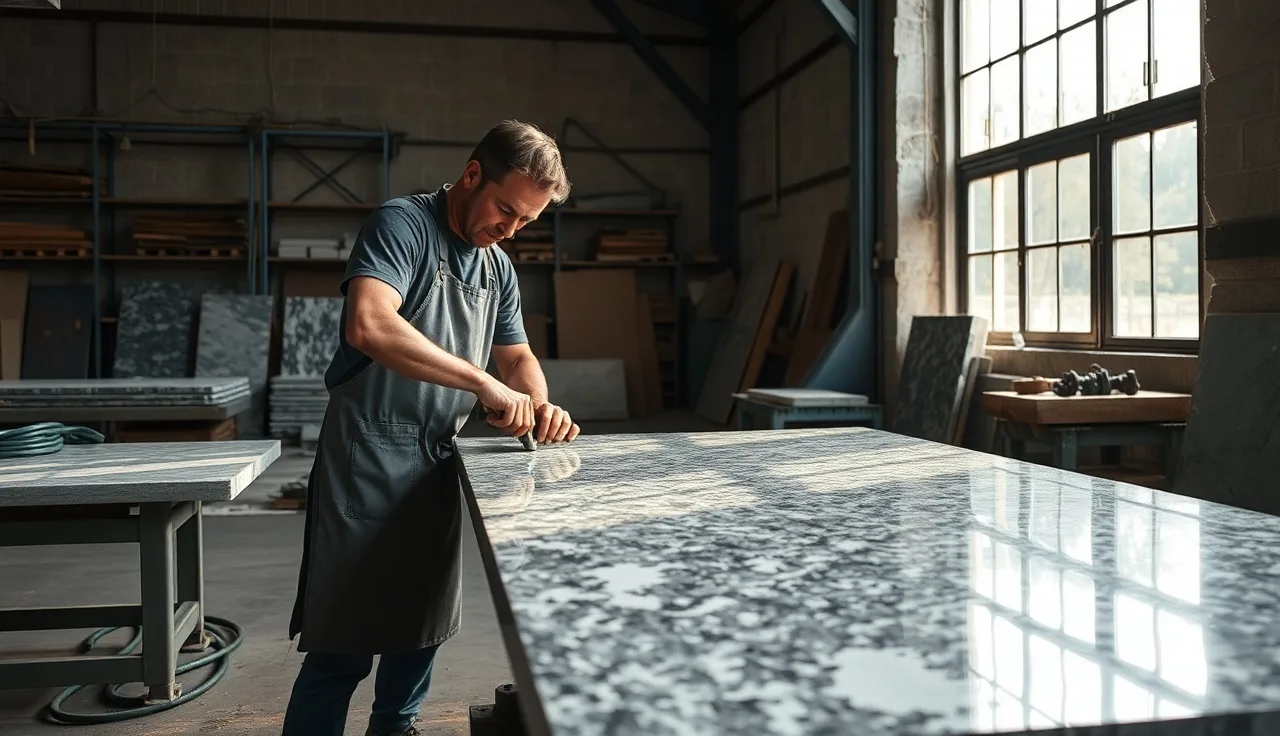
The fabrication step is what turns a 120-by-65-inch slab resting in a stone yard into a precisely dimensioned kitchen countertop with polished edges and cutouts for a sink and cooktop. A fabricator takes the template measurements from your kitchen, programs a CNC (computer numerical control) waterjet or bridge saw, and cuts the slab to shape. Then comes edge profiling, surface finishing, seam cutting, and final polish.
Here's the part homeowners miss. Fabrication is a distinct trade from simply buying stone. Two shops can buy slabs from the same importer and produce countertops that feel completely different, because the difference lives in the cutting tolerances, the edge work, and the finishing. The stone is the ingredient. Fabrication is the cooking.
What materials count as fabricated stone countertops?
The term covers any slab-based surface that goes through a shop process. In practice, the market splits into two camps.
Natural stone includes granite, marble, quartzite, soapstone, travertine, and limestone. These come out of the ground, get sliced into slabs at a processing facility (usually overseas), and ship to regional distributors. Your local fabricator buys from those distributors or directly from importers. Every slab is unique, so pricing and looks vary by lot.
Engineered stone (most often called quartz) is a manufactured product: roughly 90 to 94 percent ground quartz particles bound with polymer resins and pigments [1]. Brands like Cambria, Silestone, Caesarstone, and Cosentino's Dekton dominate this segment. Engineered slabs are uniform in dimension and color, which makes nesting (fitting multiple jobs out of one slab with minimal waste) more predictable.
There's a third category that sometimes gets lumped in: ultra-compact sintered surfaces like Dekton and Neolith. These get fired at very high temperatures to fuse glass, porcelain, and quartz particles. They need diamond tooling and are harder to cut than standard quartz, so fabrication costs run higher.
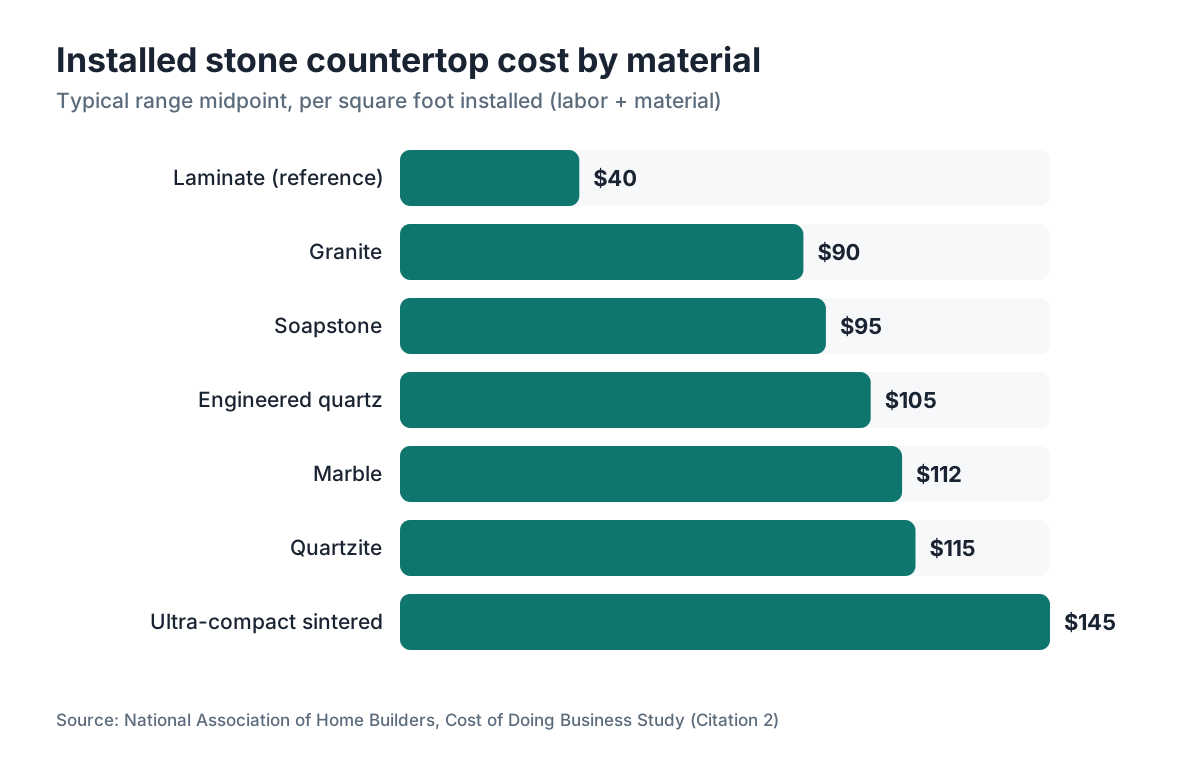
The table below compares the main material types on typical installed price, hardness (Mohs scale), and sealing needs.
| Material | Installed cost ($/sq ft) | Mohs hardness | Needs sealing? |
|---|---|---|---|
| Granite | $50, $130 | 6 to 7 | Annually |
| Marble | $75, $150 | 3 to 4 | Frequently |
| Quartzite | $70, $160 | 7 | Annually |
| Soapstone | $70, $120 | 1 to 2 | Oil regularly |
| Engineered quartz | $60, $150 | ~7 | No |
| Ultra-compact sintered | $90, $200 | 8+ | No |
| Laminate (for reference) | $20, $60 | N/A | No |
Prices come from a synthesis of industry distributor data and the NAHB Cost of Doing Business survey; ranges reflect regional variation and material tier [2].
For a broader look at kitchen countertops including non-stone surfaces, that guide covers the full field.
How does the stone fabrication process work, step by step?
Most shops run a five-stage process, though the exact order shifts with shop size and equipment.
Template. A templater visits your home after cabinets are installed (or confirmed level and plumb) and records the exact field dimensions. Modern shops use digital templating: a laser device maps the countertop footprint in three dimensions, and that file feeds directly into the shop's CAM (computer-aided manufacturing) software. Older shops still use hardboard or luan strips, which work fine but introduce more human error.
Nesting and programming. The templated shapes get laid out digitally against the slab dimensions to minimize waste. This step is called nesting, and it matters economically because slabs are priced by the slab, not by the square foot you actually use. A skilled shop (or good nesting software) can sometimes fit two jobs on one slab. Poor nesting means you pay for offcuts that go in the dumpster.
Cutting. A CNC bridge saw, a waterjet, or a combination of both cuts the slab to shape. Bridge saws use diamond-tipped blades and are fastest for straight cuts. Waterjets use an abrasive slurry at extremely high pressure and handle curves and complex shapes with no blade heat, which matters for brittle materials. Most modern shops own both [3].
Edge profiling. A CNC router with diamond-tipped bits profiles the exposed edges: eased, beveled, bullnose, ogee, waterfall, and so on. Edge complexity is one of the primary cost drivers. A simple eased edge adds almost nothing. A full ogee or a stacked mitered waterfall edge can add $15 to $30 per linear foot or more.
Finishing and polishing. The surface gets polished to its final finish (polished, honed, leathered, or brushed) using progressively finer diamond pads. If you ordered a honed finish on granite, the fabricator stops the polishing sequence at a lower grit than they would for a high-gloss mirror finish. Seams get glued with color-matched epoxy and sanded flush.
Delivery and installation. The finished pieces ride to your home on padded A-frames. Installation usually takes two to four hours for an average kitchen. Fabricators set the slabs on silicone beads, secure them to the cabinet tops, and grout or caulk at the walls.
How much do fabricated stone countertops cost?
Installed costs run from about $40 per square foot on the low end (basic granite or entry-level quartz in a competitive market) to $200 or more per square foot for rare natural stone or premium sintered surfaces with complex edgework [2].
The price stack for any job breaks down roughly like this:
- Material cost: What the fabricator paid for the slab, plus their markup. Slab prices at the distributor level range from about $5 to $30 per square foot for the raw stone, before any fabrication labor.
- Fabrication labor: Cutting, edging, and finishing. A mid-size shop in a major metro might charge $35 to $65 per square foot for labor alone.
- Edge upgrades: Standard eased edge is usually included. Each step up in profile complexity adds to the bill.
- Cutouts: Sink cutouts typically run $100 to $200 each. Cooktop cutouts are similar. Undermount sinks need more precise work and cost more than drop-in sinks.
- Seams: Unavoidable when the run exceeds slab width (usually 65 to 68 inches). Each seam adds shop time and may carry a placement fee.
- Delivery and installation: Often bundled, sometimes separated. Expect $200 to $500 for a typical kitchen.
One thing homeowners consistently miss: the total square footage in a quote includes the full rectangular bounding box of cutouts, more than the net counter area. If your quote says 45 square feet but your kitchen has a big farm sink, the stone you actually see might be closer to 38 square feet. That's standard practice, not a scam, but knowing it lets you compare quotes apples-to-apples.
For granite countertops specifically, pricing tends to cluster in the $50 to $130 range installed, making it one of the better value natural stones. Marble countertops run $75 to $150 and higher depending on the variety.
What drives quality differences between fabrication shops?
This is the question homeowners almost never ask but should. Two shops can buy the exact same slab and produce very different countertops.
Cut tolerance is the first quality marker. A well-calibrated CNC bridge saw holds tolerances within about 1/32 of an inch. Sloppy programming or worn equipment drifts to 1/8 inch or worse, which shows up as uneven overhangs, gaps at the wall, or seams that won't close cleanly.
Seam quality is arguably the clearest quality signal. A good seam is nearly invisible: color-matched, level within 1/32 of an inch, and tight. A bad seam has color mismatch, height variation, or an obvious gap filled with excess epoxy. Ask any shop you're considering to show you a finished seam in person or in a photo before you commit.
Edge consistency matters more than it sounds. On an eased or beveled edge, you want a consistent bevel angle around every corner and curve. On an ogee, you want even relief depth all the way around. The only way to check this before you hire is to look at their finished work.
Slab selection and book-matching is a softer skill but a real one. For marble and exotic granites with strong veining, an experienced fabricator positions the slab so the veins flow in a direction that looks intentional. Some shops charge for slab selection time; some include it. Either way, go to the slab yard yourself if you care about the final look.
For fabricators reading this: quoting and nesting accuracy are where shop software has the clearest ROI. Manually computing slab yield is where material estimates go wrong. Tools like SlabWise (slabwise.com) let you lay templates over slab images digitally and catch waste problems before cutting starts, which protects margin on every job.
How long does stone fabrication and installation take?
From the day you sign a contract to the day you have usable countertops, budget two to four weeks for most residential jobs. Here's where the time goes.
Template day usually happens within a week of signing. Shops schedule templates after cabinets are confirmed in place, level, and plumb. If your cabinet installer runs late, your countertop schedule slides with it.
Shop production takes three to eight business days depending on backlog, material availability, and complexity. A simple rectangular kitchen in a common granite moves through quickly. A 30-linear-foot marble kitchen with waterfall edges and custom radius corners at an island takes longer.
Delivery scheduling adds another few days. Most residential shops work on a two-week lead time for installation slots once production is done.
There are real ways to speed this up. Some shops offer rush fabrication for a fee (usually a 10 to 20 percent premium). Choosing a material the shop has in stock rather than ordering from a distributor cuts distributor lead time, which can run two to three weeks on its own for specialty stones. Buying from the shop's remnant rack (smaller pieces left over from previous jobs) is the fastest path to stone on your counters.
What is the difference between natural stone and engineered fabricated stone?
Natural stone is quarried from the earth. Every slab is unique, with natural variation in color, veining, and mineral content. That uniqueness is part of the appeal, but it means you need to see the actual slab you're buying, more than a sample chip.
Engineered stone (quartz composite) is manufactured under controlled conditions. The Marble Institute of America notes that engineered quartz countertops consist of 90 to 94 percent natural quartz crystals combined with polymer resins [1]. The result is a surface that chips less easily than most natural stones, needs no sealing, and comes in consistent colors that match across multiple slabs. For large kitchens needing several slabs with matched color, quartz is simpler to specify.
The fabrication process is largely the same for both, but quartz and sintered materials are harder on tooling. Diamond blades wear faster cutting quartz composites than granite. Fabricators who specialize in natural stone may charge more for quartz jobs, or the reverse.
One durability note: quartz is not heat-resistant the way granite is. The polymer binders can yellow or crack under sustained heat. Don't set a hot pan directly on quartz. Granite handles brief heat contact much better.
If you're looking at Cambria countertops, that brand is American-made engineered quartz and goes through the same fabrication process as any other quartz slab. The brand distinction is in raw material quality and warranty, not in how it gets cut.
On the other end of the price spectrum, laminate countertops skip the stone fabrication process entirely and get cut with woodworking tools, which is why they cost so much less.
How do you find and vet a stone fabricator?
Start with referrals from your general contractor, kitchen designer, or anyone who recently had stone countertops installed and loves them. A shop that does consistently good work is easy to find by word of mouth in any metro area.
When you talk to a shop, ask these specific questions:
- Do you fabricate in-house, or do you outsource cutting to a third party? (Some 'fabricators' are really re-sellers who send your slab to a production shop you never meet.)
- What CNC equipment do you run? The brand and vintage tell you whether they're investing in modern tooling.
- Can I visit the shop and see a job in progress? Reputable shops generally say yes.
- Do you offer a written warranty on seams and edge work? One to five years is reasonable.
- Who does your installation: your own crew or a subcontractor? If a sub, have they worked with you long-term?
Get at least three quotes. Compare them on the same material, the same edge profile, the same cutout count, and the same square footage. Watch for shops that omit line items others include, like sink cutout fees or seam location charges.
Check licensing. Stone fabrication has no single national license, but most states require a general contractor license for installation work (since it attaches to the building). Your state's contractor licensing board website tells you the rules, and many states have lookup tools [4].
For countertop installation specifics, including what to verify on delivery day and how to punch-list a finished job, that guide covers the post-fabrication steps.
How do you care for fabricated stone countertops once they're installed?
Care depends heavily on the material, and this is an area where homeowners get bad advice constantly.
Granite, quartzite, and most natural stones need periodic sealing. A simple water test tells you when: pour a tablespoon of water on the surface and time how long it takes to absorb. If it soaks in within four minutes, seal it. If it beads for ten minutes or more, you're fine [5]. Most granite kitchens need sealing once a year to once every two years depending on the stone's porosity. Use a penetrating (impregnating) sealer, not a topical coating.
Marble is softer (Mohs 3 to 4) and etches on contact with acids: lemon juice, vinegar, wine. Etching is not a stain, it's a physical change in the surface polish. Honed marble hides etches better than polished marble. If you cook a lot with citrus or acidic ingredients, marble is a harder choice to live with. That's not a dealbreaker for many people, but go in knowing it.
Engineered quartz needs almost nothing. Wipe with mild dish soap and warm water. Avoid abrasive cleaners and prolonged strong UV (quartz can discolor in direct sunlight near windows over several years).
For detailed care routines by material, the how to clean stone countertops guide has specific product recommendations and frequency guidance. If you have quartzite, how to clean quartzite countertops covers a material suppliers frequently misrepresent.
What are the environmental and health considerations with fabricated stone?
This topic got serious attention in the early 2020s because of occupational silicosis among stone fabricators. Cutting engineered quartz generates respirable crystalline silica dust at concentrations far above OSHA limits. A 2019 study in Australia found fabricated stone products contained up to 93 percent crystalline silica, versus roughly 20 to 45 percent in natural granite [6]. Several countries issued fabricator health advisories, and several states have enacted or proposed tighter controls.
OSHA's permissible exposure limit (PEL) for respirable crystalline silica is 50 micrograms per cubic meter as an 8-hour time-weighted average, set in the 2016 silica standard for general industry (29 CFR 1910.1053) [7]. Modern shops handle this through wet-cutting (which suppresses dust), local exhaust ventilation, and supplied-air respirators for workers. If you tour a shop and see dry cutting of quartz without respiratory protection, that's a serious red flag for how the whole operation is run.
For homeowners, finished countertops carry no meaningful silica risk. The hazard lives entirely in the cutting phase.
On the environmental side, quarrying and slab transport carry a real carbon footprint. Most stone slabs are quarried in Brazil, India, Italy, or China and shipped by container [10]. Engineered quartz is manufactured, so it skips quarrying, but the resin binders are petrochemical-derived. There's no clear winner on lifecycle impact; it depends heavily on transport distance and the energy sources at the manufacturing plant. The National Stone, Sand and Gravel Association publishes sustainability data for member operations [8].
Where does shop software fit into modern stone fabrication?
For fabricators and shop owners specifically: fabrication has gotten measurably more complex as designs have moved toward thicker edges, waterfall islands, and tight material matching across adjoining pieces. Manual quoting with paper templates and square-footage rules of thumb leaves real money on the table.
The core problem is slab yield. Quote a job assuming 75 percent yield from a slab and hit only 62 percent because of veining, pits, or awkward template shapes, and you just ate the margin difference. Nesting software fixes this by letting you lay actual template shapes over an actual slab outline before you buy, so the yield math is real, not estimated.
SlabWise (slabwise.com) is built specifically for residential countertop fabricators and covers the quoting-to-nesting workflow in a browser-based tool. For shops still quoting from spreadsheets and templating by feel, a demo is worth the 30 minutes. The ROI is clearest on jobs with multiple seams or expensive material.
Beyond nesting, digital quoting that breaks out material, labor, edge work, and cutouts by line item makes it far easier to explain pricing to homeowners, which shortens the sales cycle.
Is fabricated stone better than alternatives like laminate or solid surface?
Better depends entirely on what you want out of a countertop.
Stone wins on heat resistance (natural stone), prestige, long-term durability, and resale value perception. A 2022 National Association of Realtors survey found stone countertops remained among the top features buyers look for in a kitchen, though the exact ROI on the upgrade varies by market [9].
Laminate wins on cost, ease of replacement, and DIY-friendliness. Modern laminate prints have gotten good enough that from a few feet away they can pass for stone. Formica countertops and similar products install faster and much cheaper. If you're flipping a house on a tight budget, laminate is often the rational choice.
Solid surface (like Corian countertops) lands in between. It's repairable (scratches sand out), joins nearly invisibly, and comes in shapes stone can't do (integral sinks, curved edges). It scratches more easily than stone under daily use.
Butcher block countertops are worth a separate mention because some homeowners mix stone and wood in one kitchen: stone near the range, wood on a prep island. That combination works well and can cut total cost.
The honest summary: if you're staying in your home more than five years and you cook regularly, fabricated stone at mid-tier pricing is a sound investment. If you're renovating to sell fast or working on a tight budget, laminate or solid surface is nothing to be embarrassed about.
Frequently asked questions
What is the difference between fabricated stone and natural stone countertops?
Natural stone like granite or marble comes directly from quarries and is unique slab to slab. Fabricated stone, in the engineered sense, refers to manufactured products like quartz composites made from ground stone particles and polymer resin. Both go through the same fabrication shop process (cutting, edging, polishing) to become countertops. The difference is in the raw material: one is mined, one is manufactured under controlled conditions.
How much does it cost to have stone countertops fabricated and installed?
Installed prices typically run $40 to $200 per square foot depending on material, edge complexity, and your region. Entry-level granite or quartz in a competitive market sits at the low end. Rare quartzite, heavily veined marble, or sintered surfaces with complex profiles hit the top end. Get at least three quotes that break out material, fabrication labor, edge profiles, and cutouts as separate line items so you can compare accurately.
How long does stone countertop fabrication take from template to installation?
Most residential jobs run two to four weeks from template day to installation. Template scheduling happens within about a week of signing a contract. Shop production takes three to eight business days. Delivery and installation scheduling adds a few more days. Rush fabrication is sometimes available for a 10 to 20 percent premium. Choosing material the shop has in stock (versus ordering from a distributor) cuts the most time.
Is engineered quartz or natural stone better for kitchen countertops?
Quartz chips less easily, needs no sealing, and comes in consistent colors across slabs, which simplifies large kitchens. Natural stone handles brief heat contact better, has a unique appearance, and for some buyers carries more prestige. Quartz's polymer binders can discolor under sustained heat or prolonged UV. Natural stone (marble especially) etches with acids. Neither is universally better; it depends on how you cook and what you value.
What questions should I ask a fabricator before hiring them?
Ask whether they fabricate in-house or outsource cutting. Ask what CNC equipment they run and whether you can visit the shop. Request to see example seams in person or in photos. Ask for a written warranty on seams and edge work. Confirm whether installation is done by their own crew. Get a quote that breaks out material, labor, edge profiles, cutout fees, and delivery as separate line items so nothing is hidden.
Do fabricated stone countertops need to be sealed?
Natural stones (granite, quartzite, marble, soapstone) generally need sealing on some schedule. The frequency depends on the stone's porosity. A simple water absorption test tells you when to reapply: if water absorbs within four minutes, it's time to seal. Engineered quartz and sintered surfaces like Dekton do not need sealing because there are no open pores for liquids to penetrate.
Can fabricated stone countertops be repaired if they chip or crack?
Small chips in granite and quartz can often be filled with color-matched epoxy by a fabricator. Results vary by location and chip size. Cracks are harder to repair invisibly; a major crack usually means a section replacement. Marble is the toughest to repair because its translucency makes fills visible. Engineered quartz chips repair reasonably well in inconspicuous spots but can be tricky at sink edges where stress concentrates.
What is nesting in stone fabrication and why does it matter?
Nesting is arranging template shapes (the cut pieces you need) on a slab to minimize waste before cutting. Slabs are priced as a whole, not by what you use, so a poorly nested job wastes stone you already paid for. A skilled fabricator or nesting software can sometimes fit two small jobs on one slab. Better nesting directly reduces material cost and is one of the biggest drivers of shop profitability.
What edge profiles are available for stone countertops and do they cost extra?
Common options include eased (slightly rounded), beveled, bullnose (fully rounded), ogee (S-curve), waterfall (vertical slab side), and mitered thick-edge profiles. A simple eased edge is usually included in the base price. Each step up in complexity adds cost, typically $10 to $30 or more per linear foot for complex profiles like ogee or stacked mitered edges. Waterfall islands (stone wrapped vertically down the cabinet side) can add several hundred dollars to a job.
Is silica dust from stone fabrication dangerous to homeowners?
Not from finished countertops. The silica hazard is entirely in the fabrication shop during cutting, especially with engineered quartz, which can be 93 percent crystalline silica. OSHA limits respirable silica to 50 micrograms per cubic meter (29 CFR 1910.1053). Professional shops use wet-cutting and ventilation to control dust. Once stone is installed in your home, there is no ongoing silica exposure risk from normal use.
How do I compare stone fabrication quotes accurately?
Make sure every quote uses the same square footage (verify how each shop counts around cutouts), the same edge profile, the same number and type of cutouts, and the same material tier. Some shops include delivery; others add it as a line item. Ask each shop to break out material cost, fabrication labor, edge fees, cutout fees, and installation separately. A quote with fewer line items is not necessarily cheaper; the costs are just hidden.
What is the lifespan of a fabricated stone countertop?
Properly maintained stone countertops can last decades. Granite and quartzite in particular are among the most durable surfaces you can put in a kitchen; 30 to 50 years is realistic with proper care and sealing. Marble can last as long but may show etching and wear that some owners find beautiful (called a patina) and others find frustrating. Engineered quartz has a shorter field history, but manufacturer warranties of 10 to 25 years are common for the product itself.
What is the difference between a waterjet and a bridge saw in stone fabrication?
A bridge saw uses diamond-tipped circular blades and is fastest for long straight cuts. A waterjet uses an abrasive slurry under extreme pressure (up to 60,000 PSI) and cuts curves, complex shapes, and decorative inlays without blade heat stress, which matters for brittle or thin materials. Most modern shops own both and use each for the cuts it handles best. Waterjet time is generally slower and costlier per linear foot than bridge saw cutting.
Can I see the slab before fabrication starts?
Yes, and you should. Reputable fabricators take you to their slab yard or their distributor's yard to approve the specific slab(s) you're buying. This matters most for natural stone with veining (marble, exotic granite, quartzite) where each slab looks different. For engineered quartz with consistent color, slab approval is less critical but still worth doing to check for defects. Never approve fabrication on a natural stone slab you haven't seen in person.
Sources
- Marble Institute of America, Quartz Surfaces Technical Information: Engineered quartz countertops consist of 90 to 94 percent natural quartz crystals combined with polymer resins and pigments
- National Association of Home Builders, Cost of Doing Business Study: Installed stone countertop prices range from approximately $40 to $200 per square foot depending on material tier and region
- Natural Stone Institute, Fabrication Standards and Practices: Modern fabrication shops use CNC bridge saws and waterjet cutters; waterjets use abrasive slurry at high pressure to cut curves and complex shapes without blade heat
- U.S. Small Business Administration, State Contractor Licensing: Stone countertop installation may require a general contractor license depending on state rules; state licensing boards maintain online lookup tools
- Natural Stone Institute, Care and Maintenance Guidelines: A water absorption test determines when natural stone needs sealing: if water absorbs within four minutes, sealing is recommended
- Occupational and Environmental Medicine (BMJ journal), study on crystalline silica content in engineered stone: A 2019 study found fabricated stone products contained up to 93 percent crystalline silica, versus roughly 20 to 45 percent in natural granite
- U.S. Occupational Safety and Health Administration, 29 CFR 1910.1053 Respirable Crystalline Silica Standard for General Industry: OSHA's permissible exposure limit for respirable crystalline silica is 50 micrograms per cubic meter as an 8-hour time-weighted average, established in the 2016 silica rule
- National Stone, Sand and Gravel Association, Sustainability: The NSSGA publishes sustainability data for member quarrying and stone processing operations
- National Association of Realtors, 2022 Remodeling Impact Report: Stone countertops remain among the top kitchen features buyers look for according to the 2022 NAR Remodeling Impact Report
- U.S. Geological Survey, Minerals Information: Stone, Crushed and Dimension: Most dimension stone slabs used in U.S. countertop fabrication are quarried in Brazil, India, Italy, and China and imported by container ship
Last updated 2026-07-10