TL;DR
- A stone countertop fabricator measures your kitchen, cuts the raw slab to fit, finishes the edges, and installs the finished pieces.
- Quality varies a lot between shops.
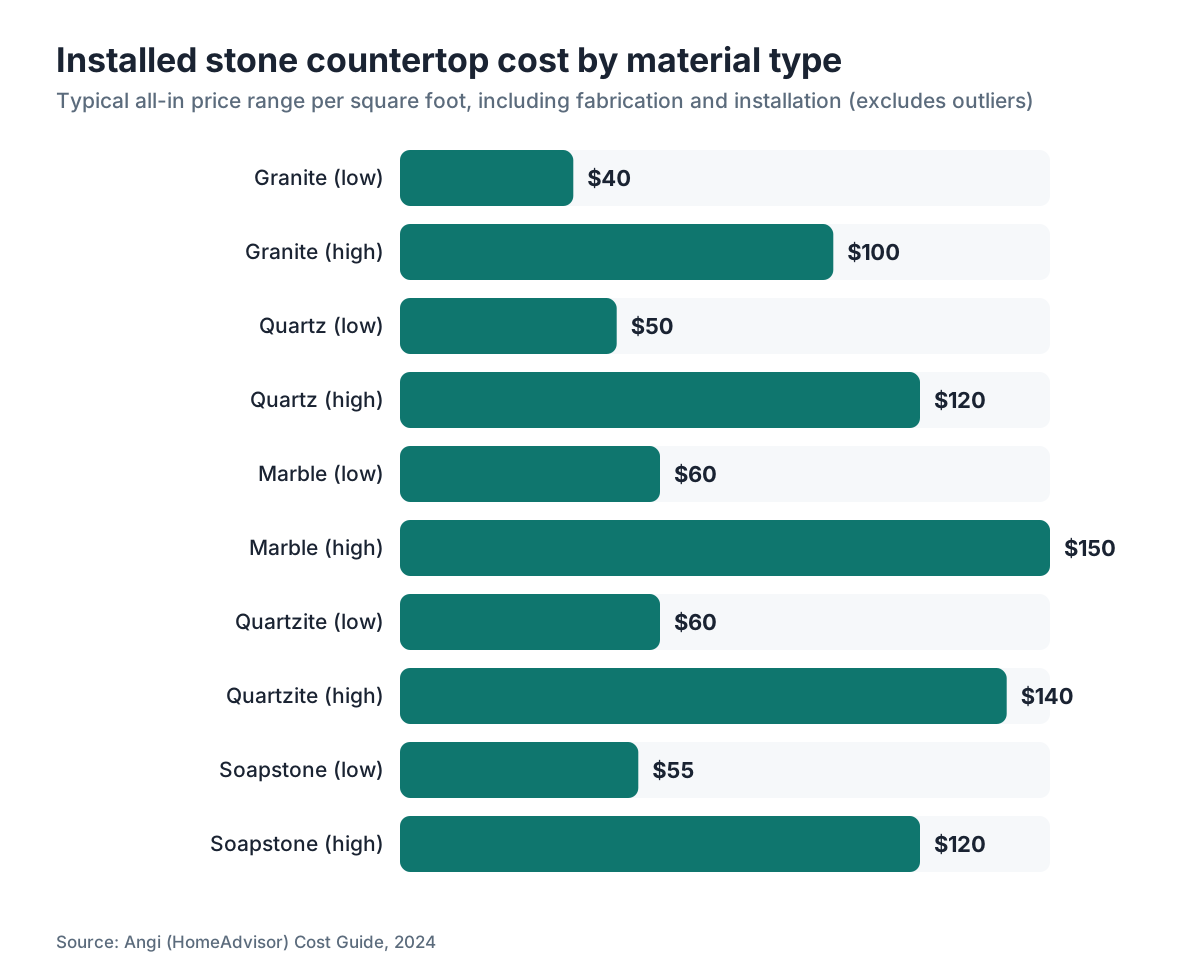
- Installed prices run $40 to $200 per square foot depending on the stone, edge profile, and region.
- Getting three quotes from local fabricators is the most reliable way to avoid overpaying.
What does a stone countertop fabricator actually do?
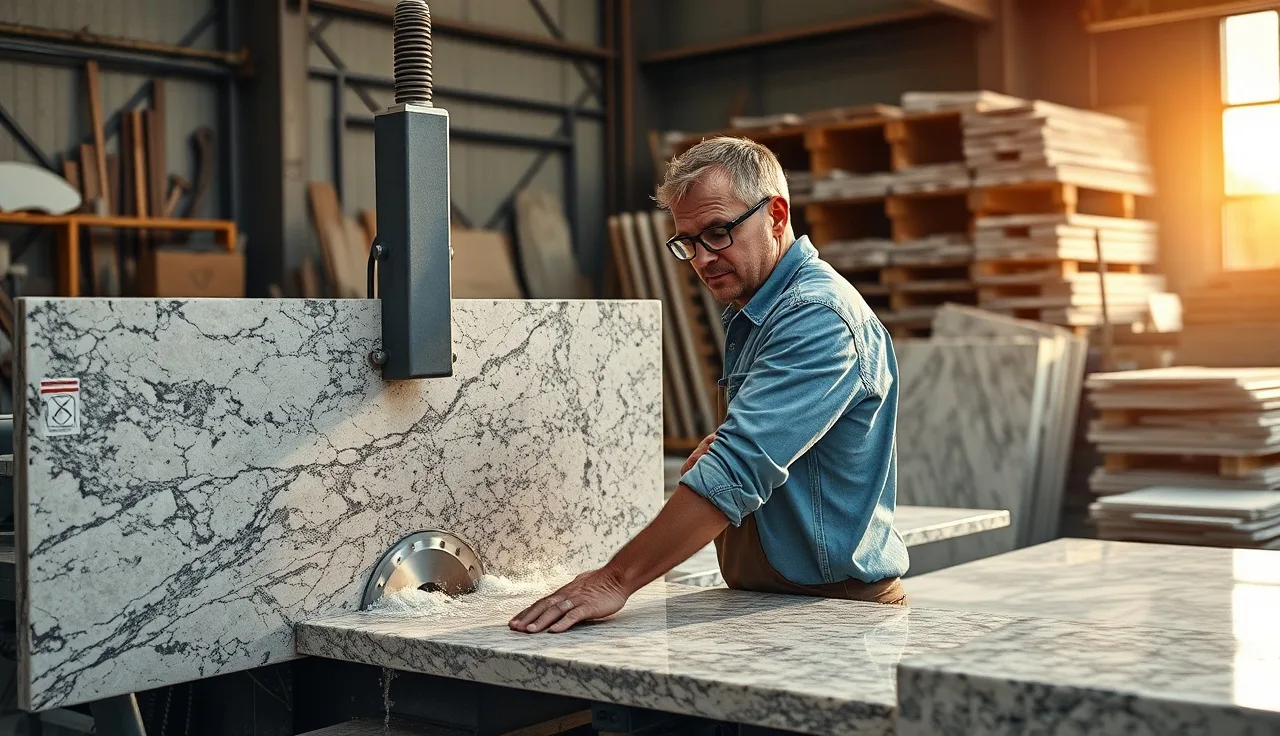
A stone countertop fabricator buys raw slabs from a distributor or importer, then cuts, shapes, finishes, and installs them in your home. That's the whole job. Each step takes real skill and real equipment.
The process starts with a template. A technician comes to your home after the cabinets are set and either lays physical template strips along the cabinet run or uses a laser device to capture the exact dimensions of every wall angle, appliance cutout, and corner. That data becomes the cutting plan.
Back at the shop, the fabricator loads the slab onto a CNC bridge saw or waterjet table and cuts the pieces. An edge machine then grinds and polishes the exposed edges, from a simple eased edge to a stacked ogee. Sink cutouts, faucet holes, and cooktop openings get cut with a router or wet saw, and each piece gets a final hand polish before delivery.
Installation day is usually a two- or three-person crew. They carry the finished pieces in, dry-fit them on the cabinets, apply construction adhesive and silicone at the seams, and level everything. A standard kitchen install takes three to five hours.
The fabricator is the last trade in the countertop chain. The quarry extracts the stone, a distributor imports and warehouses it, and the fabricator turns that raw slab into a finished surface. Some fabricators own their own slab yard. Others buy from a separate distributor, which means you can sometimes shop slabs on your own before you pick a shop.
How much does a stone countertop fabricator charge?
Fabricators quote per square foot, and the number almost always covers fabrication plus installation. It doesn't always cover the raw slab. Confirm whether a quote includes stone before you compare anything.
Granite installed typically runs $40 to $100 per square foot, with budget level-1 granite at the low end and exotic slabs with complex edges at the top [1]. Quartz (engineered stone) runs $50 to $120 per square foot installed from most regional fabricators [1]. Marble and quartzite sit in a similar range, though the material cost for rare marbles can push totals past $150 per square foot. Soapstone and other specialty stones vary widely by availability.
A standard kitchen with 40 to 60 square feet of counter runs $1,600 to $6,000 through most mid-market shops, including a basic edge, one sink cutout, and installation. Add a waterfall island, mitered edges, or a bookmatched backsplash and the price climbs fast.
Here's what drives the fabricator's portion of the bill:
- Edge profile complexity. A flat eased edge adds almost nothing. A triple waterfall or stacked ogee can add $15 to $25 per linear foot.
- Number of cutouts. Each sink cutout adds $100 to $250 depending on shape. Undermount sinks need extra grinding.
- Seam count and placement. More seams mean more labor and more adhesive. A skilled fabricator plans cuts to keep seams to a minimum.
- Travel and delivery distance. Shops charge for fuel and crew time. A job 60 miles out costs more than one across town.
- Stone source. Supply your own slab and some shops add a handling fee. Others welcome it.
Nobody has clean national pricing data for fabricators. The ranges above come from aggregated consumer cost surveys and contractor pricing guides, and they shift by region. Coastal urban markets run 20 to 30 percent higher than rural Midwest markets as a rough rule.
What's the difference between a fabricator, a distributor, and a big-box store?
These three look like they sell the same thing. They don't.
A stone distributor (sometimes called an importer or slab yard) warehouses raw slabs and sells them to fabricators, and occasionally to the public. They don't cut or install anything. Walk into a slab yard and you're shopping raw stone, not a finished product.
A fabricator buys from the distributor, does the cutting and finishing in their shop, and installs the finished pieces. The fabricator is who you actually hire to get a countertop done.
Big-box retailers like Home Depot and Lowe's sell countertops by contracting fabrication out to local or regional shops. The store is a middleman. That's not automatically bad, but it adds a layer of margin, it limits your ability to negotiate directly with the person cutting your stone, and it sometimes caps your slab selection to whatever the contracted shop stocks.
A dedicated local fabricator usually gives you more slab choices (especially with their own yard), more edge options, and a direct line to the crew doing the work. When something goes wrong, you call the shop, not a national customer service number.
For straightforward jobs with common materials, big-box is fine. For complex layouts, specialty stone, or high-dollar projects, a direct relationship with a real fabricator earns its keep.
How do fabricators template and measure for a countertop?
Most installation errors start at the template, so this step deserves attention from both you and the shop. Get it right here and the rest of the job usually goes smoothly.
Old-school shops use cardboard or luan strip templates. A technician cuts thin strips and tapes them together along the cabinet run to capture every dimension. It works, but it invites human measurement error, and the template has to physically travel back to the shop.
Digital templating uses a laser device (common brands include the Proliner by Prodim and the LT-55 by Laser Products Industries) to capture the entire counter run in minutes [2]. The file goes back digitally and feeds straight into the CNC cutting software. Error tolerance drops from plus or minus 1/8 inch with hand templates to plus or minus 1/32 inch or better with digital. That gap matters on long runs and around out-of-square walls, which are nearly universal in older homes.
The template visit should happen after all cabinets are installed and level, after the sink is on-site (the fabricator needs to see it), and before any appliances go in if they create an overhang issue. Budget about an hour for a standard kitchen.
Ask every shop you're considering: digital or hand templates? Hand templates only isn't a dealbreaker on a simple job, but ask how they handle out-of-square walls. A good craftsman with cardboard produces a tight fit. A careless one with a laser still leaves a gap.
How do you find a reputable stone countertop fabricator near you?
Start with referrals. Ask your kitchen designer, general contractor, or cabinet installer who they use. Trades refer each other when the work is good and stop the second it isn't. That social pressure is a filter no review site can match.
No contractor in the loop? The Natural Stone Institute (formerly the Marble Institute of America) keeps a member directory of certified fabricators [3]. Membership requires meeting standards for equipment and training, so it's a reasonable first screen.
Read Google reviews, but read them hard. Look for reviews with specifics: how the seam looked, whether the crew showed up on template day on time, whether they called back when something needed adjusting after install. Vague five-star reviews with no detail are close to worthless.
Then do this. Visit the shop in person before you sign anything. A fabricator's shop tells you plenty. Is it organized? Is dust extraction running? Will they show you work in progress? Are finished slabs handled with care? A chaotic, poorly lit shop with slabs stacked unsafely is a warning sign no matter what the reviews say.
Get at least three written quotes from three shops. Quote formats vary wildly. Some shops itemize (stone, fabrication, edge, cutouts, installation as separate lines). Others hand you one total. Ask every shop to quote the same scope: same stone, same edge, same cutout count. That's the only way to compare apples to apples.
Turnaround time is revealing too. Most shops run two to four weeks from template to install. A shop promising one week may be overcommitting. A shop quoting eight weeks may be swamped or short-staffed.
What questions should you ask a stone fabricator before hiring them?
Here's the list I'd actually use. Not every question fits every job, but these separate the shops that know what they're doing from the ones hoping you don't ask.
Ask: Who does the template, and is it digital or hand? You want to know whether the person templating is a skilled tech or a part-time sub.
Ask: Who installs the finished pieces? Some shops sub out installation. That's not disqualifying, but you want to know who to call if there's a chip on delivery day.
Ask: Can I see the slab before you cut it? For natural stone, always lay eyes on the exact slab going into your kitchen. Every slab is different, and the one marked for your job should match the one you approved.
Ask: What's your seam policy, and where will the seam land? A good fabricator plans seam placement before cutting and shows you on paper where it goes. Seams should sit away from the sink and out of the main sight line when possible.
Ask: What's your warranty on fabrication and installation? Most shops warranty workmanship for one year, and some go longer on material defects. Get it in writing.
Ask: Do you carry liability insurance and workers' comp? If a crew member gets hurt in your home on an uninsured job, you could have exposure. A real shop carries both [4].
Ask: What's in this quote, and what's extra? Confirm whether the stone, edge, sink cutout, faucet holes, haul-away of old counters, and plumbing reconnection are included or billed separately.
What materials can a stone fabricator work with?
Most stone fabricators handle the full range of natural and engineered stone, but some specialize and some hit equipment limits.
Granite is the baseline. Almost every fabricator can cut it. Granite countertops are dense and hard but predictable. Marble countertops need more careful handling because the material is softer and cracks more easily during fabrication. Quartzite is harder than both and demands diamond tooling in good shape. A shop with dull blades will chip the edges. Soapstone is soft and easy to cut, but it needs a fabricator who knows how to finish and seal it right.
Engineered quartz (Silestone, Cambria, MSI Q, and others) is now the highest-volume material in most shops. Cambria countertops and similar brands come with specific fabrication requirements from the manufacturer, and certified fabricators have completed brand training. Ask whether a shop is a certified fabricator for the brand you want.
Some fabricators also work with porcelain slabs (large-format sintered stone). That material needs a different blade and extra care at the edges, and not every shop has invested in the tooling or training for it. Same story with ultra-compact surfaces like Dekton.
If you're weighing laminate countertops, Corian, or Formica, stone fabricators don't touch those. Those get installed by cabinet shops or dedicated solid-surface fabricators running entirely different tooling.
How do fabricators price and manage jobs internally?
This one is for shop owners, but homeowners benefit from reading it, because it explains why two quotes for the same kitchen can be hundreds of dollars apart.
Most small and mid-size shops still quote jobs by hand in spreadsheets. It's slow and error-prone. A fabricator measures the job, calculates square footage, adds edge linear footage, counts cutouts, looks up current material cost, applies a markup, and adds installation labor. Run that for 20 jobs a week and mistakes happen.
Shops that moved to purpose-built quoting software generate accurate quotes in minutes instead of hours, and they can attach photos of the actual slab to the customer quote so nobody argues later about which material got approved. SlabWise is one platform built for this workflow, covering quoting, nesting (laying out cuts on a slab to minimize waste), and job tracking. Tighter nesting cuts material waste, which is one of the biggest cost variables in a stone shop.
Nesting matters more than most homeowners realize. A poorly nested job might waste 30 percent of a slab. A well-nested one wastes closer to 10 percent. On a $500 slab, that gap is real money, and it feeds straight into what the fabricator has to charge to stay profitable.
For complex jobs with multiple materials, mitered edges, or specialty stone, the spreadsheet approach falls apart fast. Asking how your fabricator runs their back office is fair game on a large order.
What does the stone countertop installation process look like step by step?
Knowing what to expect makes installation day far less stressful.
The day before, your plumber (or you, if you're handy) should disconnect the sink plumbing and pull the old countertops if the fabricator isn't doing it. Confirm with your shop whether haul-away is included. Plenty of shops charge extra for it, or won't do it at all.
Installation morning, the crew arrives with finished pieces racked in padded van or flatbed racks. They carry them in with suction cup handles. For large islands or long runs, moving pieces through doorways and around corners is a two-person job minimum, and tight entries sometimes mean pulling a door off its hinges.
The crew dry-fits each piece, checks level, and shims as needed. Adhesive goes down, pieces get set, and seams join with color-matched epoxy. Most epoxies reach working strength in about 30 minutes, but full cure takes 24 hours.
Sink cutouts and faucet holes are pre-cut at the shop, so the crew just confirms fit on-site. With an undermount sink, they attach undermount clips to hold it from below.
Once everything is set, they caulk the backsplash joint (the gap between the stone and the wall) with matching silicone, not grout. Grout cracks. Silicone flexes. That joint has to stay flexible because the cabinet, wall, and stone all move slightly with humidity and temperature.
Full cure takes 24 hours. Don't set heavy items on the stone or reconnect plumbing until the next day. Read the fabricator's care instructions for your specific stone. Most natural stone needs sealing within the first month, and how to clean stone countertops is worth understanding before you reach for the wrong product. For quartzite, how to clean quartzite countertops has specific guidance, and soapstone has its own routine in how to clean soapstone countertops.
For the full sequence across all materials, countertop installation covers what to expect.
What are the most common fabrication problems and how do you avoid them?
Even good shops have bad days. Knowing the common failure modes helps you catch them before they're permanent.
Chipped edges top the complaint list. They usually happen during cutting when the blade is dull or the feed rate is too fast. Inspect every edge carefully before the crew leaves on install day. Small chips fill with color-matched epoxy. Large chips usually mean a replacement piece.
Seam gaps and mismatched seams come from off template accuracy, or from pieces shifting during adhesive set. A seam should be nearly invisible from standing height. If you can catch a fingernail in it or see daylight through it, that's a workmanship problem.
Out-of-level installation is more common than you'd think. Stone is heavy, and once it's down, releveling is a major job. Watch the crew check level during dry-fit. They should run a four-foot level across the full run.
Cracks during installation are rare with granite and quartz but more likely with marble and quartzite when a slab has a natural fissure running through a weak point. A good fabricator inspects slabs before cutting and flags fissures to the customer. If a fissure crosses an unsupported span (say, over a dishwasher), a reputable shop reinforces it with fiberglass mesh on the underside.
Wrong cutout sizing bites people too. Faucet holes have to match your faucet's template exactly. Bring the actual faucet to the template appointment if you can, or confirm the hole size before the slab gets cut.
Last one: sealing neglect. Most natural stone needs a penetrating sealer within the first few weeks. Some fabricators include the first application. Many don't. Ask, and if it's not included, do it yourself within 30 days.
How do fabricator licensing and business requirements work?
Stone fabrication isn't licensed uniformly at the state level the way plumbing and electrical are, but that doesn't mean anything goes.
Most states require a general contractor's license or a home improvement contractor registration to do installation work in a home. Requirements vary. In California, the Contractors State License Board requires a C-54 (Ceramic and Mosaic Tile) or C-61 (Limited Specialty) classification for some stone installation work, and any job over $500 in combined labor and materials requires a license [4]. In Texas, registration lives at the city level and varies. The point is simple: your fabricator should be able to show a business license and contractor registration for your state.
Workers' compensation insurance is required in almost every state for businesses with employees [5]. Liability insurance protects your home if a slab drops through a cabinet or cracks a floor tile during installation. Both matter. Ask for proof of both, or ask the fabricator to name you as an additional insured on the liability policy for the duration of the job.
The Natural Stone Institute runs a voluntary Fabricator Accreditation Program that evaluates shops on safety, equipment, and quality systems [3]. Accredited shops have passed an independent audit. That's a meaningful signal when you can't easily judge a shop's back-office practices yourself.
Silica dust is a serious occupational health issue in fabrication shops. OSHA's 2016 final rule set a permissible exposure limit for respirable crystalline silica at 50 micrograms per cubic meter of air averaged over an 8-hour shift [6]. The rule requires employers to "limit worker exposure to respirable crystalline silica." Shops that follow it run wet cutting, use dust extraction, and provide respirators. You can see that when you visit.
How do fabrication shops handle waste and leftover stone?
Most jobs leave remnants, the pieces of slab left over after cutting your countertop. What happens to them affects both your cost and the shop's environmental footprint.
Remnants from a standard kitchen might be big enough for a bathroom vanity, a small bar top, or a fireplace surround. Fabricators usually keep ownership of remnants unless your contract says otherwise. Some shops sell them at a discount off a remnant rack. Others save them for smaller jobs.
Want the remnant for a future bathroom with matching stone? Negotiate it into your contract before you sign. A reasonable shop will either include it in your price or sell it to you at a fair discount.
Slurry and stone dust from wet cutting are the main waste streams in a fab shop. Slurry (the water-and-stone-dust mix from wet saws and polishers) can't go straight down a storm drain. Most municipalities require it settled or filtered before disposal. Some shops use settling tanks, others a vacuum slurry system. Ask how your shop handles it if this matters to you.
Cutoff pieces too small to reuse usually go to a dumpster. Some shops donate remnants to Habitat for Humanity ReStore locations. A few cities have stone recyclers who crush remnants into aggregate. None of this is something the homeowner has to worry about legally, but it's a fair question if sustainability matters to your project.
Frequently asked questions
How long does it take a stone fabricator to complete a countertop job?
Most shops run two to four weeks from the template visit to installation. The timeline breaks down roughly like this: one to three days to schedule and complete the template, five to ten business days in the fabrication queue (CNC cutting, edging, polishing), then a scheduled install day. Some shops do rush jobs for a fee, but quality can slip when work gets pushed through faster than normal.
Can I supply my own slab to a fabricator?
Yes, most fabricators will work with a customer-supplied slab, though some add a handling fee of $50 to $150 or more. Buying your own slab from a distributor lets you hand-select the exact piece and sometimes saves money on material. Confirm the shop will accept it before you buy, and understand that if the slab has a defect or breaks during cutting, the liability question gets messy. Get that in writing.
What is a seam in a countertop and how visible will it be?
A seam is the joint where two pieces of stone meet, needed when a counter run is longer than a single slab or turns a corner. On dark, uniform stones like black granite, seams are nearly invisible. On marble or stone with strong veining, a seam interrupts the pattern visibly. Good fabricators use color-matched epoxy and align the pieces tightly. Ask your fabricator to show you exactly where the seam lands before they cut.
Do stone fabricators also install backsplashes?
Many fabricators cut and install a stone backsplash, especially a simple four-inch ledge or a full slab backsplash in the same material as the counter. Not all shops include it by default, so ask during quoting. Tiled backsplashes in a different material (subway tile, for example) are a separate trade, usually handled by a tile setter after the counters go in.
What is slab fabrication software and why does it matter to homeowners?
Fabrication software handles quoting, nesting (laying out cuts on a slab to minimize waste), and job tracking in a stone shop. Better software means fewer quoting errors, faster turnaround, and less wasted stone. For homeowners, that can mean more accurate quotes and slightly lower prices when a shop runs efficiently. Shops still on manual spreadsheets are more prone to pricing errors that either cost you money or show up as delays.
How do I know if a fabricator's price is reasonable?
Get three written quotes for the same scope: same material grade, same edge profile, same cutout count. If one quote comes in 40 percent below the others, ask why. It might be a less experienced crew, lower-grade material, or missing line items like installation or haul-away. Quotes that look suspiciously low often grow after the template, once the shop finds reasons to add charges.
Should I seal my stone countertop and does the fabricator do it?
Most natural stone (granite, marble, quartzite, soapstone) benefits from a penetrating sealer applied within the first month and periodically after that. Engineered quartz does not need sealing. Some fabricators apply a first coat before delivery. Many don't. Ask directly. If it's not included, apply a quality impregnating sealer yourself within 30 days. It's a simple wipe-on, wait, wipe-off process.
What's the difference between fabricated stone and prefabricated countertops?
Fabricated countertops are cut custom from a full slab to your exact kitchen dimensions. Prefabricated (prefab) countertops are pre-cut in standard widths and lengths at a factory, usually 25.5 inches deep in 8-, 10-, and 12-foot lengths. Prefab is cheaper and faster but won't handle unusual dimensions, curves, or most edge upgrades. Most fabricators don't work with prefab. Those sell through big-box stores and get installed by a handyman or tile contractor.
What is an undermount sink and how does it affect fabrication?
An undermount sink mounts below the countertop surface, with the stone overhanging the sink rim. It needs a polished, finished cutout edge (that edge is visible from above) plus undermount clips or brackets anchored to the cabinet. Fabrication for an undermount costs more than for a drop-in sink because of the extra edge finishing. Confirm undermount clip placement with your fabricator before install day.
Can a stone fabricator repair a cracked or chipped countertop?
Yes, repairs are standard at most shops. Small chips get filled with color-matched epoxy and buffed smooth, often invisibly. Hairline cracks can be stabilized with epoxy injection. A large break through the slab (common on unsupported spans over dishwashers) usually needs a full replacement piece. Call the fabricator who installed it first. If the crack showed up within the first year, ask whether it's covered under their workmanship warranty.
How do I compare stone countertop options before choosing a fabricator?
Nail down the material first. Granite, marble, quartz, quartzite, and soapstone each have different maintenance needs, pricing, and durability. Reading up on each material before you start calling shops makes quoting faster, and it makes it harder for a salesperson to upsell you into something you don't need. Then get quotes with the material locked in, so you're comparing fabrication costs instead of apples to oranges.
Is a big-box store or a local fabricator better for stone countertops?
For a standard granite or quartz job in common dimensions, big-box stores are a reasonable option if you're okay not knowing exactly which shop fabricates your stone. For specialty materials, complex layouts, or when something goes wrong and you need a person to call directly, a local fabricator wins. Local shops usually offer more slab choices, more edge options, and faster resolution when there's a problem after install.
What should I do if there's a problem after my countertop is installed?
Document it immediately with photos. Contact the fabricating shop in writing (email is best, so you have a record) within 48 hours of noticing the issue. Describe it specifically: exact location, size, and when you first saw it. Most shops want to fix workmanship issues without a fight, because their reputation runs on referrals. If the shop goes quiet, your state's contractor licensing board and the Better Business Bureau are the next steps.
Sources
- HomeAdvisor (Angi) – Countertop Installation Cost Guide: Granite countertops installed typically run $40 to $100 per square foot; quartz runs $50 to $120 per square foot installed from most regional fabricators.
- Laser Products Industries – LT-55 digital templating device: Digital templating devices such as the LT-55 capture the entire counter run in minutes and feed directly into CNC cutting software.
- Natural Stone Institute – Fabricator Accreditation Program: The Natural Stone Institute maintains a member directory of certified fabricators and offers an accreditation program that evaluates shops on safety, equipment, and quality systems.
- California Contractors State License Board – License Classifications: In California, any home improvement job over $500 in labor and materials requires a contractor's license from the Contractors State License Board.
- U.S. Department of Labor – Workers' Compensation: Workers' compensation insurance is required in almost every state for businesses with employees.
- OSHA – Occupational Exposure to Respirable Crystalline Silica Final Rule: OSHA's 2016 final rule set a permissible exposure limit (PEL) for respirable crystalline silica at 50 micrograms per cubic meter of air averaged over an 8-hour shift.
- U.S. Geological Survey – National Minerals Information Center: The USGS tracks domestic stone production and import data, providing context for raw slab availability and pricing trends.
- U.S. Census Bureau – Construction Spending: The Census Bureau tracks residential improvement spending trends that provide context for countertop and kitchen renovation market size.
- National Kitchen and Bath Association – Industry Statistics: NKBA industry data covers countertop material preferences and kitchen remodel spending benchmarks used in the stone fabrication industry.
- Natural Stone Institute (formerly Marble Institute of America) – Stone Industry Standards: The Natural Stone Institute (formerly Marble Institute of America) publishes fabrication and installation standards referenced by the stone industry.
Last updated 2026-07-10