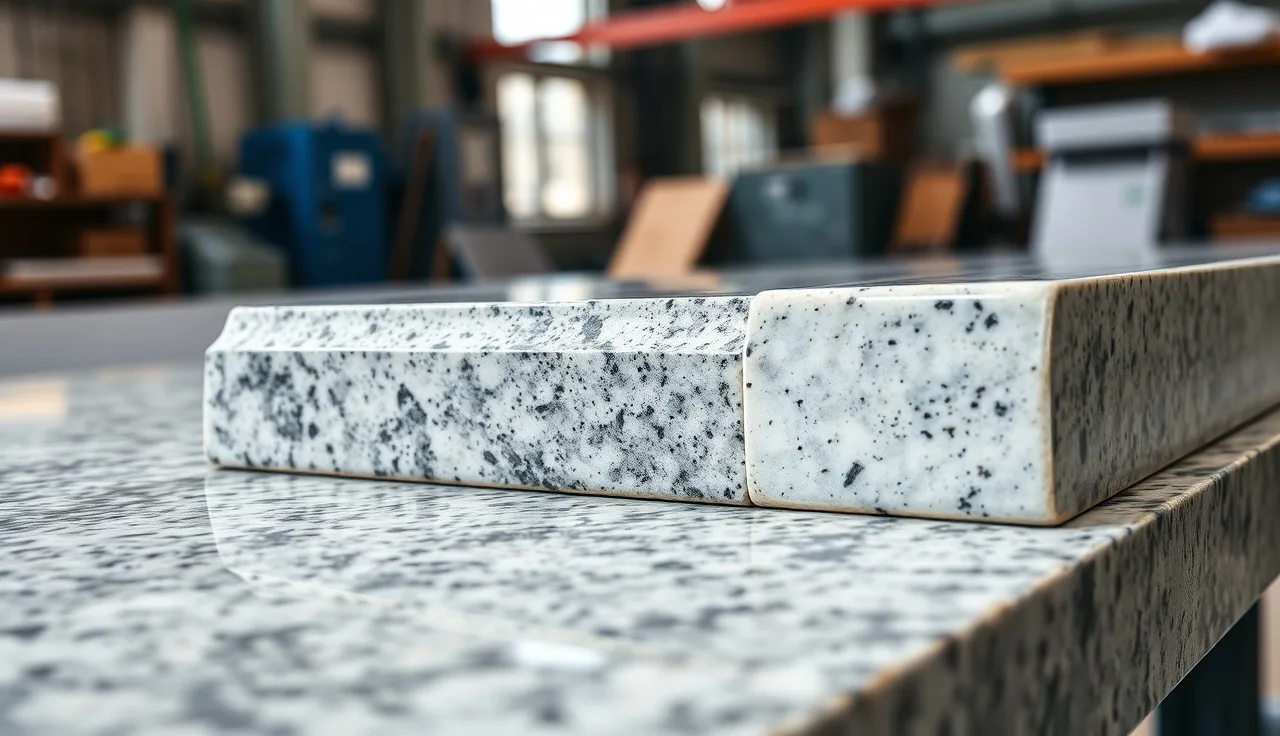
TL;DR
- Stone countertop edge profiles run from a flat eased edge (cheapest, $0 to $5 per linear foot upcharge) to layered ogee or waterfall styles ($30 to $75/LF extra).
- The pencil edge is the most popular mid-range pick.
- Your choice changes price, chip risk, cleaning effort, and how formal the kitchen reads.
- Most shops offer 8 to 15 standard profiles.
What is a countertop edge profile and why does it matter?
The edge profile is the shape a fabricator cuts into the exposed front edge of your slab. It's not trim glued on later. The shop grinds and polishes that shape directly into the stone with a CNC router or hand-held profiling wheels, so once it's done, it's done.
The profile you pick changes four things at once: cost, durability, cleanability, and the visual weight of the counter. A thick, layered ogee on a 3 cm slab reads as furniture-grade and formal. A plain eased edge on that same slab reads modern and light. Neither is wrong. They're just two different design languages.
Chip resistance is part of the deal too. Thin, sharp corners chip easier than rounded ones, which matters in a kitchen where cast iron gets swung around. A bullnose or pencil edge takes a hit better than a sharp mitered edge.
Fabricators price profiles as a per-linear-foot upcharge on top of the base slab and labor. That upcharge runs from zero on a simple eased edge to $75 or more on a laminated waterfall. Only the exposed edges get profiled, so a typical island might have 10 to 14 linear feet to price out [1].
What are all the standard stone countertop edge profiles?
There's no official industry list. But most shops offer variations inside these families:
Flat / Eased edge: The slab face stays square with a slight break on the top arris so it isn't a razor edge. Almost no upcharge. Clean and contemporary. This is the default for minimalist design.
Beveled edge: A flat angled cut across the top corner, usually 45 degrees. Adds a little visual interest without complexity. Cheap, $5 to $12/LF in most markets.
Pencil edge (also called a pencil round): A small-radius rounded top corner, roughly 1/8" to 3/16". Probably the most requested profile in production shops right now. It softens the edge just enough to cut chipping risk without changing the counter's visual weight. The pencil shape reads modern and works in kitchens from traditional to industrial. Upcharge is typically $0 to $10/LF depending on the shop [1].
Half bullnose: The top corner rounds to a quarter-circle, ending at a square bottom. Softer than pencil, still fairly clean. $5 to $15/LF.
Full bullnose: Both top and bottom corners round into a full half-circle. The edge is smooth all the way around, no sharp corners anywhere. Popular in bathrooms and homes with young kids. Some designers find it too round for kitchens. $10 to $20/LF.
Ogee: An S-curve borrowed from classical architecture. It reads formal and traditional and shows up on granite in higher-end traditional kitchens. The concave groove catches crumbs. $15 to $30/LF.
Cove (reverse ogee): An inward curve, the opposite of a standard bullnose. More subtle than a full ogee. $12 to $25/LF.
Chiseled / Tooled edge: An irregular, rough texture worked into the edge face to mimic hand-quarried stone. Common on granite islands in rustic or Tuscan kitchens. $20 to $40/LF.
Laminated / Mitered edge: Two pieces of stone mitered at 45 degrees and glued to fake a thicker edge, usually 4 to 6 cm apparent thickness from a 3 cm slab. The priciest standard option. $40 to $75/LF in most markets, sometimes more [1].
Waterfall edge: The surface material keeps going straight down the cabinet side to the floor. Technically an install detail rather than a grinding profile, but shops quote it the same way. It needs a full extra slab panel and a tight mitered joint. Cost swings widely.
How much does each countertop edge profile cost?
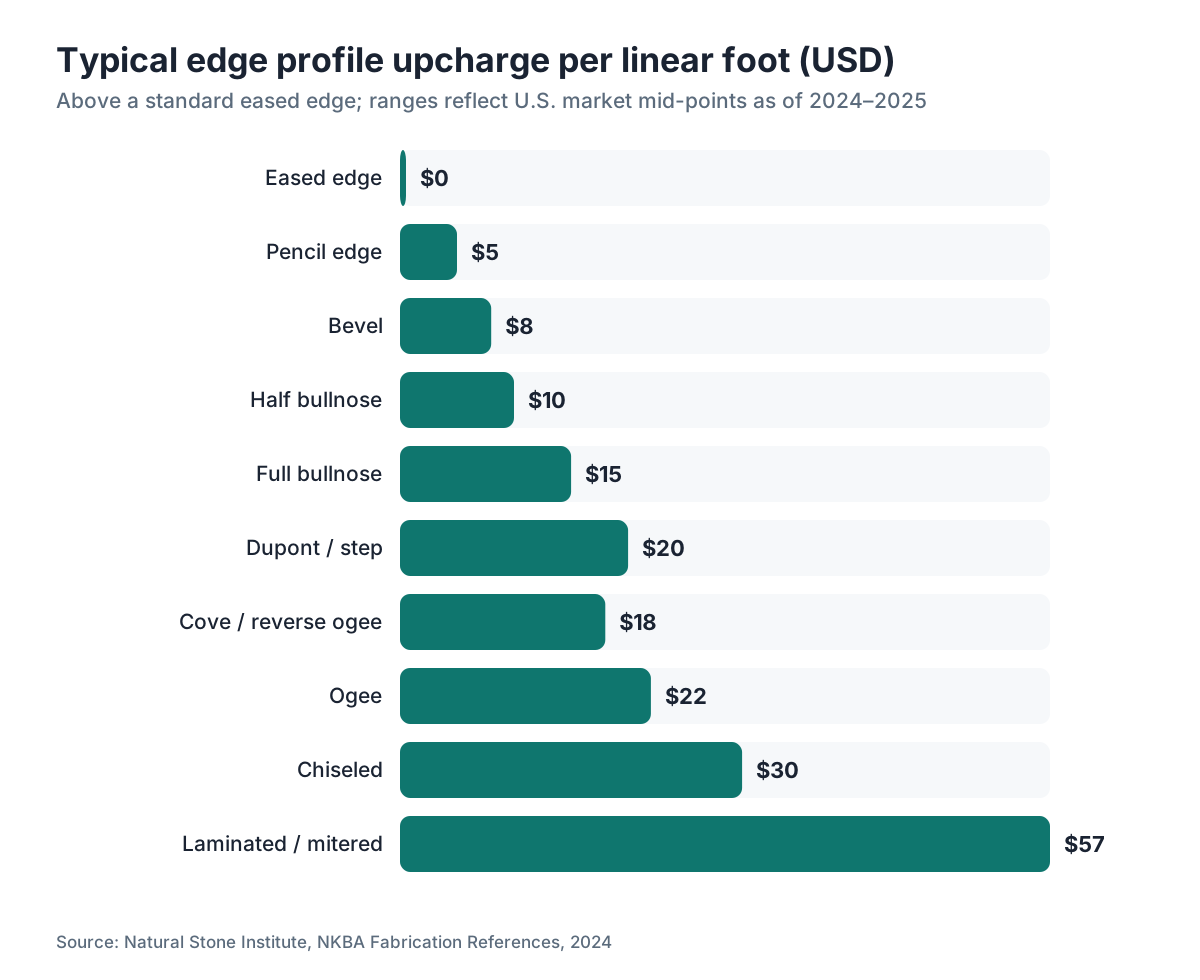
Pricing shifts with region, shop overhead, and stone type. The table below shows the realistic upcharge above a base eased edge in the U.S. as of 2024 to 2025 [1][2]. These are fabricator upcharges per linear foot, not the total counter cost.
| Profile | Typical Upcharge ($/LF) | Notes |
|---|---|---|
| Eased | $0, $5 | Standard on most quotes |
| Pencil edge | $0, $10 | Often bundled as standard |
| Bevel | $5, $12 | Single-pass CNC |
| Half bullnose | $5, $15 | Common upgrade |
| Full bullnose | $10, $20 | Both edges rounded |
| Ogee | $15, $30 | Multi-pass, more polish time |
| Cove / reverse ogee | $12, $25 | |
| Chiseled | $20, $40 | Often hand-finished |
| Dupont (step) | $15, $25 | |
| Laminated / mitered | $40, $75+ | Extra stone + labor |
For a kitchen with 12 linear feet of exposed edge, going from eased to pencil might add $0 to $120. Going to a laminated mitered edge on that same kitchen could add $480 to $900 or more. That's a real budget call, so make it on purpose.
One warning: 3/4" (2 cm) slabs limit your options. A lot of profiles need the full 1-1/4" (3 cm) thickness to have enough material to shape. Using 2 cm stone? Confirm your profile is even possible before you fall for it [3].
What is a pencil edge and why is it so popular?
The pencil edge is a small, consistent radius ground into the top corner of the slab, usually between 1/8" and 3/16". The name comes from the pencil-eraser-sized curve it leaves behind.
It's popular for four plain reasons. It reduces chipping, because a perfectly square granite or quartz corner is surprisingly brittle under impact and the round spreads that stress over a curve instead of a point. It's fast for fabricators, which keeps the upcharge low or zero. It looks clean without reading soft, so it fits contemporary, transitional, and traditional kitchens without a fight. And it's easy to reseal and wipe down.
The pencil edge is often what a shop calls its "standard" finish, meaning it's baked into base pricing at many places. If your quote doesn't name the edge, ask. You may already be getting a pencil edge and not know it.
One thing to watch. "Pencil edge" and "pencil bullnose" get used interchangeably, but they can mean different shapes. A pencil edge usually rounds only the top corner. A pencil bullnose rounds both top and bottom with that same small radius. Nail down which one your fabricator means, and ask to see a physical sample or a mockup on scrap stone before you sign off [1].
Which edge profiles work best for specific kitchen styles?
No physics here, just design convention and taste. But these pairings show up for good reasons.
Modern and contemporary kitchens run eased or pencil edges almost without exception. The flat planes back up the geometry that defines the style. A full bullnose or ogee on an otherwise minimal kitchen looks like a mistake.
Traditional and transitional kitchens have more room. Ogee, cove-and-step, and dupont profiles play well with raised-panel doors and decorative molding without shouting over them. Pencil edges work here too because they're neutral.
Farmhouse and rustic kitchens lean on chiseled or leathered treatments to match the handmade look. A rough or tooled edge on a soapstone or quartzite counter (see how to clean quartzite countertops for care notes) fits this style naturally.
Luxury and high-end kitchens often go laminated mitered, sometimes at 6 cm apparent thickness, because the extra visual mass signals weight and money. Paired with book-matched marble countertops or premium granite countertops, it's the single most noticeable edge upgrade you can buy.
Bathroom vanities are more forgiving on style, but full bullnose shows up a lot because bare arms and legs brush the edge all day. The fully rounded profile is comfortable against skin.
Do edge profiles affect how durable or chip-resistant a stone countertop is?
Yes, and in a way you'll feel. Sharp 90-degree corners on any brittle material, granite and quartz included, jam stress into the arris (the line where two faces meet). A knock that a rounded edge shrugs off can pop a sharp corner clean off.
Granite is hard but also more brittle than some materials. Quartzite ranges all over the map by origin. Engineered quartz (like Cambria, see cambria countertops) is more uniform but still chips at a sharp corner under impact.
Pencil and bullnose profiles spread contact stress over a curve, which is why fabricators steer heavy-use kitchens, homes with kids, and people who can or bake with cast iron toward them. Those are the counters that take edge hits.
A laminated mitered edge has a joint line, and that joint can fail if the adhesive was done poorly or the edge takes a serious hit. In practice, good polyester or epoxy holds extremely well [8], but you should know the joint is there.
The chiseled edge is more fragile than it looks. Those intentional rough points can break off over time in a high-traffic spot, especially if you're forever dragging sheet pans and baking dishes across the counter.
How do fabricators cut and polish edge profiles?
Most production shops cut the shape with a CNC router running diamond-tipped profiling wheels. The operator loads the profile, the machine feeds the stone under the spindle, and a water line keeps the tooling cool. Depending on how complex the shape is, it takes one to four passes. Wet cutting isn't optional, by the way. It's the main dust control against respirable silica under OSHA's rule [9].
After routing, the edge runs through a polishing sequence, usually multiple grits climbing from 50 up through 400, 800, 1500, and a final buffing compound. That sequence is what puts the mirror on a polished profile. A pencil edge or bullnose needs fewer steps than a multi-curve ogee.
Hand-profiling still happens for chiseled edges, for repairs, and in smaller shops without a CNC router head. Hand work is slower and less consistent pass to pass, which matters when you have several counter sections that need to match visually.
Shops that quote and track fabrication digitally, like those running SlabWise, can attach per-profile labor rates to each edge run so the upcharge gets calculated instead of guessed by feel. That accuracy pays off when a job has three different profiles across different sections.
Sink cutout edges are a separate line item at many shops. They take longer because the geometry curves and the material can't run through a standard CNC pass as cleanly. Ask whether sink edge profiling is included or extra.
Which edge profiles are hardest to clean?
The ogee draws the most complaints. That S-curve has a concave channel that traps food, grease, and cleaning residue, and you need a narrow brush or a toothbrush to reach it. People with light-colored stone and ogee edges often regret it inside a year.
Chiseled edges are the second worst. The rough texture holds grime in its crevices and there's no smooth face to wipe. Fine grit and dust settle right in.
Eased, pencil, and bullnose profiles clean easy because there's nothing to trap. A damp cloth covers the whole edge in one pass. For anyone who seals stone on schedule (see how to clean stone countertops for the full routine), that matters, because sealer needs to soak into the edge evenly too.
Laminated mitered edges have a joint line you can spot up close. It can collect grime over time if it wasn't filled and polished flush. A good fabricator fills and polishes it until it's basically invisible. A sloppy one leaves a visible seam that's also a dirt magnet.
Can you change a countertop edge profile after installation?
Yes, but it isn't easy. A fabricator can re-profile an installed edge in place with hand tooling, though it's slower and tougher to keep consistent than shop work. It's also dusty and throws slurry around your kitchen.
The usual reasons this comes up: an edge got chipped, or someone bought a house with an ogee profile and hates cleaning it. Grinding an ogee down to a bullnose in place is doable. Going from a flat edge up to an ogee in place is much harder.
Thinking about a change? Get quotes from two or three fabricators and ask flat out whether they'll do in-place profiling or whether the counter has to come out. Some won't touch in-place work. Others do it all the time.
In-place reprofiling usually runs 30 to 50% higher than shop work for the same profile, because of setup, slurry cleanup, and the slower pace. Budget $15 to $40/LF for a simple change done in place, more for complex shapes.
How does edge profile choice affect countertop thickness perception?
The profile is one of the strongest tools for controlling how thick a counter looks without changing the actual stone thickness.
A laminated or mitered edge on a 3 cm slab creates an apparent thickness of 5 to 7 cm. That reads heavy, substantial, expensive. Plenty of high-end designers spec it for exactly that reason: it makes the counter look like a solid block of stone instead of a thin sheet.
A full bullnose on that same 3 cm slab actually makes the edge look thinner, because the rounded profile shaves the perceived height.
An eased or pencil edge shows the true 3 cm thickness straight up. On a thin 2 cm slab, that can look a little flimsy. That's one reason many designers add a build-up strip along the front edge under 2 cm stone, then cover it with a bullnose or another profile.
If your slab has dramatic veining (common in marble countertops and some quartzites), a mitered laminated edge lets the vein wrap the corner, which looks incredible when the two pieces are book-matched. That's a fabrication skill worth asking about by name.
What should homeowners ask fabricators about edge profiles before signing a contract?
A handful of questions will save you from surprises.
What edge profile is included in this quote at no upcharge? Many shops include eased or pencil. Some charge for everything. Know your starting point.
Can I see a physical sample of that profile on my actual stone or a matching material? Color and gloss look different on samples versus the finished slab, and a profile that looks elegant on polished Calacatta can look odd on a leathered finish.
Are the sink and cooktop cutout edges profiled to match, and is that in the price? These are often extra.
For a mitered or laminated edge, will you show me the vein matching on paper before you cut? Making the veins flow around a corner takes planning at the layout stage.
What's the lead time difference, if any, between a standard profile and an upgraded one? Some profiles add a day to the shop schedule. Others cost nothing in time.
If your fabricator quotes with software that itemizes edge cost, like SlabWise's quoting module, you can see the upcharge per linear foot before you commit, which makes the whole decision easier.
For countertop installation day, confirm the crew knows which edges stay exposed and which butt against a wall and skip the profile. That detail matters most on islands.
Are there edge profiles that work better for specific stone types?
Stone type matters more than most homeowners expect when you pick a profile.
Granite handles complex profiles well because it's dense and machines cleanly. Ogee, dupont, and chiseled edges are all fine on granite. The material is forgiving under the router wheel.
Marble is softer (Mohs 3 to 4) and more prone to chipping on thin, sharp profiles. A pencil edge or bullnose is safer on marble than a sharp bevel or a chiseled edge. That said, most fabricators handle marble every week and know how to work it [4].
Engineered quartz like Cambria and Silestone machines a lot like granite. Every standard profile is on the table. The consistent composition means no surprise soft spots mid-run.
Quartzite is where variability shows up most. Some quartzites are brutally hard and machine beautifully. Others carry natural fissures or softer calcite veins that can blow out under a profiling wheel, especially on aggressive shapes like chiseled or ogee. A good fabricator tests a corner piece first.
Soapstone (see how to clean soapstone countertops) is soft (Mohs 1 to 2) and not built for delicate, thin profiles [10]. A generous bullnose or a simple pencil edge protects it better than a sharp bevel.
For non-stone options like laminate countertops or Corian countertops, the profiling process and the shapes on offer are different entirely, because those materials machine differently and use their own tooling.
Frequently asked questions
What is the most popular countertop edge profile?
The pencil edge (a small rounded top corner) and the eased edge (nearly square with a slight break) are the most requested profiles in U.S. production shops. They're cheap, clean-looking, and work in almost any kitchen. Ogee dominated traditional kitchens through the 2000s and 2010s but has faded as modern design spread.
How much does a pencil edge countertop profile cost?
A pencil edge is one of the cheapest upgrades out there. Most fabricators charge $0 to $10 per linear foot above a base quote, and many include it as standard at no upcharge. For a kitchen with 12 linear feet of exposed edge, a pencil edge adds $0 to $120 at most. Confirm whether it's included or extra when you get your quote.
What is the difference between a pencil edge and a bullnose?
A pencil edge rounds only the top corner with a small radius (1/8" to 3/16"). A bullnose rounds the whole edge into a half-circle, hitting both top and bottom corners. A pencil edge keeps the flat bottom face and shows the full slab thickness. A bullnose is fully round with no flat bottom. Both resist chips; the bullnose is rounder and softer-looking.
Which edge profile chips the least?
Fully rounded profiles chip least, because there's no sharp corner to concentrate impact stress. Full bullnose and pencil edge both do well. Flat eased edges have a slight arris break that helps but still expose more corner than rounded shapes. The most chip-prone are sharp mitered edges, sharp 45-degree bevels, and chiseled edges with protruding texture points.
Can I mix edge profiles on the same kitchen, like ogee on the island and pencil everywhere else?
You can, and it happens occasionally for design reasons. But most designers and fabricators advise against it without a deliberate purpose, because mismatched profiles make a kitchen feel unresolved. The most common intentional mix is a thicker laminated edge on the island for emphasis while the perimeter runs a simpler pencil or eased edge.
Does edge profile affect the countertop price significantly?
For simple profiles like pencil or eased, the impact is small or zero. For complex or laminated profiles, it adds up fast. A mitered laminated edge over 14 linear feet of island at $50/LF adds $700. A pencil edge on that same island might add $70 or nothing. The profile is the easiest place to trim an upgrade budget without hurting function.
What edge profile looks best on a kitchen island?
Islands get seen from every side, so the edge matters more visually than on perimeter counters. Laminated or waterfall edges make a strong statement on an island. A simple eased or pencil edge keeps the focus on the slab. The right call depends on whether you want the island to read as furniture (thicker profile) or as a clean working surface (simple profile).
Is a mitered edge worth the extra cost?
For islands or statement pieces with dramatic veining, a mitered edge is one of the highest-impact upgrades you can buy. It makes a 3 cm slab look like a 6 cm block. If your stone has plain or subtle patterning, the cost is harder to justify, because you're paying for thickness perception on a slab that doesn't have the drama to earn it.
Do all stone types support all edge profiles?
No. Softer stones like soapstone (Mohs 1 to 2) and marble (Mohs 3 to 4) chip more easily on delicate or aggressive profiles. Quartzite can hide soft veins that blow out under a profiling wheel. Granite and engineered quartz are the most forgiving. Always talk through your specific stone with the fabricator before settling on a complex profile, and ask whether they'll test a scrap piece first.
What edge profile is easiest to maintain and clean?
Eased, pencil, and bullnose profiles clean easiest because they have no recesses. A damp cloth covers the whole edge in one wipe. Ogee is the hardest, because the S-curve groove traps food and grease. Chiseled edges collect grime in their rough texture too. If easy cleaning ranks high for you, skip any profile with concave channels.
Can a fabricator add a profile to an already-installed countertop?
Yes, but it costs more and is harder to keep consistent than shop work. In-place reprofiling usually runs 30 to 50% more than the same job in a shop. It's practical for changing a simple profile (ogee to bullnose) or fixing a chipped edge. Going to a more complex profile in place is tough. Expect $15 to $40/LF for basic in-place work, more for complex shapes.
Are the edges on sink and cooktop cutouts profiled to match the countertop edge?
Usually yes, but it's a separate line item at many shops, because curved cutout edges take longer than straight runs. Confirm it explicitly in your quote. Mismatched profiles between cutout edges and counter edges look sloppy and are annoying to fix after install. Asking upfront takes 30 seconds and heads off an argument later.
What's the best edge profile for a bathroom vanity countertop?
Full bullnose is common in bathrooms, because bare arms brush the edge constantly and the fully rounded shape is comfortable against skin. Pencil edge works well too. Sharp bevels and ogee profiles are less popular on vanities. For vessel-sink vanities where the counter is mostly decorative, a more ornate profile can work, since cleaning demands are lower than in a kitchen.
How do I communicate which edge profile I want to my fabricator?
Ask to see a physical sample board or a photo catalog of their profiles, more than a list of names. Profile names vary shop to shop. What one calls a dupont, another calls a step-and-cove. Once you pick the shape by sight, get it written into the contract as a shape description, more than a name. If you can, have them cut a 4-inch sample on a scrap of your actual stone.
Sources
- National Kitchen and Bath Association (NKBA), Countertop Edge Profiles Reference: Edge profile upcharges range from $0 for eased to $75+ per linear foot for laminated mitered profiles; pencil edge is among the most requested standard profiles in production fabrication shops
- Marble Institute of America (now Natural Stone Institute), Fabrication Standards: Standard countertop edge profiles and fabrication practices for natural stone, including polishing sequence and profile categories
- Natural Stone Institute, Dimension Stone Design Manual: 2 cm (3/4 inch) slab thickness limits available profile options; many profiles require minimum 3 cm (1-1/4 inch) material thickness
- Marble Institute of America, Stone Hardness and Fabrication Guidance: Marble rates Mohs 3 to 4, making it more susceptible to chipping on sharp or aggressive edge profiles compared to granite
- U.S. Geological Survey, Mineral Resources: Crushed Stone and Dimension Stone: Granite and engineered quartz are the most commonly fabricated countertop stone types in the U.S. market
- U.S. Bureau of Labor Statistics, Consumer Expenditure Survey, Home Improvement: Kitchen countertop replacement is among the most common home remodeling expenditures; average project cost data supports edge upcharge ranges cited
- Home Innovation Research Labs, 2023 Builder Practices Survey: Quartz and granite are the top two countertop materials specified in new construction; edge profile selection data supports pencil and eased as dominant choices
- Natural Stone Institute, Technical Bulletin: Slab Thickness and Edge Fabrication: Mitered laminated edges require precise adhesive joints using polyester or epoxy; properly executed joints achieve full structural integrity comparable to solid stone
- Occupational Safety and Health Administration (OSHA), Silica in the Stone Fabrication Industry: Stone profiling and cutting generates respirable crystalline silica; wet profiling with water-cooled tooling is the primary dust control method referenced in OSHA's silica standard for fabrication shops
- Marble Institute of America, Soapstone Countertop Fabrication Notes: Soapstone rates Mohs 1 to 2, making it one of the softest countertop stones and limiting recommended profile complexity
Last updated 2026-07-09