TL;DR
- Stone coat countertops are two-part epoxy coatings poured over an existing surface to imitate granite or marble.
- A DIY kit runs $150 to $500 for a typical kitchen.
- Professional application costs $1,000 to $3,500.
- They look convincing at first glance but scratch and yellow faster than real stone, and you can't refinish them the way a fabricator polishes a natural slab.
What are stone coat countertops exactly?
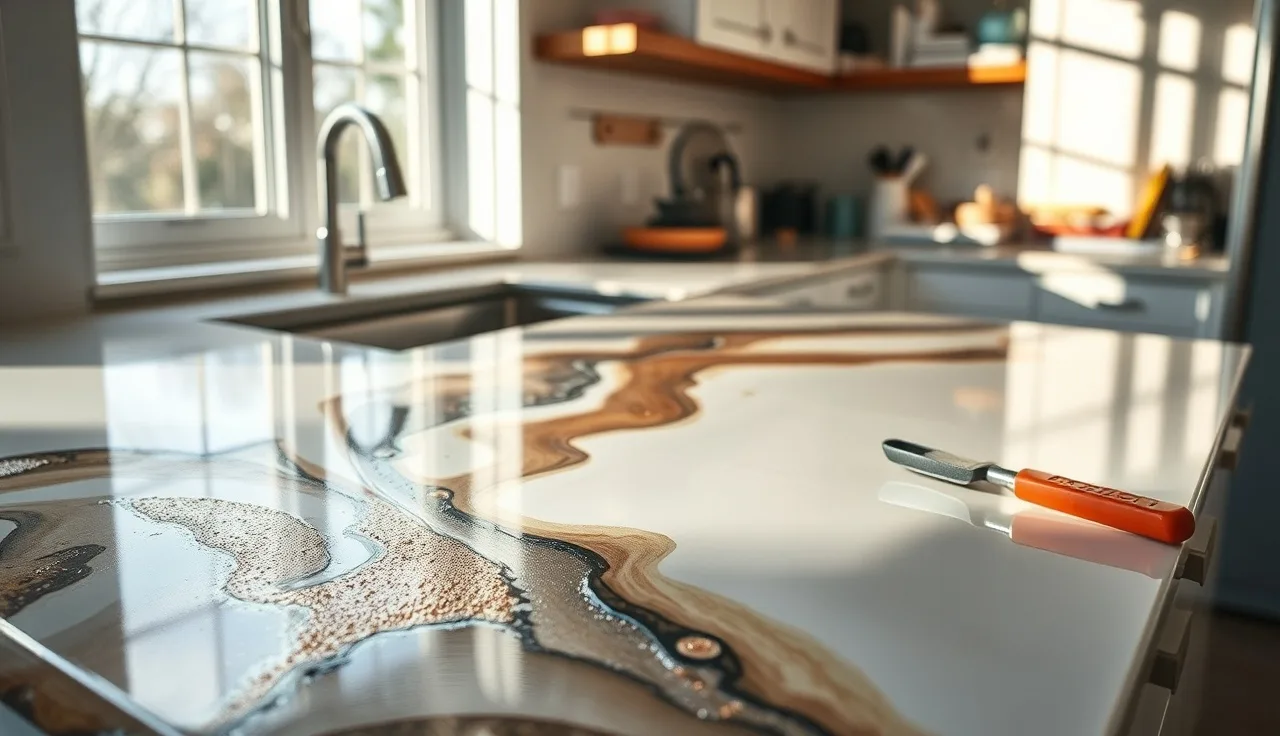
Stone coat countertops are not stone. They're a two-component epoxy system, usually a resin and a hardener, that you mix and pour over an existing countertop surface. Metallic pigments, alcohol inks, or stone-flake additives create the movement that mimics granite, marble, or quartz. The finished surface cures hard, develops a high-gloss shine, and can fool the eye in photos.
The most searched brand in this category is Stone Coat Countertops, a company based in New Braunfels, Texas, that sells kits directly to homeowners and runs a large YouTube channel. Because of that marketing reach, the brand name became shorthand for the whole category, the way "Xerox" once meant photocopying. Other brands selling similar epoxy counter kits include Leggari, Countertop Epoxy, and Rust-Oleum's Countertop Coating line.
The substrate under the epoxy matters a lot. These coatings bond to laminate, plywood, MDF, existing tile, and old countertop surfaces if they're clean, dry, and properly abraded. They don't work over active moisture, silicone contamination, or a surface that flexes. The epoxy layer itself runs 1/16 to 1/8 inch thick after build-up coats, so the structural countertop underneath does all the real work.
This product sits in a crowded field of surface-refresh options. For where epoxy lands next to the real materials, see kitchen countertops for a full comparison.
How much do stone coat countertops cost?
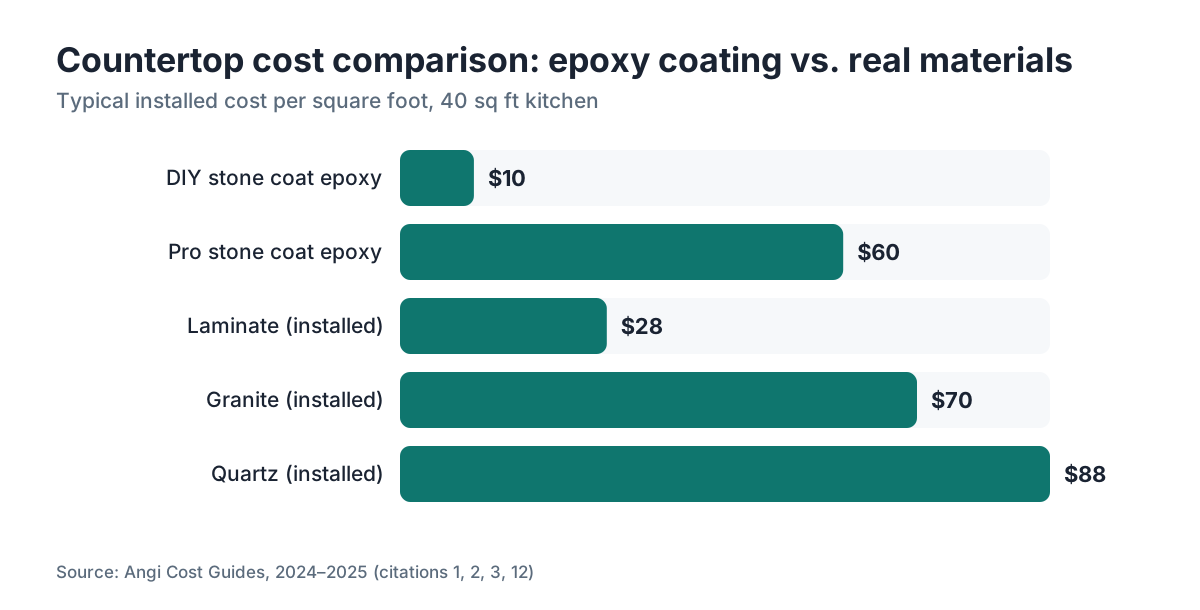
Cost splits almost entirely on one question: do you pour it yourself or hire it out. DIY materials for a 40-square-foot kitchen run $150 to $500. Professional application of the same area runs $1,800 to $3,000, sometimes $3,500 in high-labor markets.
A kit from Stone Coat Countertops covers about 35 square feet at roughly $100 to $130 per kit as of 2025 pricing on their direct site. A standard 40-square-foot kitchen needs one to two kits plus pigments, a heat gun, a torch, mixing supplies, and a topcoat. If the first pour goes wrong, the cost climbs, because you sand back and recoat.
Contractors who specialize in epoxy coatings typically charge $45 to $75 per square foot for labor and materials combined [1]. That price range overlaps directly with entry-level granite and mid-grade laminate, which is the honest tension you need to sit with before you commit.
Compare it to real stone. Installed granite averages $40 to $100 per square foot depending on grade and region [2]. Quartz runs $55 to $120 installed [3]. Laminate countertops sit at $15 to $40 installed [12]. Epoxy is cheap as a weekend project and expensive when you hire it out, relative to what you actually get.
One cost people forget: the topcoat. Most pros apply a polyurethane or urethane topcoat over the epoxy for UV resistance, and that adds $10 to $20 per square foot in some bids. Skip it and the surface yellows noticeably within 12 to 24 months under window light.
| Method | Typical cost per sq ft | Total for 40 sq ft |
|---|---|---|
| DIY kit (materials only) | $4, $13 | $150, $500 |
| Professional installation | $45, $75 | $1,800, $3,000 |
| Laminate countertops (installed) | $15, $40 | $600, $1,600 |
| Granite countertops (installed) | $40, $100 | $1,600, $4,000 |
| Quartz countertops (installed) | $55, $120 | $2,200, $4,800 |
How durable are stone coat countertops compared to real stone?
Epoxy is hard, but it's not stone-hard. On the Mohs scale, cured epoxy sits around 2 to 3. Granite measures 6 to 7 [4]. That gap is real. A ceramic knife dragged across an epoxy counter leaves a mark. A granite counter shrugs it off.
Heat is the next weak point. Epoxy starts to soften above roughly 120 to 150°F depending on the formulation. Set a pan straight off the burner and you get discoloration, warping, or adhesion failure. Stone Coat Countertops' own FAQ warns against placing hot pots directly on the surface [10]. Granite, quartz, and marble countertops all take high heat far better than any epoxy coating.
Scratch resistance in daily use is passable for a light-duty kitchen. Cut directly on it and you'll damage it. That's also true of quartz and marble, so epoxy isn't alone there, but the scratch depth tends to be worse because the surface is softer.
Yellowing draws the most complaints in forums and review threads. Standard epoxy resin is not UV-stable. Without a UV-protective topcoat, a surface exposed to sunlight or even fluorescent UV can yellow within a year. UV-resistant topcoats slow it down but don't stop it. Nobody has long-term controlled studies specific to countertop epoxy. The closest data comes from marine and flooring epoxy research, which shows measurable yellowing in UV-exposed samples within 500 to 1,000 hours of light exposure [5].
Chemical resistance is decent. Cured epoxy handles water, most household cleaners, and dilute acids better than unsealed natural stone. Strong solvents, acetone, and bleach will dull or damage the finish over time. The cleaning habits at how to clean stone countertops still apply to the stone surfaces around your kitchen even if the counter itself is epoxy.
What's the actual application process like?
The application is the reason this product gets split reviews. It's genuinely skill-dependent.
The basic steps: clean and degrease the existing surface hard, scuff with 120-grit, apply a base coat, mix resin and hardener at the exact ratio specified (usually 1:1 by volume), add pigments, pour and spread, hit it with a propane torch or heat gun to pop bubbles and move the metallics into patterns, let it level for 24 to 48 hours, sand lightly, apply a second build coat if needed, then topcoat. Pot life after mixing is typically 30 to 45 minutes depending on temperature and humidity. You work fast.
Temperature matters more than most first-timers expect. Epoxy cures too fast in a hot room and stays tacky too long in a cold one. Most manufacturers specify a working temperature of 70 to 80°F. Humidity above 85% can cause blush, a cloudy surface defect from moisture interfering during cure.
Common failures: fish-eye craters from silicone contamination, uneven leveling from a tilted substrate, bubbles that didn't get torched in time, and color patterns that don't come out the way the tutorials show. Those tutorials are shot by experienced pros under ideal conditions. First-timers can get good results, but budget time for the learning curve.
Cure time before light use is 24 to 72 hours. Full chemical cure, where the epoxy reaches maximum hardness, takes 7 to 30 days depending on formulation [6]. Skip harsh cleaning and heavy use during that window.
Can you apply stone coat epoxy over existing countertops?
Yes, and that's most of the appeal. You can pour epoxy over laminate, tile, wood, plywood, MDF, and old solid surface like Corian, as long as the base is structurally sound. Compare that to a full replacement: demo, disposal, template, fabrication, reinstall.
For laminate, the surface needs a scuff, not a strip. Formica countertops and similar laminate give a stable, non-porous base that epoxy bonds to well once sanded. Tile counters need the grout lines filled before the pour or they telegraph through the finish.
What you can't successfully coat: anything with real flex (a counter with a broken substrate), surfaces with active moisture underneath, and anything contaminated with silicone caulk or oil-based product that wasn't fully stripped. Silicone is epoxy's enemy. Even tiny traces cause fish-eye craters that are very hard to fix cleanly.
Whether to coat or replace comes down to the substrate condition and your goals. Epoxy over rotting laminate won't fix the rot. Epoxy over a solid, flat, dry laminate can genuinely extend the life and change the look. If you want a stone look without the cost of real fabrication, it works. If you want durability close to granite, it doesn't match up.
How does the look of stone coat compare to real granite or quartz?
In photographs, a well-done epoxy pour is hard to tell from real stone. The metallic inks fake the veining. The high-gloss finish reads like polished granite. On Instagram and YouTube, the results look great.
In person, the differences show up on close inspection. Real granite has depth and a three-dimensional quality because the crystals catch light at different angles. Epoxy movement sits on a flat plane. From arm's length most people won't clock it, but anyone who knows stone will.
Texture is another tell. Granite has a slight tooth from polishing. Epoxy is uniformly slick. Quartz from brands like Cambria uses engineered patterning that looks natural, and even that can beat epoxy in person because the material has depth from the aggregate particles.
Here's the honest part for resale: experienced buyers and appraisers recognize epoxy coatings and don't value them like real stone. The National Association of Realtors' 2022 Remodeling Impact Report found a minor kitchen refresh (where epoxy would land) returned about 67 cents on the dollar at resale on average [7], versus roughly 59 cents for a full kitchen renovation. Neither is a great return, but a $300 DIY epoxy project doesn't have to add much value to pay for itself.
What are the real pros and cons of stone coat countertops?
The honest list, minus the marketing.
Pros: the DIY cost is genuinely low. Turning ugly laminate into something that reads like stone for $200 to $400 is hard to argue with when a full replacement starts at $600 and climbs. Application doesn't need pro tools, though skill still drives the result. It's reversible in the sense that you can sand back and recoat, though getting to the original surface is harder. Color and pattern options are basically unlimited because you mix your own.
Cons: durability is the soft spot. Softer than real stone, vulnerable to heat and UV, prone to yellowing without a topcoat. Professional application costs overlap with real countertop materials, which guts the value case. The skill floor is higher than the ads suggest. If you rent, your landlord may hate the modification. Buyers who know materials will spot it.
Who it's right for: renters with landlord permission, homeowners doing a quick pre-sale refresh, tight budgets that want a stone look in a secondary space like a laundry room or basement bar, and experienced DIYers who want a creative project.
Who should skip it: anyone expecting granite-level durability, anyone pricing professional installation without pulling real stone quotes first, and anyone redoing a primary kitchen in a home they'll sell to buyers who care about materials.
How do you maintain and clean stone coat countertops?
Day-to-day cleaning is easy. Warm water and mild dish soap handle most messes. Dry the surface after, because standing water can work into micro-cracks in the topcoat over time.
Skip abrasive scrubbers, which scratch the epoxy. Skip bleach-based cleaners, which break down epoxy bonds over time. Acetone and nail polish remover strip the finish. The same rules at how to clean quartzite countertops apply here: gentle cleaners, no harsh acids, no abrasives.
Light surface scratches in the topcoat can sometimes buff out with automotive polish. Deeper scratches that reach the epoxy layer need the area sanded and spot-recoated with fresh epoxy or topcoat, and matching it invisibly is tricky. That's one practical disadvantage versus real stone, where a fabricator can often refinish or polish out damage.
Re-topcoating every 3 to 5 years is what most pros recommend, both to protect the surface and to head off UV yellowing before it gets ugly. That adds about $5 to $15 per square foot in maintenance over the counter's life if you hire it out.
Are stone coat countertops safe and food-safe?
Once fully cured, most epoxy countertop systems are considered food-safe for incidental contact. The relevant agency is the FDA, which regulates surface coatings in contact with food under 21 CFR Part 175 [8]. Stone Coat Countertops and several other brands state their cured product is food-safe. In the countertop context, "food-safe" means the surface won't leach harmful chemicals during normal use, not that it's sterile or fit for cutting.
The key word is "cured." Uncured or partially cured epoxy contains reactive amines and bisphenol-A compounds that are not safe for food contact. Full cure at room temperature takes 7 to 30 days. Some manufacturers only certify food-safe after 30 days. Don't use the surface for food prep in the first week no matter how hard it feels, because surface hardness and chemical cure are two different things.
For families with young kids or anyone worried about exposure during application and early cure, ventilation is mandatory. Epoxy vapors during application and the first 24 hours of cure irritate eyes and airways. The EPA lists many epoxy hardener components as potential sensitizers with repeated exposure [9]. Wear nitrile gloves and eye protection, and run the job with windows open and fans going.
How does stone coat epoxy compare to other countertop refresh options?
Stone coat epoxy is one of several ways to change a counter without replacing the stone. Here's how the main alternatives stack up.
Paint-on refinishing kits (brands like Rust-Oleum Countertop Transformations) use different chemistry, a water-based coating with a stone-chip layer, not poured epoxy [11]. They're cheaper at $50 to $100 per kit but look less convincing and have similar or worse durability. It's basically a painted finish with stone-colored flakes.
Peel-and-stick countertop film is the cheapest at $1 to $3 per square foot for materials. Films look flat in person, show seams, and lift at the edges over time. Fine for short-term rentals or staging, not a durable solution.
Actual replacement with laminate countertops at $15 to $40 installed [12] beats epoxy on long-term durability, at a higher upfront cost. Modern laminate in stone-look patterns is the best it's ever been and stays underrated.
Epoxy sits above films and about even with paint kits on cost, above paint kits on looks when done well, and below real stone or quality laminate on durability. If you're already spending $1,500 to $2,000 on professional epoxy, pull a real stone and quality laminate quote before you commit. If it's a $300 DIY weekend, epoxy has a clear use case.
Fabricators who see homeowners stuck between a DIY epoxy project and a real stone quote can run the numbers fast with quoting software. SlabWise's instant quote tool lets homeowners enter dimensions and get a real stone estimate in minutes, which makes the comparison concrete instead of a guess.
What should you watch out for when hiring someone to apply stone coat epoxy?
The epoxy countertop space has a low barrier to entry. Anyone with a YouTube education and a kit can call themselves a refinisher. That's fine for skilled hands, but it means quality is all over the map.
Ask before you hire: How many countertop epoxy jobs have you finished? Can you show photos of work that's at least 12 to 18 months old, so I can see how it held up? What topcoat do you use, and is it UV-resistant? Do you run a moisture meter before applying to confirm the substrate is dry? What's your surface prep process?
Red flags: a bid with no topcoat, a contractor who can't explain pot-life management, anyone who promises it'll look exactly like real stone.
Contracts should spell out the specific products, the cure time before you can use the surface, and your recourse if the finish fails (fish-eye, peeling, bubbling) within 90 days. Epoxy failure in the first month is almost always a prep or application error, not a materials defect, which matters for warranty claims.
For fabricators tracking this work alongside real stone jobs, comparing material and labor costs across job types is where good shop software earns its keep. Shops on platforms like SlabWise can template multiple quote options side by side, which helps when a customer is wavering between epoxy refinishing and real stone fabrication.
How long do stone coat countertops last?
Honest answer: 3 to 10 years in a kitchen, with wide variance based on application quality, topcoat, UV exposure, and how hard the surface gets used. That range comes from installer feedback in trade communities and product warranties, not controlled longitudinal studies, because the category is too new and too fragmented to have good published data.
Most manufacturer warranties run 1 to 3 years, which tells you something. Stone Coat Countertops' product warranty covers material defects, not installation failures or normal wear [10]. Granite installed by a competent fabricator carries no time limit on the stone itself because it's effectively inert. The granite countertops page covers what actually fails on real stone: edges, seams, and sealant, not the stone body.
In low-use spaces, a basement bar or a bathroom vanity with no UV, epoxy can look good for 10-plus years with a quality topcoat. In a busy family kitchen with a window over the sink and daily hard use, expect 5 years before real wear and yellowing show up.
Refinishing is possible once the surface degrades. You sand back the topcoat, sometimes the epoxy body, and recoat. It's cheaper than the original job but not trivial. Budget $300 to $600 in materials, or $500 to $1,500 professionally, if you plan to go that route.
Frequently asked questions
Is stone coat countertops a brand or a type of countertop?
Both, depending on context. Stone Coat Countertops is a specific brand based in New Braunfels, Texas, that sells epoxy kits and posts tutorials online. The phrase is also used generically for any poured-epoxy countertop coating that imitates stone. Other brands selling the same type of product include Leggari, Countertop Epoxy, and Rust-Oleum. When someone says 'stone coat countertop,' they might mean the brand or the category.
Can stone coat countertops be applied over tile?
Yes, but grout lines need extra prep. If the tile is flat and the grout lines are shallow, skim-coating the grout flush first keeps the lines from telegraphing through the finished epoxy. The tile must be clean, dry, and free of silicone. Cracked or loose tiles should be repaired or replaced before coating, because epoxy won't bridge structural failure underneath it.
Do stone coat countertops add home value?
Not much. Buyers and appraisers who know materials recognize epoxy coatings and don't value them like real stone. A well-done DIY application for $300 may make the kitchen show better, but it won't appraise as granite. If resale value is the goal, real stone fabrication or quality laminate from an established brand lands better with buyers.
How long does stone coat epoxy take to cure before I can use the countertop?
Surface hardness develops in 24 to 72 hours, enough for light use. Full chemical cure takes 7 to 30 days depending on the product and ambient temperature. Most manufacturers say wait 24 hours before placing objects on the surface and 7 days before normal kitchen use. Do not cut on it or set hot pans on it during the full cure window.
Can you use stone coat countertops in a bathroom?
Yes, and bathrooms are actually a better fit than kitchens for most homeowners. Lower heat exposure, less daily cutting, and often less UV mean epoxy holds up better and longer. Vanity counters get lighter use than kitchen counters, and the smaller square footage makes a DIY project more manageable and cheaper. Vanities are a reasonable use case for first-time applicators.
Why is my stone coat countertop yellowing?
Yellowing comes from UV degradation of the epoxy resin. Standard epoxy is not UV-stable, and exposure to sunlight or UV-emitting fluorescent lights shifts the color over time, typically within 12 to 24 months. A UV-resistant urethane or polyurethane topcoat slows this significantly. If yours is already yellowing, sanding back the topcoat and applying a fresh UV-resistant coat is the standard fix.
How do you fix bubbles or fish-eyes in stone coat epoxy?
Bubbles during application are best addressed with a propane torch or heat gun passed quickly over the surface within the pot-life window, usually the first 30 to 45 minutes. After cure, surface bubbles need sanding flat and recoating. Fish-eyes from silicone contamination are harder to fix and may require sanding the whole area flat and redoing the section. Thorough silicone removal before application is far easier than remediation.
Is it cheaper to do stone coat yourself or hire someone?
DIY materials for a 40-square-foot kitchen run $150 to $500. Professional application of the same area typically costs $1,800 to $3,000. The gap is substantial. If you have a steady hand, can manage the temperature and humidity requirements, and are willing to study instructional content before starting, DIY is the better financial choice. Hiring makes sense for a high-visibility space where you want a guaranteed finish.
Can stone coat epoxy be applied over butcher block countertops?
Technically yes, but it's a poor match. Wood expands and contracts with humidity and temperature, and epoxy doesn't flex with it. Cracking at the epoxy-wood interface is a documented failure mode. If you have butcher block you want to keep, finishing it with oil or wax as covered in butcher block resources is a better path than coating it with epoxy.
What's the difference between stone coat epoxy and Corian or solid surface?
Corian and other solid surface materials are cast acrylic or polyester composites, solid through their full thickness. A scratch or burn on solid surface can often be sanded out because the material is consistent all the way through. Stone coat epoxy is a thin coating over a substrate; damage goes through the coating to the material beneath. Solid surface is more repairable and generally more durable for kitchen use, though pricier than a DIY epoxy kit.
Does stone coat epoxy need to be sealed?
The epoxy itself is non-porous and doesn't need sealing the way granite or marble does. But a topcoat layer, typically a UV-resistant urethane, is strongly recommended over the cured epoxy. The topcoat protects against UV yellowing, light scratching, and chemical exposure. Without it, the surface degrades faster. Most professional applicators include a topcoat; DIY kits sometimes sell it separately.
Can you put a hot pan on stone coat countertops?
No. This is one of the clearest limits of epoxy coatings. Epoxy starts to soften and discolor above roughly 120 to 150°F, well below what a pan off a stovetop burner reaches. Direct heat causes permanent damage: discoloration, bubbling, or adhesion failure. Always use trivets or heat pads. This is also true of quartz, but granite and stainless steel handle direct heat better.
How do stone coat countertops compare to painting countertops?
Paint-on kits like Rust-Oleum Countertop Transformations cost $50 to $100 and are easier to apply, but they produce a less convincing stone look and are less durable than poured epoxy. Poured epoxy has better depth, more realistic movement, and a harder final surface. If budget is the main concern, paint kits work for low-use spaces. For a kitchen refresh that actually reads like stone, poured epoxy is the more credible result.
Are stone coat countertops worth it?
For a DIY project in a secondary space or a budget kitchen refresh, yes. The cost-to-impact ratio is hard to beat at $300 or less in materials. For a primary kitchen where durability matters and you're comparing professional installation costs, the value case weakens sharply, because you're spending close to real stone money without real stone durability. It depends almost entirely on whether you do it yourself and how hard the surface gets used.
Sources
- HomeAdvisor (Angi), Epoxy Countertop Cost Guide: Professional epoxy countertop installation typically costs $45, $75 per square foot for labor and materials combined
- HomeAdvisor (Angi), Granite Countertop Installation Cost: Installed granite countertops average $40, $100 per square foot depending on grade and region
- HomeAdvisor (Angi), Quartz Countertop Cost Guide: Quartz countertops run $55, $120 per square foot installed
- National Park Service, Mohs Hardness Scale (Geology education material): Granite minerals measure roughly 6 to 7 on the Mohs hardness scale, versus cured epoxy at about 2 to 3
- Journal of Coatings Technology and Research, UV degradation of epoxy coatings: UV-exposed epoxy samples show measurable yellowing within 500 to 1,000 hours of light exposure in coatings research studies
- Dow, Building and Construction market technical resources: Full chemical cure for epoxy at room temperature takes 7 to 30 days depending on formulation and ambient conditions
- National Association of Realtors, 2022 Remodeling Impact Report: Minor kitchen refreshes return about 67 cents on the dollar at resale on average per the 2022 NAR Remodeling Impact Report
- U.S. Food and Drug Administration, 21 CFR Part 175, Indirect Food Additives: Adhesives and Components of Coatings: The FDA regulates surface coatings in contact with food under 21 CFR Part 175
- U.S. Environmental Protection Agency, chemical safety and sensitizer guidance: The EPA lists many epoxy hardener components as potential sensitizers with repeated exposure
- Stone Coat Countertops, Product FAQ and Usage Instructions: Stone Coat Countertops' own FAQ warns against placing hot pots directly on the epoxy surface, and its product warranty covers material defects only
- Rust-Oleum, Countertop Coating product line overview: Rust-Oleum's Countertop Coating line is one of the major paint-on alternatives to poured epoxy countertop kits
- National Association of Home Builders, Remodeling Market Index and Cost Data: Laminate countertops install at $15, $40 per square foot as a benchmark for comparing refresh-product costs
Last updated 2026-07-09