TL;DR
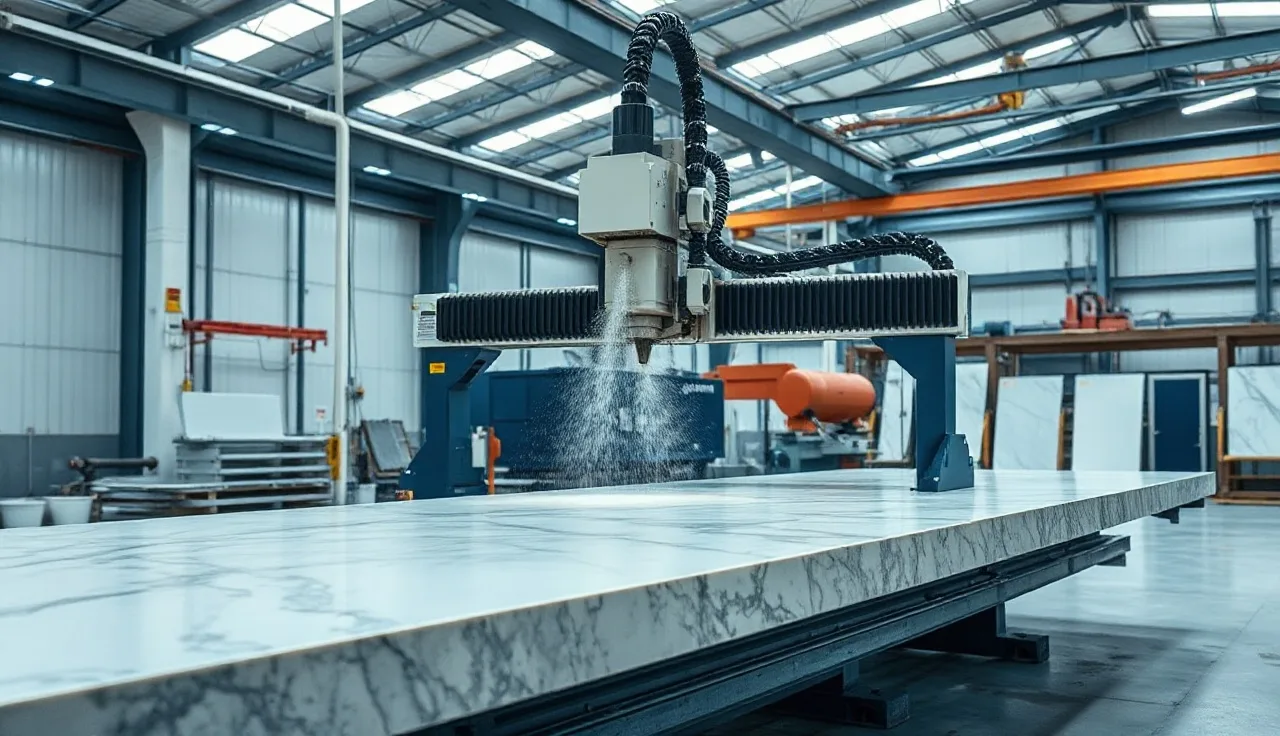
- A sawjet is a CNC machine that pairs a rotary diamond blade with an abrasive waterjet on the same cutting head.
- The blade handles straight bulk cuts at high speed; the waterjet handles curves, miters, and tight radii without blade deflection.
- Sawjets cut stone 40-60% faster than waterjet-only machines and hold tolerances around ±0.005 inches.
- Entry-level machines start near $150,000.
What is a sawjet and how does it actually cut stone?
A sawjet is a CNC cutting machine that mounts both a rotating diamond blade and an abrasive waterjet nozzle on the same gantry head. The two tools hand off mid-cut without any repositioning of the slab. The blade rips through long straight sections at speeds that would take a waterjet five to ten times longer, then the head pivots and the waterjet takes over for the curve, the notch, the sink cutout, or the miter.
The waterjet side works exactly the same way a standalone waterjet does. High-pressure water, typically running between 60,000 and 90,000 PSI, mixes with garnet abrasive in a mixing tube and the resulting jet erodes the stone by abrasion rather than cutting in the mechanical sense [1]. The diamond blade side is a standard bridge-saw blade spinning at a few thousand RPM, flooding the cut with water to cool the segments and carry away slurry.
The real engineering achievement is the switching logic. The machine's CAM software analyzes the cut file and automatically segments each cut path: long straight runs go to the blade, everything else goes to the waterjet. The operator doesn't make those decisions manually. That segmentation is what generates the speed advantage, because diamond blades remove material at rates waterjets simply cannot match on straight lines.
Some fabricators still describe their sawjet as "a waterjet with a saw attached," but that framing undersells the blade's contribution. On a typical kitchen countertop job with a full-height backsplash, two sink holes, and standard straight edges, the blade does maybe 70-80% of the total linear cutting. The waterjet just handles what the blade can't.
How does a sawjet compare to a standalone waterjet or bridge saw?
Three machines cut stone in most shops: the bridge saw (blade only), the waterjet (high-pressure abrasive stream only), and the sawjet (both). Each has a real use case. None is strictly obsolete.
| Machine type | Typical cut speed (granite, 3cm) | Positional accuracy | Entry-level price | Best for |
|---|---|---|---|---|
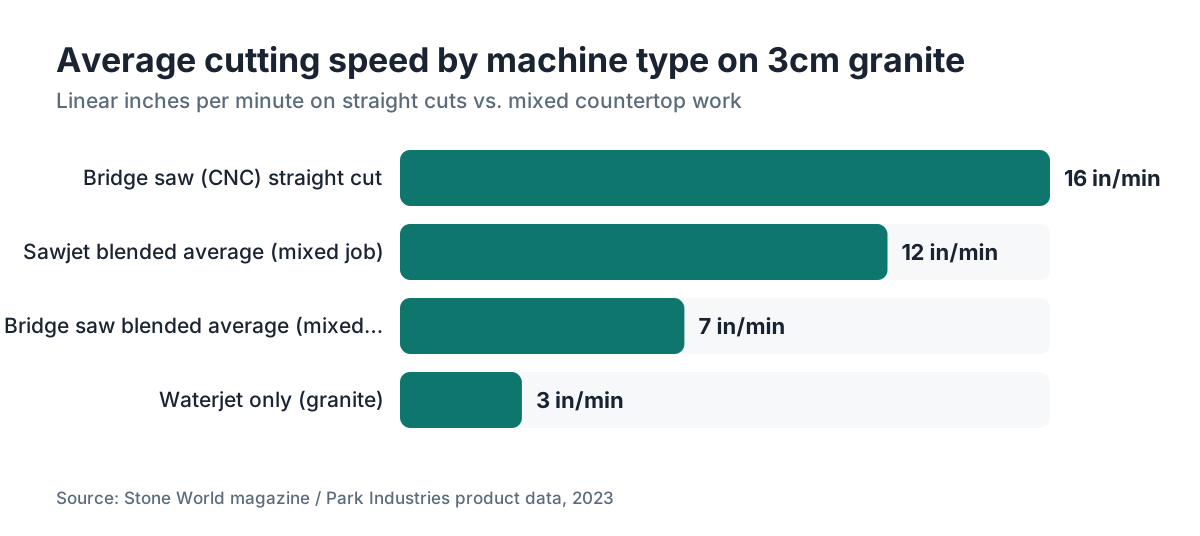
| Bridge saw (CNC) | 12-20 in/min on straight cuts | ±0.010 in | $40,000-$90,000 | High-volume straight cutting, edge profiling |
| Waterjet only | 1-4 in/min on granite | ±0.003-0.005 in | $100,000-$200,000 | Detailed shapes, inlays, very tight tolerances |
| Sawjet | 8-16 in/min blended average | ±0.003-0.005 in | $150,000-$350,000+ | Mixed straight/curved work, production volume with variety |
Speed numbers above are rough shop averages. Actual rates vary with stone hardness, abrasive flow, blade diameter, and machine brand. Fabrication trade sources put the speed advantage of a sawjet at roughly 40-60% faster than waterjet-only for a typical countertop job [2].
A bridge saw is still the right call for a shop that does almost nothing but straight rectangles, island overhangs, and simple square cutouts. The capital cost is a third of a sawjet and throughput on that specific work type is comparable. But the moment you're quoting marble countertops with ogee details, or doing granite countertops with curved peninsulas and undermount sink radii on a daily basis, a bridge saw becomes the bottleneck.
Waterjet-only machines still make sense for shops doing inlay work, medallions, or fine custom pieces where the blade would cause problems. The blade can't cut inside a closed curve or make a plunge cut into the middle of a slab. The waterjet can start anywhere. For a shop where 20% of jobs are production countertops and 80% are custom decorative work, a waterjet-only might still win.
What level of accuracy does a sawjet hold on stone?
Most modern sawjet machines hold positional tolerances between ±0.003 and ±0.005 inches (roughly ±0.08 to 0.13mm) under normal shop conditions [3]. That's tight enough for seam work on marble countertops and matches the tolerances you'd expect from a well-maintained waterjet-only machine.
The accuracy isn't uniform across all cut types. Waterjet cuts on a sawjet are as accurate as the same cut on a standalone waterjet, assuming the same pump pressure, nozzle condition, and appropriate slowdown at corners. Blade cuts are fast and straight but can deflect slightly on very hard stones like quartzite if you push the feed rate. Shops doing tight mitered edges on quartzite typically run the blade conservatively and sometimes finish with the waterjet.
Machine calibration matters a lot more than the spec sheet. A sawjet that's been properly leveled, with a recently trued blade and a fresh mixing tube, will hold its spec. One with 300 hours on the mixing tube and a slightly worn blade guide will not. The mixing tube is the waterjet's most consumable precision component. It wears out and changes the jet geometry. Most high-volume shops replace mixing tubes every 40-80 hours depending on abrasive and material [4].
Here's what ±0.005 inches means in the kitchen: your sink cutout radius, your seam line, and your cooktop opening all land within about the thickness of two sheets of copy paper. That's accurate enough that installation fits are limited by template quality and substrate levelness, not by the machine cut.
What does a sawjet machine cost to buy and operate?
New sawjet machines from the major manufacturers (Park Industries, Intermac, Breton, Prussiani, CMS) run from about $150,000 on the low end to $400,000 or more for large-format, high-pressure systems with full automation [5]. Used machines vary wildly, from $60,000-$100,000 for a 5-8 year old mid-range unit in good condition, to "parts only" machines you shouldn't touch unless you have an in-house mechanical team.
The purchase price is only part of the cost picture. The operating cost side is what surprises shops that come from a bridge-saw background.
Garnet abrasive is the biggest recurring expense. A typical sawjet running 8 hours a day uses roughly 700-1,000 lbs of garnet abrasive, at a cost of $0.20-$0.30 per pound for 80-mesh garnet [6]. That's $140-$300 in abrasive alone per full shift, or $35,000-$75,000 per year for a shop running close to full capacity. Some shops offset this by using recycled garnet systems, which can cut abrasive costs by 30-50%, though recycled abrasive cuts slightly slower.
Other operating costs include:
- High-pressure pump maintenance: the intensifier pump needs seal kits every 500-1,000 hours, typically $500-$2,000 per service depending on pump size
- Mixing tubes: $30-$80 each, replaced every 40-80 cutting hours
- Diamond blade segments: a quality 14-16 inch segmented blade runs $200-$600 and lasts 200-600 linear feet depending on stone hardness
- Water treatment: most municipalities require shops to treat and filter waterjet slurry before discharge; a basic settling system costs $5,000-$20,000 installed
- Electricity: a 100HP pump running 8 hours draws roughly 600-700 kWh per shift
Shops pricing jobs should add a per-square-foot machine cost to their quotes. A rough blended operating cost (abrasive, blades, consumables, power, maintenance amortized) for a mid-size sawjet often works out to $3-$6 per square foot of stone processed, before labor or overhead. Your actual number depends on how hard your material mix is and how well you manage consumables.
How does a sawjet affect cutting speed and shop throughput?
The speed argument for sawjets is real but often overstated in vendor marketing. Here's the honest picture: a sawjet is much faster than a waterjet on production countertop work, but it's not dramatically faster than a well-run bridge saw on straight work.
The advantage shows up on jobs that mix straight and curved cuts, which is most residential countertop work. A kitchen with two peninsulas, an undermount sink, a cooktop cutout, and a curved island takes maybe 45-60 minutes of cutting time on a waterjet-only machine. The same job on a sawjet might take 20-30 minutes because the blade handles all the straight runs in a fraction of the waterjet time [2].
On a purely rectangular job with a square sink cutout, the sawjet advantage over a modern CNC bridge saw is smaller. You might save 10-15 minutes. For a shop doing 8-12 jobs a day, that still adds up.
The throughput gains also compound with nesting. When you're cutting multiple tops from a single slab, a sawjet's speed on straight separation cuts means you get through a full slab's nest faster, which matters for shops running two-shift operations. Software that does tight nesting, like what fabrication platforms such as SlabWise generate, reduces both material waste and total cutting time regardless of which machine you're running.
Realistic production benchmarks from mid-size fabricators suggest a single sawjet with one operator can process 15-25 kitchen jobs per week depending on complexity. A waterjet-only shop running comparable work would need more machine time for the same output, or would need two machines to match it.
What stones and materials can a sawjet cut?
The short answer: virtually any stone or engineered stone product used in countertop fabrication.
Granite, marble, quartzite, soapstone, limestone, travertine, onyx, porcelain, sintered stone (like Dekton and Neolith), and engineered quartz (Cambria, Silestone, Caesarstone, and the rest) all run on sawjets regularly. The machine parameters change, but the machine handles all of them.
Harder, denser materials like quartzite and porcelain chew through consumables faster. A blade that lasts 400 linear feet on marble might last 150-200 linear feet on a hard quartzite. Abrasive waterjet cutting rates drop too on very hard materials. You either slow the feed rate or accept a rougher edge. Most fabricators profile-polish the cut edge anyway for countertop work, so edge roughness from the cut itself usually gets cleaned up.
Very thin materials (6mm or 12mm porcelain panels, for example) need a different nozzle standoff distance and lower pressure to prevent edge chipping. Some thick slabs (6cm or laminated edges) need multiple passes or a slow-speed single pass with the blade. The machine can handle them but the setup takes more operator judgment.
Materials that don't work well on sawjets: very soft stones like some limestones and travertines can get undercut by the waterjet and need special care, and loose or porous material can absorb water in ways that affect structural integrity. Solid surface products like Corian countertops are typically routed rather than sawn and aren't normally run on stone sawjets at all. Laminate countertops and Formica countertops are likewise router work, not waterjet work.
What software and file formats does a sawjet need?
Sawjets run on CAM (computer-aided manufacturing) software that takes a digital cut file and generates the machine toolpath, including all the blade-to-waterjet handoff decisions. The most common file input formats are DXF (from CAD programs), DWG, and in some newer systems, direct digital template files from a laser or structured-light templating system.
Most machine manufacturers bundle their own CAM software with the machine. Park Industries ships with their CAM package. Intermac uses Intermac Master. Third-party CAM options like Alphacam and Prodim's ProKitchen module also export to common machine controllers. The key compatibility question when buying a used machine is this: does the controller still accept files from your current template workflow? Older machines may need a $5,000-$15,000 controller upgrade to work with modern digital templates.
The CAM software automatically identifies which segments of a cut path are straight lines longer than a threshold (user-configurable, typically 3-6 inches) and routes those to the blade. Everything else goes to the waterjet. Good CAM software also handles the tab system: leaving small uncut bridges to hold the piece in place during cutting and prevent it from shifting or chipping as the cut completes. Tabs are cut last, either by waterjet or by hand after the piece is lifted.
Nesting is done either in the CAM software or in upstream shop management software before the file reaches the machine. Tight nesting directly reduces abrasive and blade consumption per square foot, which is why investing in good nesting logic matters financially. A shop running 80% utilization on slab material versus 65% utilization is saving real money per job, especially on expensive marble countertops or exotic stones.
What are the main maintenance issues fabricators deal with on sawjets?
Sawjets have two distinct maintenance domains because they have two different cutting systems. Most shops with bridge-saw backgrounds find the waterjet side is the steeper learning curve.
On the blade side, maintenance is familiar to anyone who has run a bridge saw. Keep the blade clean, watch for segment wear, make sure the spindle bearings aren't developing play, and keep the cooling water flow consistent. Dull blades leave heat marks and micro-fractures in stone edges.
The waterjet side is where most maintenance hours go:
High-pressure pump: The intensifier pump cycles from low to high pressure thousands of times per shift. The check valves, seals, and high-pressure cylinder are wear items. Most machine manuals recommend checking seal condition every 500 hours and replacing proactively at 800-1,000 hours rather than waiting for a failure mid-job [4]. A pump failure on a Friday afternoon is an expensive weekend.
Mixing tube: As noted, these wear out and change the jet geometry. The practical sign of a worn mixing tube is a cut that's no longer square (kerf taper increases) or a surface finish that gets rougher at the same feed rate. Most shops track tube hours on a log.
Abrasive feed system: Garnet bridging in the hopper, moisture in the abrasive, and worn abrasive metering parts are common issues. Damp garnet clumps and starves the jet, which causes incomplete cuts or surface streaking.
Water quality: High mineral content water is hard on high-pressure seals and nozzles. Most shops run a water softener upstream of the pump, which extends seal life meaningfully.
Gantry and rails: Both blade and waterjet share the same motion system. Rail cleanliness, lubrication, and periodic backlash checks matter as much as they do on any CNC machine.
Is a sawjet worth the investment for a small or mid-size fabrication shop?
This depends on your job mix, current throughput, and how you're financing equipment. The honest answer isn't always "yes."
For a shop doing under 30-40 kitchen jobs per month, a sawjet's capital cost is hard to justify purely on productivity grounds. At $200,000 financed over 5 years at 7%, you're looking at roughly $4,000/month in debt service before operating costs. You'd need the machine to generate meaningful additional revenue or replace labor costs to pencil out. Many smaller shops are better served by a good CNC bridge saw and an outsourced relationship with a waterjet-equipped shop for the 5% of jobs that need curves.
For shops doing 60+ jobs per month with a diverse material mix, the math gets much friendlier. The throughput increase over a waterjet-only machine means you can either take on more work without adding labor, or reduce your per-job cutting time, which has value even if you're not running at capacity. Shops that have added a sawjet consistently report being able to bring waterjet work in-house that they were previously outsourcing, which has a real margin impact.
A few questions worth running through before committing:
- What percentage of your jobs have curved cuts or cutout shapes that a bridge saw can't handle?
- Are you currently outsourcing any CNC cutting? What does that cost per year?
- Do you have the shop infrastructure for waterjet (water treatment, compressed air, 3-phase power, floor drainage)?
- Can your team manage the added maintenance complexity?
Shops that track job cost data rigorously, including machine time per square foot, are much better positioned to model the ROI honestly. That kind of job-level costing is exactly where fabrication quoting software earns its keep.
What should homeowners know about how sawjets affect their countertop project?
If you're a homeowner pricing countertops, you probably won't hear the word "sawjet" from your fabricator. But the machine a shop runs affects your project in ways you can see in the finished product.
Shops with sawjets or waterjets can give you tighter inside radii on sink cutouts, cleaner curves on shaped islands, and more precise seam placement than shops limited to bridge saws. On granite countertops with an undermount sink, the sink cutout edge quality is a direct product of what machine made it and how carefully the operator ran it.
For standard straight countertops with square or rectangular cutouts, the machine type has almost no visible effect on the finished result. A well-run CNC bridge saw makes a perfectly clean straight cut. You're paying for the versatility of more advanced machines even if your job doesn't use it.
On pricing, shops that run sawjets tend to carry higher overhead per square foot, which can show up in their base pricing. That same equipment also tends to correlate with shops that have invested in digital templating and tighter quality control across the whole workflow, which generally means fewer installation problems.
If you're getting quotes for a complex kitchen with curved edges, a specialty stone, or a commercial application, ask your fabricator what CNC cutting equipment they run. A shop that can describe their machine and workflow clearly is usually a shop that knows what they're doing.
For more on how countertop fabrication works from a homeowner perspective, see the countertop installation guide.
How does digital templating connect to sawjet cutting?
The full benefit of a sawjet only materializes if the cut file going into the machine is accurate. That's where digital templating comes in.
Traditional stick templating (cutting cardboard or Lauan strips to trace the countertop shape) introduces human error. Gaps in the template, tape compression, slightly off-square corners: all of those errors get reproduced in the stone cut. With a sawjet holding ±0.005-inch accuracy, your biggest source of error is often the template, not the machine.
Laser templating systems (Prodim Proliner is the industry standard) and structured-light systems capture the countertop space digitally and produce a DXF file with sub-millimeter accuracy [7]. That file goes directly to the sawjet's CAM software. The chain from measure to cut has very few manual steps and very few places for human error to compound.
Digital templating also integrates cleanly with shop management and nesting software. When the template file comes in as a DXF, your nesting software can immediately lay out cut paths on the available slabs and calculate material utilization before any stone is touched. That's a meaningful operational improvement for shops managing multiple jobs with expensive material.
The combination of digital templating, tight nesting, and a sawjet is what separates high-efficiency production shops from shops where throughput is limited by each manual step in the workflow. Software platforms like SlabWise connect quoting and nesting to this digital workflow, so the cut files that reach the machine already reflect real material costs and optimized layout.
What are the leading sawjet machine brands and how do they differ?
The North American market has a handful of dominant names, with some European manufacturers also well-represented in larger shops.
Park Industries (Minnesota) is probably the most common name in mid-size American stone shops. Their Fusion Pro sawjet is widely used and well-supported with North American service infrastructure [5]. Park machines are known for being approachable for shops transitioning from bridge saws, with relatively intuitive controls.
Intermac (Italian, distributed in North America) builds the Master Sawjet line. Intermac machines tend to have more automation options and larger working areas, and are popular with higher-volume fabricators. Service is available but can take longer if you're not near a major metro.
Breton (Italian) is another European manufacturer with strong presence in large-format shops. Their machines are built to heavy industrial standards and priced accordingly.
Prussiani and CMS are two other Italian manufacturers with products in the North American market, typically targeting mid-to-high volume shops.
When comparing machines, the specs that actually matter for production: maximum pump pressure (higher pressure cuts faster and cleaner in hard stone), table size (determines maximum slab size you can process in a single setup), positioning speed (how fast the gantry moves between cuts, which affects cycle time on multi-piece nests), and controller/software compatibility with your existing digital workflow.
Service support geography matters as much as machine specs. A $250,000 machine sitting idle waiting for a technician or a part is an expensive problem. Ask every manufacturer for their average service response time in your region before signing anything.
Frequently asked questions
What is the difference between a sawjet and a waterjet for stone cutting?
A waterjet uses only a high-pressure abrasive stream to erode stone. A sawjet adds a rotary diamond blade on the same cutting head. The blade handles straight cuts at speeds 5-10x faster than the waterjet; the waterjet handles curves, plunge cuts, and tight radii the blade can't manage. For typical countertop production work, a sawjet cuts 40-60% faster than a waterjet-only machine.
How accurate is sawjet cutting compared to a CNC bridge saw?
Sawjet waterjet cuts hold tolerances around ±0.003-0.005 inches, which is tighter than most CNC bridge saws (±0.010 inches). Blade cuts on a sawjet are comparable to a bridge saw on straight runs. The practical difference shows up on sink cutouts, curved edges, and miter joints where waterjet precision is genuinely tighter than what a blade alone can achieve.
How much does garnet abrasive cost to run a sawjet?
A sawjet running a full 8-hour shift typically uses 700-1,000 lbs of garnet abrasive. At $0.20-$0.30 per pound for 80-mesh garnet, that's $140-$300 per shift in abrasive alone. Shops running 250 days per year can spend $35,000-$75,000 annually just on abrasive. Recycled garnet systems can cut that cost by 30-50% but require additional capital investment.
Can a sawjet cut porcelain and sintered stone like Dekton?
Yes. Porcelain and sintered stone (Dekton, Neolith, Lapitec) are regularly cut on sawjets. These materials are very hard and abrasive, so they wear blades and mixing tubes faster than granite or marble. Thin formats (6mm-12mm porcelain) need adjusted standoff distance and lower pressure to prevent edge chipping. Most fabricators slow feed rates slightly on sintered stone compared to natural stone.
What water pressure does a sawjet waterjet run at?
Most production sawjets run the waterjet circuit between 60,000 and 90,000 PSI. Higher pressure cuts faster and produces a cleaner kerf edge in hard stone but puts more stress on pump seals and high-pressure components, increasing maintenance frequency. The intensifier pump is the most mechanically demanding component on the machine and typically needs seal replacement every 500-1,000 operating hours.
How long does it take to cut a typical kitchen countertop on a sawjet?
A single kitchen countertop piece (say a 25-inch by 96-inch L-shape with an undermount sink cutout) typically takes 10-20 minutes of machine cutting time on a sawjet, depending on stone hardness and cutout complexity. A full kitchen nest of 4-6 pieces might take 45-90 minutes. Compare that to 2-4 hours for the same job on a waterjet-only machine.
What file format does a sawjet machine use for cutting?
Most sawjets accept DXF files as the primary cut file input, along with DWG and in some systems proprietary template formats from Prodim or other digital templating tools. The CAM software bundled with the machine converts these files into machine toolpaths and automatically assigns each cut segment to either the blade or the waterjet based on geometry.
How often do you need to replace the mixing tube on a waterjet or sawjet?
Mixing tubes typically last 40-80 cutting hours depending on abrasive type, stone hardness, and operating pressure. A worn tube changes the jet geometry, increasing kerf taper and reducing cut quality. Most high-volume shops track tube hours on a maintenance log and replace proactively rather than waiting for a visible quality drop. Tubes cost $30-$80 each.
Do I need a water treatment system for a sawjet shop?
Almost certainly yes. Waterjet cutting produces a slurry of water, garnet abrasive, and stone particles. Most municipalities prohibit discharging this directly to the sewer. A basic settling tank and filtration system costs $5,000-$20,000 installed. Check your local industrial discharge permit requirements before installing any waterjet equipment. Some areas require a separate wastewater discharge permit.
What electricity service does a sawjet require?
A typical sawjet with a 60-100 HP high-pressure pump requires 3-phase electrical service, usually at 208V or 480V. The pump motor alone draws 45-75 kW under load. Most shops budget roughly 600-700 kWh per full shift for the machine. If you're in a space with only single-phase service, upgrading the electrical supply is a significant added cost before installation.
What is a reasonable ROI timeline for a sawjet in a stone fabrication shop?
For a shop doing 60+ kitchen jobs per month with mixed straight and curved work, most equipment advisors suggest a 3-5 year payback period on a mid-range sawjet. That assumes the machine allows you to bring outsourced waterjet work in-house and modestly increases throughput without adding a full-time operator. Shops under 30 jobs per month typically have a harder time justifying the capital cost on throughput alone.
Can a sawjet do miter cuts for waterfall edges?
Yes, this is one of the applications where sawjets earn their keep. A waterfall edge requires a precise 45-degree miter cut on both the countertop slab and the vertical drop panel. The sawjet's blade handles the long straight miter cut accurately and quickly. The miter surfaces then need to be polished before assembly. Sawjets with tilting cutting heads can cut miters directly; those without tilt use jigs.
How does sawjet technology affect countertop pricing for homeowners?
Shops running sawjets generally have higher equipment overhead, which can mean slightly higher base pricing. However, that equipment also typically means better cut accuracy, the ability to handle curved shapes, and faster turnaround. For standard straight kitchen countertops, you may not see a price difference. For complex shapes, curved islands, or specialty stone, a sawjet-equipped shop may actually quote more competitively because the work is routine for their equipment.
What thickness of stone can a sawjet cut?
Most production sawjets handle stone from about 6mm up to 60mm (roughly 1/4 inch to 2.5 inches) in a single pass, covering the full range of countertop applications including 2cm, 3cm, and laminated edges. Very thick stock (over 60mm) may require multiple passes or reduced feed rates. The waterjet side is less affected by thickness than the blade, but both slow down on thicker material.
Sources
- OSHA Technical Manual, Section III: Chapter 5, Waterjet/Abrasivejet Machining: Abrasive waterjet systems operate at pressures between 60,000 and 90,000 PSI and cut by abrasion rather than mechanical shear.
- Fabricator magazine (Stone World), sawjet productivity comparisons: Sawjets cut 40-60% faster than waterjet-only machines on typical countertop production work because the blade handles straight sections at much higher speed.
- Park Industries, Fusion Pro Sawjet product specifications: Modern sawjets hold positional tolerances of approximately ±0.005 inches under normal operating conditions.
- Flow International Corporation, waterjet maintenance documentation: High-pressure pump seals should be checked every 500 hours and mixing tubes replaced every 40-80 cutting hours depending on material and pressure.
- Park Industries, Fusion Pro Sawjet product page: Sawjet machine prices from major North American manufacturers range from approximately $150,000 to over $400,000 for large-format, high-automation systems.
- OMAX Corporation, abrasive waterjet operating cost guide: Garnet abrasive for waterjet cutting typically costs $0.20-$0.30 per pound for 80-mesh garnet, with high-production machines consuming 700-1,000 lbs per 8-hour shift.
- Intermac, Master Sawjet product specifications: Sawjet working table sizes vary by model; large-format machines accommodate full-size slabs up to approximately 3200mm x 2000mm.
- U.S. EPA, National Pollutant Discharge Elimination System (NPDES) program: Facilities generating industrial wastewater including stone fabrication slurry must comply with local pretreatment standards before discharge to municipal sewers under the Clean Water Act NPDES program.
- Occupational Safety and Health Administration, machine guarding standards 29 CFR 1910.212: CNC sawjets must comply with OSHA machine guarding requirements for rotating blade hazards and high-pressure fluid systems.
- Stone World magazine, fabrication technology annual surveys: Digital templating combined with CNC cutting has become standard practice in high-volume fabrication shops, with adoption rates increasing year over year among shops doing over 40 jobs per month.
Last updated 2026-07-09