TL;DR
- Countertop edge profiles run from a plain eased edge (usually free) to a stacked double ogee that adds $20 to $40 per linear foot.
- Waterfall miters cost the most: $75 to $150 per linear foot plus a second slab panel.
- Harder stone holds sharp profiles better; softer marble chips at sharp corners.
- Rounded edges hide wear and resist chipping.
- This guide covers every common profile, real prices, and what fabricators recommend.
What is a countertop edge profile, and why does it matter?
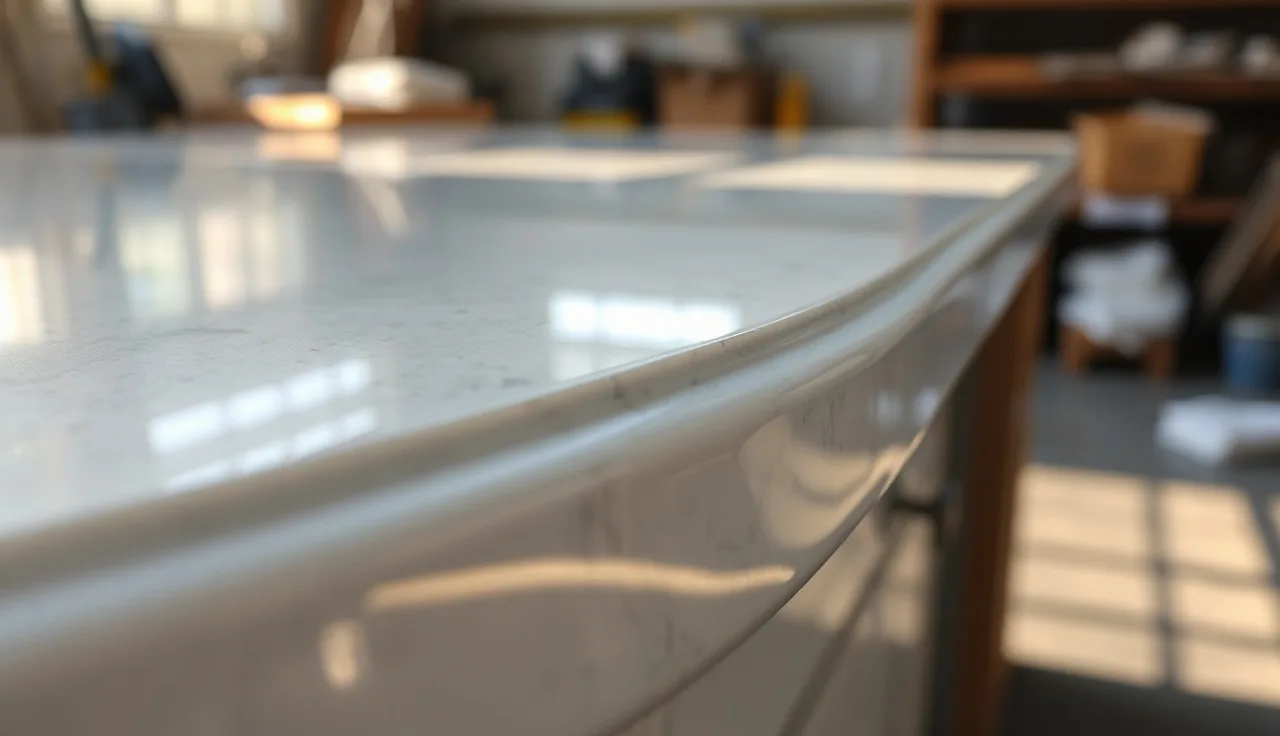
An edge profile is the cross-sectional shape cut into the exposed edges of a countertop slab. Sounds like a small finishing detail. It's not. The profile affects safety, cleaning, slab waste, fabrication time, and the visual weight of your whole kitchen. A thick mitered waterfall edge makes a 2 cm quartz slab read like 4 cm of solid stone. A pencil round on the same slab keeps your eye on the material itself.
Every exposed edge gets a profile: the front of the island, the peninsula returns, the window sill piece, sometimes the back edge if people walk past it. Those linear feet add up. The gap between a basic eased edge and a double ogee can run into hundreds of dollars on a full kitchen.
Profile choice interacts with the material too. Granite and quartzite are hard enough to hold a tight arris on a mitered edge. Marble is softer and chips at sharp corners over time. Laminate like Formica uses post-formed and applied edges that have nothing to do with stone fabrication. Knowing this before you talk to a fabricator saves you from picking something that either looks wrong or costs more than you planned.
For fabricators, edge profiles drive real shop decisions: which tooling path to run, how much time the CNC or hand polisher needs, and whether the profile leaves enough slab to avoid waste on tight jobs. Most shops build edge costs into their per-linear-foot line items so customers can compare options before a template is cut.
What are all the standard countertop edge profiles?
The trade has settled on about a dozen commonly named profiles, and combinations multiply from there. Here's what each one looks like and what it's good for.
Eased (straight eased): A flat vertical face with the top corner broken at a very slight angle, maybe 1 to 2 mm. This is the default on most slabs. It reads square and contemporary. Most fabricators include it in the base price or charge almost nothing.
Beveled: The top corner is cut at 45 degrees, creating a distinct angled band. Width varies. A 1/8-inch bevel is subtle. A 1/2-inch bevel is a real design element. Good for modern kitchens. Chips more than a rounded edge on harder stone.
Pencil round (small radius or 1/8" round): A small round-over on the top corner. Safe for kids, easy to wipe, and nearly impossible to chip. This is the most practical everyday edge there is. Costs little to nothing over eased.
Full bullnose: The entire edge is one continuous half-circle, giving a thick, rounded look. Popular in traditional kitchens. It hides the slab's real thickness well, but the underside is a magnet for grime and a pain to clean.
Half bullnose (demi bullnose): The top is fully rounded and the bottom drops straight down. Cleaner underneath than a full bullnose. Still reads soft and traditional. Common on granite in resale-focused remodels.
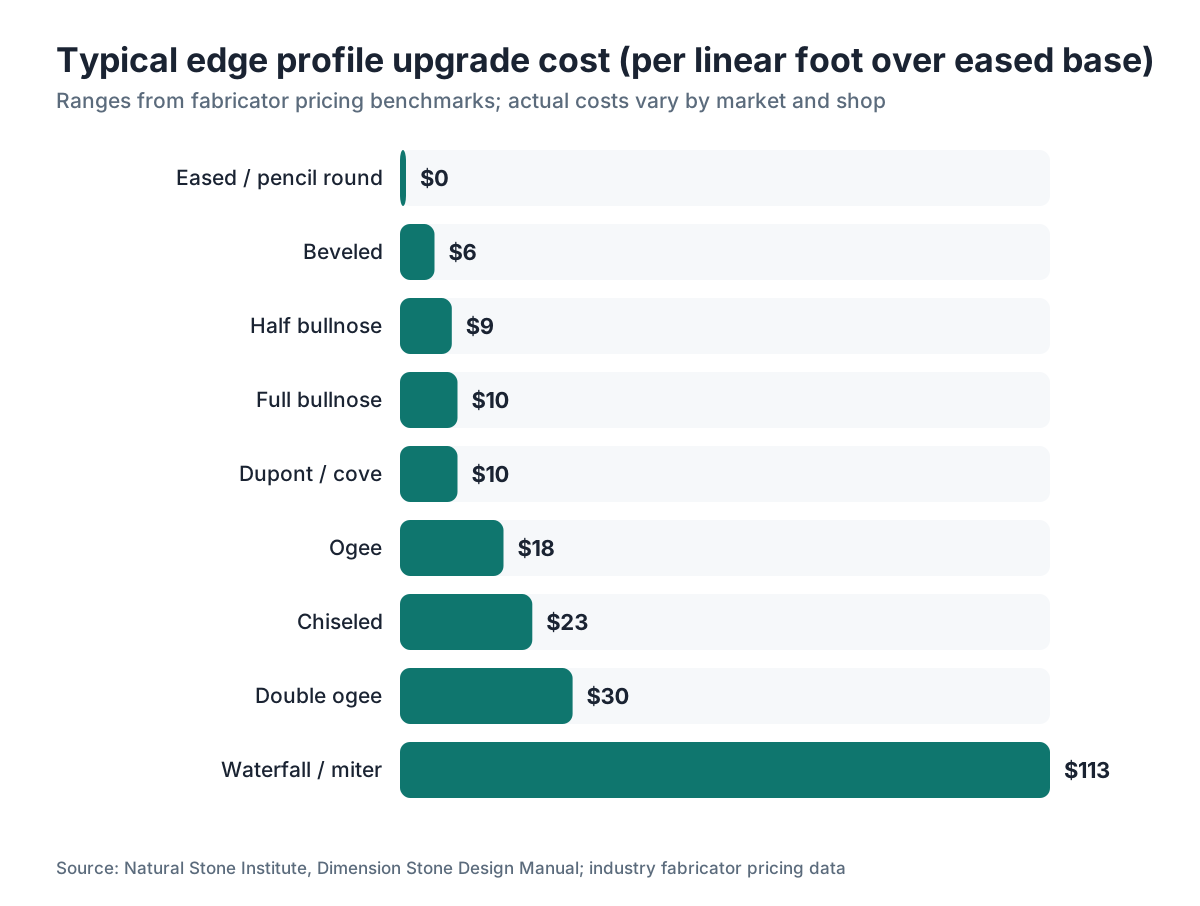
Ogee: An S-curve, concave at the top, convex at the bottom. The classic formal profile. It needs more CNC passes and more polishing time, so it usually costs $10 to $25 per linear foot over a simple edge [1]. The tight inside curve is hard to polish evenly on some stones.
Double ogee: Two stacked S-curves. Very ornate. Works in traditional or Old World kitchens and looks out of place in anything contemporary. This is where edge work starts demanding real CNC skill and real money.
Waterfall / mitered: The countertop surface and a vertical panel meet at a 45-degree miter, so the slab appears to pour down the side of an island. This is a fabrication process more than an edge shape, and it demands very tight tolerances. Expect $75 to $150 per linear foot of mitered joint, plus the cost of the vertical panel slab [2].
Chiseled / leathered edge: A rough, natural-looking break along the edge, often paired with a leathered surface finish. Popular on quartzite and some granites. Done by hand or with specific tooling. Every edge comes out slightly different.
Dupont / cove dupont: A small notch or step near the top of a mostly flat edge, creating a shadow line. Gives visual depth without ornate curves. Costs a bit more than eased.
Triple pencil / stacked edge: Several small round-overs stacked to fake the look of a thicker slab. Common on 2 cm stone when you want the visual weight of 3 cm without paying for it in material.
| Profile | Relative cost over eased | Best materials | Maintenance ease | Kid-friendly |
|---|---|---|---|---|
| Eased | $0 | All | Easy | Good |
| Pencil round | $0, $3/lf | All | Easy | Best |
| Beveled | $3, $8/lf | Granite, quartz | Easy | Moderate |
| Half bullnose | $5, $12/lf | Granite, quartz, marble | Moderate | Good |
| Full bullnose | $5, $15/lf | Granite, quartz | Harder underneath | Good |
| Ogee | $10, $25/lf | Granite, quartz | Moderate | Lower |
| Double ogee | $20, $40/lf | Granite, quartz | Harder | Lower |
| Waterfall/miter | $75, $150/lf | Quartz, quartzite, granite | Easy | Good |
| Chiseled | $15, $30/lf | Quartzite, granite | Moderate | Moderate |
These are typical ranges from published fabricator pricing and trade sources [1][3]. Your actual quote depends on the shop's labor market, tooling, and the stone.
How much do different edge profiles cost per linear foot?
Pricing varies more than most guides admit. A shop in rural Montana and a shop in a high-cost metro like Portland, Oregon are not charging the same rate for the same ogee. But the relative gaps between profiles hold steady, because they reflect real differences in machine time and hand polishing.
A standard eased or pencil round is either baked into the base slab price or runs $0 to $5 per linear foot. Most shops treat it as no-charge, since it's a single CNC pass with almost no polishing.
Ogee profiles usually run $10 to $25 per linear foot over base. A double ogee, which needs multiple passes and careful polishing in the inside curves, often runs $20 to $40 per linear foot over base. On an island with 20 linear feet of exposed edge, that's a $400 to $800 swing against a pencil round [1].
Waterfall edges live in their own category. The miter work alone runs $75 to $150 per linear foot of mitered joint, and you're also buying the vertical slab panel. On a standard 10-foot island with two waterfall ends, the edge work and extra material together add $2,000 to $5,000 to the project [2].
Chiseled edges tend to run $15 to $30 per linear foot because they need skilled hand work even when a CNC starts the shape. The hand finishing is slow and hard to systematize.
For fabricators, building edge profile costs into a quoting template with per-linear-foot line items by profile stops the classic mistake of undercharging on complex edge orders. Tools like the SlabWise quoting platform let shops put those line items into their price books so every estimate captures the real labor cost of each profile.
One thing homeowners miss: the profile cost applies to every exposed linear foot, including side returns and the back edge of an island if it faces a walkway. Count all your exposed edges before comparing quotes, more than the front run.
Which edge profile works best for each countertop material?
Material hardness and the way a stone polishes both limit which profiles look good and hold up over time.
Granite is hard and takes a sharp arris well. It handles ogee, dupont, beveled, and even mitered profiles without chipping. Polishing inside curves on an ogee takes longer but comes out consistent. Granite is one of the most forgiving materials for complex edges. See our guide to granite countertops for more on how the material behaves.
Quartz (engineered) is also hard but chips differently from natural stone. The resin binder means sharp beveled corners can sometimes show a faint white line where the pigment sits differently than the surface. On darker quartz colors especially, skip the ultra-sharp bevel. A pencil round or half bullnose sidesteps the issue.
Marble is soft (Mohs 3 to 4) next to granite (Mohs 6 to 7) [4]. Sharp corners on marble chip with normal use, especially near a sink or on an island where people lean. A full bullnose, half bullnose, or generous pencil round is the practical call. Ogees on marble look stunning in photos and will show chips within a few years in a working kitchen.
Quartzite varies by slab. True quartzite (not quartzite-marketed marble) is harder than granite in many cases and handles complex profiles well. The chiseled or leathered edge is popular here because it plays up the natural stone character. More on care in our how to clean quartzite countertops guide.
Butcher block doesn't get a CNC profile the way stone does. A simple routed round-over or a hand-planed chamfer is standard. Complex ogees on wood look fussy and need re-sanding every time the surface gets refinished. Stick to simple round-overs. Details on wood care at butcher block countertops.
Laminate (Formica and similar) uses post-formed edges, rolled edges, or applied edge banding instead of CNC stone profiles. A self-edge with a slight round-over is common. Some laminate products allow a beveled metal edge strip for a more modern look. See laminate countertops for the full picture on laminate edge options.
Premium quartz brands sometimes use proprietary edge profile names or partner with specific fabricators for consistency. The underlying profile is still one of the standard shapes above. The branding is mostly marketing.
Soapstone and Corian both have surfaces soft enough that simple profiles work best. See how to clean stone countertops for material-specific cleaning guidance.
Which edge profiles are safest for homes with kids or elderly residents?
Sharp corners are the problem. A standard eased edge reads square, and for adults in everyday use it's fine. At hip or toddler-head height, it's a real hazard. This is a safety question more than a design preference.
The pencil round (1/8-inch radius round-over) is the safest option for most households. It kills the sharp arris while keeping the edge clean and contemporary. It costs almost nothing extra. If there's one piece of advice for anyone with young kids: skip the fancy edge and get a pencil round.
A full bullnose removes all sharp corners, but it brings its own problem. The curved underside traps crumbs and moisture, and kids who grab the edge over and over can wear it down on softer stones.
Ogee and beveled profiles still have edges that can catch: the inside corners on an ogee, the angled band on a bevel. Less dangerous than a true square arris, but not ideal for low countertops in a kids' bathroom.
For elderly residents or anyone who braces against the counter for balance, a half bullnose or pencil round gives a comfortable grip. A sharp bevel hurts to press against. The Consumer Product Safety Commission tracks sharp countertop edges as a kitchen injury risk, which supports rounded profiles in homes with children or older adults [10]. The National Kitchen and Bath Association's planning guidelines recommend radiused edges and rounded corners at counter height as part of accessible design [5].
How do fabricators actually cut edge profiles, and what does that mean for quality?
Most stone shops today use a CNC router (or a CNC bridge saw with profile wheels) to cut the basic shape, then finish with hand polishing or automated belt polishing. Quality depends on both the machine setup and the finishing work.
A CNC router runs a profile wheel, a diamond-tipped bit shaped to match the profile, along the slab edge at controlled speed and pressure. A simple eased edge is one pass. An ogee is typically two or three passes with different wheels, plus hand polishing in the inside curve where a wheel can't reach cleanly. That hand step is where most of the quality difference between shops shows up.
Polishing runs through grits, usually from 50 or 100 up through 200, 400, 800, 1500, and finally a buff or resin pad [8]. Skip grits or rush the hand polish on inside curves and you get scratches that look fine under shop lighting but jump out in finished-kitchen photos under recessed cans. When you compare quotes, ask the fabricator about their finishing process on inside-curved profiles. A shop that can walk you through its polishing sequence knows what it's doing.
For fabricators holding tight tolerances, CNC toolpath accuracy matters as much as the finish. A worn profile wheel cuts a slightly different radius than spec, and on matching pieces (two sections of a continuous island, say) that inconsistency is visible. Shops running high volume on multiple CNCs need to check wheel profiles regularly.
Waterfall mitered edges need the tightest tolerances of any standard profile. The two pieces meeting at the miter have to match within a fraction of a millimeter for the veining or color to flow. Digital templating and CNC cutting make this doable, but only with a template-to-production workflow that has no manual measurement errors. See our countertop installation guide for what the install looks like in the field.
What edge profile goes best with different kitchen cabinet styles?
The edge profile should match the cabinet door style. It's one of the clearest ways a kitchen reads as coherent or thrown together.
Flat-front (slab) cabinets, the ones that run contemporary and minimalist kitchens, pair best with eased, pencil round, or beveled edges. A full bullnose next to flat-front cabinets looks dated on day one. The lines fight each other.
Shaker cabinets are versatile. They work with pencil round, half bullnose, beveled, and even a modest dupont. The simple framed inset of a Shaker door doesn't clash with moderate profile complexity.
Traditional raised-panel cabinets are the natural home for ogee and double ogee. The curves in the door profiles echo the curves in the countertop edge. Same design language. A plain eased edge on traditional cabinets looks like someone ran out of budget.
Inset cabinets, where doors sit flush inside the frame, read formal. They pair well with ogee, dupont, or half bullnose. The precision of inset construction suggests a level of detail that a flat eased edge undersells.
Outdoor kitchens and commercial prep areas? Profile barely matters. Function wins. Pencil round or eased, easy to clean, done.
Edge profile is one element of the larger kitchen design. For how it interacts with slab selection and layout, our kitchen countertops guide covers the decisions in order.
Does edge profile affect countertop durability and chipping?
Yes, and this is probably the most underrated trade-off in edge selection. Profile geometry decides how stress concentrates at the edge, which decides how likely you are to chip the stone.
A sharp 90-degree arris concentrates impact at a single point. Hit it with a pot or a dropped can and you get a chip. A rounded edge (pencil round, bullnose) spreads that same impact across a curved surface, which cuts chipping way down. Physics, not preference.
Granite is hard enough that even a sharp eased edge rarely chips in normal use. Marble, at Mohs 3 to 4, chips at sharp corners with grim regularity [4]. Engineered quartz is harder than marble, but its resin content means it can fracture differently from natural stone, and thin sharp bevels can reveal the substrate color on some products.
Beveled edges create a second arris: the line where the bevel meets the top surface. That arris is sharper than the corner on an eased edge, and it sits exactly where someone dragging a heavy cutting board off the counter makes contact. Chips at the top of bevel edges are common on marble and softer stones.
Ogee profiles have an inside curve that leaves a thin cross-section at the cove. On 2 cm stone, that thin section can crack under impact. On 3 cm it's much less of an issue. If you want an ogee on 2 cm material, ask whether the shop laminates the edge or builds it up. A good shop flags this before you sign.
Here's the short version. If durability is your top priority, go rounded on any material, full stop. If visual drama is the goal and the stone is hard, a miter or ogee absolutely works, but you're accepting a small bump in long-term chip risk.
How do you clean and maintain different edge profiles?
Maintenance differences between profiles are real but often overstated. The one thing that matters is whether the profile has inside curves or undercuts that trap debris.
Flat profiles (eased, beveled, dupont) wipe clean in a single pass. Nothing to catch crumbs. A damp cloth and a stone-safe cleaner, five seconds.
Rounded profiles (pencil round, half bullnose) are almost as easy. The small radius on a pencil round doesn't trap anything worth mentioning. The underside of a half bullnose, where the curve meets the cabinet face, can build up a line of grease over months of cooking, but it wipes off without a fight.
Full bullnose is where cleaning gets real. The full curve wraps under the slab, and the underside, especially on an island, collects grease, crumbs, and dried water in a groove a cloth doesn't naturally reach. Not a hygiene crisis. It just needs deliberate cleaning instead of a casual swipe.
Ogee profiles have that inside cove. Grease and debris settle in the concave section. A cloth dampened with your stone cleaner and worked into the cove, or a soft toothbrush for stubborn buildup, handles it. Adds maybe 30 seconds to a thorough cleaning.
For general stone cleaning technique, including which cleaners are safe on polished versus leathered finishes, see our guide on how to clean stone countertops.
Sealing the edge uses the same sealer as the top surface. The edge needs it too, especially on porous stones like certain granites and most marbles. Ogee inside curves and bullnose undersides are easy to skip during sealing. Work the sealer in with a soft brush instead of a cloth on those profiles to get full penetration [6].
What should you ask a fabricator before choosing an edge profile?
Most homeowners walk into a showroom, get shown a sample board with a dozen edges, pick the prettiest one, and leave. That's a bad process. Here are the questions that actually matter.
Does that profile work on my slab thickness? A double ogee on 2 cm stone can leave dangerously thin cross-sections at the cove. A good fabricator tells you this upfront. If they don't mention slab thickness, ask.
What does it cost per linear foot, and how many linear feet am I buying? Get it in writing, not as a vague upgrade. Count the exposed edges yourself before the meeting so you can do the math.
Does this profile come with the polished finish I expect? Some stones (leathered quartzite, for instance) don't polish the same on every profile shape. The inside curve of an ogee on a leathered slab may need a different finish treatment.
What does the inside curve look like on this specific stone? The ogee cove on white quartz looks different from the same profile on a dark, busy granite. Ask to see a sample in your actual material if you can.
How do you handle edge matching on multi-piece countertops? On a large kitchen with several fabricated pieces, the edges have to match in width, radius, and polish level. Ask how the shop checks consistency across pieces cut on different days or machines.
How does this affect lead time? Complex profiles take more machine and polishing time. In busy seasons, an ogee or double ogee can add a week to your fabrication timeline. Know this before you commit.
Fabricators reading this: these are the questions your customers should be asking, and building clear answers into your quoting process, with line-item transparency on edge types and linear footage, cuts down revision requests after estimate delivery. The SlabWise quoting software structures these line items so customers see edge profile costs broken out by profile type and linear foot count in every quote.
Are there regional style preferences for countertop edge profiles?
There are, though they're blurring as design content homogenizes online. A few honest observations from industry pattern data, not invented trend-speak.
The Pacific Northwest has leaned hard contemporary for the past decade. Eased, pencil round, and waterfall miters dominate new construction and remodel work there. Ogee and double ogee are rare in contemporary Pacific Northwest kitchens.
The South and Midwest still show strong demand for traditional profiles. Ogee, double ogee, and full bullnose turn up more often on granite kitchen countertops in those markets than in coastal cities. That tracks with the heavier presence of traditional cabinet styles there.
Northeast urban markets (Boston, New York, DC) follow contemporary style closely, with mitered waterfall edges and pencil rounds on engineered stone doing well in condo and townhouse renovations.
None of this is destiny. Design is personal. A well-executed traditional kitchen with a double ogee in Portland and a clean contemporary kitchen with a pencil round in Nashville both work fine. The regional pattern mainly affects what your fabricator's sample board leads with and what the comparables in your neighborhood look like, which matters if resale value factors into your decision.
The National Kitchen and Bath Association publishes an annual design trends study that tracks profile preferences by region based on designer survey data, though the public summary version has limited depth [7].
How do edge profiles affect countertop quotes and total project cost?
For homeowners trying to manage budget, edge profile is one of the few levers you can pull without changing your slab material or layout. Dropping from a double ogee to a pencil round on a 30-linear-foot kitchen might save $600 to $900 with no visible effect on the countertop material.
For fabricators, edge profiles are a classic source of quote error. Shops that quote a flat rate per square foot without breaking out edge type are either averaging the edge cost into their slab rate (which overcharges simple-edge jobs and undercharges complex ones) or eating the difference as margin compression on complex profiles.
The clean approach is to quote edges as a separate line item: base edge included (eased or pencil round), then each upgrade listed with a per-linear-foot cost and the customer's linear footage. Transparent, easy to audit, and it survives a change order when the customer decides mid-process to upgrade the island only from pencil round to waterfall.
Real pricing inputs to account for: tooling wear (profile wheels for ogee and dupont wear faster than eased wheels, typically needing replacement every 150 to 300 linear feet depending on stone hardness [3]), hand-polishing labor (ogee inside curves can add 15 to 25 minutes per linear foot of hand finishing over a flat edge), and polishing consumables (foam pads, resin pads, and compounds at each grit step).
On a shop running 1,000 linear feet of ogee per month, underpricing by even $5 per linear foot leaves $5,000 a month on the table. That compounds fast.
Frequently asked questions
What is the most popular countertop edge profile right now?
Eased and pencil round dominate new construction volume because they fit contemporary cabinet styles and cost almost nothing extra. Among upgrade profiles, the waterfall miter has grown a lot over the past five years, especially on kitchen islands. Traditional markets still see strong demand for ogee and half bullnose on granite countertops.
Does edge profile add cost to a countertop quote?
Yes, for most profiles beyond a standard eased or pencil round. Simple upgrades like a bevel or half bullnose add $3 to $15 per linear foot. Ogee profiles typically add $10 to $25 per linear foot. A waterfall mitered edge can add $75 to $150 per linear foot of miter joint, plus the cost of the vertical slab panel. Always ask for a per-linear-foot line item on the quote.
Can I change my countertop edge profile after installation?
Technically yes, but it's rarely practical. Re-profiling in place is difficult and messy, and the result depends on whether enough material remains at the edge to cut the new shape. For some upgrades (eased to pencil round, for example) a skilled fabricator or stone restoration company can re-polish in place. Changing to an ogee after installation is essentially not feasible without removing the countertop.
What edge profile is hardest to chip on stone countertops?
A full bullnose or pencil round, because the rounded geometry spreads impact force across a curve instead of concentrating it at a sharp arris. Sharp eased edges and beveled edges chip most easily, especially on softer stones like marble (Mohs hardness 3 to 4). For any marble countertop in a working kitchen, a rounded edge is a maintenance decision more than an aesthetic one.
What is a waterfall edge countertop and how much does it cost?
A waterfall edge is a mitered joint where the countertop surface meets a vertical slab panel at 45 degrees, so the stone appears to pour down the side of an island or cabinet. It's a fabrication technique more than a profile shape. Expect $75 to $150 per linear foot for the miter work, plus the cost of the extra slab for the vertical panel. A full island with two waterfall ends typically adds $2,000 to $5,000 to project cost.
Is an ogee edge profile hard to keep clean?
More effort than a flat edge, but not dramatically so. The inside curve of an ogee collects grease and crumbs and doesn't wipe clean in one pass the way a flat edge does. A damp cloth worked into the cove, or a soft brush for tougher buildup, handles it. If low-maintenance cleaning is a priority, a pencil round or eased edge is genuinely easier over years of daily use.
What countertop edge profile looks best on a thick slab?
On 3 cm stone (the current standard for most kitchen countertops), almost any profile works. The extra thickness makes complex profiles like ogee look proportional and gives the fabricator enough material to avoid thin cross-sections at inside curves. On 2 cm stone, simple profiles (pencil round, half bullnose, eased) are safer; complex ogees on 2 cm can leave fragile thin sections at the cove.
Does edge profile choice affect countertop resale value?
Not directly. Buyers rarely add or subtract value based on edge profile alone. What matters more is whether the profile fits the kitchen's cabinet style. An ogee on flat-front contemporary cabinets can read dated and may hurt perceived value. A pencil round on traditional raised-panel cabinets looks underfinished. Matching profile to cabinet style matters more than picking any specific profile for resale.
What edge profile works best for outdoor kitchens?
Eased or pencil round. Outdoor countertops get UV exposure, temperature swings, and moisture that stress complex profiles more than interiors. The inside curves of an ogee trap water, which speeds up sealer breakdown and can cause cracking in freeze-thaw climates. Simple profiles are also much easier to re-seal consistently. If the stone is granite, a small bevel also works and sheds water cleanly.
Can laminate countertops have the same edge profiles as stone?
No. Laminate countertops use post-formed edges, self-edge banding, or applied edge strips rather than CNC-profiled stone edges. A post-formed laminate edge is rolled during manufacturing, producing a smooth integrated curve. Flat laminate (non-post-formed) can accept various edge banding options including PVC tape, solid wood edging, or metal strips. The profile variety is narrower than stone, and complex shapes like ogee aren't available.
How long does it take a fabricator to cut and polish an ogee edge versus a simple eased edge?
A standard eased edge on CNC typically takes 1 to 3 minutes per linear foot including polishing. An ogee needs two to three CNC passes with different profile wheels, plus hand polishing in the inside curve, which can add 15 to 25 minutes per linear foot of hand finishing over a flat edge. On a 20-linear-foot island, an ogee may take 5 to 8 hours more total labor than an eased edge on the same piece.
What is a dupont edge on a countertop?
A dupont (sometimes called cove dupont) edge has a flat vertical face with a small notch or cove cut near the top, creating a shadow line just below the surface. It reads contemporary with more visual depth than a plain eased edge. The small cove needs an additional CNC pass and a bit more polishing, so it typically costs $5 to $15 per linear foot over a standard eased edge.
Do fabricators charge per linear foot or per piece for edge profiles?
Per linear foot is standard, applied to every exposed edge on the countertop. The total charge is the per-linear-foot rate multiplied by all exposed linear footage. Some shops include a basic eased or pencil round in the base square-foot rate and charge per-linear-foot only for upgrades. Ask which edges are included in the base price and which trigger an upgrade charge.
What edge profile is best for a bathroom vanity countertop?
Pencil round or half bullnose work well in bathrooms. The softer profile is safer at hip height, easy to clean, and fits both contemporary and traditional vanity styles. A full bullnose looks heavy on a narrow vanity top. Ogee works in a traditional master bath with ornate cabinetry but is overkill and harder to clean in a powder room or kids' bath.
Sources
- Marble Institute of America (now Natural Stone Institute), Dimension Stone Design Manual: Edge profile fabrication costs and complexity tiers for stone countertops; ogee profiles require additional CNC passes and hand polishing over simple flat edges
- Natural Stone Institute, Stone World trade publication coverage of mitered waterfall edge fabrication costs: Waterfall mitered edge fabrication adds significant per-linear-foot cost plus additional slab material; typical range $75-$150/lf for miter work
- NTCA (National Tile Contractors Association) and stone fabrication industry trade literature on diamond tooling wear rates: Profile wheels for complex edge profiles (ogee, dupont) wear faster than flat wheels, requiring replacement approximately every 150-300 linear feet depending on stone hardness
- National Park Service / USGS, Mohs Hardness Scale reference for common minerals: Marble (calcite-based) rates roughly Mohs 3 to 4 while granite rates roughly Mohs 6 to 7, explaining marble's greater tendency to chip at sharp edges
- National Kitchen and Bath Association (NKBA), NKBA Kitchen and Bathroom Planning Guidelines with Access Standards: NKBA universal design guidelines recommend radiused edges and rounded countertop corners as part of accessible kitchen and bath design
- Natural Stone Institute, Care and Cleaning for Natural Stone Surfaces technical bulletin: Edge profiles including inside curves and undercut areas require sealer application with a soft brush to ensure full penetration on porous stone surfaces
- National Kitchen and Bath Association, NKBA Design Trends Study (annual): NKBA annual design trends survey tracks edge profile and surface finish preferences among designers nationally, including regional variation data
- Marble Institute of America (Natural Stone Institute), Fabrication Standards for Dimension Stone: Industry fabrication standards specify polishing grit sequences (typically 50 through 1500 grit plus buff) for achieving consistent polish on stone edge profiles
- U.S. Census Bureau, American Housing Survey: Kitchen remodeling is among the most common home improvement projects tracked in the American Housing Survey, providing context for countertop upgrade prevalence
- U.S. Consumer Product Safety Commission (CPSC): Sharp countertop edges are identified as a kitchen injury risk factor, supporting recommendations for radiused profiles in households with children and elderly residents
Last updated 2026-07-09