TL;DR
- Post form countertops are pre-laminated slabs with a built-in curved backsplash and a finished front edge.
- The three standard edge profiles are the self-edge (straight), the waterfall or eased edge, and the no-drip or recessed edge.
- Each profile has a different look, price point, and functional tradeoff.
- Most stock post form tops cost $10 to $30 per linear foot installed.
What is a post form countertop, exactly?
A post form countertop is a sheet of high-pressure laminate bonded to a particleboard substrate during manufacturing, then shaped with heat and pressure so the laminate wraps continuously over the front edge and up the back cove into an integrated backsplash. The whole thing comes out of the factory as one continuous curve. No separate backsplash tile. No visible seam between the field and the cove.
The term "post form" refers to the forming process that happens after (post) the laminate is applied, when the heated sheet is bent over the contoured substrate. Manufacturers like Wilsonart, Formica, and Nevamar supply decorative laminate sheets to countertop fabricators who then post form them on a dedicated forming machine, or they sell pre-made post form tops in standard lengths to home centers. [1]
Post form is the dominant material in rental units, builder-grade kitchens, and laundry rooms. It costs a fraction of stone and installs in an afternoon. The edge profile baked into the top at the factory is one of the few design choices you actually have, so understanding your options matters more than most buyers realize.
For a broader look at how laminate compares to other surface materials, the laminate countertops guide covers the full picture.
What edge profiles are available on post form countertops?
Post form tops are not like custom stone slabs where a fabricator can run any profile the router can cut. The edge is formed at the factory as part of the bending process, so your choices are limited to what the forming machine can physically produce. There are three profiles you will realistically encounter.
Self-edge (straight/square edge) This is the simplest look. The laminate wraps over the front of the substrate and the edge face is covered with a matching strip of laminate, glued on separately. The result is a clean, flat vertical face. From the side, the countertop looks like a rectangular slab. Builders use this when they want a modern, no-fuss appearance. The glued-on edge strip is the one weak point: if the bond fails or a sharp blow catches it, the strip can chip away from the corner. [2]
Waterfall edge (also called the eased or beveled edge) This is the most common profile shipped in home centers. The top laminate sheet wraps continuously over the front edge in a gentle downward curve, so there is no separate edge strip and no exposed substrate at the corner. The curve radius is typically 1/8 inch to 3/16 inch, just enough to kill the sharp corner while keeping a fairly angular look. Because the laminate is continuous, this edge holds up better to daily bumps than a self-edge. It is what most people picture when they think of a standard post form top. [2]
No-drip edge (recessed or under-cove edge) This profile adds a small upturned lip or a slight downward tuck at the very front of the countertop. The idea is to stop water from running straight off the edge onto the cabinet face or the floor. Some versions have a slightly concave face on the front edge. It is less common than the waterfall but shows up in utility kitchens and laundry rooms where water management matters. It reads as slightly bulkier than the other two options.
A small number of manufacturers offer a fourth variation sometimes called a bevel edge, where the front face is cut at a slight angle before the laminate is applied, giving the edge a faceted look. This one is less standardized and not all post form lines carry it.
For comparison with edge profiles on stone tops, see the kitchen countertops overview.
How do post form edge profiles compare side by side?
Here is a direct comparison of the three standard post form profiles across the factors that matter most when you are choosing.
| Profile | Laminate wrap | Exposed substrate risk | Water runoff | Modern look | Typical price premium |
|---|---|---|---|---|---|
| Self-edge (straight) | Edge strip glued on | Yes, at corner if strip chips | Moderate | High | None (baseline) |
| Waterfall (eased) | Continuous over edge | Very low | Moderate | Medium-high | None to +$2/LF |
| No-drip (recessed) | Continuous, with lip | Very low | Low (lip catches drip) | Lower | None to +$3/LF |
| Bevel (where available) | Continuous, angled face | Low | Moderate | High | +$2 to +$5/LF |
The waterfall edge is the default on the overwhelming majority of stock post form tops at home centers. Walk into a Lowe's or Home Depot, look at the 8-foot laminate tops on the shelf, and almost all of them have the waterfall. [3] The self-edge shows up more in made-to-order post form from regional fabricators who want a cleaner, more contemporary line.
Price differences between profiles are often zero at the home center level, because you are buying whatever the manufacturer chose to make. When you order custom post form from a fabricator, expect small upcharges for profiles that require extra setup or finishing steps.
What does post form laminate countertop edge profile actually affect day-to-day?
Beyond looks, the edge profile choice has three real-world consequences.
First, durability at the corner. The laminate-wrapped waterfall and no-drip edges survive bumps better than a self-edge with a glued strip. High-pressure laminate is rated by cycle count for abrasion resistance under NEMA LD 3, and the surface itself is tough, but a glued-on edge strip adds a mechanical joint that is only as good as the adhesive and the care taken during fabrication. [4] If you are putting a post form top in a busy kitchen or a rental unit, the continuous wrap wins.
Second, water management. Post form countertops are especially vulnerable to water damage at the front edge because the substrate is usually particleboard, which swells badly when wet. A no-drip profile reduces the amount of water that runs forward off the surface. But honestly, the cove at the back (where the countertop meets the wall) is a bigger water risk than the front edge on most installations. Silicone sealing at the cove and at any sink cutout matters far more than which front edge profile you chose.
Third, appearance with hardware. A straight self-edge reads more contemporary and pairs well with flat-front (slab-door) cabinetry. The waterfall curve is neutral and works with most door styles. The no-drip can look dated in an otherwise modern kitchen. If you are doing a kitchen refresh and keeping older cabinets, the countertop edge profile either helps or hurts visual coherence more than you might expect.
What does a post form countertop actually cost, including the edge?
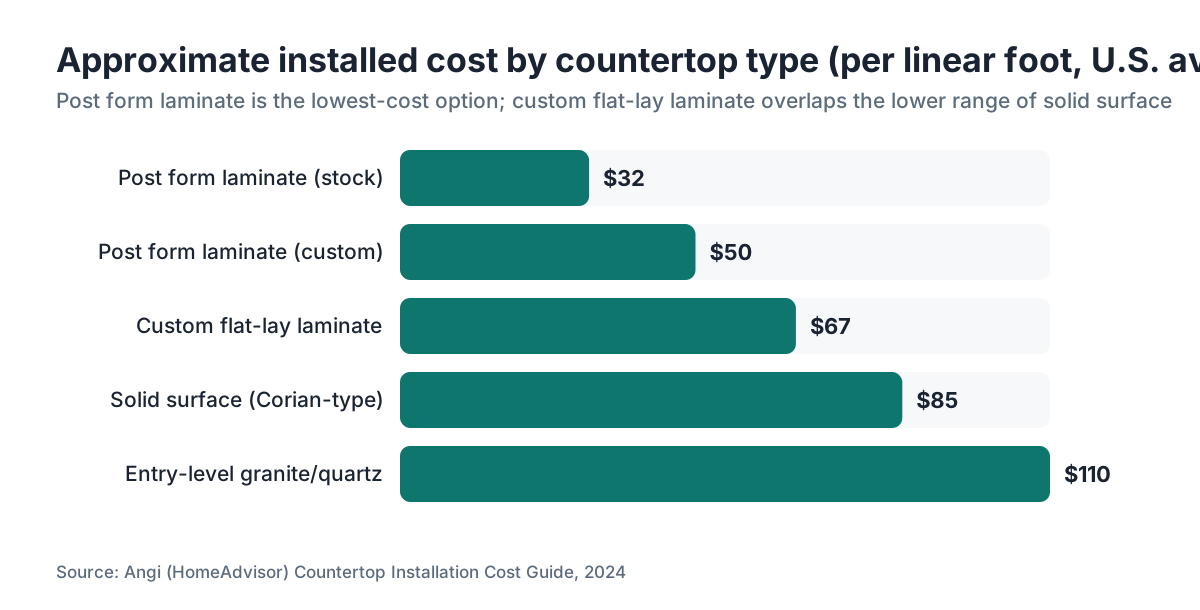
Stock post form tops at home centers typically run $7 to $15 per linear foot for the material alone, with standard lengths of 4, 6, 8, 10, and 12 feet and standard depths of 25.5 inches. [3] That price includes whatever edge profile the manufacturer built in, usually the waterfall.
Installed, the total cost with a basic sink cutout runs roughly $20 to $45 per linear foot once you add labor. A 10-linear-foot kitchen (roughly an L-shaped layout) might run $200 to $450 all in, which is why post form stays so common in rentals and flips.
Custom post form, ordered from a local fabricator and cut to your exact dimensions with end caps and mitered corners, typically runs $35 to $65 per linear foot installed, depending on your market. At that price point you can often get close to the cost of a basic quartz or granite remnant, so compare before you commit. [5]
If you are a shop owner quoting post form jobs and trying to track material and labor costs accurately, software like SlabWise can automate the per-linear-foot pricing and end-cap counting so jobs do not slip through unprofitably.
For context on where post form sits in the broader price spectrum, compare with granite countertops and corian countertops.
How is the edge profile formed on a post form countertop?
The manufacturing process explains why profile options are limited. A post form machine heats the laminate sheet to roughly 300 to 325 degrees Fahrenheit, making it pliable, then presses it over a pre-shaped substrate using rollers and a vacuum or pressure bag. The substrate is routed to the desired edge profile before forming begins. Once the laminate cools, it holds the curved shape permanently. [6]
The key constraint: the laminate can only bend so far before it cracks. The minimum inside bend radius for standard 0.050-inch high-pressure laminate is about 3/4 inch per Formica fabrication guidelines, and tighter radii require thinner "postforming grade" laminate designed for this purpose (typically 0.028 to 0.038 inches thick). [1] This is why you will never see an ogee or a bullnose on a post form top. Those profiles need router passes on a rigid laminated edge, which is a different process entirely.
When fabricators add a self-edge strip, they switch to a thicker standard laminate for the field and use contact cement (or a pressure-sensitive adhesive) to bond a matching strip to the front edge after routing. The result looks clean but is structurally different from the continuous-wrap profiles.
This process also explains why post form tops come in limited widths. The forming machine beds are sized for standard kitchen-counter depth (25.5 inches finished, sometimes 26 or 28.5 for wider tops). Island-depth or very wide post form is uncommon and expensive.
Can you change or update the edge profile on an existing post form countertop?
In a word, no. Once the laminate is formed and bonded to the substrate, you cannot re-form the edge. The laminate is already cooled and set. You can sand and re-laminate an edge strip for a self-edge look, or add a wood edge band that covers the original profile, but you cannot unbend the waterfall curve and swap in a straight drop.
If you want a different edge profile and you are already replacing the top anyway, specify the profile before ordering. If you have an existing post form top and you just want to update the look, the realistic options are two: apply a hardwood edge nosing over the existing laminate edge (this adds thickness and changes the reveal, so it takes careful planning), or replace the top entirely.
Some homeowners add wood edge banding to existing post form as a DIY upgrade. The result can look good if the wood is properly routed, finished, and sealed where it meets the laminate field. The risk is water intrusion at the joint, especially around the sink. Use a quality waterproof adhesive and caulk any gap at the top surface seam.
For guidance on other upgrade paths, the countertop installation article walks through what full replacement involves.
How does the post form edge profile differ from custom laminate edge options?
Custom laminate countertops, meaning a flat sheet of laminate glued to a substrate and then edge-treated separately rather than post formed, can take almost any edge profile a router can cut. Fabricators commonly offer:
- Eased edge: a light 1/8-inch break at the corners, no visible curve
- Beveled edge: a 45-degree chamfer on the top corner
- Waterfall/roundover: a fully rounded top corner, typically 1/4 to 1/2 inch radius
- Wood edge nosing: a hardwood strip glued on and shaped after the fact
- Double-layer buildup: two layers of substrate glued together for a thicker, more substantial-looking edge
These options are not available on a post form top because the substrate shape is locked in at the forming stage. The distinction matters if you are comparing quotes: a "laminate countertop" from a custom shop and a "post form laminate top" from a home center are both laminate, but they are made differently and offer different edge design latitude.
Custom flat-lay laminate with a built-up edge typically runs $45 to $90 per linear foot installed, more than stock post form, but it can handle complex layouts, wider depths, and design details that post form cannot. [5]
The formica countertops guide goes deeper on custom laminate options.
What post form edge profile looks the most modern?
The self-edge (straight) profile is the most contemporary-looking option on post form because it gives the countertop a flat, rectangular face with no visible curve. Paired with a solid or subtly textured laminate pattern, it reads closer to a stone slab or a solid surface material than the rounded waterfall does.
The waterfall edge is neutral. It does not look specifically dated, but the soft curve does signal "laminate countertop" to anyone who has seen a few kitchens. If your goal is to hide the visual tell of a post form top, the straight self-edge with a matte finish laminate in a concrete or linear stone pattern does a better job.
The no-drip profile is the hardest to make look current. The forward lip or concave edge face reads as an older design convention, and it fights modern hardware and cabinetry.
Honestly, the laminate pattern and finish (gloss versus matte versus texture) drive the perceived quality of a post form top more than the edge profile does. A flat-matte laminate in a wood grain or solid color with a clean self-edge can look intentional and current. A high-gloss marble-print laminate with a waterfall edge will read like a 1990s renovation no matter which profile you choose.
How do post form edges compare to stone or solid surface countertop edges?
On stone countertops (granite, quartzite, marble, quartz), the edge is machined separately from the slab by a CNC router or a manual profile grinder. Fabricators offer anywhere from 8 to 20-plus distinct profiles: bullnose, demi-bullnose, ogee, eased, waterfall, beveled, dupont, and many others. The edge profile on stone is a genuine design choice that can add $5 to $20 per linear foot depending on complexity. [7]
On solid surface materials like Corian, the edge is usually routed after installation and can be sanded smooth at any profile the router can follow. Solid surface has the added advantage that seams and transitions can be heat-fused and sanded until they disappear, which post form cannot replicate.
Post form's edge is fixed at the factory and the options are narrow. That constraint is the tradeoff for the low price. If you want real edge design latitude at a low budget, custom laminate flat-lay (not post form) is actually a better choice than post form, because the edge is free-standing and can be shaped or laminated after fabrication.
For a look at stone edge options specifically, the granite countertops and marble countertops articles cover what fabricators can cut and what it costs.
What should fabricators know about quoting and producing post form edge profiles?
If you are running a post form operation, a few practical points separate profitable jobs from headaches.
Edge profile affects material waste. A no-drip or self-edge job using flat-lay laminate on a custom substrate needs careful attention to end cap matching. The laminate grain or pattern direction on the front edge strip has to line up with the field, and mismatches show badly on high-contrast patterns. Always order extra laminate for end caps and any potential remakes.
Forming machine setup time varies by profile. Switching between profiles on the same machine day means re-routing a substrate template and adjusting the pressure bag or rollers. Small shops often batch one profile type per production run to skip the setup overhead.
Post form tops for cutouts (sinks, cooktops) need careful substrate prep. The particleboard or MDF substrate is exposed at the cutout perimeter, and if it is not sealed with waterproof edge banding or paint before installation, it will swell and delaminate over time. This is not specific to the edge profile, but it is the most common call-back on post form jobs.
On pricing, the per-linear-foot model works well for straight runs but breaks down on complex layouts with many inside and outside corners, end caps, and miter joints. Shops that track end caps separately and charge per joint avoid losing money on jobs that look simple on paper.
For fabricators managing quotes across multiple post form jobs, SlabWise's quoting tools let you set per-linear-foot pricing and count edge details automatically, so the math is done before you commit to a price.
Are there code or building standard requirements for post form edge profiles?
There are no federal building codes in the U.S. that specify a required edge profile for residential countertops. The International Residential Code (IRC) addresses countertop construction in bathrooms mainly around water resistance (Section R307, wet area finishes) but does not mandate a specific edge shape. [8]
Some local accessibility codes or ADA (Americans with Disabilities Act) guidelines address countertop height and knee clearance for accessible kitchens and bathrooms but do not specify edge profiles. The 2010 ADA Standards for Accessible Design, Section 804.3, set a maximum countertop height for accessible surfaces (34 inches above the finished floor) but say nothing about the front edge shape. The standard states in Section 902.3 that a portion of a work surface "shall be 34 inches (865 mm) maximum above the finish floor." [9]
Where edge profile does matter from a standards perspective: NEMA LD 3 is the industry standard for high-pressure laminate performance, covering scratch resistance, impact resistance, and dimensional stability. It is a product performance standard, not a code, and it does not differentiate by edge profile. [4] Laminate sold for post forming is tested separately under the postforming flexibility test in NEMA LD 3.
In commercial food service settings, NSF/ANSI 2 covers food equipment surfaces and can affect countertop specifications in commercial kitchens, but post form is rarely specified in commercial food prep because seams are hard to clean. [10]
Frequently asked questions
What is the most common edge profile on post form countertops?
The waterfall edge, also called the eased edge, is the most common profile on stock post form tops at home centers. The laminate wraps continuously over the front edge in a gentle curve, with no separate edge strip. Most pre-made 8-foot post form tops sold at Lowe's, Home Depot, and similar retailers use this profile as the factory default.
Can I get a bullnose edge on a post form laminate countertop?
No. A bullnose requires routing a fully rounded profile into a rigid edge, which is not possible on a post form top where the edge shape is set at the factory during the heat-forming process. If you want a bullnose look with laminate, a custom flat-lay laminate top with a shaped wood or laminate edge nosing is the closest option, but it costs significantly more than post form.
What does a post form countertop cost per linear foot installed?
Stock post form material runs $7 to $15 per linear foot at home centers. Installed, with a basic sink cutout, expect $20 to $45 per linear foot. Custom post form ordered from a local fabricator to your dimensions runs $35 to $65 per linear foot installed, depending on your market, the layout complexity, and the number of end caps and joints.
How do I know which post form edge profile I have?
Look at the front edge from the side. A straight vertical face with a visible seam line at the top corner is a self-edge. A smooth continuous curve from the top surface down to the bottom, with no visible seam, is a waterfall edge. A slight forward lip or concave front face that seems designed to stop drips is a no-drip or recessed edge.
Can I add a wood edge to my existing post form countertop?
Yes, but it takes careful work. A hardwood nosing strip can be glued over the existing laminate edge with contact cement or construction adhesive, then routed to a finished profile. The joint at the top surface has to be caulked with a waterproof sealant. The added thickness changes the countertop height slightly. Results vary; water intrusion at a poorly sealed joint is the main failure point.
Is post form laminate the same as Formica?
Formica is a brand name for high-pressure laminate, not the countertop construction method. Post form is a manufacturing process. You can post form a Formica-brand laminate sheet, a Wilsonart-brand sheet, or any other HPL sheet made for postforming. The terms get used interchangeably in casual talk, but they describe different things.
Why do post form countertops have that curved backsplash?
The integrated cove backsplash is formed in the same heat-and-press step as the front edge. It closes the gap between the countertop and the wall where water, crumbs, and grease would otherwise collect. It also means no tile or separate backsplash material is needed for the first few inches up the wall. The cove height is typically 4 inches, though some lines offer taller options.
Does the edge profile affect how durable a post form countertop is?
Yes, modestly. A continuous-wrap edge (waterfall or no-drip) is more durable at the corner than a self-edge with a glued-on strip, because there is no adhesive joint to fail. The self-edge strip can chip away if hit hard or if the adhesive bond degrades. For rental properties or high-traffic kitchens, the waterfall edge is the safer bet on durability grounds.
How thick is the laminate on a post form edge?
Postforming-grade laminate is thinner than standard high-pressure laminate, typically 0.028 to 0.038 inches thick (versus 0.050 inches for standard HPL). The thinner sheet allows the tight bends needed at the edge and cove without cracking. Because it is thinner, the edge surface is slightly less scratch-resistant than the field of a custom flat-lay laminate top made with standard HPL.
What is the difference between a post form top and a custom laminate countertop?
A post form top is heat-bent from a single laminate sheet at the factory, creating integrated curves at the front edge and back cove. A custom laminate top is a flat sheet bonded to a substrate and then edge-treated separately. Custom laminate can take many edge profiles and handle wider or irregular dimensions. Post form is cheaper but offers very limited edge and design options.
Are post form countertops waterproof?
The laminate surface itself is highly water-resistant, but the particleboard substrate is not. Water that gets in at seams, the sink cutout, or the back cove will make the substrate swell and delaminate. Proper sealing with silicone at the cove, a waterproof end cap at cut ends, and sealed sink cutout edges is required. The edge profile does not make the top waterproof on its own.
What depths do post form countertops come in?
The standard depth is 25 inches to 25.5 inches, which gives a finished depth of about 25 inches after scribing to the wall. Some manufacturers offer 28.5-inch or 30-inch depths for wider layouts. Island-depth post form (36 to 42 inches) is uncommon and usually special-order. Standard widths at home centers are 4, 6, 8, 10, and 12 linear feet, cut to length on site.
Can post form countertops be used in bathrooms?
Yes. Post form vanity tops are a common and inexpensive option for bathroom vanities. The same edge profiles apply. The cove backsplash is especially useful in bathrooms where water splashing against the wall is constant. Use the same waterproofing precautions at seams and cutouts as you would in a kitchen. Some post form tops are sold pre-configured with an integrated sink opening.
Sources
- Formica Group, Fabrication Guide for High Pressure Laminates: Postforming-grade laminate is thinner than standard HPL to allow bending; minimum bend radius guidance and forming temperature range (approximately 300-325°F) are specified by laminate manufacturers including Formica.
- Wilsonart, Postforming Technical Guide: Continuous-wrap waterfall and no-drip edges eliminate the separate edge strip used on self-edge profiles, reducing the risk of edge delamination from impact.
- The Home Depot, Post Form Countertops product listings: Stock post form laminate countertops at major home centers are priced from approximately $7 to $15 per linear foot and the waterfall edge is the standard profile on most shelf units.
- National Institute of Standards and Technology (NIST), Voluntary Product Standard reference for decorative laminates: High-pressure decorative laminate performance is measured against published product standards covering abrasion, impact, and dimensional stability; postforming flexibility is a distinct test within these standards.
- HomeAdvisor (Angi), Countertop Installation Cost Guide: Custom post form laminate countertops typically run $35 to $65 per linear foot installed; custom flat-lay laminate with built-up edge runs $45 to $90 per linear foot installed depending on market and complexity.
- U.S. Department of Energy, industrial process heating reference: Postforming heats decorative laminate to a pliable temperature range before pressing it over a shaped substrate, after which the cooled laminate holds the formed shape permanently.
- Natural Stone Institute, Dimensional Stone Design Manual: Edge profile machining on stone countertops can add roughly $5 to $20 per linear foot depending on profile complexity, per industry fabrication standards.
- International Code Council, International Residential Code (IRC) 2021: IRC Section R307 addresses wet area finishes in bathrooms but does not mandate a specific edge profile for residential countertops.
- U.S. Access Board, 2010 ADA Standards for Accessible Design: ADA Standards Section 902.3 set a maximum work surface height of 34 inches above the finish floor for accessible surfaces but do not specify a required front edge profile.
- NSF International, NSF/ANSI 2: Food Equipment standard: NSF/ANSI 2 governs food contact surface materials in commercial kitchens and can affect countertop specifications in commercial food service environments.
- Lowe's, Laminate Countertops buying guide: Stock post form tops at Lowe's are sold in standard lengths (4, 6, 8, 10, 12 feet) at standard 25-inch depth; the waterfall edge is the factory default on most lines carried.
Last updated 2026-07-09