TL;DR
- Marble countertops range from stark white Calacatta with bold gray veining to jet-black Nero Marquina with white lines.
- The look depends on the quarry, the finish (polished vs.
- honed), and where the slab sat in the block.
- This guide describes what each major marble type actually looks like, how finishes change the appearance, and what to expect in real kitchens and bathrooms.
Why do marble countertop photos look so different from the real slab?
Every slab of marble is a one-of-a-kind cut through a block of metamorphic rock. The veining pattern, the background tone, and the contrast between them shift from slab to slab, sometimes hard. A showroom photo labeled "Calacatta Gold" might show tight, faint gold veining on a bright white field, while the slab sitting three feet away in the same yard has a thick, branching gray vein that swamps the background.
Photography makes this worse. Polished marble under studio lighting can look blinding white on screen but shows obvious cream tones in person. Honed slabs, which have a matte surface, photograph darker and flatter than they appear in a real kitchen with window light bouncing around. Phone cameras also tend to blow out the whites and flatten the subtle gray gradations that give marble its depth.
Here is the honest answer. Treat any photo as a direction, not a contract. The categories below describe the full visual range of each type, so when you look at a photo you understand where on that spectrum it lands. Then go see the actual slab. Most fabricators let you pull the slab out and lean it upright so you see the full 9-to-10-foot height the way your eye will read it on a countertop.
Fabricators who quote and lay out jobs digitally can sometimes show you a photorealistic render of your specific slab mapped to your kitchen dimensions. That is genuinely useful. It is still not a substitute for standing in front of the stone.
What does Calacatta marble look like on a countertop?
Calacatta is the marble most people picture when they imagine a luxury white kitchen. The background is a true, cool white, closer to paper white than to cream. The veining is bold, usually gray or gold, and runs in dramatic diagonal sweeps rather than the finer, diffuse veining you see in Carrara. Vein thickness ranges from hairline to almost a half inch. Gold varieties have warm amber and caramel tones threading through the white. Gray varieties stay in a cool blue-gray palette.
Calacatta Borghini is one of the most recognizable: dense, branching gray veins on a near-white background. Calacatta Gold has that signature warm vein with occasional rust tones. Calacatta Macchia Vecchia (sometimes called "old stain") shows a more dispersed, painterly pattern with multiple vein colors in the same slab.
On a polished finish, Calacatta reads glossy and high-contrast, which photographs dramatically. On a honed finish, the background shifts slightly warm and the veins soften visually, giving the surface a quieter, more stone-like character. Leathered Calacatta is rare but exists, and the texture breaks up the large field of white so the surface looks less stark.
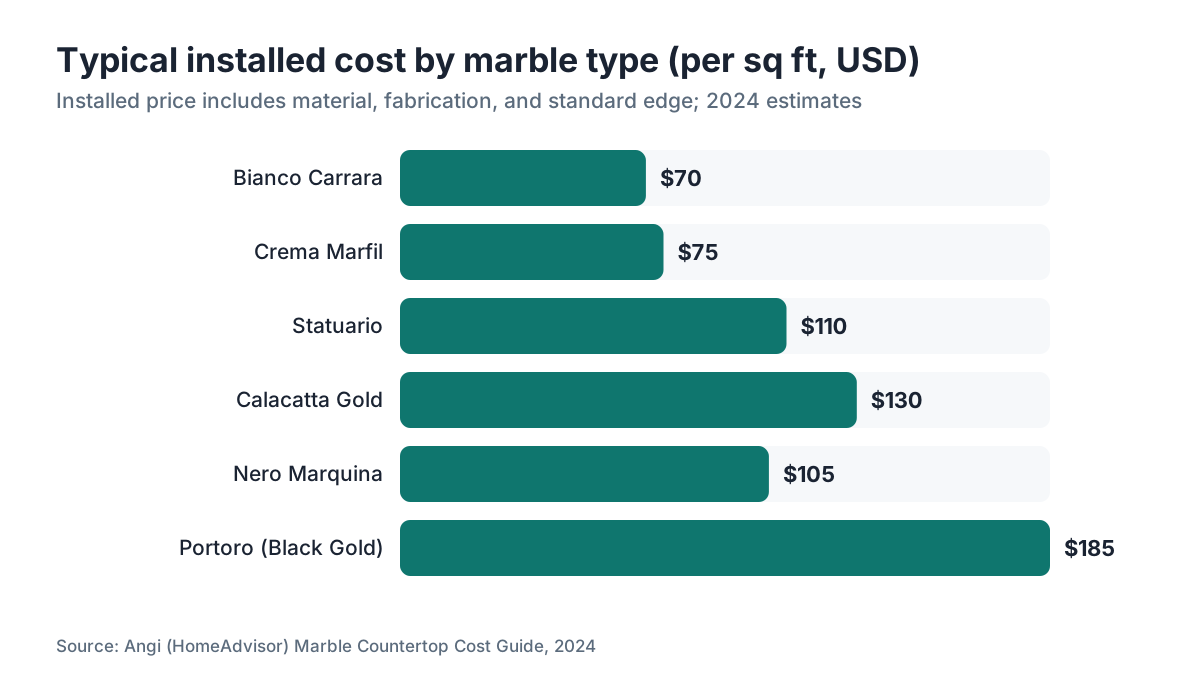
Calacatta comes from a small quarry region in the Apuan Alps near Carrara, Italy [1]. Supply is genuinely limited compared to Carrara, which is why Calacatta commands higher prices, typically $80 to $180 per square foot installed, versus $40 to $100 for standard Carrara [2].
For a broader look at how marble fits among other natural stone options, the marble countertops guide covers material properties alongside the visual ones.
What does Carrara marble look like, and how is it different from Calacatta?
Carrara is softer-looking than Calacatta. The background is a cooler, slightly blue-tinged gray-white, not the bright white of Calacatta. The veining is finer and more uniform, running in feathery, almost brushstroke patterns rather than the bold statement veins of Calacatta. From across a room, Carrara can read as almost solid light gray. Up close, the delicate veining becomes visible.
Carrara White (also written Bianco Carrara) is the most common variety and one of the most heavily quarried marbles on earth. Michelangelo's David was carved from Carrara marble [1], which tells you how long humans have been pulling this stone out of those mountains. That long history also means supply is reliable and the price is lower than most luxury marbles.
Carrara C shows tighter, more consistent veining. Carrara CD has slightly more movement. Arabescato, which shares the Carrara region, has more dramatic looping and swirling veins and sits visually between Carrara and Calacatta in boldness.
For countertops, Carrara's quieter look works well in bathrooms and in kitchens where the cabinetry is the star. It does not fight for attention. The trade-off: it can look flat in photos, which is why homeowners sometimes pull up pictures expecting drama and feel underwhelmed, then see it installed and fall for it.
What do dark and black marble countertops look like?
Black marble is a different visual world. The most recognized variety is Nero Marquina, quarried in the Basque Country of Spain. The background is a deep, almost matte black, and the veining is bright white in sharp, angular fractures. On a polished finish the contrast is stark, almost graphic. On a honed finish the black reads softer and the white veins less aggressive, giving the slab a more understated quality.
Emperador Dark is a Spanish marble too, brown-black with fine white and gold veining that creates a warmer, richer look than the stark contrast of Nero Marquina. Portoro, also called Black Gold, comes from Italy and shows thick gold and white veins on black, which is among the most dramatic natural stones you can buy. Supply is limited and prices reflect that.
Black marble on a kitchen countertop shows water spots and fingerprints more visibly than white marble does, particularly on a polished finish. Honed helps, but no black marble hides daily use the way a heavily veined white does. That is a practical reality worth understanding before you fall in love with a picture.
Black and white marble combinations, pairing a white perimeter countertop with a black island (or the reverse), photograph beautifully. In person, the effect is just as strong. Trying to identify the stone from a photo of one of those kitchens? Look at the vein color and character: straight angular white lines on black is almost always Nero Marquina; branching gold-white on black is Portoro.
What does marble look like in different finishes: polished vs. honed vs. leathered?
The finish changes the look of the same stone more than most people expect. It is one of the main reasons photos mislead you.
Polished marble has a mirror-like surface, achieved by progressive grinding with finer and finer abrasives until the surface reflects light directly. The color reads at full saturation. Veins pop. Whites look whiter, blacks look blacker. It photographs dramatically and tends to be the finish used in most studio and magazine shoots. In a real kitchen, it shows every water drop, smear, and fingerprint. It also etches more visibly because the etch disrupts the reflective surface and creates dull spots.
Honed marble is ground to a smooth, flat matte with no reflectivity. Colors shift: whites go slightly warmer and creamier, blacks go slightly lighter and softer. Veining softens. The surface is less dramatic but easier to live with, because etches and minor scratches hide better on matte than on a mirror. Most designers and fabricators who work with marble in high-use kitchens recommend honed.
Leathered marble (sometimes called brushed) has a light texture created by running diamond brushes across the surface. It has a slight sheen, more than honed but far less than polished. The texture hides water spots well and feels warm and tactile. It photographs with an interesting depth. The visual effect is earthy and less formal than polished. Not every marble holds up to leathering; very soft or friable marbles can chip along vein lines during the brushing.
Satin or semi-polished is a middle step some fabricators offer. It reads as low-sheen polished in photos, which can look vaguely clinical. It is not widely used for marble specifically.
| Finish | Sheen | Etch Visibility | Fingerprints | Best Use Case |
|---|---|---|---|---|
| Polished | High | High | High | Bathrooms, low-use kitchens |
| Honed | None | Low | Low-Medium | Everyday kitchen countertops |
| Leathered | Low | Low | Low | Kitchens, casual spaces |
| Satin | Medium | Medium | Medium | Less common; decorative |
For anyone sourcing fabrication and needing to quote multiple finish options for a client, SlabWise can model different finish upcharges in the same quote without rebuilding the job from scratch.
What does marble look like in a white kitchen vs. a dark kitchen?
Context changes everything about how marble reads, on a photograph and in person.
In an all-white kitchen, white Calacatta or Carrara marble disappears a little. The stone blends with the cabinetry and the walls, and what you notice is the veining pattern rather than a contrast between stone and cabinet. The effect is quiet and architectural. It photographs as a bright, clean, editorial space. The marble reads clearest when the veins run continuously across the slab, sometimes across multiple slabs, a technique called book-matching.
In a kitchen with dark cabinetry, white marble becomes the dominant visual element. The contrast of bright stone against navy, black, or deep green cabinets is one of the most requested looks in kitchen design right now. Photos of this combination tend to run very high contrast and graphic. In person, the marble's texture and depth are more apparent because you are reading it as the light field against a dark background.
Gray or greige cabinetry is the most neutral backdrop and lets the marble speak without shouting. Calacatta Viola, which has lavender-gray veining on white, looks particularly good against warm gray cabinetry because the vein colors echo the cabinet tone.
Wood cabinetry with marble countertops creates a warm, layered look that photographs with a lot of texture. Shaker cabinets in natural oak or walnut with honed Carrara is probably the most common high-end kitchen combination in new construction right now. The marble stays cool, the wood stays warm, and the two offset each other well.
What do marble countertops look like in bathrooms vs. kitchens?
Marble in bathrooms is where the material really comes into its own. The surfaces see less abrasive daily use than kitchens, and the lighting, often from recessed downlights or sconces close to the mirror, makes polished marble glow in a way kitchens rarely match.
Vanity tops in marble are usually smaller slabs, which means you can sometimes select a particularly dramatic or book-matched piece that would be too expensive to run across an entire kitchen. A 36-inch vanity top in Calacatta Borghini with a vessel sink is a completely different scale of commitment than a 60-square-foot kitchen countertop.
Marble shower walls use thinner tile rather than slab, but the visual effect of a full marble shower reads very similarly to a slab surface in photos. People searching for marble countertop inspiration often end up looking at shower photos and the other way around; the material is the same even when the fabrication is different.
Bathroom floors in marble, particularly hexagonal mosaic or large-format slabs with book-matched veining, are another place where marble photos can be inspiring. The same material on the floor, the wall, and the vanity top creates a monolithic, spa-like effect that photographs beautifully with the right light.
One practical note. Marble bathroom floors etch from soap and hard water over time. Honed finishes age more gracefully than polished in that setting.
What are the most popular marble types for countertops and what does each look like?
Here is a working reference for the marble varieties you will most often see in countertop photos and showrooms.
Calacatta Gold: Bright white background, bold veining in warm gold and gray. High contrast, dramatic. From the Carrara region, Italy [1]. Price: $80 to $180 per square foot installed [2].
Bianco Carrara: Cool white-gray background, fine feathery gray veining. Quiet and classic. Also from the Carrara region. Price: $40 to $100 per square foot installed [2].
Statuario: Bright white background, bold gray and gold veining, similar to Calacatta but with more open veins. Less gold than Calacatta Gold. From Italy.
Nero Marquina: Jet black background, sharp white veins. High drama. From the Basque Country, Spain [3]. Price: $60 to $150 per square foot installed [2].
Portoro: Black background with thick gold and white veins. Rare supply, high price. From La Spezia, Italy.
Emperador Dark: Rich brown-black background with fine white and gold veining. Warm and complex-looking. From Spain [3].
Crema Marfil: Warm beige to cream background, minimal subtle veining. Soft and neutral, reads almost like limestone in some lights. From Alicante, Spain [3].
Thassos: Exceptionally pure white, very little veining. Snow-white appearance. From the Greek island of Thassos [4]. Often used in bathrooms and mosaics.
Calacatta Viola: White background with distinctive lavender and soft purple veining. Unusual and striking. From Italy.
Verde Guatemala (Green Marble): Deep green background with white veining. Quarried in Guatemala. Used more for accents and vanity tops than full kitchens.
Rosso Levanto: Deep red-burgundy background with white veins. A bold choice, mostly for accent surfaces.
The table below compares key visual attributes:
| Marble Type | Background Color | Vein Color | Vein Character | Drama Level |
|---|---|---|---|---|
| Calacatta Gold | Bright white | Gold/gray | Bold, flowing | Very high |
| Bianco Carrara | Cool white-gray | Gray | Fine, feathery | Low |
| Statuario | Bright white | Gray/gold | Open, sweeping | High |
| Nero Marquina | Jet black | White | Angular, sharp | Very high |
| Portoro | Black | Gold/white | Thick, bold | Very high |
| Crema Marfil | Warm beige | Cream | Minimal | Very low |
| Thassos | Snow white | Near none | Minimal | Low |
| Calacatta Viola | White | Lavender/purple | Flowing | Medium-high |
How does marble compare visually to quartzite, quartz, and granite?
This is where a lot of confusion happens, especially with photos.
Quartzite can look almost identical to marble in a photo. Super White Quartzite and White Macaubas quartzite are routinely mislabeled as marble in showrooms, and the reverse happens too. The difference a photo cannot show is hardness: quartzite is much harder and more acid-resistant than marble [8]. If the surface is described as white stone with gray veining and the yard says it does not etch, it is either quartzite or engineered quartz, not marble. True marble etches from lemon juice within seconds [5].
Engineered quartz (brands like Cambria, Silestone, Caesarstone) has manufactured marble-look patterns that can be impressive in photos, particularly for white-with-gray-vein designs. In person the differences show: quartz lacks the translucency of real marble, the veining repeats at regular intervals on some slabs, and the surface has a more uniform depth. Cambria countertops has its own design range that mimics Calacatta and Carrara specifically.
Granite is a different visual category in most cases. The crystal structure creates a speckled, granular pattern rather than veining. Some granites, like White Ice or Bianco Romano, have movement that can look vaguely marble-like in photos, but up close the crystalline structure is obvious. Granite countertops covers the visual range of granite specifically.
Shopping from photos and cannot tell what you are looking at? Ask the supplier for the material name and country of origin, then cross-reference it. Country of origin often narrows the category immediately.
For cost comparison across all surface types, the kitchen countertops overview has current price ranges for each major material.
What should I look for when evaluating actual marble slab photos from a supplier?
When a supplier sends a photo of a specific slab, or when you browse an online slab inventory, a few things are worth checking before you drive to the yard.
First, look at whether the photo shows the full slab or just a detail shot. A detail shot zoomed 200 percent on the most dramatic part of a slab can look nothing like the full 115-by-75-inch piece. Reputable suppliers provide full-slab photography.
Second, check for a ruler or a person in the frame for scale. Vein widths and spacing that look tight in a close shot may be quite spread out at countertop scale.
Third, ask whether the photo is of the specific slab number you would receive or a stock library photo of the variety. Many online retailers use beauty shots of the most attractive specimens of a type, not the actual slab they are shipping. Bundle and online slab sales, where you pick a type and receive a slab, carry real visual risk unless the retailer shows lot-specific photos.
Fourth, ask about the slab's lot number and block number. Slabs from the same block match closely in pattern and tone. If you need more than one slab for a large kitchen, you want slabs from the same block, or at minimum the same quarry run.
Fifth, remember that different lighting at the yard versus your home changes the reading. Take a sample home if you can, or hold a paint chip against the slab in the yard to simulate your cabinet color.
Fabricators who use digital layout tools during quoting can help you visualize exactly which portion of the slab lands on which section of your countertop. This matters most for large islands with dramatic veining, where the orientation of cuts relative to the vein pattern changes the final look a lot. Tools like SlabWise let fabricators model the slab layout before templating, which cuts the chance of a beautiful slab getting oriented the wrong way on the job.
How does marble age and change its appearance over time?
This is the question most homeowners skip until the marble is already installed.
Marble is calcium carbonate, so it reacts chemically with acids [5]. Lemon juice, vinegar, tomato sauce, wine, and even aggressive cleaning products etch the polished surface, creating dull spots that show clearly against the gloss. On a honed surface, etches are much harder to see because there is no reflective surface to disrupt.
Over years, a polished marble kitchen countertop develops what some people call patina, a mellow, slightly softened look where the surface has been etched and micro-scratched by daily use. Whether this reads as beautiful or bothersome depends entirely on the homeowner. Some people love how a 10-year-old marble kitchen looks, like the stone has been lived in. Others hate it. Look at aged marble photos, more than new installation shots, before you commit.
Honed marble in a kitchen ages more uniformly and tends to look intentionally worn rather than damaged. Most fabricators and designers who have both installed and maintained marble kitchens recommend honed for daily-use surfaces.
Staining is a separate issue from etching. Marble is porous and will absorb oil, red wine, and dark liquids if they sit long enough. Sealing helps. The Marble Institute of America (now part of the Natural Stone Institute) recommends sealing marble annually in kitchen applications [6]. A simple lemon juice test, a few drops on the surface for 30 seconds, tells you if the stone needs resealing: if it etches quickly and deeply, the calcite is exposed and a fresh seal application will help.
For general stone care routines, the how to clean stone countertops guide covers sealing and daily maintenance.
What does a book-matched marble countertop look like?
Book-matching is what happens when two consecutive slabs from the same block are opened like a book, so the vein pattern mirrors itself across a seam [9]. The result is a butterfly or Rorschach-like symmetry in the stone. On a large island, it is one of the most striking effects marble can produce.
To book-match correctly, the fabricator cuts both slabs with the mirrored faces exposed, matches them at the seam, and aligns the veins so the pattern flows symmetrically. This takes precise templating and layout work, and it doubles the slab material you need since you are using two slabs to cover what one could handle in square footage.
Not every marble variety book-matches equally well. Strongly directional stones like Calacatta Gold or Statuario, with clear sweeping vein lines, create dramatic book-match effects. Stones with diffuse or irregular patterns like Crema Marfil barely show the symmetry.
For a kitchen island, the seam in a book-matched countertop falls in the middle. A good fabricator can make that seam nearly invisible, but it will always be there. For a backsplash or feature wall, book-matching with marble tiles or thin slabs creates a continuous mirrored panel that is the reference look in high-end hospitality design.
See a marble kitchen photo with an island that looks almost impossibly symmetrical? It is almost certainly book-matched.
Frequently asked questions
What is the most popular marble for white kitchen countertops?
Calacatta Gold and Bianco Carrara are the two most specified white marbles for kitchen countertops. Calacatta has a brighter white background with bolder gold or gray veining and costs more. Carrara has a cooler, softer gray-white background with fine feathery veining and is more widely available. Statuario sits between them in price and drama. All three come from the Carrara region of Italy.
How can I tell if a countertop in a photo is real marble or quartz?
In photos, the difference is hard to spot. Real marble has slight translucency, natural vein irregularity, and no pattern repeat. Engineered quartz veins tend to repeat at intervals, look slightly flatter, and lack translucency. In person, run a fingernail along the vein: marble veins sit flush with the surface; some quartz products have a subtle texture change. The definitive test is a drop of lemon juice: marble etches within 30 seconds, quartz does not.
Does honed marble look different from polished marble in photos?
Yes, noticeably. Polished marble photographs with high contrast and brilliant color. Honed marble photographs flatter and slightly warmer or darker. Whites look creamier on honed, blacks look softer. Most professional kitchen photography uses polished marble because it photographs better, which means online photos are not representative of what honed marble looks like in your home. Look for photos specifically tagged as honed to set realistic expectations.
What does Nero Marquina marble look like on a countertop?
Nero Marquina is jet black with sharp white veins that run in angular, linear fractures. On a polished finish the contrast is very graphic, almost architectural. On honed, the black softens slightly and the veins turn less aggressive. It is quarried in the Basque Country of Spain. It shows water spots and fingerprints clearly on polished surfaces, so honed is the practical choice for a kitchen countertop.
How much does marble countertop installation cost?
Installed marble countertops range from roughly $40 per square foot for standard Carrara to over $200 per square foot for rare types like Portoro or Calacatta Borghini. Most mid-range marble projects run $75 to $150 per square foot installed, including material, fabrication, and basic edge work. Price depends on slab rarity, slab thickness, edge profile complexity, and regional labor rates. Exotic marbles with thin veins that need careful cutting cost more in fabrication labor.
Can marble countertops stain, and what does a stain look like?
Yes. Marble is porous and absorbs oils, red wine, coffee, and dark liquids if they sit unsealed. Stains appear as darker discoloration in the stone, distinct from etching, which is surface dullness. Oil stains tend to look like a darkened wet patch. Wine or juice stains appear as color change. Many stains can be drawn out with a poultice, a paste of baking soda and hydrogen peroxide applied overnight, though results depend on how long the stain sat and whether the stone was sealed.
What marble countertop style looks best in a small bathroom?
In a small bathroom, low-contrast marbles like Thassos (near-pure white, minimal veining) or Crema Marfil (warm beige, soft veining) keep the space feeling open. A heavily veined Calacatta or Nero Marquina can feel busy in a compact vanity. If you want drama in a small space, a single strong slab on the vanity top with a simple white field tile on the walls focuses attention without overwhelming. Honed finishes are practical in bathrooms.
What does green or colored marble look like for countertops?
Verde Guatemala is the most common green marble, with a deep forest-green background and white veining. It reads bold and warm in person and tends to work as an accent surface rather than a full kitchen countertop. Rosso Levanto is a deep burgundy-red marble with white veins, striking and very specific in its palette. Calacatta Viola has lavender and purple veining on white. These are niche choices that look very intentional; they need a considered design context to work.
Does marble look good with wood cabinets?
Yes, particularly honed Carrara or Statuario with natural oak or walnut shaker cabinets. The marble reads cool and the wood warm, and the contrast is flattering. Heavily figured marble like Calacatta Gold can compete visually with busy wood grain; if the wood has strong character, a quieter marble often looks better. White painted cabinets with marble is the classic pairing that appears in most design photography.
What is book-matched marble and how does it look?
Book-matching opens two consecutive slabs from the same quarry block like a book, creating a mirror image of the vein pattern across a central seam. The result is a symmetrical, butterfly-like pattern. It is most dramatic on large islands with strongly directional marbles like Calacatta Gold or Statuario. It requires two slabs to cover the area one would normally handle, which raises the cost. The seam is real, but a skilled fabricator makes it nearly invisible.
Is Calacatta the same as Carrara marble?
No. Both come from the Carrara region of Italy, but they are different products with different visual characters and price points. Calacatta has a brighter white background and bolder, more dramatic veining, often in gold or strong gray. Carrara has a cooler gray-white background with finer, softer veining. Calacatta is rarer and more expensive. The two get confused in showrooms, which matters for your budget: Calacatta can cost double or triple Carrara for the same square footage.
How do I find a marble that matches a photo I saw online?
Start with the visual descriptors: background color (warm white, cool white, gray, black, beige), vein color (gray, gold, white, purple), and vein character (fine and feathery vs. bold and dramatic). Those three factors narrow the type down significantly. Then search for that type name plus 'slab' or 'natural stone supplier.' Most stone distributors have online inventory with full-slab photos. Cross-reference by country of origin. If the image has no label, a natural stone forum or the Natural Stone Institute's resource library can help with identification.
Sources
- U.S. Geological Survey, Mineral Resources Program: Marble: Carrara and Calacatta marble originate from the Apuan Alps quarry region near Carrara, Italy; Michelangelo's David was carved from Carrara marble
- HomeAdvisor (now Angi), Marble Countertop Cost Guide: Installed marble countertops range from roughly $40 per square foot for Carrara to $80-$180 per square foot for Calacatta
- Natural Stone Institute, Stone Type Reference: Nero Marquina and Emperador Dark marble are quarried in Spain; Crema Marfil originates from Alicante, Spain
- U.S. Geological Survey, Dimension Stone Statistics and Information: Thassos marble is quarried from the Greek island of Thassos and is noted for exceptional white purity
- Natural Stone Institute, Care and Maintenance of Natural Stone: Marble is calcium carbonate and reacts chemically with acids including lemon juice, vinegar, and aggressive cleaning products, causing etching
- Marble Institute of America / Natural Stone Institute, Sealing and Stone Care Guidance: Natural Stone Institute recommends sealing marble countertops annually in kitchen applications
- U.S. Geological Survey, Mineral Commodity Summaries: Stone (Dimension): Dimension stone (including marble) production and import data; Italy and Spain are among the leading sources of marble for U.S. countertop fabrication
- Penn State Extension, Understanding Natural Stone Countertops: Quartzite can be visually indistinguishable from marble in photographs but has significantly higher hardness and acid resistance
- Marble Institute of America / Natural Stone Institute, Dimension Stone Design Manual: Book-matching technique requires slabs to be consecutive cuts from the same quarry block to achieve mirrored vein alignment
- U.S. International Trade Commission, Dimension Stone Import Data: Marble import pricing and country-of-origin data supporting price ranges for Calacatta versus standard Carrara
Last updated 2026-07-09