TL;DR
- Next-level stone fabrication combines digital templating, CNC cutting, tight slab nesting, and disciplined shop workflow to cut waste, speed delivery, and produce cleaner edges than hand work.
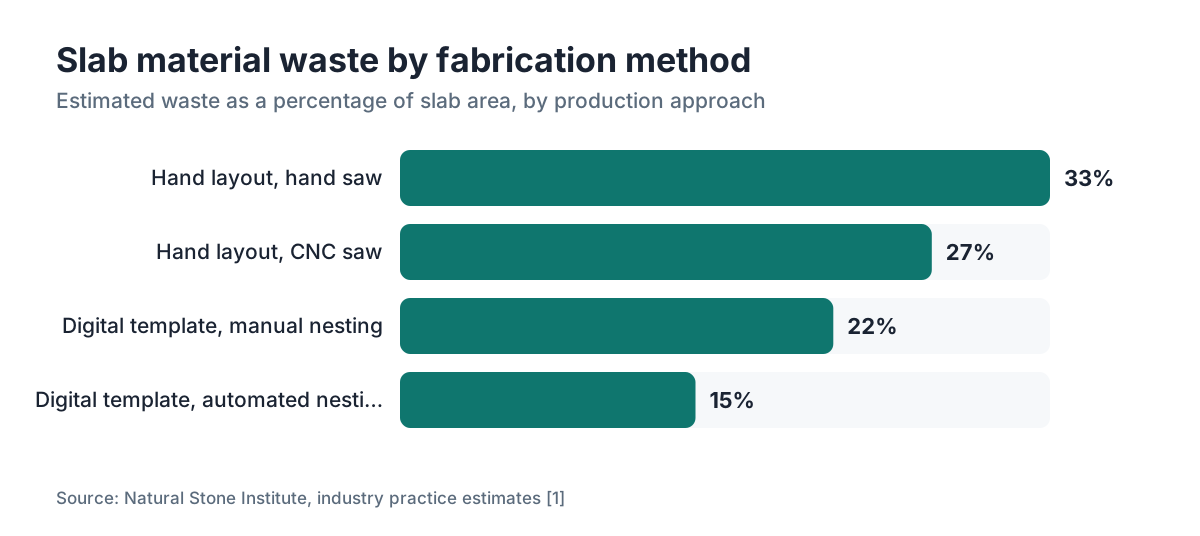
- Average shops waste 20-35% of a slab; optimized shops run 12-18% on the same material.
- The gap between good and great is mostly process discipline, not equipment budget.
What does 'next level' stone fabrication actually mean?
Most countertop shops can cut a straight piece of granite and polish an edge. That's the floor, not the ceiling. Next-level fabrication squeezes more precision, more yield, and more throughput out of every slab, while producing work that doesn't come back for callbacks.
The phrase gets thrown around loosely, so let's pin it down. At a baseline shop, a templater uses foam board or luan strips, transfers dimensions by hand, and a saw operator lays out cuts by eye. A next-level shop uses a laser or structured-light digital templater that captures a kitchen in under 20 minutes and sends a DXF file straight to a CNC waterjet or bridge saw with automatic optimization. No redrawing. No transfer error.
The difference shows up in three places: material yield (how much of an expensive slab you actually use), labor hours per job (which directly sets your margin), and rework rate (callbacks for bad fits, chips, or voids). The Natural Stone Institute puts average slab waste in the 20-35% range depending on shop practice [1]. Shops running optimized nesting software routinely report 12-18% waste on the same material.
For homeowners, this affects your price and your timeline. A fabricator burning 30% of a slab on waste has to price that loss into your quote. One running 15% waste can quote you cheaper or take on more jobs per week.
How does digital templating work, and is it worth the investment?
Digital templating replaces the luan-strip or foam-board method with a laser or structured-light scanner that maps an entire kitchen in one site visit. The device captures wall returns, appliance cutouts, sink locations, and corbel positions as a point cloud or vector file. That file goes straight into your CAD or fabrication software.
Two technologies dominate. Laser distance measurement systems (the Proliner from Prodim, or the Laser Products LT-2D3D) and photogrammetry-based systems. Proliner units run roughly $15,000 to $22,000 new. Photogrammetry tools like Slabsmith pair with shop photography to handle both templating and slab inventory [11].
Is it worth it? Run the numbers honestly. If a templater makes one costly transfer error per month on a $4,000 job, that's $48,000 a year in exposure. A $20,000 digital templater pays for itself in avoided remakes inside a year at that error rate, and it speeds each site visit by 30-40% over hand templating. For shops doing fewer than 15 jobs a month, the math is tighter. You might be better off with a clean analog workflow and a very experienced templater while you scale.
The hidden gain is file handoff. When the template is already a DXF or DWG, it flows into nesting software and CNC programs without a redraw step. That saves 20-45 minutes of shop labor per job. Over 200 jobs a year, that's real money.
What is slab nesting and why does it cut costs so dramatically?
Nesting arranges all the cut pieces for a job, or several jobs, on a slab to minimize waste before a single cut is made. Think of it like a puzzle. You have a fixed-size slab (say 115" x 65" for a standard granite bundle) and a set of countertop pieces with defined shapes. Nesting software finds the arrangement that uses the most slab area.
Manual nesting by an experienced fabricator is not bad. A skilled layout person gets within 5-8 percentage points of optimal. Automated nesting beats that consistently, especially on irregular pieces like L-shapes, curved islands, and pieces with angled walls. The gains compound when you nest remnants from multiple jobs together.
Here's a concrete example. A 3cm slab of Calacatta marble runs roughly $80-$140 per square foot at the yard, depending on source and grade [3]. Cut a 50-square-foot kitchen from a 60-square-foot slab with tight nesting versus an 80-square-foot slab from a sloppy layout, and the material difference is $1,600-$2,800, before you count slab handling labor.
For fabricators, nesting software often integrates with CNC post-processors, so the optimized layout feeds straight to the saw or waterjet. No re-entering cut dimensions. Shops running integrated nesting and CNC report throughput gains of 15-25% per machine shift [4].
For homeowners pricing a project, ask your fabricator whether they nest your pieces or run them one-off. A shop that nests is pricing you more accurately and wasting less of your slab.
CNC bridge saws vs. waterjets: which technology actually improves quality?
Both beat hand cutting for consistency, but they do different things well. A CNC bridge saw is your workhorse for straight cuts and volume. A waterjet is your specialist for curves and detail. Top shops run both.
A CNC bridge saw uses a diamond blade for straight cuts, miters, and notches. Modern 5-axis saws (Comandulli, Park Industries) cut compound angles for waterfall edges, apron fronts, and mitered sink cutouts in a single setup. They're fast on straight work and cheap per cut to run. A new 5-axis CNC bridge saw runs $150,000-$350,000 [4].
A waterjet cuts with a high-pressure stream of water and abrasive garnet, typically at 60,000-90,000 PSI. It cuts curves, complex shapes, and inlays with no heat-affected zone, which matters for tight-grain stones like quartzite where a blade can start micro-fractures along veining. Waterjets are slower and pricier to run (garnet alone costs $1.50-$2.50 per minute of cutting), but for detailed work there's no real alternative [4].
If you're a single-machine shop, a 5-axis CNC bridge saw covers 80-90% of residential work at lower operating cost. Add a waterjet when decorative and commercial work grows enough to justify it.
Edge quality from a CNC machine with proper tooling and feed rates beats hand-polished edges on complex profiles. The machine doesn't fatigue, doesn't vary pressure, and runs the same profile on piece 40 as it did on piece 1.
How do top fabricators handle edge profiles and surface finishing?
Edge profiles are where fabrication quality becomes visible to the homeowner. A poorly cut ogee or a lumpy bullnose is obvious the moment light hits it. CNC edge polishing machines (edge profilers) run a programmed profile automatically through a sequence of diamond tooling.
The variables that matter are tooling quality, feed rate, and coolant flow. Cheap tooling leaves chatter marks that show up under raking light. Feed the piece too fast and you get the same problem. Shops running quality tooling (Tenax, Braxton-Bragg, or equivalent) at the right feeds, with coolant flowing steadily, get edges that need almost no hand finishing [5].
Leathered, brushed, and honed finishes take more labor than a polish. Leathering (sometimes called brushing) runs textured diamond brushes across the surface to open the texture of stones like granite and quartzite, giving a matte finish that hides fingerprints better than polish. It takes 2-4 extra passes with progressively finer brushes. Some shops charge a 15-30% premium; others price it as a flat per-square-foot upcharge.
Finish quality also depends on the stone. Calacatta marble polishes beautifully but scratches easily, so a honed finish is often the smarter call for kitchens (see our guide to marble countertops for how finish affects durability). Quartzite varies enormously by origin. Some cuts like butter. Others fracture along crystal planes and demand slower tooling speeds.
For granite countertops, polished is the standard, and a well-run CNC edge machine produces work that's hard to tell from the best hand finishing, in a fraction of the time.
What shop workflow changes separate high-volume fabricators from average ones?
Equipment matters. Workflow discipline matters more. The best shops run close to a manufacturing cell: material moves one direction, each station has defined inputs and outputs, and nothing waits in a queue without a known time.
A few specific practices stand out.
Job packets at every machine. Each slab travels with a printed or digital packet showing the cut layout, edge profile, finish spec, and delivery date. The saw operator never has to ask the project manager what profile the customer wanted. The polisher never guesses which pieces are rush. This sounds obvious. Most shops don't do it consistently.
Real-time inventory tracking. Knowing where every remnant is, its size, color, and quantity, means you sell remnants instead of trashing them. Remnants in the 8-25 square foot range cover bathroom vanities and small bars. A shop doing 150 jobs a month might hold 30-50 saleable remnants at any time. At $200 each, that's $6,000-$10,000 a month sitting in the yard.
Standardized installation kits. Pre-kit every job's hardware, adhesives, seam setter, support brackets, and caulk before the truck leaves. Then installers don't improvise in the field. Field improvisation is where callbacks are born.
Software that connects quoting to production. When a quote gets approved, the job data (dimensions, material, edge, cutouts) should flow into production scheduling without being re-entered. Re-entry is where errors hide. Tools like SlabWise connect the quote directly to the shop floor, so the number the customer approved is the number the saw operator sees. Worth evaluating if your shop still runs quoting and production on separate systems.
For how installation quality depends on fabrication quality, the countertop installation guide covers what good field prep looks like on the receiving end.
How does material selection affect fabrication complexity and cost?
Not all stone fabricates the same. Porosity, crystal structure, vein direction, and thickness all change how a slab machines, polishes, and installs. The U.S. dimension stone industry works granite, marble, quartzite, sandstone, and limestone, and each one behaves differently on the saw [10].
Granite is the workhorse. Most granite cuts clean, polishes reliably, and has low porosity variance. Fabrication is predictable. Exotic granites with big crystals (Blue Bahia, some Brazilian golds) can fracture along crystal boundaries if feed rates get too aggressive.
Quartzite is harder and more variable. Some (White Macaubas) machines close to granite. Others (Taj Mahal, Sea Pearl) have distinct cleavage planes that delaminate under bad handling. You need templaters who know how to orient pieces relative to slab vein direction. See the guide on how to clean quartzite countertops for how finish choice affects long-term care.
Marble is soft (Mohs 3-4) and wants slow speeds and sharp tooling. Dull blades chip marble far more than they chip granite. Marble also telegraphs seams through its translucent veining, so seam placement has to be deliberate.
Porcelain and sintered stone (Dekton, Neolith) are increasingly common and genuinely hard to fabricate. They're brittle, and blade selection is make-or-break. Porcelain-specific diamond blades and low feed rates are non-negotiable. Waterjets work well but cost a lot per linear foot on these materials.
Soapstone is soft and easy to cut but finishes differently. It's usually left natural or oiled rather than polished. The guide on how to clean soapstone countertops explains why finish choice drives maintenance.
Your material mix decides what tooling you need, what training matters, and where your error risk is highest.
What does quality control look like in a top fabrication shop?
Quality control in stone fabrication isn't complicated. It's discipline. The best shops build checkpoints into the flow instead of inspecting only at the end.
At templating: verify template dimensions against field notes before leaving the site. Digital templaters flag anomalies automatically. Analog templating needs a second-person dimension check.
At cutting: after CNC, physically check piece dimensions against the template file. A 1/16" error in a 120" run is fine. A 1/4" error is a problem. Shops that skip this check find out during installation, which is a far more expensive place to discover it.
At edging and polishing: visual check under raking light for chatter, chips, or profile breaks. A $20 LED work light at the polishing station catches 90% of issues.
At seam inspection: the Natural Stone Institute fabrication guidance treats seams within 1/32" of flush as the target, and any height difference over 1/16" is noticeable to the hand [9]. Fix it in-shop, not at the jobsite.
At crating and loading: load pieces vertically, never flat, padded at every contact point. Slab fractures in transit almost always come from flat loading or thin padding. Basic, and a common source of remakes.
One more thing every top shop does: run wet cutting and local exhaust ventilation to control silica dust. OSHA's silica standard (29 CFR 1910.1053) requires engineering controls, and its guidance states that "engineering and work practice controls are the primary means of protecting workers" [6]. NIOSH ties occupational silica exposure in stone cutting directly to silicosis and lung disease [7]. A shop that runs dry with no dust capture is cutting corners you can't see in the countertop but will see in worker health.
Shops that track callback and remake rate by job type and material get real data on where their process fails. Nobody publishes an industry-wide remake rate (the Natural Stone Institute doesn't put out that figure), but fabricators I've spoken with quote typical rework rates of 2-5% of jobs. Best-in-class shops report under 1%.
How do fabricators price next-level work without leaving money on the table?
Precision fabrication costs more to deliver, and your pricing has to reflect it. Most shops have the same problem: a quoting system built for a simpler operation that doesn't capture the real cost of complex jobs.
A few things drive quoting accuracy at high-performing shops.
Actual measured square footage, not guessed. Digital templating gives you exact piece dimensions. Your quote should ride on those, not on a rough field sketch. A job quoted on rough dimensions and fabricated from precise ones often eats 5-10% in uncaptured material.
Edge profile pricing that reflects machine time. A standard eased edge and a double ogee don't take the same time or tooling wear. Shops that charge one flat per-linear-foot rate regardless of profile give away money on decorative work.
Cutout pricing that reflects complexity. A single undermount sink cutout takes maybe 15 minutes on a CNC. A farmhouse sink with a notched apron, plus a cooktop and a built-in soap dispenser, is a different job. Charge accordingly.
Material uplift for difficult stones. Porcelain, some quartzites, and ultra-thin 6mm slabs warrant a fabrication premium of 15-25% over standard granite because tooling wears faster and error risk climbs.
For homeowners comparing quotes, a higher number from a shop with digital templating and CNC production is often a better deal than a lower number from a hand-cut shop. The precision difference shows up in the final install. The kitchen countertops guide covers how to read quotes across shop types.
Shops using integrated quoting software that pulls from actual template dimensions (instead of re-entered estimates) close this gap automatically. SlabWise builds that link between quote and shop floor into its workflow, which is why fabricators running complex projects find it worth a look.
What equipment investments give the best return for a growing fabrication shop?
If you're prioritizing capital purchases, here's an honest ranking by return for a shop doing 60-150 jobs per month.
First priority: digital templating. The labor savings and error reduction pay back a $15,000-$22,000 investment faster than almost any other single purchase. It also speeds site visits, which creates capacity.
Second priority: CNC bridge saw with basic 3-axis capability. Moving from a hand-operated bridge saw to a CNC removes operator variability on straight cuts and improves throughput hard. Entry-level CNC bridge saws start around $80,000-$120,000. Expect $150,000-$250,000 for reliable production-grade equipment [4].
Third priority: nesting and production software. Costs are low next to hardware ($3,000-$12,000 a year for most shop management platforms), but the workflow gains compound over every job you run. This gets underinvested because it's not a machine you can walk around.
Fourth priority: CNC edge profiler. Past 100 jobs a month, a dedicated edge machine frees your bridge saw for cutting and tightens edge consistency. Expect $60,000-$150,000 for a quality unit.
Fifth priority: waterjet. High to buy, high to run, but required for decorative work, curves, and inlays. Justify it when decorative and commercial work hits 20%+ of revenue.
For smaller or newer shops, the order shifts. A 20-job-a-month shop gets more from better software and a cleaner layout workflow before any hardware.
| Equipment | Typical Cost | Primary Benefit | Best For |
|---|---|---|---|
| Digital templater | $15,000-$22,000 | Error reduction, speed | All shops |
| CNC bridge saw (3-axis) | $80,000-$250,000 | Consistency, throughput | 40+ jobs/month |
| CNC edge profiler | $60,000-$150,000 | Edge quality, saw capacity | 80+ jobs/month |
| Waterjet | $120,000-$300,000 | Complex shapes, curves | Decorative/commercial focus |
| Shop management software | $3,000-$12,000/yr | Workflow, yield, quoting | All shops |
How does fabrication quality affect long-term countertop performance?
Fabrication quality is about more than how the counter looks on install day. It sets how the countertop performs over 15 to 30 years of daily use.
Seam quality is the biggest long-term variable. A seam with a gap, even a small one, collects water, food debris, and bacteria. In natural stone, repeated moisture at a seam causes staining or, in softer stones, structural weakening over time. A tight, properly rodded seam (stone-to-stone contact, color-matched epoxy, fully cured) is effectively permanent.
Edge finish quality affects chip resistance. A well-polished edge with no tooling micro-fractures resists impact chipping better than an edge with surface damage that creates stress points. This holds especially for harder, more brittle materials like quartzite and porcelain.
Flatness matters for appliance integration. A countertop that crowns or warps (from bad support, or from thin slabs unsupported over long spans) fights with slide-in ranges, undermount cooktops, and built-in appliances. Fabricators running 3cm stone over unsupported spans past 24" should build in support at the cabinet level.
Proper sealing at fabrication, or at least clear customer guidance on sealing, stretches maintenance intervals. The guide on how to clean stone countertops covers what each stone type actually needs.
Do the math on the upgrade. A $200 bump in fabrication quality on a job that lasts 25 years costs $8 a year. It's rarely the wrong call.
Frequently asked questions
What is the difference between a standard fabrication shop and a next-level one?
The practical difference is technology integration and process discipline. A standard shop uses hand templates, manual saw layout, and hand-finished edges. A next-level shop uses digital templating, CNC cutting with automated nesting, and CNC edge profiling. The result is lower material waste (typically 12-18% versus 20-35%), faster turnaround, and more consistent quality across every job.
How much does a CNC bridge saw actually cost, and do smaller shops need one?
Entry-level CNC bridge saws start around $80,000-$120,000. Production-grade 5-axis units run $150,000-$350,000. Smaller shops doing under 40 jobs per month often get better return from digital templating and nesting software first. A CNC bridge saw makes the most sense when a shop is constrained by cutting throughput or consistency, more than looking to modernize.
What is slab nesting software and how does it reduce waste?
Nesting software arranges all the cut pieces for a job on a digital representation of the slab before any cutting begins. It finds the layout that uses the most slab area, beating manual layout by 5-8 percentage points. On expensive stone at $80-$140 per square foot, that waste reduction translates directly to material savings of hundreds of dollars per job.
Is waterjet cutting worth the cost for a residential fabrication shop?
Only if your job mix includes significant decorative work, complex curves, inlays, or medallions. Waterjets cost $120,000-$300,000 to buy and $1.50-$2.50 per minute in abrasive alone to run. For standard residential work (straight cuts, undermount sinks, eased edges), a CNC bridge saw covers nearly everything at lower operating cost. Add a waterjet when decorative and commercial work hits 20%+ of revenue.
How long does digital templating take compared to traditional methods?
Digital templating typically takes 15-25 minutes for an average kitchen versus 45-75 minutes for careful hand templating. The bigger gain is accuracy and file transfer: a digital file goes directly to CNC software with no redrawing, saving another 20-45 minutes of shop labor per job. That adds up to hundreds of hours a year for a busy shop.
What materials are hardest to fabricate and why do they cost more?
Porcelain and sintered stone (Dekton, Neolith) are the most demanding. They're brittle and need specialized blades, low feed rates, and careful handling. Some quartzites with distinct cleavage planes also require experienced handling to avoid delamination. These materials typically warrant a 15-25% fabrication premium over standard granite because tooling wears faster and error risk is higher.
How does a homeowner tell if a fabricator does quality work before hiring them?
Ask specifically about their templating method (digital or hand), whether they use CNC cutting, and what their remake or callback rate is. Ask to see a finished seam on a sample or in their showroom under raking light. A shop that answers these confidently and shows physical examples is doing things right. Vague answers about 'experience' with no specifics are a warning sign.
What causes seams to look bad in stone countertops?
Bad seams come from a few sources: inaccurate templating that leaves a gap, mismatched material thickness that creates a height difference, poor epoxy color matching, or bad seam placement (across a sink cutout, for example). A tight seam from a precision digital template, set with color-matched epoxy and a seam setter, should be nearly invisible at normal viewing distance.
Should fabricators invest in software or hardware first?
Software first, usually. A digital templater ($15,000-$22,000) and shop management software ($3,000-$12,000 per year) pay back faster than any cutting machine because they reduce errors and save labor on every single job. Hardware makes sense after software has your workflow tight. Otherwise you're just running a faster version of a disorganized process.
How does fabrication shop efficiency affect what homeowners pay?
Directly. A shop burning 30% of a slab on waste prices that loss into every quote. A shop running 15% waste on the same material can be meaningfully cheaper or can offer better service. Digital nesting and CNC cutting reduce both material waste and labor hours per job, which is why well-equipped shops are sometimes more competitive than low-overhead hand-cut operations.
What edge profiles require CNC to do well?
Complex profiles (double ogee, triple waterfall, dupont, and multi-step stacked profiles) are hard to produce consistently by hand. Hand-finishing a double ogee takes 30-45 minutes and varies between pieces. A CNC edge machine runs the same profile in 8-12 minutes with consistency across every linear foot. For simple profiles like eased or beveled edges, experienced hand work is nearly equivalent.
What is a leathered or brushed stone finish and how is it done?
Leathering (also called brushing) uses textured diamond brushes to abrade the polished surface, creating a matte, slightly tactile finish that hides fingerprints and water spots better than a high polish. It takes 2-4 extra machine passes with progressively finer brushes. Most shops charge a 15-30% premium. It works best on granite and harder quartzites. Softer stones don't hold the texture as well.
How does slab thickness affect fabrication and installation?
Standard residential countertops use 3cm (roughly 1.25") slabs. Thinner 2cm slabs need a laminated edge to look substantial and require more cabinet support to prevent cracking over unsupported spans. Ultra-thin 6mm porcelain and sintered slabs are increasingly common for wall and furniture applications but are fragile to cut and need specialized handling. For kitchen countertops, 3cm is the practical standard for a reason.
Can fabrication technology help with unusual countertop shapes like curves and waterfall edges?
Yes, and it's one of the clearest wins for CNC. A CNC waterjet cuts accurate curves that would take hours by hand with inconsistent results. A 5-axis CNC bridge saw cuts the precise compound miter a waterfall edge needs so both faces meet cleanly. These details push a project from competent to exceptional, and they're reliably achievable only with the right equipment.
Sources
- Natural Stone Institute, Stone Industry Education: Average slab waste in stone fabrication ranges from 20-35% depending on shop practice
- USGS, National Minerals Information Center, Dimension Stone: Dimension stone (marble, granite) retail slab pricing ranges from $80-$140 per square foot for premium imported material
- Park Industries, CNC Bridge Saw and Waterjet product specifications: Production-grade CNC bridge saws cost $150,000-$350,000; waterjets $120,000-$300,000; shops using integrated CNC and nesting report 15-25% throughput gains per machine shift
- Braxton-Bragg, Diamond Tooling and Abrasives catalog: Tooling quality and feed rate are primary variables in edge chatter; quality diamond tooling brands for stone fabrication include Tenax and Braxton-Bragg
- OSHA, Crystalline Silica standard (29 CFR 1910.1053): Stone fabrication generates crystalline silica dust; OSHA's silica standard requires engineering controls including wet cutting and local exhaust ventilation, and states engineering and work practice controls are the primary means of protecting workers
- NIOSH / CDC, Silica occupational exposure health effects: Occupational silica exposure in stone cutting is associated with silicosis and lung disease; engineering controls are the primary mitigation
- Natural Stone Institute, ANSI/NSI 373 Sustainable Production of Natural Dimension Stone: ANSI/NSI 373 is the sustainability certification standard for natural stone production and fabrication shops
- Natural Stone Institute, Dimension Stone Design Manual / fabrication guidance: Seam height tolerance best practice is within 1/32 inch of flush; height differences over 1/16 inch are noticeable to the hand
- USGS, National Minerals Information Center, Stone (Dimension): The U.S. dimension stone industry produces and processes granite, marble, quartzite, sandstone, and limestone for construction and decorative use
- Slabsmith, Digital Slab Inventory and Photogrammetry System: Slabsmith combines photogrammetry-based slab photography with templating integration for shop inventory and job layout
Last updated 2026-07-10