TL;DR
- Engineered quartz countertops are 90 to 95% ground natural quartz crystals bound with polymer resin and pigment.
- They cost roughly $50, $150 per square foot installed, resist stains and etching better than marble, and need no sealing.
- They are not the same as quartzite, which is a natural metamorphic stone.
- Heat resistance is the main weakness.
What is natural quartz in a countertop, exactly?
The phrase "natural quartz countertop" trips people up constantly, so let's be precise. Quartz countertops (sold under brand names like Silestone, Caesarstone, and Cambria) are engineered slabs. They contain 90 to 95% ground quartz crystals by weight, which is genuinely natural mineral content, but the final product is manufactured. Quartz crystals are crushed, mixed with polyester or epoxy resin (roughly 5 to 10% of the mix), pigments, and sometimes recycled glass or mirror chips, then compressed under vacuum and cured. The result is a non-porous, consistent slab [1].
Quartz crystals themselves rank 7 on the Mohs hardness scale, making them harder than most kitchen knives and resistant to scratching under normal use. The resin binder is what gives engineered quartz its non-porous quality, which is the single biggest practical advantage over granite or marble.
Where the confusion comes in: some retailers and even some contractors call it "natural quartz" to emphasize the mineral origin and distinguish it from fully synthetic surfaces like Corian or laminate. That usage is technically defensible but misleading because the slab itself is manufactured. If you see a countertop described as 100% natural quartz with no further processing, that is quartzite, not engineered quartz. Those are different materials with different maintenance needs. More on that below.
How is engineered quartz different from quartzite?
This is the most common mix-up in the countertop category, and it costs homeowners real money when they buy one expecting the properties of the other.
Engineered quartz is a manufactured product. Quartzite is a natural metamorphic rock formed when sandstone undergoes heat and pressure deep in the earth. Both contain quartz mineral, but quartzite is a mined slab that gets cut and polished like granite, while engineered quartz is a factory-made composite.
The practical differences matter a lot:
| Property | Engineered Quartz | Quartzite |
|---|---|---|
| Porosity | Non-porous (resin sealed) | Porous, needs sealing |
| Sealing required | No | Yes, 1 to 2x per year |
| Heat resistance | Low (resin discolors ~150°C) | High |
| Etching from acid | Resistant | Possible on some slabs |
| Pattern variation | Consistent/repeatable | Unique per slab |
| Installed cost range | $50, $150/sq ft | $60, $200/sq ft |
| Outdoor use | Not recommended | Fine with proper care |
Quartzite also gets confused with marble because some quartzite slabs have similar veining. If you are buying a white veined slab from a yard and want to confirm what you have, put a drop of muriatic acid on an inconspicuous spot: marble etches immediately, quartzite does not [2]. Engineered quartz is obviously manufactured and comes in labeled sheets.
For day-to-day cleaning guidance on quartzite once it is installed, how to clean quartzite countertops covers the specifics.
How much do quartz countertops cost in 2025?
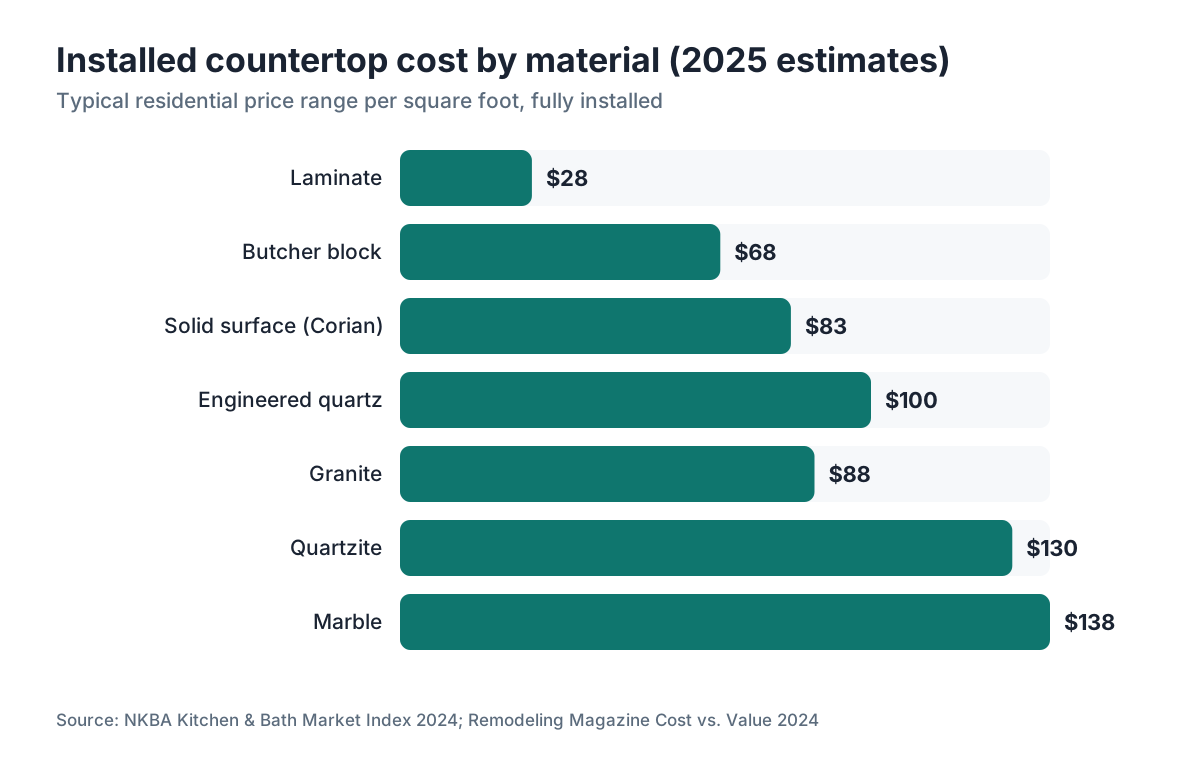
Installed cost runs from about $50 to $150 per square foot for most residential projects in 2025. That range is wide because it folds in material tier, edge profile, cutouts, and regional labor. Breaking it down:
Material tier alone (slab cost, not installed):
- Entry-level (solid colors, basic patterns): $25, $50/sq ft
- Mid-range (complex veining, brand-name products): $50, $80/sq ft
- Premium and designer collections: $80, $120/sq ft or more
What gets added at fabrication:
- Fabrication labor (cutting, polishing): $10, $30/sq ft depending on shop rates and complexity
- Edge profiles: simple eased edge is often included; waterfall, ogee, or laminated edges add $15, $50 per linear foot
- Sink cutout: $100, $200 per opening
- Cooktop cutout: $75, $150
- Seam work: $50, $150 per seam depending on visibility and complexity
- Removal of old countertops: $200, $500 flat
- Delivery and installation: often bundled into the per-square-foot fabrication price but verify this
A typical kitchen with 40 square feet of countertop, one undermount sink cutout, and a simple eased edge runs $2,500, $4,500 installed at mid-range material. High-end kitchens with large islands and decorative edges can easily hit $8,000, $12,000 [3].
Labor rates vary significantly by region. Shops in coastal metro areas charge more than Midwest or rural shops. Getting three quotes from local fabricators is genuinely useful because material markup and labor rates vary enough that one shop can be 30% higher than another for the same slab.
If you are a fabricator reading this and want to tighten up your own quoting process, SlabWise's quoting tool handles material waste, edge pricing, and cutout charges automatically, which reduces the manual math that leads to under-quoting.
What are the real advantages of quartz countertops?
The non-porous surface is the headline benefit and it is genuine. Bacteria, wine, coffee, and cooking oils cannot penetrate the surface the way they can with unsealed granite or marble. The NSF International certification process for food-contact surfaces recognizes this property, which is why quartz appears frequently in commercial kitchen specs [4].
No sealing, ever. With granite you should reseal every one to three years depending on porosity. Marble needs sealing and still etches from acidic foods. Engineered quartz skips that maintenance entirely because the resin binder fills every pore during manufacturing.
Consistency of appearance is a big deal for remodelers who need a specific look. Natural stone slabs vary slab-to-slab, which means matching an island to a perimeter counter requires careful slab selection. Quartz patterns are reproduced consistently across production runs (especially solid colors and simple patterns), so matching is easier.
Scratching resistance is good for day-to-day use. At Mohs 7, the quartz crystals resist most knives (steel runs Mohs 5 to 6.5). You can still scratch it with a ceramic knife or diamond, but normal kitchen use is fine. That said, using a cutting board is still the right call, because the knife edge suffers even when the surface does not.
Longevity. A properly installed quartz countertop should last 25+ years without significant maintenance beyond cleaning. That is comparable to granite and better than laminate or solid surface [5].
What are the real disadvantages of quartz countertops?
Heat is the primary weakness and it is significant. The polymer resin that makes quartz non-porous begins to discolor and can delaminate at temperatures around 150°C (300°F), which is well within the range of a hot pan pulled directly from the oven or a cast iron skillet off the stove [6]. Unlike granite or quartzite, the damage is often permanent and visible: yellowing, cracking, or a white ghosted ring. Always use trivets. No exceptions.
UV exposure degrades the resin over time, which is why quartz manufacturers universally recommend against outdoor installation. Color fading and resin breakdown are documented problems in outdoor kitchens. If you are building an outdoor kitchen, quartzite, granite, or porcelain are better choices.
Repair is difficult. Because the patterning runs only through the thickness of the slab and the resin is integral to the structure, deep chips or cracks are hard to fix invisibly. Granite chips can sometimes be filled with a color-matched epoxy that blends. Quartz repairs tend to be more visible because the manufactured pattern is harder to replicate on-site.
The environmental picture is mixed. Mining quartz and manufacturing resin are energy-intensive. Some brands have made progress on recycled content and low-VOC resins, but calling engineered quartz an "eco" product requires scrutiny of specific brand claims rather than the category as a whole.
For comparison with a natural stone option, granite countertops covers how that material handles heat, sealing, and long-term costs differently.
How does quartz compare to marble, granite, and laminate?
Here is a direct comparison across the most common alternatives:
| Material | Sealing | Heat Resist. | Acid Resist. | Scratch Resist. | Installed Cost |
|---|---|---|---|---|---|
| Engineered quartz | None needed | Poor | Good | Good | $50, $150/sq ft |
| Granite | Annual | Excellent | Good | Excellent | $45, $130/sq ft |
| Marble | Annual | Good | Poor (etches) | Fair | $75, $200/sq ft |
| Quartzite | Annual | Excellent | Good | Excellent | $60, $200/sq ft |
| Laminate | None | Poor | Good | Fair | $15, $40/sq ft |
| Butcher block | Oiling | Poor | Good | Fair | $35, $100/sq ft |
| Solid surface (Corian) | None | Poor | Good | Fair | $45, $120/sq ft |
Granite is probably quartz's closest real competitor. Granite is harder, handles heat better, and has a natural depth of pattern that engineered products have not fully replicated. The trade-off is that granite needs sealing and every slab is unique, which complicates matching. Marble countertops are a separate decision tree entirely because of the etching issue.
Laminate has made a real comeback and the gap in appearance has narrowed. At $15, $40 per square foot installed, a quality laminate is hard to beat purely on budget. Laminate countertops cover those options in detail.
Corian countertops and other solid surface options compete directly with quartz on low maintenance but are softer and more vulnerable to scratching, though they can be sanded and repaired more easily.
What quartz brands are actually worth buying?
The quartz countertop market has consolidated around a handful of major manufacturers, but there are also many smaller brands importing slabs from Asia at lower price points. Quality varies.
Caesarstone (Israel-based, with U.S. manufacturing) was one of the early market leaders and still has a strong reputation for consistency and warranty support. Their warranty is 25 years for residential use [7].
Silestone (by Cosentino, Spain) is the largest quartz brand by volume. They have a wide color range and have invested in low-VOC manufacturing. Their HybriQ technology uses recycled water and renewable energy in production, though the environmental claims should be evaluated against their published sustainability reports rather than taken at face value.
Cambria countertops are manufactured in the U.S. (Le Sueur, Minnesota), which is a genuine differentiator for buyers who want domestic production. Cambria sells only through authorized dealers, which limits price shopping but also means more consistent installation quality.
MSI, Vicostone, and Vadara are mid-market options that offer lower prices but with more variable quality control. For a kitchen that needs a tight budget and straightforward patterns, these work fine. For a large luxury project where color consistency across multiple slabs is critical, sticking with a tier-one brand is worth the premium.
Buyer's practical note: the brand matters less than the specific production run for complex patterns with heavy veining. Always view the actual slabs you are buying, more than a sample chip. Color and pattern variation between production lots can be significant even within the same SKU.
How do you clean and maintain quartz countertops?
Daily cleaning is simple. Warm water and a few drops of dish soap on a soft cloth handles almost everything. Rinse and dry to avoid water spots, especially if you have hard water.
For stuck-on food, a plastic scraper works without scratching. Avoid steel wool or abrasive pads.
For tougher stains like dried wine or coffee, a damp cloth with a small amount of isopropyl alcohol works well. Most quartz manufacturers explicitly approve isopropyl alcohol at concentrations up to 70% for spot cleaning [8].
What to avoid:
- Bleach at full concentration: can discolor the resin over time
- Oven cleaner or drain cleaner: highly alkaline, will degrade the resin
- Acetone (nail polish remover): avoid extended contact, it can cloud the surface
- Abrasive powders like Bar Keepers Friend: these are formulated for stainless steel and will scratch quartz
There is no sealing, polishing, or annual maintenance treatment needed. If someone sells you a "quartz sealer" it is unnecessary. The resin binder is already the sealant, built into the slab.
For the broader category of cleaning stone surfaces properly, how to clean stone countertops is a good reference.
Does quartz add value to a home?
The honest answer is: moderately, but the data is imprecise. Remodeling Magazine's Cost vs. Value report consistently shows that a minor kitchen remodel recoups roughly 85 to 96% of its cost at resale, while a major kitchen remodel recoups around 38 to 65% depending on the year and market [9]. Those figures cover the whole kitchen, more than countertops.
Quartz specifically is viewed favorably by buyers because it reads as low-maintenance and high-end. In a buyer's mind, "no sealing required" is a tangible benefit. Real estate agents frequently cite updated countertops as a selling point, but isolating the ROI of the countertop material alone is not something the existing data can do cleanly.
The practical frame: if you are staying in the house for 5+ years, the daily comfort and low maintenance of a quality quartz countertop justifies the cost on its own terms. If you are remodeling to sell, quartz at mid-range pricing ($60, $80/sq ft installed) is a safe choice that will read well to buyers without over-improving for the neighborhood. Installing a $200/sq ft exotic quartz in a house where comps are $350,000 is over-improving and you will not recover the spend.
For a broader look at how countertop material choice fits into kitchen remodeling decisions, kitchen countertops covers the full landscape.
What should you ask a fabricator before buying quartz?
The fabricator relationship matters as much as the brand choice. A mediocre fabricator with a good slab will produce a worse result than a skilled fabricator with a mid-tier slab. Here are the questions worth asking:
About the slab:
- Can I see the actual slabs I am buying, laid out, before you cut? (Always say yes to this.)
- Are these slabs from the same production lot? (Critical for multi-slab projects.)
- What is the slab thickness? (Most residential quartz is 3 cm; 2 cm exists and is cheaper but weaker.)
About fabrication:
- How are seams placed and finished? (Ask to see a seam sample on quartz, more than photos.)
- What is included in the quoted price? (Clarify whether removal, haul-away, and sink cutouts are included.)
- What is your lead time from template to install? (Two to three weeks is typical; faster is possible but verify.)
About the warranty:
- Is the warranty from the slab manufacturer or from your shop? (Both should exist; know who covers what.)
- What voids the manufacturer warranty? (Heat damage and outdoor use are the most common exclusions.)
For fabricators who want to deliver accurate quotes upfront without the back-and-forth, SlabWise handles material waste calculation, edge pricing, and cutout fees in a single quote so customers see the real number before the template appointment. More at slabwise.com.
For the full installation process from template through final trim, countertop installation has a step-by-step breakdown.
Are there health or safety concerns with quartz countertops?
Two legitimate topics come up here: silica dust during fabrication and VOCs in the resin.
Silica dust is a serious occupational hazard for fabricators who cut and grind engineered stone. The quartz content is high enough that dry cutting without respiratory protection carries real risk of silicosis, a permanent and progressive lung disease. OSHA's permissible exposure limit for respirable crystalline silica is 50 micrograms per cubic meter as an 8-hour TWA, a standard that was tightened in OSHA's 2016 silica rule update [10]. Wet cutting, vacuum dust collection, and proper respirators are required, not optional. Several countries have banned or restricted dry cutting of engineered stone entirely.
For homeowners with installed countertops, the silica risk is not a concern. The resin binder encapsulates the quartz particles completely, and normal use does not release dust.
VOCs from resin: during manufacturing, polyester resins off-gas styrene and other VOCs. By the time slabs arrive at a fabrication shop and are installed, curing is complete and off-gassing is negligible. The EPA's indoor air quality guidance does not flag installed quartz countertops as a VOC concern for residential use [11]. Some brands use epoxy resins rather than polyester, which have lower styrene content during manufacturing, but this is a manufacturing-environment concern, not a homeowner-use concern.
Frequently asked questions
Is quartz the same as quartzite?
No. Engineered quartz is a manufactured product made of 90 to 95% ground quartz crystals bound with polymer resin. Quartzite is a natural metamorphic rock mined and cut into slabs, similar to granite. Quartzite is porous and needs sealing; engineered quartz does not. Both contain quartz mineral, but they behave very differently in daily use. Confusing them when buying is a costly mistake.
Does quartz need to be sealed?
No. The polymer resin binder fills all pores during manufacturing, making the slab non-porous from the start. There is no sealing schedule, no annual treatment, and no sealer product you need. If a contractor or retailer suggests a quartz sealer, it is unnecessary and you can skip it. This is one of quartz's genuine advantages over granite and marble.
Can you put hot pans on quartz countertops?
You should not. The polymer resin starts to discolor and can crack at around 150°C (300°F), which is within the range of a pan pulled from a hot oven. Damage is often permanent. Always use a trivet or hot pad. This is the most common cause of warranty voids and the one heat-related complaint that comes up consistently in fabricator forums.
How long do quartz countertops last?
A properly installed quartz countertop should last 25+ years under normal residential use. Most major brands offer a 25-year residential warranty (Caesarstone, for example). The surface does not require sealing or polishing to maintain its integrity. Heat damage and impact cracks are the most common failure modes, not natural wear.
What is the average cost to install quartz countertops?
Installed cost runs $50, $150 per square foot for most residential projects in 2025. A typical kitchen with 40 square feet, one sink cutout, and a simple edge comes to roughly $2,500, $4,500 at mid-range pricing. Complex edges, large islands, and premium brand slabs push costs toward the top of the range. Get at least three local fabricator quotes, as prices vary significantly by region and shop.
Can quartz countertops be used outdoors?
No, and manufacturers explicitly exclude outdoor use from their warranties. UV exposure degrades the polymer resin over time, causing color fading and potential structural weakening. For outdoor kitchens, granite, quartzite, or porcelain tile are the standard recommendations. Even covered outdoor installations with reflected UV are typically excluded by manufacturer warranty language.
What is the best thickness for a quartz countertop?
3 cm (about 1.2 inches) is the residential standard and the right choice for most kitchens. It is strong enough to span cabinet openings without additional support and has a substantial look at the edge. 2 cm slabs exist and cost less, but they need a plywood substrate for support and look thinner at the edge profile. For islands or counters with an overhang over 12 inches, 3 cm is strongly preferred.
Does quartz scratch easily?
Not from typical kitchen use. The quartz mineral rates 7 on the Mohs scale, harder than standard steel knives (which run Mohs 5 to 6.5). Ceramic knives and diamond tools can scratch it. Under normal cooking conditions, scratching is not a common problem. That said, using a cutting board protects both the surface and your knife edge, which dulls faster on hard stone than on wood or plastic.
What colors and patterns are available in quartz?
The range is very wide. Solid whites, grays, and blacks are the most popular. Engineered quartz can closely mimic marble veining, concrete, and even exotic granite patterns. Unlike natural stone, patterns are reproduced consistently across production runs, which makes matching multiple slabs easier. The limitation is that engineered veining looks different from the real thing under certain lighting, particularly the sense of depth you get in natural stone.
Is quartz better than granite for a kitchen?
It depends on your priorities. Quartz wins on low maintenance: no sealing, better stain resistance, consistent patterning. Granite wins on heat resistance, natural variation and depth of pattern, and outdoor suitability. Both last equally long with proper care. For a household that wants to set hot pans directly on the surface or loves the organic look of natural stone, granite is the better fit. For low-maintenance simplicity, quartz has the edge.
Can you repair a chipped quartz countertop?
Yes, but repairs are more visible than on granite. Fabricators use color-matched epoxy or acrylic fillers, and the result is functional but usually noticeable on close inspection because the manufactured pattern is hard to replicate on-site. Chips at sink cutouts and corners are the most common repair location. Prevention, meaning avoiding heavy impact at edges, is more practical than relying on invisible repair.
Are there health concerns with quartz countertops in the home?
For installed countertops, no meaningful health risk exists. The resin encapsulates the quartz particles and off-gassing from the cured resin is negligible. The significant health concern in the quartz industry is silica dust exposure for fabricators during cutting and grinding, which requires wet cutting and respiratory protection per OSHA regulations. Homeowners living with installed quartz are not exposed to respirable silica.
How do I choose between quartz and solid surface like Corian?
Quartz is harder and more scratch-resistant. Solid surface (Corian and similar products) is softer but can be sanded and repaired without a visible line, which matters if you nick a corner or burn a spot. Solid surface also allows fully integrated sinks with no visible joint. Quartz wins on stain resistance and perceived premium look. Solid surface wins on repairability and integrated sink options. Costs overlap: both run roughly $45, $120 per square foot installed.
Sources
- USGS Minerals Information: Quartz Crystal: Quartz crystals rank 7 on the Mohs hardness scale and are a primary component of engineered stone products
- USGS Open-File Report: Identification of Stone: Acid test distinguishes quartzite from marble: marble etches from dilute acid, quartzite does not
- National Kitchen and Bath Association (NKBA), Kitchen & Bath Market Index 2024: Installed quartz countertop costs for typical kitchens ranging $50, $150 per square foot
- NSF International, NSF/ANSI 51 Food Equipment Materials: Non-porous surfaces are recognized under food equipment material standards for commercial and residential food contact use
- Remodeling Magazine, Cost vs. Value Report 2024: Quality countertop surfaces including quartz expected to last 25+ years under normal residential use
- Caesarstone USA, Product Care and Maintenance Guide: Quartz surfaces can discolor and crack when exposed to temperatures around 150°C (300°F); trivets required
- Caesarstone USA, Residential Warranty Terms: Caesarstone offers a 25-year limited warranty for residential quartz countertop installations
- Silestone by Cosentino, Care and Maintenance Instructions: Isopropyl alcohol up to 70% concentration approved for spot cleaning quartz surfaces per manufacturer guidance
- Remodeling Magazine, 2024 Cost vs. Value Report: Kitchen Remodel: Minor kitchen remodel recoups roughly 85 to 96% of cost at resale; major kitchen remodel recoups 38 to 65%
- OSHA, Occupational Exposure to Respirable Crystalline Silica (29 CFR 1910.1053): OSHA permissible exposure limit for respirable crystalline silica is 50 micrograms per cubic meter as an 8-hour TWA, per the 2016 silica rule
- EPA, Indoor Air Quality: An Introduction for Health Professionals: EPA indoor air quality guidance does not flag installed cured-resin quartz countertops as a VOC concern for residential use
Last updated 2026-07-10