TL;DR
- Modern kitchen countertops run about $20 to $250 per square foot installed, depending on material.
- Quartz wins most remodels for low maintenance.
- Natural stone (marble, granite, quartzite) wins on looks.
- Laminate and butcher block win budget builds.
- The right pick depends on how you cook, what you'll spend, and how much sealing you'll do each year.
What makes a countertop 'modern' in a kitchen?
Modern is a slippery word. In design shorthand it usually means flat-front cabinetry, minimal ornamentation, and surfaces that feel deliberate rather than fussy. In the countertop trade, modern really just means the materials and edge profiles fabricators sell and install right now, as opposed to the tile counters and ceramic-on-drywall setups common in homes built before the 1990s.
The materials dominating remodel jobs are engineered quartz, natural marble, granite, quartzite, porcelain slabs, butcher block, concrete, and high-pressure laminate. Solid surface (Corian-type products) never fully went away. Each one has a different cost floor, a different maintenance requirement, and a different tolerance for heat, acids, and impact.
Edge profiles shifted over the last decade toward eased edges (a subtle 1/8-inch bevel), mitered waterfall edges, and thick 2-cm mitered stacks that fake the look of a 4-cm slab. Bullnose edges, which were everywhere in the early 2000s, read as dated now. That's the only styling note that genuinely matters for resale.
If your kitchen already has flat-panel cabinets and hardware in brushed nickel or matte black, almost any slab material will look intentional. The bigger decision is practical: porosity, hardness, and how many years you want before you resurface or replace.
How much do modern kitchen countertops cost per square foot?
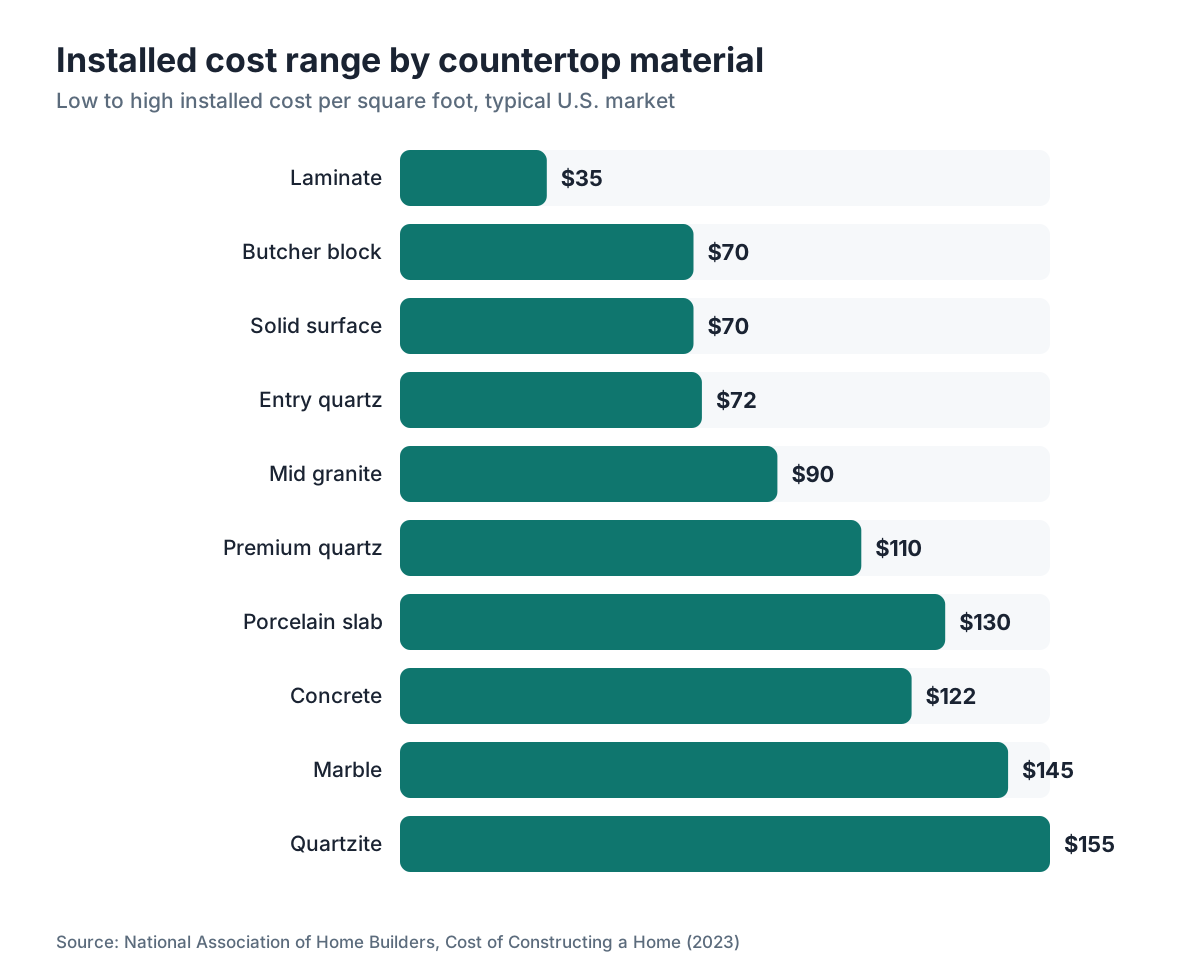
Installed cost (material plus fabrication plus installation, but not demolition or plumbing reconnects) runs roughly as follows for a typical 40-50 square foot kitchen [1][2]:
| Material | Low end (installed/sq ft) | High end (installed/sq ft) |
|---|---|---|
| Laminate (post-form) | $20 | $50 |
| Butcher block | $40 | $100 |
| Solid surface (Corian-type) | $45 | $95 |
| Tile | $25 | $65 |
| Entry-level quartz | $55 | $90 |
| Mid-grade granite | $60 | $120 |
| Premium quartz | $80 | $140 |
| Marble | $90 | $200 |
| Quartzite | $90 | $220 |
| Porcelain slab | $80 | $180 |
| Concrete | $85 | $160 |
Those ranges come from a mix of NAHB cost-of-construction data and NKBA project cost surveys [1][2]. They're honest ranges, not worst-case scenarios. Your number can land outside them if you're in a high-labor market (San Francisco, New York) or you have a weird layout with lots of cutouts.
The single biggest cost driver is edge linear footage relative to slab square footage. A kitchen island with four exposed sides costs far more per square foot than a simple L-shaped run with one exposed front edge, because edge work is labor. Cutouts for sinks and cooktops add $150 to $350 per cutout depending on material hardness and whether you want an undermount or drop-in fit [3].
Demolition of existing tile or stone counters usually adds $200 to $500. Plumbing disconnect and reconnect for an undermount sink is a separate plumber invoice, running $100 to $250 depending on your area. Budget for both before you fall in love with a slab at the showroom.
Which countertop material is the most popular right now?
Engineered quartz holds the largest share of the U.S. countertop remodel market. The National Kitchen and Bath Association's 2023 design trends report found quartz specified in roughly 66 percent of kitchen remodel projects tracked by their member designers [2]. Granite held second, and marble came third despite its reputation for high maintenance.
Why quartz dominates: it's non-porous (no annual sealing), consistent in color (no odd veining surprises in the slab), harder than marble, and sold in hundreds of finishes including convincing marble lookalikes. Cambria, Silestone, and Caesarstone all sit here. You can read more about one of the higher-end options at Cambria countertops.
The shift toward quartz picked up around 2012, when manufacturing quality improved and pricing dropped enough to compete with mid-grade granite. Before that, granite was the default upgrade from laminate.
Laminate still takes a big share of new construction and budget remodels. Builders put laminate in entry-level homes because it keeps the price per square foot under $50 installed, and modern high-pressure laminate (HPL) actually looks decent next to the peeling 1980s stuff. The Formica countertops and laminate countertops category has legitimately improved.
What are the pros and cons of quartz countertops?
Quartz countertops are made from roughly 90 to 93 percent ground quartz aggregate bound with polymer resins and pigments [4]. They are not natural stone, even though they contain a natural mineral.
Pros: non-porous (no sealing, ever), consistent appearance, stain-resistant to common kitchen acids like vinegar and citrus, a huge color range, and hard (Mohs hardness around 7).
Cons: it can't take direct heat. A pan straight off the burner can cause thermal shock and crack the resin matrix. Fabricators universally recommend trivets. Outdoor use voids most warranties because UV light yellows the resins. Quartz also shows seams more than granite, since the pattern repeats across slabs. A fabricator who knows what they're doing will place seams smartly, but you can't hide them in quartz the way you sometimes can in a busy granite.
One more thing worth knowing: silica dust from cutting quartz is a serious occupational hazard. OSHA and NIOSH have issued specific guidance on silica exposure in stone fabrication, noting that engineered stone runs 90 percent or more crystalline silica versus roughly 25 to 45 percent in granite [5]. That's a fabricator safety issue, not a homeowner one, but it's part of why shops increasingly invest in wet-cutting and local exhaust ventilation.
For most homeowners running a busy family kitchen, quartz is probably the right call. Low drama, long life, easy cleaning.
Is marble worth it for a kitchen countertop?
Marble is calcium carbonate, which means it etches when it touches acids. Coffee, lemon juice, wine, tomato sauce, all of them leave a dull mark that isn't a stain but a physical change to the surface chemistry [6]. You can reseal marble, but sealing doesn't stop etching. It only stops absorption of colored liquids.
So is it worth it? For serious cooks who wipe spills instantly and use cutting boards and trivets religiously: sometimes yes. Marble stays cool, which helps with pastry work. The look is irreplaceable. A kitchen with Calacatta Gold or Statuario slabs looks like nothing else.
For anyone who makes pasta sauce every week, has kids, or doesn't want to think about the counter: probably no. The etch marks that show up over a few years get called a "patina" by marble fans. Some people genuinely love that lived-in look. Others find it maddening.
Honed marble (matte finish) hides etching better than polished marble because the surface is already non-reflective. If you're set on marble, honed is the more practical choice for a kitchen.
See the full marble countertops guide for sealing schedules and etch repair options.
How do granite and quartzite compare to quartz?
Granite is a natural igneous rock. It's porous and needs sealing once a year or so, but it takes heat well (you can set a hot pan on it without thermal shock risk in most cases), and every slab is unique. Entry granite starts around $60 installed per square foot; premium slabs with dramatic movement run $120 and up [1].
Quartzite gets confused with quartz constantly but is a completely different thing. Quartzite is a metamorphic natural stone, formed when sandstone gets compressed under heat [8]. It's harder than marble (Mohs around 7 to 8) and more acid-resistant than marble, but it's still porous and needs sealing. Some quartzite labeled "soft quartzite" in showrooms is actually marble or dolomitic marble, which etches just as badly. Ask your supplier for an acid test before you buy.
Cleaning stone counters of any type (granite, quartzite, marble) comes down to pH-neutral cleaners and avoiding bleach and vinegar. The how to clean stone countertops guide has the specifics on cleaners and sealer schedules.
Here's the comparison that matters most for most kitchens:
| Trait | Quartz | Granite | Quartzite |
|---|---|---|---|
| Heat resistance | Poor (use trivets) | Good | Good |
| Stain resistance | Excellent (non-porous) | Good (sealed) | Good (sealed) |
| Acid/etch resistance | Excellent | Good | Good |
| Sealing required | No | Yes, annually | Yes, annually |
| Outdoor use | No (UV damage) | Yes | Yes |
| Typical installed cost | $55-$140/sq ft | $60-$120/sq ft | $90-$220/sq ft |
Granite is still the best all-around natural stone for a kitchen, in my view. The full breakdown is at granite countertops.
What about butcher block, concrete, and other non-stone options?
Butcher block works well in kitchens leaning warm, craftsman, or Shaker. It's renewable, scratches sand out, oil finishes restore, and a well-kept butcher block can last decades. The downside is water damage near the sink if you let standing water sit. Most fabricators recommend keeping butcher block away from the sink area or using a tight-grained species (maple, walnut) with a penetrating oil rather than a polyurethane film finish, which peels [10]. See the full butcher block countertops guide for species comparisons and oiling schedules.
Concrete countertops have real design appeal and one big practical problem: they almost always crack. Concrete shrinks as it cures, and the thin sections typical in countertops (around 1.5 inches) crack over time no matter how much fiber reinforcement goes in. Sealers help with porosity but need reapplication. Installed cost runs $85 to $160 per square foot with a skilled concrete fabricator [1]. DIY pours cost less, but the failure rate climbs.
Porcelain slab countertops are newer to the U.S. market. They're fired clay baked at very high temperatures, which makes them extremely hard (Mohs around 7 to 8), non-porous, UV-stable, and nearly scratch-proof. The catch is fabrication: cutting and polishing porcelain is unforgiving, and edge chips are hard to repair. Porcelain slabs also come in large formats (up to 126 by 63 inches), which cuts seams on big islands. Cost runs $80 to $180 installed [1].
Corian countertops and other solid surfaces sit in an interesting middle ground. They're non-porous, repairable (deep scratches sand out), and can be thermoformed into integrated sinks with no seam. They scratch more easily than stone or quartz, but the scratch is fixable. Cost is $45 to $95 installed [1].
What thickness should you choose for a modern countertop?
Stone slabs come in two standard thicknesses: 2 cm (roughly 3/4 inch) and 3 cm (roughly 1 1/4 inch). Most U.S. fabricators default to 3 cm for kitchen counters because it's stronger, needs no plywood substrate, and gives a more substantial edge without laminating.
2 cm slabs cost less per slab but usually need a plywood substrate plus an edge buildup strip to hit the 1.5-inch finished edge most homeowners expect. Once you add substrate and labor, the savings shrink fast.
The waterfall island edge (where the slab turns 90 degrees and runs vertically down the island side) looks best in 3 cm because the top and the vertical panel appear to be one continuous thick piece. In 2 cm, the miter joint shows more.
For laminate and solid surface, thickness barely varies. Post-form laminate is typically 1.5 inches at the front edge and 3/4 inch at the deck. Custom laminate can be built thicker with substrate.
Butcher block typically comes in 1.5-inch or 2-inch thicknesses. The thicker option handles sanding and resurfacing better over a long life.
How do you choose the right edge profile for a modern kitchen?
Edge profiles do more than decorate. They change how a corner feels when you brush past it, how crumbs collect (or don't), and how seams read.
The profiles fabricators see most in modern kitchen projects right now:
Eased edge: a simple 1/8-inch bevel at the top and bottom corners. Clean, contemporary, minimal. The default for modern flat-panel kitchens. Shows the full slab thickness. Barely catches crumbs.
Mitered edge: the front edge is cut at 45 degrees and a strip of stone is glued underneath to fake a 4-cm or even 6-cm thick slab. Popular for statement islands. Costs more because it needs extra material and precise joinery.
Ogee and full bullnose edges: these look dated in a contemporary kitchen. They're fine in a traditional or transitional kitchen, but if you're reading this because you want a modern look, skip them.
Waterfall: really a design element more than an edge. The slab keeps running over the side of the island down to the floor. Dramatic, expensive (needs an extra partial slab and a precise mitered joint), and a fingerprint magnet on polished surfaces.
For most kitchens, an eased edge is the right call. It's the cheapest profile to fabricate, and it reads modern without locking you into a specific design.
How long does countertop installation take from templating to finished kitchen?
From template appointment to finished install, expect 5 to 14 business days for stock-material projects and 3 to 6 weeks for custom or imported stone [3].
Here's how those days break down. The fabricator templates (measures with laser or physical template) your existing cabinet layout. That data goes into fabrication software to lay out slab cuts, cut waste, and plan seam placement. Cutting and edge profiling take 1 to 3 shop days depending on material and complexity. Then the install crew comes back, and the actual install runs a half-day to a full day for a standard kitchen.
Shops that run efficient nesting software, like the kind SlabWise is built for, squeeze more jobs per slab and turn projects faster by cutting material waste at the layout step. That's mostly a fabricator efficiency story, but it can mean a shorter backlog for homeowners scheduling in a busy season.
Demolition of your old countertops usually happens the day before or the morning of the install. You'll be without a fully working kitchen for at least a day, sometimes two if plumbing reconnects are complex. Plan accordingly.
If your slab is on consignment or needs importing, lead times blow out. Exotic stones from Italy, Brazil, or India can take 4 to 10 weeks to arrive once a slab is confirmed. Always ask the supplier for a confirmed lead time before you lock in a remodel schedule.
What should homeowners look for when getting a countertop quote?
A good countertop quote itemizes: square footage (show your work), linear footage of edge profile, number of cutouts (sink, cooktop, any outlets), material cost per square foot, fabrication labor, and installation labor. If any of those get bundled into one number, ask them to break it out.
Red flags: a quote with a single total and no line items, a "measuring fee" that doesn't credit back if you hire them, and any company that won't hand you a written quote within 48 hours of the template.
If you want a rough number before calling a fabricator, online instant quote tools (including the one at SlabWise.com) can give you a ballpark from kitchen dimensions and material choice. Those estimates don't replace a real template, but they help you walk into the conversation with a number to sanity-check.
Make sure the quote spells out who handles demolition, whether sink reconnect is included, and what the warranty covers. Most fabricators warranty fabrication defects (seams separating, edges cracking from a manufacturing flaw) for one year. They don't warranty damage from misuse, which includes hot pans on quartz or cutting directly on marble.
The full countertop installation guide covers what to expect on install day, how to inspect your finished counter before you sign off, and what to do if you find a chip or an uneven seam.
How do you maintain and clean modern countertops?
Maintenance splits cleanly by material.
Engineered quartz: wipe with a damp cloth and mild dish soap. Skip abrasive scrubbers and bleach (bleach can discolor the resin over time). No sealing. For stuck-on messes, a plastic scraper and a little isopropyl alcohol work without hurting the surface.
Natural stone (granite, quartzite, marble): pH-neutral stone cleaners only. No vinegar, no lemon, no standard multi-surface sprays (most contain acids or ammonia). Seal with an impregnating sealer once a year, or run the water-bead test: drip water on the surface, and if it soaks in instead of beading, it's time to seal [6]. The how to clean quartzite countertops guide covers quartzite specifically. Marble adds etch-repair complexity, covered in the how to clean stone countertops guide.
Butcher block: oil regularly (food-grade mineral oil or a dedicated butcher block oil), sand scratches out with 120-grit then 220-grit, then re-oil. Keep it dry between uses near the sink.
Laminate: gentle cleaner, no abrasives. Laminate chips rather than scratches, and chips don't repair. The main enemies are standing water at seams (swells the substrate) and direct heat (bubbles the surface layer).
Solid surface: scratches buff out with a Scotch-Brite pad. Deep gouges fill with the manufacturer's repair compound. Non-porous, so no sealing.
Porcelain: the easiest of all. Care is essentially the same as porcelain tile. A damp cloth handles nearly everything.
Frequently asked questions
What is the most durable countertop material for a busy kitchen?
Porcelain slab and engineered quartz take daily abuse best. Porcelain is harder (Mohs around 7 to 8), non-porous, and scratch-resistant, though chips are hard to repair. Quartz is nearly as hard, non-porous, and stain-resistant but can't handle direct heat. Granite is close behind and beats quartz on heat, but needs annual sealing. For high-traffic family kitchens, quartz is the practical standard pick.
How much does it cost to replace kitchen countertops?
Replacing countertops in a standard 40-50 square foot kitchen runs roughly $2,000 to $6,000 for mid-grade materials like granite or quartz, installed. Laminate replacements can come in under $1,500. High-end marble or quartzite in a large kitchen can top $10,000. Add $200 to $500 for demo of existing surfaces and $150 to $250 if a plumber handles the sink reconnect. Get at least three itemized quotes first.
Does quartz stain or scratch easily?
Quartz resists most stains well because it's non-porous. Harsh chemicals like paint remover, oven cleaner, and bleach can discolor the resin binder. Quartz scratches less easily than marble or solid surface but isn't scratch-proof. A knife dragged across it leaves a mark. The biggest weakness isn't stains or scratches, it's heat. A hot pan can crack or discolor the surface permanently.
Can I put hot pans on granite countertops?
Generally yes. Granite is a natural stone formed under extreme heat, so it handles thermal shock from hot pots and pans far better than quartz. That said, most fabricators still recommend trivets as a precaution, since the temperature gap between a pan's hot center and the cooler stone around it can in theory cause stress. In practice, granite takes hot pans without issue in the vast majority of kitchens.
How often do you need to seal stone countertops?
Once a year is standard for granite and quartzite sealed with a standard impregnating sealer. Marble may need it twice a year in heavy-use kitchens. Easiest test: drip a few drops of water on the surface. If it soaks in and darkens the stone within a few minutes instead of beading, reseal. Some dense granites only need sealing every two to three years.
What countertop adds the most resale value to a home?
Quartz and granite show up consistently in real estate agent surveys as the countertops buyers prefer. NAR surveys and Remodeling Magazine's Cost vs. Value reports have tracked kitchen remodel payback at roughly 50 to 70 percent depending on market and scope [7]. Stone countertops tend to help close a sale rather than add dollar-for-dollar value. Budget laminate can hurt perceived value even in an otherwise updated kitchen.
What is the difference between quartzite and quartz countertops?
Quartz countertops are engineered: ground quartz mineral plus polymer resins, made in factories. Quartzite is a natural metamorphic rock quarried from the earth [8]. Quartzite is porous and needs sealing; engineered quartz doesn't. Quartzite handles heat better. Both are hard, but quartzite varies slab to slab while engineered quartz stays consistent. Some soft quartzite sold in showrooms is actually dolomitic marble, so ask for an acid test.
Is laminate a good option for a modern kitchen?
Modern high-pressure laminate is a legitimate option, especially for rentals, budget remodels, and secondary kitchens. Current laminate prints mimic wood grain, stone, and solid color convincingly. It installs fast, costs $20 to $50 per square foot installed, and cleans easily. It doesn't handle chips or standing water at seams, and it isn't resurfaceable. For a primary kitchen where you plan to stay 10 or more years, stone or quartz holds up better.
How thick should kitchen countertops be?
The U.S. standard for natural stone and quartz is 3 cm (about 1.25 inches). That thickness supports itself on typical cabinet spans without a plywood substrate. Some projects use 2 cm slabs to save on material, but a plywood substrate and laminated edge buildups are then required, which often erases the savings. Butcher block is typically 1.5 to 2 inches. Laminate post-form counters are 3/4 inch at the deck with a 1.5-inch built-up front edge.
What countertop styles look outdated now?
Tile countertops with grout lines, beveled bullnose and ogee edge profiles on stone, and high-contrast speckled granite in beige-and-brown families all read as pre-2010. Country-blue laminate and hunter-green solid surface are gone from new projects. None of these are structurally wrong, but if resale or a fresh look is the goal, moving to an eased or mitered edge on a neutral-toned slab is the most effective change.
How long does it take to install new countertops?
From template appointment to finished install, expect 5 to 14 business days for in-stock materials and 3 to 6 weeks for custom or imported stone. The install itself usually takes a half-day to a full day for a standard kitchen. You'll be without a working sink during install and for several hours after, until sealant and adhesive cure. Plan to reconnect plumbing the same day or the next morning.
Can you DIY countertop installation?
Laminate post-form and butcher block are reasonable DIY jobs with basic carpentry tools. Natural stone and quartz are not. Slabs weigh 15 to 20 pounds per square foot, need specialized cutting gear (wet saw with a diamond blade), and require precise undermount sink cutouts. A failed DIY stone install can crack a slab worth $800 to $2,000 in material alone. Most fabricators won't sell raw stone to homeowners, specifically because of the installation damage risk.
What is the easiest countertop to maintain?
Engineered quartz and porcelain slab are the easiest. Both are non-porous (no sealing), clean with a damp cloth, resist common kitchen stains, and don't need special cleaners. Solid surface is nearly as easy, with the bonus that scratches buff out. Laminate cleans easily but is vulnerable to edge chipping and seam water damage. Natural stone takes the most ongoing attention because of sealing and, for marble, etch management.
Sources
- National Association of Home Builders, Cost of Constructing a Home (2023): Installed countertop cost ranges by material from roughly $20/sq ft (laminate) to $220/sq ft (premium quartzite)
- National Kitchen and Bath Association, Design Trends Study 2023: Quartz specified in approximately 66% of kitchen remodel projects tracked by NKBA member designers in 2023; granite second, marble third
- Home Innovation Research Labs, Builder Practices Survey (2023): Typical countertop fabrication and installation lead time is 5 to 14 business days for stock materials; cutout fees run $150-$350 per opening
- U.S. Geological Survey, Mineral Commodity Summaries (Silica): Engineered quartz surfaces are made primarily from ground quartz aggregate (roughly 90-93%) bound with polymer resins and pigments
- OSHA and NIOSH, Hazard Alert: Worker Exposure to Silica during Countertop Manufacturing, Finishing, and Installation: Engineered stone contains 90%+ crystalline silica versus roughly 25-45% in natural granite, representing elevated occupational silica exposure risk for fabricators
- Natural Stone Institute, Care and Maintenance Guide for Natural Stone: Calcium carbonate-based stones (marble, limestone) etch when exposed to acids; sealing prevents absorption of colored liquids but does not prevent etching; water-bead test recommended to assess sealer effectiveness
- Remodeling Magazine, Cost vs. Value Report 2024: Kitchen remodel projects recoup roughly 50-70% of cost at resale depending on market and project scope
- U.S. Geological Survey, Mineral Resources Program: Quartzite is a metamorphic rock formed from sandstone under heat and pressure; distinct from engineered quartz products
- U.S. Environmental Protection Agency, Radon: EPA notes that while granite can emit small amounts of radon, levels from countertops are generally low and unlikely to pose a significant health risk in well-ventilated homes
- Forest Products Laboratory, USDA, Wood Handbook: Dense hardwoods like maple and walnut used in butcher block countertops are susceptible to moisture-related swelling and dimensional change when exposed to standing water
Last updated 2026-07-10