TL;DR
- Marble countertop restoration removes etch marks, scratches, and stains, then repolishes the surface back to its original finish.
- DIY kits run $30, $80 and fix light etching.
- Professional honing and repolishing costs $200, $800 for a typical 50 sq ft kitchen, depending on surface area and damage.
- Sealing afterward is not optional.
What does marble countertop restoration actually involve?
Restoration is not cleaning. People mix those up constantly, and the confusion wastes money and sometimes causes more damage. Cleaning removes surface dirt and residue. Restoration removes damage that has physically changed the stone, then brings the finish back to match the original.
Marble is calcium carbonate. It reacts with any acid the second they touch. Lemon juice, coffee, vinegar, wine, even some hand soaps will etch the surface within seconds. An etch looks like a dull, slightly lighter spot. It is not a stain. No amount of scrubbing fixes it, because the acid dissolved a microscopic layer of the stone. [1]
The process has four stages: grinding or honing to flatten scratches and etch damage, polishing through progressively finer abrasives to bring back sheen, poulticing to pull out stains, and sealing to slow future damage. Light surface etching needs only the polishing and sealing stages. Deep scratches or heavy wear may need all four. Knowing which stage you actually need keeps costs down and stops you from turning a minor problem into a major one.
How do you tell etching from staining, and why does it matter for repairs?
Run a finger over the spot. If it feels slightly rough or sunken compared to the stone around it, that is an etch. If the surface feels smooth and the color goes darker rather than lighter and dull, it is probably a stain. A flashlight held at a shallow angle helps too. Etches scatter light and look hazy. Stains do not change the reflection.
The difference decides the fix. Etches need abrasion. You re-grind the affected area to get below the damage, then polish back up. Stains need a poultice that draws the contaminant out of the stone's pores. A poultice on an etch does nothing. An abrasive on a stain might lift the stain, but it can also spread it or leave a polished patch that no longer matches the finish around it.
Oil-based stains from cooking oil, butter, or lotion look yellowish or dark and can spread over time. Organic stains from coffee, tea, or berries look pinkish-brown and often fade on their own under UV light. Rust stains are orange-brown, usually circular, and come from metal objects or iron in the water supply. Each type needs a different poultice base, covered in the stain removal section below. [2]
Can you restore marble countertops yourself, and what are the real risks?
Yes, with real caveats. Light surface etching on a polished finish is genuinely DIY-able. Marble polishing powders based on tin oxide or aluminum oxide, the kind the Natural Stone Institute recommends, work on fresh shallow etches. A kit costs $20 to $50 per application, and results on minor damage are good. [3]
The risk starts with misdiagnosis and heavy-handed abrasion. Start sanding a honed surface while thinking you are fixing an etch, and you create a glossy patch in a matte counter. That mismatch shows far worse than the original etch ever did. Hit a shallow surface etch with a medium-grit pad and you can grind a depression a professional then has to flatten.
Here is a risk people forget. Most marble slabs are 3/4 inch to 1.25 inches thick. There is a finite amount of stone to work with, and aggressive grinding removes it permanently. Professionals use thickness gauges and stop well short of structural limits. A DIYer running a random-orbit sander with 60-grit paper has no feedback at all. Leave power tools to fabricators and restoration specialists.
The honest answer: DIY is fine for light etching on standard polished Carrara or similar white marble. Honed finishes, patterned stone like Calacatta or Verde Guatemala, or anything with heavy veining near the damage should go to a pro. A blending mistake on strongly veined marble is close to impossible to fix without replacing the slab.
What does professional marble restoration cost?
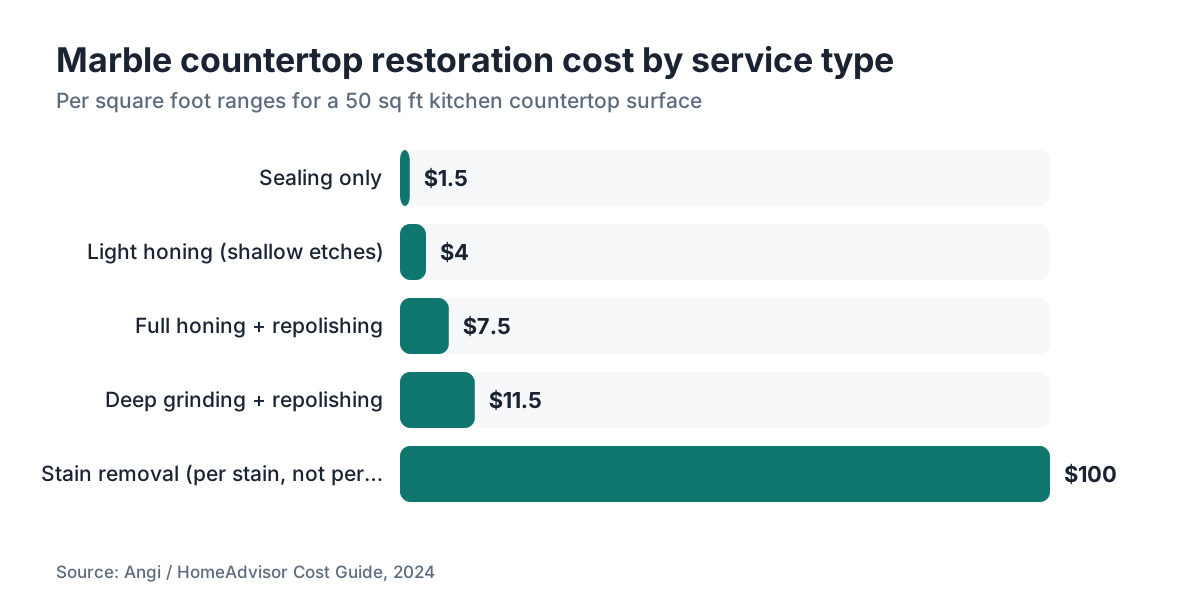
Professional restoration runs $3 to $15 per square foot, which puts a typical 50 sq ft kitchen at $250 to $750. Price swings on region, damage level, and whether the contractor does polishing only or also grinding and stain removal. Here are the 2024 ranges from contractor cost guides.
| Service | Typical cost per sq ft | Typical kitchen total |
|---|---|---|
| Light honing (remove shallow etches) | $3, $5 | $150, $250 |
| Full honing + repolishing | $5, $10 | $250, $500 |
| Deep grinding + repolishing | $8, $15 | $400, $750 |
| Stain removal (poultice, per stain) | $50, $150 per stain | Varies |
| Sealing only | $1, $2 | $50, $100 |
Those totals assume a 50 sq ft surface, typical for a medium U-shaped kitchen. Islands and larger layouts push higher. [4]
Many contractors charge a flat minimum visit fee of $150 to $200 no matter the square footage, which makes small jobs feel expensive. One etch on a bathroom vanity quoted at $200 is not a ripoff. That is the trip-and-setup cost. Bundle all your restoration work into one visit and the per-item cost drops.
For the fabricators reading this: restoration is a real revenue line. A shop with a polisher and a diamond pad set can turn a profitable restoration call in 2 to 3 hours. If your shop quotes countertops, track restoration leads right alongside new installs. SlabWise has a demo showing how fabricators drop service line items into the same quote template as slab work.
How do you remove etch marks from marble countertops?
For light etching on a polished finish, the process is short. You need a marble polishing powder (tin oxide or aluminum oxide based) and a soft buffing pad. Wet the etched area, apply a little powder, and work it in circles with a damp cloth or low-speed buffer. The mild abrasion removes the top 1 to 2 microns of damaged surface and brings back the optical smoothness that gives polished marble its shine. Rinse, dry, and check. Repeat if needed. [3]
Deeper etches need diamond abrasive pads in sequence. Start at the coarsest grit that is still finer than the damage depth, usually 200 or 400 grit for moderate etching. Work through 800, 1500, and 3000 grit, keeping the surface wet the whole time. Finish with a polishing powder or a 5-step diamond pad kit. The goal is a scratch pattern so fine the surface reads as mirror-smooth.
Honed marble plays by different rules. The finish is deliberately matte, roughly a 200 to 400 grit equivalent. Fixing an etch on honed stone means honing the repair area to match the surrounding matte texture, then feathering the edges so the patch disappears. This is harder to DIY because honed finishes punish over-polishing. A slightly too-glossy patch jumps out under raking light.
Work in a contained area, protect the cabinetry, and rinse the slurry thoroughly. Diamond abrasive slurry is mildly acidic from the stone particles and will stain grout if it dries in place.
How do you remove stains from marble countertops using a poultice?
A poultice is an absorbent material mixed with a chemical agent that pulls a stain out of the stone as it dries. The Natural Stone Institute documents this as the professional standard for porous stone, describing it as the recommended method to draw a stain up out of the pores and into the poultice material. [2]
The basic recipe: pick an absorbent carrier (flour, diatomaceous earth, chalk powder, or thick layers of plain white paper towel) and a chemical matched to your stain.
- Oil-based stains: carrier + acetone, mineral spirits, or household ammonia
- Organic stains (coffee, tea, wine): carrier + 12% hydrogen peroxide (hair developer) + a few drops of ammonia
- Rust stains: commercial rust remover formulated for stone (never generic rust removers, which run too acidic for marble)
- Biological stains (mold, algae): carrier + household bleach, heavily diluted
Mix to a peanut butter consistency. Spread it 1/4 to 1/2 inch thick over the stain. Cover with plastic wrap, tape the edges, and let it sit 24 to 48 hours. The slow dry-out lifts the stain up into the carrier. Peel off the dry poultice, rinse, and check. Stubborn stains take 2 to 3 applications. [2]
One thing most DIY guides skip: test the chemical in a hidden spot first. Ammonia on some green or black marbles can shift the color. Bleach on marble with certain metallic minerals can trigger new staining. If you are unsure of the marble type, hydrogen peroxide is the safest broad-spectrum choice for organic stains.
How do you fix deep scratches in marble countertops?
A true deep scratch, one you can catch with a fingernail or a dragged wooden toothpick, needs material removal. No filler or sealant repairs a structural scratch in polished marble. The scratch breaks the surface plane, so the only real fix is grinding down the stone around it until the surface is flat again, then repolishing.
For a single deep scratch, a professional reaches for a weighted lap stone or a small diamond pad on a right-angle grinder, starting around 120 to 200 grit and working finer. Flattening a 1mm deep scratch might remove 2 to 5 microns of stone across a 4 to 6 inch work area. That sounds tiny. It still takes time, skill, and the right gear.
Chips are harder. A chip at a countertop edge can sometimes take a color-matched epoxy, but the repair rarely looks identical. Matching the translucency of white Carrara with epoxy is genuinely hard. A fabricator with the original slab remnant can occasionally do better by cutting out the chipped section and inlaying a new piece, though that runs expensive. For chips larger than about 1/4 inch, price replacing the affected section against repairing it.
Weighing your options as a homeowner? Our guide to kitchen countertops lays out cost-versus-replacement across stone types.
What is the best sealant for marble after restoration?
Sealing is the one step you cannot skip after restoration. Grinding and polishing open the stone's pore structure slightly, so it is temporarily more porous than before you started. Seal within 24 hours of finishing any abrasive work.
Use an impregnating sealer, also called a penetrating sealer, not a topical coating. Topical coatings sit on the surface and build a plasticky film that peels, yellows, or dulls the finish. Impregnating sealers soak into the pores and repel liquid from below the surface. The stone still looks and feels like stone. [5]
Water-based sealers are easier to apply and work well on most white and cream marbles. Solvent-based sealers go in deeper and last longer, roughly 3 to 5 years against 1 to 3 years for water-based, but they need ventilation and a bit more care going on. Solvent-based sealers and adhesives can release VOCs, so the EPA advises adequate ventilation during application. [8] For a heavy-use kitchen, solvent-based earns the extra effort.
Test first. Drop a little water on a clean, dry section. If it beads, the sealer still works. If it soaks in within 3 to 4 minutes, reseal. The Natural Stone Institute recommends resealing marble countertops every 1 to 3 years depending on use and sealer type. [5]
For context: granite countertops are denser than marble and usually need sealing less often, every 3 to 5 years. Marble's higher porosity is the whole difference.
How do you restore marble that has been damaged by harsh cleaners?
This is more common than people think. Bleach spray, vinegar-based cleaners, lemon cleaning solutions, and plenty of commercial bathroom sprays run acidic or alkaline enough to etch marble on contact. Clean marble every day with a vinegar-water spray and you can etch an entire surface into a uniform dull finish inside a few weeks.
The good news: uniform dull etching from repeated mild acid is one of the easier restoration jobs. The whole surface just needs to come up to the same scratch pattern, which is simpler than blending a single repair into undamaged stone. A full honing and repolishing brings it back.
The less-good news: if the cleaner had bleach and got used over and over, it may have stripped the sealer and started bleaching organic minerals in the stone. Some green, black, or red marbles carry iron or organic compounds that react with bleach and cannot return to their original color. For those, talk to a stone professional before you touch anything abrasive.
Going forward, pH-neutral stone cleaner is the only safe daily option. Products labeled specifically for natural stone and marble clean without reacting with calcium carbonate. For more on ongoing care, see how to clean stone countertops.
When should you replace marble instead of restoring it?
Restoration has limits. Here are the cases where replacement is the honest call.
Cracks that run the full thickness of the slab are structural failures. Epoxy can fill and stabilize a hairline crack, but a crack that shifts, sits at different heights on each side, or runs near a seam or edge means the slab is compromised. Polishing a cracked slab can move it and widen the crack.
Thickness loss from repeated aggressive restoration is another. Every grind removes stone. On a 3/4 inch slab you have a finite number of passes before the slab gets too thin to handle safely. If a counter has been professionally restored several times, ask the restorer to measure the current thickness before you commit to another grind cycle. The Tile Council of North America notes that marble slabs run 3/4 inch (2 cm) to 1.25 inch (3 cm), and excessive material removal compromises structural integrity. [9]
Pattern mismatch on heavily veined stone. If a deep scratch or chip crosses dramatic veining and no remnant of the original slab exists, no restoration method recreates that veining. The repair will always show.
Mold or biological contamination that has gone deep. Rare, but real. Marble near a sink that stayed damp and neglected for years can host mold down in the pore structure, past where surface treatment reaches. At that point the health concern alone justifies replacement.
For a wider look at replacement, marble countertops covers slab selection and material grades. If you are leaning toward lower maintenance, cambria countertops or laminate countertops are worth a look.
How long does marble restoration last?
A professional honing and repolishing job holds up 5 to 10 years with good care: pH-neutral cleaners, quick cleanup of spills, and resealing every 1 to 3 years. That lifespan assumes normal household use, not a restaurant prep line or a house where citrus juice sits on the counter overnight.
The finish does not wear out on its own. What ends a restoration's life is the pile-up of new etch marks, scratches, and stains crossing your threshold for what looks acceptable. Some people live happily with a few small etches for years. Others want the surface looking new and book a pro every 2 to 3 years. Both are fine.
One practical note. Each restoration removes a little material. Over decades that adds up, so it is worth tracking. A standard 1.25 inch (3 cm) slab has plenty of depth for many restoration cycles across a normal 20 to 30 year countertop life. A thinner 3/4 inch slab, or a marble tile counter, leaves you less margin, so factor that in.
For fabricators quoting restoration next to new work: the restoration conversation is a natural moment to bring up your quoting workflow. SlabWise lets shops build restoration line items into the same quote as new countertop work, which simplifies billing and shows customers the total project cost in one document.
What tools and materials do you need for a DIY marble restoration?
Here is an honest kit list for light-to-moderate DIY restoration, with rough costs.
| Item | Purpose | Approx cost |
|---|---|---|
| Marble polishing powder (tin oxide) | Fix light surface etching | $15, $30 |
| Diamond hand pads 200 to 3000 grit set | Progressive scratch removal | $30, $60 |
| pH-neutral stone cleaner | Pre-cleaning before work | $10, $20 |
| Impregnating sealer (water-based) | Post-restoration protection | $20, $40 |
| Poultice ingredients (see above) | Stain removal | $5, $20 |
| Buffing pads (soft white) | Final polish application | $5, $10 |
| Spray bottle + clean cloths | Keeping surface wet during polishing | $5 |
A complete DIY kit runs $90 to $185. Compare that to $200 to $500 for a basic professional visit on a 30 to 50 sq ft kitchen.
Power tools are optional but handy if you own them. A variable-speed angle grinder or random-orbit polisher with diamond pad attachments speeds the work up a lot. If you already have one, add a 5-step diamond pad set for stone ($25, $50). If you don't, the hand pad route is safer for a first attempt. Dry grinding of stone throws respirable silica dust, and OSHA requires wet methods and respiratory protection for that work, so keep the surface wet and wear a mask if you power-grind. [7]
Skip these for DIY: generic auto-body polishes, boat wax, or anything not formulated for calcium carbonate stone. Many carry fillers or oils that hide etching for a while and trap stains later. And never put anything acidic on marble, including citric acid 'natural' cleaners, at any stage of restoration or maintenance.
Frequently asked questions
Can etched marble be restored to its original polished finish at home?
Yes, for light surface etching. Use a marble polishing powder with a damp cloth, working in circles over the etched area. That removes the top micron or two of dulled stone and brings back reflectivity. Deeper etches you can feel with a fingernail need diamond abrasive pads in a grit sequence (200 up to 3000), still DIY-able but slower and more demanding.
How much does it cost to have marble countertops professionally restored?
Expect $3 to $5 per sq ft for light honing, $5 to $10 for full honing and repolishing, and $8 to $15 if grinding is needed for deep scratches. A typical 50 sq ft kitchen counter runs $250 to $750 total. Most contractors also charge a minimum visit fee of $150 to $200. Stain removal is usually quoted separately at $50 to $150 per stain.
What causes dull spots on marble countertops?
Almost always acid etching. Marble is calcium carbonate and reacts chemically with acids on contact: lemon juice, vinegar, wine, coffee, and many household cleaners. The acid dissolves a thin layer of stone, leaving a dull, slightly rough patch. It is not a stain and cannot be cleaned away. It needs abrasive polishing to remove.
How do you remove rust stains from marble?
Use a poultice of diatomaceous earth or chalk powder mixed with a commercial rust remover made for natural stone. Never use generic hardware-store rust removers, which are usually oxalic or hydrochloric acid based and will etch marble badly. Apply the poultice 1/4 inch thick, cover with plastic, leave 24 to 48 hours, then rinse. Repeat if needed. Rust from iron minerals inside the stone can recur.
Is honed marble easier to maintain than polished marble?
In one way, yes. Etch marks are less visible on a matte honed surface because the finish is already non-reflective. But honed marble is more porous than polished and soaks up oil stains more readily, so you still seal it regularly. The overall effort is about the same; the damage just looks different. Pick your finish for looks, not on the idea that one needs less care.
How long does marble sealer last?
Water-based impregnating sealers usually last 1 to 3 years on a kitchen counter. Solvent-based sealers last 3 to 5 years. Easiest check: drop a little water on the dry surface. If it beads for 4-plus minutes without soaking in, the sealer works. If it absorbs within 2 to 3 minutes, reseal. Heavy use, acidic exposure, and abrasive cleaners all shorten sealer life.
Can you use a magic eraser or baking soda on marble?
No. Magic erasers are micro-abrasive and will dull a polished marble finish with repeated use. Baking soda is mildly alkaline (pH around 8.3), and while it will not etch marble the way acids do, it is abrasive enough to affect the finish over time. Both show up in general cleaning guides, and both cause real damage to marble specifically. Use only pH-neutral stone cleaner.
What is the difference between marble restoration and resurfacing?
Restoration returns the existing marble surface to its original condition through abrasion and polishing, removing damage without changing the stone. Resurfacing sometimes means applying a coating or overlay over the existing surface, a different product category. For real marble, restoration (grinding and polishing) is the standard professional approach. Coatings on marble are generally a bad idea because they trap moisture and eventually peel.
How do you restore marble countertops with a honed finish?
Honed marble restoration means matching the matte finish, not polishing to a shine. Use diamond hand pads at the grit that approximates your finish (usually 200 to 400 grit for a standard hone) and blend the repaired area into the surrounding stone, feathering the edges of the work area. The hard part is matching the exact sheen, which is why honed restoration is better left to a professional once the damage covers more than a few square inches.
Does homeowner's insurance cover marble countertop damage?
Standard homeowner's insurance usually does not cover gradual wear, etching, or maintenance damage. A sudden covered event like a fire or a burst pipe that cracks your marble might fall under dwelling coverage, but normal etching, scratching, and staining from use are maintenance items. Some specialty kitchen and bath riders exist; check your policy directly. The bar for structural damage that triggers a claim is usually high.
Can you restore marble countertops that have been painted or coated?
Yes, but you strip the coating first. Use a chemical stripper safe for stone (check the manufacturer's spec sheet for pH compatibility), remove all residue, then assess the underlying marble before starting abrasive work. If the previous coating was a solvent-based product that soaked into the pores, you may need a professional to gauge how deep it went before deciding whether restoration is viable.
How do professionals polish marble countertops?
Professionals use planetary or handheld grinders fitted with resin-bond diamond pads. They work through a grit sequence, typically 50 or 100 grit for heavy damage down to 3000 grit or higher for the final polish, keeping the surface wet throughout to control heat and prevent micro-cracking. The final pass uses a polishing powder (tin oxide or aluminum oxide) or a high-grit buffing pad for the mirror finish. The whole process on a 50 sq ft kitchen takes 3 to 5 hours.
Are quartz countertops better than marble if you want to avoid restoration costs?
For maintenance, yes. Engineered quartz like Cambria or Silestone does not etch from acids, needs no sealing, and resists staining far better than marble. The trade-off is that quartz cannot be restored the same way: surface damage on quartz usually means replacement. Marble can be ground, polished, and made to look new again repeatedly. If you love the look of natural stone but not the upkeep, quartzite is worth comparing in our quartzite cleaning guide.
Sources
- Natural Stone Institute, Technical Bulletin on Etching and Marble Care: Marble is calcium carbonate and reacts with acids to produce surface etching, a chemical dissolution of the top layer of the stone
- Natural Stone Institute, Stain Removal Guidelines for Natural Stone: Poultice method is the professional standard for removing stains from porous stone, with chemical agent matched to stain type
- Marble Institute of America (now Natural Stone Institute), Care and Maintenance of Natural Stone: Polishing powders based on tin oxide or aluminum oxide are recommended for light etch removal on polished marble
- Angi, Marble Polishing and Restoration Cost Guide 2024: Professional marble polishing and restoration costs $3 to $15 per square foot depending on damage level and service type
- Natural Stone Institute, Sealing Natural Stone Technical Bulletin: Impregnating (penetrating) sealers are recommended for marble; resealing frequency is 1 to 3 years depending on use and sealer type
- U.S. Geological Survey, National Minerals Information Center: Marble is a metamorphic rock composed primarily of calcium carbonate (calcite) or calcium magnesium carbonate (dolomite)
- Occupational Safety and Health Administration (OSHA), Crystalline Silica standard: Stone grinding and cutting operations generate respirable silica dust; OSHA requires controls including wet methods and respiratory protection for workers
- U.S. EPA, Indoor Air Quality (IAQ): Certain solvent-based sealers and adhesives used in stone restoration contain VOCs requiring adequate ventilation during application
- Tile Council of North America (TCNA), Handbook for Ceramic, Glass, and Stone Tile Installation: Standard marble slab thickness for countertop applications is 3/4 inch (2 cm) to 1.25 inch (3 cm); structural integrity is compromised by excessive material removal
- Natural Stone Institute, industry resources on stone restoration and maintenance services: Restoration service is a growing revenue segment for stone fabricators as the installed marble base ages
Last updated 2026-07-09