TL;DR
- Marble damage comes in four flavors: chips, cracks, etch marks, and stains.
- Small chips and light etches are real DIY fixes with epoxy filler or polishing powder.
- Deep cracks and missing chunks need a stone restorer.
- Plan on $75 to $300 for professional spot repairs and $400 to $1,200 for full resurfacing, depending on damage and slab size.
What kinds of damage can actually be repaired on marble countertops?
Almost all of it. Marble is calcium carbonate, which makes it softer and more reactive than granite or quartzite. That chemistry means it scratches, etches, chips, and stains in ways most homeowners never expect when they fall for it at the showroom. Good news: most of that damage is fixable.
Four damage types show up over and over. Chips and gouges. Hairline or structural cracks. Etch marks, the dull chalky rings acidic liquids leave behind. And deep staining. Each one has its own repair path, its own materials, and its own honest ceiling on how good the result will look.
Chips in a polished marble edge or surface are the most common call fabricators get. A chip smaller than a quarter and less than about 3 mm deep is a strong DIY candidate. Larger chips, anything that took out a visible chunk of the profile, need color-matched epoxy and a skilled hand to blend the repair into the surrounding stone.
Etch marks are the most misunderstood damage type by a mile. People call them scratches. They're not. Acid from lemon juice, vinegar, wine, or even tomato sauce dissolves the surface of the calcite crystals and leaves a dull patch. No amount of cleaning removes an etch, because it's a chemical change to the stone itself, not a deposit sitting on top. Light etches polish out at home. Heavy ones need professional re-polishing or honing.
Cracks fall on a spectrum. A hairline crack that doesn't go through the full thickness is usually stable and takes low-viscosity epoxy well. A crack that runs edge to edge, or that has any vertical step between the two sides, is a structural problem. Call a fabricator or stone restoration pro before you touch it.
How to repair a chip in a marble countertop yourself
You need three things: a two-part clear or tinted epoxy or polyester stone adhesive, a color-matched pigment or pre-tinted filler that matches your stone, and the patience to let each layer cure fully before you sand. The whole job takes about two hours of hands-on work spread across a day.
Step one is cleaning the chip. Use acetone on a cotton ball to degrease the break zone completely. Any oil, wax, or sealer residue inside the chip kills adhesion. Let it dry at least 10 minutes.
Step two is mixing the filler. For most light-colored marble like Carrara or Calacatta, a clear two-part epoxy tinted with white and gray pigment paste works well. For heavily veined stone, you may need a pre-tinted polyester adhesive from a stone supply company. Mix only what you can apply in 5 minutes, because working time is short. Tenax, Integra Adhesives, and Akemi all make stone-specific fillers in a wide color range [1].
Step three: overfill the chip slightly, maybe 1 to 2 mm proud of the surface. The filler shrinks a touch as it cures. You can always remove excess. You can't add more once you've sanded through the repair.
Curing time matters. Most polyester fillers reach handling strength in 20 to 30 minutes but need 24 hours to harden fully before sanding. Sand too early and you tear the repair instead of leveling it.
Step four is leveling and polishing. Use wet-dry sandpaper starting at 220 grit, then 400, then 800, then 1500, keeping the paper wet and working in small circles. Finish with marble polishing powder (tin oxide or aluminum oxide compound) on a damp felt pad to bring the gloss back. On a polished countertop, a careful sanding and polish sequence gets the repair to about 85 to 90% invisible on plain white marble. Heavily veined marble hides repairs better, because the filler disappears into the visual noise of the veining.
For a closer look at how different stone types behave and what that means for maintenance, the how to clean stone countertops guide covers the chemistry clearly.
Can you fix etch marks on marble without calling a professional?
Often, yes. Light etch marks, the kind left by a single spill that sat a few minutes, usually polish out at home with marble polishing powder. The powder is a mild abrasive that re-polishes the dulled calcite crystals back to a reflective surface. Mix a small amount with water into a paste, apply it to the etch with a soft cloth, and rub in circles for 2 to 4 minutes. Wipe clean and check the gloss. Repeat if needed. This works for etches with no depth you can feel when you run a fingernail across them.
Deep etches feel rough or sit in a slight depression. Those have removed enough material that you need to re-hone or re-polish the stone with diamond abrasive pads. The professional sequence usually runs from a 200-grit diamond pad through 400, 800, 1500, and 3000, then finishes with polishing compound. You can buy wet-dry diamond hand pad sets for about $30 to $60 and do this yourself, but matching the surrounding finish is genuinely hard. If the rest of the countertop is highly polished, the repaired spot will read slightly different unless you polish a broader zone around it.
Honed marble (matte finish) is far more forgiving. New etches on a honed surface are nearly invisible and blend right in after re-honing with a 400-grit pad.
If the etch covers a large area or you want a guaranteed match, a stone restoration company can re-polish the entire countertop surface for $400 to $900 depending on square footage [2]. That brings everything to one finish and clears out years of micro-scratching at the same time. For most homeowners, that beats chasing individual etches one at a time.
How do you repair a crack in marble, and when does a crack mean replace?
A hairline crack that runs with the veining, doesn't flex when you press it, and has no step between the two sides is almost certainly cosmetic. These are common in thin (2 cm) marble and in slabs with heavy veining, because the veins are actually weaker zones in the stone. You can stabilize and fill them.
The repair: clean with acetone, then wick low-viscosity cyanoacrylate (thin super glue) or low-viscosity clear epoxy into the crack. Capillary action pulls the adhesive in without you forcing it. Let it cure, level with a razor blade, and polish with marble powder. The crack stays faintly visible in raking light, but it's stable and won't grow.
A crack that flexes, has any vertical displacement, or runs perpendicular to the longest dimension of the slab is a different animal. That kind of crack means the support underneath is inadequate, or the slab took an impact hard enough to compromise the stone. Before you touch the surface, fix the underlying cause. Check that all cabinet supports are solid and that the countertop has support spans no greater than 24 inches for marble, because marble has lower flexural strength than granite [3]. Add a support if needed, then stabilize the crack from below with two-part epoxy and fiberglass mesh tape (the same stuff used in under-counter rodding) before finishing the top.
Cracks that go edge to edge with any separation are usually a fabricator call. The fabricator can judge whether the slab can be rodded, pinned, and epoxied back together or whether replacement is the honest answer. On a heavily veined Calacatta or book-matched slab, replacement often costs more than repair, because matching the stone is so hard. A skilled stone restorer can pin and fill a full break with nearly invisible results on plain marbles.
What are the costs for professional marble countertop repair?
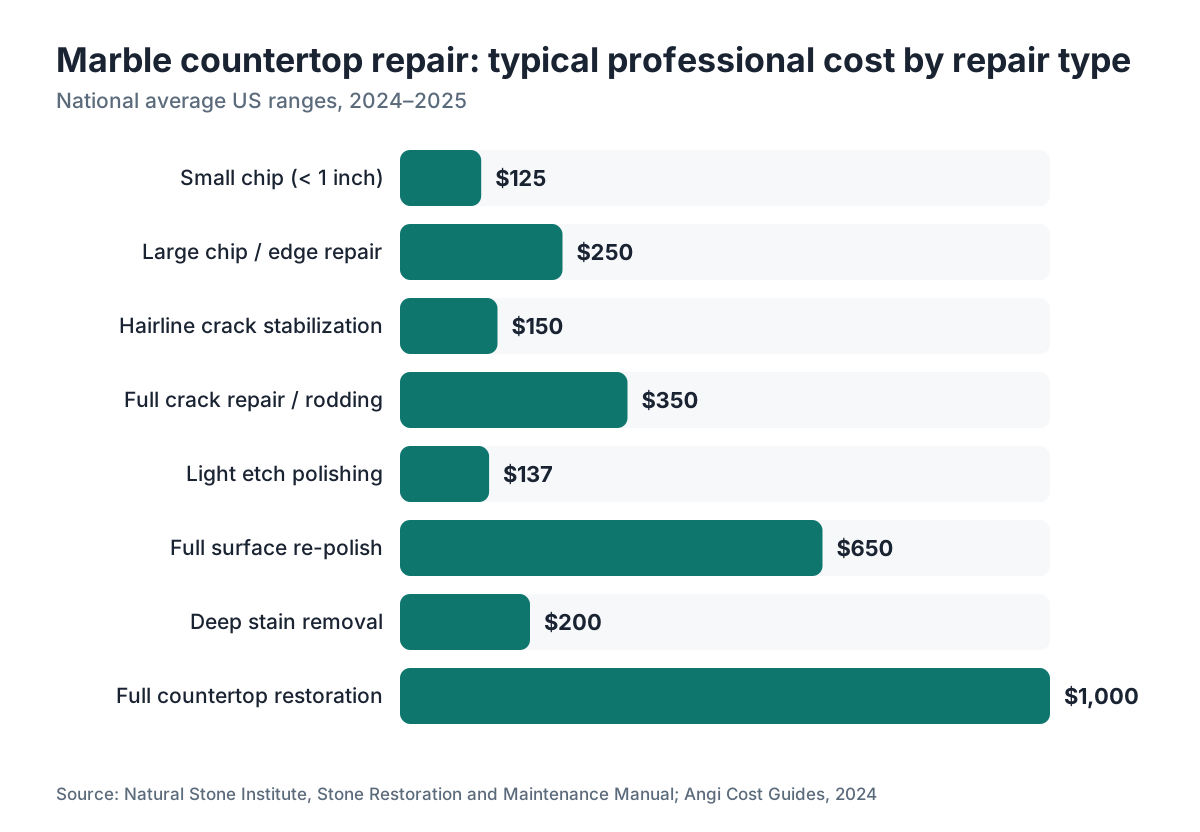
Professional repair costs swing a lot based on damage type, marble variety, and your region. The ranges below come from stone restoration industry pricing surveys and represent national averages in the United States as of 2024 to 2025 [2][4].
| Repair Type | DIY Material Cost | Pro Labor Range |
|---|---|---|
| Small chip (< 1 inch) | $15, $40 in filler | $75, $175 |
| Large chip or broken edge | $40, $80 in materials | $150, $350 |
| Hairline crack stabilization | $10, $25 | $100, $200 |
| Full crack repair/rodding | N/A (pro only) | $200, $500 |
| Light etch polishing | $20, $50 in powder | $75, $200 |
| Full surface re-polish | $60, $120 in pads | $400, $900 |
| Deep stain removal | $20, $60 in poultice | $100, $300 |
| Full countertop restoration | Rarely practical DIY | $500, $1,500 |
Pro tip: if you have several repairs on the list, bundling them into one service call is almost always cheaper than scheduling separate visits. Most stone restoration companies charge a minimum trip fee of $75 to $150, so two separate calls cost $150 to $300 in trip charges alone.
Geography matters. Rates in New York, Los Angeles, and San Francisco run 40 to 60% above the national average for the same work. Rural and smaller-market rates trend toward the low end of these ranges.
These figures are repair costs only, not replacement costs. Full countertop replacement in marble runs $60 to $200 per square foot installed, depending on marble grade and edge profile [5]. For a typical 30-square-foot kitchen countertop, that's $1,800 to $6,000. A $300 repair job wins that comparison almost every single time.
How do you remove stains from marble countertops?
Marble stains are different from stains on most other surfaces, because the stain usually lives inside the stone, not on top of it. Marble's porosity lets liquids penetrate past the sealer if they sit long enough, and the fix is a poultice that draws the stain back out.
A poultice is a paste made from an absorbent powder (diatomaceous earth, baking soda, or white chalk) mixed with a solvent or chemical agent that attacks the specific stain type. Apply it thick, cover with plastic wrap, leave it 24 to 48 hours, then remove it. As it dries, it pulls the staining agent up out of the stone.
The solvent depends on what caused the stain:
- Oil-based stains (cooking oil, grease, butter): acetone or mineral spirits as the solvent.
- Organic stains (coffee, tea, wine, fruit): 12% hydrogen peroxide as the agent.
- Rust stains (iron in water, a metal pan left wet): a commercial rust remover made for stone, usually oxalic acid based. Careful here, because strong acid can etch the marble around the stain.
- Ink or marker: acetone or lacquer thinner in the poultice.
The Natural Stone Institute publishes specific poultice recipes for different stain types in its care and maintenance guidance [6]. Its formulations are the best starting point, because they're built on stone science rather than guesswork.
Old or deep stains sometimes need several applications. Don't assume the first attempt failed if the stain is lighter but still there. Give it three cycles before you call the stain permanent.
Some stains genuinely don't come out. A metallic rust stain that's been sitting for months and worked its way below the sealed surface may have chemically bonded to the calcite. At that point, mechanical removal (grinding and re-polishing the area) is the only option, and that's a professional job.
For how to clean marble without creating these problems in the first place, the how to clean stone countertops guide is worth bookmarking.
Should you seal marble after repair, and how often does it need resealing?
Yes, always. Reseal after any repair that involved sanding or chemical treatment. Sanding opens the pores of the stone, and chemical solvents strip existing sealer. Apply a penetrating impregnating sealer (not a topical coating) within 24 to 48 hours of finishing the repair to protect both the repair and the stone around it.
For the rest of the countertop, resealing frequency depends on marble type, finish, and use. The water test tells you everything. Pour a quarter-sized puddle of water on the marble and wait 10 minutes. If the stone darkens around the puddle, it's absorbing water, the sealer is gone or nearly depleted, and it's time to reapply.
Polished marble holds sealer better than honed marble, because the polished surface has tighter, more closed pores. Even so, polished Carrara in a heavy-use kitchen typically wants resealing every 1 to 2 years. Honed marble in the same kitchen may need it every 6 to 12 months [6].
Impregnating sealers don't prevent etching. That's the most common misconception in marble care. Sealer blocks moisture absorption but does nothing to stop acid from attacking the calcium carbonate at the surface. If acid resistance is a priority, a polished finish with frequent resealing is your best defense (because it slows absorption), but it's not a complete fix. Truly acid-resistant countertop options are quartzite or engineered quartz, as covered in the marble countertops overview.
What tools and materials do you actually need for DIY marble repair?
Straight talk: a lot of the kits big-box stores sell as 'marble repair kits' are mediocre. They pack in generic filler that color-matches poorly and polishing compounds too mild to touch deep damage. Buy from a stone supply company or a professional distributor instead.
For chip repair:
- Two-part polyester or epoxy stone adhesive (Tenax Tefill Kit, Integra Fix, or Akemi Color Fast)
- Pigment pastes to tint filler to your stone
- Plastic mixing paddle and a disposable mixing surface
- Razor blades for leveling
- Wet-dry sandpaper: 220, 400, 800, 1500 grit
- Marble polishing powder (tin oxide or 3M's Marble Polishing Compound)
- Felt buffing pad
- Blue painter's tape to protect the surrounding stone
For etch removal:
- Marble polishing powder for light etches
- Diamond hand pad set (200 through 3000 grit) for deeper etches
- Water spray bottle
For stain removal:
- Diatomaceous earth or white chalk powder (poultice base)
- The right solvent for your stain type
- Plastic wrap and tape
- Non-metallic scraper to lift dried poultice
For crack stabilization:
- Low-viscosity cyanoacrylate or clear two-part epoxy
- Accelerator spray for cyanoacrylate (drops cure time from minutes to seconds)
A proper chip repair kit from a stone supplier runs about $60 to $120. That's more than the $20 big-box kit, but the color match and adhesion are in a different league.
If you run a shop and juggle repair jobs alongside quoting and templating work, tools like SlabWise help track job scope and materials per project, which keeps repair add-ons from slipping through the cracks on bigger installation orders.
How do professionals match color when repairing marble?
Color matching is where professional marble repair earns its price. Marble isn't one color. Even 'white' Carrara has blue-gray veins, cream undertones, and micro-crystal variation that catches light differently from every angle. Matching that with tinted filler is part science, part craft.
Pros start with a pre-tinted adhesive closest to the stone's base color, then add pigment pastes in small increments. They test each mix on a piece of tape stuck to the slab surface, let it cure, and compare in both natural and artificial light before committing to the repair. The match reads different wet versus dry, so judging the cured sample is the only honest way to check.
For veined marble, a separate step means painting veins into the cured filler with a fine brush using oil-based paint or tinted lacquer. That takes steady hands and a good eye. Some restorers run multiple passes: fill, cure, vein, cure, then polish, a two-day process for a single repair.
On exotic marbles like Emperador Dark, Nero Marquina, or heavily figured Calacatta Gold, color matching gets much harder. A pro who has done dozens of repairs on those specific stones beats one who's seeing the marble for the first time.
Ask anyone you hire for photos of past repairs on similar marble. That's the most reliable signal of competence you'll get.
When does marble damage mean it's time to replace the countertop instead of repair it?
Rarely, but it happens. There's no shame in replacing a countertop that's past the point of economic repair. The threshold is just higher than most homeowners think.
Replace instead of repair when the slab has multiple full-depth cracks crossing each other, the stone has delaminated from the backing mesh (common in thin modular marble tiles), the damage covers more than about 20% of the total countertop area, or the marble has been etched and stained so badly over years that even a full re-polish won't produce an acceptable result.
Factor in slab matching too. If your countertop came from a specific batch of Calacatta Borghini or a distinctive blue-gray marble and you need to replace a section, you almost certainly can't match the new piece to the old stone. Quarries produce stone with natural variation, and the lot from five years ago is gone. In that case, repairing even a significant damage area often beats replacing one section and living with a visible mismatch.
If replacement is the call, it's a good moment to compare options. Granite countertops are harder and more acid-resistant. Engineered surfaces like Cambria countertops are non-porous and etch-proof. If budget drives the decision, laminate countertops have improved a lot and offer marble-look patterns that need none of this maintenance. No option is perfect. The right choice depends on how you actually use your kitchen.
For a wider look at countertop materials, the kitchen countertops overview compares the major options honestly.
How do you find a qualified marble repair professional?
Look for restoration experience specifically, and demand references on repair jobs. The stone restoration industry has no universal licensing, which means the quality range is very wide. Here's how to find someone who knows what they're doing.
Start with the Natural Stone Institute's member directory [6]. Member companies have signed on to its standards and code of ethics. The Building Stone Institute is another industry body with a member directory worth checking [7].
Ask for stone restoration experience, more than installation experience. Plenty of countertop fabricators install marble but never do restoration work. The skill sets don't overlap much.
Ask for references on repair jobs, not installation references. A gorgeous new install tells you nothing about how they handle a difficult chip repair on existing stone.
Get at least two written estimates. Each should spell out what they'll do (better than 'repair chip') and what result you should expect. A pro who promises invisible repairs on every type of damage is overpromising. The honest answer is that results depend on damage severity, marble type, and your expectations.
Walk away from anyone who offers to 'coat' your marble with a topical sealer to hide damage. Topical coatings peel, look plasticky, and trap moisture under them. Legitimate stone restoration uses impregnating sealers and mechanical polishing, never surface coatings.
Shops that run professional quoting and job management software (like SlabWise) tend to run tighter operations, which often lines up with better quality control on repair work. That's no guarantee, but a chaotic back office is sometimes a tell for chaotic field work.
What can you do to prevent marble countertop damage in the first place?
Prevention is cheaper than repair, and a few habits protect marble better than any product on a shelf.
Always use a cutting board. Marble's Mohs hardness is 3 to 4, which means a steel knife cuts it [8]. People assume stone shrugs off knife marks. It doesn't.
Wipe acidic spills right away. The reaction between acid and calcium carbonate is fast. Wine, lemon juice, and tomato sauce can start etching within minutes on an unsealed or under-sealed surface. A paper towel and 30 seconds of attention saves you a repair job.
Use trivets for hot pans. Marble handles heat better than most people think (it goes in fireplace surrounds), but rapid thermal shock from a screaming-hot pan on cold stone can crack the surface.
Seal consistently. Run the water test every six months. Reseal whenever water absorbs noticeably. A good impregnating sealer applied correctly takes about 30 minutes and costs $20 to $40 in product.
Use pH-neutral cleaners. Dish soap diluted in water is fine. Vinegar, bleach, and generic bathroom cleaners all damage marble [9]. The how to clean stone countertops guide has a product-by-product breakdown.
Consider honed instead of polished if you're picking marble for a high-use area. Honed marble shows etches and scratches far less, because the surface isn't reflective to begin with. You're not lowering the bar. You're choosing a finish that performs better in a real kitchen.
Frequently asked questions
Can I repair a marble countertop chip myself, or do I need a professional?
Small chips under about 1 inch and 3 mm deep are genuine DIY repairs. You need a color-matched two-part epoxy or polyester filler, pigment paste, sandpaper from 220 to 1500 grit, and marble polishing powder. Material cost is $60 to $120 from a stone supplier. Larger chips, edge damage, or repairs on highly veined exotic marble are better left to a professional, because color matching takes real experience.
How much does professional marble countertop repair cost?
Small chip repairs run $75 to $175 for a professional. Crack repair ranges from $100 to $500 depending on severity. Full surface re-polishing to clear widespread etching costs $400 to $900 for an average kitchen countertop. These are national averages; major-metro rates run 40 to 60% higher. Most companies charge a trip fee of $75 to $150 minimum, so bundling repairs into one visit saves real money.
What causes those dull, chalky rings on marble countertops?
Those are etch marks, not stains. Acidic liquids like lemon juice, vinegar, wine, and coffee dissolve the calcium carbonate crystals at the marble's surface, leaving a chemically altered zone that doesn't reflect light like the stone around it. Cleaning won't remove an etch, because there's nothing to wipe off. Light etches polish out with marble polishing powder. Deep etches need diamond abrasive re-polishing.
Will a sealer prevent marble from etching?
No. This is the most common marble care misconception. Impregnating sealers block liquid absorption into the stone's pores, which prevents staining. They do nothing to stop acid from chemically attacking the calcium carbonate at the surface. Even freshly sealed marble will etch if acid sits on it long enough. The only real etch prevention is wiping acidic spills immediately and choosing a honed finish that makes etches less visible.
How do I know if a marble crack is serious or just cosmetic?
Press gently on each side of the crack. If it flexes or you feel movement, or if there's a step where one side sits higher than the other, that's a structural crack and needs professional assessment before any surface repair. A crack that runs with the veining, doesn't flex, and has no vertical displacement is likely cosmetic and can be stabilized with low-viscosity epoxy and finished at the surface.
What is a poultice and how do I use it to remove stains from marble?
A poultice is a thick paste made from absorbent powder mixed with a solvent matched to the stain type. Apply it thick over the stain, cover with plastic wrap, and leave it 24 to 48 hours. As the paste dries, it draws the staining material up out of the stone. Use acetone for oil-based stains, hydrogen peroxide for organic stains like coffee or wine, and oxalic acid products for rust. Old stains often need several applications.
How often does marble countertop need to be resealed?
There's no fixed schedule. Use the water test: pour a small puddle of water and wait 10 minutes. If the stone darkens around it, the sealer is depleted and needs reapplication. Polished marble in a typical kitchen usually lasts 1 to 2 years between sealings. Honed marble may need it every 6 to 12 months, because its more open surface absorbs liquids faster.
Can a broken marble countertop be repaired, or does it need full replacement?
A fully broken marble slab can often be repaired by a professional using color-matched epoxy adhesive, structural pins or rods, and careful surface finishing. On plain white marble like Carrara, skilled repair is frequently nearly invisible. On heavily patterned exotic marble, color matching is harder. Full replacement makes more sense when the break sits where it can't be pinned adequately, or when the slab has multiple cross-cutting cracks.
What is the best filler for marble chip repair?
Stone-specific two-part polyester or epoxy adhesives from Tenax, Integra Adhesives, or Akemi outperform generic big-box repair kits. They bond hard to stone, take pigment paste for color matching, and polish to a finish close to the surrounding marble. Expect to spend $60 to $100 for a proper repair kit from a stone supplier, versus $15 to $25 for a generic kit that usually won't color-match well.
Does marble countertop repair affect the value of my home?
A well-repaired marble countertop reads the same as an intact one to buyers, and marble is a premium material they respond to. An unrepaired chip or crack gives buyers a negotiating point and a reason to question your maintenance. Professional repair cost is almost always recovered in perceived value, especially in kitchens, where countertop quality is a primary focus for most buyers.
How do I remove a rust stain from marble?
Rust stains need a poultice made with an oxalic acid-based stone rust remover mixed into a powder base like diatomaceous earth. Apply it thick, cover with plastic wrap for 24 to 48 hours, and remove carefully. Oxalic acid is strong enough to etch marble if left too long or mixed too strong, so follow product directions exactly. Old, deep rust stains that have bonded to the calcite may need mechanical grinding by a professional.
Is it worth repairing marble or should I switch to a different material?
Repair almost always makes financial sense against replacement or switching materials. A $150 professional chip repair versus a $2,000 to $6,000 countertop replacement is an easy call. Whether to stay with marble long-term is a separate question. If the maintenance frustrates you, granite is harder and more acid-resistant, and engineered quartz like Cambria is non-porous and etch-proof. But if you love the look, marble with good habits is completely livable.
Can you repair marble tile countertops the same way as slab marble?
The techniques for chips, etches, and stains are identical. The difference is grout. Tile countertops have grout joints that stain, discolor, and grow mold in ways slab marble doesn't. Grout cleans up with alkaline cleaners, takes grout colorant, or gets removed and replaced entirely. Slab marble skips this problem, which is one reason fabricators usually push slab over tile for countertops in food-prep areas.
How long does a professional marble countertop repair take?
Most professional chip or etch repairs take 2 to 4 hours of on-site work. The technician needs time for the filler or adhesive to cure before polishing, so same-day completion is typical for small repairs, though large crack repairs that need multiple epoxy layers may require a return visit. Full surface re-polishing of a kitchen countertop usually takes 4 to 8 hours depending on size and the stone's starting condition.
Sources
- Tenax USA, Stone Adhesive and Repair Product Line: Tenax, Integra Adhesives, and Akemi produce stone-specific two-part polyester and epoxy fillers in wide color ranges for marble chip repair
- Natural Stone Institute, Stone Restoration and Maintenance Manual: Professional marble repair costs range from $75 for small chip repairs to $900 or more for full surface re-polishing
- Marble Institute of America (now Natural Stone Institute), Technical Manual Vol. 1: Marble has lower flexural strength than granite and requires support spans no greater than 24 inches to prevent cracking
- Angi, Marble Repair Cost Guide: National average professional stone repair pricing ranges cited for chip, crack, and re-polish services in the US as of 2024
- Angi, Marble Countertop Installation Cost Guide: Full marble countertop replacement costs $60, $200 per square foot installed depending on marble grade and edge profile
- Natural Stone Institute, Care and Maintenance of Stone: Natural Stone Institute publishes poultice recipes for different stain types and recommends resealing when the water absorption test shows darkening; honed marble may need resealing every 6 to 12 months
- USGS, Mohs Hardness Scale Reference: Marble has a Mohs hardness of 3 to 4, meaning common steel knives and tools can scratch and cut the surface
- EPA, Safer Choice Program: EPA Safer Choice program guidance identifies pH-neutral cleaners as appropriate; acidic and bleach-based cleaners are not recommended for calcite-based stone
- ASTM International, ASTM C503 Standard Specification for Marble Dimension Stone: ASTM C503 defines marble dimension stone properties including flexural strength minimums relevant to slab support and crack risk
Last updated 2026-07-09