TL;DR
- The cheapest kitchen countertops are laminate ($1-$15/sq ft installed), tile ($5-$30), butcher block ($20-$85), and concrete ($65-$135 pro).
- Laminate has closed the looks gap with stone-realistic prints.
- Quartz and granite start around $50-$100/sq ft installed.
- Your real decision is how much upkeep you'll actually do, more than sticker price.
What counts as an inexpensive countertop in 2025?
Cheap is relative. A fabricator in Manhattan calls anything under $80 per square foot a budget material. A homeowner in rural Ohio might balk at $30. So let's anchor to real installed costs, because the slab price alone is meaningless once you add fabrication, edge profiles, cutouts, and labor.
The national average for all countertop materials combined runs somewhere between $40 and $100 per square foot installed, using cost context tracked in the U.S. Bureau of Labor Statistics producer price index for stone products [1]. Budget territory, for this article, is anything that can land installed under $50 per square foot if you shop reasonably and don't go crazy on edge upgrades.
That puts four main categories in play: laminate, ceramic or porcelain tile, butcher block wood, and poured concrete. Solid surface (like Corian) sits right at the edge of that threshold. Natural stone remnants and prefab granite can squeeze in too if you know where to look.
Here's the thing most buyers get wrong. They compare material prices without factoring in longevity. A $10/sq ft laminate you replace in 8 years costs more over 20 years than a $45/sq ft butcher block you refinish twice. Keep that math in your head as you read.
What is the cheapest countertop material you can actually buy?
Laminate wins on raw price, and it isn't close. Sheet laminate from a home center runs $1 to $5 per square foot for the material alone [2]. Post-form laminate tops (the prefabricated strips with the built-in backsplash curve) run $10 to $40 per linear foot at retail. Get a local fabricator to build a custom laminate top with a 3cm substrate and you're looking at $15 to $35 per square foot installed, depending on your area.
The stigma around laminate is mostly outdated. High-pressure laminate (HPL) today includes photographic layers printed at resolutions that genuinely fool people at arm's length. Brands like Wilsonart and Formica produce patterns that mimic Calacatta marble, concrete, and quartzite with enough detail that you won't miss the real thing in a busy kitchen [3]. See our deeper look at Formica countertops if you want the full breakdown.
The legitimate knocks on laminate: the substrate (usually particleboard or MDF) swells if water gets under the seams. The surface can't be sanded or refinished once it chips. Heat from a pan set directly on it will bubble or delaminate the top. None of those are dealbreakers if you use trivets and keep the seams caulked.
Ceramic tile is the other sub-$10 option. Field tile from a big-box store runs $0.50 to $3 per square foot. Installed, tile countertops cost $5 to $30 per square foot depending on the tile and the complexity of the layout [4]. Grout lines are the real enemy. They stain, they harbor bacteria, and they make prep work annoying. Large-format porcelain tile (24x24 or bigger slabs) removes most of those complaints but costs more.
How much does butcher block cost, and is it worth it?
Butcher block is the budget option that actually improves with age if you maintain it. Hard maple edge-grain butcher block from IKEA runs around $12 to $15 per square foot for the panel itself [5]. Mid-grade domestic hardwood butcher block from specialty suppliers lands at $20 to $50 per square foot for material. Get it professionally installed with a sink cutout and you're typically at $30 to $85 per square foot all-in.
Wood expands and contracts with humidity, which creates real problems around undermount sinks if the wood isn't sealed and the installer doesn't account for movement. That said, scratches and shallow knife marks sand out completely. A light pass with 120-grit sandpaper and a coat of food-safe mineral oil, and the surface looks new. No stone material can match that.
Big warning: don't do butcher block around a farmhouse or undermount sink without understanding what you're signing up for. Constant water exposure will warp and crack unsealed wood in under a year. Sealed and maintained properly, the same wood lasts decades. Our full guide on butcher block countertops has the oil-and-seal schedule.
Now the cost-per-year math. A $40/sq ft butcher block top that lasts 20 years with two refinishing jobs (about $150 each for a 30-square-foot kitchen) costs roughly $2.17 per square foot per year. A $12/sq ft laminate top replaced at year 10 costs $1.20 per year, plus the disruption and installation cost all over again. The gap is smaller than people assume.
Is concrete a real budget countertop, or does it always get expensive?
Concrete has a split personality. DIY poured-in-place concrete runs $10 to $25 per square foot in materials if you do all the labor yourself and own a decent orbital sander [6]. Professionally cast and installed concrete countertops run $65 to $135 per square foot or more, which blows the budget category entirely.
The reason for that gap is labor. Concrete counters need precise forms, mixing and pouring in layers (often with fiber reinforcement or GFRC, glass fiber reinforced concrete), cure time, grinding, and multiple coats of sealer. A good concrete fabricator earns every dollar. A bad one gives you hairline cracks within a year because they didn't control the water-to-cement ratio or cure time.
If you're a confident DIYer willing to invest 2 to 3 weekends, concrete is one of the most customizable budget surfaces there is. You choose the aggregate, the pigment, the finish texture, and the edge profile. Nobody else on your street has that counter. If you won't do it yourself, concrete is not a budget material.
Can you get granite or quartz countertops for under $50 per square foot?
Sometimes, yes, but you need to know exactly how.
Remnant granite slabs are the real play. A fabricator who just cut a 60-square-foot island top out of a slab has a 20-to-40 square foot piece left. That remnant might cover a bathroom vanity or a small kitchen perfectly, and the shop often prices it at $20 to $40 per square foot just to clear floor space. Call local fabricators directly, or check Craigslist and Facebook Marketplace where shops sometimes post remnant lists. The selection is what it is, you don't get to pick the color, but the price is real.
Prefab granite (also called prefabricated or modular granite) is the other route. These are pre-cut slabs in standard widths (typically 25.5 inches) with pre-polished edges, sold at home centers or granite suppliers. Material cost runs $20 to $50 per square foot, and because the edge work is already done, installation labor drops. Total installed cost can land at $35 to $65 per square foot depending on your market. See our full article on granite countertops for a breakdown of the grades and sources.
Entry-level quartz (builder-grade colors in neutrals and whites) hits the market at $50 to $75 per square foot installed in most regions. That's at the top of, or slightly over, the budget ceiling we set. In a competitive market or during slow season, fabricators will negotiate. Mid-2024 quartz import data from the U.S. International Trade Commission showed average import values for engineered stone (HTS 6810) ranging from about $8 to $22 per square foot at the port, which means there's real margin in the system [7].
If you want help comparing these options from the fabricator side, SlabWise gives shops an instant quoting tool that breaks down material and labor cost by slab. Some fabricators share that breakdown with customers, which helps when you're comparing bids.
What is solid surface (Corian), and where does it sit on price?
Solid surface is the category, Corian countertops being the most recognized brand (owned by Trinseo). These are acrylic or polyester composites that are non-porous, joined with glued seams sanded until they disappear, and renewable, meaning scratches buff out with fine sandpaper.
Installed solid surface typically runs $35 to $85 per square foot depending on color, thickness, and edge complexity [8]. Basic colors in standard thickness from big-box certified installers can come in under $50. Elaborate veining patterns or thicker builds push it higher.
The advantage over laminate at a similar price is that solid surface handles moisture much better (no substrate to swell), integrated sinks are possible, and you can sand out cuts and burns. The downsides: it's softer than stone and scratches more visibly, heat resistance is fair but not great, and the look is clearly synthetic at close range. For a rental property or a high-use kitchen where you want durability without stone pricing, it earns its place.
Price comparison: inexpensive countertop materials side by side
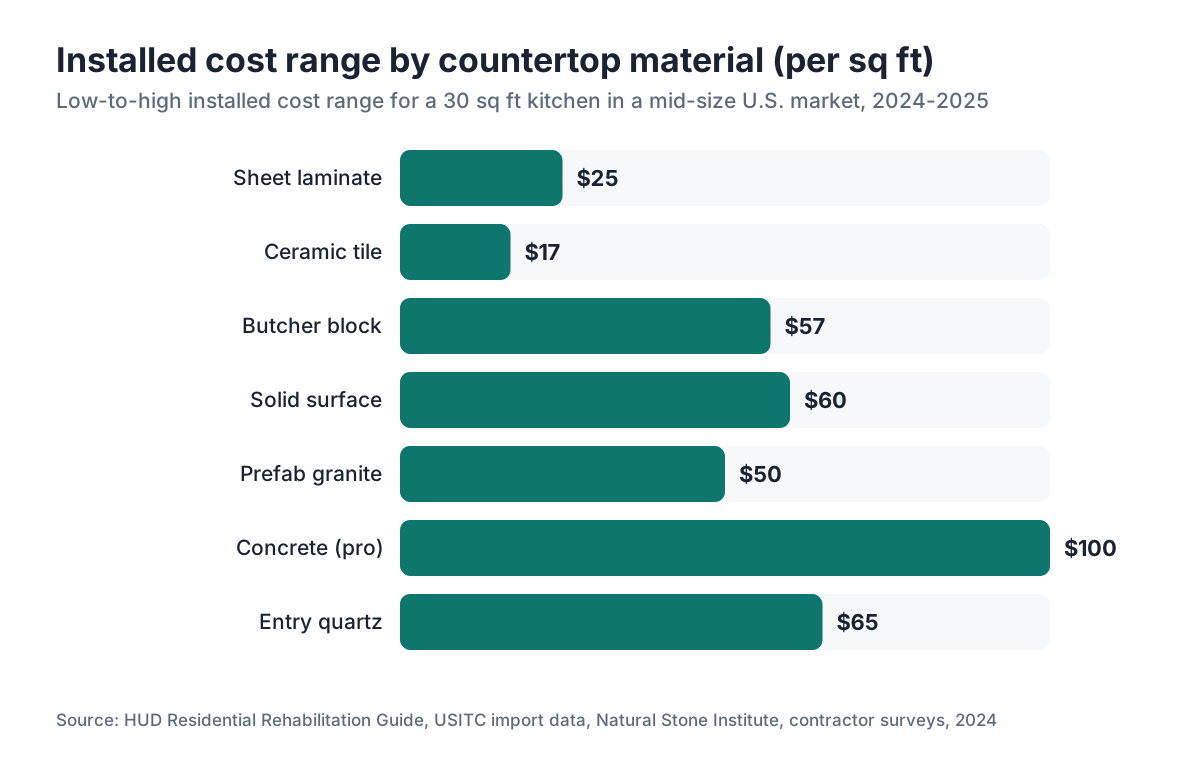
Here's an honest cost table for a typical 30-square-foot kitchen counter project in a mid-size U.S. metro, using 2024-2025 pricing from contractor surveys and retail data. Ranges are wide because regional labor costs and material grades vary a lot.
| Material | Material cost ($/sq ft) | Installed cost ($/sq ft) | DIY-able? | Refinishable? | Typical lifespan |
|---|---|---|---|---|---|
| Sheet laminate | $1-$5 | $15-$35 | Moderate | No | 10-20 yrs |
| Post-form laminate | Pre-made strips | $10-$40/linear ft | Yes | No | 10-20 yrs |
| Ceramic tile | $0.50-$3 | $5-$30 | Yes | Grout only | 20+ yrs |
| Butcher block | $12-$50 | $30-$85 | Moderate | Yes | 20-30 yrs |
| Concrete (DIY) | $10-$25 | $10-$25 | Hard | Sand/reseal | 15-30 yrs |
| Concrete (pro) | $25-$65 | $65-$135 | No | Sand/reseal | 15-30 yrs |
| Solid surface | $20-$45 | $35-$85 | No | Sand/buff | 15-25 yrs |
| Prefab granite | $20-$50 | $35-$65 | Moderate | No | 30+ yrs |
| Entry quartz | $25-$50 | $50-$80 | No | No | 25+ yrs |
| Remnant granite | Varies | $20-$55 | No | No | 30+ yrs |
Sources: contractor surveys, retail pricing from Home Depot and Lowe's, USITC import data [2][4][7].
A few notes on reading that table. "DIY-able" means a handy homeowner with basic tools can do it without professional help. Laminate sheet installation needs a router and a steady hand. Tile needs a tile saw and patience. Butcher block is heavy but manageable with a helper. Granite and quartz require pro fabrication and installation in almost every case, because the weight and cutting tolerances are unforgiving.
What hidden costs make a cheap countertop more expensive than it looks?
The advertised material price is almost never the final number. Several things add up fast.
Demo and haul-away. If you're replacing existing counters, someone has to remove them. DIY demo on tile or laminate is messy but doable. Removing granite or quartz professionally runs $150 to $400 depending on square footage and whether the old material is donated, dumped, or sold [9]. Landfill tipping fees for stone waste run $50 to $150 per load in some counties.
Plumbing disconnection and reconnection. Your plumber disconnects the sink and garbage disposal before anyone installs a new top, then reconnects after. Expect $75 to $200 for that service call, or $0 if you're comfortable doing it yourself.
Edge upgrades. Every budget material has an upsell. Post-form laminate comes with a basic bevel. Custom laminate shops charge extra for waterfall edges or custom profiles. Butcher block ships with square edges, and rounding or easing those costs more. A simple eased edge on fabricated stone is usually included. An ogee or mitered waterfall edge adds $10 to $30 per linear foot on top of the base price.
Backsplash. The countertop quote rarely includes the backsplash. If you're tiling behind the counter, that's a separate material and labor cost.
Installation for heavy materials. Quartz and granite weigh roughly 18 to 20 pounds per square foot in 3cm material [10]. Your base cabinets need to be in good shape to carry that load. If cabinet boxes are soft or uneven, you may need shimming, leveling, or minor cabinet repair before the top goes on. That's an extra labor charge.
For fabricators pricing these jobs: consistent job costing across material types is genuinely hard in a spreadsheet. SlabWise handles material grades, waste factors, and edge upcharges in a single quote so nothing gets missed.
Which inexpensive countertop holds up best in a hard-use kitchen?
Depends on the kind of abuse your kitchen dishes out.
If your kitchen takes a lot of water (big family, frequent cooking, kids washing hands at the counter), ceramic tile with epoxy grout or solid surface are the most resilient. Laminate fails at wet seams over years of exposure. Wood fails fast if it stays wet.
If scratch resistance matters most (you slice directly on the counter, you drop things), prefab granite or entry-level quartz wins. Both score 6 to 7 on the Mohs hardness scale [11], meaning a knife won't scratch them under normal use. Laminate scratches. Wood scratches but heals. Solid surface scratches but heals.
If heat is the issue (you bake constantly, you set pots down without thinking), tile is the only truly heat-safe budget surface. Granite handles heat, but thermal shock from a very hot pan can theoretically crack stone, though that's rare in practice. Laminate blisters around 150 degrees Fahrenheit. Solid surface warps. Wood scorches.
For a rental unit or a high-traffic kitchen where you need something that takes a beating without a repair call, large-format porcelain tile over a cement board substrate is probably the most abuse-tolerant choice in the budget tier. It's near-indestructible under normal use, the grout lines are minimal, and a cracked tile can be replaced individually without redoing the whole counter.
For a family kitchen where looks matter and you're willing to maintain things, butcher block gives the best return in the budget tier. It looks genuinely good, it gets better with use (most people love the worn patina), and you can restore it yourself.
Can you install budget countertops yourself, and what does that actually save?
Yes, for some materials. The savings are real but often smaller than people expect.
Post-form laminate is the most DIY-friendly countertop on the market. The pieces come pre-made in standard 6-foot and 8-foot sections, you cut them with a circular saw, and you screw them down from inside the cabinet. A beginner can do a straight kitchen run in an afternoon. The material costs $10 to $40 per linear foot, and you skip $200 to $600 in installation labor depending on kitchen size [2].
Ceramic tile DIY is accessible if you've tiled before. Budget $30 to $80 for tools if you don't own them (tile saw rental, trowels, grout float). First-timers should expect some waste from mis-cuts. Material savings over pro installation typically run $400 to $900 on a 30-square-foot kitchen.
Butcher block installation is manageable. The panels are heavy (maple butcher block at 1.5 inches thick weighs about 12 to 15 pounds per square foot), so you need a helper. Cutting the sink opening with a jigsaw is the trickiest part. Save roughly $200 to $500 in labor.
Sheet laminate is technically DIY-able but harder than it looks. You're gluing contact cement, which is unforgiving. Once the laminate touches the substrate, it bonds instantly. Bubbles and misalignments are permanent. If you're confident with tools, it works. If not, hire it out and budget for the labor.
Quartz and granite: don't DIY this. The slabs weigh 200 to 400 pounds each, the cuts need a wet saw and diamond blades, and a cracked slab mid-install is a $500 to $2,000 loss with no recourse. The fabricator's installation cost covers their liability when something goes wrong.
For a general sense of installation costs by region, the countertop installation guide has the full breakdown.
What are the best-looking budget countertops that don't look cheap?
Looks are subjective, but a few options consistently fool people.
High-resolution laminate in a concrete or slab-marble pattern is the most convincing value play. Wilsonart's Calcutta Marble and Formica's 180fx line use high-definition photography of real stone printed under the wear layer. In a kitchen with good cabinet color and hardware, it reads as intentional design rather than budget compromise [3].
Large-format porcelain tile (24x48 slabs) with minimal grout lines reads almost like a quartz surface. Some porcelain manufacturers produce patterns that are genuinely hard to distinguish from quartz or marble at normal viewing distances. The grout line is the giveaway, and with matching grout color and tight joints, even that fades.
Butcher block has a premium look in the right context. A white Shaker cabinet kitchen with a thick walnut butcher block countertop looks expensive. The material is warm and natural in a way no synthetic surface matches.
Concrete, done well, looks like something from an architectural magazine. Done poorly, it looks like a sidewalk. The difference is in the sealing, finishing, and pigment choices.
Prefab granite, if you find a color you actually like, is hard to tell apart from custom fabricated granite once it's installed. The difference is in the edge profile options (more limited) and joint placement (fixed by standard widths). See our broader overview of kitchen countertops for a full look at how different materials photograph and age.
Are there green or sustainable options in the budget countertop category?
A few real ones exist, more than marketing language.
Reclaimed wood butcher block uses timber that would otherwise go to waste. Some suppliers source reclaimed barn wood, factory flooring, or bowling alley maple for butcher block production. The embodied carbon in reclaimed wood is lower than virgin timber by a meaningful margin, and the character of old-growth wood is genuinely different from new lumber.
Ceramic and porcelain tiles fire at high temperatures, which is energy-intensive, but the raw material (clay and silica) is abundant and non-toxic. Several U.S. and European manufacturers (Crossville, Dal-Tile) publish Environmental Product Declarations (EPDs) and participate in third-party recycled content certification [12].
Laminate is largely a petroleum-based product on the surface layer, but the core substrates increasingly use recycled wood fiber. Formica and Wilsonart both publish sustainability reports with data on recycled content in their particleboard substrates [3].
Concrete is a mixed story. Portland cement production is a significant source of CO2, accounting for about 8% of global CO2 emissions according to the Global Cement and Concrete Association [13]. But concrete counters use tiny quantities compared to floors or structural concrete, and many GFRC mixes substitute fly ash or slag for a portion of the Portland cement, which cuts embodied carbon.
For most homeowners in the budget tier, the greenest choice is keeping what you have, or buying a durable material you won't need to replace in a decade.
Frequently asked questions
What is the cheapest countertop material per square foot?
Sheet laminate is the cheapest, running $1 to $5 per square foot for the material alone. Post-form laminate tops at home centers cost $10 to $40 per linear foot fully finished. Custom-fabricated laminate installed by a shop runs $15 to $35 per square foot. No other countertop material gets close to the low end of that range.
Can you get granite countertops on a budget?
Yes, through two routes. Prefab granite (pre-cut standard widths with polished edges) installs for $35 to $65 per square foot in most markets. Remnant slabs from fabricators often go for $20 to $40 per square foot because shops want to clear inventory. You don't get to pick the color from remnants, but the material quality matches a full slab.
How long does laminate countertop last?
With normal care, high-pressure laminate lasts 10 to 20 years. The failure modes are heat damage (blistering from pans set directly on the surface), moisture at seams (which swells the particleboard core), and edge chipping from impact. Keep the seams caulked, use trivets, and a laminate top will run a full kitchen cycle without problems.
Is butcher block cheaper than granite?
At entry level, yes. Basic hard maple butcher block installs for $30 to $60 per square foot. Entry-level granite starts around $40 per square foot installed and climbs quickly. But butcher block needs annual oiling and care around sinks. Granite needs almost no maintenance. Over 15 to 20 years, the total cost of ownership for both is closer than the sticker prices suggest.
What countertop material is easiest to install yourself?
Post-form laminate is the most DIY-friendly. The pieces come pre-finished in standard lengths, you cut them with a circular saw, and fasten them from inside the cabinet. No special tools or adhesives required. Ceramic tile is second, accessible for anyone who has tiled before. Butcher block is manageable with a helper. Quartz and granite should not be DIYed due to slab weight and cutting requirements.
What is the most durable inexpensive countertop?
For scratch and heat resistance combined, prefab granite or entry-level quartz wins in the budget tier. Both are extremely hard and don't scratch under normal kitchen use. If durability means surviving moisture and abuse in a rental, large-format porcelain tile with epoxy grout is nearly indestructible. For a family kitchen where occasional nicks are acceptable and refinishability matters, butcher block is hard to beat.
Does a cheap countertop hurt home resale value?
Not necessarily. Remodeling Magazine's Cost vs. Value report consistently shows kitchen countertop upgrades recover roughly 60 to 70 cents per dollar spent at resale. The ROI difference between a $20/sq ft laminate and an $80/sq ft quartz is small. A clean, well-maintained laminate countertop in a market-appropriate home won't hurt a sale. Stained, damaged, or dated counters in any material will.
Can you put new countertops over old ones to save money?
Sometimes. Tiling over existing laminate is possible if the laminate is glued down solidly and the added height won't cause clearance issues at appliances or the sink. Laminate-over-laminate is not recommended because adhesion is unreliable. Most contractors advise demo and fresh installation. The haul-away cost ($150 to $400) is usually worth avoiding the risk of a failed overlay.
What are the best countertop options for a rental property?
Durability and low maintenance matter most for rentals. Large-format porcelain tile, post-form laminate, or solid surface are the top choices. Tile survives the most abuse and can be repaired tile by tile. Solid surface resists moisture and buffs out. Laminate is the cheapest upfront. Avoid butcher block in rentals, since tenants rarely maintain the oiling schedule and water damage around sinks is common.
Is solid surface (Corian) worth it over laminate?
At the same price point, solid surface wins on moisture resistance and repairability. Its seams disappear, sinks can be integrated, and scratches buff out. Laminate is cheaper at entry level, but solid surface handles a kitchen that sees real abuse better over a 15- to 20-year span. If you're deciding between a $35/sq ft solid surface and a $20/sq ft laminate, the $15 difference per square foot usually pays off in a primary kitchen.
How much does it cost to replace countertops in a small kitchen?
A small kitchen typically has 25 to 35 square feet of counter space. Using those numbers: laminate installs for $375 to $1,225 all-in. Butcher block runs $750 to $2,975. Prefab granite comes in at $875 to $2,275. Entry quartz hits $1,250 to $2,800. Add $150 to $400 for demo and $75 to $200 for plumbing disconnection on top of those ranges.
What hidden fees should I watch for in a countertop quote?
Watch for these line items: cutout fees for the sink ($50 to $150) and cooktop ($50 to $100), edge upgrade charges ($10 to $30 per linear foot for decorative profiles), seam location fees, delivery charges for heavy stone, and demolition or haul-away fees for your old tops. Some fabricators also charge extra for tricky angles, islands, or any cutout over a certain size. Always ask for an itemized quote.
Are concrete countertops actually cheap?
Only if you do the work yourself. DIY concrete countertops run $10 to $25 per square foot in materials. Professionally installed concrete costs $65 to $135 per square foot or more, which places it above quartz in many markets. The appeal is full customization, not cost. If you want concrete on a budget, plan for two to three weekends of real work and be honest about your skill level.
What countertop looks most like stone without the stone price?
High-definition laminate from Wilsonart's HD line or Formica's 180fx series is the closest substitute for a fraction of the price. Large-format porcelain tile with a marble or travertine surface is another strong option, and it's harder and more heat-resistant than laminate. Neither fools a stone fabricator up close, but in a finished kitchen under normal light, the visual difference is minimal for most homeowners.
Sources
- U.S. Bureau of Labor Statistics, Producer Price Index for stone products: National average countertop pricing context derived from BLS PPI data for stone and fabricated stone products
- Formica Corporation, Product Sustainability and 180fx line documentation: High-definition laminate pattern realism and recycled content in substrate described by manufacturer
- U.S. Department of Housing and Urban Development, Residential Rehabilitation Inspection Guide: Ceramic tile countertop installed cost ranges ($5 to $30 per square foot) consistent with HUD rehabilitation cost benchmarks
- IKEA USA, butcher block countertop pricing: Hard maple butcher block panel pricing approximately $12 to $15 per square foot at IKEA retail
- Portland Cement Association, Concrete Countertop Materials Guide: DIY concrete countertop material cost range of $10 to $25 per square foot based on cement and aggregate pricing
- U.S. International Trade Commission, HTS Chapter 68 engineered stone import data: Average import values for engineered stone (HTS 6810) ranged approximately $8 to $22 per square foot at U.S. ports in 2024
- Trinseo (Corian), Solid Surface Product Specifications: Solid surface (Corian) installed cost range of $35 to $85 per square foot cited from manufacturer specification and distributor pricing
- National Association of Home Builders, Remodeling Cost Data: Countertop demo and haul-away costs of $150 to $400 consistent with NAHB remodeling cost benchmarks
- Marble Institute of America (now Natural Stone Institute), Stone Weight Reference: 3cm granite and quartz slabs weigh approximately 18 to 20 pounds per square foot as cited in Natural Stone Institute technical references
- Natural Stone Institute, Granite and Quartz Hardness Data: Granite and engineered quartz both score approximately 6 to 7 on the Mohs hardness scale
- Crossville Inc., Environmental Product Declarations for porcelain tile: Crossville porcelain tile products carry third-party EPDs and recycled content certifications
- Global Cement and Concrete Association, Concrete Future: The GCCA 2050 Cement and Concrete Industry Roadmap: Portland cement production accounts for approximately 8% of global CO2 emissions according to GCCA data
Last updated 2026-07-09