TL;DR
- Wrap each stone piece in foam padding or moving blankets first, then secure it with stretch wrap and straps.
- Stand pieces on edge (never flat) on an A-frame or padded cart, and brace them so they can't shift.
- Most breakage starts at an unsupported overhang or one unbuffered corner hitting something hard.
- Both are preventable with the right wrapping order.
Why does wrapping method matter so much for stone?
Stone cracks in transport for one reason almost every time: stress piles up at a single unsupported point. A 3-centimeter granite slab is strong when you push straight down on it and brittle the moment it bends. Leave a corner hanging in the air and the slab's own weight bears down on that overhang like a pry bar, and a bumpy road finishes the job. Good wrapping spreads that load across the whole face and softens any sudden shock before it reaches the stone.
Abrasion is the other threat. Polished stone is harder than most metals on the Mohs scale, granite usually rates 6 to 7 [1], but hardness doesn't make it scratch-proof against another piece of stone, a steel truck wall, or a grain of grit caught under a blanket. One slide across a bare truck floor can leave a scratch that takes 20 minutes of diamond-pad polishing to remove, if it comes out at all.
For a fabricator, a broken or scratched slab on delivery means eating the cost of a new piece or having a very unhappy conversation with the homeowner. For a homeowner moving a removed or salvaged countertop, it means losing something expensive. The steps below are the ones professional stone shops run on every job.
What materials do you need to wrap stone countertops?
You don't need exotic supplies. A well-stocked moving truck rental counter or a hardware store carries almost all of it.
| Material | Typical cost | What it does |
|---|---|---|
| 1/4-inch foam roll (polyethylene) | $15-30 per 25-ft roll | Primary cushion layer; protects polished face |
| Moving blankets (furniture pads) | $8-20 each or free with truck rental | Secondary cushion; absorbs impact and vibration |
| Stretch wrap (3-inch hand roll) | $8-15 per roll | Holds blankets in place; doesn't leave residue |
| Foam corner protectors | $0.50-2 each | Protects inside and outside corners |
| 1-inch nylon ratchet straps | $15-25 per pair | Secures slab to A-frame or truck wall |
| Cardboard sheets | Often free from appliance stores | Separates multiple pieces; adds stiffness |
| Painter's tape | $5-8 per roll | Labels pieces without leaving residue on stone |
If you're wrapping natural stone like granite or marble, reach for thicker foam (3/8 inch), because those surfaces are more porous and chip more easily at thin edges. Engineered quartz like Cambria takes an edge hit a little better, but it still gets the same treatment.
One thing you should never use: newspaper or kraft paper as the first layer against polished stone. The ink and grit in newsprint scratch a honed or polished finish. Foam or a clean moving blanket touches the stone first. That's not negotiable.
What is the correct order of layers when wrapping a stone slab?
Order matters. Build it like a sandwich, from the stone out.
-
Clean the surface first. Any grit left between stone and foam turns into a sanding pad. A quick wipe with a dry microfiber cloth does it.
-
Foam padding against the face. Lay the slab face-down on a foam roll or wrap the foam around it. Cover the whole surface, with at least 2 inches of overlap on every edge.
-
Foam corner protectors on every exposed corner. This is the step most people skip and most regret. Outside corners (the 90-degree points of a peninsula piece, say) and inside corners (the notch where a range sits) both need foam or rubber guards. Inside corners are the worst offenders because they concentrate stress in the stone.
-
Moving blanket over the foam. Fold it so no raw seams press against the stone. Wrap it snug.
-
Stretch wrap to lock it all down. Run overlapping bands around the whole package. Snug, not strangling, because a hard pinch point does its own damage. The blanket should not shift or slide.
-
Label every piece before the final wrap. Painter's tape and a marker on the outside of the stretch wrap. Note the location ("Island front edge"), which face is polished, and any cutouts. Figuring this out in a driveway wastes time and leads to somebody resting a sink-cutout piece on its most fragile point.
For marble countertops, softer at Mohs 3 to 4 [2] and quick to chip, add a second foam layer before the blanket. The extra 10 minutes pays off.
Should stone pieces be transported flat or on edge?
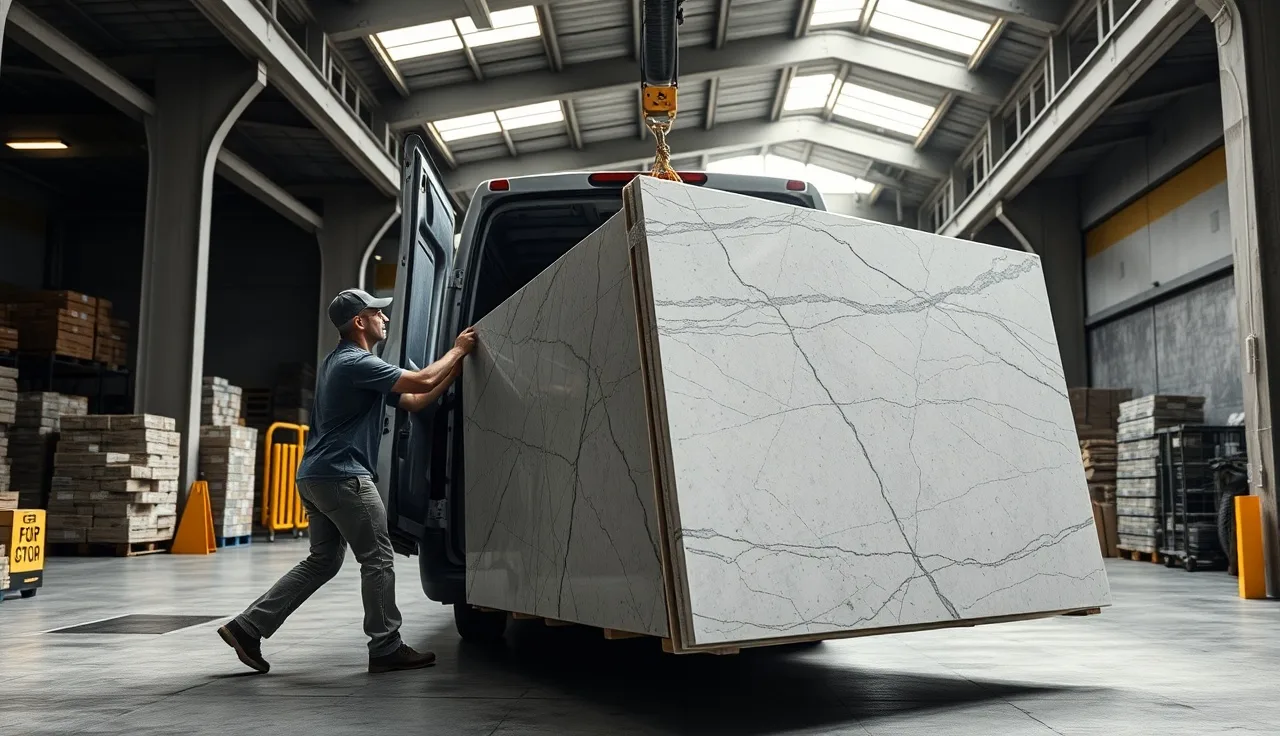
On edge. Always. This is the single most important rule in stone transport, and it's also the one that feels backward.
Lay a slab flat and its weight sits on whatever holds it up. If those supports aren't dead even, a slight ridge in a truck floor, a wrinkle in a blanket, the slab rocks on two points and bends. On a highway, vibration turns that small bend into a fatigue cycle that repeats for hours. Long pieces (anything over about 5 feet) take the worst of it, because the unsupported middle span works like a lever arm.
Stand the piece on its long edge (not the short end) and the bending load nearly disappears. Stone in compression along its edge is far stronger than stone bending across its face. Professional fabricators use A-frame carts and A-frame truck racks for exactly this [3]. No A-frame? Lean pieces against a padded truck wall at roughly 75 to 80 degrees from horizontal, braced so they can't slide forward or back.
The only exception: very thick (4-centimeter or thicker) pieces under about 3 feet long can ride flat if the whole underside is supported. Even then, on edge is still the better call.
For countertop installation jobs where pieces need to land in a set sequence, label each A-frame position so unloading runs in order.
How do you wrap and transport multiple pieces together?
Multiple pieces riding together is where most damage actually happens. Loosely secured pieces shift, knock into each other, and chip edges or crack corners.
The rule is simple: no two pieces of stone ever touch. Every piece gets its own full wrap. Between adjacent pieces on an A-frame or in a stack, slide in a sheet of cardboard or an extra moving blanket. This isn't about padding a big impact. It's about stopping the edge of one piece from buzzing against the face of another for 45 minutes of highway.
Loading several pieces on one A-frame rack? Heavier pieces go toward the center and bottom of the frame, lighter ones toward the outside. Heavy pieces at the ends put a twisting load on the frame and raise the odds of a tip-over.
Shops running multiple deliveries a week get real value from software that tracks which pieces belong to which job and how each one was templated. SlabWise generates labeled cut sheets that fabricators tape to the outer wrap of each piece, so the driver knows the loading order at a glance.
Strap the whole loaded A-frame to the truck wall. Two straps per frame, one high and one low, is the standard. Never trust the frame's own weight to hold it in place.
How do you handle cutouts and sink openings during wrapping?
Sink cutouts and cooktop openings make a piece far more fragile. The opening removes material from what would be the strongest cross-section of the slab, leaving two narrow necks on either side. Those necks are where cracks start.
Before you wrap a piece with a cutout, brace the opening. Cut a piece of rigid foam board (the pink or blue XPS insulation foam from the hardware store works great) to fit snug in the hole. Push it in from the bottom face and wrap it in place. The foam fills the void and keeps the piece from flexing across the cutout on the road.
With undermount sink cutouts, watch the corners of the opening. A good fabricator relieves those corners with a radius, but even a rounded corner is a stress riser [7]. Foam corner guards inside the sink opening, plus the rigid foam infill, give you the most protection.
Once the piece is on the A-frame, turn it so the cutout sits on the uphill side (away from road camber or the truck floor's slope). Small detail, real effect: it changes which side carries the weight through a corner.
What are the most common wrapping mistakes that cause breakage?
These aren't hypothetical. They're the scenarios that produce cracked slabs.
Skipping corner protection. A bare corner catches on a truck wall or another piece and chips. Foam corner protectors cost under $2 each. There's no excuse.
Laying pieces flat in a pickup bed. A truck's suspension is built for a flat, stiff cargo floor. A stone slab is neither. Run an F-150 over a pothole and the bed drives a brief, sharp push up at two points near the rear axle while the slab's ends hang unsupported. Cracks follow. If you absolutely must lay a short piece flat, support the entire slab length continuously and drive slow.
Wrapping too loose. A blanket that shifts in transit folds into a hard ridge that wedges against the stone. Wrap tight enough that you can't slide the blanket by hand.
Moving pieces too soon after fabrication. Silicone-bonded seams and repairs need about 24 hours of cure before the piece moves [4]. Move it early and you stress the joint.
Leaving the bottom edge on bare metal. The edge sitting in the A-frame should rest on rubber or foam, not steel. Pro carts come with rubber feet [3], but a folded moving blanket under the edge works if you're improvising.
And the classic: not strapping the A-frame itself. A loaded, well-packed frame will still slide across a truck floor under hard braking. Two ratchet straps, minimum.
Are there special considerations for outdoor or long-distance transport?
Long hauls (more than a few hours) add thermal cycling to the risk list. The air inside a closed truck can swing 30 to 50 degrees Fahrenheit between a shaded morning load and a sun-baked midday run. Stone handles temperature change fine on its own, with a coefficient of thermal expansion around 4 to 8 parts per million per degree Fahrenheit [5]. The weak point is the resin fills and epoxy seam joins, which move at a different rate than the stone and can open hairline cracks you couldn't see before.
For long trips, wrap every piece as described and leave the trailer or truck cap vented if the outside air allows. A sealed metal trailer in summer sun can hit 140 degrees Fahrenheit inside. That's less a stone problem than a bonding-material problem.
Rain or snow on a short leg? The wrapping here shrugs off brief exposure. But if a wrapped piece is going to sit outside overnight before install, throw a waterproof tarp over the whole bundle. Moving blankets soak up water, and once they're wet they lose most of their cushion.
Freight shipping by common carrier piles documentation and packaging rules on top of the physical protection. Carriers usually want stone crated rather than wrapped, and the crate has to meet their weight and stacking standards. Cargo hauled commercially also falls under federal securement rules that require it to be "immobilized or secured" against shifting with tie-downs, blocking, or bracing [9]. For anything leaving the country or moving by LTL freight, wooden crating around the wrapped, A-framed piece is the floor, not the ceiling.
How do you unload and unwrap stone pieces safely?
Unloading is where a lot of good wrapping gets wrecked in a hurry. The piece survives the drive, then somebody tries to muscle it out solo and sets it down hard on bare concrete.
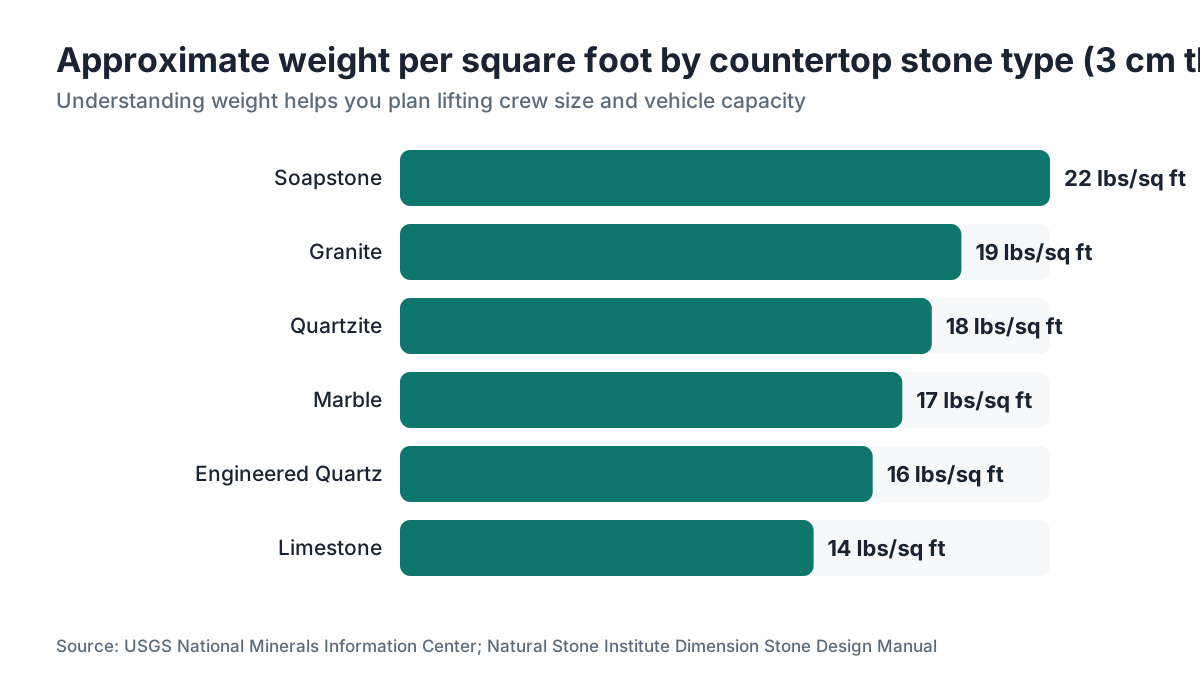
Never move a stone countertop piece alone if it tops about 50 pounds. A 3-centimeter granite top runs roughly 18 to 20 pounds per square foot [1], so a 10-square-foot section is 180 to 200 pounds. Two people, each gripping a long edge and carrying the piece on edge, not flat, is the minimum for anything that size.
Off the truck, set the piece on padded sawhorses or a padded bench. Not bare concrete, not a wood floor. Concrete is hard enough to chip a polished edge on contact. A scrap of carpet under the piece costs nothing.
Unwrap in reverse: stretch wrap first, then blankets, then foam. Skip the knife if the blade can reach the stone. Cut from the outside in, away from the surface.
Inspect every piece the moment it's unwrapped, before the install crew starts fitting. If a chip or crack happened in transit, you want to know before the piece lands on the cabinets, not after. Photograph anything questionable if a damage claim is possible.
For what happens once the pieces are in position, see countertop installation.
What does professional stone transport equipment look like, and do you actually need it?
Professional shops use A-frame carts (also called stone carts or slab carts), welded steel with rubber-padded lower rails. A standard A-frame holds pieces on both sides of a central spine, standing on edge at roughly 70 to 80 degrees. The rubber lower pads grip and cushion the bottom edge. Good carts roll on a wheeled base for shop-floor moves and load straight into truck bodies built with matching A-frame racks.
Do homeowners need this? Mostly no. For a single kitchen removal or delivery, a cargo van, $40 in foam and stretch wrap, and an improvised lean against a padded van wall handles pieces under about 8 feet just fine.
For fabricators and shops, a dedicated cart and a truck with A-frame racks earns back every dollar. Movers who specialize in stone, not general household movers, carry the same gear. If you're paying for transport, confirm before booking that the mover has A-frame capability and isn't planning to lay pieces flat.
Shops that want to track which pieces are on which cart, in what orientation, and headed to which job can do it digitally. SlabWise handles job-level piece tracking and prints delivery manifests that match the physical labels on each wrapped piece, which cuts loading errors on multi-job days.
How should you wrap specific stone types differently?
Most natural and engineered stones ride under the same protocol, but a few have quirks worth knowing.
Granite is dense (about 160 pounds per cubic foot) [1] and takes an impact well, but it chips clean at thin edges and cutout corners. Standard wrapping applies. Watch the edge profile: an eased or bullnose edge is more exposed than a square-cut edge because there's less material at the outermost point.
Marble and limestone are softer and scratch fast. Their natural veining can also turn into a fault line under bending stress. Double the foam on marble, keep pieces under 6 feet upright with extra lateral bracing, and for long runs strap a rigid backing board (1/2-inch plywood [10]) to the back face before wrapping.
Quartzite often runs harder than granite and travels much the same way. For a sense of how it holds up after install, see how to clean quartzite countertops.
Soapstone is unusually dense (up to 175 pounds per cubic foot) [6] and quite soft (Mohs 1 to 2). It scratches easily but resists chipping better than harder stones, so soft packaging matters more than hard corner guards. Read how to clean soapstone countertops for how the surface wears.
Engineered quartz (brands like Cambria) has resin binders that soften under prolonged heat. Same wrapping protocol, but don't leave wrapped quartz baking in a hot enclosed trailer for more than a few hours.
Butcher block countertops and laminate don't face the same breakage risk, but they drink up moisture. Keep them off the truck floor and wrapped in something water-resistant if transport runs more than a day.
What should you do if a piece chips or cracks during transport?
Chips and cracks take different repair paths.
A small edge chip (under about 1/4 inch) usually fills with color-matched epoxy and re-polishes. That's routine shop work for a fabricator. A homeowner can handle minor chips with a stone repair kit (most tile and stone suppliers sell them for $20 to $60), though a pro touch generally looks better.
A crack running through the full thickness is a different animal. Hairline cracks through polished stone can sometimes be stabilized with epoxy injection and reinforced from the underside with fiberglass mesh and epoxy. But a crack at or near a cutout is often a structural failure, and the piece may need to be remade.
Document everything. If the damage happened in professional transport, photograph it in context (show the wrapping condition, the piece's spot in the truck) before anything moves. Carriers run claims processes, and photos taken on the spot are the difference between a paid claim and a fight.
For fabricators, a documented wrapping and loading checklist on every job builds a paper trail that protects the shop in exactly these disputes. If a homeowner says a piece arrived cracked and the shop has checklist records plus driver photos, resolution goes a lot smoother.
Frequently asked questions
Can I transport a stone countertop in a pickup truck?
Yes, for short pieces under about 5 feet, with conditions. The piece rides on edge, braced against the cab, with padding between stone and truck wall. Full-length pieces (over 6 feet) in a pickup bed risk cracking, because the suspension puts a bending load through the axle points. Rent a cargo van or trailer for longer sections, and use foam padding and moving blankets no matter the distance.
How much does it cost to have a fabricator deliver and install countertops?
Delivery and install fees vary by region and shop, but $150 to $400 for a standard kitchen install on top of the fabrication price is a reasonable ballpark based on fabricator pricing surveys. Stairs, long carries, or tight access add cost. Some shops fold basic delivery into the quoted price, so always ask what's included before you compare quotes.
Do you need to wrap countertops differently for quartz vs. granite?
The core protocol is the same: foam against the face, corner protectors, moving blankets, stretch wrap, and transport on edge. Quartz has a more uniform structure with no natural veining fault lines, so it's a bit more forgiving of minor flex. Granite with heavy veining or a visible fissure earns extra lateral bracing along that line to keep it from opening under vibration.
Can one person carry a stone countertop piece?
Not safely for anything over about 50 pounds. A 3-centimeter granite piece runs 18 to 20 pounds per square foot, so a 3-square-foot section already hits 60 pounds of dense, hard-to-grip material. Solo carrying also concentrates stress at your grip points, which can chip the stone. Two people, both on long edges, carrying the piece on edge, is the safe minimum for anything over a few square feet.
How do you wrap a stone countertop corner piece or L-shaped piece?
L-shaped mitered pieces are the most fragile shapes in a job. The miter joint is only as strong as the epoxy holding it, and the inside corner of the L concentrates stress. Move mitered pieces one of two ways: fully assembled with a rigid backing board clamped across both legs, or separated into two straight pieces with the miter joint protected and remated on site. Never let an assembled L-piece flex in transit.
What type of foam is best for wrapping stone countertops?
Closed-cell polyethylene foam roll in 1/4-inch or 3/8-inch thickness is the standard. It's firm enough to cushion impact, it doesn't absorb moisture, and it leaves no residue on polished surfaces. Skip open-cell foam (the soft, spongy seat-cushion type), which compresses too easily and protects less. Foam roll runs $15 to $30 per 25-foot roll at moving supply stores and online.
Is it safe to stack stone countertop pieces on top of each other?
Only if each piece is fully wrapped, a rigid separator (cardboard or foam board) sits between them, the stack stays very short (two or three pieces), and the whole thing is fully supported. Stacking loads the bottom pieces in compression and can crack thinner ones. On edge in an A-frame is always safer. If you must stack, heavier pieces go on the bottom, and you give up any argument that stack vibration didn't cause damage.
How do you protect stone countertop edges specifically?
Edge profiles (bullnose, ogee, beveled) are the most exposed part of a finished slab. Foam corner protectors go on every outside corner. Along the full-length edges, the moving blanket should wrap past the edge by at least 3 inches and get secured with stretch wrap so it can't pull back and bare the stone. For fancy profiles like ogee or dupont, molded foam edge protectors cut to the shape beat flat foam for contact.
How long can stone countertops stay wrapped before installation?
Wrapped stone can sit for days or weeks without harm if it's stored right: upright on edge, stable, in a dry space, out of extreme heat. Wet moving blankets trap moisture, so keep wrapped pieces off damp floors. Resin-filled stones (some granites, engineered quartz) should stay out of temperatures above 100 degrees Fahrenheit for long stretches to avoid bonding-agent expansion.
What's the right way to label wrapped stone pieces so they don't get mixed up?
Painter's tape on the outer stretch wrap works well. Write the room, the location (kitchen island back section, for example), which face is polished, and any cutout or seam details. Shops often print a job sheet and tape it to the piece. Never mark stone or foam directly with permanent marker. If a piece has a defined 'up' orientation, mark that too so it doesn't get flipped on the A-frame.
Do I need to seal stone before transporting it?
No. Sealing is an installation or post-install step and has nothing to do with transport safety. Moving an unsealed piece of natural stone a short distance won't hurt the stone. If a piece was just sealed with a penetrating sealer, wait the manufacturer's recommended dry time (typically 24 to 72 hours) before wrapping it tight, since trapping the sealer under foam while it's still off-gassing can slow the cure.
Can I rent an A-frame stone cart for a one-time move?
Some stone and tile suppliers rent or loan A-frame carts for a day, though it's not universal. General equipment rental companies rarely stock stone-specific A-frames. Your best moves: ask the fabricator who made the tops if they'll lend one, rent a cargo van and improvise a lean against a padded wall, or hire a stone-specialized moving service that brings its own gear.
What is the biggest mistake homeowners make when moving a countertop themselves?
Laying pieces flat in a truck bed or van floor without full continuous support. It looks like the safe, stable choice, but it puts the slab in bending instead of compression. Over any bump or vibration, the center of a flat, unsupported slab flexes a hair. Stone doesn't flex without cracking. Standing on edge against a padded wall, even improvised, beats laying flat on the best-padded floor you've got.
Sources
- USGS National Minerals Information Center: Stone, Dimension: Granite rates 6 to 7 on the Mohs hardness scale and has a unit weight of approximately 160 to 165 pounds per cubic foot, yielding roughly 18 to 20 pounds per square foot at 3-centimeter thickness
- USGS National Minerals Information Center: Marble and Limestone: Marble registers 3 to 4 on the Mohs hardness scale, significantly softer than granite
- Natural Stone Institute: Handling and Storage Guidelines: Professional stone fabricators transport slabs on edge using A-frame carts with rubber-padded lower rails to prevent bending stress and edge damage
- DuPont Silicone Sealant Technical Data (general construction silicone cure guidance): Standard construction silicone sealants require approximately 24 hours of cure time before the joint should be subjected to movement or load
- National Institute of Standards and Technology (NIST): Properties of Common Building Materials: Natural stone has a coefficient of thermal expansion of approximately 4 to 8 parts per million per degree Fahrenheit
- USGS National Minerals Information Center: Talc and Pyrophyllite (soapstone mineral composition): Soapstone (composed primarily of talc) has a Mohs hardness of 1 to 2 and a density up to approximately 175 pounds per cubic foot depending on talc content
- Natural Stone Institute: Dimension Stone Design Manual: Inside corners in stone cutouts are stress concentration points and are specified with radius reliefs in professional fabrication to reduce crack initiation
- Federal Motor Carrier Safety Administration: Cargo Securement Rules (49 CFR Part 393): Federal cargo securement regulations require cargo to be immobilized or secured against shifting using tie-downs, blocking, or bracing; stone slabs transported commercially must comply with these standards
- APA (The Engineered Wood Association): Plywood and Panel Design Specification: Half-inch plywood used as a rigid backing board provides sufficient stiffness to support stone slabs during transport when strapped in place
- Natural Stone Institute: ANSI/NSI 373 Sustainability Standard for Natural Stone: Industry standards for stone fabrication and handling address packaging and transport protocols for finished stone products
Last updated 2026-07-11