TL;DR
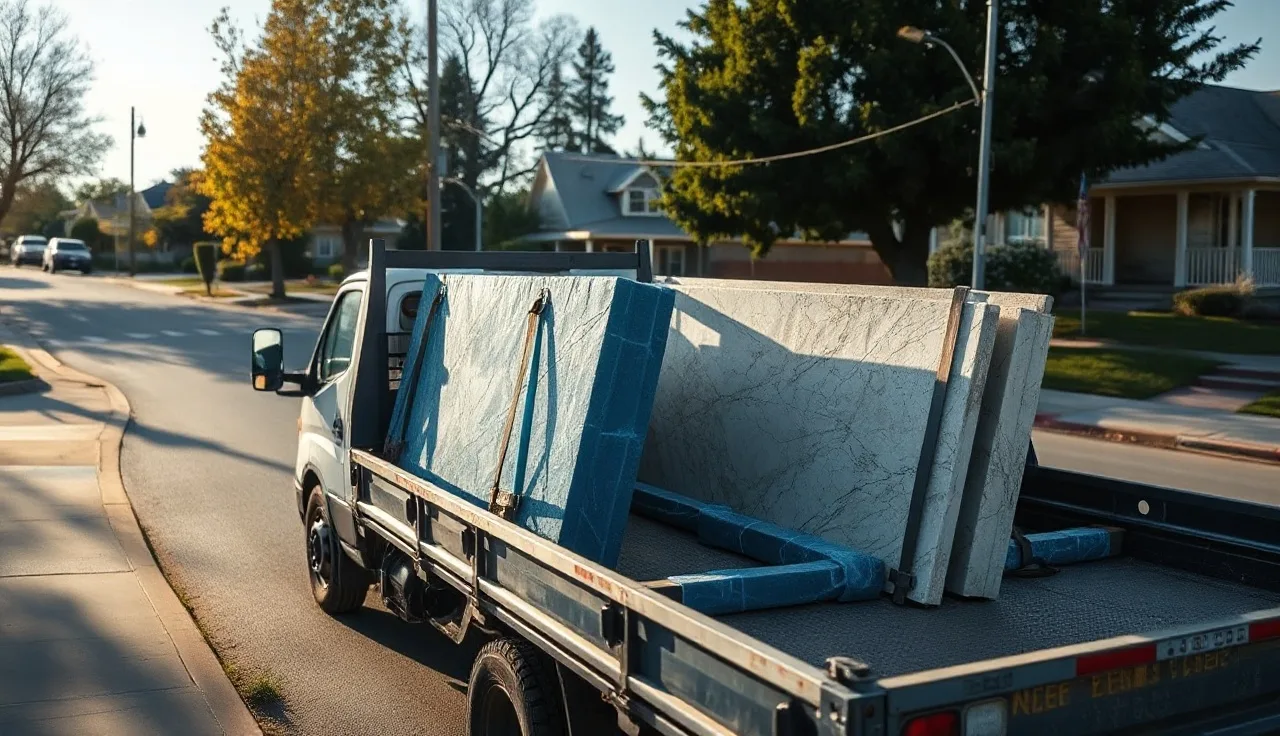
- Stone slabs ride on edge, angled 3 to 5 degrees from vertical, on padded A-frame racks bolted to the truck bed.
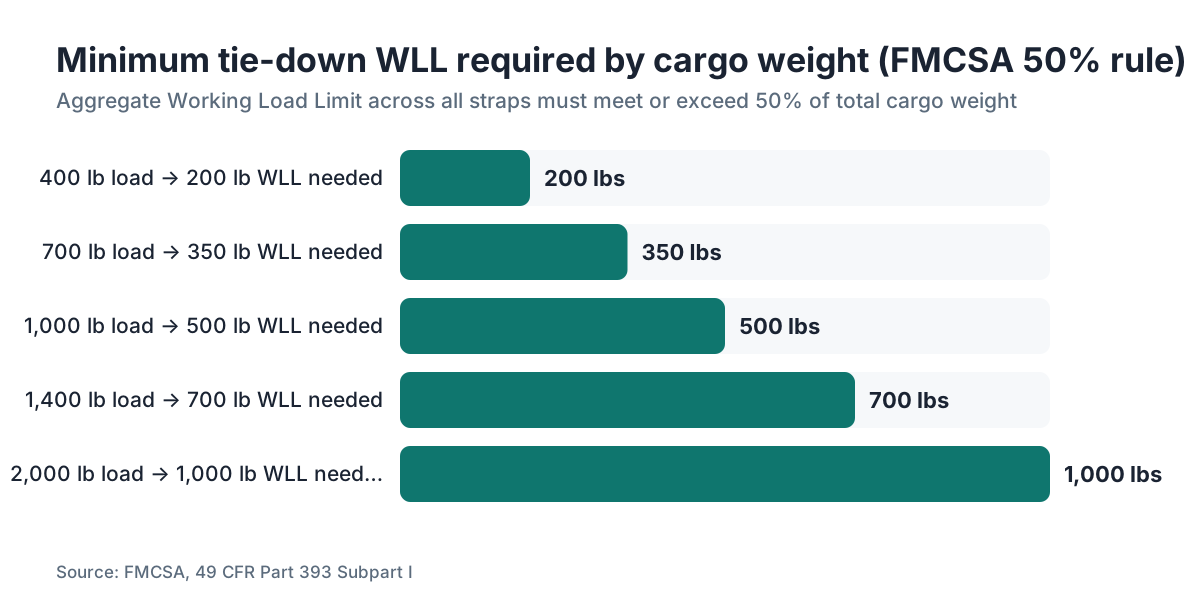
- Strap each cluster with ratchet straps whose combined working load limit hits at least 50% of cargo weight, protect corners with rubber pads, and never exceed the rack's rating.
- FMCSA cargo securement rules (49 CFR Part 393) apply to any commercial truck over 10,001 lbs.
Why does slab transport go wrong, and what does it actually cost?
A cracked slab on the highway is the most expensive four seconds in a shop's week. A full slab of 3 cm granite runs roughly 15 lbs per square foot [1]. A common 55 x 110-inch kitchen slab clocks in around 350 lbs. Drop it, crack it in transit, or let it slide off a badly strapped rack, and you're out $400 to $1,200 on mid-grade material before you count labor, rebooking the install, and the customer call nobody wants to make.
The physics are unforgiving. Stone has zero flex. It can't absorb shock the way wood or engineered material can, so every pothole, hard brake, and sharp turn goes straight into stress at the thinnest points, usually around cutouts, narrow peninsulas, and any section where the fabricator already removed material. Those are the places that crack first.
Insurance rarely pays a "transport damage" claim when the shop can't show it used compliant tie-down methods. The Federal Motor Carrier Safety Administration's cargo securement rules (49 CFR Part 393) cover commercial vehicles over 10,001 lbs GVWR, and stone shop trucks almost always qualify [2]. A violation at a roadside inspection means fines that start around $1,000 per infraction, an out-of-service order, and a mark on your safety record.
Homeowners, this is for you too. Rent a truck or trailer to move a remnant yourself and the same physics apply even though the federal regs don't. The tie-down math below still matters.
What equipment do you need before the slab ever leaves the shop?
The A-frame slab rack is the one thing you can't fake. Good racks are steel-welded, hot-dipped galvanized or powder-coated, with rubber or dense foam padding on the cradle rails. They bolt into the truck bed's stake pockets or to a custom sub-frame. They do not sit loose in the bed.
The rack holds slabs at 3 to 5 degrees off true vertical, leaning slightly toward the vehicle's centerline. That lean keeps the slab's center of gravity over the cradle instead of cantilevered out. Racks rated for 2,000 to 3,000 lbs total load are standard for a one-ton flatbed. Verify the manufacturer's load rating and don't exceed it.
Beyond the rack, here's what belongs on every run:
| Item | Spec to look for | Why it matters |
|---|---|---|
| Ratchet straps | 1" or 2" webbing, WLL ≥ 500 lbs each | FMCSA requires aggregate WLL ≥ 50% of cargo weight [2] |
| Rubber corner protectors | 90-degree notched rubber, ≥ 3/8" thick | Stone edges cut webbing; webbing pressure chips stone |
| Foam or carpet pad between slabs | 1/2" closed-cell foam or moving blanket | Stops slab-on-slab vibration chips |
| Non-slip mat under cradle | Ribbed rubber mat | Kills lateral slide during cornering |
| Load binder (if using chains) | Grade 70 transport chain, 3/8" minimum | For heavy exotic stones or large-format tile |
Run the straps over the top of the slab cluster and down to anchor points on both sides of the rack. Never lay a strap across a bare stone edge. On a long highway run the strap saws into the stone; on a bump the stone cuts the strap. Rubber-protect every contact point.
One thing shops skip that they shouldn't: a rubber mallet and a thin wood wedge. When you load multiple slabs, small gaps open between them. Wedge them snug so they can't rattle. Rattling is how hairline cracks start.
How do you load slabs onto the truck rack without breaking them or hurting someone?
Two people, minimum, every time. A 350-lb slab handled by one person is a back injury or a cracked slab waiting to happen. Four people is better for anything over 250 lbs or any cut piece with a big void like a farm-sink cutout.
Use slab lifter clamps, sometimes called vacuum lifters or mechanical grab clamps, for a distributed grip. Vacuum lifters are the cleanest option for polished faces because they grab without touching an edge. Mechanical clamps work on thicker stock but can chip honed or leathered finishes when the jaws aren't padded.
The loading sequence matters:
- Set the heaviest, largest slab in the rack's center position first. Center mass reduces side-loading stress on the rack's welds.
- Load the next slabs on alternating sides, keeping the stack balanced left to right.
- Load every slab with the long axis vertical (tall dimension standing up, parallel to the rack uprights). A slab laid horizontal on a cradle sits in its weakest orientation.
- Point polished faces of adjacent slabs toward each other with foam between them. Any movement scuffs foam, not stone.
- Once loaded, hand-tighten the straps, then make one full-tension pass. Confirm no strap crosses a bare edge.
Cut pieces with sink or cooktop holes need extra help. The cutout removes material that was holding the piece rigid. Slip a 2x4 or a foam block under the void so the slab isn't spanning the gap unsupported while the truck flexes.
Full slabs headed to a customer's home for countertop installation load last if you're also carrying tools, so they come off first at the site.
What do FMCSA cargo securement rules actually require for stone loads?
The short answer: your straps have to hold at least half the weight of what they're holding, and the load can't move in any direction. 49 CFR Part 393, Subpart I sets the cargo securement standards for commercial motor vehicles [2]. Here are the numbers that decide a stone load.
The combined working load limit (WLL) of all your tie-downs must reach at least 50% of the cargo's weight. Carry 1,400 lbs of slabs and your total tie-down WLL has to hit 700 lbs. Four 2-inch ratchet straps rated at 333 lbs WLL each give you 1,332 lbs of aggregate WLL, well past the requirement for that load.
The rules also require cargo to be blocked from moving forward, rearward, and laterally. Stone on a proper A-frame rack is held sideways by the rack itself, but you still need longitudinal restraint. That means a front headboard or forward-facing straps anchored to the front of the rack, more than side-to-side straps.
FMCSA's requirements for "dressed lumber and similar building materials" (how stone slabs are typically classified for securement) require at least one tie-down for cargo up to 5 feet long and at least two for cargo between 5 and 10 feet [2]. Forward is where the energy goes in a panic stop, so that's where you plan first.
State rules stack on top. Most states adopt FMCSA standards by reference, but some add oversize requirements or require permits for loads wider than 8 feet 6 inches. Check your state DOT before hauling oversize pieces.
If your truck sits under 10,001 lbs GVWR (uncommon for a stone hauler, but possible with a half-ton), federal commercial rules technically don't apply, though state highway codes still ban unsecured loads. California Vehicle Code Section 23114 is one example, with fines up to $1,000 for spilled cargo [3].
How should you drive differently when hauling slabs?
The slab doesn't know you're being careful. It answers to physics. Your driving does as much work as your rigging.
Accelerate and brake gradually. Hard stops shove momentum into the slab stack faster than any strap can absorb it. Leave triple your normal following distance on the highway. Haul stone regularly and your idea of a safe gap needs to shift for good.
Corner at half your normal speed. Lateral G-force is what tips slabs off-angle in the rack. A 15 mph turn that feels slow can still generate enough side force to start shifting a 300-lb slab if there's any slack in the straps.
Speed bumps and railroad crossings: slow to a near-stop. A speed bump at 10 mph sends a jolt through the whole stack. Take it at 25 and you're gambling with $1,000 of stone.
Route planning is real work. A longer route on smooth pavement beats the short way on a rough road. Google Maps has "avoid tolls" but no "avoid rough pavement," so this is manual judgment. Ask your drivers which local roads beat them up. They know.
Check your load after the first mile, then again around the 50-mile mark, which is also what FMCSA expects [7]. Pull over, get out, look at strap tension and slab position. Vibration settles loads even on smooth pavement. Re-tension anything that moved before you roll again.
In hot weather, watch the rubber pads and foam. Heat compresses foam and quietly loosens straps. Re-tension after loading on a hot day even if you checked before leaving the shop.
How do you safely unload slabs at the job site?
Job sites aren't the shop. The surface is uneven, there's less room, and you might not have your full crew. Plan for all of it before you leave.
Bring your vacuum lifters and clamps to the site. Don't let a homeowner or the GC's carpenter "help" by grabbing a slab edge barehanded. Their grip and lifting angle will be wrong, and the liability is yours.
Walk the path from truck to countertop before you unload. Measure doorways (a 26-inch slab through a 28-inch door is a nightmare). Check for steps. Look for carpet or hardwood that needs protection. If you'll have to stand the slab up in a hallway, know which wall it leans against.
Installing granite countertops or marble countertops on an upper floor? Confirm elevator availability and stairwell clearance the day before. Nothing is worse than finding a tight spiral staircase with a full slab already in your hands.
On two-person unloads, talk through every step out loud. "Ready to tilt? Tilting now. Step back." Experienced crews have a good injury record partly because they narrate every movement. Don't assume your partner knows which way you're going.
Once the slab is off the truck and inside, lay it flat on padded sawhorses or on the cabinets themselves if they're level and the job calls for direct placement. Never prop a cut slab against a wall on its bare edge. Hardwood floors dent. Tile floors crack. A 300-lb slab leaning at 80 degrees is not stable.
What are the specific risks with different stone types during transport?
Not all stone moves the same way. The material decides how much caution you stack on top of your standard procedure.
Granite countertops are the most forgiving. Granite's interlocking crystal structure gives it decent shock resistance. You still can't bounce it, but small vibrations are less likely to crack it than other materials. A standard A-frame with foam padding handles granite fine.
Marble countertops are a lot more fragile. Marble's natural veining runs along calcite planes, and those planes are the weak spots. A slab can crack along a vein under vibration that would leave granite untouched. Extra padding between marble slabs and slower speeds both earn their time.
Quartzite gets sold as granite-tough, but haul it like marble. Some quartzite has pronounced foliation that creates crack planes. If you've ever had a quartzite slab come apart on the saw, you already know.
Engineered quartz (like Cambria countertops) is polymer-resin bonded and takes vibration better than natural stone, but the weight is similar and the edges chip the same way under point loads. Don't get casual with it just because it's engineered.
Porcelain slab (large format, 6mm or 12mm) is its own category. A 6mm porcelain slab is genuinely fragile and needs full-length continuous support, not rack cradles. These travel flat on foam, not on edge, when possible. Many fabricators use dedicated porcelain carts and never put porcelain on a standard A-frame.
Butcher block countertops are wood, obviously, but worth a note: they're heavy, they flex under load, and a wet butcher block (freshly oiled or rained on) gains real surface weight. Lay them flat, never on edge.
How do you handle oversized slabs or full slabs that haven't been cut yet?
Full uncut slabs from the distributor usually run 55 to 65 inches wide and 110 to 130 inches long. Some exotics reach 130 x 75 inches. Those pieces are heavy, they're long, and they often overhang the bed.
Federal rules (49 CFR 392.9 and state equivalents) require a red flag or light on any overhang that extends more than 4 feet past the rear of the vehicle [2]. Check the overhang before every run. A rear-extending slab that clips a passing cyclist isn't a paperwork problem. It's a criminal one.
For very large slabs, some shops use a flatbed trailer instead of a truck bed. That's usually the right call for anything over 120 inches long. A trailer drops the slab closer to the ground (lower center of gravity on the rack) and gives you more room to anchor the forward restraints.
When you pick up full slabs from a stone yard, use the yard's overhead crane or A-frame gantry to load, not muscle alone. Most yards have this gear and expect to load your truck. If a yard tells you to hand-carry a full slab, that tells you something about how the yard runs.
Shops doing a lot of full-slab work eventually look at a dedicated slab truck with a side-loading crane (a knuckle-boom or a small articulating crane behind the cab). These rigs run $60,000 to $120,000 configured, and they take manual full-slab lifting almost entirely off the table.
What should a slab transport checklist include before every run?
Checklists sound bureaucratic right up until the day one keeps a $900 slab off the highway as gravel. A good pre-departure check takes under five minutes.
Before loading:
- Rack bolts tight, no visible cracks in welds
- Rubber cradle pads present and in good shape
- Foam separators ready for between slabs
- Ratchet straps checked for fraying or bent hooks
- Corner protectors on hand
After loading:
- All slabs on edge at 3 to 5 degree lean toward centerline
- Polished faces separated by foam
- Cutout pieces supported under the void
- Straps tensioned over rubber corner protectors, not bare edges
- Forward restraint in place (headboard or forward strap anchor)
- No strap crosses a bare stone edge
- Total strap WLL calculated and past 50% of load weight
- Any overhang beyond 4 feet marked with red flag or light
After first mile:
- Pull over, inspect strap tension
- Re-tension if any slack shows
Shops that track deliveries in shop management software (SlabWise includes a job checklist and delivery status tracker in its fabrication workflow tools) can attach this list to the specific job ticket, so there's a record of who loaded and signed off on what.
At the job site:
- Walk the path before unloading
- Two-person minimum on any slab over 150 lbs
- Protect floors before dragging or setting any stone
What are the most common transport mistakes and how do you fix them?
The most common mistake is strapping over bare edges. You see it on trucks that have been running for years. The strap looks tight, the driver assumes it's fine, and after 40 highway miles the strap has cut a 1/16-inch groove into the edge of a marble slab. That's a reject piece you eat.
Fix: make rubber corner protectors mandatory gear, same as the straps. Replace them when they crack or compress. They're cheap.
Second most common: loading too many slabs on one side of the rack. Asymmetric loading puts a lateral moment on the uprights. Over time that fatigues the welds, and one day the failure is catastrophic. Alternate sides as you load.
Third: skipping cutout support. A kitchen piece with a big sink cutout has roughly 25 to 30% of its center mass removed. That piece needs support under the void during transport. It's the piece that cracks in transit and the one the homeowner screams about, because the crack almost always runs from a cutout corner.
Fourth: worn ratchet straps. Webbing degrades from UV, abrasion, and chemical contact (sealer, adhesive). A strap that looks intact can have reduced WLL. Replace straps annually or at the first sign of fraying, broken stitching, or bent hardware.
Fifth: over-trusting the rack. An A-frame rack isn't magic. It has a rated load limit and needs periodic weld inspection, especially at the base-to-upright junction. Galvanic corrosion between a steel rack and an aluminum bed can quietly eat mounting hardware. Check the bolts every few months.
Homeowners moving a remnant in a rented pickup: lay a moving blanket in the bed, stand the slab on edge against the bed wall, pad the contact point, and use at least two ratchet straps. Keep it under 45 mph. Not ideal, but survivable for short distances.
How does vehicle choice affect slab transport safety?
The truck matters more than most shops admit. A standard half-ton pickup carries roughly 1,500 to 2,000 lbs of payload depending on trim. That sounds like plenty until you add a steel A-frame rack (200 to 400 lbs), two full slabs (600 to 700 lbs), tools, and a crew member in the cab. You hit the payload limit fast.
A three-quarter-ton or one-ton flatbed is the minimum sensible choice for a shop doing regular full-slab deliveries. One-ton flatbeds (a Ford F-450 or Ram 4500 platform) carry 4,000-plus lbs of payload and give you the flat bed geometry that a mounted A-frame wants.
High-volume shops go to a dedicated flatbed with a 12 to 16-foot bed. That gives room for a bigger rack and keeps the slab weight centered between the axles instead of hanging over the rear. Weight split between front and rear axles changes handling a lot when the load is top-heavy on a rack.
Tire condition and inflation matter more with stone. Underinflated tires under a heavy load deform on every rotation, and that vibration is what cracks stone over distance. Check tire pressure before every run. The door placard shows the correct pressure for maximum load [4].
Suspension upgrades (helper springs, load-leveling air bags) earn their cost on any truck hauling regular slab loads. They cut body roll in corners and soften the shock reaching the slab. Air bags in particular let you dial stiffness to the load weight.
Are there any regulations specific to stone and countertop transport beyond FMCSA rules?
FMCSA is the main federal framework, but OSHA, state weight limits, and workers' comp all reach into slab transport. The cargo securement standard (49 CFR Part 393) does the heavy lifting [2]. Stone slabs fall under general freight, with a reasonable argument that large dressed pieces fit the "dressed lumber and similar building products" category (Section 393.116), which requires at least one tie-down for cargo up to 5 feet long and at least two for cargo between 5 and 10 feet [2].
OSHA has separate standards for stone shops that touch handling and lifting (29 CFR 1910.178 for powered industrial trucks, 29 CFR 1926.602 for construction site equipment) [5]. Loading and unloading the shop truck sits in a gray zone between shop and highway, and OSHA's general duty clause applies: you have to provide a workplace free from recognized hazards. A 350-lb slab handled by one worker with no mechanical assist is a recognized hazard.
Silica dust is a big OSHA concern in stone fab (crystalline silica from cutting and grinding), but transport itself is low risk unless you're hauling freshly cut slabs in an enclosed space with no dust control [6].
State weight limits apply to the loaded vehicle, more than the cargo. If your truck plus rack plus stone tops the registered GVW, you may need commercial plates, a weight permit, or both. Some states set bridge formula limits that treat multi-axle trucks differently from single-rear-axle pickups. Check your state DOT before putting a very heavy load on a light-registered vehicle.
Workers' comp exposure for transport injuries is real. Back injuries from manual materials handling are among the most common work-related injuries and are preventable with mechanical handling gear, per NIOSH [8]. Mechanical lifters, proper crew sizes, and handling training cut both injuries and insurance costs.
Frequently asked questions
How heavy is a typical stone countertop slab?
A standard 3 cm (roughly 1.25-inch) granite or quartz slab runs about 13 to 18 lbs per square foot depending on the stone. A common full slab around 55 x 110 inches weighs 350 to 450 lbs. Porcelain slabs at 6mm are lighter, around 4 to 5 lbs per square foot, but far more fragile.
Can I transport a stone slab in a regular pickup truck?
Yes, for short distances with a remnant, but it's not ideal. Lay a thick moving blanket in the bed, stand the slab on edge against the front of the bed, pad the contact points, and use at least two ratchet straps. Keep your speed under 45 mph and avoid rough roads. For anything over 60 to 70 lbs or longer than 6 feet, get help or hire a pro.
What angle should slabs be loaded on an A-frame rack?
3 to 5 degrees from true vertical, leaning toward the truck's centerline. That slight inward lean keeps the center of gravity over the cradle. Perfectly vertical is unstable; more than 10 degrees off vertical starts putting excessive bending stress on the bottom edge. Most commercial A-frame racks build this angle in already.
How many straps do I need to haul stone slabs legally?
FMCSA 49 CFR Part 393 requires aggregate working load limit (WLL) across all tie-downs to reach at least 50% of cargo weight. For 800 lbs of stone, you need at least 400 lbs of total WLL. A single 2-inch ratchet strap is typically rated 333 lbs WLL, so you'd need a minimum of two, though four is the practical standard for any load over 300 lbs.
Should stone slabs be transported flat or on edge?
On edge, almost always. Stone is strongest in compression along its face, not in bending across it. Laying a slab flat over unsupported spans puts it in bending, which is how it cracks. The exception is very thin porcelain (6mm), which travels flat on continuous foam support because its edge strength is too low for A-frame cradle contact.
What's the best way to transport a slab with a sink cutout?
Transport it on edge like any other slab, but add a foam block or piece of 2x4 under the void so the slab isn't spanning the cutout unsupported. Sink cutout corners are stress concentrators. That's where cracks start under transport vibration. Add extra padding around those corners where straps or adjacent slabs could make contact.
Do I need special permits to haul stone on a flatbed truck?
Possibly. If the loaded vehicle tops its registered GVW, or if the load overhangs more than 4 feet behind the vehicle, you may need a state oversize or overweight permit. Any overhang beyond 4 feet requires a red flag or light under federal rules. Check your state DOT for specifics, since requirements vary a lot by state.
How do I prevent slabs from cracking against each other in the rack?
Place foam or carpet padding between every pair of slabs. Closed-cell foam at least 1/2 inch thick is the standard. Load slabs with polished faces toward each other so any vibration contact happens face-to-face through foam, not edge-to-face. After loading, use thin wood wedges or foam offcuts to fill gaps so slabs can't rattle against the separator.
How do I inspect my A-frame slab rack for safety issues?
Check welds at the base-to-upright junction every few months, more often on high-mileage trucks. Look for cracking paint or rust streaking, which signals weld fatigue. Inspect mounting bolts for galvanic corrosion (common when a steel rack meets an aluminum bed). Check rubber cradle pads for compression or cracking. Replace worn pads before they go metal-on-stone.
What's the FMCSA rule for commercial vehicles hauling building materials?
49 CFR Part 393, Subpart I governs cargo securement for commercial motor vehicles over 10,001 lbs GVWR. Stone slabs fall under general freight or dressed building materials categories. The minimum tie-down requirement for cargo over 10 feet long is two tie-downs, with aggregate WLL at least 50% of cargo weight. Forward securement is the primary requirement.
How do fabricators handle very large slabs that don't fit a standard truck bed?
Most shops use a flatbed trailer for slabs over 120 inches long. A trailer drops the rack closer to the ground and improves stability. Some high-volume shops invest in a flatbed truck with a small knuckle-boom crane for loading, which removes manual handling almost entirely. Full slabs from distributors are typically loaded at the stone yard using overhead cranes.
What should I do if a slab shifts during transport?
Pull over as soon as it's safe. Never adjust load restraints while moving. Assess whether the slab is still safe to continue, re-secure all straps, and check for cracking. If the slab has cracked significantly, it may not be safe to keep hauling it vertically. Photograph the slab's condition for insurance documentation before you do anything else.
Do OSHA rules apply to loading and unloading stone slabs from a truck?
Yes. OSHA's general duty clause (Section 5(a)(1) of the Occupational Safety and Health Act) requires employers to protect workers from recognized hazards, which includes manual slab handling injuries. OSHA 29 CFR 1910.178 covers powered industrial trucks used in loading. Back injuries from slab lifting are among the most common injuries in stone fabrication and are considered preventable with mechanical assists.
How often should I recheck the load on a long haul?
After the first mile, then again near the 50-mile mark, which is what FMCSA expects for cargo inspection [7]. Recheck after any change in driving conditions, like moving from smooth highway to rough local roads. Vibration settles even well-secured loads, so re-tension any strap showing slack. Hot weather compresses foam and loosens straps, so check more often on hot days.
Sources
- Natural Stone Institute (formerly Marble Institute of America), Stone technical resources: Granite slabs run approximately 13 to 18 lbs per square foot at 3 cm thickness depending on stone density
- Federal Motor Carrier Safety Administration, 49 CFR Part 393 Subpart I, Cargo Securement Rules: FMCSA requires aggregate tie-down WLL of at least 50% of cargo weight; applies to commercial vehicles over 10,001 lbs GVWR; red flag required on overhangs beyond 4 feet
- California Legislative Information, California Vehicle Code Section 23114: California Vehicle Code 23114 penalizes spilled cargo with fines up to $1,000 and applies to non-commercial vehicles
- National Highway Traffic Safety Administration, Tires: Correct tire inflation pressure for maximum load is found on the vehicle door placard, not the tire sidewall
- Occupational Safety and Health Administration, Powered Industrial Trucks (29 CFR 1910.178): OSHA 29 CFR 1910.178 governs powered industrial trucks (forklifts, vacuum lifters) used in shop loading operations
- Occupational Safety and Health Administration, Crystalline Silica: OSHA's silica standard applies to stone fabrication cutting and grinding; transport of freshly cut slabs in enclosed spaces presents lower but nonzero silica exposure risk
- FMCSA, Federal Motor Carrier Safety Regulations (49 CFR 392.9, Inspection of Cargo): 49 CFR 392.9 requires cargo inspection before departure and after the first 50 miles; re-inspection required after change in driving conditions
- National Institute for Occupational Safety and Health (NIOSH), Ergonomics and Musculoskeletal Disorders: Back injuries from manual materials handling are among the most common work-related injuries and are preventable with mechanical handling equipment
- Natural Stone Institute, Technical resources for professionals: Stone slabs are strongest in compression along their face plane; transporting flat over unsupported spans creates bending stress that can cause fracture
- FMCSA, Hours of Service and driver safety: Commercial vehicle operators are required to conduct pre-trip inspections including cargo securement before each run
Last updated 2026-07-10