
TL;DR
- A 20 to 30 minute video call before any site visit lets fabricators screen job complexity, confirm budget, capture rough square footage, and catch deal-breakers like tight access or damaged cabinets.
- Shops that add a structured pre-visit video step commonly cut wasted drive time by roughly a third and close more jobs, because a client who shows up to the template is already sold.
Why do fabricators bother qualifying leads over video at all?
Drive time is the most expensive line item most small shops never track. A two-person template crew burning 90 minutes in transit for a job that was never going to close costs real money, and it happens all the time.
Countertop work runs on thin margins. IBISWorld's Kitchen Cabinet and Countertop Manufacturing industry data puts average net profit margin in the space at roughly 5 to 8% [1]. Add labor, fuel, and the opportunity cost of a slot on your template calendar, and a single dead site visit can eat the profit from two jobs you actually land.
Video calls fix that at almost zero cost. You're not replacing the template visit. You're filtering before it, so every physical appointment has a real shot at converting.
There's a second payoff fabricators rarely mention. The call itself builds trust faster than a phone call ever could. A homeowner who can see your face, watch you react to photos of their kitchen, and ask questions in real time feels like they know you before you walk through their door. That familiarity shortens the sale.
What equipment do you actually need to run a pre-visit video call?
Nothing fancy. A laptop or tablet with a decent front-facing camera, a quiet room, and a stable connection. That's the floor.
Do more than a handful of these a week and a few small upgrades earn their keep. An external USB webcam (Logitech makes reliable ones in the $70 to $120 range) beats most built-in laptop cameras by a wide margin. A ring light or a desk lamp aimed at your face, not behind you, kills the silhouette problem that makes you look like you're in witness protection. A USB headset mic, even a $40 one, sounds far better than laptop speakers echoing off a hard-surface shop floor.
For the platform, Zoom is the default because almost everyone over 35 has used it and can join without an account [2]. Google Meet works just as well and is free. FaceTime is fine iPhone to iPhone, but you lose screen sharing, which matters here. Steer clear of anything that makes the homeowner download an unfamiliar app. You'll drop leads at the install screen.
Screen sharing is the one feature that lifts a video call above a phone call. Pull up a material comparison, show a photo of a similar kitchen you built, or walk through a rough quote together. Confirm your platform supports it and practice turning it on before you're live with a client.
How do you actually structure a 20 to 30 minute qualifying video call?
The call has four phases. Keep them in order and you'll rarely run long.
Phase 1: Confirm logistics (3 to 5 minutes) Verify the address, confirm they own the home or can approve the project, and pin down the timeline. "Are you hoping to have this in before the holidays, or is the timing flexible?" A client who says "we close in six weeks" has urgency. One who says "whenever, no rush" might be shopping for the next year. Neither is bad. You just need to know which one you've got.
Phase 2: Walk the space together (8 to 10 minutes) Ask them to grab their phone and walk you through the kitchen on camera. You're reading several things at once: the layout, the existing material (which tells you about removal), the backsplash, the sink type, and obstacles like a peninsula that wraps a corner or a cooktop cutout. Corners and cutouts add fabrication time and material waste. Spot a lot of them early and your estimate goes up.
While they walk, ask them to hold the camera steady over the counter surface for five seconds. Look for cracks, chips, and uneven cabinet lines. Cabinets that aren't level become your problem at install, not theirs. Catching it now lets you quote a leveling allowance or flag it straight.
Phase 3: Discuss material and budget (8 to 10 minutes) This is where most fabricators get shy. Don't. Ask it plainly: "Do you have a budget range in mind?" If they push back with "we don't know what things cost yet," that's your cue to educate. Give real numbers. Laminate runs about $15 to $40 per square foot installed [3]. Mid-range quartz lands around $55 to $120 per square foot installed. Granite or marble can start near $50 and run well past $200 depending on the slab and complexity.
Honest ranges early don't lose jobs. They keep you from quoting jobs that were never yours to win. A client who needs budget laminate has no business in your template queue if you only do stone.
Phase 4: Set clear next steps (3 to 5 minutes) End with a specific commitment. Either book the template on the call, send a follow-up with two or three slots, or tell them honestly you're not the right fit. The worst way to end a qualifying call is a vague "we'll think about it." Push for a decision before you hang up.
What questions should you ask on a countertop video qualifying call?
Here's the core set. You won't hit every one on every call, but these catch the common deal-breakers and budget signals.
Scope and complexity
- Roughly how many linear feet of countertop are we replacing? (Even a guess helps.)
- How many sinks, and are they undermount or drop-in?
- Any cooktop cutouts, or is the range freestanding?
- Are the cabinets existing or new? If new, are they installed yet?
- Any waterfall edges, curved sections, or unusually deep counters?
Access and logistics
- Is the kitchen on the ground floor? (Slab weight matters on upper floors and tight stairwells.)
- Any parking situation we should know about for a delivery vehicle?
- Are you handling demolition and removal, or is someone else?
Decision process
- Is it just you deciding, or is a partner or contractor involved too?
- Have you gotten quotes from other shops already?
- What's driving the timeline?
Material knowledge
- Have you settled on a material, or are you still looking?
- Have you seen slabs in person, or are you working from photos?
That last pair matters. A client who has never touched a quartzite slab and thinks it's maintenance-free like quartz is headed for a very different experience than one who spent three months researching. Setting expectations before the template saves you a hard conversation after install.
How do you get homeowners to actually show up to the video call?
A booked call that doesn't happen wastes nearly as much as a dead site visit. The fixes are simple and easy to skip.
Send a calendar invite within five minutes of agreeing on a time. Put the video link right in the invite. Don't make them hunt. Add one line: "Please have your phone handy so you can walk us through the space on camera." That sentence doubles the quality of the call because they show up ready.
Text a reminder the morning of, not an email. Open rates for text run near 98% against 20 to 30% for email, per Mobile Marketing Association benchmarks [4]. A plain "Looking forward to our 2pm call, here's the link: [link]" does the job.
Afternoon call? A second text 30 minutes out is not overkill for a potential multi-thousand-dollar job.
For no-shows, wait five minutes and text: "Standing by for our call, here's the link again." Wait five more. Still nothing? Send one message offering to reschedule. No answer within 24 hours and they go to your low-priority pile. You can't close everyone, and chasing ghosts costs more than letting them go.
What are the biggest mistakes fabricators make on pre-visit video calls?
The most common one is treating the call like a friendly chat instead of a qualifying conversation. Without a framework, calls drift. You spend 25 minutes on granite versus quartz, never ask about budget, and book a template for someone who wants prices you don't offer.
The second is doing all the talking. Your job on a qualifying call is to listen. Ask, then let the homeowner run. Their words tell you more about the job than anything you can say.
Third: showing up on camera in a dim, cluttered, chaotic background. It sounds superficial. It isn't. A homeowner deciding whether to hand you a $15,000 job is making a trust call, and your background is part of it. A clean shop wall, a tidy sample display, or a well-lit home office reads as competence.
Fourth: skipping the decision-making question. Fabricators book a template with one spouse, cut the tops, then watch the other spouse veto the material. Asking "who else is involved in this decision?" on the video call heads that off. It's not rude. It's professional.
Fifth: ending the call with no specific next step. "I'll send you some pricing" is not a next step. "Let me get you a rough range right now, and let's talk about a template date" is.
How do you handle rough measurements and square footage estimates over video?
You're not templating over video. Drop that idea. You're getting a defensible ballpark that lets you quote a range and decide whether the job earns a site visit.
Ask the homeowner to measure the countertop sections with a tape measure before the call. Most people own a tape, and most kitchens take under 10 minutes with basic instructions. Send a simple guide by text or email the day before: measure the length of each section, measure the depth front to back, and count sinks and cooktop cutouts.
If they measure during the call, coach them. "Hold one end at the wall, run it to the far cabinet, tell me the number." Write it down and do the math yourself. Length times depth in inches, divide by 144 for square feet per section, add them up. A typical kitchen holds 25 to 45 square feet of countertop, per NKBA design standards [5].
Add 10 to 15% for waste and cutouts on your end. Don't frame that buffer like padding. It's standard fabrication waste, and if they ask, say so plainly.
For layouts with angles, returns, or curves, be upfront: "I can give you a rough range from what I'm seeing, but the template visit is where we lock the real number." That honesty builds more trust than false precision.
Want to turn those rough numbers into a formal quote fast? Quoting software like SlabWise takes rough dimensions and produces a priced estimate with material options in minutes, handy to share right after the call while the client is still warm.
Can you show material samples over video, and how well does it actually work?
You can show samples over video, and it helps, with honest limits. Screen color varies, so a Calacatta Gold that reads warm and cream on your monitor might look cool and stark on their phone. Say it out loud: "Colors shift on screens, so you're getting the pattern and movement here, not an exact color match."
Even so, showing a sample beats describing one. Hold the slab or tile sample close to your camera. Move it to show how the veining runs. Tilt it to show the edge profile. A homeowner who has never been to a stone yard has no picture of what "dramatic veining" means until you put it on screen.
For a client stuck between two materials, send them to a local slab yard or a big-box store to touch the material before the template. That's not a stall. It's good advice that protects you both from a buyer who flips after fabrication starts.
Screen-share photos of completed jobs in the material they're considering. Real kitchens with real slabs in context sell harder than stock images. If you keep a portfolio, the video call is the moment to walk through it.
How do you qualify for job complexity and flag red flags before visiting?
Red flags show up on video if you know the tells. Here are the ones experienced fabricators watch for.
Unlevel or damaged cabinets. Ask the homeowner to run a hand along the cabinet top. Wobble, gaps, or uneven spots mean a leveling job that adds time and may sit outside your scope.
Very old homes. Walls and counters in homes built before 1980 often run out of square past normal tolerance. A 90-degree corner might really be 87. You can't template that over video, but you can flag it: "Older homes often have walls that aren't perfectly square, so we'll need extra time at template and some measurements may shift."
Asbestos and lead. Removing countertops in pre-1980 homes can disturb materials that contain asbestos or lead. The EPA recommends professional testing before renovation work that may disturb these materials [6]. It's not a reason to refuse the job, but raise it on the call so the homeowner isn't blindsided by a testing step.
Existing stone. Pulling out stone is heavy, slow, and sometimes wrecks cabinets. See thick granite or marble on the walk-through, add a line item, and say so.
Multiple contractors. A general contractor, a plumber, and a tile setter all touching the kitchen means coordination complexity climbs fast. Ask who's managing the project and how decisions get made. Jobs without a clear coordinator run more delays and change orders.
Out-of-scope work. If they mention moving electrical for a new cooktop or shifting plumbing for a relocated sink, that's usually not your work. Clarify scope early or you'll get pulled into managing work you're not licensed or equipped to do.
How do you turn a successful qualifying call into a booked template appointment?
The move from call to appointment is a sales moment. Most fabricators treat it as paperwork. It isn't.
By the end of a good call you know the scope, have a rough square footage, understand the material direction, and have confirmed the budget fits. That gives you standing to say: "Based on everything you've told me, I think we can build a solid project here. Let's get you on the template calendar. My next slots are Tuesday at 9 or Thursday at 1. Which works better?"
Offer two specific times. Not "what works for you?" Not "I'll check and send options." Two slots forces a choice instead of kicking off a scheduling thread that drags across a week of email.
If they want to think, respect it but set a follow-up: "Totally fine. I'll send the rough pricing we discussed within the hour, and let's touch base Friday morning. Sound good?" Now you have a defined next contact.
After the call, send a short follow-up email within 30 minutes. Include the rough square footage you estimated together, the one or two materials you discussed, the rough range, and the two template slots. Four or five lines. Long follow-up emails go unread.
Sharing a preliminary range from your quoting software right after the call is one of the strongest closes you've got. A client staring at a real number, even a range, has something concrete to approve. The ones who say yes in writing to a range almost always book the template. Tools like SlabWise are built for exactly this, turning your call notes into a range quote in a few minutes.
Still exploring materials at this stage? Point clients toward kitchen countertops, granite countertops, marble countertops, or laminate countertops so they land at the template with a clearer direction.
What's a realistic close rate improvement from adding a pre-visit video call step?
Honest answer: research on countertop shops specifically is thin. Nobody has run a controlled trial on this. The closest numbers come from adjacent industries.
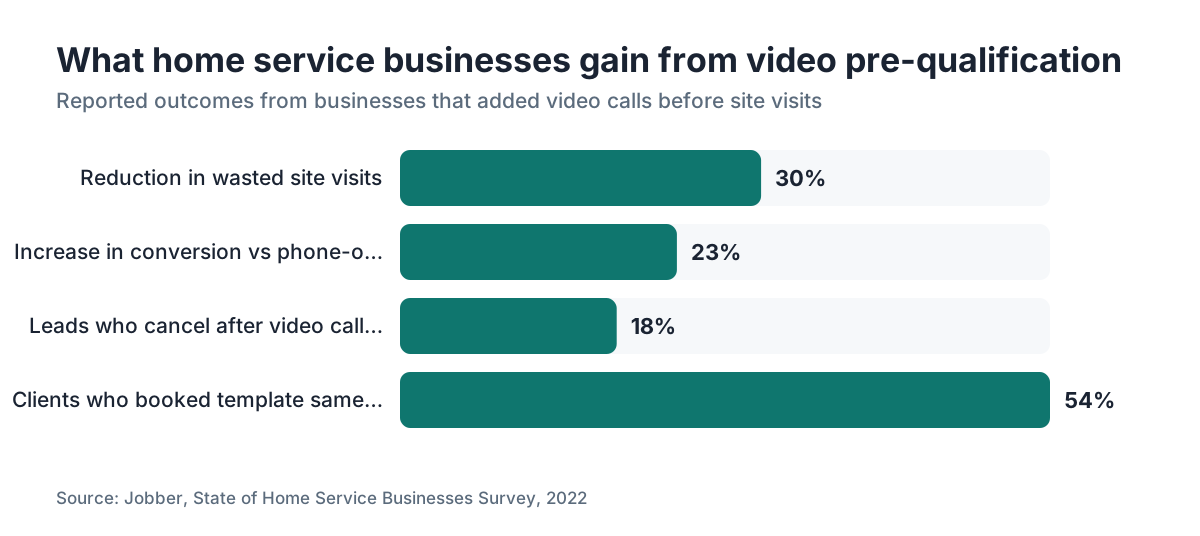
A 2023 study in the Journal of Business Research found that video-mediated sales consultations raised conversion rates by an average of 23% over phone-only consultations across service businesses, driven mostly by higher perceived trust and clearer communication of complex product details [7]. Countertop work, with physical samples, spatial complexity, and big purchase amounts, fits that profile.
In home services broadly, a 2022 Jobber survey of more than 1,000 business owners found that companies using video calls for initial consultations reported 30% fewer wasted site visits and rated lead quality higher on average [8].
The math for a typical shop is clean. Run 40 template appointments a month, lose 25% to no-conversions (10 dead visits), figure each visit at 2 hours of crew time plus fuel around $80 fully loaded, and that's $800 a month in pure waste. Cut it 40% with video pre-qualification and you save $320 a month and a stack of labor hours, at zero tool cost.
The close-rate lift from the calls themselves, apart from the waste savings, is harder to pin down. But the logic holds. A client who sits through a 25-minute video call, sees your process, and hands over their own measurements is far more committed than one who found you on Google an hour ago. Higher commitment at the top of the funnel converts better at the bottom.
How should fabricators handle leads who refuse to do a video call?
Some people just hate video. Some don't have a reliable setup. Some are private. None of that makes them bad clients.
If a lead balks at video, offer a phone call with photos. Ask them to text three to five shots before you talk: a straight-on view from the doorway, a close-up of the existing counter surface, the sink and cooktop area, and any odd feature like a peninsula or eating bar. That's nearly as useful as a live walk-through and asks nothing they find uncomfortable.
For leads who won't do video or send photos, you have a call to make. Schedule the site visit as-is, knowing you're going in half-blind. Or make a short phone call your minimum and say so: "We always do a quick phone consult before booking a template, just to confirm we're the right fit and can give you accurate pricing."
Most people are fine with that. It reads professional, not demanding, and it still hands you the information you need to decide whether the visit is worth the drive.
For clients weighing premium stone, point them to cambria countertops or how to clean stone countertops in your pre-visit prep email so they understand care expectations before you sit down together.
Frequently asked questions
How long should a countertop lead qualifying video call be?
Twenty to thirty minutes is the target. Under fifteen and you can't do a proper space walk-through and cover materials. Over forty-five usually means the call has drifted into scope creep or the lead is indecisive. Set the expectation upfront: 'This will take about 25 minutes.' Most people appreciate the specificity and respect it.
What's the best video platform for qualifying countertop leads?
Zoom is the default because familiarity is high and clients can join without an account. Google Meet is a solid free alternative. FaceTime works iPhone to iPhone but lacks screen sharing. Avoid any platform that makes the homeowner download a new app or create an account. Friction at the login step loses leads before the conversation even starts.
Should I charge for a pre-visit video call or offer it free?
Offer it free. The call's job is qualification, not revenue. Charging for a discovery call before any commitment will cost you leads who are genuinely interested but haven't decided to spend money with you yet. The payoff comes from converting more of those calls into paid template appointments, which is where your real time investment begins.
How do I get homeowners to take rough measurements before or during the video call?
Send a simple one-page measurement guide by text or email the day before. Include a diagram of a basic kitchen layout and ask for the length and depth of each countertop section in inches. Most homeowners can do it in 10 minutes with a tape measure. If they haven't measured before the call, coach them through it live. A rough number beats no number.
Can I do a rough quote during or right after the video call?
Yes, and you should. A rough range while the conversation is fresh keeps momentum going. Use your measured square footage, add 10 to 15% for waste, pick the material tier they discussed, and multiply by your installed price per square foot. Frame it as a range: 'Based on what you've described, you're looking at roughly $4,500 to $6,200 for that material. The template visit locks the exact number.'
What if the kitchen has very complex features I can't evaluate well over video?
Be honest about the limits. Tell the client: 'I can give you a rough range from what I'm seeing, but a curved peninsula or radius corner really needs to be measured in person to quote accurately. The template visit is where we finalize that.' Quoting complex geometry precisely over video leads to change orders and unhappy clients. Under-promise on video, over-deliver at template.
How do I handle a client who has already gotten two or three quotes before calling me?
Ask directly on the call: 'Have you gotten a sense of pricing from other shops?' That tells you where you stand and whether their budget is calibrated. Don't knock competitors. Use the call to explain what sets your process apart. If their other quotes come in well below your range, find out whether they're comparing the same materials and installation quality before you discount your price.
What do I do if the homeowner's budget is clearly too low for what they want?
Tell them clearly and respectfully on the video call, not after a wasted template visit. Suggest alternatives: a cheaper material in the same look, a smaller scope, or a shop that works in their price range. Homeowners remember fabricators who are honest about fit. That honesty generates referrals even from clients you never end up working with.
Is it appropriate to discuss asbestos or lead concerns on a video qualifying call?
Yes, especially for homes built before 1980. The EPA recommends testing before renovation work that may disturb older building materials. You don't need to alarm anyone, but raising it professionally signals you take their health seriously. Say: 'Older homes sometimes have materials under the countertop that need testing before removal. We can point you to a certified inspector if that's a concern.' It protects both sides.
How many qualifying video calls should a fabricator aim to do per week?
It depends on lead volume and crew capacity. A shop running 3 to 5 template appointments a week should pre-qualify every lead over video or phone before booking a template. Getting 20 or more inquiries a week? Video calls help you rank them and fill your calendar with the most likely conversions. There's no magic number. The goal is zero wasted template visits.
Should I use a script for video qualifying calls or keep it conversational?
Use a framework, not a script. A word-for-word script sounds robotic and makes it hard to respond when the client goes somewhere unexpected. Keep a one-page checklist of the four phases and key questions beside your screen. You can glance at it without breaking eye contact. The goal is a structured conversation, not a recitation.
How do I handle a no-show for a scheduled video qualifying call?
Wait five minutes, then text the video link with a note that you're available. Wait five more. If they don't join, send one more text offering to reschedule. No response within 24 hours, send a single follow-up email and move them to a low-priority list. Don't spend more than three touches on a no-show. The ones who want to work with you will reschedule.
Can video calls help qualify commercial countertop jobs, more than residential?
Absolutely, and they arguably matter more on the commercial side where jobs are larger and site visits run longer. For commercial leads, the pre-visit call should also cover scope documents, who the general contractor is, whether there's a bid deadline, and whether the job is prevailing wage. Commercial clients tend to be more comfortable with structured meetings than some homeowners, so the video format fits naturally.
What background should I use for a countertop fabricator video call?
A tidy area of your shop, a wall with a few material samples displayed, or a simple well-lit office. Whatever you pick, keep it clean and intentional. Avoid cluttered shop floors, harsh backlight from windows behind you, or anything chaotic. Your background is a visual signal about how organized your operation is. It shapes whether a homeowner trusts you with a $10,000 project.
Sources
- IBISWorld, Kitchen Cabinet and Countertop Manufacturing in the US industry report: Average net profit margin in countertop fabrication is approximately 5-8%
- Zoom Video Communications, Join a Meeting support page: Zoom allows participants to join meetings without creating an account
- U.S. Department of Housing and Urban Development, Home Improvement Cost Data: Laminate countertop installation costs typically range from $15-40 per square foot installed
- Mobile Marketing Association, SMS Marketing Benchmarks: SMS open rates average approximately 98% compared to 20-30% for email
- National Kitchen and Bath Association (NKBA), Kitchen Design Standards: A typical residential kitchen has approximately 25-45 square feet of countertop surface
- U.S. Environmental Protection Agency, Asbestos in Your Home: The EPA recommends professional testing before renovation work that may disturb asbestos-containing materials in older homes
- Journal of Business Research, Video-Mediated Sales Consultations study, 2023: Video-mediated sales consultations increased conversion rates by an average of 23% compared to phone-only consultations in service businesses
- Jobber, State of Home Service Businesses Survey 2022: Home service businesses using video calls for initial consultations reported 30% fewer wasted site visits
- U.S. Bureau of Labor Statistics, Occupational Employment and Wage Statistics: Labor cost benchmarks for skilled installation crews in countertop fabrication
- U.S. Environmental Protection Agency, Lead in Paint, Dust, and Soil: Renovation work in pre-1978 homes may disturb lead-containing materials and requires precautions per EPA Renovation, Repair and Painting Rule
Last updated 2026-07-11