
TL;DR
- Marketing ROI for countertop fabricators = (revenue from a channel minus what you spent on it) divided by what you spent, expressed as a percentage.
- Most shops have no idea which channel closes jobs.
- The fix is simple: track lead source on every quote, assign a close rate and average job value per channel, then cut what underperforms.
- A 3-to-1 return (300% ROI) is a reasonable floor for paid channels.
Why do most countertop shops struggle to measure marketing ROI?
Most fabricators run a mix of channels: Google Ads, a website, maybe Houzz or Angi, referrals from contractors, a yard sign or two. Jobs come in. Phones ring. But ask an owner which channel drove the last 20 jobs and you get a shrug. That's the core problem. Without tracking lead source from first contact through to a signed contract, you are flying blind.
The countertop business has a few features that make tracking harder than, say, a product sold on Amazon. The sales cycle is short but the decision trigger is emotional: a homeowner walks into your showroom after seeing three Google ads, asking a neighbor, and clicking a Houzz listing. Any of those could claim credit. Attribution is genuinely messy, and anyone who tells you otherwise is selling something.
The other complication is ticket size variance. A kitchen countertops job in quartz might run $4,000 while a full marble countertops kitchen runs $14,000. Average job value swings that wide mean your ROI math can look wildly different depending on which jobs happened to close in a given month. You need a larger sample before drawing conclusions.
What is the correct ROI formula for countertop marketing?
The basic formula is straightforward:
ROI (%) = ((Revenue from channel - Cost of channel) / Cost of channel) x 100
Spend $2,000 on Google Ads in a month and those ads generate $8,000 in gross revenue (not profit), and your ROI is ((8,000 - 2,000) / 2,000) x 100 = 300%. That sounds great, but it ignores material cost, labor, and overhead. A more honest version uses gross profit instead of revenue:
ROI (%) = ((Gross profit from channel - Cost of channel) / Cost of channel) x 100
For a typical stone fabrication shop, gross margin on installed countertops runs somewhere between 40% and 55% depending on material mix, shop efficiency, and local market [1]. So that $8,000 in revenue might be $3,600 to $4,400 in gross profit. Run that through the formula and the 300% ROI collapses to something between 80% and 120%. Still positive, but far less exciting.
Use gross profit ROI internally for decisions. Use revenue ROI when reporting to a marketing vendor who doesn't know your margins. Either way, use the same formula consistently so you can compare channels apples-to-apples.
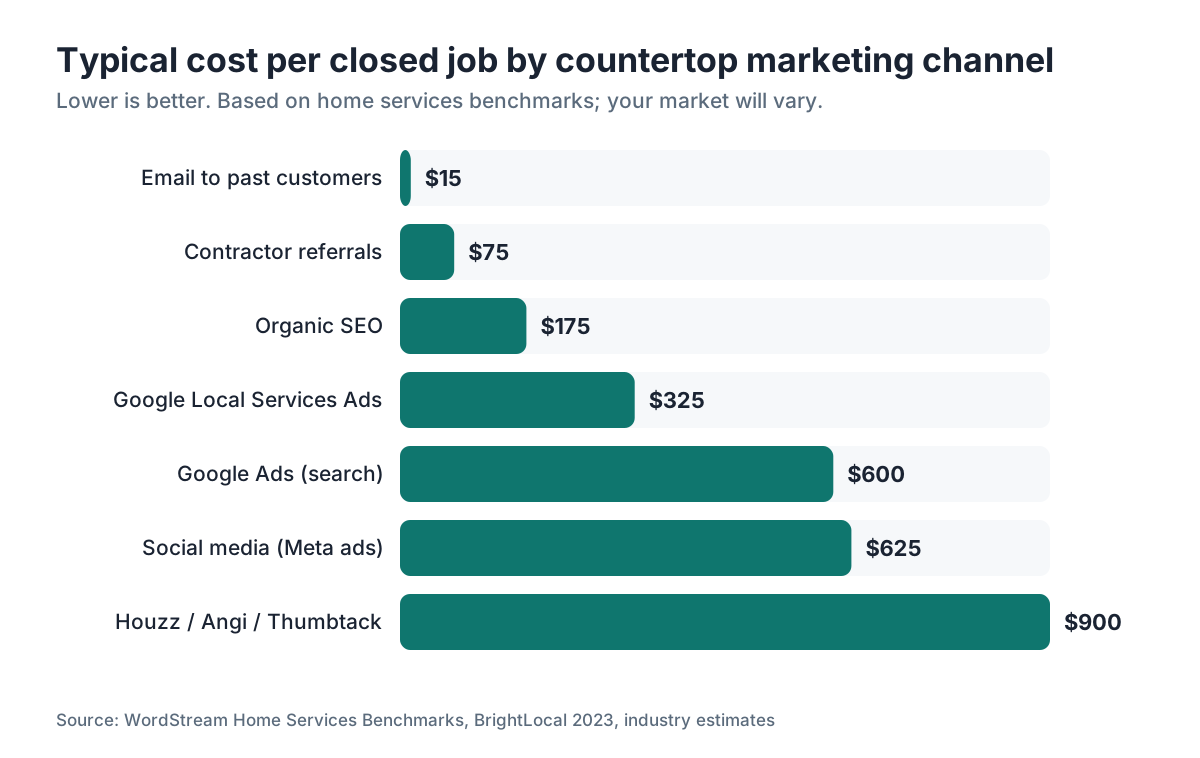
One more adjustment worth making: account for close rate by channel. If your Google Ads leads close at 25% and your contractor referrals close at 60%, the cost per closed job from referrals is much lower even if you pay a small referral fee. The table below shows how to build a simple channel comparison.
How do you actually track which channel each lead came from?
The simplest system that works: ask every single person who contacts you how they found you, record the answer in whatever CRM or quoting tool you use, and never skip it. That one habit, done consistently for 90 days, tells you more than any analytics dashboard.
For digital channels, layer on some basic tracking:
Phone tracking numbers. Services like CallRail assign different phone numbers to different channels: one for your Google Ads, one for your website's organic traffic, one for your Yelp listing. When someone calls, you see which number they dialed. Pricing starts around $45 per month for basic plans [2].
UTM parameters. Any link you put in an email, a social post, or a paid ad should carry UTM tags (source, medium, campaign). Google Analytics picks these up automatically and shows you which campaigns drove form fills or quote requests. This is free and takes about 20 minutes to set up.
Unique landing pages. If you're running ads for granite countertops and a separate campaign for laminate countertops or Formica countertops, send each ad to its own landing page with its own form. The form submissions tell you exactly which campaign converted.
Showroom and truck inquiries. These are harder. A paper sign-in sheet or a quick intake question on your job form works fine. The goal is just to record it somewhere structured, not in a salesperson's memory.
The biggest tracking failure in small fabrication shops is that leads come in through multiple channels before converting and nobody records the last touchpoint systematically. You don't need perfect multi-touch attribution. You need consistent last-touch tracking as a starting baseline.
What metrics should a countertop fabricator actually watch?
Four numbers matter most. Everything else is context.
Cost per lead (CPL). Total spend on a channel divided by the number of leads it generated. Spend $1,500 on Houzz and get 12 leads, and your CPL is $125. This is your efficiency metric for top-of-funnel.
Cost per closed job (CPJ). CPL divided by your close rate for that channel. If those 12 Houzz leads close at 20%, you got 2.4 jobs. CPJ is $1,500 / 2.4 = $625 per job. This is your real acquisition cost.
Average job revenue (AJR). The average contract value of jobs that came from this channel. Referrals from contractors skew high. Google Ads for generic terms like "cheap countertops" skew low. Know which channels bring you the customers you actually want.
Return on ad spend (ROAS). Revenue divided by ad spend. A ROAS of 4.0 means every dollar of ad spend returned four dollars of revenue. Google Ads ROAS across home services generally lands somewhere around 2.0 to 4.0, according to WordStream's analysis of its own customer data [3]. Countertops, with higher average ticket sizes, can push above that if targeting is tight.
Secondary metrics worth watching monthly: lead response time (slower than 5 minutes and your close rate drops sharply [4]), quote-to-close rate by material type, and seasonality patterns by channel. Spring and early summer are historically the peak countertop seasons in most U.S. markets, which affects how you interpret any single month's numbers.
What does a realistic ROI look like for common countertop marketing channels?
Nobody publishes countertop-specific channel benchmarks with real sample sizes. What follows is an honest synthesis of home services data and what fabricators report anecdotally. Treat these as rough orientation, not guarantees.
| Channel | Typical CPL | Typical Close Rate | Typical CPJ | Notes |
|---|---|---|---|---|
| Google Ads (search) | $60-$150 | 15-30% | $300-$900 | High intent, competitive in metro markets |
| Google Local Services Ads | $40-$100 | 20-35% | $150-$500 | Pay per lead, not per click; lower volume |
| Houzz / Angi / Thumbtack | $50-$200 | 10-25% | $300-$1,500 | Quality varies wildly by market |
| Organic SEO | $10-$50 | 15-30% | $50-$300 | Slow to build; lowest long-run CPL |
| Contractor referrals | $0-$50 | 40-70% | $0-$100 | Best ROI channel for most shops |
| Social media (Meta ads) | $30-$100 | 8-18% | $250-$1,000 | Good for brand awareness; lower intent |
| Email to past customers | Near $0 | 25-50% | Near $0 | Highest ROI if list is maintained |
The numbers above reflect home services industry data from BrightLocal, WordStream, and Local Services Ads benchmarks [2][3][5]. Your market will differ. A fabricator in a rural market competes less on Google Ads but may see faster payback from local sponsorships or contractor relationships.
One thing almost always holds: contractor referrals and past-customer reactivation return more per dollar than any paid digital channel. The math is simple because acquisition cost is near zero. If you are not tracking those separately, you are probably underestimating their value and overspending on paid ads.
How do you set a marketing budget based on ROI targets?
Work backwards from your revenue goal. Say you want to add $300,000 in countertop revenue next year. Your average job is $5,500. That's about 55 additional jobs. If your overall close rate is 25%, you need 220 leads. If your blended CPL across channels is $90, you need a marketing budget of roughly $19,800 for the year, or about $1,650 per month, to hit that target.
That math only works if your close rate and CPL estimates are real. Most shops overestimate their close rate ("we close almost everything that walks in") and underestimate their CPL because they forget to count time spent managing campaigns and responding to leads.
The U.S. Small Business Administration's marketing guidance points established businesses in competitive consumer markets toward spending 7-8% of gross revenue on marketing [6]. For a fabrication shop doing $1M in revenue, that's $70,000-$80,000 per year. Most shops I've seen spend less than 3% and wonder why growth stalls. That said, the right number depends entirely on your growth target, your market's competitiveness, and which channels you're using.
If you're just starting to track ROI seriously, pick one paid channel, run it for 90 days with tight tracking, and measure the result before expanding. Trying to track five channels at once when your attribution system is still half-built is a good way to produce useless data.
Shops using quoting software (SlabWise is built for this) can attach lead source to every quote automatically, which makes this math much less painful to run at month-end. That kind of system-level tracking is where the time savings really add up.
How do you calculate the lifetime value of a countertop customer?
Lifetime value (LTV) matters because it changes how much you should be willing to pay to acquire a customer. A homeowner who buys once and never refers anyone is worth one job. A homeowner who comes back for a bathroom remodel two years later and refers two neighbors is worth three jobs.
Simple LTV formula: LTV = Average job value x Average number of jobs per customer over their lifetime.
For countertops specifically, repeat purchase rates are low. Most homeowners remodel a kitchen once every 10-20 years. But referral behavior is where countertop businesses compound value. If your average job is $6,000 and each happy customer refers 1.5 other customers over their lifetime (a reasonable estimate for a shop with strong reviews), your effective LTV per acquired customer is closer to $6,000 x 2.5 = $15,000.
That reframe matters. If your LTV is $15,000, paying $800 to acquire a customer through Google Ads is a 1,775% lifetime ROI. The math can justify much higher CPLs than shops typically allow themselves.
The catch is that referral behavior depends heavily on your review volume and customer experience. Harvard Business Review has published research showing that referred customers carry a 16% higher lifetime value than non-referred customers [7]. That difference is real money. Track where your referrals originate (which happy customers send the most leads) and treat those relationships differently.
What are the most common ways fabricators waste marketing money?
Paying for leads you can't follow up fast enough. If your team takes 24 hours to call back a Google Ads lead, you've almost certainly lost them. A study published in Harvard Business Review found that companies that contacted leads within an hour were seven times more likely to qualify the lead than those that waited even an hour longer [4]. Spending $100 on a lead and then losing it to a slow callback is the most common ROI destroyer in the business.
Running broad-match Google Ads with no negative keywords. Broad match will happily serve your granite ad to someone searching "granite gravel for driveway" or "granite headstones". Without a negative keyword list, you burn budget on irrelevant clicks. Check your search terms report weekly, at minimum monthly.
Paying for lead aggregator platforms at full price without testing close rates. Houzz, Angi, and Thumbtack vary enormously by market. In some cities they deliver solid, pre-qualified homeowners. In others they send tire-kickers who are collecting five quotes and buying on price. Run a 60-day test, track the close rate rigorously, and make a data-driven decision. Don't renew on autopilot.
Ignoring organic search because it's slow. Yes, SEO takes 6-12 months to show results. But the CPL once it's working is the lowest of any channel. A solid local SEO strategy for a fabrication shop, including Google Business Profile optimization and a handful of well-written service pages, can generate leads for years with minimal ongoing cost [5].
Not tracking offline conversions. If someone calls from a Google Ad and becomes a $9,000 job, that conversion almost certainly never gets recorded in Google Ads unless you've set up call tracking and offline conversion import. Google's algorithm then thinks your campaign has zero conversions and throttles or raises your CPCs. Import your closed jobs back into the ad platform. It's a technical step most small shops skip, and it's expensive to miss.
How do online reviews affect countertop marketing ROI?
Reviews work as free marketing that compounds. A Google Business Profile with 80 reviews at 4.7 stars converts more of your existing traffic, cuts the cost per lead from your paid ads, and ranks better in local search. The BrightLocal Local Consumer Review Survey found that 98% of consumers used the internet to find information about local businesses in 2023, and that positive reviews directly influence purchasing decisions [5].
For fabricators, the review impact runs especially high because the purchase is large, unfamiliar, and anxiety-inducing for the homeowner. A countertop installation is not something most people do more than once or twice. They are trusting you with their kitchen. Strong reviews cut that anxiety and cut your sales friction.
The ROI math on reviews is hard to isolate, but the mechanism is clear: more reviews, higher star rating, higher conversion rate on all paid and organic traffic, lower effective CPL across every channel. Systematically asking for reviews after installation is one of the highest-return marketing activities a fabrication shop can do, and it costs almost nothing.
Respond to negative reviews in writing, publicly, and promptly. Potential customers read your responses as closely as they read the original review.
How should you report marketing ROI to hold yourself or your team accountable?
A monthly one-page marketing report is the right cadence for most shops. More often and you're reacting to noise. Less often and problems compound for too long.
The report should have five rows, one per active marketing channel, and four columns: leads generated, cost per lead, jobs closed, and cost per closed job. Add a sixth row for totals. That's it. You can build this in a spreadsheet in under two hours.
Review it the same day each month. Set a benchmark for what a "passing" CPJ looks like in your market: if your average job is $5,500 and you want a 10:1 return on acquisition cost, your maximum acceptable CPJ is $550. Any channel consistently above that threshold gets cut or renegotiated. Any channel consistently below it gets more budget.
If someone else runs your marketing, whether an agency, a freelancer, or an in-house person, this report protects you. Agencies love to report on impressions, clicks, and "reach." Those metrics are fine as diagnostics but they don't pay your shop's bills. The report above keeps the conversation focused on what matters.
The Federal Trade Commission's advertising guidance requires that any performance claims made to you by a marketing vendor be substantiated [8]. If a vendor promises "guaranteed leads" or a specific ROI, ask for that in writing. Most legitimate vendors won't guarantee specific outcomes because too many variables sit outside their control.
What tools do countertop shops actually need to track marketing ROI?
You don't need expensive software. Here's the honest minimum viable stack:
Google Analytics 4 (free). Tracks website traffic, form submissions, and which channels drove them. Steep learning curve but nothing else comes close for web data [9].
Google Business Profile (free). Tracks calls, direction requests, and website clicks from your Google listing. Every shop should have this claimed and updated [10].
A call tracking service ($45-$100/month). CallRail, CallTrackingMetrics, or WhatConverts. Essential if any significant portion of your leads come in by phone.
A simple CRM or quoting tool with lead source field. Could be a spreadsheet, could be a purpose-built tool. The key feature is that lead source is recorded on every job, not optional. SlabWise's quoting workflow includes this so job-level attribution is built into the quote process rather than bolted on later.
Google Search Console (free). Shows which search terms bring traffic to your site. Use it to find which materials or services people search for before finding you [11].
That stack costs under $150 per month and gives you more data than most fabrication shops can act on. Don't add more tools until you're actually using these consistently. More dashboards do not mean better decisions.
How long does it take to get reliable ROI data from a marketing channel?
90 days is the minimum for any paid channel. 6 months is more honest for SEO or content marketing. The countertop sales cycle is short (a homeowner who fills out a form usually decides within 2-4 weeks), so 90 days gives you enough closed jobs to see a pattern.
For seasonal businesses, 90 days in peak season (spring and early summer) and 90 days in shoulder season tell different stories. Don't cancel a channel after a bad January if you never ran it through a March. Don't double down on a channel after a great April before you know whether it holds up in September.
Sample size matters. If a channel delivered 8 leads in 90 days, your close rate estimate from those 8 leads has huge error bars. You need at minimum 20-30 leads per channel before the close rate number means anything statistically. For most small fabrication shops running modest ad budgets, getting to statistical significance takes longer than people want to wait. That's the honest answer, and it's why anecdotal "this channel worked for my buddy's shop" reasoning is so unreliable.
One practical workaround: pool data across channels to set your baseline CPL and close rate, then look for channels that deviate significantly in either direction. You don't need perfect precision to catch the obvious winners and obvious losers.
Frequently asked questions
What is a good ROI for countertop marketing?
A 3:1 return on gross revenue (300% ROI) is a reasonable floor for paid digital channels. That means every dollar spent on ads returns three dollars in revenue before material and labor costs. On gross profit (typically 40-55% of revenue for fabricators), that translates to roughly 20-65% gross profit ROI, which still leaves margin. Contractor referrals and past-customer email typically return 10:1 or better because acquisition cost is near zero.
How do I know which marketing channel is actually bringing in my countertop jobs?
Ask every lead how they found you and record the answer on the quote. For digital channels, use unique phone tracking numbers per channel and UTM parameters on all ad links. Connect those leads to your closed jobs monthly. This takes about 30 minutes to set up and one hour per month to maintain. It's the single most valuable tracking habit a small fabrication shop can build.
Is Google Ads worth it for a countertop fabricator?
Depends on your market. In competitive metro areas, cost per click for "countertops near me" can run $8-$20, and you need a strong landing page and fast follow-up to make it pay. In smaller markets, CPCs are lower and the competition is weaker. Run a 90-day test with a defined budget, track every lead to a closed job, and calculate your cost per closed job. Then compare that to your average job value and decide.
How much should a countertop fabricator spend on marketing?
The SBA's general guidance for established businesses in competitive consumer markets is 7-8% of gross revenue. Most fabrication shops spend closer to 2-3% and cap their growth as a result. A shop doing $800,000 in revenue spending $16,000-$24,000 on marketing is likely underinvesting. The right number is whatever generates your target number of leads at an acceptable cost per closed job.
What is cost per lead and how do I calculate it for countertop marketing?
Cost per lead (CPL) = total spend on a channel divided by the number of leads it generated. If you spend $1,200 on Google Ads and get 15 leads, CPL is $80. CPL alone doesn't tell you much because leads vary in quality by channel. Pair it with close rate to get cost per closed job, which is the number that actually tells you whether a channel is worth keeping.
Does Houzz or Angi actually deliver ROI for stone fabricators?
In some markets yes, in others no. There's no universal answer. Angi and Houzz leads tend to close at lower rates than Google Search leads because the homeowner is often in early research mode rather than ready to buy. Track your close rate from these platforms separately for at least 60 days. If it's below 15%, the math usually doesn't work unless your average ticket is very high.
How do I calculate customer lifetime value for a countertop shop?
Multiply your average job value by the average number of jobs per customer over their lifetime, then factor in referrals. Most homeowners remodel once in 10-20 years, but referred customers add significant value. If your average job is $6,000 and each customer refers 1.5 future customers on average, your effective LTV per acquired customer is closer to $15,000. That changes how much you should be willing to spend to acquire a single customer.
How do Google reviews affect my countertop shop's marketing ROI?
Reviews improve conversion rates on all traffic sources, reduce cost per lead across paid and organic channels, and improve local search rankings. BrightLocal's 2023 consumer survey found 98% of consumers used the internet to research local businesses, with reviews directly influencing decisions. Systematically requesting reviews after installation is one of the highest-ROI marketing activities a fabrication shop can do, and the direct cost is essentially zero.
What tracking tools do small countertop shops actually need?
The minimum useful stack is Google Analytics 4 (free), Google Business Profile (free), a call tracking service like CallRail (around $45-$100 per month), and a quoting or CRM tool that records lead source on every job. Google Search Console (free) rounds it out for SEO data. That's under $150 per month total and gives you more actionable data than most shops currently use.
How long should I run a marketing channel before deciding if it works?
90 days minimum for paid channels, 6 months for SEO or content. The countertop sales cycle is short (most leads decide within 2-4 weeks), so 90 days gives enough closed jobs to see a pattern. You need at least 20-30 leads from a channel before your close rate estimate is meaningful. Running a test through both a peak season month and a shoulder month gives a more complete picture.
What is ROAS and is it a useful metric for countertop advertising?
ROAS (return on ad spend) = revenue divided by ad spend. A ROAS of 4.0 means four dollars of revenue per ad dollar. It's useful for comparing paid campaigns head-to-head but ignores your gross margin, so a high ROAS campaign can still lose money if margins are thin. For countertops with 40-55% gross margins, a minimum ROAS of 2.5-3.0 is generally needed to stay profitable after material and labor costs.
How do I track conversions from phone calls if most countertop leads call in?
Use a call tracking service that assigns unique phone numbers to each marketing channel. When someone calls, the system records which number they dialed, logs the call, and can connect it to your CRM. Services like CallRail start around $45 per month. Without this, any leads that call rather than fill out a form are invisible to your analytics, which causes you to undercount digital channel performance.
Should I use last-touch or multi-touch attribution for countertop marketing?
Start with last-touch attribution, meaning you credit whichever channel the customer contacted you through most recently. It's imperfect but it's consistent and easy to implement with a simple intake question or call tracking system. Multi-touch attribution is more accurate but requires sophisticated software and enough lead volume to be meaningful. Most fabrication shops should master last-touch first and worry about multi-touch later, if ever.
How do contractor referrals fit into a marketing ROI calculation?
Contractor referrals almost always have the best ROI of any channel because acquisition cost is near zero and close rates are high (often 40-70% vs. 15-25% for paid digital). Track them separately with a dedicated source code in your quoting system. If you pay a referral fee, subtract that from the channel cost. Even with a 5-10% referral fee, the cost per closed job is typically a fraction of any paid channel.
Sources
- U.S. Small Business Administration, 'Calculate your startup costs / Fund your business' financial guidance: Gross margin on installed countertops typically runs 40-55% depending on material mix, shop efficiency, and market
- CallRail, Pricing Page: Call tracking services like CallRail start around $45 per month for basic plans
- WordStream, 'Google Ads Benchmarks for Your Industry': Google Ads ROAS across home services typically sits around 2.0 to 4.0
- Harvard Business Review, 'The Short Life of Online Sales Leads': Companies that contacted leads within an hour were seven times more likely to qualify the lead than those that waited even an hour longer
- BrightLocal, 'Local Consumer Review Survey 2023': 98% of consumers used the internet to find information about local businesses in 2023, and positive reviews directly influence purchasing decisions
- U.S. Small Business Administration, 'Market and sell / Marketing and sales' business guide: Established businesses in competitive consumer markets should generally budget 7-8% of gross revenue on marketing
- Harvard Business Review, 'The Value of Keeping the Right Customers': Referred customers have a 16% higher lifetime value than non-referred customers
- Federal Trade Commission, 'Advertising and Marketing': FTC guidelines require that performance claims made in advertising be substantiated
- Google, 'Google Analytics': Google Analytics 4 tracks website traffic, form submissions, and channel attribution at no cost
- Google, 'Google Business Profile Help': Google Business Profile tracks calls, direction requests, and website clicks from local listings at no cost
- Google, 'Search Console Help': Google Search Console shows which search terms bring organic traffic to a website
Last updated 2026-07-11