TL;DR
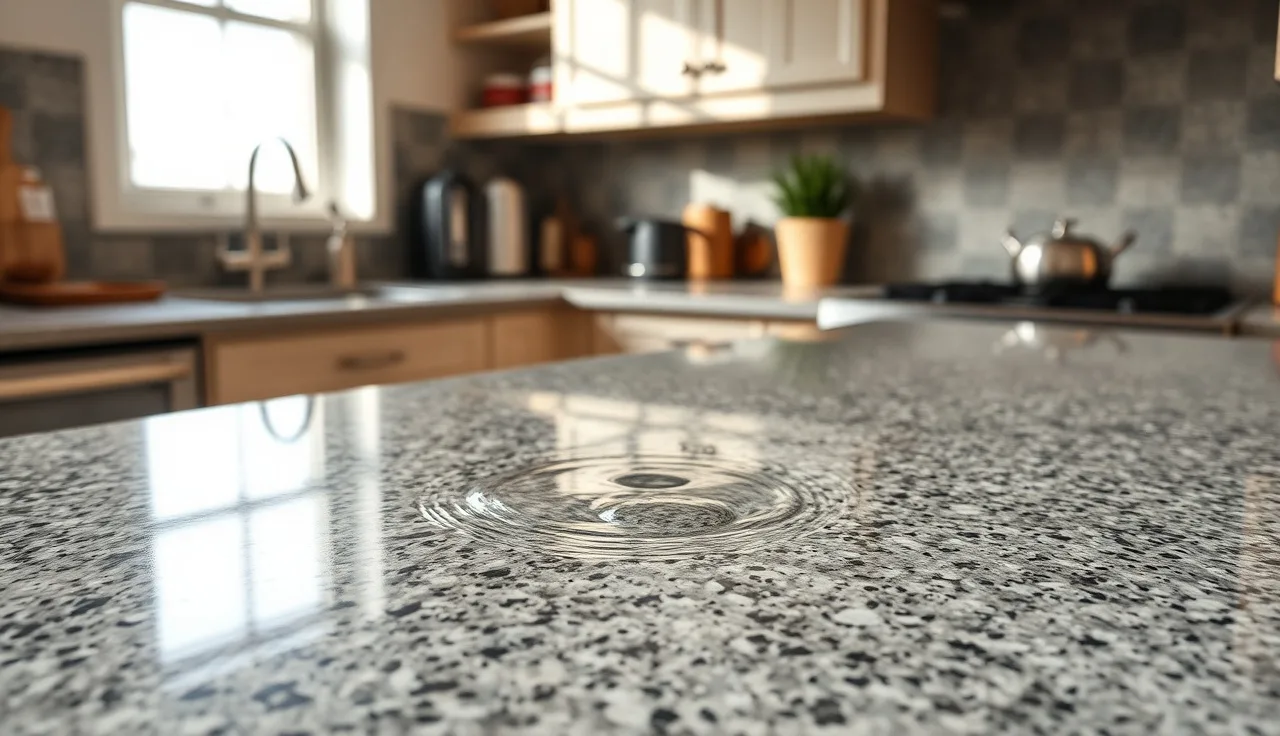
- Drop a tablespoon of water on your granite and watch.
- If it soaks in within 5 minutes and darkens the stone, reseal now.
- If it beads for 10 to 30 minutes before absorbing, you have a year or two left.
- If it still beads after 30 minutes, the seal is fine.
- No special tools required.
Why does granite need sealing at all?
Granite is a natural igneous rock, and most slabs are porous to some degree. The pores are small compared to marble or limestone, but they're there. Liquids that sit on an unsealed surface long enough wick into the stone, carrying oils, pigments, and bacteria with them. That's where stains come from.
Sealer doesn't fill those pores permanently. It deposits a thin layer of fluoropolymer or silicone resin in the top fraction of the stone that slows liquid penetration. Cleaning products, abrasion, and acidic foods wear that layer down over time. When it thins past a useful point, you're back to bare stone.
Not every granite needs sealing. Dense, dark granites like Absolute Black or Black Galaxy have almost no porosity and won't absorb sealer anyway. Light, speckled stones like New Venetian Gold or Santa Cecilia run more porous and need more frequent attention. The only way to know where your slab stands is to test it. [1]
Fabricators often seal new countertops before installation. That first shop seal isn't a lifetime guarantee. It gives you a baseline, not a free pass.
What is the water bead test and how do you do it?
The water bead test is the standard field check for sealer condition. It costs nothing and takes 15 to 30 minutes of watching. If water beads on the surface past 30 minutes, your seal is intact. If it soaks in and darkens the stone within 5 minutes, the seal is gone.
Here's exactly how to run it:
- Clean the area first. Wipe the surface with a damp cloth and let it dry completely. Grease or residue on top of the stone throws off the result.
- Pour about 2 to 3 tablespoons of plain tap water in a small pool on the granite.
- Leave it alone and watch what happens over the next 30 minutes. Set a timer.
What the results mean:
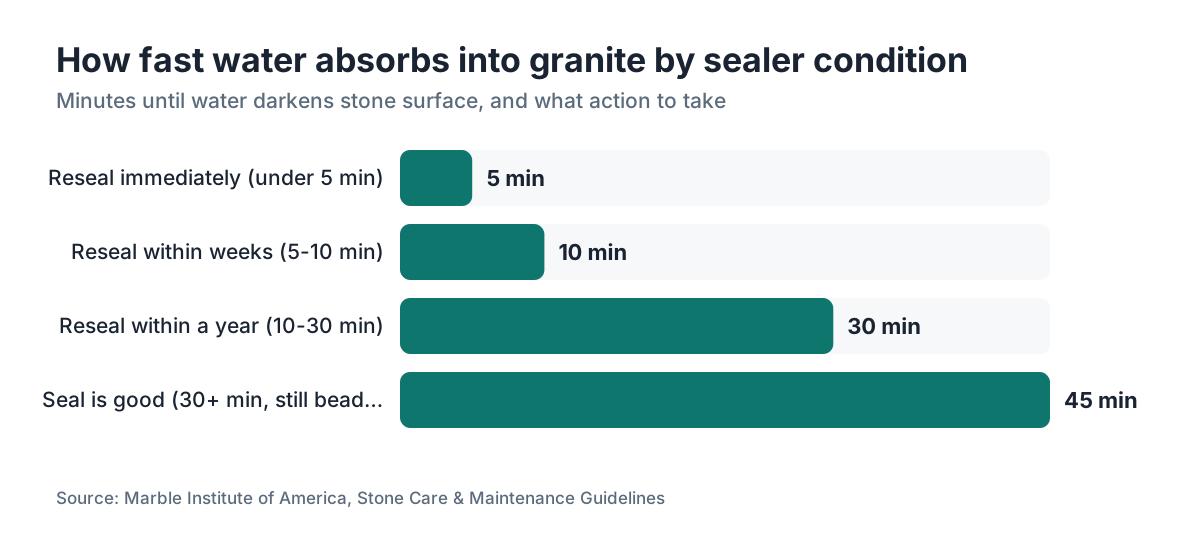
| Time until water absorbs / darkens stone | What it tells you |
|---|---|
| Under 5 minutes | Reseal immediately |
| 5-10 minutes | Reseal within a few weeks |
| 10-30 minutes | Sealer is partially worn; reseal within 6-12 months |
| Still beading at 30 minutes | Sealer is in good shape; test again next year |
The darkening you're watching for is a visible wet shadow in the stone's surface. It disappears once the water evaporates. If you saw it, the sealer isn't doing its job in that spot. [2]
Test a few spots: near the sink, next to the stove, and in the middle of the counter. The sink area degrades fastest because it gets the most water and cleaning product.
How does the lemon or oil test work?
The water test tells you about general porosity. The lemon test checks something slightly different: acid resistance. Etching and sealer failure are related problems, but they aren't the same thing.
Put a few drops of lemon juice on an out-of-sight spot. Wait 5 minutes. Wipe it dry and look at the surface in raking light (hold a flashlight at a low angle). If you see a dull or lighter patch where the lemon sat, the stone etched. On real granite this is rare, since granite is largely acid-resistant. But some stones sold as granite carry enough calcite to etch. If yours etches, you may actually have a quartzite or a marble-granite blend.
For an oil test, put a dime-sized drop of vegetable oil in a corner. Leave it 10 minutes. Wipe it off. A dark oil shadow still visible after wiping means the sealer is compromised against oils specifically. Kitchens that go through a lot of olive oil or butter should not ignore that result.
The water test stays your main diagnostic. The lemon and oil tests are secondary checks worth running once a year, especially on lighter stone where stains show more. [1]
How often should granite countertops be resealed?
There's no single right answer, and anyone who tells you "every year" flat out is oversimplifying. Frequency depends on the stone's porosity, the sealer quality, how hard the surface gets used, and which cleaners hit it every day.
Guidance from the Marble Institute of America and most fabricators puts kitchen granite at once every 1 to 5 years [3]. That range is wide on purpose.
High-porosity, light-colored stones: reseal every 6 to 12 months. Medium-density stones with moderate use: every 1 to 2 years. Dense, dark stones: every 3 to 5 years, sometimes never.
Harsh cleaning products break sealer down faster than anything else. Bleach-based cleaners, ammonia sprays, and acidic degreasers strip it quickest. If someone in your house sprays a bleach cleaner on the granite every day, expect to reseal twice as often as the product label suggests.
The water bead test tells you the actual current condition. Run it once a year in a kitchen, and every 6 months near the sink if you want to stay ahead of it. That beats any calendar schedule.
Does darker granite really need less sealing than lighter granite?
Usually, yes. Color tracks with mineral composition, and darker granites tend to have more feldspar and less open microporosity. But color is not a perfect stand-in for porosity.
The most accurate comparison is an absorption test, which the water bead test approximates. Suppliers and labs can run a formal test per ASTM C97 [4], which measures the percentage increase in mass after immersion. Stones under 0.1% absorption count as practically non-porous for countertops. Most granites fall between 0.1% and 0.5%, while some softer stones marketed loosely as granite run 1% or higher.
Absolute Black granite typically tests below 0.1% absorption and genuinely doesn't need sealing in most kitchens. Sealing it can cause streaks, because the product has nowhere to go and sits on top.
A practical rule: if your water bead test shows active beading after 30 minutes, don't bother sealing. If water absorbs in under 10 minutes, seal it regardless of color. [1] [4]
Can you test granite that's already been sealed to see if the sealer is still good?
Yes. The water bead test works the same way on sealed stone as on bare stone. You're not checking whether sealer exists in some abstract sense. You're checking whether whatever protection is there still works. The result tells you what you need to know no matter how many times the stone was sealed before.
One common mix-up: people assume that if they resealed 6 months ago, the sealer must be fine. Not always. A cheap sealer applied over a dirty or wet surface can fail fast. A good penetrating sealer on a clean, dry, prepped surface can last 3 to 5 years. The test overrules the calendar.
If the water absorbs quickly on a recently sealed surface, you either had poor adhesion (applied over residue, or the stone was still wet) or you used a low-quality product that broke down early. Re-clean carefully, let it dry 24 hours in low humidity, and reseal with something better.
Fabricators tracking stone types and sealing schedules across dozens of jobs get a lot of mileage from software that logs material specs. SlabWise shop software has material notes fields for this kind of customer follow-up. [5]
What does it mean if the granite darkens immediately when water hits it?
Immediate darkening means the stone is drinking water with almost no resistance. The sealer is either gone or was never there.
This doesn't mean your countertop is ruined. It means it's exposed right now. Any oil, wine, coffee, or juice that sits on the surface for more than a few minutes has a real shot at soaking in and staining.
The urgency depends on how you use the kitchen. A surface that sees heavy cooking and spills needs resealing within days if it's failing this badly. A bathroom vanity with light use has more room.
Clean the surface first with a stone-safe degreaser to lift any oils or residue already sitting in the pores. Then let it dry 24 to 48 hours before applying sealer. Sealing over a damp or dirty surface is the number one reason sealed stone still stains. [2] [3]
If a stain is already present, deal with that before sealing. Sealer traps stains in. It doesn't lift them out.
Are there any tools or professional tests that work better than the water test?
For homeowners, the water test is hard to beat. It runs on the same principle professionals use, just without formal measurement.
Labs and quarries can run ASTM C97 water absorption tests [4] and ASTM C1353 abrasion resistance tests [6], but those need dry samples and controlled equipment. They evaluate stone at the source, not countertops in place.
Some stone care companies sell moisture meters made for stone. They read moisture content in the top few millimeters of the slab and give a more quantitative sense of porosity. Consumer-grade units run $40 to $150 and are worth having if you're a fabricator checking stone all the time. For one kitchen, they're overkill.
Restoration crews also use UV dye tests: apply a UV-sensitive liquid, wait, wipe it off, then scan with a UV light to see where absorption happened. It shows exactly which areas are unsealed. Pros use this when mapping large slabs or commercial floors.
For home use, water is free and the test takes 15 minutes. Unless you're mapping a big commercial install or evaluating stone for resale, stick with water.
What type of sealer should you use after the test shows you need one?
Penetrating sealers (also called impregnating sealers) are the right pick for granite countertops in nearly every case. They soak into the pore structure instead of sitting on top as a film. They don't change the surface texture, don't peel, and don't cloud over time. [7]
Topical sealers and enhancers that sit on the surface have uses for certain porous stones and for deepening color on honed finishes, but they need stripping and reapplication in a way penetrating sealers don't. For a polished granite kitchen counter, skip topical products.
Look for fluoropolymer or fluorocarbon chemistry. Those repel both water and oil, which matters in a kitchen. Silicone-based sealers are water-repellent but weaker against cooking oils.
Brand tiers exist. Consumer products from home improvement stores (Granite Gold, Weiman, StoneTech) handle maintenance sealing and run $15 to $30 for a bottle that covers a standard kitchen. Professional-grade products (Tenax, Akemi, Dry-Treat) perform better on porous stone and last longer, but cost $40 to $100 for the same area. If your test showed absorption under 5 minutes, the pro products earn the extra money. [8]
Application is simple: clean, dry stone; apply in sections; let it penetrate 5 to 15 minutes per the label; buff off the excess before it hazes. Most penetrating sealers leave no residue if you buff while still wet.
Does resealing granite affect how you should clean it day to day?
Sealer changes what you can get away with. It doesn't change best practice.
The right daily cleaner for granite is plain dish soap diluted in water, or a pH-neutral stone cleaner. That's it. Wipe spills up fast. Keep anything acidic from sitting on the surface.
What sealer does is buy time. A sealed surface gives you 5 to 30 extra minutes to wipe up a spill before it starts to absorb. That's a real buffer in a working kitchen.
What sealer doesn't do: it won't protect against etching from acids, it won't stop scratches, and it won't make the surface heat-proof. Granite shrugs off brief contact with heat, but setting hot pans directly on polished granite over and over can stress the surface and, eventually, the sealer layer. Use trivets for anything over 400 degrees F as a habit. [2]
For stone care across different materials, the guide on how to clean stone countertops covers pH, cleaners to avoid, and daily maintenance. Also useful: the how to clean quartzite countertops guide if you're not sure your stone is actually granite and not quartzite, which gets mislabeled at retail all the time.
Harsh cleaners are the fastest way to wreck a seal. Bleach sprays, vinegar, ammonia cleaners, and many generic bathroom sprays strip fluoropolymer sealer within weeks of daily use. If someone's been using these on your granite, that explains a short seal life.
Is there any granite that should never be sealed?
Yes. Very dense, low-porosity granites get nothing from sealing and can look worse for it. When sealer has no pore structure to sink into, it sits on the polished surface and dries as a cloudy or streaky film. Buffing lifts most of it, but traces hang around in microscopic surface features.
Absolute Black is the classic example. If the water bead test shows zero absorption after 30 minutes on a truly clean surface, apply no sealer. You'd be wasting product and risking a haze.
Some fabricators put a courtesy seal on every stone at installation regardless of porosity, partly for liability and partly because customers expect it. That's not harmful if the product is well buffed, but it isn't adding protection to a genuinely non-porous stone.
If you inherited a countertop and don't know its history, run the water test before buying anything. The result tells you more than the stone name, because slab quality varies within the same quarry and even within the same block.
For how different stone types compare on porosity and maintenance, the granite countertops overview and the marble countertops guide both cover material-specific sealing needs.
When should you call a professional instead of doing this yourself?
Testing for seal condition is always a DIY job. Resealing most granite is too. But a few situations call for a stone restoration pro.
Deep stains that didn't come out with a standard poultice need professional-grade extraction or light honing. A pro can tell whether the stain sits in the sealer layer or in the stone itself.
Heavy etching or scratching on polished granite needs mechanical re-polishing. No sealer fixes a dulled surface. The surface has to be restored first, then protected.
If your granite was originally honed or leathered rather than polished, the sealing and maintenance rules change. Honed granite is more porous at the surface and stains more easily, so getting the sealer type and application right the first time is worth a pro's eyes.
Residential stone restoration runs roughly $5 to $15 per square foot for resealing and light restoration, and $25 to $75 per square foot for grinding, honing, and repolishing, depending on region and severity [9]. A kitchen with 40 square feet might run $200 to $600 for professional resealing with prep, or $1,000 to $3,000 for full restoration including re-polishing.
For how replacement stacks up against restoration, the kitchen countertops and countertop installation guides cover what new stone typically costs if restoration doesn't pencil out.
Frequently asked questions
How long does the water bead test actually take?
Set a 30-minute timer after you pour the water. You often see a result much sooner. If the water soaks in and darkens the stone within 5 minutes, you have your answer right away. If it's still beading at 30 minutes, the seal is intact. The observation window is 5 to 30 minutes total, though setup takes under a minute.
Can I test a small area or do I need to test the whole counter?
Test at least 3 to 4 spots: near the sink, next to the stove, in the center, and near any heavily used edge. The sink and stove areas almost always show the most wear. A single test in the middle of a rarely used section can give you a falsely optimistic read.
My granite is dark and shiny. Does it still need testing?
Run the water test regardless of color. Dark polished granite often needs no sealer, but not always. Some dark stones are actually gabbro or other types with moderate porosity. The 15-minute test settles it. If water beads for 30 minutes on a clean surface, skip the sealer.
How soon after installation should I seal new granite countertops?
Many fabricators seal countertops before installation. Ask yours. If they didn't, wait 24 hours after installation to let adhesive and caulk cure. Then run the water test. If the stone absorbs in under 10 minutes, apply a penetrating sealer right away. If it beads well, you may have a few months before you need to act.
What happens if I skip resealing for years?
Unsealed granite in a kitchen will eventually stain. How fast depends on use. Cooking oils and dark liquids like red wine, coffee, and soy sauce are the biggest risks. A stain in the top layer of unsealed stone can sometimes be pulled out with a poultice. Staining deeper in the pore structure is harder to remove without mechanical grinding.
Does sealing granite make it completely stain-proof?
No. A good penetrating sealer slows liquid absorption a lot, buying you time to wipe up spills. It doesn't make an impermeable barrier. Leave red wine pooled on sealed granite overnight and there's a real chance of staining. Sealer is insurance against accidents, not a substitute for wiping spills fast.
Can I use olive oil or baby oil to test for sealer instead of water?
You can run an oil absorption test separately (described in the lemon and oil section above), but water is the standard diagnostic. Oil tests read slower and are harder to clean up. Use water as your primary test and oil as a secondary check if you're worried specifically about oil-based staining in a kitchen.
The water absorbs but my granite has no stains yet. Should I still reseal?
Yes. Stains come from absorption over time, not from absorption itself. If your stone hasn't stained yet while soaking up water, you've been lucky or careful with spills. Reseal before the first bad spill, not after.
How do I know if what I have is granite or quartzite?
Quartzite and granite look alike to the eye and get mislabeled at retail all the time. A definitive answer needs a petrology test or an acid test (quartzite etches with acid; true granite does not). If your "granite" etches from lemon juice, it's likely quartzite or a marble-granite composite. See the quartzite cleaning guide for how to care for it correctly.
My fabricator says granite never needs sealing. Is that true?
True for some stones, not all. Very dense granites like Absolute Black genuinely don't need sealer. But plenty of light-colored or medium-density granites benefit from periodic sealing. Run the water test on your specific slab. The result overrides any general claim about granite as a category.
Can sealing granite make it darker or change the color?
Penetrating sealers should not change color on a polished surface when applied and buffed properly. Color-enhancing sealers are a different product made to deepen color, used mainly on honed or brushed finishes. If you don't want to change your stone's look, choose sealers labeled "natural finish" or "no color enhancement."
How do I prep the surface before resealing after a failed water test?
Clean with a stone-safe degreaser and rinse well. Let the stone dry completely, at least 24 hours in normal indoor humidity. Sealing over moisture is the most common mistake and produces a cloudy or fast-failing seal. On a warm, dry day you can shorten drying time with a clean fan aimed at the surface.
Is sealing granite a DIY job or should I hire someone?
Resealing standard polished granite is a reasonable DIY project. Clean the stone, apply the sealer in sections, wait 5 to 15 minutes per the label, and buff off excess. The products are widely available and forgiving. Hire a pro for deep stains, scratched or dulled polish that needs mechanical restoration, or honed and leathered finishes that need more precise sealer selection.
Sources
- Marble Institute of America, Dimension Stone Design Manual: Porosity varies significantly among granite types; dense dark granites may require no sealing while light-colored granites may need resealing every 1-2 years
- University of Minnesota Extension, Caring for Natural Stone Surfaces: Water absorption into stone darkens the surface visibly; recommended to clean and dry stone fully before sealing
- Marble Institute of America, Stone Care & Maintenance Guidelines: General resealing frequency for kitchen granite ranges from 1 to 5 years depending on stone density and use
- ASTM International, ASTM C97 Standard Test Methods for Absorption and Bulk Specific Gravity of Dimension Stone: ASTM C97 measures water absorption as a percentage mass increase; stones under 0.1% absorption are considered practically non-porous
- SlabWise, Countertop Fabrication Software: Shop software with material notes fields supports fabricator documentation of stone type and maintenance recommendations for customers
- ASTM International, ASTM C1353 Standard Test Method for Abrasion Resistance of Dimension Stone: ASTM C1353 tests abrasion resistance of dimension stone; used for stone evaluation at quarry or lab level
- Tile Council of North America, Guidelines for Natural Stone Maintenance: Professional-grade fluoropolymer sealers outperform consumer silicone-based products in oil and water repellency longevity
- Tile Council of North America, Guidelines for Natural Stone Maintenance: Professional-grade fluoropolymer sealers outperform consumer silicone-based products in oil and water repellency longevity
- Angi, Stone Countertop Restoration Cost Guide: Professional granite resealing costs approximately $5-$15 per square foot; full re-polishing and restoration runs $25-$75 per square foot depending on region and condition
- National Stone, Sand and Gravel Association, Natural Stone Characteristics: Granite is an igneous rock with porosity generally ranging from 0.1% to 0.5% water absorption, lower than marble or limestone
Last updated 2026-07-10