TL;DR
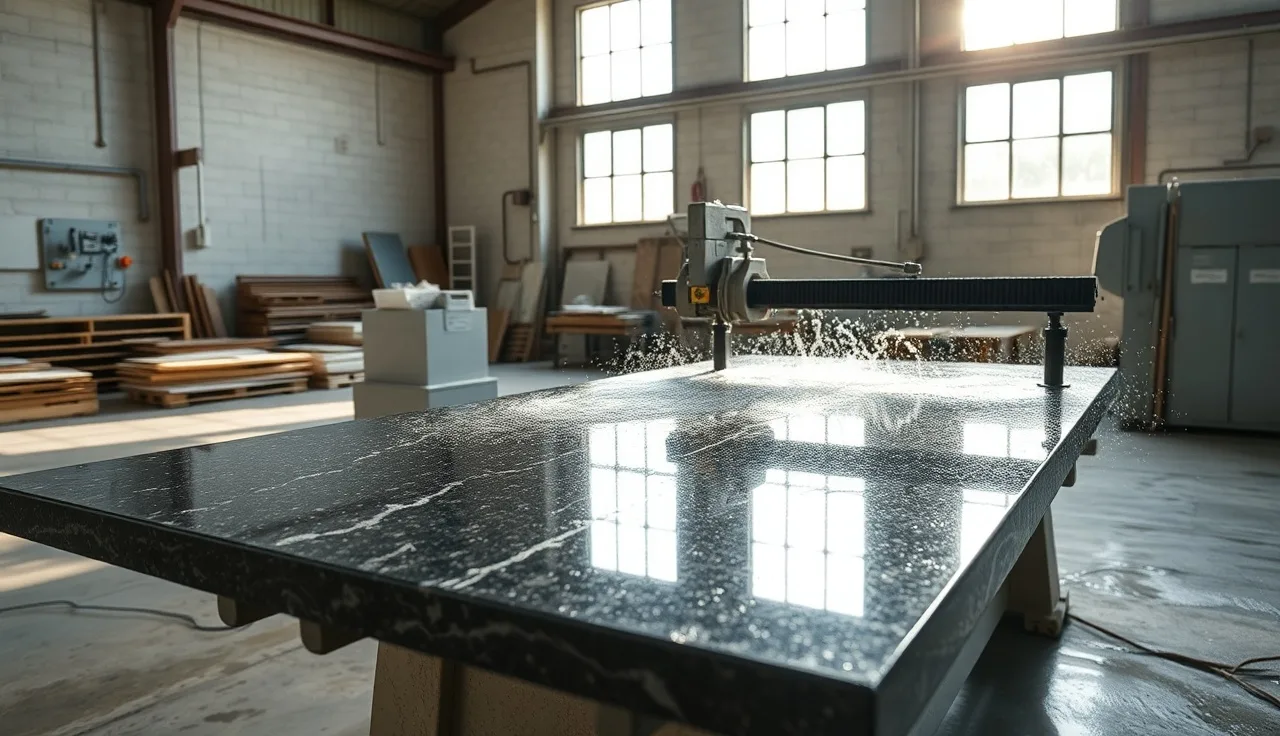
- Wet cutting suppresses respirable crystalline silica at the source by flooding the stone with water during every second of blade contact.
- OSHA's construction silica standard (29 CFR 1926.1153) lists wet methods as a Table 1 control for angle grinders and saws.
- A properly set-up wet system cuts airborne silica by 90 to 97 percent compared to dry cutting.
- Respirators are still required.
Why does silica exposure matter so much in stone fabrication?
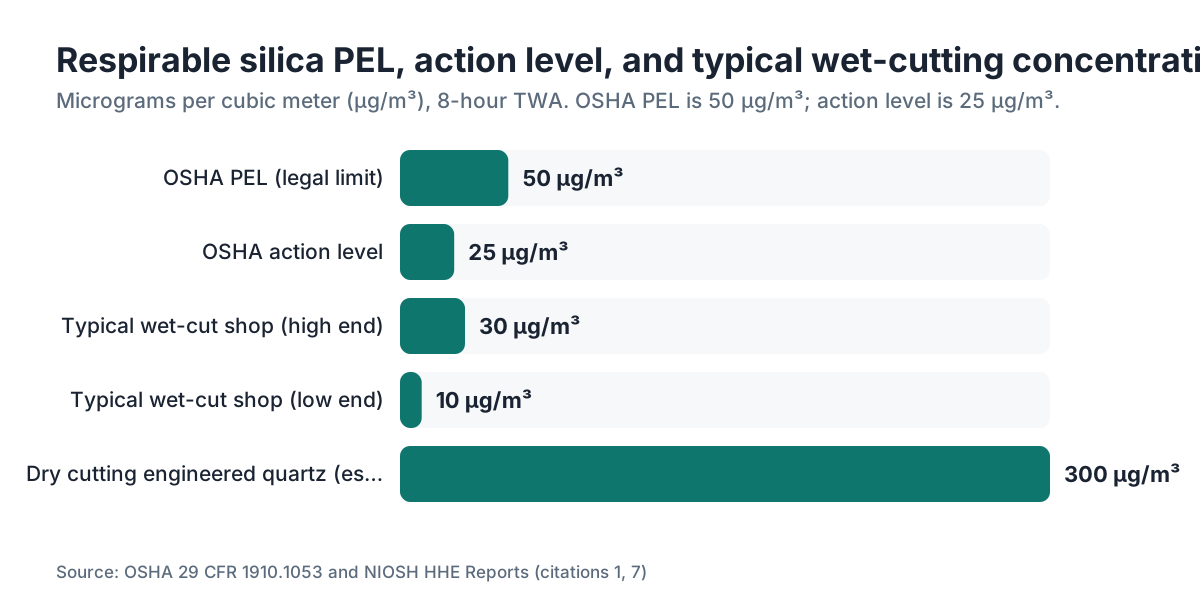
Cutting, grinding, or polishing stone releases respirable crystalline silica, particles small enough to reach the deepest part of the lung. Once there, they cause silicosis. It has no cure. OSHA's 2016 final rule on occupational exposure to crystalline silica set the permissible exposure limit (PEL) at 50 micrograms per cubic meter of air (50 µg/m³) as an 8-hour time-weighted average, half the old limit. [1]
Engineered stone countertops, branded products like Silestone or Caesarstone, run 90 to 95 percent silica by weight. The California Department of Public Health tracked 52 cases of severe silicosis among California stone countertop fabricators between 2019 and 2023, with 10 deaths confirmed. [2] Natural granite runs roughly 25 to 30 percent silica, dangerous enough on its own. Engineered quartz is the worst case in any shop.
The hazard is not hypothetical. Australia banned the manufacture and installation of engineered stone in 2024, and several U.S. states have added enforcement aimed straight at stone fabrication shops. If you cut quartz surfaces daily, getting your wet setup right is the whole job, not a side detail.
What does OSHA actually require for wet cutting in stone shops?
OSHA's silica standard for general industry (29 CFR 1910.1053) and construction (29 CFR 1926.1153) both run on a hierarchy of controls: engineering controls first, then administrative controls, then respirators as a last resort. [1] Wet methods sit at the top of the engineering control list.
For angle grinders and hand-held grinders used on stone, Table 1 in 1926.1153 names "use wet methods" as the primary control. Table 1 compliance gives employers a safe harbor. Follow the listed controls and you don't have to measure airborne dust. Prove your wet setup meets Table 1, and you're generally in compliance without air monitoring.
Table 1 also tells you to put a half-face air-purifying respirator with an N95 filter or better on any worker running a grinder, even with water flowing. Water suppresses most dust. It does not kill all of it. OSHA's language is exact: "Use wet methods or water delivery systems to control dust exposures during the use of the following equipment: handheld power saws, angle grinders, tuck cutters, drivable saws." [11]
The action level, where you must begin medical surveillance and exposure monitoring, is 25 µg/m³ TWA. The PEL is 50 µg/m³. Shops running a proper wet setup with good ventilation consistently measure well below 25 µg/m³ in third-party industrial hygiene surveys.
What equipment do you need for a compliant wet cutting setup?
Four things carry the load: a water delivery system, blades and tooling rated for wet use, water containment, and a slurry management plan. None of it is exotic. Most fabricators already own some of it.
Water delivery systems
For bridge saws and CNC routers, the machine should have water delivery built into the blade guard or spindle. If yours doesn't, aftermarket wet-conversion kits exist for common bridge saw brands. The nozzle has to put water on both sides of the blade at the cut line without stopping, not in bursts. Blade manufacturers commonly recommend 0.5 to 1.0 gallon per minute at the blade, though you should check your specific tooling spec.
For angle grinders, you have two practical options. One is a garden-hose adapter that threads onto a standard grinder and feeds water to the wheel. The other is a dedicated wet grinder with a reservoir built around the guard. DEWALT, Metabo, and Makita all make wet grinder shroud attachments. Expect $40 to $150 per tool for a decent one. [3]
Blades and tooling
Dry blades run wet will fail faster and can delaminate. Use blades and core bits marked specifically for wet use. They have open segments that flush heat and slurry away from the bond. Dry blades have closed or semi-closed segments that trap debris.
Containment
Water and silica slurry go somewhere. You need a drip table or cutting station with a built-in sump, or a portable catch basin under the work. Most shops run a recirculating water system with a settling tank. Solids drop out before the water cycles back to the blade. A two-stage settling system with a 200-gallon tank handles a small shop. Larger operations use three-stage systems or bag filter housings.
Slurry disposal
Settled slurry is more than wastewater. It holds silica fines and sometimes trace metals off your tooling. Most jurisdictions call it non-hazardous solid waste if it passes a toxicity characteristic leaching procedure (TCLP) test, but you have to confirm local rules. Some shops dry the slurry and toss it as solid waste. Others hire a waste hauler. Pouring it down a drain without a sediment trap violates most municipal sewer use ordinances.
How do you set up wet cutting on a bridge saw step by step?
Start by confirming your bridge saw's water lines are clear. A clogged nozzle is the single most common reason wet cutting fails in the real world. Pull the nozzle, run water through the line, and check flow before every shift.
-
Set the flow rate. Open the water valve and let it run before the blade spins. You want a steady sheet of water covering both faces of the blade as it enters the stone, not a trickle.
-
Aim the nozzles so water hits the blade at the 10 o'clock and 2 o'clock positions relative to the cut direction. That's what drags water into the kerf with the blade's rotation.
-
Confirm the sump pump is running and the return line is clear. A classic mistake is cutting with a full sump and no return flow, so the water level climbs until it stops draining right.
-
Set your feed rate conservatively. Aggressive cutting makes more heat and more dust no matter how much water you throw at it. Slower cuts stay cooler, blades last longer, and slurry stays manageable.
-
After cutting, keep water running 10 to 15 seconds after the blade stops. Residual heat can flash-dry slurry on the blade and throw dust into the air the next time you start.
-
Log your water use and sump pump cycles. A settling tank that fills with slurry but never gets cleaned loses its punch. Most small shops need to pump out settled solids monthly.
For granite countertops and other natural stone, this workflow is well established. For engineered quartz (products like Cambria countertops), push the flow rate toward the high end of the manufacturer's range. Quartz throws finer, more respirable particles than natural stone.
How do you set up wet cutting for handheld angle grinders?
Handheld grinders are the hardest tool to control for silica. The operator stands right at the cut, the dust aims toward the body, and wet attachments are less reliable than an integrated bridge saw system.
Step one is the right wet shroud. It wraps around the grinder guard and has a water inlet port. You feed it from a garden hose with a flow control valve, or from a portable water bottle rig for remote work. Some fabricators mount a retractable shop hose reel above each grinder station, which keeps the line from tangling during hand shaping.
Flow rate matters more on grinders than most people realize. If water atomizes into a mist at the wheel instead of running as a film, your flow is too low or your pressure is too high. Aim for a gentle, continuous flood that sheets off the wheel without spraying everywhere. Too much pressure makes aerosols, and aerosols carry fine particles.
For sink cutouts and edge work, some fabricators use a slurry paste of water and stone dust smeared on the cut line before grinding. It's not a substitute for continuous flow. It helps in tight spots where a shroud won't fit.
Even with a flawless wet setup on a grinder, OSHA still requires a minimum of an N95 respirator for the worker at the tool. [1] Where grinder use is heavy, many industrial hygienists push for a half-face elastomeric respirator with P100 cartridges. P100 filters capture 99.97 percent of particles 0.3 microns and larger.
What ventilation do you need alongside wet cutting?
Wet cutting knocks dust generation down hard, but it doesn't zero it out. The next control layer is local exhaust ventilation (LEV) or general dilution ventilation in the shop.
Local exhaust ventilation means a hood or capture device set close to the cut that pulls air away from the worker's breathing zone. On bridge saws, that's often a slotted exhaust port in the saw enclosure. On CNC routers, most machines have dust shrouds tied to a central vacuum or dust collector. The spec that matters is capture velocity. Airspeed at the cutting point should hit at least 100 feet per minute to grab residual particles, per ACGIH (American Conference of Governmental Industrial Hygienists) industrial ventilation guidance. [4]
General dilution ventilation, meaning supply and exhaust fans that move a lot of shop air, is the backup layer. It doesn't replace LEV at the source. It keeps background concentrations low. ASHRAE recommends roughly 10 to 15 air changes per hour for industrial fabrication spaces with heavy dust, though the right target depends on shop volume and how much you're cutting. [5]
Placement matters. Exhaust fans should pull air away from workers toward outside, not drag it across a breathing zone from one side of the shop to the other. A common error is a big exhaust fan on the wall behind the cutting area, which sucks contaminated air right past the worker before it leaves. Better: a low exhaust point near the floor (heavier slurry and coarse particles settle) plus a high point near the ceiling for the residual fines.
What PPE is required even with a wet setup?
Wet cutting is an engineering control, not a full solution on its own. OSHA's hierarchy of controls tells you to layer engineering controls with the right PPE.
For silica, the required respiratory protection tracks your measured or estimated airborne concentrations:
| Estimated silica concentration | Minimum respirator required |
|---|---|
| At or below 25 µg/m³ (action level) | None required, but recommended |
| 25 to 50 µg/m³ (action level to PEL) | Half-face APF 10 (N95 or better) |
| 50 to 500 µg/m³ (1x to 10x PEL) | Half-face elastomeric with P100 |
| Above 500 µg/m³ (>10x PEL) | Full-face PAPR or supplied air |
Source: OSHA 29 CFR 1910.134, Table 1 assigned protection factors [6]
In a wet-cutting shop with proper water delivery and good ventilation, concentrations during active cutting usually land between 10 and 30 µg/m³ in third-party industrial hygiene surveys of stone fabrication shops. [7] That puts most workers at or near the action level, so N95 respirators should be on during cutting no matter what.
Past respiratory protection: safety glasses or goggles (wet grinding throws grit), cut-resistant gloves rated for blade work, and slip-resistant footwear are standard. Wet floors around saws are a real fall hazard. Anti-fatigue mats with drainage channels help on high-volume saw stations.
Respirators only work if they fit and workers actually wear them right. OSHA 29 CFR 1910.134 requires a written respiratory protection program, fit testing, and annual medical evaluation for any worker required to wear a respirator. [6] These aren't suggestions. They're compliance requirements.
How do you handle slurry disposal legally and safely?
Silica slurry is water, fine stone particles, and whatever metal comes off your tooling. It is not ordinary wastewater.
Most jurisdictions ban discharging slurry to the sanitary sewer without pretreatment. The EPA's general pretreatment regulations (40 CFR Part 403) prohibit discharges that could obstruct flow or interfere with a wastewater treatment plant's processes. [8] Fine stone particles settle in sewer lines and cause blockages. Your local sewer authority may run a local limits permit or a zero-discharge rule for solids above a certain size.
What works in the field:
Two-stage settling system. Slurry flows into a primary settling tank, then a secondary tank, before recirculating. Settled solids get pumped out as a semi-solid cake. Most small shops (under five workers, one or two saws) can run this with a 200-gallon primary and 100-gallon secondary tank.
Filter press. Larger shops sometimes use a small filter press to dewater the cake and shrink hauling volume. A basic fabrication-scale filter press runs $2,000 to $8,000 new.
Drying beds. Some shops spread slurry thin on a bermed concrete pad, let it sun-dry, then dispose of the dried material as non-hazardous solid waste. Works in dry climates. Impractical in the Pacific Northwest or Florida.
Before you toss dried slurry as solid waste, confirm it's non-hazardous under your state's waste rules. Most natural stone slurry passes TCLP without a problem. Engineered stone slurry can carry trace metals from filler materials. A one-time waste characterization test, usually $200 to $400 from a commercial lab, is cheap insurance.
If you're hauling to a municipal solid waste landfill, carry the waste characterization documentation. Some landfills have started asking for it on stone shop waste.
How much does a compliant wet cutting setup cost?
Cost swings hard on shop size and whether you're retrofitting existing gear or building from scratch. Here's a realistic breakdown for a small to mid-size fabrication shop:
| Item | Estimated cost range |
|---|---|
| Wet shroud attachments for 2 angle grinders | $80 to $300 |
| Bridge saw water line upgrade/nozzle retrofit | $150 to $600 |
| Two-stage settling tank system (200 + 100 gal) | $800 to $3,000 |
| Sump pump and return plumbing | $200 to $800 |
| LEV hood for bridge saw | $500 to $2,500 |
| Half-face elastomeric respirators (per worker, per year) | $30 to $80 each |
| P100 cartridges (per worker, per year) | $60 to $120 each |
| Annual fit testing per worker | $40 to $100 each |
| Slurry waste disposal (small shop, annual) | $500 to $2,000 |
Total for a basic two-saw shop building from scratch: $2,500 to $10,000 upfront, plus $1,000 to $3,000 per year in ongoing costs.
That sounds like a lot. It isn't, next to an OSHA citation. OSHA's maximum penalty for a serious violation is $16,550 per violation as of 2024, and willful or repeat violations can reach $165,514 each. [9] Those numbers don't even touch a workers' comp claim or litigation from a worker who develops silicosis.
Shops running quoting software like SlabWise can fold PPE and dust control costs into job pricing, spreading them across every slab processed instead of eating them as lump overhead.
What are the most common wet cutting mistakes that still cause overexposure?
Getting wet cutting wrong is easy. These are the failures that keep showing up in OSHA inspection reports and industrial hygiene surveys of stone fabrication shops.
Inadequate water flow. The most common problem. Operators cut the flow because it makes a mess or they run out of water partway through. A thin mist doesn't suppress silica. It wets the dust for a second, then the dust dries and goes airborne again. Flow has to be continuous through the whole cut.
Wrong blade for the job. Run a dry blade wet and the water gets repelled instead of pulled into the kerf, so the blade overheats anyway. Buy wet-rated tooling.
Cutting dry at the start or end of a pass. Spin the blade before the water comes on, or shut the water before the blade stops, and you've got a window of dry cutting. Brief, but it throws a burst of high-concentration dust right at the worker's face.
Letting the slurry tank go unmanaged. A full settling tank stops settling. Slurry backs up into the return lines, the pump starves, and eventually the water at the blade already carries silica fines and works poorly as a suppressant.
Cutting near exhaust that scatters the slurry. Cutting close to a strong exhaust fan can atomize the water at the blade and fling fine particles farther than still air ever would. LEV should capture, not disperse.
Trusting wet cutting instead of respirators. Workers pull respirators off because "we're cutting wet." OSHA Table 1 still requires respiratory protection for grinder work even with water running. [11] Wet cutting cuts exposure. It doesn't erase it.
How do you document wet cutting controls for OSHA compliance?
If OSHA shows up, documentation is the line between a citation and a warning. Table 1 compliance leans hard on proving your controls were in place and working at the moment of exposure.
Keep a written exposure control plan. OSHA 29 CFR 1910.1053 and 1926.1153 both require a written plan that names each task involving silica exposure, the engineering and work practice controls in place, and how the employer protects workers. [1] It doesn't need to be long. It does need to exist on paper.
Maintain equipment inspection logs. A simple daily log noting that water lines were checked, flow was confirmed, and the slurry tank was checked before the shift is strong evidence of a working system. Date, operator name, equipment, and a notes field for anything odd.
Record training. OSHA requires workers exposed to silica to get training on health effects, the exposure control plan, and proper PPE use. Document who was trained, when, and what the training covered.
Store fit test records. OSHA requires annual fit testing for all workers required to wear respirators. Keep those on file for at least three years. [6]
If you run air monitoring to show you're below the action level, keep those records for 30 years under OSHA 1910.1053(d). [1] Most small shops skip monitoring by holding full Table 1 compliance instead, which is a legitimate and practical path.
For fabricators on shop management software, some platforms let you attach job-level compliance notes or link cutting records to dated equipment logs. That timestamped record helps if an inspection lands well after a job wrapped.
What materials besides engineered quartz require the same wet cutting precautions?
Engineered quartz gets the most attention for its extreme silica content, but the OSHA silica standard applies any time workers may be exposed to respirable crystalline silica above the action level. [1] That covers more materials than most shops assume.
Granite countertops run 25 to 30 percent silica by weight. Lower than engineered quartz, still a real source of respirable dust during dry cutting. Wet cutting is required or strongly recommended for any production granite work.
Marble countertops are mostly calcium carbonate, not silica, and carry lower silicosis risk. But plenty of marble slabs have quartz veining, and calcium carbonate dust itself irritates the airways. Wet cutting is still best practice.
Quartzite, often confused with marble at retail, is a metamorphic rock that's mostly quartz. Silica content can hit 95 percent. If you're cutting quartzite (or any stone sold under a name that might be quartzite), treat it like engineered quartz. See also the guide on how to clean quartzite countertops for material context.
Concrete countertops are portland cement, sand, and aggregate. Sand is crystalline silica. Dry cutting or grinding concrete throws serious silica exposure. Wet cutting requirements apply.
Ceramic and porcelain tile carry silica in the clay body and in some glazes. Large-format porcelain slabs used as countertops (a growing segment) get cut with bridge saws and grinders and need the same wet protocols as stone.
Laminate countertops, butcher block countertops, and solid surface like Corian countertops don't hold significant crystalline silica and aren't subject to the silica standard. Their dust can still raise other health concerns, so eye and respiratory protection during cutting is good practice anyway.
How do you train workers to use wet cutting systems correctly?
OSHA 29 CFR 1910.1053(i) requires employers to train all workers who may be exposed to silica at or above the action level. The training has to cover the health effects of silica, where silica-containing materials sit in the workplace, the specific tasks that make silica dust, how to use and maintain the engineering controls and PPE in place, and the purpose and limits of each control. [1]
Documentation aside, practical training in a stone shop means supervised hands-on work, more than a video. Have new hires set up the wet system, check flow, change nozzles, and clean the settling tank while a senior fabricator watches. One supervised session beats ten safety videos.
Common training gaps in stone shops: workers who don't know how to tell if their N95 or half-face respirator actually fits, workers who don't grasp that a wet blade still makes some dust and the respirator is still required, and workers who figure the dust problem is solved the second the water's on.
Run a pre-shift checklist. Post it at the saw. Five items: water supply on and flowing, nozzles aimed at the blade, sump pump running, settling tank below capacity, respirator on before starting. Filled out daily, that checklist doubles as documentation for your exposure control plan.
For shops with non-English-speaking workers, OSHA publishes training materials in Spanish on its website. [10] Training must be given in a language the worker understands. Posting the checklist in both English and Spanish on the saw is cheap and it works.
Frequently asked questions
What is the OSHA permissible exposure limit for silica dust in a stone shop?
OSHA's PEL for respirable crystalline silica is 50 micrograms per cubic meter of air (50 µg/m³) as an 8-hour time-weighted average, for both general industry and construction. The action level, where medical surveillance and monitoring kick in, is 25 µg/m³. These limits apply to every worker in the shop, not only the person at the saw.
Does wet cutting eliminate the need for respirators?
No. OSHA's Table 1 in 29 CFR 1926.1153 still requires at minimum an N95 respirator when using angle grinders or handheld saws on stone, even with water running. Wet cutting reduces airborne silica concentrations sharply but does not reduce them to zero. Respirators remain required for grinder and saw work.
How much water flow is needed at the blade for effective dust suppression?
Most blade manufacturers recommend 0.5 to 1.0 gallon per minute at the cut line for bridge saws and angle grinders. The water should form a continuous liquid film on both blade faces at the kerf, not a mist or intermittent drip. Check your specific blade manufacturer's spec; some larger blades need higher flow rates.
Can I use a dry blade for wet cutting to save money?
No. Dry blades dump heat through air, not water. Run them wet and the water pools in closed segments, bond wear speeds up, and the blade can delaminate. Buy blades rated for wet use. The price gap between wet and dry blades is small. A blade failure mid-cut is not.
What do I do with the silica slurry from my settling tanks?
Dry it or dewater it, then dispose of it as solid waste if it passes a toxicity characterization test. Do not discharge it to the sewer without a permit from your local sewer authority. Pouring it on the ground violates most state and local rules. A commercial waste characterization test costs $200 to $400 and confirms how to dispose of the material legally.
What type of respirator is required for engineered quartz fabrication?
At minimum, a NIOSH-approved N95 filtering facepiece or half-face elastomeric respirator with N95 or P100 cartridges. For heavy grinder work or shops without strong LEV, a half-face elastomeric with P100 cartridges is the better choice. Full-face respirators or PAPRs come into play only if measured concentrations exceed 500 µg/m³, which is rare in a properly set-up wet shop.
Is engineered quartz more dangerous to cut than granite?
Yes, meaningfully. Engineered quartz holds 90 to 95 percent silica by weight versus 25 to 30 percent for granite. Cutting engineered quartz dry throws far higher silica concentrations per unit of material removed. Australia banned engineered stone entirely in 2024. Wet cutting with higher water flow rates matters most for engineered quartz products.
How often should I clean my settling tanks?
Most small shops (one to two saws) need to pump settled solids monthly. A tank that fills with solids stops settling and starts recirculating fine silica particles back to the blade, which defeats the whole system. Weekly visual inspection is faster: if you can't see the tank bottom through 6 inches of water, pump it.
What ventilation does a stone fabrication shop need besides wet cutting?
Local exhaust ventilation (LEV) set to capture residual dust at the cutting point, with at least 100 feet per minute capture velocity at the tool. General dilution ventilation (10 to 15 air changes per hour) handles background levels. Exhaust should pull air away from workers' breathing zones, not across them. LEV and wet cutting together beat either one alone.
Does OSHA require air monitoring if I use wet cutting?
Not if you're fully complying with Table 1 in OSHA 29 CFR 1926.1153. Table 1 compliance gives you a safe harbor from the air monitoring requirements. If any Table 1 control is missing or incomplete, you must either run monitoring or show through objective data that exposures fall below the action level.
What records do I need to keep for OSHA silica compliance?
A written exposure control plan, equipment inspection and maintenance logs, worker training records, and respirator fit test records kept at least three years. If you run air monitoring, those records must be kept 30 years. Table 1 compliance does not drop the need for a written exposure control plan; it only drops the monitoring requirement.
Does marble or quartzite require wet cutting like granite does?
Quartzite is mostly quartz, with silica content potentially as high as 95 percent, and should be treated exactly like engineered stone for wet cutting. Marble is mostly calcium carbonate and carries lower silicosis risk, but many slabs have quartz veining, so wet cutting is still best practice. Confirm the material's actual mineralogy before relaxing any control.
How do I handle wet cutting for sink cutouts where a shroud won't fit?
Use a wet-rated plunge saw with integrated water feed where you can. For grinder work in tight geometries, some fabricators run a squeeze bottle to feed continuous water to the cut line by hand while cutting. A second person with a water bottle works for short cuts. Not ideal, but far better than dry cutting in a confined space.
What is the cost of an OSHA silica violation for a stone shop?
A serious violation carries a maximum penalty of $16,550 per violation as of 2024. Willful or repeated violations can reach $165,514 per violation. OSHA has flagged stone fabrication shops as a priority enforcement target because of the silicosis outbreak linked to engineered stone. A full compliance setup for a small shop typically costs far less than a single serious citation.
Sources
- OSHA, Occupational Exposure to Respirable Crystalline Silica standard (29 CFR 1910.1053 and 1926.1153): OSHA PEL of 50 µg/m³ TWA, action level of 25 µg/m³, Table 1 wet method requirements for grinders and saws, written exposure control plan and training requirements
- NIOSH, Silica topic page (CDC), engineering controls for silica in construction and manufacturing: Wet methods as primary engineering control for stone cutting; water delivery system recommendations for handheld grinders
- ACGIH, Industrial Ventilation: A Manual of Recommended Practice: Minimum capture velocity of 100 feet per minute at tool face for local exhaust ventilation in stone cutting operations
- ASHRAE, Standard 62.1 Ventilation for Acceptable Indoor Air Quality: Air change rate guidance for industrial spaces with high dust generation activities
- OSHA, Respiratory Protection Standard (29 CFR 1910.134): Assigned protection factors for respirator types; fit testing requirements; written respiratory protection program requirement; medical evaluation requirement
- NIOSH, Health Hazard Evaluation Program (CDC), stone fabrication shop evaluations: Third-party industrial hygiene surveys of stone fabrication shops showing airborne silica concentrations during wet cutting typically 10 to 30 µg/m³
- EPA, National Pretreatment Program (general pretreatment regulations, 40 CFR Part 403): Federal prohibition on discharging materials that obstruct sewer flow or interfere with wastewater treatment, applicable to stone slurry discharge
- OSHA, OSHA Penalties (civil penalty amounts and adjustments): Maximum penalty for serious violation $16,550; maximum for willful or repeat violation $165,514 per violation (2024 amounts)
- OSHA, agency website (Spanish-language safety and health resources): OSHA training materials available in Spanish, including silica hazard resources for construction and general industry workers
- OSHA, Silica in Construction (Table 1, specified exposure control methods): Table 1 specifies wet methods as the primary engineering control for handheld power saws and angle grinders used on stone; N95 respirator required even with water running
Last updated 2026-07-11