
TL;DR
- Respond within 24 to 48 hours, stay calm, acknowledge the problem in public, then move the fix offline.
- Don't argue in the reply.
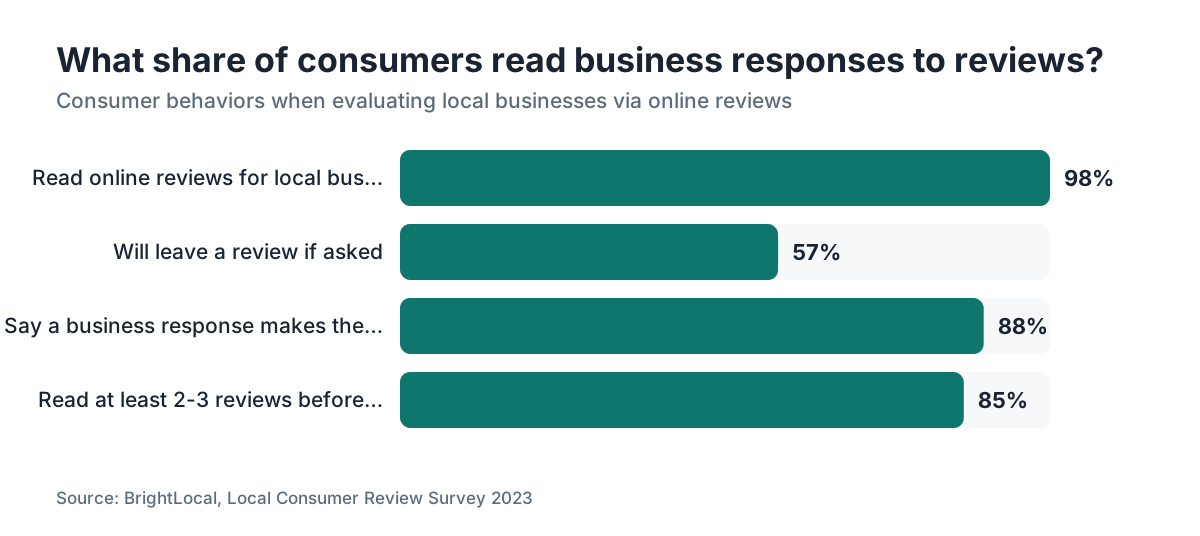
- A good response to a 1-star review can build more trust than a spotless record, because 88% of consumers say a business reply makes them feel more positive about the shop.
Why does one bad countertop review hit so hard?
A countertop job is a big, nervous purchase. Homeowners spend $2,000 to $10,000 or more, the slab goes in the room they use most, and they live with it for decades. So they research hard before they pick a fabricator. Google reviews are usually the first thing they read.
BrightLocal's 2023 Local Consumer Review Survey found that 98% of consumers read online reviews for local businesses, and the average shopper reads about 10 reviews before forming an opinion [1]. Stone and tile shops sit in home services, one of the categories where trust drives the buying decision hardest. One 1-star review sitting at the top of your listing does real damage.
Here's the part most owners miss. A shop with a perfect 5.0 is sometimes trusted less than one sitting at 4.6 with a mix of reviews, because perfection looks curated. What shoppers actually study is how you handle things when a job goes sideways. That reply is your reputation test, and it's public.
How quickly should you respond to a negative Google review?
Respond within 24 hours if you can. 48 hours is the outer edge before your silence becomes part of the story.
Google doesn't publish a response-time ranking factor. But research from Harvard Business School economist Michael Luca found that when hotels started responding to reviews, their overall ratings climbed and they got more reviews total [2]. The mechanism carries over to any local business: a reply signals that a real person is minding the shop. For a small fabricator up against big-box installer programs, that human signal counts.
Turn on notifications so every new review hits your phone. Setup takes five minutes. Go to business.google.com, open your profile, click Settings, then Notifications, and switch on Customer Reviews. That one step fixes the slow-response problem for most shops, because the reason owners reply late is almost never laziness. They just never saw the review.
What should you actually say? A word-for-word framework
Four parts, every time: acknowledge, apologize (or empathize, if the complaint is factually wrong), offer to fix it, and move it offline. Keep the public reply short. 75 to 150 words is the sweet spot.
Here's a template you can adapt:
"[Reviewer name], thank you for taking the time to share this. What you're describing doesn't match the standard we hold ourselves to, and I'm sorry the experience fell short. I'd really like to make this right. Please call us at [phone] or email [email] so we can look at this together and find a solution. Ask for [your name] directly."
That's the whole thing. Notice what's missing. No detailed defense, no blame on the homeowner, no story about how hard the job was. All of that reads as excuse-making to everyone who wasn't in the room.
When the complaint is legitimate, a seam that shows, a sink cutout that chipped, a slab that came in with the wrong edge profile, say it plainly: "You're right that the seam placement wasn't where we discussed, and I own that." Specific ownership earns trust. Vague corporate language burns it.
When the complaint is factually wrong, or you suspect a competitor's fake, the reply still follows the same template. You note calmly that you can't find this job in your records and invite them to contact you. You do not call them a liar in public. Ever.
What are the biggest mistakes fabricators make when responding to negative reviews?
Getting defensive is the big one, and it makes the original problem worse. The argument plays out in public, and every future customer who reads it sees a shop that fights with its clients.
Here are the patterns that hurt you:
Writing a wall of text. A 400-word rebuttal signals you're rattled. Nobody finishes it. The reviewer doesn't care, and shoppers read the length itself as a red flag.
Mentioning the price you charged. "We gave them a great deal" has nothing to do with the complaint and reads as petty.
Blaming the homeowner. Maybe the granite cracked because they dropped a cast-iron skillet on it. Saying so in public still makes you look like you're dodging. Handle it privately.
Promising things you can't deliver. "We'll have someone there tomorrow" in a public reply, then nobody shows, produces a follow-up review nastier than the first.
Using a template that's obviously a template. "Dear Valued Customer, Thank you for your feedback" reads as a robot. Use the reviewer's first name.
Ignoring it. No response is a response. Shoppers clock the silence.
Can you get a fake or unfair countertop review removed from Google?
Sometimes. Google removes reviews that break its content policies, but the bar is narrow [3]. Reviews that qualify for removal include spam or fake content, off-topic content (someone reviewing a business they never visited), prohibited content like hate speech or personal attacks, and conflicts of interest such as a competitor posing as a customer.
What Google will not touch: reviews that are negative but real, reviews where the customer has the facts wrong, and reviews that exaggerate a genuine experience.
To flag one, open your Google Business Profile, find the review, click the three-dot menu, and choose "Report review." Pick the policy category that fits best. Google usually takes 3 to 14 days to evaluate. If it declines and you're sure the review is fraudulent, escalate through Google Business Profile support chat and cite the exact policy it violates.
In 2024 the FTC finalized a rule on fake reviews (16 CFR Part 465) that makes it illegal to create, buy, or suppress consumer reviews [4]. The rule also bars threatening legal action against reviewers and paying for positive reviews. Penalties run up to $51,744 per violation. That's the real risk for any shop tempted to bury one bad review under a pile of fakes. Don't do it. The math never works out.
How do you respond when the complaint is about a countertop defect specifically?
Countertop complaints cluster around a handful of issues: visible seams, edge chips during install, staining or etching the customer blames on you, wrong measurements, and color mismatch between the sample and the installed slab. The public response is the same for all of them (acknowledge, empathize, redirect offline). The private follow-up is where they split.
Seam complaints show up a lot because most homeowners don't know that granite, quartz, and quartzite all need seams on long runs, and that seam visibility depends on the stone's pattern and color. In the private call, bring photos and standards. The Natural Stone Institute (formerly the Marble Institute of America) publishes fabrication tolerances you can point to if a dispute escalates [5].
Edge chips during install are usually on you. Own it, schedule the repair, document it. A fast repair with zero argument often flips a 1-star into a 4-star follow-up.
Staining and etching complaints that land weeks later are trickier. Marble etches from acidic liquids no matter how well you sealed it, and no sealer stops that. That education belongs in a private conversation, not the review reply. Your public line just says you'd like to understand what happened and you're reachable.
If you track jobs in software like SlabWise, you can pull the original quote, template notes, and edge-profile approval in about 30 seconds when a complaint lands. Having that documentation open before you dial changes the whole call.
For setting expectations before the crew ever shows up, the countertop installation guide covers what to tell customers at each stage.
Should you ever respond to a positive review mentioning a past problem?
Yes, once in a while. When a reviewer writes "they had a rough start but made it right," a short public thank-you that nods to the recovery is worth writing. It tells future customers you take callbacks seriously and you follow through.
Don't go mining your good reviews for chances to re-argue the hard parts. A reply like "as you know, there were some initial communication issues" drags the problem back into view for no reason at all.
How do you build enough positive reviews so that one bad one doesn't dominate?
Volume is your buffer. A shop with 6 reviews and one 1-star sits at a 4.0 average and looks risky. A shop with 80 reviews and one 1-star sits at 4.9 and looks safe. Same single complaint, opposite outcome.
The FTC's 2024 rule matters here too. You can ask customers for reviews, but you can't pay them, incentivize them, or ask only the happy ones [4]. The compliant move is a plain ask at the right moment. For countertop shops that moment is the day after installation, when the homeowner is standing in the kitchen staring at a finished slab they love. A text or email with a direct link to your Google review page converts well.
BrightLocal found that 57% of consumers will leave a review if asked, up from 35% in 2020 [1]. The ask works. Most shops just never make it a habit.
Build the request into your job-completion checklist. When the final invoice goes out, the review link rides along with it. Automate it if your software allows.
Material choice shapes what people complain about, too. Stones with heavy movement like some marble countertops varieties draw more seam-visibility complaints, because the pattern break is obvious. More uniform materials like Cambria countertops and solid-surface options like Corian countertops draw fewer, because the visual break is subtle.
What does the law say about responding to customer reviews?
Three legal areas matter here.
First, defamation. A customer who posts a false statement of fact about your business can, in theory, be liable. But the bar is high, the legal costs are real, and most small-business attorneys will tell you a single review almost never justifies a suit. The bigger practical risk is that threatening legal action tends to draw more negative reviews and sometimes press attention. The FTC's 2024 rule also specifically bans using legal threats to suppress reviews [4].
Second, the Consumer Review Fairness Act, passed by Congress in 2016 as Public Law 114-258, makes it illegal to put clauses in consumer contracts that prohibit or penalize customers for writing negative reviews [10]. If your fabrication contract has any language restricting reviews, strike it today. The FTC enforces this and has taken action against businesses that ignored it [6].
Third, HIPAA does not apply to countertop shops (it's medical privacy law), but plain privacy sense does. Don't put personal details in your public reply: no last name, no address, no account details the customer didn't already share in their review.
The FTC's guidance is blunt on the point: businesses cannot threaten legal action against consumers who leave honest reviews, even negative ones [4].
When should you take the conversation offline versus keeping it on Google?
Keep the public reply short, and always invite the conversation offline. The public reply is written for future customers, not for the reviewer. Once you've acknowledged the issue and given contact info, stop talking on Google.
If the customer fires back in the thread with more complaints, don't take the bait with a point-by-point rebuttal. One more reply, max: "I'm sorry to hear there are additional concerns. I've sent you an email and I hope we can connect." Then stop.
The offline conversation is where you actually solve things: a repair, a partial refund, or an explanation with documentation behind it. What you offer depends on whether the complaint holds up and what your contract says about warranties and callbacks.
For fabricators, document everything in your job system. Install dates, who signed off on the template, photos of the finished work before the crew pulled out. That record protects you in a dispute and lets you respond with confidence instead of nerves. SlabWise stores those notes next to the original quote, so pulling the full picture is fast even when the review shows up weeks later.
Response examples by complaint type
Four common scenarios with suggested language. Adapt freely.
Complaint: visible seam "[Name], I hear you, and a seam that catches your eye every day in your kitchen is genuinely frustrating. I'd like to come look at it in person and understand what's happening. Please call me at [phone]. I want to see it myself."
Complaint: installation chip "[Name], that shouldn't have happened, and I'm sorry it did. Edge chips during installation are on us. Please reach out at [phone or email] and we'll get a repair scheduled as fast as we can."
Complaint: color looks different than the sample "[Name], I know how disappointing that feels after months of planning. Natural stone does vary slab to slab, but that's a conversation we should have had more clearly before templating. I'd like to walk through what happened. Please call [phone]."
Complaint: job took longer than quoted "[Name], I appreciate you being direct. Delays are frustrating and your time matters. I want to understand your experience better. Please reach out at [phone or email] so we can talk."
None of these includes an explanation, a defense, or a promise beyond contact. That's on purpose. The explanation belongs in the private conversation, not the public one.
For care issues that surface weeks after install, the how to clean stone countertops and how to clean quartzite countertops guides have specifics you can hand customers before a problem ever starts.
Does responding to reviews actually improve your Google ranking?
Google's own help pages say that high-quality, positive reviews from your customers can improve your business's visibility, and that replying to reviews shows you value customers and their feedback [7]. Google doesn't publish the exact weight reviews carry in local ranking. But Whitespark's 2023 Local Search Ranking Factors survey of SEO professionals put review signals (quantity, velocity, diversity, and responses) among the top factors, at roughly 16% of the local pack algorithm [8].
The takeaway is simple. Responding to every review, good and bad, is a local SEO signal. It costs two minutes each. Almost no other two-minute task moves your local ranking more.
A shop with 60 responded-to reviews outranks a shop with 60 ignored ones when everything else is equal. The math is plain enough that it should change your daily habits.
Frequently asked questions
How long should my response to a negative countertop review be?
Keep it between 75 and 150 words. Long replies look defensive and most readers won't finish them. Acknowledge the issue, express real concern, give a direct contact (phone or email), and stop. The actual fix happens offline. Brevity reads as confidence, not indifference.
What if the reviewer is lying or the review is completely fake?
Use the same calm template you'd use for a real complaint. Note briefly that you can't find this job in your records and invite them to contact you. Then flag the review in Google Business Profile for a policy violation. Don't call them a liar in the public reply, even if you're certain. Reviews flagged as spam or fake typically take 3 to 14 days for Google to evaluate.
Can a bad Google review hurt my countertop business's search ranking?
Review signals account for roughly 16% of Google's local pack ranking algorithm, per Whitespark's 2023 survey of SEO professionals. A low rating paired with few reviews hurts visibility. The best fix is building review volume from happy customers so one outlier stays a small slice of your total.
Should I offer a refund in my public Google reply?
No. Never make specific offers, refunds included, in the public reply. You can't evaluate the right resolution yet, and a public refund offer sets an expectation before you've even seen the problem. Offer contact instead. Decide on the fix once you're talking privately.
Is it legal to ask customers not to leave bad reviews in a contract?
No. The Consumer Review Fairness Act (Public Law 114-258, 2016) makes non-disparagement clauses in consumer contracts illegal and unenforceable. The FTC enforces it. If your fabrication contract has any language restricting or penalizing customers for reviews, remove it. Violations can draw FTC enforcement action.
How do I ask happy countertop customers for a Google review without paying them?
Ask directly the day after installation, when the kitchen is fresh and they're happy. A short text or email with your direct Google review link works. The FTC lets businesses ask for reviews but bans paying, incentivizing, or asking only satisfied customers. BrightLocal found 57% of consumers will leave a review when asked.
What if the customer responds to my reply with more complaints on Google?
Post one more reply, no more. Two sentences: acknowledge the added concerns, confirm you've reached out by phone or email, say you want to resolve it. Then stop replying in the thread. A public back-and-forth tells future customers the dispute is unfixable, which is worse than the original review.
How do countertop shops handle a review about a defect that's actually the customer's fault?
Respond publicly with the same empathetic template you'd use for your own mistake. In private, share documentation: install photos, signed approval forms, and material care information. If the damage is confirmed misuse, like etching on marble from lemon juice, explain it educationally, not defensively. Keep that explanation out of the public reply.
Does Google notify me when I get a new review?
Yes, if notifications are on. Go to business.google.com, open your profile, click Settings, then Notifications, and make sure Customer Reviews is turned on. You can get alerts by email. Most owners who respond slowly simply never set this up, so reviews sit for days before anyone notices.
What rating average should a countertop shop aim for?
Northwestern's Spiegel Research Center found purchase likelihood peaks for products rated between 4.2 and 4.5 out of 5, not at a perfect 5.0, because a flawless score looks filtered. For local services like fabrication, staying above 4.3 with at least 30 reviews gives you the credibility floor most shoppers need to call.
Can I threaten to sue a customer who leaves a false negative review?
You can, but you almost certainly shouldn't. The FTC's 2024 rule on fake reviews specifically bans using legal threats to suppress consumer reviews, even negative ones. Beyond the regulatory risk, threatening reviewers tends to generate more negative attention, not less. Talk to an attorney if you believe a review is genuinely defamatory before you act.
How long does Google take to remove a review that violates its policies?
Google usually takes 3 to 14 days to evaluate a flagged review. There's no guaranteed timeline. If the first flag is denied and you still believe the review breaks policy, escalate through Google Business Profile support chat and cite the exact policy section. Removal isn't guaranteed even for reviews that look like clear violations.
Should I respond to positive reviews too, or just the negative ones?
Respond to both. Replying to positive reviews reinforces the behavior (customers who see you reply are likelier to leave one), signals to Google that your listing is actively managed, and takes about 30 seconds. A short, specific line ("So glad the leathered granite came out the way you pictured it") beats a generic "Thanks for the kind words!"
Sources
- BrightLocal, Local Consumer Review Survey 2023: 98% of consumers read online reviews for local businesses; 57% will leave a review if asked, up from 35% in 2020
- Harvard Business School, Michael Luca research on online reviews and hotel review responses: Hotels that responded to reviews saw improved overall ratings and increased review volume over time
- Google Business Profile Help, Prohibited and restricted content policy: Google will remove reviews that are spam, fake, off-topic, or a conflict of interest; negative but genuine reviews are not removable
- Federal Trade Commission, Final Rule on Fake Reviews and Testimonials (16 CFR Part 465), effective October 2024: FTC prohibits businesses from creating, buying, or suppressing consumer reviews and from threatening legal action against reviewers; penalties up to $51,744 per violation
- Natural Stone Institute, Fabrication Tolerances and Standards: Natural Stone Institute publishes industry fabrication tolerances for seams, edges, and installation that can be referenced in customer disputes
- FTC, Consumer Review Fairness Act overview: The Consumer Review Fairness Act makes non-disparagement clauses in consumer contracts illegal and unenforceable; FTC enforces the law
- Google Business Profile Help, Get reviews on Google: Google states that high-quality positive reviews improve business visibility and that replying to reviews shows businesses value customer feedback
- Whitespark, Local Search Ranking Factors 2023: Review signals including quantity, velocity, diversity, and responses account for roughly 16% of the local pack ranking algorithm per SEO professional surveys
- Northwestern University Spiegel Research Center, 'How Online Reviews Influence Sales' (2017): Purchase likelihood peaks for products rated between 4.2 and 4.5 out of 5, not at a perfect 5.0, because a flawless score appears filtered to consumers
- U.S. Congress, Consumer Review Fairness Act of 2016 (Public Law 114-258): Public Law 114-258 makes it illegal to include contract clauses that prohibit, penalize, or restrict customers from leaving honest reviews
Last updated 2026-07-11