
TL;DR
- General contractors control job sequencing, client communication, and payment on most remodels.
- Fabricators who treat the GC as a scheduling partner, put the template-to-install timeline in writing, and protect margin with signed work orders and lien rights rarely get burned.
- Homeowners who understand the GC's role avoid duplicate work, mixed messages, and delays that cost real money.
What does a general contractor actually do on a countertop project?
A general contractor runs the whole remodel. That means scheduling subs, calling for inspections, and keeping the homeowner informed. On a kitchen or bath, the GC is usually the person who hired your shop or handed the homeowner your name. Either way, the GC sees your countertop as one line item in a big project, not the star of the show.
That matters because countertops depend on the schedule in a way most finishes don't. You can't template until cabinets are set, level, and screwed down. You can't install until the template is done and the slab is cut and polished, which takes three to ten business days depending on the queue [12]. If the GC's cabinet installer runs late, your template date slides, your production slot slides, and another job may get pulled in to fill your machine time. The ripple is real.
Fabricators who get this stop waiting for the last-minute call. They get into the GC's scheduling loop on day one. That one shift changes almost everything about how a job goes.
How should a fabricator set expectations with a GC before the job starts?
Get it in writing before any deposit moves. A one-page document beats a handshake, and it doesn't need to be ten pages of legalese. State four things: the trigger for templating (cabinets fully set and leveled), the turnaround from template to install (your real number, not a best case), the change order process, and who talks to the homeowner about scheduling.
That last point starts more fights than anything else. GCs want to own client communication, and they should, since they carry the relationship and the budget. But homeowners call the fabricator directly all the time, especially after they fall for a slab in the showroom. Agree upfront on who calls whom and when. It keeps the GC from feeling blindsided and keeps the homeowner from hearing two different stories.
Quote speed is your other lever. GCs juggle a dozen subs and they remember who answers fast. Send a clean, detailed quote within 24 hours of the site visit and you're the one who gets the next call. Shops running quoting software can build accurate square-footage quotes with material breakdowns and edge profiles in minutes instead of days [1].
Be honest about lead time. If you're six weeks out, say six weeks. A GC would rather plan around a true number than eat a two-week promise that turns into five when the cabinet crew finally shows.
What does typical GC markup on countertop work look like, and how should you handle it?
GCs mark up every sub, usually 10% to 20% on top of your invoice, and some push higher on design-build work [2]. This is normal. Don't fight it. What matters is whether the trade price you quote leaves room for their markup without making the homeowner's final number look insane.
Some fabricators offer a formal trade discount, often around 10% off retail, to GCs and designers who bring steady volume. Others quote standard and let the GC stack their margin on top. Both are fine. What's never fine is quoting the homeowner directly to go around the GC. Do that once and you've torched the relationship and every future job that came with it.
If a GC asks you to eat their markup by dropping your price, that's a negotiation, not a rule. Know your floor. Labor, material, waste factor, overhead, and a real net margin all belong in the number before you give up a nickel. Shops that quote from the gut instead of a calculated cost basis give away margin under pressure and never feel it happen.
Payment terms are a separate animal from pricing, and the one that stings fabricators most. More on that next.
How do GC payment terms differ from direct-to-homeowner jobs, and how do you protect yourself?
Direct homeowner jobs usually run 50% deposit at signing, balance before or at install. GC jobs often ride the GC's own draw schedule, which ties your money to when the GC gets paid by the homeowner or the bank. Commercial work runs net-30 or net-60. In residential remodeling, you'll still see net-30 from GCs who just run their books that way.
That's real cash flow risk. You buy the slab, cut it, polish it, install it, then wait a month while the stone sits in someone's kitchen. If the GC and homeowner get into a dispute, your invoice gets caught in the crossfire.
Protect yourself with a few moves. Get a signed work order or purchase order before you buy material. Preserve your lien rights, because most states let suppliers and subcontractors file a mechanics lien on the property when they aren't paid [3]. For any GC you haven't worked with, ask for 50% upfront the way you would with a homeowner, then negotiate down based on their track record.
Lien deadlines vary by state, so know yours. California Civil Code Section 8414 requires a subcontractor to record a mechanics lien "after the claimant ceases to provide work" and within the statutory window, which for a claimant on a project without a recorded notice of completion runs 90 days after the work of improvement finishes [4]. Miss that window and your lien rights are gone.
Some shops charge a modest carrying fee (interest, basically) on invoices past 30 days. Put it in the contract upfront. Trying to enforce it after the fact almost never works.
What is the right template-to-install timeline to communicate to a GC?
Five to ten business days from template to install is the honest answer for a typical residential job in a moderately busy shop with the slab in stock. GCs often expect faster because they don't know how stone fabrication works. Your real number depends on your shop, equipment, and queue. Here's how a normal project breaks down:
| Stage | Typical duration |
|---|---|
| Template appointment | 1-2 hours on site |
| Template to production (scheduling) | 1-3 business days |
| Cutting and edge work (CNC + hand) | 1-2 days |
| Polishing and QC | Half-day to 1 day |
| Install scheduling buffer | 1-3 days |
| Total: template to install | 5-10 business days |
That assumes the slab is on your floor. If you have to order from the distributor, add three to seven business days depending on availability and delivery.
Give the GC this timeline in writing before the project starts. Some shops hand over a written production schedule with the quote. Now it's a reference, not a memory. When the GC says "you told me two weeks," you point to the paper.
If your shop software tracks jobs through the pipeline, give GCs real status updates instead of guesses. That kind of transparency earns trust faster than any pitch.
How do you handle change orders when the GC is in the middle?
Route every change order through the GC. Change orders get messy because three people are involved: the homeowner who wants a different edge or sink cutout, the GC who has to approve it, and you who has to price and cut it. Skip the process and here's the movie: the homeowner asks you for a change, you say yes, and the GC finds out at invoice time. Bad day for everyone.
So when a homeowner calls you with a change, say something like: "Totally doable. I'll price it and send the change order to [GC name] for approval, then we'll get it scheduled." That keeps the GC in control, keeps you from doing free work, and doesn't make the homeowner feel brushed off.
Price every change as its own line item with a written description, the cost, and any hit to the install date. If a change pushes the install back, say so on the page. If the GC or homeowner wants to expedite to hold the date, that's an upsell (rush fees are legitimate), but the base change order shouldn't bake it in. NARI's project guidance recommends documenting every change order in writing with cost and schedule impact before work begins [9].
Never swallow change order costs quietly to dodge a conflict. Fabrication runs thin, and free changes stack up into real money fast.
Who is responsible for cabinet readiness before the fabricator templates?
The GC is. On GC jobs, making sure cabinets are ready before the template appointment sits with the general contractor, and it should be in your written agreement. Cabinets have to be fully installed, screwed to the wall and floor, level, and shimmed before anyone templates. This isn't a preference. It's physics. Template over unlevel cabinets and the countertop rocks or gaps once the cabinets settle, the seam lines drift, and the sink won't drain right.
Show up to an unready site and you lose your labor hours, your drive time, and maybe a production slot. A re-template fee of $150 to $300 is fair, and it belongs in your contract upfront so nobody's surprised.
Smart shops make a two-minute call to the GC or cabinet installer two to three days out. "Just confirming uppers and lowers are fully secured and level?" That call kills a lot of wasted trips.
Homeowners working with a GC: ask your GC to confirm cabinet readiness in writing before the template date gets booked. A cabinet crew and a fabricator on the same week is tight. Give yourself a buffer day in case something slips.
How do you build a long-term relationship with GCs who send repeat business?
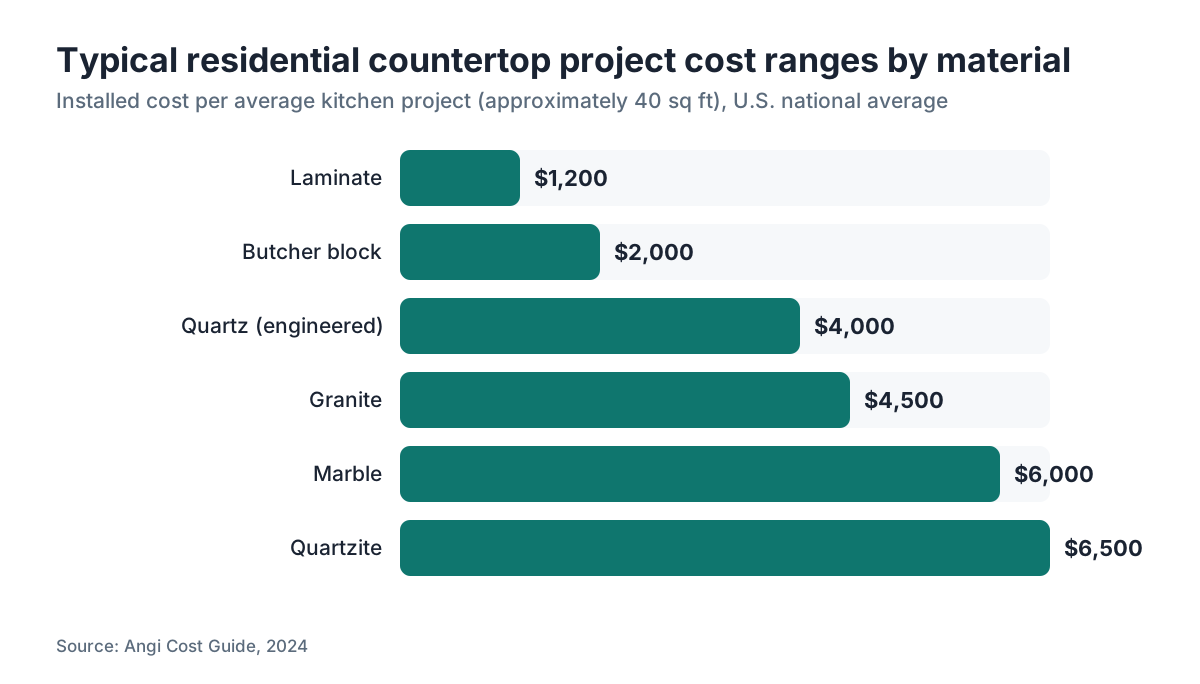
One good GC is worth real money. A GC running four to six kitchen remodels a year, at $5,000 to $10,000 of countertop each, is $20,000 to $60,000 a year from a single relationship [5]. That's worth protecting.
The fabricators who keep the repeat work do the same handful of things. They answer fast. They hit their timelines or call ahead when something slips. They make the GC look good in front of the homeowner by being clean and professional on site. And they never go around the GC to sell direct.
Visit a GC's active sites now and then, with permission. You learn their workflow and build the kind of familiarity that makes scheduling easy. Knowing their cabinet subs, their usual project types, and how they like to communicate (text, email, phone) means fewer crossed wires.
Track which GCs bring volume and what the margin looks like on their jobs. If one keeps sending low-margin work and paying slow, that relationship doesn't deserve the same priority as one sending profitable jobs that close on time. Shops running software like SlabWise can track job-level profitability by referral source, so this is a real analysis instead of a gut feeling.
GCs talk to each other. One strong referral opens a chain of new relationships. The reverse works too.
What should homeowners know about their GC's role in the countertop selection process?
Your GC probably has a preferred fabricator or a short list of shops they trust. That referral has value, because the GC already knows those shops' quality, timing, and communication. You don't have to use them. But switching to your own fabricator hands the GC a coordination headache with none of the relationship upside.
Your GC should walk you through material timing. In most cases you pick your slab before cabinets go in, because distributor availability isn't guaranteed. A specific lot of Calacatta marble or a particular Cambria pattern may not exist in six weeks. Selecting early and putting down a deposit to hold the slab is common and worth it for anything you really want. Our guide to kitchen countertops breaks down the material options and what drives the price gaps.
Here's what a lot of homeowners miss: the fabricator is a subcontractor, not the GC's employee. They run their own business, carry their own insurance, and own their own warranty. If the installation has a problem, call the fabricator for a workmanship issue and the GC for a project coordination issue. Knowing that difference saves a lot of confusion.
Budget transparency helps. If you know the GC marks up the countertop line, you can ask what the fabricator's base price is, or visit the showroom yourself to see where material cost sits. Most GCs will share it if you ask respectfully.
How does insurance and licensing work when a fabricator works under a GC?
A fabricator working as a sub needs their own general liability insurance and, in many states, a contractor's license. The GC's policy does not automatically cover the sub's work or the sub's employees. That surprises people, so nail it down before you need it.
GCs routinely want proof of insurance before you set foot on the site. A certificate of insurance (COI) naming the GC as an additional insured is a standard ask, not a hassle. No current COI on short notice means lost jobs. General liability for a small fabrication shop runs roughly $1,000 to $3,500 a year depending on payroll, revenue, and state, per SBA guidance on business insurance [6], though your quote turns on claims history and coverage limits.
Workers' compensation is required for employees in almost every state [7]. If your installers are employees rather than 1099 contractors, you need workers' comp, and some GCs verify it before crews go on site. Every sub on the job is also subject to OSHA construction standards, regardless of working under a GC [11].
Licensing varies a lot by state. California requires a C-54 tile contractor license or a relevant C-61 specialty classification for certain stone and countertop work [8]. Other states have no countertop installer license at all. Check your state contractor board before you call yourself a licensed contractor.
Homeowners: ask your GC to confirm their subs carry liability insurance and workers' comp. A GC who can't confirm it leaves you exposed if someone gets hurt on your property.
What are the most common things that go wrong on GC countertop jobs, and how do you prevent them?
Late templates top the list. Cabinets aren't ready when promised, the appointment gets pushed, and the production slot vanishes. Fix: require written confirmation the cabinets are ready, with a re-template fee in your contract if you arrive to an unready site.
Material substitutions bite when the specified slab is gone and the sub swaps in something else without sign-off. Fix: get written approval for any material change before cutting.
Seam placement disputes happen when the homeowner pictured the seam somewhere other than where the template puts it. Fix: mark seam locations on the template drawing and have the GC or homeowner sign off before fabrication.
Unlevel cabinets found at install, after the stone is cut, get expensive fast. The top may need a re-cut or the cabinets need re-leveling. Fix: check level at template and note problem areas in writing to the GC.
Payment delays are predictable on GC work. Fix: deposit before buying material, a signed purchase order, and your state's lien deadlines on your calendar.
Appliance cutout mix-ups (cooktops, farmhouse sinks, undermount sinks) happen more than they should. Fix: confirm every cutout dimension in writing at template, off the actual appliance spec sheet, not the GC's memory.
For homeowners eyeing specific materials like granite countertops, marble countertops, or engineered surfaces like Cambria countertops, confirm the exact cutout and support specs for your sink and cooktop with the fabricator before the template date.
How do commercial GC jobs differ from residential remodel work?
Commercial GC jobs (restaurants, offices, medical suites, multi-unit residential) run on different rules than a homeowner kitchen. Payment is almost always net-30 to net-60. Change orders need formal paperwork. Submittals and shop drawings may be required before you can even start fabrication. And the scale gets big enough that material availability becomes a genuine procurement problem.
Commercial work usually comes with a subcontract agreement carrying insurance minimums, indemnification language, and dispute resolution clauses. The AIA A401 Standard Form of Agreement Between Contractor and Subcontractor covers exactly these terms, and any commercial subcontract deserves an attorney's eyes before you sign [10]. Indemnification clauses especially can expose you to liability far beyond the value of your work.
Multi-unit projects (apartments, condo remodels) look attractive on volume. The per-unit margin is often thin, and templating and installing across 20 or 40 units eats shop capacity that small fabricators underestimate. Bid commercial volume with real labor hours and a re-work buffer built in.
Payment protection matters even more here. Preliminary notices, required in many states to keep lien rights alive on commercial jobs, carry strict deadlines that start when you first furnish labor or material, not at project completion [3]. Miss the preliminary notice deadline and your lien rights are gone no matter how strong your contract is.
Frequently asked questions
Should I quote the GC a different price than I'd quote a homeowner directly?
Many fabricators offer a trade price to GCs, roughly 8% to 15% below retail, in exchange for steady volume and repeat referrals. Others quote standard and let the GC stack their own markup. Either works. What matters is knowing your cost floor before you agree to any discount, so you don't hand over margin you can't afford to lose.
Can I work directly with the homeowner if a GC brought me the job?
Not without the GC's knowledge and agreement. Going around the GC to sell straight to their client is the fastest way to burn a relationship for good. Route all client communication and change orders through the GC, or with their explicit okay. The one-time sale never covers the referral pipeline you lose.
What happens if the GC doesn't pay me after I've installed the countertops?
File a mechanics lien on the property as soon as you hit your state's deadline. Most states give subcontractors 60 to 90 days from project completion, though deadlines vary. A filed lien clouds the title, which pushes payment because the homeowner can't refinance or sell without clearing it. Call a local construction attorney if the amount justifies it.
How much should I charge for a re-template fee when cabinets aren't ready?
Most fabricators charge $150 to $300 for a wasted trip, covering labor, drive time, and the lost slot. The number matters less than disclosing it upfront in your contract so the GC knows it exists. A disclosed fee prevents conflict; a surprise fee starts one. Some shops waive the first occurrence for a GC with a strong track record.
Do I need my own contractor's license to work as a subcontractor under a GC?
Depends on your state. Some require a specific license for countertop or stone work; others don't. California, for example, requires either a C-54 or a relevant C-61 specialty license. Check your state contractor board before working on permitted projects. Working without a required license on a permitted job can void your insurance and bring penalties.
Who is liable if the countertop cracks after installation on a GC job?
Liability follows the cause. A fabrication defect (thin section, bad seam, improper support notching) is the fabricator's problem. Cabinet movement or substrate failure is a GC coordination issue. Homeowner impact is usually not warrantied. Get your workmanship warranty terms in writing in your contract with the GC so nobody argues about it later.
How do I get a GC to send me jobs consistently, more than once?
Hit your timeline, answer calls and texts fast, and make their clients happy without drama. GCs work with people they trust not to embarrass them in front of homeowners. A fabricator who shows up on time, communicates clearly, and leaves a clean site gets the next call. One who creates scheduling problems or sells around the GC does not.
What insurance does a countertop fabricator need when working under a GC?
At minimum, general liability and workers' compensation if you have employees. GCs routinely require a certificate of insurance before you're on site, and may ask to be named as an additional insured. General liability for a small shop typically costs $1,000 to $3,500 a year. Some GCs also require a minimum limit, commonly $1 million per occurrence.
How should I handle it when a homeowner wants a material the GC hasn't budgeted for?
Price it and send the change order to the GC. Don't quote the homeowner a different price than you quote the GC, and don't agree to any material upgrade without the GC's written approval. The homeowner's wish to spend more is the GC's revenue opportunity, not yours to grab. Keep the GC in the loop and everyone comes out ahead.
What is a preliminary notice and do I need to send one to protect my lien rights?
A preliminary notice (also called a prelien notice or notice to owner) is a document sent early in a project to preserve your right to file a mechanics lien later if you go unpaid. Many states require it for subs and suppliers on both commercial and residential jobs. Deadlines start from first furnishing of labor or material, often 20 to 30 days. Miss it and you forfeit lien rights.
Can a GC require me to use specific materials or suppliers?
Yes. GCs sometimes specify materials through a design-build process, a designer's spec sheet, or a homeowner's allowance budget. You can decline a job if you can't source the material or meet the price, but you can't unilaterally substitute without written approval. A swap that looks like an upgrade to you may break a spec the GC is contractually obligated to deliver.
How early in a remodel project should the fabricator get involved?
As early as slab selection. Homeowners and GCs often treat the fabricator as a late-stage sub, but material lead times, especially for natural stone, mean deciding late means waiting. A fabricator brought in during design can flag lead times, suggest available alternatives, and reserve slab inventory. Getting in early also builds the GC relationship before the job is under pressure.
What should the countertop contract with a GC include?
At minimum: scope with exact materials and edge profiles, the trigger for templating (cabinets set and leveled), your template-to-install timeline, payment terms and deposit, change order process, re-template fee, warranty terms, and lien rights language. A one-page document covering these beats a verbal deal, and most GCs respect a sub who puts things in writing.
Sources
- SlabWise, countertop quoting software overview: Fabrication shops using quoting software can generate detailed square-footage-based quotes with material breakdowns in minutes.
- National Association of Home Builders, Remodelers business practices survey: General contractors typically mark up subcontractor work 10% to 20% on residential remodel projects.
- American Subcontractors Association, mechanics lien and payment guidance: Most states give subcontractors and suppliers the right to file a mechanics lien on a property if they are not paid, with state-specific deadlines and preliminary notice requirements.
- California Civil Code Section 8414, mechanics lien deadline for subcontractors: In California, a subcontractor generally must record a mechanics lien within 90 days after completion of the work of improvement when no notice of completion is recorded.
- Angi, Kitchen Countertop Cost Guide: Average countertop project costs for kitchen remodels range from approximately $2,000 to $5,000 for mid-range materials, with premium stone jobs often exceeding $10,000.
- U.S. Small Business Administration, Get Business Insurance guide: General liability insurance costs for small contractors typically range from $1,000 to $3,500 per year depending on payroll, revenue, and state.
- U.S. Department of Labor, Workers' Compensation overview: Workers' compensation insurance is required for employees in almost every U.S. state.
- California Contractors State License Board, Specialty License Classifications: California requires a C-54 tile contractor license or a relevant C-61 specialty classification for certain stone and countertop installation work.
- National Association of the Remodeling Industry (NARI), project management guidelines: Industry guidance from NARI recommends all change orders be documented in writing with cost and schedule impact before work begins.
- American Institute of Architects, AIA A401 Standard Form of Agreement Between Contractor and Subcontractor: Standard subcontract agreements address indemnification, insurance requirements, and dispute resolution, and should be reviewed by an attorney before signing.
- Occupational Safety and Health Administration (OSHA), Construction Industry Standards: Subcontractors on job sites are subject to OSHA construction safety standards regardless of whether they work under a general contractor.
- National Stone, Sand and Gravel Association, stone fabrication industry overview: Stone fabrication lead times from template to installation typically range from five to ten business days for in-stock material in standard residential projects.
Last updated 2026-07-11