
TL;DR
- Quartz is brittle across long, unsupported spans.
- A sink cutout removes the material that carried load across the deck, leaving two cantilevered stone wings.
- Fabricators reinforce those wings with steel rods, corbels, or cabinet support, and radius the corners to spread stress.
- Skip these steps and you get the most common quartz sink crack.
Why does a sink cutout weaken quartz so much?
A sink cutout weakens quartz because it removes the continuous material that carried the countertop's weight and left two narrow stone wings hanging over the bowl. Those wings, sometimes only 2 to 3 inches wide at the cabinet corner, bend under load. Quartz is brittle in bending, so that's where cracks start.
Quartz countertops are engineered stone, roughly 90 to 95% crystalline silica bound with polymer resin [1]. The resin makes quartz a little more flexible than natural granite, but the slab still behaves like a brittle material when you bend it. Cut a rectangular or large-oval opening for an undermount sink and you take out the material that was carrying the deck's own weight plus anything you set on it.
Those wings are the failure point. Set a heavy cast-iron pot on the front edge, or let a plumber lean on the slab while he tightens the drain, and the bending moment concentrates right at the inside corners of the cutout. Without reinforcement, that's exactly where a crack begins. Square inside corners make it far worse. They create a stress concentration, what an engineer calls a notch effect. That's why every serious fabrication standard sets a minimum corner radius on sink cutouts.
What corner radius should a sink cutout have?
Use at least a 3/8-inch inside radius on a quartz sink cutout, and 1/2 inch is the safer default for most residential sinks. Larger radii spread stress and cut crack risk. Once the sink clips go on, nobody can tell the difference in appearance anyway.
The Marble Institute of America (now the Natural Stone Institute) technical bulletins, along with Breton equipment guidelines used by most quartz manufacturers, recommend inside corner radii of at least 3/8 inch (roughly 10 mm), and plenty of shops use 1/2 inch or larger as policy [2]. Cambria's own installation guidelines set a minimum 1/4-inch radius but note that larger radii reduce stress risk [3].
If the cutout is unusually long, say a 36-inch undermount, some fabricators go to 3/4 inch. The look is invisible under the sink. The crack risk is real.
Homeowner reviewing a quote? Ask straight out: "What radius are you cutting the corners?" A shop that can't answer that number probably hasn't thought hard about the rest of the reinforcement either.
What reinforcement methods do fabricators actually use?
Three methods do the work: steel rods routed into the underside, corbels or cabinet support carrying the wing from below, and lamination strips that thicken the slab at the stress point. Most professional jobs combine at least two of them.
Steel rod reinforcement. The most common method for slab quartz is to rout a channel into the underside parallel to the long sides of the cutout, then epoxy a steel or fiberglass rod into that channel. The rod runs from the solid field of the counter, past the cutout corner, so the wing can't deflect on its own. Rod diameter is usually 3/8 to 1/2 inch. Stainless or epoxy-coated steel keeps rust from staining the underside. It works because it turns a bending problem into a tension problem, and steel carries tension far better than quartz resists bending.
Corbels and cabinet support. A corbel, either metal angle iron or a wood bracket screwed to the cabinet interior, presses against the underside of the wing and carries load directly. Simple, cheap, effective when the cabinet framing cooperates. The catch: sink base cabinets are often frameless or have horizontal stretchers in the way, so the corbel has to dodge the plumbing. Some fabricators run a small ledger board across the front of the sink cabinet opening so the countertop rests on it instead of cantilevering over.
Lamination strips. A scrap of quartz or matching stone, usually 3 to 4 inches wide, gets epoxy-laminated to the underside parallel to the cutout edge. This doubles the effective thickness at the stress point, which raises the section modulus and drops bending stress. Less elegant than a rod, but fast, and it adds real strength when you use structural epoxy.
A well-reinforced undermount opening in quartz usually gets rodding plus either corbels or a lamination strip. Rodding alone is standard practice. All three together shows up on wide cutouts or thick slab jobs where the load path is harder to predict.
How do you install steel rods in a quartz sink cutout?
Rod installation is shop work, done before the countertop ever leaves the building. The CNC or bridge saw finishes the cutout with proper corner radii, then the router cuts channels into the underside along both long sides of the opening. Rods get epoxied in, cleaned up, and cured. Once it's done you can't see a thing from above.
Here's the sequence most fabricators follow.
The slab gets flipped, or the router works from below, to cut the channels. Channels run perpendicular to the crack risk, so on a rectangular sink they run along both long sides of the cutout, set about 1 inch in from the edge of the opening. Depth is roughly half the slab thickness, typically 5/8 to 3/4 inch in a 3 cm (1-3/16 inch) slab. Channel width matches the rod diameter with a little room for epoxy, usually 1/2 to 9/16 inch.
The channel runs well past the cutout corner into the solid field of the slab, at least 4 to 6 inches on each end. That extension is what gives the rod its lever arm against deflection.
Cut the rod to length, clean it, and rough it up with sandpaper or a grinder so the epoxy grips. Structural epoxy made for stone, usually a two-part methacrylate or epoxy system rated for stone bonding, goes into the channel. Set the rod, wipe the excess, and let it cure before anyone handles or loads the slab. Cure time runs 1 to 4 hours at room temperature depending on the product [4].
The underside shows a faint seam where the channel was filled. The sink hides it.
Does slab thickness change what reinforcement you need?
Yes, and it changes it a lot. Most residential quartz is 3 cm (about 1-3/16 inches) thick. Some jobs use 2 cm (about 3/4 inch) slab with a laminated edge buildup, and 2 cm is far more fragile at a sink cutout. Thinner stone means shorter allowable spans and mandatory rodding.
On 2 cm slab, many fabricators refuse to leave the bridge strip (the material between the sink front and the counter's front edge) less than 4 inches. The 3 cm standard is more forgiving, but the Natural Stone Institute's residential countertop guidelines put the practical unsupported span for 3 cm material around 24 to 30 inches without added support [2]. A typical 30-inch kitchen sink cutout sits right at that edge, which is why rodding isn't optional, it's just good practice.
Brands like Cambria and Silestone publish their own installation guides that echo these minimums [3]. Working with a specific brand? Get their technical installation PDF. It's usually a download from the manufacturer's site and lists cutout dimension limits plainly.
Some shops upgrade to 3.5 cm or a mitered 4 cm edge for heavy-use kitchens. That adds strength at the cutout, but it doesn't retire the need for corner radii and rodding on wide sinks.
What role does the sink clip and mounting system play?
Sink clips hold the sink bowl up against the underside of the quartz. They don't reinforce the stone. What they do is keep the sink from hanging free and dumping its weight onto the silicone bead. Lose a clip or skip one, the silicone lets go, and the sink plus water plus dishes transfers straight to the quartz edge. That's the classic quarter-circle crack from a sink corner toward the cabinet wall.
Proper undermount installation uses at least 4 clips for a standard 30-inch sink, and some installers run 6 for heavier cast-iron or fireclay bowls [5]. Clips get epoxied or mechanically anchored to the underside of the slab every 8 to 10 inches around the bowl perimeter. The silicone bead between rim and stone is a waterproof seal, not a structural connection.
The reinforcement takeaway is blunt: even a perfectly rodded cutout can crack if the sink is badly clipped and eventually sags. Stone reinforcement and sink mounting are two separate systems, and both have to work.
Can a cracked quartz sink cutout be repaired?
Sometimes, but not always, and the result is rarely invisible. A hairline crack at an inside corner, caught before it spreads, can be stabilized with color-matched epoxy or acrylic filler and refinished. The structural question beats the cosmetic one: if the crack hasn't gone through the full depth and you fix the cause (add a corbel, reinstall a missing clip), the fill will hold.
A crack that crosses the full depth of the slab, or one that's starting to separate, usually means that countertop section gets replaced. Quartz can't be welded or fused the way metal can. Epoxy filler in a full-depth crack shows on a polished surface and will almost certainly reopen under load if the root cause is still there.
Replacing a sink section of quartz varies widely by region and shop, but figure roughly $400 to $1,200 for the slab piece alone, before sink reinstallation and plumbing reconnection [6]. Good reason to get it right the first time.
Have the fabricator assess a crack in person, not from a photo. They need to tap around it to check for delamination and confirm the sink is still supported.
What should homeowners ask their fabricator before installation?
Ask four things: what corner radius they cut, whether they rod or laminate the cutout and for which sinks, how they support the slab during delivery, and whether they set the rod with structural epoxy or silicone (silicone alone isn't adequate). The answers tell you fast whether a shop takes this seriously.
You don't need to hand-hold a skilled fabricator through the process. But those questions surface the ones who cut corners.
The corner radius answer should be a number, not a shrug. On delivery, a slab with a large cutout is fragile in transit unless it's carried face-up with support under both wings. And silicone under a rod fails under shear, so structural epoxy is the right call.
Comparing quotes and one comes in way under the others? The gap is often labor. Rodding and lamination eat real shop time, so a shop that skips them quotes faster and cheaper. Fabrication software like SlabWise (slabwise.com) lets shops calculate the true cost of a job, cutout complexity and reinforcement labor included, so honest shops can price competitively without cutting corners. Ask whether the quote line-items the sink cutout work or buries it in a vague "installation" fee.
For countertop installation in general, getting specifics in writing before you sign is worth the five extra minutes.
How does quartz compare to granite and other stone for sink cutout risk?
Engineered quartz and granite have similar reinforcement needs at a sink cutout, but granite is a little less prone to catastrophic fracture. Its crystalline grain structure distributes stress differently than a polymer-bound composite does [7]. Granite still cracks at poorly radiused corners, though, especially in thinner 2 cm slabs.
Natural quartzite, marble, and soapstone all behave more like granite than like engineered quartz. They're crystalline and a bit more tolerant of stress concentration, but that doesn't retire rodding on wide spans.
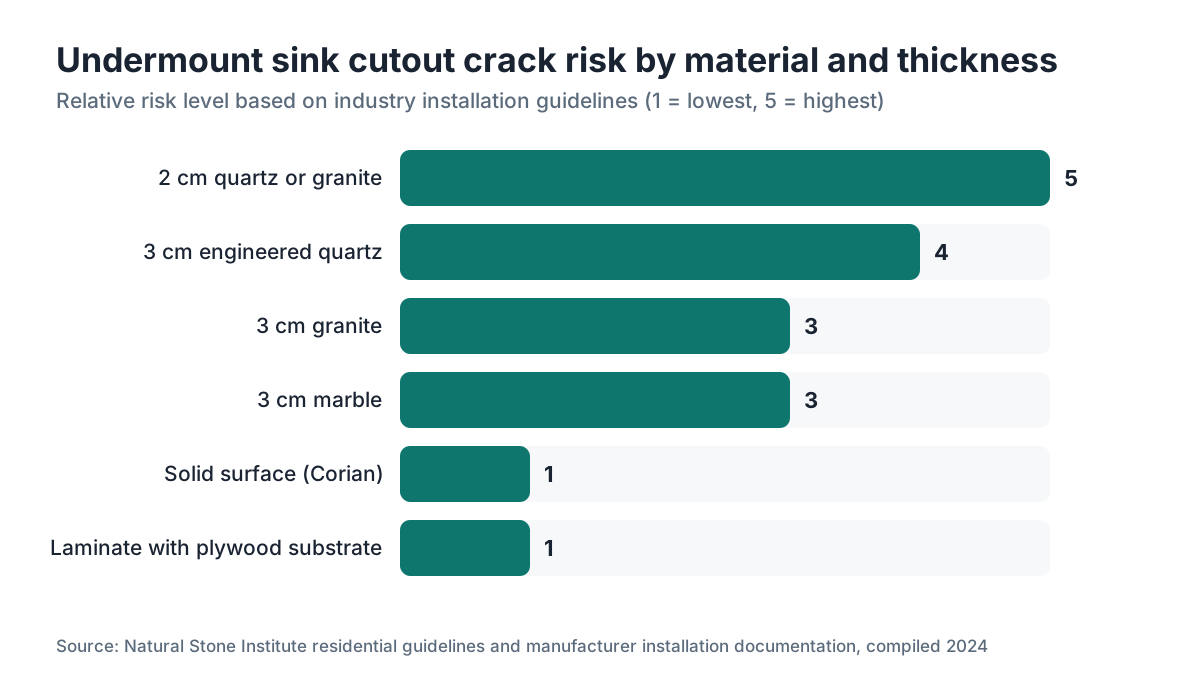
For how different countertop materials handle undermount sinks, see the table below. Granite countertops and marble countertops each have their own installation quirks worth a read if you're deciding between stone types.
Materials like laminate countertops, formica countertops, and corian countertops behave very differently. Laminate and Formica sit on a plywood substrate that gives continuous support, so undermount risk drops. Solid surface like Corian can bond directly to the sink in some configurations, which erases the overhang problem outright.
| Material | Typical undermount crack risk | Corner radius needed | Rodding typical? |
|---|---|---|---|
| Engineered quartz (3 cm) | Moderate-high | 3/8"-1/2" min | Yes, standard practice |
| Granite (3 cm) | Moderate | 3/8" min | Common on wide cuts |
| Marble (3 cm) | Moderate | 3/8" min | Common on wide cuts |
| Quartzite (3 cm) | Moderate | 3/8" min | Common on wide cuts |
| 2 cm quartz or granite | High | 1/2" min | Always recommended |
| Solid surface (Corian) | Low | Per manufacturer | Rarely needed |
| Laminate with plywood | Very low | N/A | No |
Data compiled from Natural Stone Institute guidelines [2] and manufacturer installation documentation [3][5].
Are there building codes or standards that govern this?
No single federal building code sets sink cutout reinforcement dimensions. The International Residential Code (IRC), which most U.S. jurisdictions adopt in some form, covers countertop substrate and mounting at a high level under finished carpentry but says nothing about stone cutout geometry [8]. Your real protection is a fabricator who follows industry guidelines, not an inspector.
The governing documents are voluntary standards from the Natural Stone Institute (NSI), formerly the Marble Institute of America, particularly their "Dimension Stone Design Manual" and residential countertop guidelines [2]. Quartz manufacturers publish their own technical installation guides that reference or align with NSI practice.
ASTM International has standards for engineered stone (ASTM C1524, covering quartz surface panels) that set physical property minimums but don't prescribe field fabrication methods [9]. So the working standard is shop practice informed by manufacturer guidelines, not code enforcement.
For homeowners, nobody's coming to verify your corner radii. Pick a shop that follows NSI and manufacturer guidelines, and ask them directly. For fabricators, following those guidelines is the right technical call and the thing that protects you if a crack turns into a dispute.
What is the typical cost to properly reinforce a quartz sink cutout?
Reinforcement is usually priced into the overall fabrication job, not billed as a separate line. When shops break it out, rodding a sink cutout runs about $50 to $150 depending on rod count and local labor rates [6]. A lamination strip adds a similar amount. Corbels or brackets during setting are minimal, maybe $20 to $50 in hardware plus 30 minutes.
Put another way: reinforcement adds 2% to 5% to the total countertop cost on a typical kitchen. Skipping it to save that is a bad trade, because a replacement quartz section plus the labor to pull and reset the sink usually runs $600 to $1,500 or more, and that assumes the rest of the countertop stays put.
Want to compare quotes fairly? SlabWise's quoting tool lets fabricators itemize cutout work so homeowners see exactly what they're paying for, which beats guessing why one shop is $200 cheaper.
For the broader picture on kitchen countertops pricing, material choice, edge profiles, and cutout complexity are all real cost drivers.
Frequently asked questions
How close to the edge of a quartz countertop can an undermount sink cutout get?
Most fabricators require at least 1.5 to 2 inches of quartz between the front of the sink cutout and the front edge of the countertop. That bridge is where the slab is most vulnerable. Going tighter than 1.5 inches on 3 cm quartz sharply raises crack risk, and most shops will push back on it. Some manufacturer guidelines set 1.5 inches as a hard minimum.
Can I reinforce a quartz sink cutout after the countertop is already installed?
Partially. A competent installer can add corbels or cabinet support brackets after installation without pulling the slab. Rodding can't be done in place, because the channel routing has to happen from the underside in a controlled shop environment. If you have an installed slab with no rodding, corbels are your practical in-place option.
Why did my quartz crack at the sink corner even though the fabricator said it was reinforced?
A few possibilities: the corner radius was too small, the rod channel didn't extend far enough into the solid slab, the sink lost a clip and started hanging on the silicone bead, or someone loaded the counter edge above the sink. Have the fabricator inspect the underside for an intact rod and proper sink support. A rod epoxied only at the ends rather than along its length can also work loose over time.
What epoxy should be used to set reinforcement rods in quartz?
Two-part methacrylate adhesives or stone-specific two-part epoxies rated for structural bonding. Brands like Tenax, Akemi, and Integra are common in the stone trade. Silicone and construction adhesive aren't adequate for rod-setting. The adhesive has to bond to both the quartz and the metal or fiberglass rod under shear loads.
Does the brand of quartz affect how much reinforcement the sink cutout needs?
Brand matters only because manufacturers publish slightly different minimum dimensions. Cambria, for instance, publishes a detailed installation guide with sink cutout specifications. The physics are the same regardless of brand: slab thickness, cutout span, and corner radius set the structural risk. A premium quartz is not inherently more crack-resistant at a cutout than a cheaper brand of the same thickness.
Is fiberglass rod better than steel rod for quartz reinforcement?
Both work. Steel has higher tensile strength, so a smaller diameter carries more load. Fiberglass (FRP) rod is rust-proof without coatings and adds no weight, which can matter on large slabs. In humid kitchens some fabricators prefer fiberglass to kill any long-term corrosion risk even with epoxy-coated steel. Either choice is defensible. The quality of the epoxy installation matters more than the rod material.
How many rods are needed for a standard 30-inch undermount kitchen sink?
Two rods is the standard, one on each long side of the cutout. Each runs parallel to the sink opening, set about 1 inch inward from the cutout face, and extends 4 to 6 inches into the solid slab on each end. Some fabricators add a third rod across the back of a wide cutout. Very wide or double-bowl cutouts benefit from more, and the fabricator should judge it case by case.
What's the difference between a sink cutout crack and a slab settling crack?
Sink cutout cracks almost always start at an inside corner and radiate diagonally toward the cabinet wall or front edge. Settling cracks from an uneven substrate tend to run across the full slab and can appear anywhere. Sink cracks come from point stress at the corner geometry. If the crack clearly starts at a sink corner, that's the cause, and it's a fabrication or mounting issue, not a substrate problem.
Can a heavy farmhouse or apron-front sink be used with quartz without cracking?
Yes, but it takes planning. Apron-front sinks cut away more of the cabinet face and require the quartz side panels to be cut rather than the main deck. The deck cutout is often smaller on an apron-front setup, which reduces stress. The side panels and front apron area need support from the sink frame or cabinet structure, not free air. A fabricator experienced with farmhouse sinks will have a specific approach.
Should the sink be installed before or after the countertop when doing an undermount?
The sink is almost always mounted from below after the countertop is set. The shop cuts the cutout, the countertop goes on the cabinets and gets secured, then the sink slides in from below, clips up, and gets plumbed. Some prefab setups clip the sink before setting the top as one unit, but that requires careful handling because the combined weight and the cutout make the assembly fragile in transit.
How long does it take a fabricator to reinforce a quartz sink cutout?
Routing channels and setting rods adds roughly 30 to 60 minutes of shop time per cutout after the main cutting is done. Epoxy cure adds another 1 to 4 hours before the slab can move, though many shops time it to cure overnight before delivery. A lamination strip takes similar setup time but needs less cure waiting if the strip is clamped well.
Does a smaller sink opening need less reinforcement than a large one?
Yes, meaningfully. A compact 24-inch sink cutout leaves longer solid wings on each side, which are stiffer and bend less. Many fabricators treat rodding as optional for cutouts under about 24 inches in 3 cm slab if the corner radii are right. Over 30 inches, rodding is essentially always warranted. Bar and prep sink cutouts in the 12 to 18-inch range rarely need anything beyond proper corner geometry.
What is the warranty implication if a quartz sink cutout cracks?
Most quartz manufacturer warranties explicitly exclude cracks caused by improper installation, which they define to include inadequate support and bad cutting practices. Cambria's warranty, for example, covers manufacturing defects but excludes installation error. If a crack happens and the fabricator ignored the brand's published installation guidelines, the homeowner may get no manufacturer coverage and has to negotiate directly with the fabricating shop.
Sources
- Occupational Safety and Health Administration, Crystalline Silica page: Engineered quartz countertops are composed of approximately 90-95% crystalline silica bound with polymer resins.
- Natural Stone Institute, Residential Countertop Guidelines: Natural Stone Institute technical guidelines specify minimum corner radii and unsupported span limits for stone countertop cutouts.
- Cambria, Installation Guide for Cambria Quartz Surfaces: Cambria's installation documentation specifies a minimum 1/4-inch radius on inside corners of sink cutouts and provides sink dimension limits.
- Tenax USA, Stone Adhesive Technical Data: Two-part structural epoxy systems used for stone fabrication typically reach handling strength in 1 to 4 hours at room temperature.
- Silestone by Cosentino, Installation Instructions: Silestone installation guidelines recommend undermount sink clip spacing and cutout dimension minimums for engineered quartz.
- Angi, Countertop Replacement Cost Guide: Countertop section replacement costs and fabrication add-on pricing ranges for sink cutout reinforcement in the U.S. residential market.
- U.S. Geological Survey, Quartz Mineral Information: Natural granite has a crystalline grain structure that distributes fracture stress differently than polymer-bound engineered quartz composites.
- International Code Council, International Residential Code (IRC): The IRC covers countertop substrate and mounting requirements in finished carpentry sections but does not specify stone cutout geometry or reinforcement methods.
- ASTM International, ASTM C1524 Standard Specification for Quartz Surface Panels: ASTM C1524 establishes physical property minimums for engineered quartz surface panels but does not prescribe field fabrication or cutout reinforcement methods.
- Caesarstone, Technical and Installation Manual: Caesarstone's published technical manual specifies minimum sink cutout corner radii and bridge dimensions for their engineered quartz products.
Last updated 2026-07-10