TL;DR
- Most stone slab breakage in storage traces to three things: slabs laid flat, racks leaned too far off vertical, and water or grit on contact surfaces.
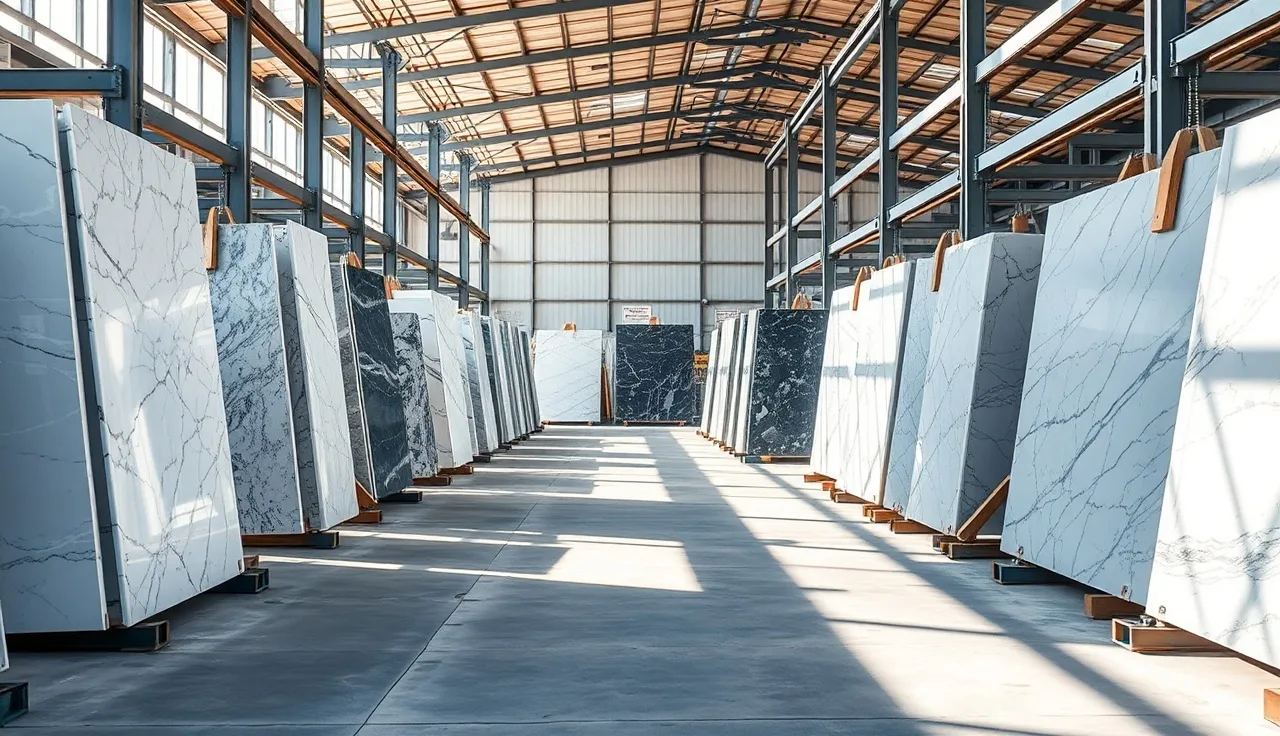
- Store slabs at 10 to 15 degrees off vertical on padded A-frame racks, keep similar weights together, and never lay a slab flat unless it is supported along its entire length.
- Do that and breakage drops sharply.
Why do stone slabs break in storage?
Stone is strong in compression and weak in tension. Bend a slab even slightly and the face in tension cracks first. That one fact explains almost every storage breakage.
The most common failure is a slab stored flat on sawhorses or a partial surface. The unsupported middle sags under its own weight. A 3 cm granite slab that is 60 inches wide and supported end to end is fine. Give that same slab a 24-inch unsupported span in the center and it carries enough bending stress to crack over time, especially in warm conditions where the material creeps a little.
The second most common failure is a rack that has drifted too far from vertical. As the lean angle grows, the slab's own weight creates a bending moment at the base where it meets the rack arm. Guidance from the Natural Stone Institute (formerly the Marble Institute of America) puts the safe lean at 10 to 15 degrees from vertical [1]. Past 20 degrees, the risk climbs fast.
Vibration matters too. Forklifts, compressors, and heavy truck traffic through a yard transmit vibration into rack systems. A slab already stressed by a bad angle or a hidden defect can propagate a crack from that vibration alone. Good yards keep slab storage away from high-traffic machine areas for exactly this reason.
Moisture under a slab or between bundled slabs does damage two ways. It lets slabs slide unexpectedly during handling, and it drives efflorescence and surface degradation in calcareous stones like marble and limestone, weakening the face layer over months of contact [2].
What is the right angle to store stone slabs on a rack?
Store slabs at 10 to 15 degrees off vertical, with 12 degrees the target most well-run shops use. At that lean the slab settles into the rack, gravity holds it against the support arms, and the bending load at the base stays low.
The Natural Stone Institute references this range for upright slab storage [1]. To check it in the field, hold a torpedo level against the rack upright. When the bubble reads about 12 degrees off plumb, you're in range.
Going shallower than 10 degrees sounds safer. It isn't. The slab starts relying on the support arms to hold it from falling forward instead of gravity holding it back against the frame, and that puts point-load stress at the arm contacts.
Going steeper than 15 to 20 degrees ramps up the bending moment at the base. A slab at 30 degrees from vertical carries roughly twice the base bending stress of one at 15 degrees. That's straight trigonometry applied to the slab's self-weight.
Thin slabs need a tighter angle. For 1.2 cm porcelain or thin marble veneers, some fabricators go closer to vertical, around 5 to 8 degrees, because the reduced thickness cuts the moment of inertia and these materials tolerate almost no bending. Storing engineered stone panels or ultra-compact surfaces from brands like Cambria? Follow the manufacturer's storage specs, which often run stricter than natural stone guidance.
What types of storage racks work best for stone slabs?
A-frame racks are the industry standard. Two angled sides lean the slabs back-to-back at the correct angle, spread weight evenly, and let you load from either side. A good A-frame has padded cradle arms of rubber or dense foam that contact the slab edge and lower face without creating a hard point [3].
The rack has to be rated for the load, full stop. A single 3 cm granite slab weighs roughly 18 to 22 pounds per square foot. A 60 by 110 inch slab covers about 45 square feet, so around 900 pounds. A rack holding 10 slabs per side carries close to 18,000 pounds. Structural steel A-frames rated for these loads are the floor of competent shop practice, not an upgrade.
Cantilever racks (wall-mounted or freestanding, loaded from one side) work in tight spaces but demand more attention to load distribution. Never pile all the heavy slabs on one end of a cantilever rack.
| Rack Type | Best For | Load Limit (typical) | Lean Angle Control |
|---|---|---|---|
| A-frame steel, fixed | Full slabs, high-volume yards | 20,000 to 40,000 lbs | Built in at manufacture |
| A-frame steel, adjustable | Mixed slab sizes | 15,000 to 30,000 lbs | Adjustable per side |
| Cantilever, wall-mounted | Small shops, remnants | 5,000 to 10,000 lbs | Depends on bracket spacing |
| Wood A-frame | Temporary only | 5,000 lbs or less | Often drifts over time |
Wood A-frames earn a specific warning. They're cheap and fine for short-term display. But wood deflects, warps with humidity, and the lean angle drifts as the joints loosen. In a working yard, a wood A-frame holding full-size slabs for more than a few weeks is a liability.
For granite countertops and similar 3 cm naturals, commercial steel A-frames with rubber cradle pads are the right call. Nothing else gives you controlled angle, rated capacity, and damage-free contact all at once.
How should slabs be bundled and ordered on a rack?
Bundle composition matters as much as the rack. The basic rule: heavy slabs on the outside, lighter or thinner slabs inside toward the center of the A-frame. The heavy slabs take any impact if the bundle shifts, and the delicate material never eats a direct hit.
Group same-species or same-thickness slabs together when you can. Put a 3 cm granite next to a 1.2 cm porcelain panel in the same bundle position and the granite presses on the porcelain edge during any movement. That edge contact chips or cracks the thin material without any obvious mishandling.
Leave at least 1/4 inch of clearance between contacting faces, using foam slip sheets or rubber pads. Slab surfaces are never perfectly flat. Without a buffer, the high spots act as stress concentrators, and grit trapped between slabs scratches polished faces. Scratch damage on a polished marble slab costs real money in repolishing that a foam sheet would have prevented.
Number and label your bundles. One underrated cause of breakage is a slab pulled from the middle of a rack because nobody knew the order. Yank a slab from the middle of a tight bundle and the adjacent slabs lose lateral support and tip. A simple numbering system on the rack end, updated whenever a slab moves, kills this problem.
Shops that track slab inventory digitally, including tools like SlabWise that follow material from quote through cut, can attach a storage location to each slab record. Anyone on the floor can then pull the right slab without digging through a rack.
What floor and ground conditions prevent slab breakage in a yard?
The floor under a slab rack does a lot of work. It has to be level, load-rated, and dry. All three, not two of three.
Level matters because a rack on an unlevel floor tilts. A 1-degree tilt in the wrong direction can turn a clean 15-degree lean into 14 degrees on one side and 16 on the other. Across a full bundle, that imbalance puts uneven lateral load on the slabs. They creep over time and eventually fall.
Load capacity gets ignored in outdoor yards more than anywhere. A full rack of stone can hit 30,000 to 50,000 pounds on four contact points. Standard structural concrete runs 3,000 to 4,000 psi compressive strength [4]. On crushed stone or compacted gravel the bearing capacity drops, and racks settle unevenly over months, which recreates the lean problem you thought you'd solved.
Drainage matters enormously. Standing water under a rack rusts and corrodes the feet, which weakens the structure. Water on the floor creates slip risk while moving slabs. And water touching bundle bottoms migrates up through capillary action, especially in limestone and some softer granites, causing staining or mineral migration that surfaces later as a defect at install [2].
On an outdoor gravel yard, anchor racks to buried concrete footings and check level quarterly. Seasonal frost heave in northern climates can shift a footing 1 to 2 inches vertically over one winter, enough to destabilize a heavily loaded rack [5].
How do you safely move and load slabs onto storage racks?
Most storage breakage actually happens during loading or unloading, not during static storage. A slab that sits correctly for six months and then gets pulled wrong breaks at the extraction point.
For moving full slabs, A-frame trolleys (slab caddies) hold the slab near vertical so one or two people can roll it. Tilt the slab from the trolley straight onto the rack without ever going horizontal and bending stress stays minimal. Try to carry a large slab horizontally with two people and you're betting on human grip staying perfect across the full length. One stumble creates a point load that snaps the slab.
Forklifts with slab clamps or vacuum lifters are the right tool above roughly 600 pounds. A vacuum lifter rated for stone typically handles 1,200 to 2,000 lbs with a 4:1 safety factor built into the rating [6]. Check the suction cup condition before every lift. Cracked or worn cups lose vacuum, sometimes mid-lift.
When you slide a slab onto a rack arm, make sure the arm pad contacts the lower third of the slab face, not the very bottom edge. Edge contact alone concentrates load at the thinnest cross-section. Lower-face contact spreads it out.
For a job, the slab leaves the rack and goes into a transit A-frame in the truck. That handoff from storage rack to transport is another high-risk moment. The full process lives in the countertop installation section.
Does stone species affect how you should store slabs?
Yes, more than most people think.
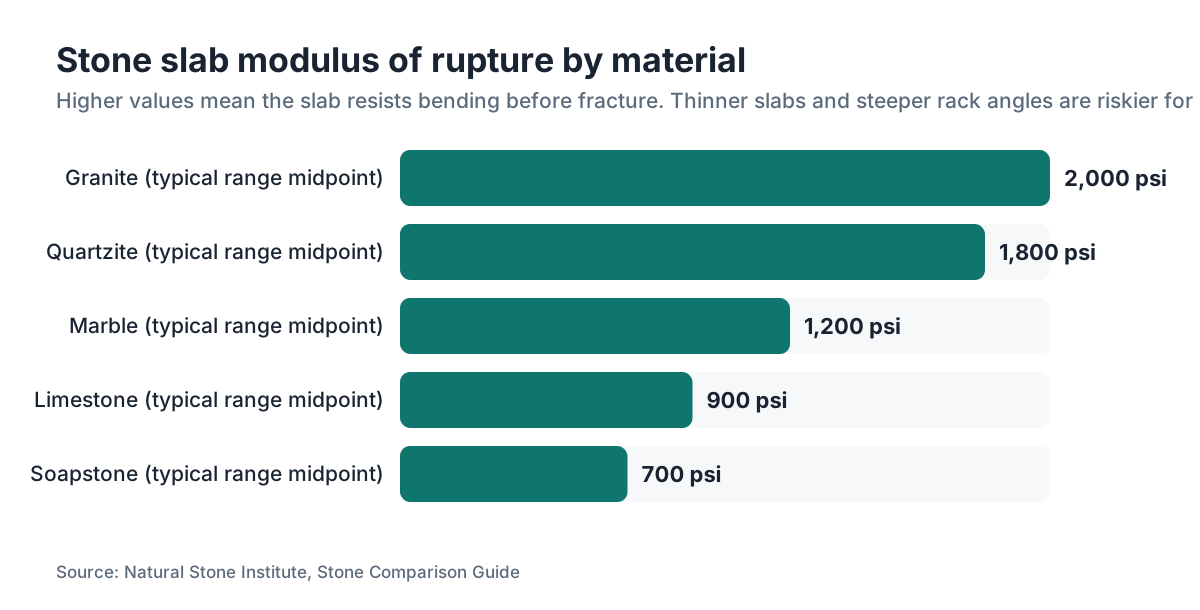
Granite is among the toughest natural stones and handles storage stress well. It's dense (roughly 165 lbs per cubic foot), so it's heavy, but it also has a high modulus of rupture, typically 1,500 to 2,500 psi [7]. Standard 3 cm granite stored at 12 degrees on padded steel racks is about as forgiving as natural stone gets.
Marble is softer (modulus of rupture often 900 to 1,500 psi) and scratches easily [7]. Foam slip sheets between marble slabs are not optional. Marble also holds calcite, which reacts with water and acids, so dry floors matter more for marble than for granite. The stone cleaning guide covers marble's chemical sensitivity in more detail.
Quartzite is often harder than granite but carries natural cleavage planes in some varieties. A slab with a hidden cleavage plane running diagonally can fail along that plane under bending stress that same-thickness granite would shrug off. Inspect for faint linear features before storage and flag the high-risk slabs.
Porcelain panels and ultra-compact surfaces are rigid but brittle in a different way. They show almost no plastic deformation before fracture, so the margin between fine and broken is narrow. Store them as close to vertical as the rack allows and never let them share a rack position with heavy natural stone.
Soapstone and quartzite each carry surface care habits that follow the material into storage: soapstone scratches easily in transit, and quartzite with high iron oxide content can stain from prolonged water contact.
What temperature and humidity conditions damage stored stone slabs?
Stone itself shrugs off the temperature swings found in most commercial warehouses. Marble and limestone are the exceptions when moisture is present, because freeze-thaw cycles expand water in micro-cracks and propagate them. That takes actual liquid water in the crack, more than humid air.
Humidity hits the rack and the packaging harder than the stone. High humidity corrodes steel frames over time. It breaks down foam padding and rubber cradle covers. It grows mold on the wood crating that comes with bundles from overseas suppliers [8].
For an indoor heated shop, holding relative humidity between 40% and 60% is a reasonable target, aimed at the equipment and packaging, not the stone [8]. Outdoor yards in humid climates should run galvanized or powder-coated steel, not bare mild steel.
Extreme cold does affect resin-filled naturals. Some granite slabs have voids filled with epoxy at the quarry or importer. Those resins turn brittle below about -20 degrees F, which isn't a practical worry in most of the US but matters for yards in northern Minnesota or Canada in deep winter.
Direct sun on a polished surface heats it hard, up to 140 to 160 degrees F on a dark stone in summer [9]. The heat gap between the sun-facing side and the shaded back creates minor thermal stress. It rarely cracks a sound slab, but slabs with pre-existing micro-cracks or old repair epoxy can open those features up. Shade cloth over outdoor racks is cheap insurance.
How long can stone slabs stay in storage without risk?
A slab on a properly set rack in a dry, covered space can sit there for years without degrading. Stone is geologically old. A few years of correct storage is nothing to it.
Time isn't the risk. Changing conditions are the risk. Rack feet corrode. Foam pads compress and harden, losing their cushion. Cradle arms grow rust that transfers to the slab face. Bundle composition shifts as some slabs get pulled and others added in ways that unbalance the load. A rack that was dead-on 18 months ago may have drifted to a steeper angle as one foot settled.
A reasonable inspection schedule is every 90 days for active outdoor yards and every 6 months for indoor climate-controlled storage. Check four things: lean angle (still 10 to 15 degrees?), rack foot condition (rust, settlement, level?), pad condition (compression, tearing, grit?), and whether any slab has crept out of its original contact position.
For imported slabs still in factory bundles, check the wood crating for rot and the strapping for corrosion at each pass. The Natural Stone Institute advises against stacking crated bundles more than two high without load calculations showing the lower crate can take it [1].
Want to know which slabs have sat longest or are near a reorder threshold? That's a material management problem inventory-aware quoting software handles better than a spreadsheet. SlabWise tracks slab status from order through cut, so storage duration shows at a glance.
What are the most common mistakes that cause slab breakage during storage?
In rough order of how often they actually happen:
Storing slabs flat on sawhorses or a partial surface. This is the top mistake in smaller shops. The math is simple: a 900-pound slab with a 24-inch unsupported span in the center applies real bending load right there. Add foot traffic vibration and you've got a ticking clock.
No padding on rack arms. Bare steel against a polished face damages the surface and creates a hard point that concentrates stress. Fixing it costs almost nothing. Standard rubber rack padding runs a few dollars per linear foot.
Wrong lean angle. Either too flat (slabs relying on arm friction to stay put) or too steep (excessive base bending moment). Measure it. Don't eyeball it.
Mixing slab weights in a bundle without heavy-out, light-in ordering. When a heavy slab shifts and contacts a thin porcelain panel, the porcelain loses every time.
Pulling slabs from the middle of a bundle. Mostly a labeling and discipline problem. Load and pull from the end of the bundle, working back, never from random positions.
Ignoring drainage. A rack with one foot in a puddle after rain corrodes faster and can settle unevenly within a single season.
Running wood A-frames past their useful life. Wood frames left outside two or three years usually have loose joints that shift the lean angle in ways you can't see until a slab falls.
Skipping the bundle inspection after an overseas shipment lands. Factory strapping shifts in transit, leaving slabs at angles or with contact points nobody intended.
How can fabricators reduce liability and insurance exposure from slab storage accidents?
A falling slab is more than a broken piece of stone. OSHA 29 CFR 1910.178 covers powered industrial truck (forklift) operations, and general industry safety rules apply to how you store heavy material [10]. A rack failure that injures a worker gets examined against these standards, and a shop with undocumented, uninspected equipment in poor shape has little defense.
OSHA's General Duty Clause, Section 5(a)(1) of the Occupational Safety and Health Act, requires each employer to furnish a workplace "free from recognized hazards that are causing or are likely to cause death or serious physical harm" [11]. A rack leaning at 25 degrees with corroded feet and no padding is a recognized hazard. Document your rack inspections. Note the angle, the pad condition, the corrections you made. That paper trail is what separates a manageable incident from a citation.
On the insurance side, commercial property policies typically cover accidental slab breakage in storage under inland marine or installation floater coverage, but coverage is conditioned on the property being stored per manufacturer or industry guidelines [12]. Store slabs flat on the floor or on overloaded wooden frames and lose a batch, and the insurer has grounds to fight the claim.
The Natural Stone Institute gives member shops technical documents including storage and handling standards [1]. Membership and access to those documents is one way to show an insurer or an OSHA inspector that your practices rest on recognized industry guidance.
For homeowners holding a slab or remnant before install: the same physics applies. Do not store it flat on sawhorses overnight and expect it to survive. Lean it vertically against a solid wall with a rubber pad or folded carpet at the base, and make sure it can't tip.
Frequently asked questions
Can I store a granite slab flat on the floor temporarily?
Only if the floor is dead flat and the entire slab face touches the surface. Any unsupported span, including a slightly uneven floor, creates a bending load that can crack the slab. For anything longer than a few hours, lean the slab on a padded A-frame at 10 to 15 degrees from vertical. Flat floor storage on a partially supported slab is one of the most common causes of shop breakage.
How heavy are stone slabs and why does that matter for storage?
A 3 cm granite slab runs about 18 to 22 pounds per square foot. A full slab (roughly 55 by 110 inches, about 42 square feet) weighs 750 to 920 pounds. Marble is a touch lighter, around 16 to 18 pounds per square foot. These weights set the rack load ratings you need, the equipment required to move slabs safely, and how much bending stress an unsupported slab puts on itself.
What is the maximum number of slabs to store per rack bundle?
It depends on rack load rating, not a fixed slab count. A steel A-frame rated at 20,000 lbs per side holds roughly 22 to 25 full granite slabs at 900 lbs each. The real limit is the rack's rated capacity, not a headcount of slabs. Most manufacturers stamp the rated capacity on the frame. Use that number, not a rule of thumb.
Do porcelain and engineered stone slabs need different storage than natural stone?
Yes. Porcelain panels and ultra-compact surfaces are brittle with almost no plastic deformation before fracture. Store them as close to vertical as possible (5 to 10 degrees), never mix them in a bundle with heavy natural stone, and use foam slip sheets between every slab. Follow the maker's specific storage instructions, which for brands like Cambria or Dekton run stricter than general natural stone guidance.
How do I inspect a rack to make sure it's storing slabs safely?
Check four things every 90 days: lean angle (torpedo level, target 10 to 15 degrees from vertical), rack foot condition (rust, settlement, level at all four contact points), pad condition (foam or rubber not compressed flat, no embedded grit), and bundle order (no slabs pulled from middle positions, heavy slabs outside). Write down what you find. That documentation matters if there's ever an insurance claim or OSHA inspection.
What happens if a slab rack tips over?
A rack failure is a serious safety event. A 900-pound slab falling from a tipped rack carries enough energy to kill or badly injure anyone nearby. After any failure, the area is off-limits until the slabs come out with proper equipment. OSHA expects incident investigation for near-miss and injury events. Beyond the immediate danger, you'll likely lose several slabs, face insurance claims, and need to document the cause before restarting operations.
Should stone slabs be covered or wrapped in storage?
For indoor storage in a clean shop, wrapping is usually unnecessary and can trap moisture against the surface. For outdoor storage or long-term holding, a breathable shade cloth or woven poly cover over the rack cuts UV exposure, keeps bird debris off polished faces, and limits dust in the bundle gaps. Avoid non-breathable plastic sheeting that seals moisture in. Crated import bundles should keep their original crating until needed.
Can moisture from the ground damage stored stone slabs?
Yes, especially for calcareous stones like marble and limestone. Ground moisture wicks up through rack feet and migrates into bundle bases. The main risks are surface staining from mineral migration, efflorescence on cut edges, and corrosion of rack steel that eventually compromises the structure. Concrete or sealed floors with good drainage are best. Outdoor gravel yards should anchor racks on concrete footings above the surrounding grade.
How do I store stone slab remnants safely?
Remnants weigh less than full slabs but are more awkward because of their odd shapes. Store them upright on padded remnant racks or lean them against a padded wall at roughly 10 to 15 degrees. Remnants with narrow sections (an L-shaped cutout or a long thin strip) are fragile along the narrow dimension and need that section supported during handling and storage. Never stack remnants flat. The irregular shapes create point loads that crack them.
What padding materials work best for stone slab racks?
Closed-cell foam and dense rubber are the two standard choices. Closed-cell foam (density around 4 to 6 lbs per cubic foot) resists compression over time and doesn't absorb water. Dense rubber (Shore A hardness around 40 to 60) holds up better in gritty environments. Skip open-cell foam, which compresses fast and holds moisture. Carpet scraps are a common improvisation but trap grit that scratches polished faces. Replace any padding that has gone hard or shows embedded debris.
Is there a difference between storing slabs in an indoor shop versus an outdoor yard?
The physics are the same, the conditions differ. Outdoor yards deal with rain drainage, frost heave, UV degradation of padding, and steel corrosion at a much faster rate. They need galvanized or powder-coated racks, a concrete or gravel base with drainage, quarterly level checks after freeze-thaw seasons, and weather covers for polished surfaces. Indoor shops mainly worry about floor levelness, forklift vibration zones, and HVAC moisture control for the rack equipment.
Who is responsible if a stone slab breaks during storage at a fabricator's shop?
Generally the fabricator, once the slab is in their possession. Most shop purchase agreements with distributors specify that risk passes at delivery. The fabricator's commercial property or inland marine insurance covers accidental breakage in storage, subject to policy terms and the condition that slabs are stored per industry standards. Slabs broken through demonstrably improper storage can trigger claim disputes. Document storage conditions and inspection records from day one.
How do temperature swings affect stone slabs in outdoor storage?
Sound natural stone handles normal temperature ranges without damage. The risk is freeze-thaw cycles when liquid water sits in existing micro-cracks and expands, propagating the crack. Resin-filled slabs can develop epoxy brittleness below about -20 degrees F. Dark stones in direct sun can reach 140 to 160 degrees F, creating thermal gradients across the slab thickness. None of these is decisive alone, but paired with a pre-existing defect or a bad rack angle, they can push a marginal slab to failure.
Sources
- Natural Stone Institute (NSI), Slab Storage and Handling Technical Standards: Recommended lean angle for upright slab storage is 10 to 15 degrees from vertical; crated bundles should not be stacked more than two high without load calculations
- USGS, National Minerals Information Center, Stone Properties: Calcareous stones like marble and limestone react with water and acidic contaminants, causing surface degradation and efflorescence on stored slabs
- Natural Stone Institute (NSI), Dimension Stone Design Manual, handling and support guidance: A-frame racks should use padded cradle arms of rubber or dense foam contacting the slab edge and lower face to avoid hard point loads
- American Concrete Institute (ACI), ACI 318 Building Code Requirements for Structural Concrete: Standard structural concrete slabs are typically specified at 3,000 to 4,000 psi compressive strength
- USDA Forest Service, publications on frost heave and foundation movement in cold regions: Seasonal frost heave in northern US climates can vertically displace shallow footings by 1 to 2 inches over a winter season
- ASME B30.20, Below-the-Hook Lifting Devices (vacuum lifters): Vacuum lifters rated for stone typically carry a 4:1 safety factor built into their stated lifting capacity
- Natural Stone Institute, Stone Comparison Guide (modulus of rupture data): Granite modulus of rupture typically 1,500 to 2,500 psi; marble modulus of rupture typically 900 to 1,500 psi
- EPA, Indoor Air Quality, Humidity and Moisture Control: Relative humidity between 40% and 60% is the recommended range for indoor environments to limit corrosion and mold growth on equipment and packaging
- NIST, materials research on thermal properties of building materials: Dark stone surfaces in direct summer sun can reach 140 to 160 degrees F, creating thermal gradients across the slab thickness
- OSHA, Powered Industrial Trucks Standard (29 CFR 1910.178): OSHA 29 CFR 1910.178 governs forklift operations including load handling and operator certification in general industry
- OSHA, General Duty Clause, Section 5(a)(1) of the OSH Act: Employers must furnish a workplace free from recognized hazards likely to cause death or serious physical harm
- Insurance Information Institute, business insurance and inland marine coverage guidance: Commercial property inland marine policies typically condition slab breakage coverage on storage per manufacturer or industry guidelines
Last updated 2026-07-11