
TL;DR
- A healthy close rate for countertop fabrication quotes sits between 30% and 50%.
- Shops below 25% usually have a quoting or follow-up problem.
- Shops above 60% are often underpricing or attracting pre-sold buyers only.
- Your target depends on lead source, market, and how you count a 'quote' in the first place.
What does 'close rate' actually mean for a countertop shop?
Close rate is the percentage of formal quotes you send that turn into signed jobs. Send 100 quotes in a month, win 35, and your close rate is 35%. Simple math. The definition breaks down fast once you dig into how shops actually track it.
Some shops count every phone inquiry as a quote. Others count only written estimates with material and edge selections. Some count kitchen-and-bath designers who walk in knowing exactly what they want, alongside cold internet leads still deciding between granite countertops and laminate. Mix all those together and your 'close rate' means almost nothing for benchmarking.
Before you compare your number to anyone else's, define your funnel. Lead comes in. You qualify them (or you don't). You produce a formal quote. They sign or they don't. Count that last step, not the step before it. Shops that track carefully almost always find their real rate is lower than they thought, because they were excluding the tire-kickers they never quoted rather than counting them as losses.
What is a typical close rate for countertop fabricators?
No large-scale published survey exists specifically for stone countertop fabrication close rates. The Kitchen and Bath Industry Show ecosystem and the Natural Stone Institute publish business data periodically, but none of it isolates quote-to-close conversion with a sample size that would satisfy a statistician. [1]
What does exist is practitioner consensus from fabricator forums, contractor trade groups, and small-business benchmarking in adjacent trades like flooring and cabinetry. Cross-reference those sources and the working range most experienced fabricators cite is 30% to 50%. [2]
Here is how to read that range:
| Close rate | What it usually signals |
|---|---|
| Under 20% | Pricing is misaligned, follow-up is missing, or you are generating unqualified leads |
| 20 to 30% | Below average; look at your quote format and response time first |
| 30 to 50% | Healthy for a mixed lead source including internet inquiries |
| 50 to 65% | Strong; likely includes referral-heavy or dealer-sourced leads |
| Above 65% | Either very referral-dependent, or you are leaving margin on the table |
A fabricator working almost entirely through a kitchen designer referral network will close 60 to 70% because those buyers arrive pre-sold on the relationship. A fabricator taking every Google Ads lead that lands on their site might close 20 to 25% and still run a profitable shop, because the job volume and average ticket justify the marketing spend. Context matters more than the raw number. [2]
Why does close rate vary so much between shops?
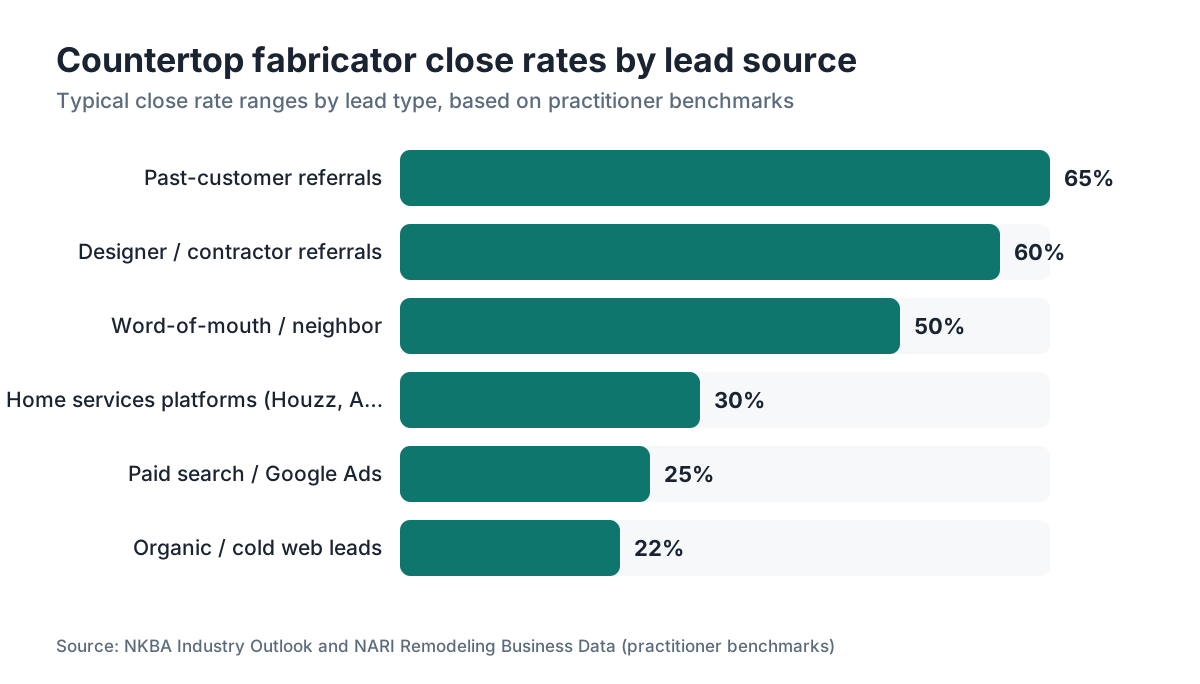
Lead source is the single biggest variable. Referrals from past customers or designers close at much higher rates than paid digital leads, because trust is already established before the first call. One National Association of the Remodeling Industry survey found that referral-generated leads convert at roughly double the rate of advertising-generated leads across remodeling trades. [3]
Response speed is the second major factor. Harvard Business Review published research showing that leads contacted within one hour of inquiry are seven times more likely to have a meaningful conversation than leads contacted after that window. [4] That research covers B2B leads broadly, but fabricators who have tightened their response time consistently report higher close rates, often moving from 28% to 38% simply by calling back within 30 minutes instead of the next morning.
Quote format matters too. A PDF with a single line item ('kitchen countertops, $4,200') invites the customer to shop it around and compare only on price. A quote that walks through material choice, edge profile, sink cutout, and installation details gives the customer a reason to stay with you. They feel understood, not processed.
The market you're in sets the ceiling. In a dense metro with 15 fabricators fighting for the same jobs, a 35% close rate might be excellent. In a rural market where you're one of two shops within 60 miles, you should be closing 55% or better.
How do you calculate your own close rate accurately?
Pull every formal written quote you sent over the last 90 days. Count them. Then count how many turned into signed contracts or deposits received. Divide jobs won by quotes sent. That's your baseline.
Do not count verbal ballpark estimates you gave over the phone. Those are not quotes. Do not exclude the quotes where the customer went silent; those are losses and belong in your denominator. A lot of shops quietly inflate their close rate by counting only 'real' leads, which means they are measuring their ability to spot good leads rather than their ability to close.
If your shop software tracks quote status, pull this automatically. If you're still on spreadsheets or paper, the exercise alone, pulling 90 days of quotes and marking each one won or lost, usually surfaces two or three patterns that explain a weak close rate before you run any analysis.
Track by lead source separately once you have the basics. You want to know one thing: does my close rate on Google leads differ from my close rate on designer referrals? Almost certainly yes, and knowing the split tells you where to spend your marketing dollars.
What is a good close rate if you're taking mostly internet leads?
If your primary source is paid search, local SEO, or home-services platforms like Houzz or Angi, a close rate between 20% and 35% is realistic and can still be very profitable. [2] These buyers comparison-shop by nature. They sent the same request to three other shops. Closing one in four while holding your margin is a win.
The math works like this. Say your average job is $5,500 and it costs you $180 in marketing to generate a qualified lead (a reasonable range for Google Local Services Ads in a mid-sized market). You spend $720 to close one job at a 25% rate. That's under 14% customer acquisition cost on a $5,500 ticket, which is manageable for most shops. [10]
What you should not do with internet leads is discount to close. Shave 10 to 15% to beat the competitor across town and you've turned a 13% acquisition cost into a 23% acquisition cost once you account for the margin you gave away. Better to lose the job at your real price and wait for the next inquiry.
Speed and presentation beat discounting every time. Call back fast. Send a clean, itemized quote within 24 hours. Follow up twice over the next week. That process moves the needle more than cutting price.
How does close rate connect to profit, more than volume?
A 50% close rate sounds better than a 30% close rate, but it means nothing without knowing what you closed and what it cost to get there. A shop that closes 30% of quotes at full margin and low marketing spend can out-earn a shop closing 55% of quotes at discounted prices with heavy ad spend.
The number to watch alongside close rate is average job revenue and gross margin per closed job. If your close rate climbs because you're discounting to compete, your revenue per job drops, your margin compresses, and your shop gets busier without getting more profitable. Common trap.
Fabricators who raise prices by 8 to 12% and watch their close rate fall from 45% to 36% sometimes find their total revenue and margin both go up, because they're doing fewer jobs at higher yield. There is no universal right answer. The goal is profitable revenue, not a flattering close rate statistic.
Shops using quoting software can model this faster. SlabWise, for example, lets fabricators run the numbers on material cost and waste before pricing, which helps set floor prices with confidence instead of guessing. That confidence tends to reduce unnecessary discounting. [5]
What close rate should a new fabrication shop expect?
New shops typically close 20 to 30% in their first year. You're building reputation, learning to qualify leads, and your referral network is thin. That's normal. Do not panic and discount.
The two things that move the needle fastest for a new shop are response time and follow-up. Most homeowners contact three to five fabricators and go with the first one who responds competently. 'Competently' means a callback within an hour, a professional quote within 24 hours, and at least one follow-up call. That process alone can push a 22% close rate to 32% without touching your price sheet.
Referrals start compounding in years two and three. Customers who had a good experience send their neighbors. Designers who used you once and liked the process become a reliable channel. By year three, a well-run shop should see its blended close rate climb to 35 to 45% as the referral mix grows.
What is a reasonable follow-up process to improve close rate?
Most fabricators follow up once, get no answer, and write the lead off. Data from remodeling industry consultants consistently shows that 60 to 70% of remodeling decisions take longer than two weeks from first inquiry to commitment. [3] A single follow-up call three days after the quote misses most of that window.
A practical process looks like this. Send the quote, then call 24 to 48 hours later to confirm receipt and answer questions. If no response, send a brief email at day 7. Call again at day 14. If still nothing, send a final note at day 21 letting them know the quote is valid for 30 days and materials are subject to availability. Then stop.
That four-touch sequence feels like a lot to shops used to one-and-done, but it isn't aggressive if each touchpoint is genuinely helpful rather than pushy. Ask if they have questions about the edge profile. Mention that the slab they liked has limited availability. Give them a reason to reply.
For homeowners still in the research phase, the kind of content at kitchen countertops or countertop installation can help them get ready to commit. Shops that send useful links in their follow-up emails get responses, because they're being helpful rather than chasing a signature.
How does quote speed affect your close rate?
The relationship between quote turnaround time and close rate is well-documented in home services. A 2021 analysis by Hatch, a home-services messaging platform, found that contractors who respond to leads within five minutes are 21 times more likely to qualify the lead than those who respond after 30 minutes. [6] The close rate advantage persists but narrows once you're past the initial response. The real damage from slow response is that you lose the conversation before it starts.
For countertop fabricators, the translation is blunt: whoever calls back first usually gets the appointment, and whoever gets the appointment usually wins the quote. Your quote itself can be excellent, but if you're sending it three days after the competitor sent theirs, the customer is already leaning the other way.
Aim for same-day contact and a formal quote within 24 hours on residential jobs. Commercial and contractor projects have longer timelines and more tolerance for turnaround, but residential buyers are impatient. They're remodeling their kitchen and they want it done. Give them a number before they move on.
What can you learn from lost quotes?
Most shops never find out why they lost a job. They sent the quote, heard nothing, and moved on. That's a missed learning opportunity, especially when you're below the 30% threshold and trying to figure out why.
Call or email lost quotes briefly. 'I know you went another direction. If you have 60 seconds, it would help to know whether it was price, timing, or something else.' A lot of customers will tell you. Maybe your price was 18% higher than the shop they chose. Maybe you never followed up and they assumed you weren't interested. Maybe they chose a friend of a friend.
Track those responses over six months. If 70% of lost jobs cite price, you have a pricing or communication problem. If 40% say they 'never heard back,' your follow-up process is broken. If most say they went with someone their designer recommended, that tells you where to spend your relationship-building energy.
This kind of win-loss analysis is standard practice in B2B sales and almost unheard-of in small fabrication shops. The shops that do it consistently find patterns they can actually fix.
Does offering financing improve close rate for countertop quotes?
Yes, but the effect is smaller than many fabricators expect and depends heavily on how you present it. The Joint Center for Housing Studies at Harvard estimates that roughly 30% of homeowners finance remodeling projects, and that percentage rises for projects over $10,000. [7] Kitchen countertop jobs often fall in the $3,000 to $8,000 range, which sits at the lower edge of where financing dramatically changes buying decisions.
For jobs in that range, financing tends to help with customers who are price-anchoring hard: the homeowner who flinches at $5,800 but can hear '$189 per month.' If you have a lending partner (GreenSky and Synchrony Financial both run programs aimed at home improvement contractors), mentioning it in your quote can close the hesitant buyer. [8][9]
Don't expect financing to rescue a quote that lost on fit or trust. If the buyer doesn't believe you'll do good work or show up on time, a payment plan won't fix that. Financing is a closing tool for buyers who are sold on you but uneasy about the upfront number.
How do referral programs affect close rates over time?
Referral-sourced leads close at 50 to 70% for most fabricators, compared to 20 to 35% for cold digital leads. That gap alone is the argument for investing in referral relationships. [2]
The most effective referral sources for countertop fabricators are kitchen designers and cabinet dealers. A single designer who specifies your shop for their clients can bring six to twelve jobs a year, all arriving pre-sold. Building two or three of those relationships over two years can shift your lead mix from 80% cold digital to 50% referral, and your blended close rate will rise accordingly.
Formal referral programs (offering past customers a gift card or discount on future work for sending a friend) work modestly for residential customers. The conversion is lower than the designer channel and it takes more management. If you have bandwidth for one relationship-building effort, focus on designers and contractors before customer referral programs.
For shops that do significant volume in marble countertops or premium materials like Cambria, Cambria countertops buyers are often designer-sourced already, and the designer relationship is the whole game.
What does a high close rate that's too high actually mean?
If your close rate is consistently above 65 to 70%, that's worth examining. It could mean you have an exceptional referral network and brand reputation. It could also mean you're underpricing your work.
A useful test: raise your prices 10% on the next 20 quotes and track what happens. If you still close 65%, you were underpriced. If your close rate drops to 50%, you're now at a normal price and a normal rate. If it drops to 35%, you may have overshot, but even then your revenue per closed job might be higher.
Fabricators who have never tested a price increase are often surprised to find that raising prices slightly improves perceived quality. Customers in the $6,000 to $10,000 job range aren't always hunting for the cheapest option. They're looking for confidence that the shop will do a good job. A quote that comes in dramatically below competitors sometimes triggers skepticism rather than excitement.
Tracking close rate alongside average ticket price and gross margin is the only way to know if a high close rate is a sign of health or a sign of underpricing. SlabWise's quoting tools let fabricators model job costs before pricing goes out, which makes deliberate price-testing easier to run and track. [5]
What operational factors hurt close rates that shops often overlook?
Slow quote delivery is the most common killer, but a few others matter nearly as much.
Quote confusion. If a customer receives a quote they don't understand, they either call to ask questions (good) or go somewhere else (common). A quote that uses jargon like 'Uba Tuba 3cm slab, OGE, u/m cutout' without explanation loses the homeowner who doesn't know what an ogee edge or an undermount cutout is. Translate it. 'Ogee edge profile (curved, classic look), undermount sink cutout included.'
No photo or visual. Countertops are a visual purchase. Quotes that include a photo of the slab the customer liked, or an edge profile diagram, close faster. The customer can see what they're buying.
Bad measurement experience. If your templating visit felt rushed or disorganized, the customer is already nervous. Shops that run a thorough, professional template visit and explain what they're doing earn more trust and close more quotes from that visit.
For customers still researching materials, pointing them toward resources like how to clean stone countertops or explaining the differences between materials like corian countertops and natural stone can keep the conversation alive while they decide. Helpful shops win more jobs than pushy ones.
Frequently asked questions
What is the average close rate for countertop fabrication quotes?
Most fabricators land between 30% and 50% when tracking formal written quotes against signed jobs. Shops heavy on referral leads often exceed 55%. Shops relying on cold digital leads typically run 20 to 35%. There is no large-scale published survey specific to stone fabrication, so these ranges come from practitioner benchmarks and adjacent trade studies.
Is a 25% close rate bad for a countertop shop?
Not necessarily. If your lead source is paid digital advertising and your average job revenue is solid, 25% can still be profitable. The issue is when a 25% rate results from poor follow-up or slow response rather than competitive market conditions. Check your response time and follow-up process before concluding the rate is acceptable.
How many quotes should a countertop fabricator send per month?
It depends on your install capacity. A shop running two install crews can handle 15 to 25 jobs per month. At a 35% close rate, you need to send 43 to 71 quotes to fill that schedule. Work backward from your install capacity and your target close rate to figure out how many leads your marketing needs to generate.
Should I track close rate by lead source?
Yes, always. Your blended close rate hides important information. A 38% overall rate might be masking a 65% rate on designer referrals and a 22% rate on Google Ads leads. That split tells you exactly where your marketing dollars are well-spent and where you're generating leads that rarely convert. Most fabricators who start tracking by source find one channel dramatically outperforms the others.
How long should a countertop quote be valid?
Most shops set 30 days as the standard validity window, and that's reasonable for residential work. Material prices and slab availability can shift. State it explicitly in your quote so customers know urgency exists. For commercial projects with long planning timelines, 60 to 90 days is more common, with language that allows price revision if material costs change significantly.
Does the type of countertop material affect close rate?
Indirectly, yes. Jobs involving premium materials like exotic granite or thick-profile quartz attract buyers who are further along in their decision and less likely to be pure price-shoppers. Shops that specialize in higher-end materials often see slightly better close rates because the buyer pool is self-selected. Budget-material shoppers tend to comparison-shop more aggressively.
How do I handle a customer who keeps asking for discounts?
Hold your price and explain what's in it. 'Here's what you get: the slab you selected, undermount sink cutout, ogee edge, delivery, and installation with a one-year workmanship guarantee.' If they still push, offer to adjust scope rather than margin: a simpler edge profile, a different slab tier, fewer cutouts. Never discount the same scope. That trains customers to always ask.
What is the best way to follow up on an unanswered countertop quote?
Contact the customer at 24 to 48 hours post-quote to confirm receipt and answer questions. Email at day 7. Call at day 14. Send a brief final note at day 21 noting the quote expires in 30 days. Four touches over three weeks covers the majority of buyers who are still deciding. Beyond that, the conversion rate drops sharply and your time is better spent on new leads.
Does response speed really affect countertop quote close rates?
Yes, significantly. Research across home services consistently shows that leads contacted within one hour convert at much higher rates than those contacted the next day. Countertop buyers typically contact multiple shops at once; whoever responds first usually gets the appointment. Whoever gets the appointment usually gets the job. Aim to call back within 30 to 60 minutes during business hours.
How does offering financing change countertop quote close rates?
Financing helps most on jobs above $6,000 to $8,000 where the upfront number is the barrier. For mid-range jobs, the effect is real but modest. Present it proactively in your quote rather than waiting for the customer to object to the price. Programs through GreenSky or Synchrony Financial are common in the home improvement space and can be added to most quote processes without much overhead.
What is a good close rate for commercial countertop projects?
Commercial jobs typically have longer sales cycles and more competitive bidding, so close rates tend to run lower: 15 to 30% is common. But the average ticket is higher, and winning one commercial contract can be worth five residential jobs. Track commercial separately from residential. Trying to hit 40% on commercial bids is likely unrealistic if you're in a competitive market with multiple qualified bidders.
How do I know if my pricing or my process is causing low close rates?
Call your lost quotes and ask. Briefly: 'Was it price, or was it something else?' If more than half cite price, test a modest price reduction or improve how you communicate value. If half cite service concerns or say they went with someone recommended to them, price isn't the problem. This simple win-loss conversation, done consistently over three months, usually tells you exactly what's wrong.
Can tracking software improve my countertop shop's close rate?
Tracking software doesn't close jobs, but it eliminates the friction and delays that cause you to lose them. Shops that move from spreadsheets to dedicated quoting tools consistently report faster quote delivery, fewer errors, and better follow-up consistency. Faster quotes and fewer mistakes translate directly to higher close rates over time, especially for shops currently taking two or three days to get a written quote out the door.
Sources
- Natural Stone Institute (formerly Marble Institute of America), Industry Data: The Natural Stone Institute and its predecessor the Marble Institute publish periodic business data on the stone fabrication industry, but no large-scale survey isolating quote-to-close conversion rates for countertop fabricators has been published.
- National Kitchen and Bath Association, NKBA Industry Outlook: Practitioner benchmarks from kitchen and bath industry forums and trade groups place countertop fabricator close rates between 30% and 50% for mixed lead sources, with referral-heavy shops often exceeding 55%.
- National Association of the Remodeling Industry (NARI), Remodeling Business Data: NARI survey data shows referral-generated leads convert at roughly double the rate of advertising-generated leads across remodeling trades, and that 60 to 70% of remodeling decisions take longer than two weeks from first inquiry to commitment.
- Harvard Business Review, 'The Short Life of Online Sales Leads' (2011): Research published in Harvard Business Review found that leads contacted within one hour of inquiry are seven times more likely to have a meaningful conversation than leads contacted after that first hour.
- SlabWise, Countertop Fabrication Quoting Software: SlabWise quoting and nesting software allows fabricators to model material cost and waste before pricing goes out, supporting deliberate price-setting and reducing unnecessary discounting.
- Hatch, Home Services Lead Response Study (2021): A 2021 analysis by Hatch found that contractors who respond to leads within five minutes are 21 times more likely to qualify the lead than those who respond after 30 minutes.
- Joint Center for Housing Studies of Harvard University, Improving America's Housing (2023): The Joint Center for Housing Studies at Harvard estimates that roughly 30% of homeowners finance remodeling projects, with the percentage rising for projects above $10,000.
- GreenSky Financial, Home Improvement Financing Programs: GreenSky offers home improvement contractor lending programs commonly used by countertop fabricators and remodelers to offer customer financing.
- Synchrony Financial, Home & Auto Financing: Synchrony Financial operates home improvement financing programs available to contractors, including countertop fabricators, as a point-of-sale lending option.
- U.S. Small Business Administration, Small Business Marketing and Sales Benchmarks: The SBA provides general small business guidance on customer acquisition cost and sales conversion benchmarks used to contextualize countertop fabricator marketing spend efficiency.
- U.S. Census Bureau, Annual Capital Expenditures Survey (Construction Sector): U.S. Census data on construction and home improvement sector activity provides context for market competition and job volume affecting fabricator close rates.
Last updated 2026-07-11