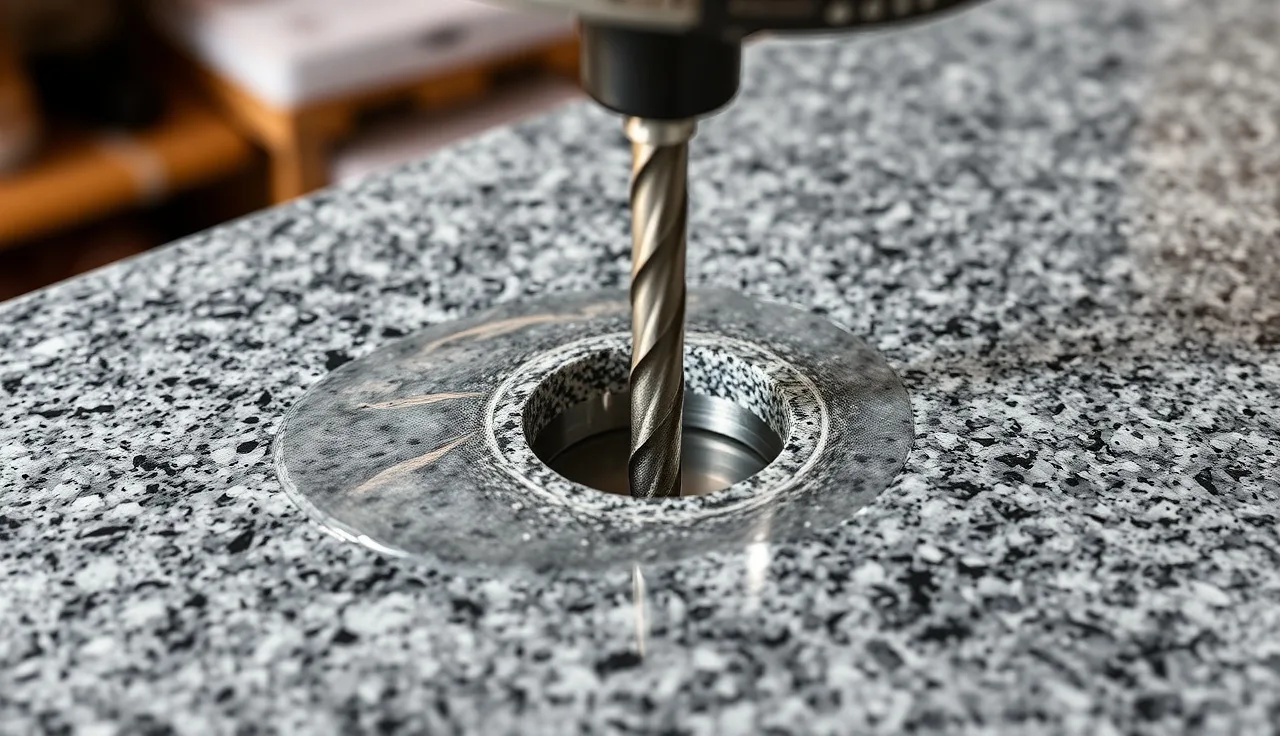
TL;DR
- Cutting a soap dispenser hole in stone takes a diamond core drill bit (usually 1-3/8 inch), a drill speed under 600 RPM, and constant water cooling.
- A confident DIYer needs 15 to 30 minutes.
- One dry, forced, or crooked cut can crack a slab worth thousands.
- Know the technique before you touch the drill.
What size hole does a soap dispenser need in a stone countertop?
Most soap dispensers need a hole between 1-1/4 inch and 1-3/8 inch across. Check the pump collar on your exact dispenser before you buy a bit. The spec is almost always printed on the box or in the installation sheet.
A few high-volume or commercial dispensers go up to 1-1/2 inch. Some slim European designs sit closer to 1-1/8 inch. Measure twice, buy the core bit once. A bit even 1/8 inch too small means the pump collar won't drop through, and you can't enlarge a hole in stone without inviting a crack.
The finished hole also has to clear the deck-mount hardware underneath, which usually means a nut and a washer. If your counter has an undermount sink apron or a thick laminated edge close by, check clearance below too. Granite, quartz, and marble tops are typically 3/4 inch (2 cm) or 1-1/4 inch (3 cm) thick [1]. Thicker slabs keep the core bit engaged longer, and that means more heat.
What tools do you actually need to drill stone?
The one non-negotiable is a diamond core drill bit. Twist bits, carbide masonry bits, and ceramic tile hole saws will not cut granite, quartz, or marble. They spin without biting, overheat in seconds, and can fracture the stone.
Here's the full list:
| Tool | Notes |
|---|---|
| Diamond core bit, 1-3/8" (or correct size) | Wet-cutting rated; dry-cutting bits exist but throw dangerous silica dust [2] |
| Variable-speed drill or drill press | Must hold steady under 600 RPM; hammer mode OFF |
| Water source or wet-drilling dam | Cools the bit; prevents cracking and dust |
| Masking or painter's tape | Marks center; cuts down on surface chipping |
| Permanent marker | Marks the center point |
| Safety glasses and N95 or P100 respirator | Silica dust is a serious health hazard [2] |
| Shop vac with HEPA filter | Slurry containment and backup dust control |
| Towels and a bucket | Water management under the counter |
A drill press gives you far more control than a hand drill. Freehand, the bit can walk before it seats, and a wandering start chips polished stone. Some pros use a suction-cup drilling jig that holds the bit square and builds a water reservoir around the cut. Those jigs run $40 to $80 and earn their keep on a one-time job on an expensive top.
Skip the rotary hammer and any hammer-drill setting. Impact on stone starts microfractures that spread from the hole and can split a whole section of countertop.
Why does water cooling matter so much when drilling stone?
Diamond core bits cut by grinding stone with industrial diamonds bonded to the rim. That makes a lot of heat. Run it dry and the bond matrix softens, the bit glazes over, it quits cutting, so you press harder. That pressure is what cracks the stone.
Water does three jobs at once. It cools the bit so the diamonds keep biting. It flushes ground slurry out of the cut so the bit isn't grinding its own waste. And it holds down the respirable crystalline silica that grinding stone throws into the air.
OSHA regulates that silica. The permissible exposure limit for construction workers is 50 micrograms per cubic meter of air as an 8-hour time-weighted average, set in OSHA's Silica Standard for Construction (29 CFR 1926.1153) [2]. A homeowner drilling a single hole isn't a daily occupational exposure, but dry grinding stone without a respirator in a closed kitchen is genuinely dangerous. Wet cutting drops airborne silica by roughly 85 to 90 percent versus dry cutting, per NIOSH research on stone work [3].
The easiest water method for a freehand drill: tape a plumber's putty dam (or a ring of foam pipe insulation) around the site to make a small reservoir, fill it with water, and start the bit into the water. Top it off as you go. A garden hose trickling slowly into the cut works too.
Step-by-step: how to cut the hole without cracking the stone
Work slowly. Speed does not save you time here.
Step 1: Mark the location. Most soap dispensers sit 2 to 4 inches from the sink rim, placed so the pump head clears the faucet and stays out of the sprayer hose. Lay painter's tape over the spot and mark your center on the tape. The tape guards the polish from chips as the bit starts.
Step 2: Set up water containment. Stuff rags or set a bucket under the counter to catch the drip-through. Using a putty dam? Press it firmly around the mark on top of the counter and fill it with about half an inch of water.
Step 3: Seat the bit. Hold the drill perpendicular to the surface and start at the lowest speed the drill offers. Tilt the bit slightly (10 to 15 degrees) for the first few seconds to cut a starting groove, then bring it fully upright once you see that groove. This keeps the bit from skating.
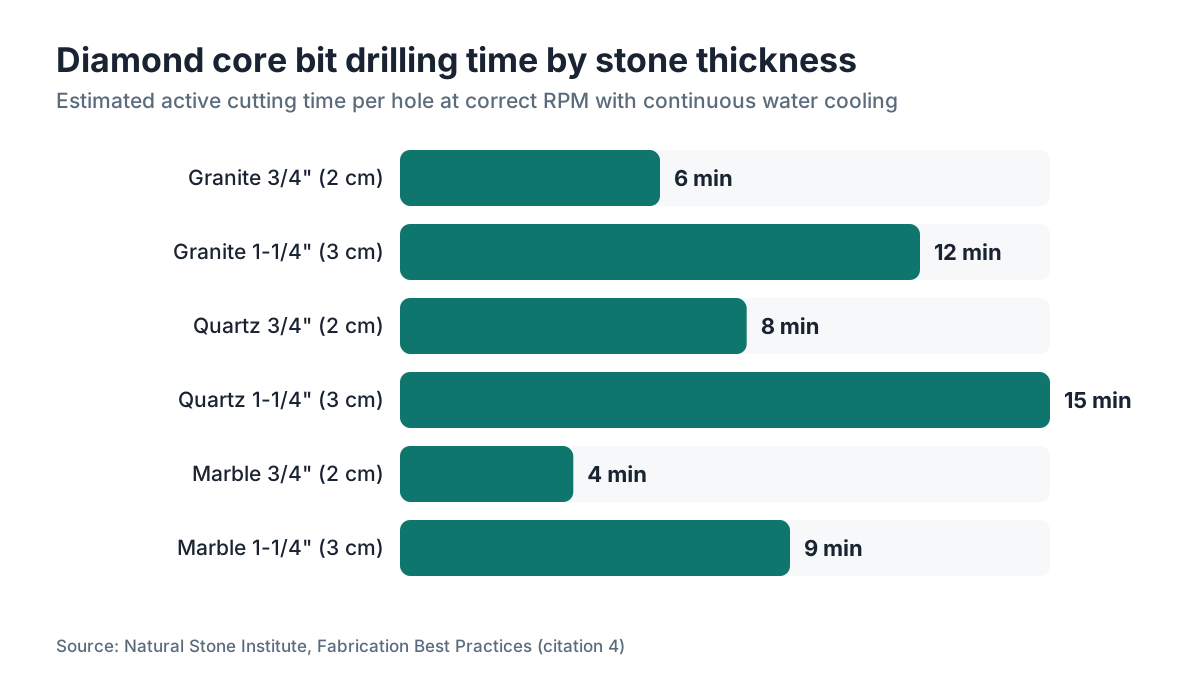
Step 4: Drill under 600 RPM, no hammering. Keep light, steady downward pressure. Let the diamonds do the work. A thin milky slurry rising in the water means the bit is cutting right. Dry dust or smoke means you need more water immediately. For 3/4 inch stone, figure 3 to 8 minutes of actual cutting. For 1-1/4 inch stone, budget 8 to 15 minutes [4].
Step 5: Ease off near breakthrough. When you feel the bit start to punch through the underside, back off the pressure hard. The stone disk dropping out under its own weight at the last second is exactly how chips and fractures happen. Some fabricators drill from both faces, meeting in the middle, for the cleanest exit top and bottom.
Step 6: Clean and finish. Rinse the slurry, dry the area, pull the tape. The raw edge of the hole is rough. A small diamond hand pad ($10 to $20) can ease it if needed. The pump collar and mounting hardware cover most of the perimeter anyway.
For a look at proper technique, the Natural Stone Institute (formerly the Marble Institute of America) publishes fabrication standards covering drilling and cutout procedures for stone [5].
Can you drill granite, quartz, and marble the same way?
Mostly yes. But each material behaves differently under the bit.
Granite is hard and granular. It drills cleanly with a diamond core bit and the wet technique above. The main surprise is hitting a pocket of feldspar or quartz crystal at a slightly different hardness, which can nudge the bit off line. Keep pressure steady.
Quartz (engineered stone like Silestone, Cambria, MSI) is harder than most natural granite and cuts slower. Cambria countertops, for one, are about 93 percent quartz bound in resin [6]. That resin is the catch: heat hurts it more than it hurts natural stone, because a dry bit can soften, discolor, or separate the resin from the aggregate. Keep water flowing without a break. Some quartz fabricators drop as low as 300 to 400 RPM.
Marble is softer than granite (roughly 3 to 4 on the Mohs scale against 6 to 7 for granite) [7] and cuts faster. It also chips and cracks at the hole edge more easily. Use lighter pressure than you would on granite, and the dual-side technique (drilling from both faces to meet in the middle) pays off more on marble than on harder stones.
Quartzite (true quartzite, not the marble that gets mislabeled as it) is one of the hardest natural stones on any countertop. Budget extra time and check the bit for wear after the cut.
Working with granite countertops or marble countertops? The technique is the same. Just adjust your expectations for cut time and how fragile the edge is.
What can go wrong, and how do you recover?
The worst outcome is a crack running from the hole toward the sink or an edge. It almost always traces to one of three mistakes: the bit walked at the start and you forced it back, you ran dry and cooked the stone, or you shoved through the last few millimeters.
A hairline crack can sometimes be filled with color-matched epoxy by a stone fabricator. Up close, with the light hitting it right, you'll still see it. The repair is not invisible. On a 3 cm granite slab, a full crack from the hole to the sink cutout often means replacing the slab.
If the bit stalls mid-cut and won't advance, stop before you force it. Pull out, add water, let the bit cool for 60 seconds, restart at a lower RPM. A stuck core plug (the disk of stone trapped inside the bit) can also stall the cut. Once you've withdrawn the bit, a thin screwdriver usually pops it free.
If the finished hole is a hair off-center or slightly small, you can re-engage the bit to widen it, but go slow and keep the bit supported. Chasing a hole that's 1/16 inch off with a bit that wants to follow the old groove is the kind of thing that turns bad fast.
One note for fabricators. If you're quoting a job with added holes (soap dispensers, filtered water, air switches), the per-hole charge in most U.S. markets runs $30 to $75 depending on material and where the hole sits on the slab [4]. Shops running countertop fabrication software like SlabWise can itemize these add-ons in the quote so the customer sees and approves the line rather than getting surprised on the invoice.
Should you DIY this or hire a fabricator?
Be honest about three things: what your countertop is worth, how confident you are with a drill, and whether you have (or can borrow) the right gear.
A decent diamond core bit for stone runs $15 to $40 from brands like Bosch or DEWALT. Add the suction-cup guide jig, a HEPA shop vac, and a respirator, and you're at $100 to $150 in tools for a job a fabricator does for $50 to $75 during installation or on a service call.
For a countertop that cost $2,000 to $6,000 installed, that math usually favors the fabricator. They own a drill press or a router jig, they've done this hundreds of times, and they carry liability for the work.
DIY makes sense in a few cases. You're adding a dispenser to laminate or butcher block (much lower stakes). You already own the tools. Or the counter is mid-range material and you're genuinely comfortable with the technique.
For laminate countertops or butcher block countertops, the process forgives a lot. A standard hole saw handles laminate. A sharp spade bit or Forstner bit handles wood. Stone is its own animal.
Getting a new countertop installed and you already know you want a dispenser? Ask for the hole during fabrication, every time. The fabricator has the slab on the bench or a CNC machine, the hole takes minutes, and there's zero risk of cracking an installed slab. More on what to request during countertop installation.
Where exactly should the soap dispenser hole go?
Placement matters more than people expect. The wrong spot makes the dispenser awkward to reach, drops it into the faucet handle's arc, or lands it right over a cabinet frame that blocks the mounting nut.
Standard guidance from plumbing and kitchen design sources puts soap dispensers 2 to 4 inches from the sink edge, on your dominant-hand side (right for most people). The pump head should clear the faucet body and the sprayer hose when both are pulled to full range. Tape a cardboard mockup at the spot and test it before you drill.
Under-counter clearance is the hidden constraint. Open the cabinet and look up at the underside where you plan to drill. You need at least 3 inches of room beneath the stone for the pump reservoir, the mounting nut, and your hand to turn it. Some undermount installations run a wood reinforcement apron along the sink perimeter that can block the exact spot you want. Measure twice.
If there's a seam nearby, stay at least 3 inches off it. Drilling close to a seam piles stress onto a joint that's already held together by epoxy.
What diamond core bit should you buy for this job?
Buy a wet-cutting diamond core bit rated for stone, not a general masonry bit or a tile bit. The difference lives in the diamond bond matrix and the geometry of the bit's water ports.
For a single home hole, a mid-tier bit from a known brand is plenty. DEWALT's dry/wet diamond core bits and Bosch's diamond core bits for stone show up at most hardware stores and run $20 to $40 for the 1-3/8 inch size [8]. Shops drilling dozens of holes a week get more from a premium segmented core from companies like Alpha Professional Tools or Tenax, worth the $40 to $80 unit cost for the longer bit life.
Check the shank. It has to match your drill's chuck. Most of these bits use a 5/8 inch shank with a threaded arbor adapter. Verify before you leave the store.
Cheap off-brand bits from unknown sellers are a gamble. The diamonds may be spread unevenly, the bond may be too soft, and the bit can glaze after one hole. On a $3,000 granite countertop, this is not the place to save $8.
How do you handle silica dust safely during this job?
Crystalline silica is the hazard the quick tutorial videos skip. Grinding stone makes fine respirable silica particles that, with repeated exposure, cause silicosis, an irreversible and sometimes fatal lung disease [9].
OSHA's Silica Standard for Construction (29 CFR 1926.1153) lists "cutting, grinding, drilling, or sculpting masonry, concrete, stone, or stucco" as a regulated activity [2]. The rule applies to workers, not homeowners doing a one-off, but the physics of the dust don't care who's holding the drill.
For a single home hole, wet cutting is your main defense. Keep the bit wet start to finish. NIOSH reports that wet methods during stone cutting cut airborne silica by roughly 85 to 90 percent versus dry cutting [3].
Past wet cutting: wear an N95 respirator at a minimum (a P100 half-face is better), keep the kitchen ventilated, keep everyone else out of the room, and clean up slurry wet instead of dry-sweeping. Dry sweeping stone dust just throws the particles back into the air. NIOSH lays this out in its safety materials on silicosis and stone countertop fabrication [9].
What does a fabricator charge to drill a soap dispenser hole?
It depends on region and on whether the hole gets cut during fabrication or as a separate service call afterward.
During fabrication (slab on the bench or a CNC router): most shops charge $30 to $60 per hole. Some throw in the first hole free with a sink cutout package. This is almost always the cheapest and safest route.
As an after-install service call: expect $75 to $150 or more, because you're paying for travel time, setup, and the risk premium of working an installed slab that can't easily be swapped if something goes sideways.
Geography moves the numbers. In high-cost metros (New York, San Francisco, Seattle) a single-hole service call can run $150 to $250. In lower-cost rural markets, the same job might land at $50 to $75 including the call.
Fabricators who itemize add-on holes in their quotes, instead of burying them in a lump total, see fewer billing fights. Shop owner reviewing your quoting process? Listing line-item pricing for soap dispenser holes, air switch holes, and filtered water holes separately is quick to set up in fabrication quoting software and makes the estimate easier for the customer to read and approve. SlabWise's quote builder handles these as line items, so the customer sees exactly what each hole costs before sign-off.
Can you add a soap dispenser hole to an already-installed countertop?
Yes, it's done all the time. The technique matches everything above. What changes is the logistics: you're working over a cabinet, the sink and faucet are in your way, and you have zero margin because you can't flip the slab or haul it back to the shop.
A few extra things to plan for on an installed slab.
Water management is harder. Gravity pulls water and slurry straight through the hole into the cabinet. Line the cabinet with plastic sheeting, put a bucket right under the drill site, and keep towels close.
Under-cabinet lighting or outlet boxes sit exactly where you may need to reach to tighten the mounting hardware. Check for them before you drill.
Vibration from drilling can stress the silicone bead at the sink perimeter. Look at the sink caulk before and after. Re-caulk if you see any separation.
If the counter is Corian or another solid surface rather than stone, the whole thing gets easier. Corian drills with standard woodworking bits and the dust is far less hazardous. Solid surface forgives a slight angle or a slow start.
Frequently asked questions
What size drill bit do I need for a soap dispenser hole in granite?
Most soap dispensers need a 1-3/8 inch hole. Check the spec sheet for your exact dispenser first, because sizes run from 1-1/8 inch to 1-1/2 inch by brand. Buy a diamond core bit rated for wet cutting in stone. A standard masonry or tile bit will not cut granite.
Can I use a regular drill to cut a hole in a stone countertop?
You can use a standard variable-speed corded drill if it holds a slow, steady speed under 600 RPM with the hammer function fully off. A drill press is safer because it keeps the bit perpendicular and lets you apply even pressure without walking. Never use rotary hammer mode on stone. The impact cracks the material.
How long does it take to drill a soap dispenser hole in granite?
Actual cutting runs 3 to 8 minutes for 3/4 inch (2 cm) stone and 8 to 15 minutes for 1-1/4 inch (3 cm) stone. Setup, water containment, marking, and cleanup add another 20 to 40 minutes. Budget an hour for the whole job if you've never done it and want to work carefully.
Will drilling a hole in my granite countertop crack it?
Use the right bit, keep the speed low, run continuous water cooling, and ease off near breakthrough, and the crack risk is low. Cracks happen when the bit walks at the start without a guide, when you run dry and overheat the stone, or when you push hard through the last millimeter. Proper technique makes this a safe job.
Is silica dust dangerous when drilling a stone countertop?
Yes. Grinding granite or quartz makes respirable crystalline silica that causes silicosis with repeated exposure. OSHA regulates this under 29 CFR 1926.1153. For a single home project, wet cutting reduces airborne silica by 85 to 90 percent per NIOSH. Wear an N95 respirator, wet-cut throughout, and clean up slurry wet rather than dry-sweeping.
Can I drill a soap dispenser hole in quartz countertops like Silestone or Cambria?
Yes, but engineered quartz is harder than most granite and its resin binder is heat-sensitive. Run the drill at 300 to 400 RPM, keep water flowing without a break, and use lighter pressure than you would on granite. Running a diamond bit dry on quartz is more likely to overheat and discolor the surface than on natural stone.
How much does it cost to have a fabricator drill a soap dispenser hole?
During slab fabrication before installation, most shops charge $30 to $60 per hole. As an after-install service call, expect $75 to $150 or more depending on region and the shop's minimum call fee. In high-cost metros the rate can reach $200. Adding the hole during original fabrication is almost always cheaper and lower risk.
Where is the best place to put a soap dispenser hole near the sink?
Place it 2 to 4 inches from the sink rim on your dominant-hand side (right for most people). Confirm the pump head clears the faucet handle arc and the sprayer hose at full extension. Check underneath for at least 3 inches of clearance for the reservoir and mounting nut. Stay at least 3 inches from any countertop seam.
Can I drill a soap dispenser hole in marble?
Yes. Marble is softer than granite (roughly Mohs 3 to 4 versus 6 to 7), so it cuts faster, but it chips and cracks at edges more easily. Use lighter pressure and consider drilling from both faces to meet in the middle, which gives a cleaner exit on both polished surfaces and lowers the risk of a spall-out chip on the underside.
Do I need a special jig to drill a hole in a stone countertop?
You don't strictly need one, but a suction-cup drilling guide ($40 to $80 at stone tool suppliers) makes the job much safer on an expensive top. It holds the bit perpendicular, stops walking at the start, and many models include a built-in water reservoir that keeps the bit wet without you building a putty dam.
What happens if I drill the hole in the wrong spot?
You cannot move a hole in stone. If the placement is wrong, you either live with it (the pump collar and hardware may hide minor imperfections) or a fabricator fills it with color-matched epoxy and drills a new hole in the right place. The filled hole shows under close inspection. Measure and mark carefully before you start the drill.
Can a soap dispenser hole be added to laminate or butcher block countertops instead of stone?
Adding one to laminate or butcher block is far easier than stone. A standard bi-metal hole saw cuts laminate cleanly. A sharp Forstner bit or spade bit works in wood. No diamond bit, no water cooling, and essentially no crack risk. The hardest part is sealing the wood edge of a butcher block hole against water.
Sources
- Natural Stone Institute (formerly Marble Institute of America), Dimension Stone Design Manual: Standard countertop thickness for granite, quartz, and marble is 3/4 inch (2 cm) or 1-1/4 inch (3 cm)
- OSHA, Silica Standard for Construction (29 CFR 1926.1153): OSHA PEL for respirable crystalline silica is 50 micrograms per cubic meter as an 8-hour TWA; cutting, grinding, and drilling stone is a listed regulated activity
- NIOSH, Health Effects of Occupational Exposure to Respirable Crystalline Silica: Wet cutting methods during stone fabrication reduce airborne silica concentrations by approximately 85 to 90 percent compared to dry cutting
- Natural Stone Institute, Fabrication Best Practices: Diamond core bit drilling time for stone countertops and typical per-hole fabrication pricing of $30 to $75 in U.S. markets
- Natural Stone Institute, Fabrication Standards and Technical Documents: Natural Stone Institute publishes fabrication standards covering drilling and cutout procedures for stone countertops
- Cambria, Product Composition and Care Guide: Cambria engineered quartz countertops are composed of approximately 93 percent natural quartz bound in resin
- National Park Service, Mohs Hardness Scale reference: Marble rates roughly 3 to 4 on the Mohs hardness scale versus 6 to 7 for granite
- Bosch Tools, Diamond Core Bit Product Specifications: Diamond core bits for stone in 1-3/8 inch diameter from major brands run $20 to $40 at retail
- CDC/NIOSH, Silicosis and Stone Countertop Fabrication safety materials: Silicosis is an irreversible and potentially fatal lung disease caused by inhaling respirable crystalline silica dust from stone cutting and grinding
- OSHA, Table 1 to 1926.1153, Specified Exposure Control Methods: OSHA Table 1 specifies wet methods as an engineering control for drilling, grinding, and cutting stone and masonry materials
Last updated 2026-07-11