TL;DR
- You can pull a stone countertop out whole.
- Cut every bead of caulk and adhesive first, keep the slab dead level as you lift, and never let one end hang.
- Granite and quartz weigh 13 to 20 lbs per square foot, so a single section can hit 300 pounds.
- Two people minimum, three for anything over 60 inches.
- Budget two to four hours for a full kitchen.
Is it actually possible to remove a stone countertop in one piece?
Yes. The catch is length. A 30-inch sink base slab comes out whole fairly often. A 14-foot L-shaped run almost certainly went in as two or three pieces, and that helps you, because you take each piece out on its own.
The physics is simple and unforgiving. Granite, quartzite, and engineered quartz all have high compressive strength and low tensile strength. They carry weight sitting flat with no complaint. Bend them, or let one end drop while you lift the other, and they crack. A 96-inch by 26-inch granite slab at 3 cm weighs roughly 200 to 250 pounds [1]. Let one corner sag six inches below the other during the lift and you may hear the sound nobody wants to hear.
So the honest answer: removal without breaking is doable, but the slab has to stay flat and supported at every point until it clears the cabinets and lands on something stable.
What tools do you need before you start?
You don't need much. Skip any one of these, though, and a crack gets a lot more likely.
For cutting adhesive and caulk:
- Oscillating multi-tool with a flexible scraper blade (the single most useful tool for this job)
- Utility knife with fresh blades
- Plastic putty knife (metal scratches the cabinet face)
- Heat gun or hair dryer (softens silicone caulk a lot)
For lifting and moving:
- Two or three people, full stop
- Heavy leather gloves (stone edges are sharp, and a dropped slab is dangerous)
- Moving blankets or carpet scraps to set the slab on
- Stone suction cup lifters rated for the load, ideally 250 lbs or better (pairs run $30 to $80 at tool rental counters)
- Furniture dollies or an appliance dolly for getting the slab out of the room
For fasteners:
- Cordless drill or screwdriver for cabinet screws
- Small pry bar (for cabinet clips only, never against the stone)
Worth having: a second pair of suction cups so one set is always engaged while the other repositions. Renting a suction lifter? Confirm its rated load before you trust it. ANSI/ASME B30.20 covers below-the-hook lifting devices and how they get rated, and any decent stone cup lists its rating on the product [2].
How is a stone countertop actually attached to the cabinets?
Three common methods, and which one you have decides how long the job takes.
Silicone caulk only. Most residential installs from the last 20 years use 100% silicone along the cabinet top rails, around the sink cutout, and at the backsplash joint. Silicone grips well but cuts cleanly. This is the easy case.
Construction adhesive. Some installers run a bead of PL Premium or similar, either on top of the silicone or instead of it. It's much harder to cut and sometimes needs real force or heat to release. If the slab won't budge after the silicone is cut, go hunting for construction adhesive.
Mechanical clips or brackets. Less common with stone, but some undermount sink setups use metal clips screwed into the slab underside that clamp to the sink rim. Unscrew those from below before anything lifts.
The fabricated drop, meaning the overhang past the cabinet face, is never mechanically fastened. Weight and silicone hold it. Don't pry under the overhang. Work from the back, near the wall.
Backsplash pieces are almost always separate from the deck slab. They sit in silicone or thinset against the wall. Take those off first, before you touch the main slab.
Step-by-step: how do you actually remove the countertop without it breaking?
Follow this order and you'll dodge most of the common breaks.
Step 1: Clear and disconnect everything. Shut off the water supply valves under the sink. Disconnect the drain, P-trap, and any garbage disposal. Disconnect the dishwasher drain if it routes through the cabinet. Pull the faucet if it's in the way or you want to reuse it. Empty the cabinets below so nobody has to reach under later.
Step 2: Remove the backsplash first. Slice the caulk joint where the backsplash meets the deck and where it meets the wall. Run the oscillating tool along the bottom edge. Wiggle each piece forward gently. Set it on a moving blanket right away.
Step 3: Cut all the caulk and adhesive. Run the oscillating tool along the inside front edge of the cabinet top rail, pushing the blade up between the rail and the stone underside. Work the full perimeter. Then cut the caulk where the back edge meets the wall. Use the utility knife for the backsplash-to-deck joint if the oscillating tool won't reach.
For silicone, hold a heat gun 2 to 3 inches off the joint for 30 to 45 seconds and the bond softens enough that a plastic putty knife breaks it free. Don't cook it. You're warming the caulk, not melting anything.
Step 4: Test for freedom. Before anyone lifts, press down gently on one end. Does it flex a hair, or is it still locked solid? Locked means there's adhesive you haven't found. Check the sink rim clips and anywhere an installer might have hidden a bead of construction adhesive.
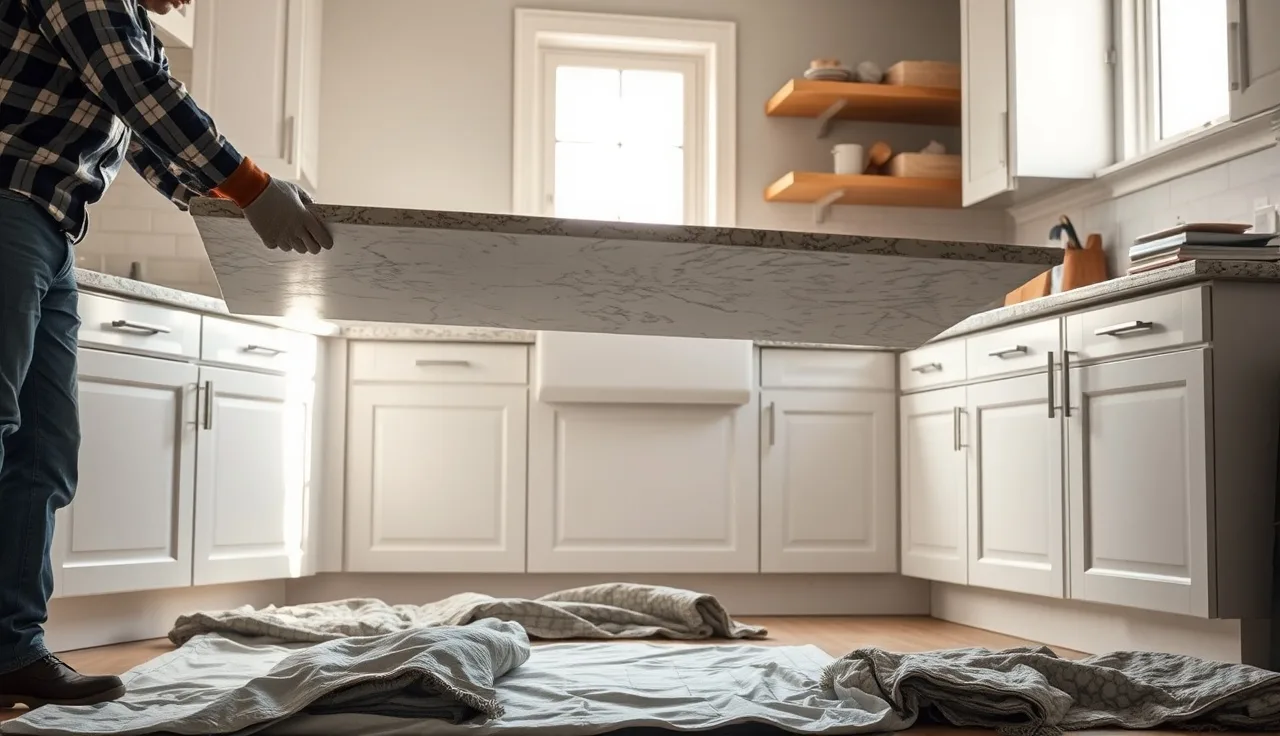
Step 5: Position your people. One person at each end, one in the middle for longer slabs. Pick a leader to call the moves. Set the suction cups. Everyone lifts on a count: straight up, slab level.
Step 6: Lift straight up, then pull forward. The slab clears the cabinet by going up 2 to 3 inches first, then sliding toward you. Don't tilt. Don't let one end rise faster than the other. Talk the whole time.
Step 7: Set it down safely. Blankets on the floor first. Set it flat. For transport, stone survives best on edge (like a book on a shelf) strapped in an A-frame, but for a short move within the house, flat on blankets is fine.
Sink-base section with a cutout? The opening weakens that slab a lot. Treat it as two half-slabs joined at the middle and support both sides of the cutout as you lift.
How heavy is a granite or quartz countertop, and how many people do you need?
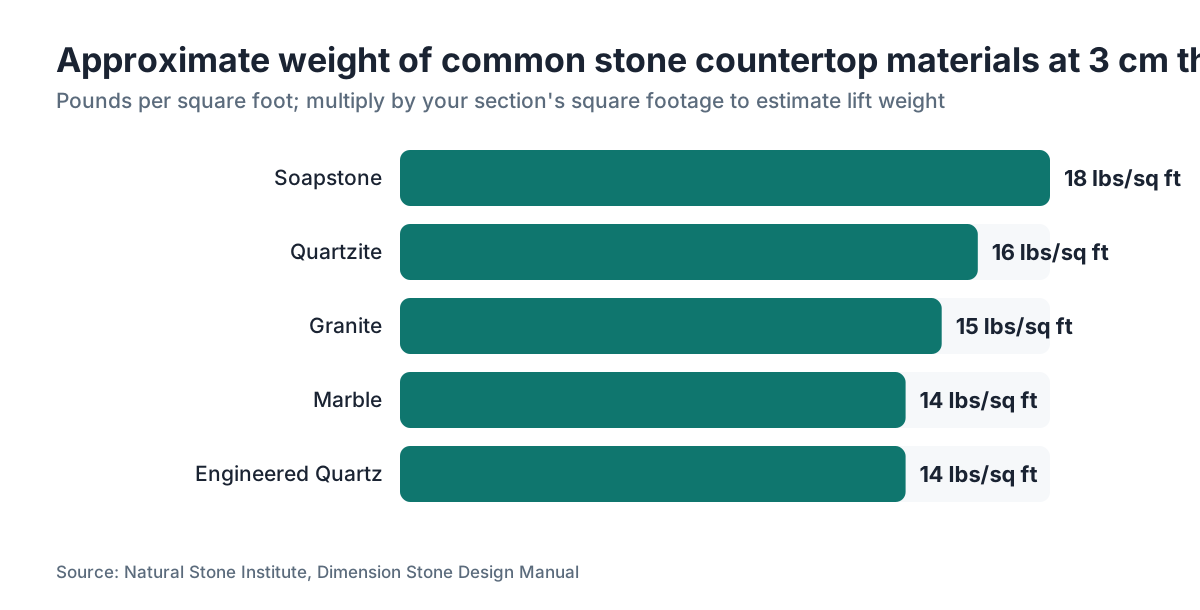
Weight is the number everyone lowballs. Here's the real breakdown by material and thickness [1]:
| Material | Thickness | Weight per sq ft |
|---|---|---|
| Granite | 2 cm | ~9 to 10 lbs |
| Granite | 3 cm | ~13 to 18 lbs |
| Engineered quartz | 3 cm | ~13 to 16 lbs |
| Marble | 3 cm | ~13 to 16 lbs |
| Quartzite | 3 cm | ~14 to 18 lbs |
| Soapstone | 3 cm | ~15 to 20 lbs |
A typical kitchen runs 50 to 60 square feet. At 3 cm granite that's 650 to 1,000 pounds total, usually split across several pieces. One section might land at 150 to 300 pounds.
Two strong people with suction cups can handle a piece under 150 pounds. Anything over 200 pounds wants three people or mechanical help. Don't eyeball it. Measure the square footage of the piece and multiply by the weight per square foot for your material.
For context, OSHA's ergonomics guidance sets recommended limits for manual and team lifts based on distance, frequency, and how the load sits [3]. A one-time lift of a heavy slab by two healthy adults stays inside those limits only when the piece is short enough that both people keep it level. Long slabs are the real problem, more than raw weight.
Where do stone countertops most often crack during removal?
Know the failure points and you know where to keep your eyes.
Sink cutouts. The single most common break. The cutout pulls material out of the slab's middle, so any downward flex piles stress into the cutout corners. Support both sides when lifting, and if you can, slide foam or a folded blanket under the slab at the cutout before you start.
Inside corners. L-shaped and U-shaped tops have inside corners that are mitered or butted, glued with epoxy and color-matched filler. The bond is good but not as strong as the stone. If the joint wasn't supported well during the original install, it may already carry a micro-crack. Lift these pieces separately when you can. Re-separating a mitered joint is usually easier than you'd guess, because the epoxy is the weak link, not the stone around it.
Cooktop cutouts. Same story as sink cutouts. Support both sides.
Long unsupported spans. Any piece past about 60 inches is at real risk if one end drops below the other during the lift. Keep it level.
Old damage. A visible chip or an old epoxy-filled crack is a stress riser. It will run if the slab flexes. Flag those spots before you start.
Should you hire a pro or do it yourself?
Honest answer: it depends on what happens to the slab afterward.
Donating or reselling? The bar is high. One crack drops the value to near zero. Paying a fabricator or a removal service to do it right runs $150 to $400 for a typical kitchen depending on region and layout [4]. That's cheap insurance on a slab worth $500 to $3,000.
Ripping it out to install new tops and you don't care if the old slab lives? DIY is fine. Cut it into sections with an angle grinder and a diamond blade (wear a P100 respirator, because granite dust is respirable crystalline silica, which OSHA regulates under 29 CFR 1910.1053 at a permissible exposure limit of 0.05 mg/m³ [5]). Cutting it up makes disposal far easier.
If the top is in great shape and you want it to find a second home, Habitat for Humanity ReStores take used countertops in many locations [6]. Some salvage yards do too. The resale market for used granite is thin (figure $5 to $15 per square foot if you find a buyer, against $40 to $100 installed new), but donation is easy and keeps stone out of the landfill.
For countertop installation of the new surface, some fabricators fold removal of the old top into their quote. Ask. It's often $100 to $200 added to the job, and it hands the whole problem to people who do it every week.
What do you do with a stone countertop once it's removed?
Four realistic options.
Resell it. Facebook Marketplace and Craigslist are the main channels. Price it low ($3 to $10 per square foot for used granite in average shape) and list exact dimensions. Buyers arrange their own pickup, which means your slab lives in the garage for a while. It moves eventually if the price is right.
Donate it. Habitat for Humanity ReStores take building materials in good condition [6]. Call your local store first to confirm they're accepting countertops. Some deconstruction salvage outfits pick up for free when the material is worth enough.
Repurpose it. A removed granite section makes a solid potting bench, outdoor bar top, or workshop surface. Quartzite and granite hold up fine outdoors. A piece with a sink cutout turns into a garden table once it's on legs.
Dispose of it. Stone is inert and goes to a regular landfill or a construction debris facility. Most curbside programs won't touch it, so plan on renting a dumpster or hauling it to a C&D site yourself. Call your local waste authority for the right facility. Costs swing by region, but a partial dumpster rental runs $300 to $500 in most markets.
For granite countertops specifically, the used market is the most established of any stone type, because granite has been in residential kitchens since the 1990s and buyers know what they're looking at.
Does removing a countertop damage the cabinets?
It can, but it usually won't if you cut the adhesive fully before lifting. Two main risks.
Delaminating the cabinet top rail. If construction adhesive was used and you pull before it's fully cut, you can rip the veneer or MDF layer right off the top of the cabinet. It's fixable with wood glue and clamps, but it's avoidable. When in doubt, cut more before you lift.
Tile backsplash damage. If somebody once replaced the countertop caulk joint with grout (a common mistake by DIYers and a few tile setters), you'll crack grout and maybe pop tiles as the stone comes off. Cut that joint carefully. If tiles pop, that's really a separate issue: tile should bond to the wall independently of the countertop. Cracked grout is cosmetic and quick to fix.
The cabinet boxes almost never get hurt, because the screws or clips live in the top rail, not the box sides. Pull those first and the box stays intact.
One thing to check before you lift: are the cabinets level? If the original installer shimmed them before setting stone, the slab rests partly on those shims. Lift the stone and the shims may drop. Note where they sit so you can reset them for the new top or fix the level properly.
Are there safety risks worth knowing about?
A few real ones.
Silica dust. Cutting stone instead of removing it whole puts respirable crystalline silica in the air, and that's a genuine lung hazard. OSHA's final silica rule for general industry (29 CFR 1910.1053, effective June 2018) sets a PEL of 0.05 mg/m³ as an 8-hour TWA [5]. Homeowner DIY isn't an OSHA enforcement matter, but the dust is just as bad for your lungs. Wear a P100 respirator and wet-cut or run a vacuum shroud [8].
Crush injuries. A 200-pound slab landing on a foot is a trip to the ER. Steel-toed boots aren't overkill here. Keep feet clear when you set the slab down.
Sharp edges. Fresh stone edges and chips cut skin fast. Heavy leather gloves, not latex or nitrile.
Back strain. The lift itself is fine with enough people. Carrying stone around corners and down stairs is where backs go. Use furniture dollies for anything past 10 feet, and rent a strapped appliance dolly for stairs [9].
Pinch points at the wall. The backsplash joint and the wall make a tight gap, and fingers get pinched there more than anywhere. Keep hands off the wall-side joint as the slab pulls away.
House built before 1980 with tile or old adhesive under the top? There's a small chance of asbestos in older mastic. EPA recommends testing suspected materials before you disturb them [7]. For a 1970s kitchen, that's worth a quick call to a certified inspector.
How do fabricators and shop owners handle countertop removals efficiently?
Running a shop and doing removals as part of a replacement job? A handful of habits separate fast from slow.
Charge for it. Removal is labor. Underprice it and you get resentment and rushed work that breaks slabs. $150 to $250 per kitchen is fair in most markets, more for complex layouts or upper-floor units [4].
Send two crew minimum and put suction cup lifters in the truck as standard kit. One person removing a kitchen top solo is how slabs break and backs blow out.
Photograph the existing install before anything gets cut. Document chip locations, prior cracks, caulk condition. That record protects you when a customer later claims you caused a chip that was already there.
Have a disposal plan before you roll up. Know whether the slab goes back to the shop, stays with the homeowner, or heads to a C&D site. Leaving a 300-pound slab in someone's garage without agreement is a complaint waiting to happen.
Pricing removal right is part of the bigger job of quoting countertops right. If you're juggling quotes, templates, and job tracking across projects, a purpose-built tool like SlabWise keeps removal labor in every estimate instead of getting dropped by accident.
For marble countertops and other soft stones, add crew time to the estimate. These slabs chip at the edges during removal more readily than granite.
What if the countertop breaks during removal?
It happens. Even careful crews break slabs sometimes, especially older stone carrying micro-cracks you never saw.
Clean break (a straight or near-straight fracture)? A pro can sometimes repair it with color-matched epoxy. Worth doing if you're keeping or reselling the stone. A good fabricator makes the seam nearly invisible from a few feet back. Figure $100 to $300 depending on the fracture length and how visible the spot is.
Break at the sink cutout into several pieces? Repair usually isn't practical. Dispose of it.
Break while you're installing new tops anyway? Doesn't matter. Cut the pieces smaller and haul them out. An angle grinder with a diamond blade turns a broken slab into manageable chunks fast. Work outside, wet the cut line, wear the P100 [8].
For next time: most removal breaks trace to one of three causes. The adhesive wasn't fully cut before the lift. The crew let one end hang lower than the other. Or an existing defect nobody spotted let go. The Step 4 test (press down and check for flex before lifting) catches that first cause almost every time.
Frequently asked questions
Can I remove a granite countertop by myself?
Only for small pieces under about 80 to 100 pounds. A typical 3 cm granite section weighs 150 to 300 pounds and takes two people minimum to keep level while lifting. Solo removal almost always means a tilted slab, and a tilted slab cracks. Rent suction cup lifters and grab a second person. It isn't worth the risk to your back or the stone.
How long does it take to remove a stone countertop?
Plan two to four hours for a full kitchen with two experienced people. Cutting caulk and adhesive eats more time than most expect, especially with construction adhesive or a backsplash bonded tight to wall tile. Add time to disconnect plumbing and get the slab out of the room. A simple section (one straight run, no sink) can go in 45 to 90 minutes.
Do I need to turn off the water before removing a kitchen countertop?
Yes, always. Shut the supply valves under the sink before you disconnect any plumbing. If the valves are stuck or you can't isolate the sink supply, shut off the main to the house. Disconnect the drain, P-trap, and garbage disposal before lifting. Lifting a countertop with plumbing still attached is how pipes get yanked out of walls.
What is the best tool for cutting caulk under a stone countertop?
An oscillating multi-tool with a flexible or rigid scraper blade is the most practical tool. It reaches into the tight gap between the stone underside and the cabinet rail and cuts silicone without wrecking the cabinet face. A utility knife handles the backsplash joint where you have more room. A heat gun softens stubborn silicone. For construction adhesive, expect to use a thin pry bar and patience.
How do I remove a countertop without damaging the cabinets underneath?
Cut all adhesive and caulk before you apply any upward force. The top rail veneer delaminates when people pull against uncut adhesive. Use a plastic putty knife instead of metal near cabinet faces. Pull any screws or clips inside the cabinet that fasten the slab from below. Once everything's cut and the fasteners are out, the slab lifts with almost no force and leaves the cabinets intact.
Can you reuse a granite countertop after removing it?
Yes, if it comes out intact. The slab may need cutting to fit the new space (a fabricator handles that) or it drops right in if the layout matches. Edge re-polishing is sometimes needed where edges got nicked. Reusing granite in the same kitchen after a layout change is fairly common. Moving it to a different house means careful measuring and possibly heavy cutting, which adds fabrication cost.
How do you remove a countertop with an undermount sink?
Disconnect all plumbing first. Then remove the undermount clips that screw into the slab underside, reaching up from inside the cabinet. Once the clips are off, the sink drops down and comes out separately. With the sink gone, the countertop lift is straightforward. Never lift the top with the sink still clipped in; the sink's weight at the cutout stresses the slab and cracks it at the cutout corners.
What should I do with an old granite countertop after removal?
Four practical options: sell it on Facebook Marketplace or Craigslist ($3 to $10 per square foot is realistic for used granite), donate it to a Habitat for Humanity ReStore, repurpose it as a potting bench or outdoor bar top, or dispose of it at a construction debris facility. Most curbside programs won't take stone. In good condition and a common color like Santa Cecilia or Ubatuba, it will find a buyer.
Does removing a stone countertop expose asbestos risk?
Usually no. Asbestos risk mostly attaches to older flooring mastics and ceiling tiles, not countertop adhesives. But if the kitchen was last renovated before 1980 and you see old tile or black mastic under the countertop, test it before disturbing it. EPA recommends having suspected asbestos-containing materials tested by a certified inspector before any demolition that could release fibers.
How much does professional countertop removal cost?
Expect $150 to $400 for a typical kitchen when hired on its own. Many fabricators add removal to a replacement install for $100 to $200. Prices vary by region, slab complexity, and whether disposal is included. If you're getting new countertops installed, ask the fabricator to fold removal into the quote. It's usually the cheapest way to handle it and puts stone-experienced hands on the job.
Can stone countertops be removed and reinstalled in a different location?
Yes, with careful planning. The slab has to survive removal intact, get stored safely on edge in an A-frame or flat on padding, travel without flexing, then get cut or refitted for the new spot by a fabricator. Transport, cutting, edge re-polishing, and reinstalling can add up to 30 to 60% of the cost of new countertops, depending on how much modification the new layout needs.
How do I safely move a stone countertop out of the room?
Set it on a furniture dolly right after it clears the cabinets, or have two people carry it upright on edge like a book, which is the strongest orientation for transport. Moving blankets protect the surface. For stairs, a strapped appliance dolly is the only safe option for one section; never carry heavy stone on stairs with two people unless it's strapped down first. Measure doorways before you start; 36-inch slabs don't fit through 32-inch doors.
What's the difference between removing quartz versus granite countertops?
The process is the same. Engineered quartz (Cambria, Silestone, and the like) tends to be a touch more flexible than granite, which helps a little during removal. It's still brittle at unsupported spans, though. The main practical difference is weight, and quartz and granite at 3 cm sit within a few pounds per square foot of each other. Use the same techniques, crew size, and precautions for both.
Sources
- Natural Stone Institute (formerly Marble Institute of America), Dimension Stone Design Manual: Natural stone weight per square foot by material and thickness; granite at 3 cm runs approximately 13 to 18 lbs per sq ft
- ASME B30.20 Below-the-Hook Lifting Devices standard: ANSI/ASME B30.20 covers rated load requirements for below-the-hook lifting devices including suction cup lifters
- OSHA, Ergonomics / Solutions to Control Hazards: OSHA guidance on team lifting limits and manual material handling recommendations
- Angi (formerly Angie's List / HomeAdvisor) Cost Guides, Countertop Removal Cost: Professional countertop removal costs $150 to $400 for a typical kitchen job depending on region and configuration
- OSHA, Occupational Exposure to Respirable Crystalline Silica, 29 CFR 1910.1053: OSHA final rule (effective June 2018) sets a PEL of 0.05 mg/m3 as an 8-hour TWA for respirable crystalline silica in general industry
- Habitat for Humanity, ReStore Donation Guidelines: Habitat for Humanity ReStores accept used building materials including countertops in good condition at many locations
- U.S. EPA, Asbestos in Your Home and Learn About Asbestos: EPA recommends having suspected asbestos-containing materials tested by a certified inspector before demolition work that could disturb them
- OSHA, Crystalline Silica in Construction: Cutting stone generates respirable crystalline silica dust; wet cutting and P100 respirators are recommended controls
- Natural Stone Institute, Safe Lifting and Handling Practices for Stone: Industry guidance on safe handling, transport, and storage of stone slabs including A-frame storage and suction cup use
Last updated 2026-07-10