TL;DR
- Most quartz countertops are either 2 cm (about 3/4 inch) or 3 cm (about 1-1/4 inches) thick.
- Residential kitchens almost always use 3 cm because it's self-supporting, needs no plywood substrate, and looks proportionally right.
- Bathroom vanities often use 2 cm.
- Edge profiles, laminated edges, and mitered waterfalls can visually change apparent thickness without changing the slab.
What thickness options do quartz countertops actually come in?
The countertop industry has two standard quartz slab thicknesses: 2 cm (roughly 3/4 inch) and 3 cm (roughly 1-1/4 inches). A handful of specialty applications use 1.2 cm or 1.3 cm ultra-thin panels, but those are almost never used as structural countertops. They're mostly wall cladding or furniture facing.
The 2 cm and 3 cm measurements are nominal, not exact. Quartz is an engineered stone made from ground quartz aggregate bound with resin, and slab dimensions vary slightly by manufacturer. Caesarstone, Cambria, Silestone, and MSI all publish nominal thickness specs, and actual measured thickness typically lands within about 1-2 mm of the stated size [1].
Four words matter here: 3 cm dominates residential. Walk into any kitchen showroom in North America and essentially everything on display runs 3 cm. The 2 cm option has real uses, but it's become a specialty choice rather than a default.
What is the standard quartz countertop thickness for kitchens?
Three centimeters (3 cm) is the residential kitchen standard in North America. This became the default for several reasons that compound on each other.
First, a 3 cm slab is self-supporting across a typical cabinet span without a plywood or particleboard substrate underneath. Cabinets have a front rail, a back rail, and maybe a center support, and 3 cm quartz bridges those gaps without flexing or cracking under normal load. With 2 cm, fabricators have to bond a 3/4-inch plywood buildup board to the underside before the stone goes down, which adds labor, material, and a small amount of height [2].
Second, 3 cm looks right on a standard 34.5-inch cabinet. The visual proportion works with the cabinet doors and drawer faces below. A 2 cm slab can look thin, almost delicate, in a full kitchen context. That may or may not matter depending on design intent, but most designers and homeowners prefer the heft of 3 cm.
Third, 3 cm handles edge profiling better. A bullnose, ogee, or waterfall edge reveals the full thickness of the stone, and 3 cm gives you something to work with. On 2 cm, an ogee can look pinched.
Plan on 3 cm for kitchen countertops unless a fabricator specifically recommends otherwise for your situation.
Is 2 cm quartz ever the right choice?
Yes. Bathroom vanities are the clearest case. Vanity tops are shorter in span, often have undermount sinks that frame the opening, and sit lower visually in the room. A 2 cm vanity top looks proportional and costs less than 3 cm. Because the spans are small and the overhang is minimal, the structural argument for 3 cm matters less.
Some designers also choose 2 cm for wall applications: backsplash panels, shower surrounds, or furniture-style side tables. The lighter weight helps with adhesion and reduces stress on vertical surfaces.
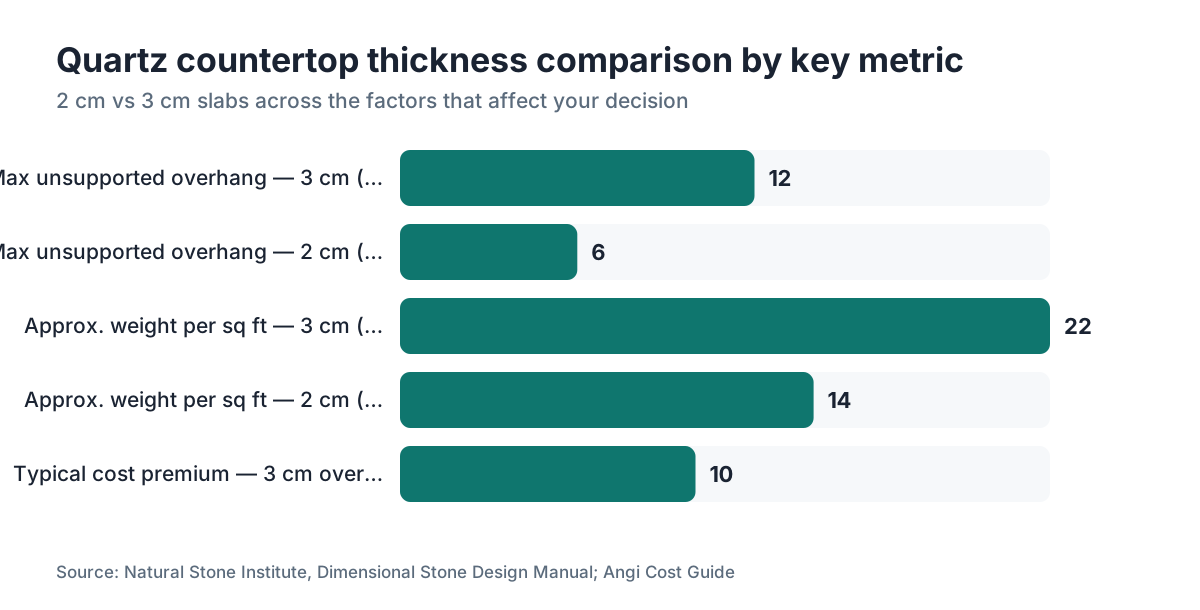
Budget is the other reason. A 2 cm slab uses roughly 33% less material than a 3 cm slab of the same footprint. That translates to a lower material cost, though you may spend some of that savings on the plywood buildup and extra labor. The net cost difference depends on your fabricator's labor rates, but 2 cm material itself typically runs $5-$15 per square foot less than 3 cm in the same color and brand [3].
One situation where 2 cm is a mistake: long unsupported runs, island overhangs beyond about 6 inches, or cooktop cutouts where the remaining stone on one side is narrow. Those configurations need the flex resistance of 3 cm. A good fabricator will flag this. If yours doesn't, ask.
How does quartz thickness compare to granite, marble, and other countertop materials?
The 2 cm / 3 cm system applies to most engineered and natural stone countertops. Granite slabs come in the same two thicknesses and are governed by the same structural rules [2]. Marble runs 3/4 inch (2 cm) and 1-1/4 inch (3 cm) as well.
Other countertop materials break from this pattern pretty sharply.
| Material | Typical thickness | Notes |
|---|---|---|
| Quartz (engineered) | 2 cm or 3 cm | 3 cm standard for kitchens |
| Granite | 2 cm or 3 cm | Same rules as quartz |
| Marble | 2 cm or 3 cm | Often 2 cm in European kitchens |
| Quartzite | 2 cm or 3 cm | Natural stone, same system |
| Butcher block | 1.5" to 3" | Much thicker, wood-based |
| Laminate / Formica | ~1.5 mm surface on substrate | Very thin surface layer |
| Corian / solid surface | 1/2" to 3/4" | Thinner, and repairable by sanding |
| Porcelain slabs | 6 mm to 12 mm | Thinner, lighter, increasingly popular |
Porcelain countertops deserve a note. Ultra-compact surfaces like Dekton run as thin as 8 mm or 12 mm and still qualify as countertops when properly installed with full-surface adhesive on a flat substrate. They're genuinely different from quartz in structure, more so than thin quartz.
For granite countertops and marble countertops, the thickness conversation is nearly identical to quartz. For laminate countertops or Corian countertops, thickness works differently because the countertop is a surface layer over a substrate, not a self-supporting slab.
How does quartz thickness affect price?
Thickness affects price in two ways: raw material and fabrication labor.
On the material side, 3 cm slab stock costs more than 2 cm because there's more quartz and resin in each square foot. The premium varies by brand and color. For commodity quartz colors (whites, basic grays), 3 cm adds roughly $5-$15 per square foot over 2 cm at the wholesale level. Premium or exotic colors show a smaller percentage difference because the base cost is already high [3].
On the labor side, 3 cm is actually easier to fabricate in most cases. Heavier, yes, but the fabricator doesn't have to laminate a buildup board. For 2 cm jobs, most shops charge for the plywood substrate plus the labor to adhere and finish it. That can run $10-$20 per linear foot depending on the shop.
The net result is that 3 cm jobs often cost only a little more than 2 cm when you account for everything, and sometimes the same. If a contractor or showroom quotes you 2 cm as a cost-saving measure, ask them to show you the full installed price comparison including substrate, more than the slab.
Typical installed quartz countertop prices in the U.S. range from about $50 to $200 per square foot depending on brand, color, complexity, and region [4]. Thickness is one variable inside that range, not the dominant one.
What is a laminated edge and how does it change apparent thickness?
A laminated edge (sometimes called a built-up edge) is when the fabricator glues an extra strip of quartz to the front edge of the countertop to make it look thicker than it really is. You'll most often see this on 2 cm slabs where the designer wants the visual heft of 3 cm or more without the weight and cost of a thicker slab.
A standard laminated edge on 2 cm quartz adds one more layer of 2 cm material, bringing the visible edge to 4 cm (about 1-1/2 inches). Some kitchen designs call for a 6 cm or even 8 cm face, which requires two or three laminated strips. These show up on furniture-style islands with a thick apron front.
The seam where laminated strips meet is visible on close inspection. A good fabricator matches the pattern tightly and uses tight-seaming techniques so the joint is minimal, but the seam is there. With a heavily veined quartz, a laminated edge that doesn't pattern-match looks obvious and cheap. With a solid-color or subtle quartz, it's nearly invisible.
Mitered edges are a higher-end alternative. Instead of laminating a separate strip, the fabricator cuts two pieces of slab at a 45-degree angle and joins them at the corner, creating a thick edge with no visible flat seam. It reads as a single solid piece. It's more labor-intensive, wastes more material, and costs noticeably more, but the result is cleaner.
For fabricators, edge buildup work is where a lot of the precision in countertop installation lives. A mitered waterfall island that isn't perfectly square looks bad immediately.
Does quartz thickness affect strength and durability?
Yes, but maybe not the way you'd expect. Quartz is quite brittle compared to wood or metal. Its strength in a countertop comes from support, not thickness. A well-supported 2 cm quartz slab is perfectly durable. A poorly supported 3 cm slab can still crack.
That said, 3 cm handles point loads better. Drop something heavy on a 2 cm slab spanning an unsupported section, and you have a real cracking risk. Drop the same thing on a 3 cm slab and it usually survives. This matters most around sink cutouts, where the remaining stone on one or more sides can be as narrow as 2-3 inches. Narrow bridges of 2 cm stone are fragile. Three centimeters gives more mass and cross-section to resist a load.
Overhang support rules apply this idea. The Marble Institute of America (MIA, now the Natural Stone Institute) publishes guidelines for unsupported overhangs in stone countertops. Their guidance for 3 cm stone allows overhangs up to about 1/3 of the total countertop depth without corbels or brackets; for 2 cm, the recommended unsupported limit is smaller [5]. Many fabricators use 12 inches as their rule-of-thumb maximum unsupported overhang for 3 cm and 6 inches for 2 cm.
For a breakfast bar or island seating overhang beyond those limits, you need support regardless of thickness. Corbels, hidden steel brackets, or a knee wall under the overhang all work. The fabricator and sometimes the cabinet maker should be in on that engineering call.
How does thickness affect sink and appliance cutouts?
Cutouts are where thickness matters most structurally. Every hole in a countertop, whether for a sink, cooktop, or outlet box, removes material and creates stress concentration points at the corners.
For undermount sinks, 3 cm is strongly preferred. The stone cantilevers over the sink opening on all four sides, and the undermount clips or adhesive need a solid purchase on the underside of the slab. With 2 cm, there's less stone depth for the clips and less mass to resist the weight of a heavy cast-iron or stainless sink. Some 2 cm undermount installations work fine for years. Others fail. Most fabricators and sink manufacturers prefer 3 cm for undermount [6].
For drop-in sinks, thickness matters less since the sink rim carries itself on the countertop surface. Two cm works fine.
Cooktop cutouts on 2 cm slabs leave narrow pieces of stone between the burner cut and the front or rear edge of the countertop. If that remaining piece is under about 2 inches wide, cracking during or after installation is a real risk. Three cm doesn't eliminate the risk, but it handles it better. Some fabricators add a metal angle support rod beneath a narrow piece on 2 cm jobs.
How do fabricators measure and specify quartz thickness?
Fabricators order quartz in bundles from distributors. Slabs come from manufacturers in standard nominal thicknesses: 2 cm and 3 cm for countertop material. When a fabricator quotes a job, they specify which thickness they're using, and that affects how they calculate material yield, edge profiles, and substrate requirements.
Measurement during fabrication usually happens with calipers. Slab thickness can vary across a single slab by 1-2 mm, especially toward the edges. Good digital calipers read to 0.01 mm, though that precision is more relevant for setting CNC machinery than for customer conversations.
On the customer side, when you get a quote, the paperwork should state the thickness. If it says "3/4 inch quartz" that's 2 cm. If it says "1-1/4 inch" or "3 cm," that's the thicker standard option. If the quote just says "quartz" without specifying, ask.
Fabricator software that handles quoting and job costing tracks thickness as a variable because it affects slab usage, lamination needs, and cutout risk flags. Tools like SlabWise let shops set thickness-specific defaults for substrate requirements and overhang warnings so estimators don't have to remember the rules job by job.
For Cambria countertops, one of the largest U.S.-based quartz manufacturers, the standard residential offering is 3 cm. Cambria does produce 2 cm for specific applications, but their primary residential line runs 3 cm [7].
What thickness should you specify for an island with a waterfall edge?
Waterfall islands are among the most thickness-sensitive jobs in residential countertops. The design wraps stone from the countertop surface down the side of the island cabinet to the floor, creating a continuous stone panel on one or both sides.
Three centimeters is the minimum you should consider for a waterfall. The vertical panel has to be structurally sound, the mitered corner at the top edge needs enough stone depth to be machined accurately, and the visual weight of the design calls for it. A 2 cm waterfall looks thin and can feel fragile at the miter joint.
For a dramatic thick-edge waterfall, many designers specify a mitered 3 cm slab that reads as 6 cm at the visible edge. The horizontal surface is 3 cm, the miter cuts 45 degrees across the full thickness, and the vertical panel is another 3 cm slab with a matching miter. Done right, it reads as a single 6 cm solid block of quartz. The matching of veins and patterns across the miter is where the artistry is.
Pattern matching for veined quartz on a waterfall takes bookmatching: the fabricator flips the second piece to mirror the first so the veins flow continuously. Not all quartz patterns allow this. Some engineered quartz products have random or non-directional patterns that can't be bookmatched. Ask your fabricator before you fall in love with a specific slab color for a waterfall design.
Does building code specify required countertop thickness?
No U.S. building code specifies a minimum countertop thickness for residential quartz. The International Residential Code (IRC) governs residential construction broadly but does not prescribe countertop material thickness [8]. Local amendments vary by jurisdiction, but countertop thickness is not a standard regulatory item.
What codes do address is structural support: cabinets must be attached to wall studs, and certain appliance installations (like cooktops) have clearances and electrical requirements. But whether your countertop is 2 cm or 3 cm is a design and structural engineering call, not a code compliance issue in normal residential work.
Commercial kitchens are different. The FDA Food Code and NSF/ANSI 2 standards govern surfaces in commercial foodservice environments, mostly around cleanability and porosity. These standards don't specify thickness numerically, but they do require surfaces to be smooth, non-absorbent, and durable. Quartz passes these criteria at both standard thicknesses [9].
If you're building an Airbnb, a commercial-grade kitchen in a home studio, or a food truck, check with your local health department about what documentation they require. But for a standard home kitchen, thickness is between you and your fabricator.
How can a homeowner verify the thickness of existing quartz countertops?
The simplest method: measure the edge. If you have an exposed edge (the front face of the countertop), lay a tape measure or caliper across it. Three cm will measure roughly 1-1/4 inches. Two cm will measure roughly 3/4 inch.
If the countertop has a laminated or built-up edge, you're measuring the visual thickness, not the slab thickness. To find the actual slab thickness, open a cabinet door and measure the stone from the underside to the top surface. Use a rigid ruler against the cabinet interior wall.
For an existing kitchen you're remodeling, knowing the current thickness matters for a few reasons. If you're replacing in-kind with the same thickness, the installation is simpler and the cabinet heights stay unchanged. If you're switching from 2 cm to 3 cm, the countertop surface will sit about 1/4 inch higher, which might affect your cooktop or sink reveal.
If you're trying to match a section of existing countertop (say, adding an island that matches the perimeter), you need to match the thickness or use a laminated edge to compensate. Your fabricator can advise on matching strategies, but having an accurate measurement before you go to the showroom saves a lot of guesswork.
Frequently asked questions
Is 2 cm or 3 cm quartz better for kitchen countertops?
Three cm is better for kitchen countertops in almost every case. It's self-supporting, handles overhangs and sink cutouts more safely, profiles well for any edge style, and doesn't require a plywood substrate. The extra cost is real but modest when you account for the substrate work 2 cm requires. For bathroom vanities with short spans, 2 cm works well and saves some money.
How much does quartz countertop thickness affect the price?
Roughly $5-$15 per square foot more for 3 cm slab material compared to 2 cm in the same color and brand. But 2 cm jobs usually need a 3/4-inch plywood buildup at $10-$20 per linear foot in added labor and material, which can erase or exceed the slab savings. Always compare fully installed prices, more than slab prices.
Can quartz countertops be only 1 cm thick?
Not as a structural countertop. Ultra-thin quartz or porcelain panels do exist at 6-12 mm for wall cladding and furniture, but they're not rated or safe for countertop use under normal kitchen loads. The minimum practical structural thickness for a quartz countertop is 2 cm (3/4 inch), and even that requires a plywood substrate for kitchen spans.
What does a laminated quartz edge mean?
A laminated edge adds an extra strip of quartz glued to the front face of the countertop to make it look thicker. A 2 cm slab with one laminated strip shows a 4 cm visible edge. It's a way to get a bolder edge profile at lower material cost than upgrading to a thicker slab. The bonded seam is visible on close inspection, though less so with solid or subtle-pattern quartz colors.
How thick should a quartz island overhang be to not need support?
Most fabricators use 12 inches as the maximum unsupported overhang for 3 cm quartz and 6 inches for 2 cm, consistent with Natural Stone Institute guidance. Beyond those limits, you need corbels, hidden steel brackets, or a structural knee wall. Island seating typically needs 12-15 inches of overhang for knee clearance, so most seating overhangs on 3 cm slabs sit right at the limit.
Does quartz thickness matter for undermount sinks?
Yes. Three cm is strongly preferred for undermount sink installations. The stone cantilevers over all four edges of the opening, and the undermount clips need a solid grab on the underside of the slab. With 2 cm, there's less material depth for clip attachment and less mass to support a heavy sink. Many undermount sink warranties and most fabricator best-practices specify 3 cm minimum.
Is 3/4-inch quartz the same as 2 cm quartz?
Yes. Two centimeters equals approximately 0.787 inches, which the industry rounds to 3/4 inch for everyday reference. The terms are used interchangeably. Similarly, 3 cm is approximately 1.18 inches, called 1-1/4 inch in inch-based references. If a quote says 3/4 inch quartz, that's 2 cm. If it says 1-1/4 inch, that's 3 cm.
How thick is a mitered waterfall edge on a quartz island?
A standard mitered waterfall on 3 cm quartz reads as 6 cm (about 2-3/8 inches) at the visible edge, because two 3 cm slabs meet at a 45-degree miter. Designers sometimes call for a 4 cm or 8 cm look by adjusting the laminated pieces. The actual slab thickness stays 3 cm; the visible edge thickness depends on how many layers are joined at the miter.
What quartz thickness do Cambria, Caesarstone, and Silestone use?
Cambria's standard residential offering is 3 cm. Caesarstone's primary residential line is also 3 cm. Silestone offers both 2 cm and 3 cm depending on the product series and application. All three brands produce 2 cm for specific uses. For kitchen countertops, all three recommend 3 cm as the standard, and most dealer orders default to it.
Can you tile over existing quartz countertops rather than replace them?
Technically possible but generally not recommended. Tile adhesive needs a stable, slightly porous substrate, and polished quartz gives you neither. The surface would need significant grinding, and the added height of tile plus adhesive changes plumbing and appliance fits. In most cases, the labor cost of properly prepping quartz for tile approaches or exceeds the cost of a proper replacement countertop.
How do I tell how thick my existing quartz countertop is without removing it?
Measure the exposed front edge with a tape measure or calipers. Three cm reads as about 1-1/4 inches; 2 cm reads as about 3/4 inch. If the edge is built-up or laminated, open a cabinet and measure from the underside of the stone to the top surface with a ruler held against the cabinet interior. That gives you true slab thickness, not visual edge thickness.
Does quartz countertop thickness affect seam visibility?
Not directly. Seam visibility depends on the color and pattern of the quartz, the quality of the seam cut and alignment, and the adhesive color match. Thickness doesn't make seams more or less visible from above. Thicker slabs do show a more visible seam at the edge face, which matters more on a waterfall or exposed-edge design than on a standard countertop where you're looking down from above.
What's the heaviest a quartz countertop gets by thickness?
Quartz weighs roughly 20-25 lbs per square foot at 3 cm thickness, and about 13-16 lbs per square foot at 2 cm. A typical 30-square-foot kitchen countertop in 3 cm quartz weighs around 600-750 lbs total. That weight matters for cabinet structural capacity, for safe transport and handling during installation, and for any wall-hung or furniture-style application.
Are there building codes that require a specific quartz countertop thickness?
No U.S. residential building code specifies countertop thickness. The International Residential Code does not address it, and local amendments rarely do. Commercial foodservice environments are regulated by the FDA Food Code and NSF/ANSI standards for surface cleanability, but those don't set a numeric thickness requirement either. Thickness is an engineering and design choice, not a code compliance item in residential work.
Sources
- Caesarstone, Technical Specifications Sheet: Quartz slab nominal thickness is 2 cm or 3 cm; actual measured thickness typically varies within 1-2 mm of nominal.
- Natural Stone Institute, Dimensional Stone Design Manual: Three cm stone is self-supporting across standard cabinet spans; 2 cm requires a substrate for residential countertop applications.
- HomeAdvisor (now Angi), Quartz Countertop Cost Guide: 2 cm quartz slab material typically costs $5-$15 per square foot less than 3 cm in the same color and brand at the consumer level.
- HomeAdvisor (now Angi), Quartz Countertop Installation Cost: Installed quartz countertop prices in the U.S. range from approximately $50 to $200 per square foot depending on brand, complexity, and region.
- Natural Stone Institute, MIA+BSI Technical Manual, Countertop Overhang Guidelines: For 3 cm stone, unsupported overhangs up to approximately one-third of the countertop depth are allowable; 2 cm limits are smaller.
- Elkay, Undermount Sink Installation Requirements: Undermount sink installations in stone countertops are recommended with a minimum 3 cm slab thickness for clip attachment and structural support.
- Cambria, Product Specifications: Cambria's standard residential quartz offering is 3 cm thickness.
- International Code Council, International Residential Code (IRC): The International Residential Code does not specify a minimum thickness for residential countertop materials.
- U.S. Food and Drug Administration, FDA Food Code 2022: FDA Food Code requires food-contact surfaces in commercial foodservice to be smooth, non-absorbent, and durable; no numeric countertop thickness is specified.
- NSF International, NSF/ANSI 2 Food Equipment Standard: NSF/ANSI 2 governs food equipment surfaces for cleanability and durability without prescribing a specific countertop thickness in millimeters.
- Silestone by Cosentino, Technical Data Sheet: Silestone offers quartz countertops in both 2 cm and 3 cm; 3 cm is the standard for residential kitchen applications.
Last updated 2026-07-10